REVIEW 2 major objections 5 minor 25 references
A lightweight adaptation turns a frozen autoregressive TTS model into a confidence-ordered diffusion decoder that is both more accurate and 3.3 imes faster.
Reviewed by Pith at T0; open to challenge. T0 means a machine referee read the full paper against a public rubric. the ladder, T0–T4 →
T0 review · grok-4.5
2026-07-11 21:23 UTC pith:CUBBUHJA
load-bearing objection Solid first transfer of AR-to-dLLM conversion to discrete speech tokens: real WER and speed gains on limited data, with the main soft spot already quantified by the authors. the 2 major comments →
DELTA-TTS: Adapting Autoregressive Model into Diffusion Language Model for Text-to-Speech
The pith
A machine-rendered reading of the paper's core claim, the machinery that carries it, and where it could break.
Core claim
A frozen autoregressive TTS backbone can be turned into a non-autoregressive discrete diffusion model by bidirectional attention plus lightweight LoRA and convolution adapters; the resulting confidence-ordered decoder produces sharper text–speech alignment, higher average token confidence, and lower word-error rate than the original left-to-right model while running several times faster.
What carries the argument
DELTA-TTS: a LoRA-plus-Conformer-convolution adapter stack that re-uses the AR next-token head under a masked-diffusion objective, combined with a 1/t-weighted loss and a time-shifted unmasking schedule that commits high-confidence positions first.
Load-bearing premise
The length of the fully masked speech-token sequence can be set accurately enough by a simple rule that scales the prompt’s audio-to-character rate by the target character count.
What would settle it
Replace the rule-based length estimator with an oracle that supplies the true ground-truth token count (or a deliberately wrong length) and measure whether the reported WER advantage and hallucination reduction disappear.
If this is right
- Any AR TTS model whose weights are already strong can be converted into a parallel decoder with only modest extra training data and parameters.
- Confidence-ordered unmasking systematically defers the low-confidence positions that cause AR hallucination cascades, giving a structural robustness gain.
- Local convolution is necessary to restore the short-range acoustic structure that pure bidirectional attention fails to capture from AR weights alone.
- The same conversion recipe should transfer to other AR speech language models and multi-codebook tokenizers once length prediction is improved.
Where Pith is reading between the lines
- The same adapter pattern may let other left-to-right generative models (music, video tokens) abandon fixed causal order without full retraining.
- If length estimation remains the main remaining bottleneck, discrete diffusion TTS will stay English-centric until a learned duration head is added.
- Reward fine-tuning that directly optimizes WER and speaker similarity could further close the remaining gap to the strongest pure AR systems.
Editorial analysis
A structured set of objections, weighed in public.
Referee Report
Summary. DELTA-TTS converts a frozen CosyVoice3 AR TTS backbone into a discrete diffusion language model via bidirectional attention, block-wise LoRA, and a Conformer-style convolution residual, trained with a 1/t-weighted masked diffusion objective and decoded with a time-shifted confidence-ordered unmasking schedule. On only 585 h of LibriTTS the adapted model reports 1.75 % WER on Seed-TTS test-en (vs 2.02 % for the AR backbone) at 3.3 imes token-generation speedup, competitive SIM/UTMOS, and subjective gains; ablations and attention/confidence analyses attribute the gains to local mixing and deferred low-confidence commitments that reduce AR-style hallucinations.
Significance. If the empirical claims hold, the work supplies a practical, parameter-efficient route (≈15 % extra parameters) for turning existing LLM-backed AR TTS systems into non-autoregressive generators without full retraining or large-scale speech corpora. The speech-specific design choices (convolution for locality, 1/t + time-shift for confidence ordering) and the supporting analyses (sharper text–speech alignment, elevated commit confidence, concrete hallucination cases) make a concrete case that confidence-ordered decoding is more robust than left-to-right commitment for speech tokens. The public-data, low-resource setting and clear Pareto comparison against strong AR/NAR baselines further increase the result’s utility for the community.
major comments (2)
- Section 4.4 and Appendix A.7: target length is set by a rule-based prompt audio-to-character rate rather than a learned duration model. While the GT-length ablation in Table 5 shows nearly identical WER (1.63 vs 1.75), SIM is substantially lower without prompt conditioning, and the authors themselves flag length estimation as an open dLLM limitation. A short quantitative stress test (WER/SIM under deliberately mismatched lengths, or comparison to a simple duration predictor) would make clear how much of the reported zero-shot quality depends on this heuristic remaining accurate on the evaluation sets.
- Tables 1 and 4: the strongest AR baselines (VoxCPM, FireRedTTS2, IndexTTS2, etc.) are trained on 55 k–1800 k hours of multi-domain data, while DELTA-TTS uses 585 h of LibriTTS. The paper correctly notes the data disparity, yet the headline claim of “outperforming its AR backbone” is sometimes read as a general superiority claim. Explicitly framing the result as “surpassing the frozen backbone under a 585 h adaptation budget” and, if possible, reporting a same-data AR fine-tune control would tighten the comparison.
minor comments (5)
- Figure 1 caption and surrounding text refer to “palette options / Final palette for the paper”; residual drafting notes should be removed.
- Equation (2) and the subsequent inference schedule both use t / µ; a brief sentence clarifying that the continuous-time formulation is discretized only at inference would help readers less familiar with masked diffusion.
- Table 3 length buckets are useful; adding the corresponding absolute token counts or average utterance lengths would make the RTF scaling easier to interpret.
- Appendix A.6 subjective protocol is transparent; stating the exact number of ratings per system (or total listener-hours) would complete the reproducibility information.
- A few typographical inconsistencies remain (e.g., “CosyV oice” spacing, “starget” vs “s_target”).
Circularity Check
No significant circularity: empirical AR-to-dLLM adaptation evaluated on external ASR/SIM metrics with no self-referential derivation.
full rationale
DELTA-TTS is an empirical systems paper. The central claims (1.75% WER on Seed-TTS test-en outperforming the frozen CosyVoice3 AR backbone, 3.3 imes token-generation speedup, sharper alignment, higher commit confidence, fewer hallucinations) are measured with independent external tools (Whisper-Large-V3 WER, WavLM-ECAPA SIM, UTMOS, human CMOS/SMOS, A100 RTF). The training objective (Eq. 2) is the standard masked-diffusion ELBO with 1/t weighting taken from the cited literature (Sahoo et al., Nie et al., Gong et al.); the time-shifted schedule (Eq. 3) is an adaptation of Esser et al.; neither quantity is fitted to the reported WER/SIM numbers. The rule-based length estimator is ablated against ground-truth length (Table 5) and does not force the intelligibility gain. Self-citations are limited to the CosyVoice3 backbone used as a frozen starting point; no uniqueness theorem, ansatz, or load-bearing premise is imported from overlapping authors. No equation reduces a claimed prediction to an input by construction. The derivation chain is therefore self-contained against external benchmarks.
Axiom & Free-Parameter Ledger
free parameters (5)
- time-shift parameter µ =
0.3
- convolution kernel size =
31
- LoRA rank / α =
α=128
- number of unmasking steps T =
16
- rule-based length ratio
axioms (4)
- domain assumption Masked discrete diffusion ELBO with 1/t reweighting is a valid training objective for recovering speech tokens.
- domain assumption Neighboring 25 Hz speech tokens exhibit strong local acoustic correlation that bidirectional attention alone under-models.
- ad hoc to paper A frozen AR backbone plus low-rank adapters can absorb the switch from causal to bidirectional attention without mask annealing.
- domain assumption Standard next-token shift operation preserves AR pretrained weights under masked prediction.
invented entities (1)
-
DELTA-TTS adapter stack (block-wise LoRA + Conformer convolution)
independent evidence
read the original abstract
Autoregressive (AR) text-to-speech (TTS) models generate discrete speech tokens sequentially, which makes inference slow and can degrade robustness by propagating local errors and hallucinations. This limitation stems from their left-to-right AR commitment: each token must be determined before future speech-token context is available. However, such ordering is not an inherent requirement for TTS, as the full input text is available before synthesis. In this paper, we introduce DELTA-TTS, a lightweight LoRA-based adaptation framework that converts a pretrained AR TTS model into a discrete diffusion language model (dLLM) for confidence-ordered speech-token decoding. To better capture the local structure of speech, DELTA-TTS incorporates a convolution module that injects local acoustic context, together with a $1/t$-weighted training objective and a time-shifted inference schedule that defer low-confidence positions to later steps. Trained on only $585$ hours of LibriTTS, DELTA-TTS achieves a $\textbf{1.75}\%$ WER on Seed-TTS test-en, outperforming its AR backbone while generating tokens $\textbf{3.3}\times$ faster. Further analysis shows that DELTA-TTS produces sharper text--speech alignment, increases overall decoding confidence, and mitigates hallucinations observed in AR generation.
Figures




Reference graph
Works this paper leans on
-
[1]
Seed-tts: A family of high-quality versatile speech generation models
Anastassiou, P., Chen, J., Chen, J., Chen, Y ., Chen, Z., Chen, Z., Cong, J., Deng, L., Ding, C., Gao, L., et al. Seed-tts: A family of high-quality versatile speech generation models. arXiv preprint arXiv:2406.02430,
-
[2]
T., Yang, Z., Qi, Z., Han, J., Sahoo, S
Arriola, M., Gokaslan, A., Chiu, J. T., Yang, Z., Qi, Z., Han, J., Sahoo, S. S., and Kuleshov, V . Block diffusion: Inter- polating between autoregressive and diffusion language models.arXiv preprint arXiv:2503.09573,
-
[3]
Soundstorm: Efficient par- allel audio generation.arXiv preprint arXiv:2305.09636,
Borsos, Z., Sharifi, M., Vincent, D., Kharitonov, E., Zeghi- dour, N., and Tagliasacchi, M. Soundstorm: Efficient par- allel audio generation.arXiv preprint arXiv:2305.09636,
-
[4]
Desplanques, B., Thienpondt, J., and Demuynck, K. Ecapa- tdnn: Emphasized channel attention, propagation and aggregation in tdnn based speaker verification.arXiv preprint arXiv:2005.07143,
Pith/arXiv arXiv 2005
-
[5]
H., Doucet, A., Strudel, R., Dyer, C., Durkan, C., et al
Dieleman, S., Sartran, L., Roshannai, A., Savinov, N., Ganin, Y ., Richemond, P. H., Doucet, A., Strudel, R., Dyer, C., Durkan, C., et al. Continuous diffusion for categorical data.arXiv preprint arXiv:2211.15089,
-
[6]
Du, Z., Chen, Q., Zhang, S., Hu, K., Lu, H., Yang, Y ., Hu, H., Zheng, S., Gu, Y ., Ma, Z., et al. Cosyvoice: A scalable multilingual zero-shot text-to-speech synthe- sizer based on supervised semantic tokens.arXiv preprint arXiv:2407.05407, 2024a. Du, Z., Wang, Y ., Chen, Q., Shi, X., Lv, X., Zhao, T., Gao, Z., Yang, Y ., Gao, C., Wang, H., et al. Cosyvo...
-
[7]
Gong, S., Li, M., Feng, J., Wu, Z., and Kong, L. Diffuseq: Sequence to sequence text generation with diffusion mod- els.arXiv preprint arXiv:2210.08933,
-
[8]
Gong, S., Agarwal, S., Zhang, Y ., Ye, J., Zheng, L., Li, M., An, C., Zhao, P., Bi, W., Han, J., et al. Scaling diffu- sion language models via adaptation from autoregressive models.arXiv preprint arXiv:2410.17891,
-
[9]
Gulati, A., Qin, J., Chiu, C.-C., Parmar, N., Zhang, Y ., Yu, J., Han, W., Wang, S., Zhang, Z., Wu, Y ., et al. Con- former: Convolution-augmented transformer for speech recognition.arXiv preprint arXiv:2005.08100,
Pith/arXiv arXiv 2005
-
[10]
Guo, H.-H., Hu, Y ., Shen, F.-Y ., Tang, X., Wu, Y .-C., Xie, F.-L., and Xie, K. Fireredtts-1s: An upgraded stream- able foundation text-to-speech system.arXiv preprint arXiv:2503.20499,
-
[11]
The curious case of neural text degeneration.arXiv preprint arXiv:1904.09751,
Holtzman, A., Buys, J., Du, L., Forbes, M., and Choi, Y . The curious case of neural text degeneration.arXiv preprint arXiv:1904.09751,
Pith/arXiv arXiv 1904
-
[12]
Qwen3-tts technical report.arXiv preprint arXiv:2601.15621,
Hu, H., Zhu, X., He, T., Guo, D., Zhang, B., Wang, X., Guo, Z., Jiang, Z., Hao, H., Guo, Z., et al. Qwen3-tts technical report.arXiv preprint arXiv:2601.15621,
-
[13]
Ditar: Diffusion trans- former autoregressive modeling for speech generation
Jia, D., Chen, Z., Chen, J., Du, C., Wu, J., Cong, J., Zhuang, X., Li, C., Wei, Z., Wang, Y ., et al. Ditar: Diffusion trans- former autoregressive modeling for speech generation. arXiv preprint arXiv:2502.03930,
-
[14]
9 DELTA-TTS: Adapting Autoregressive Model into Diffusion Language Model for TTS Ju, Z., Wang, Y ., Shen, K., Tan, X., Xin, D., Yang, D., Liu, Y ., Leng, Y ., Song, K., Tang, S., et al. Naturalspeech 3: Zero- shot speech synthesis with factorized codec and diffusion models.arXiv preprint arXiv:2403.03100,
-
[15]
W., Kim, J., Chung, S., and Cho, J
Lee, K., Kim, D. W., Kim, J., Chung, S., and Cho, J. Ditto-tts: Diffusion transformers for scalable text-to- speech without domain-specific factors.arXiv preprint arXiv:2406.11427,
-
[16]
Lou, A., Meng, C., and Ermon, S. Discrete diffusion model- ing by estimating the ratios of the data distribution.arXiv preprint arXiv:2310.16834,
-
[17]
Large language diffusion models.arXiv preprint arXiv:2502.09992,
Nie, S., Zhu, F., You, Z., Zhang, X., Ou, J., Hu, J., Zhou, J., Lin, Y ., Wen, J.-R., and Li, C. Large language diffusion models.arXiv preprint arXiv:2502.09992,
-
[18]
Utmos: Utokyo-sarulab sys- tem for voicemos challenge 2022.arXiv preprint arXiv:2204.02152,
Saeki, T., Xin, D., Nakata, W., Koriyama, T., Takamichi, S., and Saruwatari, H. Utmos: Utokyo-sarulab sys- tem for voicemos challenge 2022.arXiv preprint arXiv:2204.02152,
Pith/arXiv arXiv 2022
-
[19]
Neural codec language models are zero-shot text to speech synthesizers
Wang, C., Chen, S., Wu, Y ., Zhang, Z., Zhou, L., Liu, S., Chen, Z., Liu, Y ., Wang, H., Li, J., et al. Neural codec language models are zero-shot text to speech synthesizers. arXiv preprint arXiv:2301.02111,
-
[20]
Wang, X., Jiang, M., Ma, Z., Zhang, Z., Liu, S., Li, L., Liang, Z., Zheng, Q., Wang, R., Feng, X., et al. Spark- tts: An efficient llm-based text-to-speech model with single-stream decoupled speech tokens.arXiv preprint arXiv:2503.01710, 2025a. Wang, Y ., Zhan, H., Liu, L., Zeng, R., Guo, H., Zheng, J., Zhang, Q., Zhang, X., Zhang, S., and Wu, Z. Maskgct:...
-
[21]
Wang, Y ., Zheng, J., Zhang, J., Zhang, X., Liao, H., and Wu, Z. Metis: A foundation speech generation model with masked generative pre-training.arXiv preprint arXiv:2502.03128, 2025b. Wu, C., Zhang, H., Xue, S., Diao, S., Fu, Y ., Liu, Z., Molchanov, P., Luo, P., Han, S., and Xie, E. Fast- dllm v2: Efficient block-diffusion llm.arXiv preprint arXiv:2509.26328,
-
[22]
Xie, K., Shen, F., Li, J., Xie, F., Tang, X., and Hu, Y . Fireredtts-2: Towards long conversational speech generation for podcast and chatbot.arXiv preprint arXiv:2509.02020,
-
[23]
Dream 7b: Diffusion large language models
Ye, J., Xie, Z., Zheng, L., Gao, J., Wu, Z., Jiang, X., Li, Z., and Kong, L. Dream 7b: Diffusion large language models. arXiv preprint arXiv:2508.15487, 2025a. Ye, Z., Zhu, X., Chan, C.-M., Wang, X., Tan, X., Lei, J., Peng, Y ., Liu, H., Jin, Y ., Dai, Z., et al. Llasa: Scal- ing train-time and inference-time compute for llama- based speech synthesis.arXi...
Pith/arXiv arXiv 1904
-
[24]
Zhou, S., Zhou, Y ., He, Y ., Zhou, X., Wang, J., Deng, W., and Shu, J. Indextts2: A breakthrough in emotionally expres- sive and duration-controlled auto-regressive zero-shot text-to-speech. InProceedings of the AAAI Conference on Artificial Intelligence, volume 40, pp. 35139–35148, 2026a. Zhou, Y ., Zeng, G., Liu, X., Li, X., Yu, R., Wang, Z., Ye, R., S...
-
[25]
dllm: Simple diffusion language modeling.arXiv preprint arXiv:2602.22661, 2026b
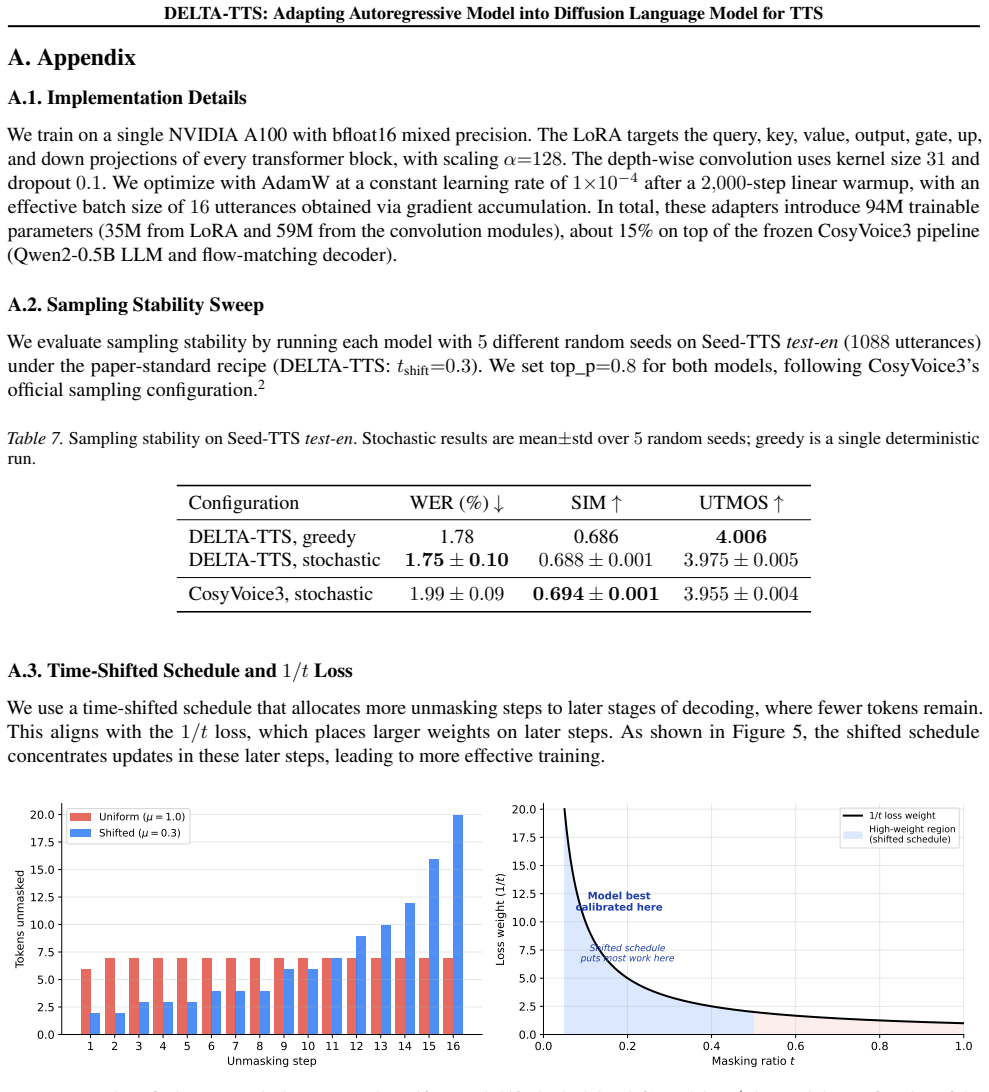
Zhou, Z., Chen, L., Tong, H., and Song, D. dllm: Simple diffusion language modeling.arXiv preprint arXiv:2602.22661, 2026b. 10 DELTA-TTS: Adapting Autoregressive Model into Diffusion Language Model for TTS A. Appendix A.1. Implementation Details We train on a single NVIDIA A100 with bfloat16 mixed precision. The LoRA targets the query, key, value, output,...
discussion (0)
Sign in with ORCID, Apple, or X to comment. Anyone can read and Pith papers without signing in.