REVIEW 2 major objections 60 references
A single query-guided residual on vision tokens stops small traffic cues from being drowned by background fusion, and a new MCQ benchmark measures that failure.
Reviewed by Pith at T0; open to challenge. T0 means a machine referee read the full paper against a public rubric. the ladder, T0–T4 →
T0 review · grok-4.5
2026-07-11 21:19 UTC pith:JCY5BDII
load-bearing objection Solid systems paper: real new traffic MCQ bench plus a modest single-pass adapter; the 2.1-pt gain is real under matched training, but the abstract oversells evidence-local gains and bbox supervision couples to the construction pipeline. the 2 major comments →
Beyond Scene Priors: Fine-Grained Traffic Scene Reasoning with Benchmarking and Query-Guided Small-Object Focus
The pith
A machine-rendered reading of the paper's core claim, the machinery that carries it, and where it could break.
Core claim
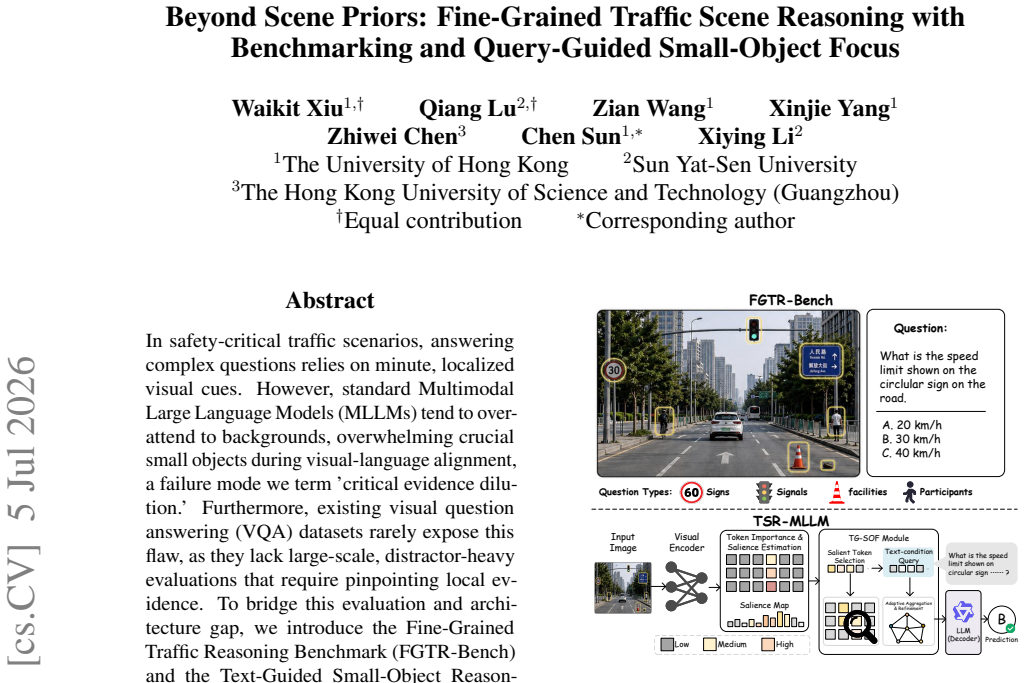
Critical evidence dilution—background-dominated fusion overwhelming sparse answer-critical vision tokens—is the main bottleneck for fine-grained traffic MCQ reasoning, and it can be reduced by a single-pass, query-conditioned Top-K residual at the decoder boundary plus evidence-grounded training, without external detectors, image re-encoding, or multi-pass pipelines. FGTR-Bench exposes the failure; TSR-MLLM with TG-SOF and auxiliary box and consistency losses improves utilization of those local cues under matched fine-tuning.
What carries the argument
Text-Guided Small-Object Focus (TG-SOF): a thin map applied once after multimodal token assembly that computes query–vision salience, sharpens it with a short-range local-detail prior, and adds gated residuals only to a sparse Top-K subset of vision rows while leaving text tokens unchanged.
Load-bearing premise
That high accuracy on this multi-agent-built, co-author-audited multiple-choice suite truly measures local-evidence use rather than fitting the benchmark’s own construction rules (same-scene distractors, box-aligned stems, letter-only scoring).
What would settle it
Hold the backbone, training budget, and decoding fixed; ablate TG-SOF’s query-conditioned Top-K residual and the bbox focus loss, then check whether overall and evidence-local track gains on the blind FGTR-Bench test and zero-shot DriveQA-V disappear while qualitative salience maps stop aligning with the stem’s critical region.
Editorial analysis
A structured set of objections, weighed in public.
Referee Report
Summary. The paper argues that MLLMs fail on safety-critical traffic VQA when answers depend on sparse local cues because background-dominated fusion dilutes critical evidence. It contributes FGTR-Bench (40,236 development MCQs plus a 4,947-sample blind test) built via multi-agent generation, consistency checks, and co-author audit, and TSR-MLLM: Qwen3-VL-4B with a single-pass Text-Guided Small-Object Focus (TG-SOF) module that scores query–vision salience, sharpens with a local detail prior, and applies sparse Top-K gated residuals only to selected vision tokens at the decoder boundary. Training freezes the backbone, adds decoder LoRA, and optimizes choice CE plus bbox-alignment KL on the same salience pathway and hidden-state consistency. Under matched FGTR fine-tuning and greedy letter decoding, TSR-MLLM reaches 74.1% overall (+2.1 over the strongest same-scale adapted baseline), with cumulative ablations and five-seed Wilcoxon tests, and remains competitive zero-shot on DriveQA-V (CARLA Signs).
Significance. If the interpretation holds, the work is a useful systems contribution: a carefully constructed evidence-local traffic MCQ benchmark and a lightweight, single-pass, detector-free residual focus mechanism that preserves the pretrained decoder interface. Strengths include matched fine-tuning protocols, a disjoint blind test, cumulative ablations (Table 3), seed-level significance tests (Appendix E), qualitative salience overlays, and an external DriveQA-V transfer check without task-specific fine-tuning. The absolute gains are modest and track-dependent, so the paper’s main value is methodological (benchmark + interface-level focus) rather than a large leap in open-ended traffic reasoning.
major comments (2)
- Abstract and §5.2 claim “larger gains on evidence-local tracks,” but Table 1 shows the opposite pattern under matched FGTR adaptation: Holistic Sign +3.3 and Daytime Signal +1.9 (near-ceiling baselines), while Roadside Micro only +1.0 (28.4→29.4) and Participant Micro +0.9 (51.4→52.3)—the tracks where dilution should matter most. Nighttime Signal improves (+3.8) but remains far from solved. The central claim that TG-SOF primarily fixes sparse local evidence dilution is therefore only weakly supported by the disaggregated results and should be restated or supported with additional controls.
- §4.3 Eqs. (6)–(9) and Appendix A couple supervision to benchmark construction: L_bbox trains the same ˜α pathway that drives Top-K using the human boxes that TSR-Gen used to write stems, gold answers, and same-scene distractors. Without a no-bbox / held-out-evidence ablation (or evaluation where gold boxes are unavailable at train time), the +2.1 overall gain can be read as “select the annotated tokens the MCQ was written from” rather than open recovery of diluted cues. DriveQA-V transfer (Table 2: 74.9 vs Traffic-MLLM 74.5) is competitive but does not isolate residual focus without FGTR-style box supervision. A control that removes or randomizes L_bbox while keeping TG-SOF architecture is load-bearing for the dilution narrative.
Circularity Check
Mild train/eval coupling via shared bbox annotations; no definitional circularity or forced prediction.
specific steps
-
other
[§3.2–3.3 (TSR-Gen / annotations); §4.3 Eqs. (6)–(9) L_bbox; Table 1/3]
"All images are manually annotated with high-precision bounding boxes... that serves as a hard constraint for downstream QA construction... The box alignment loss is forward KL on the same scoring pathway that feeds Top-K: L_bbox = Σ qbbox_j log(qbbox_j / p_j)."
Train-time L_bbox aligns TG-SOF salience ˜α (and thus Top-K residuals) to the same human boxes that TSR-Gen used to ground stems, gold letters, and same-scene distractors. Primary evaluation is still FGTR-Bench MCQ accuracy. This is methodological coupling of supervision to benchmark construction—not a definitional identity or a fitted parameter renamed as the reported metric—but it weakens the claim that gains prove open-ended recovery of sparse cues rather than better use of the audit’s evidence regions. DriveQA-V and no-box inference keep the result from being fully circular.
full rationale
This is an empirical MLLM paper, not a first-principles derivation. The central claim (TG-SOF + auxiliary losses yield +2.1 overall on FGTR-Bench under matched fine-tuning, with competitive zero-shot DriveQA-V) is measured by independent letter-match accuracy on a disjoint blind test and an external CARLA Signs suite without DriveQA fine-tuning. TG-SOF at inference uses only query–vision scores and a local detail prior; boxes are training-only. Ablations (Table 3) show incremental, non-tautological gains when modules are added under a fixed budget. The only mild circularity-adjacent issue is that L_bbox supervises the same ˜α pathway that drives Top-K using human boxes that also constrain TSR-Gen MCQ construction—so supervision and benchmark construction share an annotation layer. That couples interpretation of the gain to the audit protocol but does not make accuracy equal the fit by construction, nor does it rest on a self-citation uniqueness theorem or renamed known identity. Score 2 reflects that mild coupling only; the result is not forced.
Axiom & Free-Parameter Ledger
free parameters (7)
- Top-K keep ratio ρ =
0.05
- bbox loss weight schedule λ_bb(t) =
warmed from 0 (schedule not fully numeric)
- hidden consistency weight λ_cs =
fixed (value not numerically specified)
- local detail gain γ =
learned
- LoRA rank / α / dropout =
r=64, α=128, dropout=0.05
- learning rate and effective batch =
5e-6, batch 16, 1 epoch
- bbox KL temperature τ and floor ε =
τ=1.0, ε=1e-8
axioms (5)
- domain assumption Critical evidence dilution—background-dominated fusion overwhelming sparse local cues—is a primary failure mode of standard MLLMs on traffic MCQ.
- domain assumption Four-option MCQ accuracy with greedy letter decoding is a sufficient metric of fine-grained, evidence-local reasoning.
- domain assumption Multi-agent Planner–Writer–Verifier generation plus co-author audit yields questions whose unique correct answer is causally determined by annotated local evidence.
- ad hoc to paper A single sparse residual applied once to fused decoder inputs (text rows unchanged) is enough to redirect deep decoder attention without re-encoding or external detectors.
- standard math Standard transformer attention, LoRA, and causal LM training math hold for the frozen Qwen3-VL-4B backbone.
invented entities (4)
-
critical evidence dilution
no independent evidence
-
FGTR-Bench
no independent evidence
-
TG-SOF (Text-Guided Small-Object Focus)
no independent evidence
-
TSR-Gen multi-agent QA pipeline
no independent evidence
read the original abstract
In safety-critical traffic scenarios, answering complex questions relies on minute, localized visual cues. However, standard Multimodal Large Language Models (MLLMs) tend to over-attend to backgrounds, overwhelming crucial small objects during visual-language alignment, a failure mode we term 'critical evidence dilution.' Furthermore, existing visual question answering (VQA) datasets rarely expose this flaw, as they lack large-scale, distractor-heavy evaluations that require pinpointing local evidence. To bridge this evaluation and architecture gap, we introduce the Fine-Grained Traffic Reasoning Benchmark (FGTR-Bench) and the Text-Guided Small-Object Reasoning MLLM (TSR-MLLM). FGTR-Bench comprises 40,236 single-image Multiple-Choice Questions (MCQs) created via multi-agent generation, consistency checks, and expert audits, alongside a disjoint 4,947-sample blind test split. To resolve evidence dilution, TSR-MLLM, built on Qwen3-VL-4B, uses a query-conditioned Text-Guided Small-Object Focus (TG-SOF) map. Applied once at the decoder boundary, the map adds sparse Top-K gated residuals to the most question-relevant vision slots while leaving text tokens unchanged. Together with lightweight decoder adaptation, TSR-MLLM preserves single-pass inference without external detectors or image re-encoding. Under matched settings, TSR-MLLM outperforms the strongest 4B baseline by 2.1 points on FGTR-Bench (74.1% overall), with larger gains on evidence-local tracks. Furthermore, it remains competitive on DriveQA-V (CARLA Signs) under greedy decoding without task-specific fine-tuning.
Figures


Reference graph
Works this paper leans on
-
[1]
International Conference on Learning Representations (ICLR) , year=
An Image is Worth 16x16 Words: Transformers for Image Recognition at Scale , author=. International Conference on Learning Representations (ICLR) , year=
-
[2]
International Conference on Machine Learning (ICML) , pages=
Learning Transferable Visual Models From Natural Language Supervision , author=. International Conference on Machine Learning (ICML) , pages=
-
[3]
International Conference on Machine Learning (ICML) , pages=
BLIP-2: Bootstrapping Language-Image Pre-training With Frozen Image Encoders and Large Language Models , author=. International Conference on Machine Learning (ICML) , pages=
-
[4]
Advances in Neural Information Processing Systems (NeurIPS) , volume=
Visual Instruction Tuning , author=. Advances in Neural Information Processing Systems (NeurIPS) , volume=
-
[5]
Advances in Neural Information Processing Systems (NeurIPS) , volume=
InstructBLIP: Towards General-purpose Vision-Language Models With Instruction Tuning , author=. Advances in Neural Information Processing Systems (NeurIPS) , volume=
-
[6]
Conference on Empirical Methods in Natural Language Processing (EMNLP) , year=
Qwen-VL: A Frontier Large Vision-Language Model With Versatile Abilities , author=. Conference on Empirical Methods in Natural Language Processing (EMNLP) , year=
-
[7]
Proceedings of the IEEE/CVF International Conference on Computer Vision (ICCV) , pages=
Sigmoid Loss for Language Image Pre-Training , author=. Proceedings of the IEEE/CVF International Conference on Computer Vision (ICCV) , pages=
-
[8]
Proceedings of the IEEE/CVF Conference on Computer Vision and Pattern Recognition (CVPR) , pages=
nuScenes: A Multimodal Dataset for Autonomous Driving , author=. Proceedings of the IEEE/CVF Conference on Computer Vision and Pattern Recognition (CVPR) , pages=
-
[9]
Proceedings of the IEEE/CVF Conference on Computer Vision and Pattern Recognition (CVPR) , pages=
Scalability in Perception for Autonomous Driving: An Open Dataset Benchmark , author=. Proceedings of the IEEE/CVF Conference on Computer Vision and Pattern Recognition (CVPR) , pages=
-
[10]
European Conference on Computer Vision (ECCV) , year=
DriveLM: Driving With Graph Visual Question Answering , author=. European Conference on Computer Vision (ECCV) , year=
-
[11]
arXiv preprint arXiv:2312.09397 , year=
Personalized Autonomous Driving with Large Language Models: Field Experiments , author=. arXiv preprint arXiv:2312.09397 , year=
-
[12]
Proceedings of the IEEE/CVF Conference on Computer Vision and Pattern Recognition (CVPR) , pages=
Planning-oriented Autonomous Driving , author=. Proceedings of the IEEE/CVF Conference on Computer Vision and Pattern Recognition (CVPR) , pages=
-
[13]
Proceedings of the IEEE/CVF Conference on Computer Vision and Pattern Recognition (CVPR) , year=
Generalized Predictive Model for Autonomous Driving , author=. Proceedings of the IEEE/CVF Conference on Computer Vision and Pattern Recognition (CVPR) , year=
-
[14]
Proceedings of the IEEE/CVF Conference on Computer Vision and Pattern Recognition (CVPR) , pages=
Feature Pyramid Networks for Object Detection , author=. Proceedings of the IEEE/CVF Conference on Computer Vision and Pattern Recognition (CVPR) , pages=
-
[15]
Proceedings of the IEEE/CVF International Conference on Computer Vision (ICCV) , pages=
Mask R-CNN , author=. Proceedings of the IEEE/CVF International Conference on Computer Vision (ICCV) , pages=
-
[16]
IEEE/CVF Winter Conference on Applications of Computer Vision (WACV) , pages=
Scale Match for Tiny Person Detection , author=. IEEE/CVF Winter Conference on Applications of Computer Vision (WACV) , pages=
-
[17]
Proceedings of the IEEE/CVF International Conference on Computer Vision Workshops (ICCVW) , year=
VisDrone-DET2019: The UAV Object Detection Challenge Results , author=. Proceedings of the IEEE/CVF International Conference on Computer Vision Workshops (ICCVW) , year=
-
[18]
Proceedings of the IEEE/CVF Conference on Computer Vision and Pattern Recognition (CVPR) , year=
Zooming into Small Objects With Multimodal Large Language Models , author=. Proceedings of the IEEE/CVF Conference on Computer Vision and Pattern Recognition (CVPR) , year=
-
[19]
International Conference on Learning Representations (ICLR) , year=
Vision Transformer Adapter for Dense Predictions , author=. International Conference on Learning Representations (ICLR) , year=
-
[20]
Proceedings of the IEEE/CVF International Conference on Computer Vision (ICCV) , pages=
Swin Transformer: Hierarchical Vision Transformer Using Shifted Windows , author=. Proceedings of the IEEE/CVF International Conference on Computer Vision (ICCV) , pages=
-
[21]
arXiv preprint arXiv:1707.06347 , year=
Proximal Policy Optimization Algorithms , author=. arXiv preprint arXiv:1707.06347 , year=
-
[22]
Advances in Neural Information Processing Systems (NeurIPS) , year=
Direct Preference Optimization: Your Language Model is Secretly a Reward Model , author=. Advances in Neural Information Processing Systems (NeurIPS) , year=
-
[23]
arXiv preprint arXiv:2412.19437 , year=
DeepSeek-V3 Technical Report , author=. arXiv preprint arXiv:2412.19437 , year=
-
[24]
arXiv preprint arXiv:2501.12948 , year=
DeepSeek-R1: Incentivizing Reasoning Capability in LLMs via Reinforcement Learning , author=. arXiv preprint arXiv:2501.12948 , year=
-
[25]
European Conference on Computer Vision (ECCV) , pages=
Microsoft COCO: Common Objects in Context , author=. European Conference on Computer Vision (ECCV) , pages=
-
[26]
Proceedings of the IEEE/CVF Conference on Computer Vision and Pattern Recognition (CVPR) , pages=
Making the V in VQA Matter: Elevating the Role of Image Understanding in Visual Question Answering , author=. Proceedings of the IEEE/CVF Conference on Computer Vision and Pattern Recognition (CVPR) , pages=
-
[27]
arXiv preprint arXiv:2307.09288 , year=
Llama 2: Open Foundation and Fine-Tuned Chat Models , author=. arXiv preprint arXiv:2307.09288 , year=
-
[28]
arXiv preprint , year=
Vicuna: An Open-Source Chatbot Impressing GPT-4 With 90\ author=. arXiv preprint , year=
-
[29]
Proceedings of the IEEE/CVF Conference on Computer Vision and Pattern Recognition (CVPR) , year=
Generative Multimodal Models Are In-Context Learners , author=. Proceedings of the IEEE/CVF Conference on Computer Vision and Pattern Recognition (CVPR) , year=
-
[30]
arXiv preprint arXiv:2502.17422 , year=
MLLMs Know Where to Look: Training-free Perception of Small Visual Details with Multimodal LLMs , author=. arXiv preprint arXiv:2502.17422 , year=
-
[31]
Proceedings of the 2025 Conference on Empirical Methods in Natural Language Processing (EMNLP) , pages=
VisualWebInstruct: Scaling up Multimodal Instruction Data through Web Search , author=. Proceedings of the 2025 Conference on Empirical Methods in Natural Language Processing (EMNLP) , pages=
2025
-
[32]
Proceedings of the 2025 Conference on Empirical Methods in Natural Language Processing (EMNLP) , pages=
Seeing is Believing, but How Much? A Comprehensive Analysis of Verbalized Calibration in Vision-Language Models , author=. Proceedings of the 2025 Conference on Empirical Methods in Natural Language Processing (EMNLP) , pages=
2025
-
[33]
Proceedings of the 2025 Conference on Empirical Methods in Natural Language Processing (EMNLP) , pages=
Cache-of-Thought: Master-Apprentice Framework for Cost-Effective Vision Language Model Reasoning , author=. Proceedings of the 2025 Conference on Empirical Methods in Natural Language Processing (EMNLP) , pages=
2025
-
[34]
Proceedings of the 2025 Conference on Empirical Methods in Natural Language Processing (EMNLP) , pages=
Re-Align: Aligning Vision Language Models via Retrieval-Augmented Direct Preference Optimization , author=. Proceedings of the 2025 Conference on Empirical Methods in Natural Language Processing (EMNLP) , pages=
2025
-
[35]
Proceedings of the 2025 Conference on Empirical Methods in Natural Language Processing (EMNLP) , pages=
Shallow Focus, Deep Fixes: Enhancing Shallow Layers Vision Attention Sinks to Alleviate Hallucination in LVLMs , author=. Proceedings of the 2025 Conference on Empirical Methods in Natural Language Processing (EMNLP) , pages=
2025
-
[36]
Proceedings of the 2025 Conference on Empirical Methods in Natural Language Processing (EMNLP) , pages=
ZoomEye: Enhancing Multimodal LLMs with Human-Like Zooming Capabilities through Tree-Based Image Exploration , author=. Proceedings of the 2025 Conference on Empirical Methods in Natural Language Processing (EMNLP) , pages=
2025
-
[37]
Proceedings of the 2025 Conference on Empirical Methods in Natural Language Processing (EMNLP) , pages=
Multimodal Language Models See Better When They Look Shallower , author=. Proceedings of the 2025 Conference on Empirical Methods in Natural Language Processing (EMNLP) , pages=
2025
-
[38]
Proceedings of the 2025 Conference on Empirical Methods in Natural Language Processing (EMNLP) , pages=
LEO-MINI: An Efficient Multimodal Large Language Model using Conditional Token Reduction and Mixture of Multi-Modal Experts , author=. Proceedings of the 2025 Conference on Empirical Methods in Natural Language Processing (EMNLP) , pages=
2025
-
[39]
arXiv preprint arXiv:2602.11858 , year=
Zooming without Zooming: Region-to-Image Distillation for Fine-Grained Multimodal Perception , author=. arXiv preprint arXiv:2602.11858 , year=
-
[40]
IEEE Transactions on Intelligent Transportation Systems , volume=
TT100K: A Benchmark for Traffic Sign Recognition , author=. IEEE Transactions on Intelligent Transportation Systems , volume=
-
[41]
IEEE Transactions on Intelligent Transportation Systems , volume=
Vision-Based Traffic Sign Detection and Analysis for Intelligent Driver Assistance Systems: Perspectives and Survey , author=. IEEE Transactions on Intelligent Transportation Systems , volume=. 2012 , doi=
2012
-
[42]
arXiv preprint arXiv:2103.07784 , year=
CCTSDB 2021: A More Comprehensive Traffic Sign Detection Benchmark , author=. arXiv preprint arXiv:2103.07784 , year=
Pith/arXiv arXiv 2021
-
[43]
Proceedings of the IEEE/CVF Conference on Computer Vision and Pattern Recognition (CVPR) , pages=
BDD100K: A Diverse Driving Dataset for Heterogeneous Multitask Learning , author=. Proceedings of the IEEE/CVF Conference on Computer Vision and Pattern Recognition (CVPR) , pages=
-
[44]
arXiv preprint arXiv:2502.13923 , year=
Qwen2.5-VL Technical Report , author=. arXiv preprint arXiv:2502.13923 , year=
-
[45]
arXiv preprint arXiv:2408.03326 , year=
LLaVA-OneVision: Easy Visual Task Transfer , author=. arXiv preprint arXiv:2408.03326 , year=
-
[46]
arXiv preprint arXiv:2312.14238 , year=
InternVL: Scaling up Vision Foundation Models and Aligning for Generic Visual-Linguistic Tasks , author=. arXiv preprint arXiv:2312.14238 , year=
-
[47]
arXiv preprint arXiv:2412.05271 , year=
InternVL2.5: Advancing Open-Source Multimodal Large Language Models with Better Alignment and Reasoning , author=. arXiv preprint arXiv:2412.05271 , year=
-
[48]
Proceedings of the IEEE/CVF conference on computer vision and pattern recognition , pages=
Towards vqa models that can read , author=. Proceedings of the IEEE/CVF conference on computer vision and pattern recognition , pages=
-
[49]
Conference on Empirical Methods in Natural Language Processing (EMNLP) , year=
Evaluating Object Hallucination in Large Vision-Language Models , author=. Conference on Empirical Methods in Natural Language Processing (EMNLP) , year=
-
[50]
Proceedings of the IEEE/CVF Winter Conference on Applications of Computer Vision Workshops (WACVW) , year=
DocVQA: A Dataset for VQA on Document Images , author=. Proceedings of the IEEE/CVF Winter Conference on Applications of Computer Vision Workshops (WACVW) , year=
-
[51]
Proceedings of the IEEE/CVF Conference on Computer Vision and Pattern Recognition (CVPR) , pages=
AOKVQA: Augmented Knowledge Visual Question Answering , author=. Proceedings of the IEEE/CVF Conference on Computer Vision and Pattern Recognition (CVPR) , pages=
-
[52]
Proceedings of the IEEE/CVF Conference on Computer Vision and Pattern Recognition (CVPR) , pages=
GQA: A New Dataset for Real-World Visual Reasoning and Compositional Question Answering , author=. Proceedings of the IEEE/CVF Conference on Computer Vision and Pattern Recognition (CVPR) , pages=
-
[53]
arXiv preprint arXiv:2508.21824 , year=
DriveQA: Passing the Driving Knowledge Test , author=. arXiv preprint arXiv:2508.21824 , year=
-
[54]
arXiv preprint arXiv:2509.11165 , year=
Traffic-MLLM: Curiosity-Regularized Supervised Learning for Traffic Scenario Case-Based Reasoning , author=. arXiv preprint arXiv:2509.11165 , year=
-
[55]
arXiv preprint arXiv:2310.03744 , year=
Improved Baselines with Visual Instruction Tuning , author=. arXiv preprint arXiv:2310.03744 , year=
-
[56]
arXiv preprint arXiv:2511.21631 , year=
Qwen3-VL Technical Report , author=. arXiv preprint arXiv:2511.21631 , year=
-
[57]
and Shen, Yelong and Wallis, Phillip and Allen-Zhu, Zeyuan and Li, Yuanzhi and Wang, Shean and Wang, Lu and Chen, Weizhu , booktitle=
Hu, Edward J. and Shen, Yelong and Wallis, Phillip and Allen-Zhu, Zeyuan and Li, Yuanzhi and Wang, Shean and Wang, Lu and Chen, Weizhu , booktitle=
-
[58]
Cai, Kaitong and Zhang, Jusheng and Yang, Jing and Fan, Yijia and Xie, Pengtao and Wang, Jian and Wang, Keze , journal=. Flash
-
[59]
Transactions on Machine Learning Research , year=
Script: Graph-Structured and Query-Conditioned Semantic Token Pruning for Multimodal Large Language Models , author=. Transactions on Machine Learning Research , year=
-
[60]
and Chang, Ming-Ching , journal=
Yu, An and Tsai, Ting Yu and Zhang, Zhenfei and Lu, Weiheng and Ye, Felix X.-F. and Chang, Ming-Ching , journal=
discussion (0)
Sign in with ORCID, Apple, or X to comment. Anyone can read and Pith papers without signing in.