REVIEW 2 major objections 5 minor 300 references
A multi-band Faster R-CNN finds giant star-forming clumps in nearby galaxies at completeness ≳ 0.9 and purity ≳ 0.8.
Reviewed by Pith at T0; open to challenge. T0 means a machine referee read the full paper against a public rubric. the ladder, T0–T4 →
T0 review · grok-4.5
2026-07-11 21:09 UTC pith:VTB2RB6K
load-bearing objection Solid multi-band FRCNN + Zoobot detector with clean completeness numbers and a large public catalogue; purity is less independent than advertised but still usable. the 2 major comments →
Star-forming clump detection in nearby galaxies using Faster R-CNN and ugrizy imaging data from CLAUDS and HSC-SSP
The pith
A machine-rendered reading of the paper's core claim, the machinery that carries it, and where it could break.
Core claim
An expanded Faster R-CNN that simultaneously processes six ugrizy filter-band images and classifies six object types, using Zoobot as its feature-extraction backbone, detects simulated star-forming clumps brighter than the 5σ survey limits with completeness ≳ 0.9 and purity ≳ 0.8, thereby enabling a catalogue of ~1.5 million clump candidates in ~347 000 low-redshift galaxies.
What carries the argument
The multi-channel Faster R-CNN (FRCNN) with Zoobot ResNet50 backbone: the first convolutional block is widened to accept five or six filter bands, the detector head predicts six classes (clump, odd clump, star, background galaxy, bulge, background), and detections are refined by non-maximum suppression, size cuts and flux-peak extraction inside each bounding box.
Load-bearing premise
That a few thousand human-corrected training labels, plus clumps simulated with stellar-population models and injected into real images, faithfully represent the true low-redshift clump population so that the measured completeness and purity transfer to real detections.
What would settle it
A carefully inspected subsample of several hundred galaxies at z ≲ 0.05 with independent high-resolution imaging or spectroscopy that shows the fraction of true giant clumps recovered (or the fraction of contaminants) falls well below the claimed 0.9/0.8 thresholds.
If this is right
- Statistical studies of clump mass, colour and radial distribution become possible for the first time at z ≲ 0.5 with sample sizes of order 10^6.
- The same multi-channel architecture can be applied directly to the full HSC-SSP Wide survey area without requiring new u-band data for every galaxy.
- Future higher-resolution surveys can retrain the same backbone with only modest additional labelling and immediately improve recovery of faint or sub-clump structure.
- Photometric and physical-property catalogues released with the detections provide ready-made inputs for follow-up SED fitting and comparison with high-redshift clump samples.
Where Pith is reading between the lines
- Because completeness remains high even when the u-band is dropped, the method can be ported to any deep optical multi-band survey that lacks a dedicated NUV channel.
- The residual false positives that cluster near galaxy centres suggest a natural next filter: a simple radial or contrast cut that would raise purity without retraining.
- If the same architecture is fine-tuned on Euclid or Roman imaging, the resulting catalogue will bridge the resolution gap between local and high-redshift clump studies.
Editorial analysis
A structured set of objections, weighed in public.
Referee Report
Summary. The paper presents a multi-channel Faster R-CNN object detector that uses a Zoobot (ResNet50) backbone to locate and classify giant star-forming clumps (and several contaminant classes) in CLAUDS+HSC-SSP ugrizy imaging of low-redshift (z≤0.5) galaxies. Two models (5- and 6-channel) are trained on ~3 200 human-corrected labels, post-processed with NMS, a 7.3 kpc size cut and a galaxy segmentation mask, and then applied to ~347 000 galaxies, yielding a catalogue of ~1.5 million clump candidates. Completeness and purity are quantified by injecting ~32 000 FSPS-simulated clumps into ~14 000 real galaxies; for objects brighter than the survey 5σ depths the authors report completeness ≳0.9 and purity ≳0.8.
Significance. If the performance numbers hold, the work supplies one of the first large, publicly usable catalogues of low-redshift GSFCs and demonstrates a practical downstream use of the Zoobot foundation model for multi-band object detection. The multi-channel architecture, multi-class contaminant scheme and careful injection tests are genuine methodological advances over earlier binary or single-band approaches. The accompanying code and training data further raise the paper’s value for the community.
major comments (2)
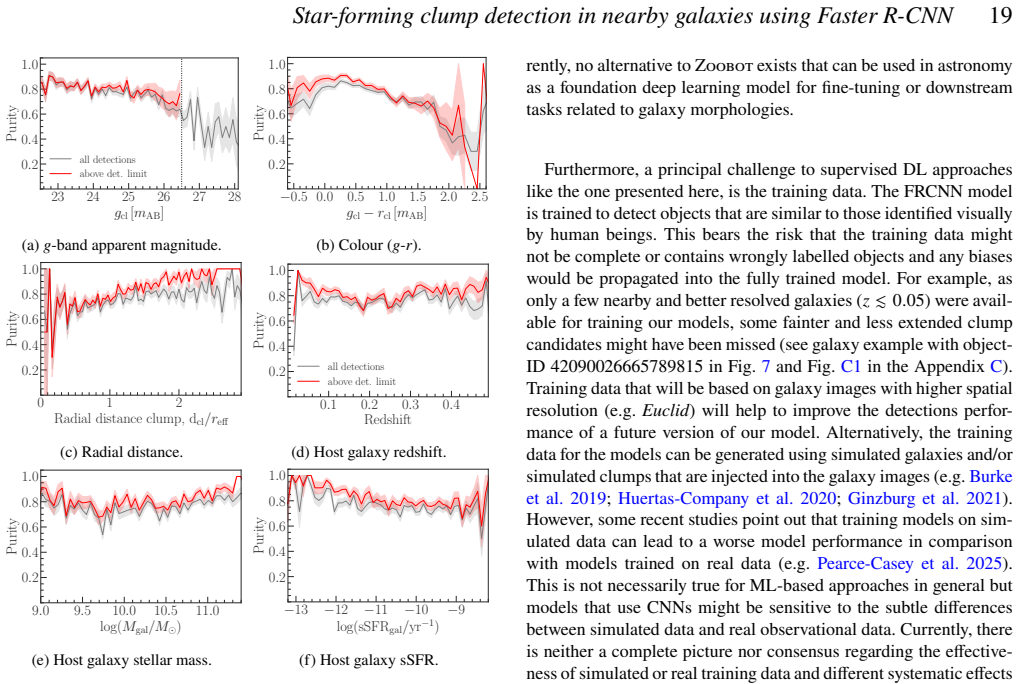
- §6.3.3–6.3.4 and Tables 6–7: purity is obtained by first masking every pre-injection detection and then counting residual detections that match the injected clumps. The residual set can still contain real clumps the original model missed plus injection-triggered false positives, so the quoted purity (≳0.8 above the 5σ limit) is an upper bound conditioned on the same detector. Completeness is cleanly measured; purity is not. A clearer statement of this limitation (or an independent purity estimate, e.g. from a fully held-out visual sample) is needed before the catalogue contamination floor can be trusted.
- §3.2 and §7: the training set of only ~3 200 galaxies (few at z≲0.05) was built by correcting an earlier machine prototype. The authors themselves note that faint, well-resolved clumps may have been missed. Because both the detector and the purity denominator inherit this bias, the claim that the measured completeness/purity transfer to the full ~1.5 M-candidate catalogue rests on an incompletely tested assumption about the representativeness of the labels and the FSPS injections.
minor comments (5)
- Figure 1 and surrounding text: the over-fitting discussion would be clearer if the epoch of the final checkpoint (and the corresponding F1) were marked on every panel.
- Equation (1) and the Lupton scaling (Eq. 2) are adopted from Zoobot pre-training; a short justification that these scalings remain optimal for multi-band clump detection would help.
- Table 2: the parenthetical “clump candidates per galaxy” ratios would be easier to interpret if the number of clumpy galaxies (rather than total galaxies) were also listed.
- Appendix C visual inspection of 579 galaxies is useful; stating the redshift and mass distribution of that subsample would strengthen the false-positive/false-negative fractions quoted there.
- A few typographical slips remain (e.g. “the the Faster”, “greater then”, inconsistent use of “GSFC” vs “clump”).
Circularity Check
No load-bearing circular derivation; empirical completeness/purity on independent FSPS injections is self-contained, with only mild self-reference in the human-corrected training labels.
specific steps
-
other
[Section 3.2 (Training data)]
"we overlaid the galaxy images with a first set of possible clump detections. This set of possible clump detections were the predictions from a model with the same architecture as the final 6-channel model … By adopting a limited ‘correct-a-machine’ approach, we expected that the final detection model will benefit from being trained not only on new clump labels but also on its previous errors."
The initial training annotations begin from detections of a prototype of identical architecture; human corrections therefore start from a distribution already shaped by the same model family. This is a mild self-reference in the training distribution, not a definitional or fitted-input circularity that forces the later completeness/purity numbers (which are measured on independent injections).
full rationale
The paper is an empirical methods paper whose central claims (completeness ≳0.9 and purity ≳0.8 for clumps brighter than the survey 5σ depths) are measured by injecting FSPS-simulated clumps whose physical parameters (stellar mass, age, AV, metallicity, SFH τ) are drawn from independent distributions (Table 3) into real galaxy images after deliberately masking the model’s own pre-injection detections, then recovering flux peaks (Sections 6.2–6.3, Tables 4–7). Completeness is simply the fraction of known injected positions recovered within 0.75× seeing FWHM; purity is the fraction of residual post-masking detections that match those injections. Neither quantity is forced by construction or by a fitted parameter renamed as a prediction. Training labels are human-corrected annotations on ~3200 galaxies (Section 3.2), not pure self-labels, and the Zoobot backbone is an external foundation model. The only mild self-reference is the limited “correct-a-machine” overlay of a prototype of the same architecture, which the authors themselves flag as a possible bias source; this does not reduce the reported metrics to their inputs. No uniqueness theorems, ansatz smuggling, or renaming of known results appear. Score 1 reflects that single non-load-bearing self-reference; the derivation chain itself is free of circularity.
Axiom & Free-Parameter Ledger
free parameters (5)
- Maximum bounding-box size cut =
7.30 kpc
- NMS IoU threshold =
0.2
- Matching radius for simulated clumps =
0.75 × FWHM
- Simulated clump stellar-mass upper limits by redshift bin =
redshift-dependent caps
- Objectness score thresholds for performance tables =
0.0 / 0.3 / 0.6
axioms (4)
- domain assumption Planck 2015 cosmology (Ωm, ΩΛ, h) = (0.31, 0.69, 0.68) for converting angular sizes to physical kpc.
- domain assumption FSPS delayed-τ CSPs with Calzetti dust, Chabrier IMF, MIST/MILES libraries adequately reproduce the broadband colours and luminosities of real GSFCs.
- domain assumption Human visual labels (including corrections of a prototype model) define the ground-truth class of clumps versus contaminants.
- ad hoc to paper asinh and Lupton scalings used for Zoobot pre-training remain optimal for multi-band clump detection.
read the original abstract
Giant Star-forming Clumps (GSFCs) are kpc-scale regions of enhanced star-formation with stellar masses of $10^7$ to $10^9\,M_\odot$ that are commonly observed in high-redshift galaxies but are rarely detected in low-redshift ($z\lesssim0.5$) galaxy analogues. However, the availability of wide-field galaxy survey data makes it possible to identify potential star-forming clumps in large samples of low-redshift galaxies using object detection models that are based on Deep Learning (DL) techniques. We apply a novel DL-based object detection model to galaxies observed by the Hyper Suprime-Cam Subaru Strategic Survey (HSC-SSP) and CFHT Large Area U-band Deep Survey (CLAUDS). Our model is based on the the Faster Region-Based Convolutional Neural Network (Faster R-CNN or FRCNN) object detection framework but expanded to process the six $ugrizy$ filter band images simultaneously and identify not only clumps and their locations in the host galaxy but also additional contaminants. By adopting the \textsc{Zoobot} foundation DL-model as a feature extraction backbone, we also demonstrate one of the first applications of \textsc{Zoobot} in a downstream task for object detection. Our model achieves a detection completeness of $\gtrsim 0.9$ and purity of $\gtrsim 0.8$ which were validated on a large set of real galaxies into which simulated clumps were injected.
Figures





Reference graph
Works this paper leans on
-
[1]
Adams, Dominic and Mehta, Vihang and Dickinson, Hugh and Scarlata, Claudia and Fortson, Lucy and Kruk, Sandor and Simmons, Brooke and Lintott, Chris , journal =. 2022 , month = may, number =. doi:10.3847/1538-4357/ac6512 , eid =
-
[2]
2010 , month = may, doi =
Houjun Mo and Frank van den Bosch and Simon White , publisher =. 2010 , month = may, doi =
2010
-
[3]
Debra Meloy Elmegreen and Bruce G. Elmegreen and Clara M. Sheets , journal =. 2004 , month = mar, number =. doi:10.1086/381357 , file =
-
[4]
Elmegreen and Debra Meloy Elmegreen , journal =
Bruce G. Elmegreen and Debra Meloy Elmegreen , journal =. 2005 , month = jul, number =. doi:10.1086/430514 , file =
doi:10.1086/430514 2005
-
[5]
Bruce G. Elmegreen and Fr. The Astrophysical Journal , title =. 2008 , month = nov, number =. doi:10.1086/592190 , file =
doi:10.1086/592190 2008
-
[6]
Yicheng Guo and Henry C. Ferguson and Eric F. Bell and David C. Koo and Christopher J. Conselice and Mauro Giavalisco and Susan Kassin and Yu Lu and Ray Lucas and Nir Mandelker and Daniel M. McIntosh and Joel R. Primack and Swara Ravindranath and Guillermo Barro and Daniel Ceverino and Avishai Dekel and Sandra M. Faber and Jerome J. Fang and Anton M. Koek...
-
[7]
Yicheng Guo and Marc Rafelski and Eric F. Bell and Christopher J. Conselice and Avishai Dekel and S. M. Faber and Mauro Giavalisco and Anton M. Koekemoer and David C. Koo and Yu Lu and Nir Mandelker and Joel R. Primack and Daniel Ceverino and Duilia F. de Mello and Henry C. Ferguson and Nimish Hathi and Dale Kocevski and Ray A. Lucas and Pablo G. P. The A...
-
[8]
de Mello and Marc Rafelski and Jonathan P
Emmaris Soto and Duilia F. de Mello and Marc Rafelski and Jonathan P. Gardner and Harry I. Teplitz and Anton M. Koekemoer and Swara Ravindranath and Norman A. Grogin and Claudia Scarlata and Peter Kurczynski and Eric Gawiser , journal =. 2017 , month = feb, number =. doi:10.3847/1538-4357/aa5da3 , file =
-
[9]
Miroslava Dessauges-Zavadsky and Angela Adamo , journal =. 2018 , month = jun, number =. doi:10.1093/mnrasl/sly112 , file =
-
[10]
Fisher and Karl Glazebrook and Ivana Damjanov and Roberto G
David B. Fisher and Karl Glazebrook and Ivana Damjanov and Roberto G. Abraham and Danail Obreschkow and Emily Wisnioski and Robert Bassett and Andy Green and Peter McGregor , journal =. 2017 , month = sep, number =. doi:10.1093/mnras/stw2281 , file =
-
[11]
The Astrophysical Journal , title =
Vihang Mehta and Claudia Scarlata and Lucy Fortson and Hugh Dickinson and Dominic Adams and Jacopo Chevallard and St. The Astrophysical Journal , title =. 2021 , month = may, number =. doi:10.3847/1538-4357/abed5b , file =
-
[12]
High-redshift clumpy discs and bulges in cosmological simulations , year =
Daniel Ceverino and Avishai Dekel and Frederic Bournaud , journal =. High-redshift clumpy discs and bulges in cosmological simulations , year =. doi:10.1111/j.1365-2966.2010.16433.x , groups =
-
[13]
Rotational support of giant clumps in high-z disc galaxies , year =
Daniel Ceverino and Avishai Dekel and Nir Mandelker and Frederic Bournaud and Andreas Burkert and Reinhard Genzel and Joel Primack , journal =. Rotational support of giant clumps in high-z disc galaxies , year =. doi:10.1111/j.1365-2966.2011.20296.x , groups =
-
[14]
Tobias Buck and Andrea V. Macci. Monthly Notices of the Royal Astronomical Society , title =. 2017 , month = mar, number =. doi:10.1093/mnras/stx685 , file =
-
[15]
Xi Meng and Oleg Y. Gnedin , journal =. Origin of giant stellar clumps in high-redshift galaxies , year =. doi:10.1093/mnras/staa776 , groups =
-
[16]
Romeo and Oscar Agertz , journal =
Florent Renaud and Alessandro B. Romeo and Oscar Agertz , journal =. 2021 , month = sep, number =. doi:10.1093/mnras/stab2604 , groups =
-
[17]
Floor van Donkelaar and Oscar Agertz and Florent Renaud , journal =. From giant clumps to clouds -. 2022 , month = mar, number =. doi:10.1093/mnras/stac692 , groups =
-
[18]
R. C. Livermore and T. Jones and J. Richard and R. G. Bower and R. S. Ellis and A. M. Swinbank and J. R. Rigby and Ian Smail and S. Arribas and J. Rodriguez-Zaurin and L. Colina and H. Ebeling and R. A. Crain , journal =. 2012 , month = nov, number =. doi:10.1111/j.1365-2966.2012.21900.x , file =
-
[19]
Miroslava Dessauges-Zavadsky and Daniel Schaerer and Antonio Cava and Lucio Mayer and Valentina Tamburello , journal =. 2017 , month = feb, number =. doi:10.3847/2041-8213/aa5d52 , file =
-
[20]
R. J. Ivison and J. Richard and A. D. Biggs and M. A. Zwaan and E. Falgarone and V. Arumugam and P. P. van der Werf and W. Rujopakarn , journal =. 2020 , month = mar, number =. doi:10.1093/mnrasl/slaa046 , groups =
-
[21]
Mike Walmsley and Anna M. M. Scaife and Chris Lintott and Michelle Lochner and Verlon Etsebeth and Tobias G. Monthly Notices of the Royal Astronomical Society , title =. 2022 , month = feb, number =. doi:10.1093/mnras/stac525 , file =
-
[22]
Monthly Notices of the Royal Astronomical Society , title =
Mike Walmsley and Chris Lintott and Tobias G. Monthly Notices of the Royal Astronomical Society , title =. 2021 , month = sep, number =. doi:10.1093/mnras/stab2093 , file =
-
[23]
2019 , groups =
Shilpa Ananth , month = aug, title =. 2019 , groups =
2019
-
[24]
Elmegreen, Debra Meloy , booktitle =. 2007 , editor =. doi:10.1017/S1743921306010210 , file =
-
[25]
Walmsley, Mike and Smith, Lewis and Lintott, Chris and Gal, Yarin and Bamford, Steven and Dickinson, Hugh and Fortson, Lucy and Kruk, Sandor and Masters, Karen and Scarlata, Claudia and Simmons, Brooke and Smethurst, Rebecca and Wright, Darryl , journal =. 2020 , month = jan, number =. arXiv , doi =:1905.07424 , groups =
Pith/arXiv arXiv 2020
-
[26]
2022 , month = nov, abstract =
Shoubaneh Hemmati and Eric Huff and Hooshang Nayyeri and Agnès Ferté and Peter Melchior and Bahram Mobasher and Jason Rhodes and Abtin Shahidi and Harry Teplitz , title =. 2022 , month = nov, abstract =
2022
-
[27]
Zoobot: Deep learning galaxy morphology classifier , year =
Walmsley, Mike and Lintott, Chris and G. Zoobot: Deep learning galaxy morphology classifier , year =. ascl , eid =:2203.027 , groups =
-
[28]
and Vaccari, Mattia , booktitle =
Fielding, Ezra and Nyirenda, Clement N. and Vaccari, Mattia , booktitle =. A Comparison of Deep Learning Architectures for Optical Galaxy Morphology Classification , year =. arXiv , doi =:2111.04353 , groups =
-
[29]
Madau, Piero and Dickinson, Mark , journal =. 2014 , month = aug, pages =. doi:10.1146/annurev-astro-081811-125615 , file =
-
[30]
2022 , month = nov, abstract =
Heng Yu and Xiaolan Hou , title =. 2022 , month = nov, abstract =. arXiv , doi =:2211.06002 , file =
Pith/arXiv arXiv 2022
-
[31]
Flaccomio and G
E. Flaccomio and G. Micela and G. Peres and S. Sciortino and E. Salvaggio and L. Prisinzano and M. G. Guarcello and L. Venuti and R. Bonito and I. Pillitteri , title =. 2022 , month = nov, abstract =
2022
-
[32]
2022 , month = nov, abstract =
Fabrizio Fiore and Andrea Ferrara and Manuela Bischetti and Chiara Feruglio and Andrea Travascio , title =. 2022 , month = nov, abstract =
2022
-
[33]
Sorce and Antonino Troja , title =
Isaac Tutusaus and Jenny G. Sorce and Antonino Troja , title =. 2022 , month = nov, abstract =
2022
-
[34]
2022 , month = nov, abstract =
Suraj Dhiwar and Kanak Saha and Avishai Dekel and Abhishek Paswan and Divya Pandey and Arianna Cortesi and Mahadev Pandge , title =. 2022 , month = nov, abstract =
2022
-
[35]
J. L. Tous and H. Domínguez-Sánchez and J. M. Solanes and J. D. Perea , title =. 2022 , month = nov, abstract =
2022
-
[36]
Sorce , title =
Antonino Troja and Isaac Tutusaus and Jenny G. Sorce , title =. 2022 , month = nov, abstract =
2022
-
[37]
2022 , month = nov, abstract =
Utsav Akhaury and Jean-Luc Starck and Pascale Jablonka and Frédéric Courbin and Kevin Michalewicz , title =. 2022 , month = nov, abstract =. arXiv , doi =:2211.09597 , file =
Pith/arXiv arXiv 2022
-
[38]
B. D. Simmons and Chris Lintott and Kyle W. Willett and Karen L. Masters and Jeyhan S. Kartaltepe and Boris Häu. Monthly Notices of the Royal Astronomical Society , title =. 2016 , month = oct, number =. doi:10.1093/mnras/stw2587 , groups =
-
[39]
Lean Crowdsourcing: Combining Humans and Machines in an Online System , year =
Steve Branson and Grant Van Horn and Pietro Perona , booktitle =. Lean Crowdsourcing: Combining Humans and Machines in an Online System , year =. doi:10.1109/cvpr.2017.647 , groups =
-
[40]
Sorce and Antonino Troja and Isaac Tutusaus , title =
Jenny G. Sorce and Antonino Troja and Isaac Tutusaus , title =. 2022 , month = nov, abstract =
2022
-
[41]
2022 , month = nov, abstract =
Michele Delli Veneri and Lukasz Tychoniec and Fabrizia Guglielmetti and Giuseppe Longo and Eric Villard , title =. 2022 , month = nov, abstract =. arXiv , doi =:2211.11462 , file =
Pith/arXiv arXiv 2022
-
[42]
Monthly Notices of the Royal Astronomical Society , title =
Joshua Wilde and Stephen Serjeant and Jane M Bromley and Hugh Dickinson and L. Monthly Notices of the Royal Astronomical Society , title =. 2022 , month = feb, number =. doi:10.1093/mnras/stac562 , groups =
-
[43]
AGNet: Weighing Black Holes with Deep Learning , year =
Joshua Yao-Yu Lin and Sneh Pandya and Devanshi Pratap and Xin Liu and Matias Carrasco Kind and Volodymyr Kindratenko , journal =. AGNet: Weighing Black Holes with Deep Learning , year =. arXiv , doi =:2108.07749 , file =
-
[44]
Poggianti and the GASP team , title =
Bianca M. Poggianti and the GASP team , title =. 2022 , month = nov, abstract =
2022
-
[45]
2015 , editor =
Ren, Shaoqing and He, Kaiming and Girshick, Ross and Sun, Jian , booktitle =. 2015 , editor =
2015
-
[46]
A chemical study of nine star-forming regions with evidence of infall motion , year =
Yang Yang and Yao Wang and Zhibo Jiang and Zhiwei Chen , journal =. A chemical study of nine star-forming regions with evidence of infall motion , year =. doi:10.1093/mnras/stac3130 , groups =
-
[47]
Jimena Rodriguez and Janice Lee and Bradley Whitmore and David Thilker and Daniel Maschmann and Rupali Chandar and Daniel Dale and Diederik Kruijssen and Mederic Boquien and Kathryn Grasha and Elizabeth Watkins and Ashley Barnes and Mattia Sormani and Thomas Williams and Jaeyeon Kim and Gagandeep Anand and Mélanie Chevance and Frank Bigiel and Adam Leroy ...
2022
-
[48]
Willett, Kyle W. and Lintott, Chris J. and Bamford, Steven P. and Masters, Karen L. and Simmons, Brooke D. and Casteels, Kevin R. V. and Edmondson, Edward M. and Fortson, Lucy F. and Kaviraj, Sugata and Keel, William C. and Melvin, Thomas and Nichol, Robert C. and Raddick, M. Jordan and Schawinski, Kevin and Simpson, Robert J. and Skibba, Ramin A. and Smi...
-
[49]
Cooke and Jeyhan S
Kevin C. Cooke and Jeyhan S. Kartaltepe and Caitlin Rose and K. D. Tyler and Behnam Darvish and Sarah K. Leslie and Ying-jie Peng and Boris Häußler and Anton M. Koekemoer , title =. 2022 , month = nov, abstract =
2022
-
[50]
Phillipps and S
S. Phillipps and S. Bellstedt and M. N. Bremer and R. De Propris and P. A. James and S. Casura and J. Liske and B. W. Holwerda , title =. 2022 , month = nov, abstract =
2022
-
[51]
Skarbinski and Sarah M
Maya S. Skarbinski and Sarah M. R. Jeffreson and Alyssa A. Goodman , title =. 2022 , month = dec, abstract =
2022
-
[52]
Goldsmith and Laurent Pagani and Tao-Chung Ching and Jinjin Xie and Chen Wang , title =
Yan Duan and Di Li and Paul F. Goldsmith and Laurent Pagani and Tao-Chung Ching and Jinjin Xie and Chen Wang , title =. 2022 , month = dec, abstract =
2022
-
[53]
Watkins and Ashley Barnes and Kiana F
Elizabeth J. Watkins and Ashley Barnes and Kiana F. Henny and Hwihyun Kim and Kathryn Kreckel and Sharon E. Meidt and Ralf S. Klessen and Simon C. O. Glover and Thomas G. Williams and B. W. Keller and Adam K. Leroy and Erik W. Rosolowsky and Mederic Boquien and Gagandeep S. Anand and Francesco Belfiore and Frank Bigiel and Guillermo Blanc and Yixian Cao a...
2022
-
[54]
Misty A. La Vigne and Stuart N. Vogel and Eve C. Ostriker , journal =. 2006 , month = oct, number =. doi:10.1086/506589 , file =
-
[55]
2022 , month = sep, abstract =
Francesco Ziparo and Andrea Ferrara and Laura Sommovigo and Mahsa Kohandel , title =. 2022 , month = sep, abstract =
2022
-
[56]
Lee and Karin M
Janice C. Lee and Karin M. Sandstrom and Adam K. Leroy and David A. Thilker and Eva Schinnerer and Erik Rosolowsky and Kirsten L. Larson and Oleg V. Egorov and Thomas G. Williams and Judy Schmidt and Eric Emsellem and Gagandeep S. Anand and Ashley T. Barnes and Francesco Belfiore and Ivana Beslic and Frank Bigiel and Guillermo A. Blanc and Alberto D. Bola...
2022
-
[57]
Riggi and D
S. Riggi and D. Magro and R. Sortino and A. De Marco and C. Bordiu and T. Cecconello and A. M. Hopkins and J. Marvil and G. Umana and E. Sciacca and F. Vitello and F. Bufano and A. Ingallinera and G. Fiameni and C. Spampinato and K. Zarb Adami , title =. 2022 , month = dec, abstract =
2022
-
[58]
Luc Simard and J. Trevor Mendel and David R. Patton and Sara L. Ellison and Alan W. McConnachie , journal =. 2011 , month = aug, number =. doi:10.1088/0067-0049/196/1/11 , groups =
-
[59]
Monthly Notices of the Royal Astronomical Society , title =
Ad. Monthly Notices of the Royal Astronomical Society , title =. 2023 , month = jan, number =. doi:10.1093/mnras/stac3791 , file =
-
[60]
and Walmsley, Mike , journal =
Dickinson, Hugh and Adams, Dominic and Mehta, Vihang and Scarlata, Claudia and Fortson, Lucy and Serjeant, Stephen and Krawczyk, Coleman and Kruk, Sandor and Lintott, Chris and Mantha, Kameswara and Simmons, Brooke D. and Walmsley, Mike , journal =. 2022 , month = oct, number =. doi:10.1093/mnras/stac2919 , file =
-
[61]
The imprint of clump formation at high redshift. II. The chemistry of the bulge
Debattista, Victor P. and Liddicott, David J. and Gonzalez, Oscar A. and Silva, Leandro Beraldo e and Amarante, Joao A. S. and Lazar, Ilin and Zoccali, Manuela and Valenti, Elena and Fisher, Deanne B. and Khachaturyants, Tigran and Nidever, David L. and Quinn, Thomas R. and Du, Min and Kassin, Susan , title =. 2023 , month = mar, abstract =. doi:10.48550/...
work page internal anchor Pith review Pith/arXiv arXiv doi:10.48550/arxiv.2303.08265 2023
-
[62]
The imprint of clump formation at high redshift - I
Adam J Clarke and Victor P Debattista and David L Nidever and Sarah R Loebman and Raymond C Simons and Susan Kassin and Min Du and Melissa Ness and Deanne B Fisher and Thomas R Quinn and James Wadsley and Ken C Freeman and Cristina C Popescu , journal =. The imprint of clump formation at high redshift - I. A disc -abundance dichotomy , year =. doi:10.1093...
-
[63]
Monthly Notices of the Royal Astronomical Society , title =
Matteo Messa and Miroslava Dessauges-Zavadsky and Johan Richard and Angela Adamo and David Nagy and Fran. Monthly Notices of the Royal Astronomical Society , title =. 2022 , month = aug, number =. doi:10.1093/mnras/stac2189 , file =
-
[64]
Angora, G. and Rosati, P. and Meneghetti, M. and Brescia, M. and Mercurio, A. and Grillo, C. and Bergamini, P. and Acebron, A. and Caminha, G. and Nonino, M. and Tortorelli, L. and Bazzanini, L. and Vanzella, E. , title =. 2023 , month = mar, abstract =. doi:10.48550/ARXIV.2303.00769 , eprint =
work page internal anchor Pith review Pith/arXiv arXiv doi:10.48550/arxiv.2303.00769 2023
-
[65]
Wet Compaction to a Blue Nugget: a Critical Phase in Galaxy Evolution
Lapiner, Sharon and Dekel, Avishai and Freundlich, Jonathan and Ginzburg, Omri and Jiang, Fangzhou and Kretschmer, Michael and Tacchella, Sandro and Ceverino, Daniel and Primack, Joel , title =. 2023 , month = feb, abstract =. doi:10.48550/ARXIV.2302.12234 , eprint =
work page internal anchor Pith review Pith/arXiv arXiv doi:10.48550/arxiv.2302.12234 2023
-
[66]
Xu, Quanfeng and Shen, Shiyin and de Souza, Rafael S. and Chen, Mi and Ye, Renhao and She, Yumei and Chen, Zhu and Ishida, Emille E. O. and Krone-Martins, Alberto and Durgesh, Rupesh , title =. 2023 , month = mar, abstract =. doi:10.48550/ARXIV.2303.08627 , eprint =
work page internal anchor Pith review Pith/arXiv arXiv doi:10.48550/arxiv.2303.08627 2023
-
[67]
R. Genzel and L. J. Tacconi and F. Eisenhauer and N. M. Förster Schreiber and A. Cimatti and E. Daddi and N. Bouch. Nature , title =. 2006 , month = aug, number =. doi:10.1038/nature05052 , file =
-
[68]
The Astrophysical Journal , title =. 2006 , month = jul, number =. doi:10.1086/504403 , file =
doi:10.1086/504403 2006
-
[69]
L. Clifton Johnson and Anil C. Seth and Julianne J. Dalcanton and Matthew L. Wallace and Robert J. Simpson and Chris J. Lintott and Amit Kapadia and Evan D. Skillman and Nelson Caldwell and Morgan Fouesneau and Daniel R. Weisz and Benjamin F. Williams and Lori C. Beerman and Dimitrios A. Gouliermis and Ata Sarajedini , journal =. 2015 , month = apr, numbe...
-
[70]
The formation of globular clusters with top-heavy initial mass functions
Fukushima, Hajime and Yajima, Hidenobu , title =. 2023 , month = mar, abstract =. doi:10.48550/ARXIV.2303.12405 , eprint =
work page internal anchor Pith review Pith/arXiv arXiv doi:10.48550/arxiv.2303.12405 2023
-
[71]
An Astronomers Guide to Machine Learning
Webb, Sara A. and Goode, Simon R. , title =. 2023 , month = apr, abstract =. doi:10.48550/ARXIV.2304.00512 , eprint =
work page internal anchor Pith review Pith/arXiv arXiv doi:10.48550/arxiv.2304.00512 2023
-
[72]
D. Heinzeller and W. J. Duschl , journal =. 2007 , month = jan, number =. doi:10.1111/j.1365-2966.2006.11233.x , groups =
-
[73]
Navarro, Maria Gabriela and Capuzzo-Dolcetta, Roberto and Arca-Sedda, Manuel and Minniti, Dante , journal =. Globular Clusters in the Galactic Center Region: expected behavior in the infalling and merger scenario , year =. doi:10.48550/ARXIV.2303.18123 , eprint =
work page internal anchor Pith review Pith/arXiv arXiv doi:10.48550/arxiv.2303.18123
-
[74]
and Tamfal, Tomas and Quinn, Thomas R
van Donkelaar, Floor and Mayer, Lucio and Capelo, Pedro R. and Tamfal, Tomas and Quinn, Thomas R. and Madau, Piero , title =. 2022 , month = oct, abstract =. doi:10.1093/mnras/stad946 , eprint =
-
[75]
Debra Meloy Elmegreen and Bruce G. Elmegreen and Max T. Marcus and Karlen Shahinyan and Andrew Yau and Michael Petersen , journal =. 2009 , month = jul, number =. doi:10.1088/0004-637x/701/1/306 , file =
-
[76]
Christopher J. Conselice and Jeffrey A. Blackburne and Casey Papovich , journal =. The Luminosity, Stellar Mass, and Number Density Evolution of Field Galaxies of Known Morphology from i z /i = 0.5 to 3 , year =. doi:10.1086/426102 , groups =
-
[77]
Ferguson and Paolo Cassata and Anton M
Yicheng Guo and Mauro Giavalisco and Henry C. Ferguson and Paolo Cassata and Anton M. Koekemoer , journal =. 2012 , month = sep, number =. doi:10.1088/0004-637x/757/2/120 , file =
-
[78]
Debra Meloy Elmegreen and Bruce G. Elmegreen and Douglas S. Rubin and Meredith A. Schaffer , journal =. 2005 , month = sep, number =. doi:10.1086/432502 , groups =
doi:10.1086/432502 2005
-
[79]
Elmegreen and Swara Ravindranath and Daniel A
Debra Meloy Elmegreen and Bruce G. Elmegreen and Swara Ravindranath and Daniel A. Coe , journal =. 2007 , month = apr, number =. doi:10.1086/511667 , file =
doi:10.1086/511667 2007
-
[80]
YOLO-CL: Galaxy cluster detection in the SDSS with deep machine learning
Grishin, Kirill and Mei, Simona and Ilic, Stéphane , title =. 2023 , copyright =. doi:10.48550/ARXIV.2301.09657 , groups =
work page internal anchor Pith review Pith/arXiv arXiv doi:10.48550/arxiv.2301.09657 2023
discussion (0)
Sign in with ORCID, Apple, or X to comment. Anyone can read and Pith papers without signing in.