REVIEW 2 major objections 4 minor 43 references
Client drift in federated learning lives mostly in low-frequency gradients; cutting those frequencies realigns updates and lifts accuracy under non-IID data.
Reviewed by Pith at T0; open to challenge. T0 means a machine referee read the full paper against a public rubric. the ladder, T0–T4 →
T0 review · grok-4.5
2026-07-11 21:04 UTC pith:E2U3DUTL
load-bearing objection Strong empirical FL regularizer that works; the “intrinsic spectral bias” framing is overstated because it depends on a particular 1-D flattening order. the 2 major comments →
SpecGradFilter: A Spectral Gradient Filtering Framework for Taming Federated Heterogeneity
The pith
A machine-rendered reading of the paper's core claim, the machinery that carries it, and where it could break.
Core claim
Inter-client gradient divergence is predominantly concentrated in low-frequency components that encode client-specific distributional shifts, while high-frequency components that carry fine-grained shared features remain relatively consistent. Suppressing the low-frequency band during local SGD therefore reduces client drift and yields higher accuracy and faster convergence under non-IID data.
What carries the argument
SpecGradFilter: a spectral modulation operator Φ that high-pass-filters each layer’s flattened gradient (via rFFT mask with ratio r, or via spatial detrending) before every local update, thereby projecting out the drift-dominated low-frequency subspace.
Load-bearing premise
A fixed low-frequency cutoff applied after one particular one-dimensional flattening order of the weight tensors cleanly separates client-specific drift from useful signal for the tested networks and data partitions.
What would settle it
Re-run the main CIFAR-10/100 Dirichlet-α=0.1 experiments with the same r=0.05 filter but with random or channel-innermost tensor flattening; if accuracy collapses back to FedAvg levels, the claimed spectral separation fails.
Editorial analysis
A structured set of objections, weighed in public.
Referee Report
Summary. The paper argues that client drift under non-IID federated data is not unstructured but exhibits a Spectral Bias of Drift: after 1-D flattening of layer-wise gradients, inter-client divergence (measured by mean and std of pairwise spectral distances Dist(m)/Std(m) in Eq. 4) concentrates in low-frequency bands that encode client-specific shifts, while high-frequency bands remain more consistent (Fig. 1, §III-B). Motivated by this and a pilot high-pass study (Fig. 2), it introduces SpecGradFilter, a plug-in operator Φ that suppresses the lowest-r fraction of Fourier coefficients (or spatial approximations via LAP-D/Gaussian detrend) inside each local SGD step (Eqs. 6–8, Alg. 1). Extensive experiments on CIFAR-10/100, Tiny-ImageNet, FEMNIST, BloodMNIST and Yahoo Answers, across ResNets, DenseNet, WideResNet and ViT, show large accuracy gains and faster convergence versus FedAvg, FedProx, SCAFFOLD, FedDyn and others, especially at α=0.1, with negligible communication cost and a basic non-convex convergence bound (Thm. IV.1).
Significance. If the spectral interpretation is robust, the work supplies a simple, architecture-agnostic regularizer that can be dropped into existing FL pipelines and that yields double-digit gains under severe heterogeneity (Table I: +19–21 points on CIFAR-10 α=0.1). The spatial detrend variants (Table III) and the consistent improvements when combined with multiple baselines and backbones (Table II, Fig. 6) are practically valuable, as is the demonstration that the same filter is mildly harmful in centralized SGD yet increasingly helpful as decentralization grows (Table V). Thorough ablations on filter type, ratio, client count, participation and feature-shift corruptions further strengthen the empirical case. The main conceptual contribution—an explicit frequency-domain view of client drift—would open a useful new research direction provided the claimed spectral concentration can be shown to be more than an artifact of a particular tensor layout.
major comments (2)
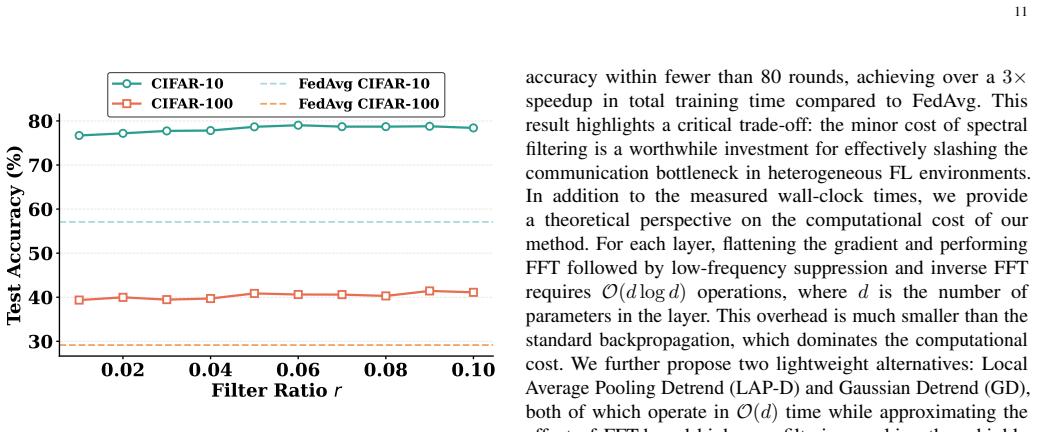
- [§III-B, Table IV] §III-B (Eqs. 3–4, Fig. 1) and §V-C (Table IV): The central claim of an intrinsic Spectral Bias of Drift is demonstrated exclusively under the default contiguous flattening order [Out,In,H,W] (0123). Table IV shows that only three channel-outermost orders retain large gains; channel-innermost orders, random permutation after flattening, and even a structure-preserving 2-D FFT collapse accuracy to FedAvg levels or below. No Dist(m)/Std(m) curves are supplied for any alternative layout, so it remains unclear whether low-frequency concentration is a genuine property of federated gradients or an artifact of how the authors chose to linearize the tensor. Because the abstract, introduction and methodology present SpecGradFilter as a general frequency-domain principle rather than a layout-specific regularizer, this gap is load-bearing: either report the spectral-distance statistics under the fai
- [§IV-B, Thm. IV.1, Table V] §IV-B–C and Thm. IV.1: The spectral-preconditioning view and the convergence bound treat P_spec = F^{-1} D F as a heterogeneity-aware projector whose residual bias is controlled by δ_high. The bound is formally correct under the stated assumptions, yet it does not explain why the same high-pass operator is beneficial only after multi-step local SGD on non-IID data and mildly harmful under centralized SGD (Table V). A short analysis or additional measurement linking the size of the low-frequency client-wise discrepancy to the number of local steps would make the theory support the empirical regime distinction rather than merely bound the filtered algorithm.
minor comments (4)
- [Abstract, §I] Abstract and §I: repeated phrasing issues (“significantly performs better performance”, “significantly severely hampers”) should be corrected for readability.
- [Fig. 1] Fig. 1 caption and §III-B: clarify that the four gradient snapshots are taken every 30 rounds; the exact communication-round indices would aid reproducibility.
- [§V-A] §V-A: the hyper-parameter search protocol is thorough, yet the final chosen values for all baselines are relegated to the supplement; a short summary table in the main text would help readers.
- [Table III] Table III and §V-C: the spatial detrend kernels (LAP-D, GD) are only sketched; giving the exact kernel sizes or σ values used would improve reproducibility of the O(d) variants.
Circularity Check
No circularity: spectral-bias observation is measured on unfiltered FedAvg gradients, method is then applied, and accuracy gains are external empirical outcomes.
full rationale
The paper's chain is observational then interventional, not definitional. In §III-B the authors compute Dist(m) and Std(m) (Eq. 4) by rFFT of ordinary client gradients under Dirichlet partitions, observe concentration in low-frequency bands (Fig. 1), and only afterwards introduce the high-pass operator Φ (Eq. 6–8). The pilot study (§III-C, Fig. 2) simply verifies that removing the high-Dist bands reduces layer-wise divergence—an immediate algebraic consequence of the measurement, not a circular prediction of accuracy. Final claims rest on held-out test accuracy (Tables I–X, Figs. 4–8) against external baselines; the filter ratio r=0.05 is a fixed hyper-parameter, not a fit that forces the reported numbers. Flattening-order sensitivity (Table IV) and the mild degradation under centralized SGD (Table V) are validity caveats about generality, not reductions of the claimed gains to the method’s own inputs. No self-citation supplies a uniqueness theorem or ansatz that the present results merely rename. The derivation is therefore self-contained against the paper’s own equations and external benchmarks.
Axiom & Free-Parameter Ledger
free parameters (3)
- spectral filter ratio r =
0.05
- local learning rate and method-specific hyperparameters
- flattening order of convolutional kernels =
0123 (natural layout)
axioms (3)
- domain assumption Local objectives are L-smooth and stochastic gradients have bounded variance; the global objective satisfies standard non-convex FL assumptions.
- domain assumption Neural networks exhibit spectral bias, learning low-frequency functions before high-frequency ones.
- ad hoc to paper After 1-D flattening of layer gradients, client-specific distributional shifts concentrate in the lowest-frequency Fourier coefficients while task-relevant features remain in higher bands.
invented entities (2)
-
Spectral Bias of Drift
independent evidence
-
SpecGradFilter operator Φ (spectral or spatial high-pass)
no independent evidence
read the original abstract
Federated Learning (FL) is fundamentally challenged by statistical heterogeneity, where non-identically distributed (non-IID) data induces client drift that severely hampers global convergence. While existing approaches attempt to mitigate this drift through spatial-domain gradient correction or regularization, they overlook the intrinsic spectral structure of optimization signals. In this work, we revisit client drift from a novel frequency-domain perspective and uncover a critical Spectral Bias of Drift: inter-client gradient divergence is predominantly concentrated in low-frequency components which encode client-specific distributional shifts, while high-frequency components representing fine-grained features remain relatively consistent. Motivated by this, we propose SpecGradFilter, a unified Spectral Gradient Filtering Framework that tames heterogeneity by suppressing discordant low-frequency signals. Crucially, we demonstrate that SpecGradFilter is a generalizable principle, effective not only via precise FFT-based truncation but also through spatial approximations like Gaussian detrending. Extensive experiments on benchmarks such as CIFAR-10/100 and Tiny-ImageNet demonstrate that SpecGradFilter significantly performs better performance in highly Non-IID settings with negligible communication overhead, establishing a new paradigm for robust federated optimization.
Figures


Reference graph
Works this paper leans on
-
[1]
Communication-efficient learning of deep networks from decentralized data,
B. McMahan, E. Moore, D. Ramage, S. Hampson, and B. A. y Arcas, “Communication-efficient learning of deep networks from decentralized data,” inProceedings of the 20th International Conference on Artificial Intelligence and Statistics (AISTATS), 2017
2017
-
[2]
Giant: Globally improved approximate newton method for dis- tributed optimization,
S. Wang, F. Roosta, P. Xu, and M. W. Mahoney, “Giant: Globally improved approximate newton method for dis- tributed optimization,”Advances in neural information processing systems, vol. 31, 2018
2018
-
[3]
Com- munication efficient distributed machine learning with the parameter server,
M. Li, D. G. Andersen, A. Smola, and K. Yu, “Com- munication efficient distributed machine learning with the parameter server,”Advances in neural information processing systems, vol. 27, 2014
2014
-
[4]
Firecaffe: Near-linear acceleration of deep neural network training on compute clusters,
F. N. Iandola, M. W. Moskewicz, K. Ashraf, and K. Keutzer, “Firecaffe: Near-linear acceleration of deep neural network training on compute clusters,”2016 IEEE Conference on Computer Vision and Pattern Recognition (CVPR), pp. 2592–2600, 2015. [Online]. Available: https://api.semanticscholar.org/CorpusID:8480861
2016
-
[5]
Co- boosting++: Coupled optimization of data and ensemble for one-shot federated learning,
X. Yang, R. Dai, Y . Zhang, A. Li, T. Liu, and B. Han, “Co- boosting++: Coupled optimization of data and ensemble for one-shot federated learning,”IEEE Transactions on Pattern Analysis and Machine Intelligence, 2026
2026
-
[6]
Tighter theory for local sgd on identical and heterogeneous data,
A. Khaled, K. Mishchenko, and P. Richt ´arik, “Tighter theory for local sgd on identical and heterogeneous data,” inInternational Conference on Artificial Intelligence and Statistics, 2019. [Online]. Available: https://api. semanticscholar.org/CorpusID:210839089
2019
-
[7]
Is local sgd better than minibatch sgd?
B. Woodworth, K. K. Patel, S. U. Stich, Z. Dai, B. Bullins, H. B. McMahan, O. Shamir, and N. Srebro, “Is local sgd better than minibatch sgd?” inProceedings of the 37th International Conference on Machine Learning, ser. ICML’20. JMLR.org, 2020
2020
-
[8]
Federated learning: Challenges, methods, and future directions,
T. Li, A. K. Sahu, A. Talwalkar, and V . Smith, “Federated learning: Challenges, methods, and future directions,” IEEE Signal Processing Magazine, vol. 37, no. 3, pp. 50–60, 2020
2020
-
[9]
Fedskip: Combatting statistical heterogeneity with fed- erated skip aggregation,
Z. Fan, Y . Wang, J. Yao, L. Lyu, Y . Zhang, and Q. Tian, “Fedskip: Combatting statistical heterogeneity with fed- erated skip aggregation,” in2022 IEEE International Conference on Data Mining (ICDM), 2022, pp. 131–140
2022
-
[10]
Federated learning based on dynamic regularization,
D. A. E. Acar, Y . Zhao, R. Matas, M. Mattina, P. What- mough, and V . Saligrama, “Federated learning based on dynamic regularization,” inInternational Conference on Learning Representations, 2021. [Online]. Available: https://openreview.net/forum?id=B7v4QMR6Z9w
2021
-
[11]
Model-contrastive federated learning,
Q. Li, B. He, and D. Song, “Model-contrastive federated learning,” in2021 IEEE/CVF Conference on Computer Vision and Pattern Recognition (CVPR), 2021, pp. 10 708– 10 717
2021
-
[12]
Towards the flatter landscape and better generalization in federated learning under client-level dif- ferential privacy,
Y . Shi, K. Wei, L. Shen, Y . Liu, X. Wang, B. Yuan, and D. Tao, “Towards the flatter landscape and better generalization in federated learning under client-level dif- ferential privacy,”IEEE Transactions on Pattern Analysis and Machine Intelligence, 2025
2025
-
[13]
Federated optimization in heterogeneous networks,
T. Li, A. K. Sahu, M. Zaheer, M. Sanjabi, A. Talwalkar, and V . Smith, “Federated optimization in heterogeneous networks,”Proceedings of Machine learning and systems, vol. 2, pp. 429–450, 2020
2020
-
[14]
Scaffold: Stochastic controlled aver- aging for federated learning,
S. P. Karimireddy, S. Kale, M. Mohri, S. Reddi, S. Stich, and A. T. Suresh, “Scaffold: Stochastic controlled aver- aging for federated learning,” inInternational conference on machine learning. PMLR, 2020, pp. 5132–5143
2020
-
[15]
Feddisco: federated learning with discrepancy-aware col- laboration,
R. Ye, M. Xu, J. Wang, C. Xu, S. Chen, and Y . Wang, “Feddisco: federated learning with discrepancy-aware col- laboration,” inProceedings of the 40th International Con- ference on Machine Learning, ser. ICML’23. JMLR.org, 2023
2023
-
[16]
Fedawa: Adaptive optimization of aggregation weights in federated learning using client vectors,
C. Shi, H. Zhao, B. Zhang, M. Zhou, D. Guo, and Y . Chang, “Fedawa: Adaptive optimization of aggregation weights in federated learning using client vectors,” in Proceedings of the IEEE/CVF Conference on Computer Vision and Pattern Recognition (CVPR), 2025
2025
-
[17]
On the spectral bias of neural networks,
N. Rahaman, A. Baratin, D. Arpit, F. Dr ¨axler, M. Lin, F. A. Hamprecht, Y . Bengio, and A. C. Courville, “On the spectral bias of neural networks,” inInternational Conference on Machine Learning,
-
[18]
Available: https://api.semanticscholar.org/ CorpusID:53012119
[Online]. Available: https://api.semanticscholar.org/ CorpusID:53012119
-
[19]
Frequency principle: Fourier analysis sheds light on deep neural networks,
Z.-Q. J. Xu, Y . Zhang, T. Luo, Y . Xiao, and Z. Ma, “Frequency principle: Fourier analysis sheds light on deep neural networks,”ArXiv, vol. abs/1901.06523,
Pith/arXiv arXiv 1901
-
[20]
Available: https://api.semanticscholar.org/ CorpusID:58981616
[Online]. Available: https://api.semanticscholar.org/ CorpusID:58981616
-
[21]
Fedpe: Adaptive model pruning-expanding for federated learning on mobile devices,
L. Yi, X. Shi, N. Wang, J. Zhang, G. Wang, and X. Liu, “Fedpe: Adaptive model pruning-expanding for federated learning on mobile devices,”IEEE Transactions on Mobile Computing, vol. 23, no. 11, pp. 10 475–10 493, 2024
2024
-
[22]
Tackling resource- constrained and data-heterogeneity in federated learning with double-weight sparse pack,
Q. Yang, L. Chen, M. Xue, and S. Li, “Tackling resource- constrained and data-heterogeneity in federated learning with double-weight sparse pack,” inProceedings of the AAAI Conference on Artificial Intelligence, vol. 40, no. 32, 2026, pp. 27 592–27 600. 14
2026
-
[23]
Feddc: Federated learning with non-iid data via local drift decoupling and correction,
L. Gao, H. Fu, L. Li, Y . Chen, M. Xu, and C.-Z. Xu, “Feddc: Federated learning with non-iid data via local drift decoupling and correction,” inProceedings of the IEEE/CVF Conference on Computer Vision and Pattern Recognition (CVPR). IEEE Computer Society, June 2022, pp. 10 112–10 121
2022
-
[24]
Certified robustness of joint embedding,
J. Zhang, Z. Li, B. Li, J. Xu, S. Wu, S. Ding, and C. Wu, “Certified robustness of joint embedding,” inProceed- ings of the 39th International Conference on Machine Learning, ser. Proceedings of Machine Learning Research, K. Chaudhuri, S. Jegelka, L. Song, C. Szepesv ´ari, G. Niu, and S. Sabato, Eds., vol. 162. PMLR, 2022, pp. 26 311– 26 329
2022
-
[25]
Revisiting weighted aggregation in federated learning with neural networks,
Z. Li, T. Lin, X. Shang, and C. Wu, “Revisiting weighted aggregation in federated learning with neural networks,” inProceedings of the 40th International Conference on Machine Learning, ser. ICML’23. JMLR.org, 2023
2023
-
[26]
Internal cross-layer gradients for extending homogeneity to heterogeneity in federated learning,
Y .-H. Chan, R. Zhou, R. Zhao, Z. Jiang, and E. Ngai, “Internal cross-layer gradients for extending homogeneity to heterogeneity in federated learning,” inInternational Conference on Learning Representations, vol. 2024, 2024, pp. 1983–2011
2024
-
[27]
Fft-based gradient sparsification for the distributed training of deep neural networks,
L. Wang, W. Wu, J. Zhang, H. Liu, G. Bosilca, M. Herlihy, and R. Fonseca, “Fft-based gradient sparsification for the distributed training of deep neural networks,” in Proceedings of the 29th International Symposium on High- Performance Parallel and Distributed Computing, 2020, pp. 113–124
2020
-
[28]
High-energy concentration for federated learning in frequency domain,
H. Shi, W. Xie, H. Ye, D. Li, J. Ma, Y . Li, and L. Fang, “High-energy concentration for federated learning in frequency domain,” 2025. [Online]. Available: https://arxiv.org/abs/2509.12630
arXiv 2025
-
[29]
C. Palihawadana, N. Wiratunga, A. Wijekoon, and H. Kalutarage, “Fedft: Improving communication performance for federated learning with frequency space transformation,” 2024. [Online]. Available: https: //arxiv.org/abs/2409.05242
Pith/arXiv arXiv 2024
-
[30]
Learning multiple layers of features from tiny images,
A. Krizhevsky and G. Hinton, “Learning multiple layers of features from tiny images,” University of Toronto, Toronto, Ontario, Tech. Rep. 0, 2009. [Online]. Available: https://www.cs.toronto.edu/ ∼kriz/ learning-features-2009-TR.pdf
2009
-
[31]
Tiny imagenet visual recognition chal- lenge,
S. U. CS231N, “Tiny imagenet visual recognition chal- lenge,” http://cs231n.stanford.edu/, 2015
2015
-
[32]
Leaf: A benchmark for federated settings,
S. Caldas, S. M. K. Duddu, P. Wu, T. Li, J. Kone ˇcn´y, H. B. McMahan, V . Smith, and A. Talwalkar, “Leaf: A benchmark for federated settings,” 2019. [Online]. Available: https://arxiv.org/abs/1812.01097
Pith/arXiv arXiv 2019
-
[33]
Medmnist v2-a large-scale lightweight benchmark for 2d and 3d biomedical image classification,
J. Yang, R. Shi, D. Wei, Z. Liu, L. Zhao, B. Ke, H. Pfis- ter, and B. Ni, “Medmnist v2-a large-scale lightweight benchmark for 2d and 3d biomedical image classification,” Scientific data, vol. 10, no. 1, p. 41, 2023
2023
-
[34]
Fedcm: Federated learning with client-level momentum,
J. Xu, S. Wang, L. Wang, and A. C.-C. Yao, “Fedcm: Federated learning with client-level momentum,” ArXiv, vol. abs/2106.10874, 2021. [Online]. Available: https://api.semanticscholar.org/CorpusID:235490679
Pith/arXiv arXiv 2021
-
[35]
Improving gen- eralization in federated learning by seeking flat minima,
D. Caldarola, B. Caputo, and M. Ciccone, “Improving gen- eralization in federated learning by seeking flat minima,” inEuropean Conference on Computer Vision. Springer, 2022, pp. 654–672
2022
-
[36]
Generalized federated learning via sharpness aware minimization,
Z. Qu, X. Li, R. Duan, Y . Liu, B. Tang, and Z. Lu, “Generalized federated learning via sharpness aware minimization,” inInternational conference on machine learning. PMLR, 2022, pp. 18 250–18 280
2022
-
[37]
Fedlws: Federated learning with adaptive layer-wise weight shrink- ing,
C. Shi, J. Li, H. Zhao, D. Guo, and Y . Chang, “Fedlws: Federated learning with adaptive layer-wise weight shrink- ing,” inInternational Conference on Learning Represen- tations (ICLR), 2025
2025
-
[38]
Deep residual learning for image recognition,
K. He, X. Zhang, S. Ren, and J. Sun, “Deep residual learning for image recognition,” in2016 IEEE Conference on Computer Vision and Pattern Recognition (CVPR), 2016, pp. 770–778
2016
-
[39]
Dynamic regularized sharpness aware minimization in federated learning: Approaching global consistency and smooth landscape,
Y . Sun, L. Shen, S. Chen, L. Ding, and D. Tao, “Dynamic regularized sharpness aware minimization in federated learning: Approaching global consistency and smooth landscape,” inInternational Conference on Machine Learning. PMLR, 2023, pp. 32 991–33 013
2023
-
[40]
Locally estimated global perturbations are better than local perturbations for federated sharpness- aware minimization,
Z. Fan, S. Hu, J. Yao, G. Niu, Y . Zhang, M. Sugiyama, and Y . Wang, “Locally estimated global perturbations are better than local perturbations for federated sharpness- aware minimization,” inInternational Conference on Machine Learning, 2024
2024
-
[41]
Group normalization,
Y . Wu and K. He, “Group normalization,” inComputer Vision – ECCV 2018: 15th European Conference, Munich, Germany, September 8-14, 2018, Proceedings, Part XIII. Berlin, Heidelberg: Springer-Verlag, 2018, p. 3–19. [Online]. Available: https://doi.org/10.1007/ 978-3-030-01261-8 1 Liyang Yuanis currently working toward the M.S. degree with the School of Arti...
2018
-
[42]
His research interests lie in machine learning and computer vision
He conducted research at JD Explore Academy and the University of Oxford. His research interests lie in machine learning and computer vision. He has published more than 40 publications in top- tier journals and conferences with more than 4000 citations. He was awarded the CAAI Wuwenjun AI Science and Technology Award, First Prize of Natural Science (5-th ...
2021
-
[43]
15 Dandan Guois currently a Professor with the School of Artificial Intelligence, Jilin University, Changchun, China
He has served as Area Chair for NeurIPS, ICML, and ICLR. 15 Dandan Guois currently a Professor with the School of Artificial Intelligence, Jilin University, Changchun, China. Since 2025, she has also been a Visiting Faculty at King Abdullah University of Science and Technology (KAUST), Saudi Arabia. She received the Ph.D. degree in electronic engineering ...
2025
discussion (0)
Sign in with ORCID, Apple, or X to comment. Anyone can read and Pith papers without signing in.