REVIEW 4 minor 88 references
Cross-code lattice surgery joins two error-correcting codes so that a universal logical gate set can prepare and certify genuine multipartite entanglement among logical qubits.
Reviewed by Pith at T0; open to challenge. T0 means a machine referee read the full paper against a public rubric. the ladder, T0–T4 →
T0 review · grok-4.5
2026-07-11 20:47 UTC pith:E4WOBEH5
load-bearing objection Solid first experiment of lattice surgery between complementary universal codes; GME and magic-state claims hold, with the usual d=2 post-selection caveats the authors already flag.
Genuine Multipartite Entanglement between Logical Qubits via Cross-Code Lattice Surgery
The pith
A machine-rendered reading of the paper's core claim, the machinery that carries it, and where it could break.
Core claim
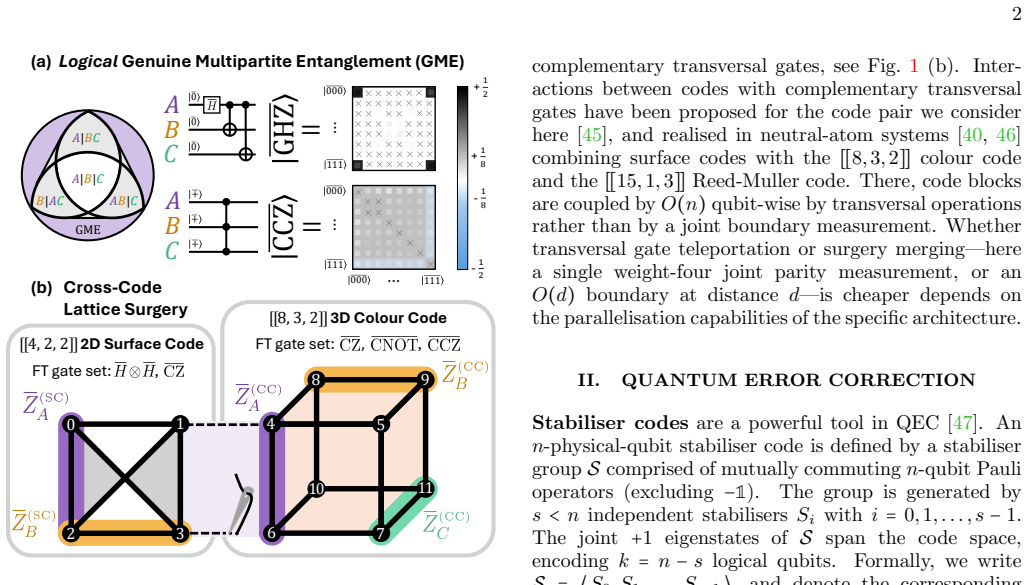
Lattice surgery that merges a [[4,2,2]] surface code with an [[8,3,2]] 3D colour code realises a transversally implemented universal logical gate set {H, CCZ}. With that set the authors prepare three-logical-qubit GHZ and |CCZ> states whose measured fidelities exceed the respective genuine-multipartite-entanglement thresholds (0.5 and 0.75) and whose stabiliser norm certifies non-stabiliserness of |CCZ>, while the same primitives implement arbitrary logical RZ(θ) rotations.
What carries the argument
Smooth merge: a single weight-four joint parity measurement MZZ = Z_SC ⊗ Z_CC that joins the two codes into a [[12,4,2]] merged code, transferring logical information so that the transversal gates of each code become available on the joint system.
Load-bearing premise
That distance-two, error-detecting codes plus post-selection on flags and merge outcomes already constitute the core building blocks of a scalable fault-tolerant architecture, even though the specific transversal CCZ does not itself belong to a distance-growing family.
What would settle it
A multi-cycle experiment that repeatedly merges and splits the same pair of codes and shows that the accumulated logical error on the resulting GHZ or |CCZ> states falls below the GME thresholds once distance is increased or flags are removed would refute the claim that the present primitives are already the building blocks of a fault-tolerant architecture.
Editorial analysis
A structured set of objections, weighed in public.
Referee Report
Summary. The manuscript reports the first experimental demonstration of lattice surgery between two complementary codes—the [[4,2,2]] surface code and the [[8,3,2]] 3D colour code—on a trapped-ion processor, thereby accessing a transversally implemented universal logical gate set {H, CCZ}. Using the resulting [[12,4,2]] merged code, the authors prepare three-logical-qubit GHZ and non-stabiliser |CCZ angle states, certify genuine multipartite entanglement via fidelity witnesses that exceed the Schmidt-coefficient thresholds (F_GHZ > 0.5 by many σ; F_CCZ > 0.75 by ~1σ with flags), and certify non-stabiliserness of |CCZ angle via the stabiliser norm D = 1.396(15). The same primitives are used to implement heralded arbitrary logical RZ(θ) rotations with average fidelity 83.4(3)%. Circuits, flag analysis, Pauli decompositions, and Pauli-frame handling are documented in detail, with depolarising simulations that largely match experiment.
Significance. If the experimental claims hold, the work supplies a concrete, hardware-validated primitive for joining codes with complementary transversal gates and for generating both stabiliser and non-stabiliser multipartite entanglement at the logical level. The complete 7- and 29-term Pauli decompositions, flag-based fault-tolerance analysis, and explicit resource counts constitute a reproducible experimental benchmark that goes beyond prior same-code or Clifford-only lattice-surgery demonstrations. The architectural framing is appropriately caveated by the authors themselves (the transversal CCZ is not scalable), so the result remains a solid near-term milestone rather than an overstated architecture claim.
minor comments (4)
- Abstract and Sec. V: the phrase “core building blocks of an architecture for fault-tolerant quantum computation” is slightly stronger than the distance-2, post-selected primitives warrant; a single-sentence softening that already appears in A.I.5 would improve precision without changing the claim.
- Fig. 2(c) and A.V.2: the ~6–7% discrepancy between experimental and simulated F_CCZ is attributed to the simplified noise model; a brief quantitative remark on which unmodelled channels (idling, coherent T-gate errors) are the leading candidates would help the reader.
- A.I.4: the post-selection procedure used for the CCZ protocol (because T/T† prevent Pauli-frame tracking) halves the acceptance rate; stating the raw shot counts before and after this cut would make the statistics fully transparent.
- Notation: logical operators are sometimes written with overlines and sometimes with (SC)/(CC) superscripts; a short consistency note early in Sec. II would reduce minor reader friction.
Circularity Check
No circularity: experimental fidelities and witnesses are direct measurements against independent theoretical thresholds; noise parameters are used only for comparison simulations.
full rationale
The paper's central claims are experimental: preparation of logical |GHZ> and |CCZ> on a merged [[12,4,2]] code via cross-code lattice surgery, certification of GME by measured fidelities exceeding the known Schmidt-coefficient bounds (F_GHZ > 0.5, F_CCZ > 3/4), non-stabiliserness by stabiliser norm D > 1, and heralded logical RZ( heta) with average fidelity ~83%. Fidelity estimators (Eq. 3 for GHZ; 29-term Pauli decomposition in A.II for |CCZ>) and thresholds follow from standard multipartite-entanglement theory and the explicit form of the target states; they are not fitted or redefined from the data. Depolarising rates p1=0.005, p2=0.015 are taken from prior hardware characterisation of the same trap and appear only in numerical simulations for comparison, never as free parameters that define the reported experimental numbers. Self-citations (prior lattice-surgery and code-switching experiments by overlapping authors) supply experimental context and techniques but are not load-bearing for the new measurements or the GME/non-stabiliserness witnesses. The acknowledged non-scalability of the transversal CCZ is an architectural caveat, not a circular step. The derivation chain is therefore self-contained against external benchmarks and free of the enumerated circularity patterns.
Axiom & Free-Parameter Ledger
free parameters (2)
- single-qubit depolarising probability p1 =
0.005
- two-qubit depolarising probability p2 =
0.015
axioms (5)
- domain assumption Eastin-Knill theorem: no single QEC code admits a transversal universal gate set
- standard math Fidelity of any biseparable state with a pure target is at most λ_max^{2} of the target across bipartitions
- domain assumption Stabiliser norm D > 1 witnesses non-stabiliserness (magic)
- domain assumption [[4,2,2]] admits transversal H⊗H (up to SWAP) and [[8,3,2]] admits transversal CCZ and CZ
- domain assumption Smooth merge by measuring Z_SC ⊗ Z_CC realises a fault-tolerant interface that preserves the transversal gates of both blocks
read the original abstract
Universal quantum computers are expected to generate arbitrary complex quantum states of logical qubits encoded in many physical qubits. This capability hinges on a fault-tolerantly implemented universal gate set, which no single quantum error-correction code admits transversally but which becomes accessible by joining complementary codes via lattice surgery. Here we report on the experimental generation and certification of logical genuine multipartite entanglement in a trapped-ion quantum processor using a transversally implemented universal logical gate set. The gate set is accessed via lattice surgery across two different codes and comprises a Hadamard gate on a four-qubit surface code and a doubly controlled Pauli-$Z$ ($\overline{\mathrm{CCZ}}$) gate on an eight-qubit 3D colour code. To showcase this lattice-surgery toolbox, we generate both stabiliser (Greenberger-Horne-Zeilinger) and non-stabiliser ($|\overline{\mathrm{CCZ}}\rangle$) states of three logical qubits and verify their genuine multipartite entanglement--a form of correlation beyond statistical mixtures of bipartite entanglement across any bipartition. We further use these cross-code primitives to demonstrate arbitrary rotations of single logical qubits via a $\overline{\mathrm{CCZ}}$-based resource gadget accessing the full universal gate set through lattice surgery. Together, these demonstrations showcase the core building blocks of an architecture for fault-tolerant quantum computation and its ability to generate complex logical quantum states.
Figures


Reference graph
Works this paper leans on
-
[1]
Richard Jozsa and Noah Linden,On the role of entangle- ment in quantum-computational speed-up,Proc. R. Soc. A459, 2011–2032 (2003), arXiv:quant-ph/0201143
Pith/arXiv arXiv 2011
-
[2]
Lo, Sandu Popescu, and T
John Preskill,Fault-tolerant quantum computation,in Introduction to Quantum Computation, edited by H.-K. Lo, Sandu Popescu, and T. P. Spiller (World-Scientific,
-
[3]
Chap. 8, p. 213–269, arXiv:quant-ph/9712048
-
[4]
Nielsen and Isaac L
Michael A. Nielsen and Isaac L. Chuang,Quantum Com- putation and Quantum Information, 10th Anniversary Edition ed. (Cambridge University Press, Cambridge, U.K., 2010)
2010
-
[5]
Lidar and Todd A
Daniel A. Lidar and Todd A. Brun,Quantum Error Cor- rection(Cambridge University Press, Cambridge, 2013)
2013
-
[6]
Bryan Eastin and Emanuel Knill,Restrictions on Transversal Encoded Quantum Gate Sets,Phys. Rev. Lett.102, 110502 (2009), arXiv:0811.4262
Pith/arXiv arXiv 2009
-
[7]
Sergey Bravyi and Alexei Kitaev,Universal Quantum Computation with Ideal Clifford Gates and Noisy An- cillas,Phys. Rev. A71, 022316 (2005), arXiv:quant- ph/0403025
arXiv 2005
-
[8]
Beverland, Aleksander Kubica, and Krysta M
Michael E. Beverland, Aleksander Kubica, and Krysta M. Svore,Cost of Universality: A Comparative Study of the Overhead of State Distillation and Code Switching with Color Codes,PRX Quantum2, 020341 (2021), arXiv:2101.02211
Pith/arXiv arXiv 2021
-
[9]
Craig Gidney, Noah Shutty, and Cody Jones,Magic State Cultivation: Growing T States as Cheap as CNOT Gates,arXiv:2409.17595 [quant-ph] (2024)
Pith/arXiv arXiv 2024
-
[10]
Phys.18, 043038 (2016), arXiv:1412.5079
H´ ector Bomb´ ın,Dimensional Jump in Quantum Er- ror Correction,New J. Phys.18, 043038 (2016), arXiv:1412.5079
Pith/arXiv arXiv 2016
-
[11]
Friederike Butt, Sascha Heußen, Manuel Rispler, and Markus M¨ uller,Fault-Tolerant Code Switching Protocols for Near-Term Quantum Processors,PRX Quantum5, 020345 (2024), arXiv:2306.17686
Pith/arXiv arXiv 2024
-
[12]
Ivan Pogorelov, Friederike Butt, Lukas Postler, Christian D. Marciniak, Philipp Schindler, Markus M¨ uller, and Thomas Monz,Experimental Fault- Tolerant Code Switching,Nat. Phys.21, 298–303 (2025), arXiv:2403.13732
Pith/arXiv arXiv 2025
-
[13]
Shixin Wu, Dawei Zhong, Todd A. Brun, and Daniel A. Lidar,Universal Weakly Fault-Tolerant Quantum Com- putation via Code Switching in the[[8,3,2]]Code, arXiv:2603.15610 [quant-ph] (2026)
Pith/arXiv arXiv 2026
-
[14]
Fowler, Simon Devitt, and Rodney Van Meter,Surface Code Quantum Computing by Lattice Surgery,New J
Clare Horsman, Austin G. Fowler, Simon Devitt, and Rodney Van Meter,Surface Code Quantum Computing by Lattice Surgery,New J. Phys.14, 123011 (2012), arXiv:1111.4022
Pith/arXiv arXiv 2012
-
[15]
Alexander Erhard, Hendrik Poulsen Nautrup, Michael Meth, Lukas Postler, Roman Stricker, Martin Stadler, Vlad Negnevitsky, Martin Ringbauer, Philipp Schindler, Hans J. Briegel, Rainer Blatt, Nicolai Friis, and Thomas Monz,Entangling logical qubits with lattice surgery,Na- ture589, 220–224 (2021), arXiv:2006.03071
Pith/arXiv arXiv 2021
-
[16]
Briegel,Fault-Tolerant Interface Between Quantum Memories and Quantum Processors,Nat
Hendrik Poulsen Nautrup, Nicolai Friis, and Hans J. Briegel,Fault-Tolerant Interface Between Quantum Memories and Quantum Processors,Nat. Commun.8, 1321 (2017), arXiv:1609.08062
Pith/arXiv arXiv 2017
-
[17]
Daniel Litinski,A Game of Surface Codes: Large-Scale Quantum Computing with Lattice Surgery,Quantum3, 128 (2019), arXiv:1808.02892
Pith/arXiv arXiv 2019
-
[18]
G´ eza T´ oth and Otfried G¨ uhne,Detecting Genuine Multipartite Entanglement with Two Local Measure- ments,Phys. Rev. Lett.94, 060501 (2005), arXiv:quant- ph/0405165
arXiv 2005
-
[19]
Nicolai Friis, Giuseppe Vitagliano, Mehul Malik, and Marcus Huber,Entanglement Certification From The- ory to Experiment,Nat. Rev. Phys.1, 72–87 (2019), arXiv:1906.10929
Pith/arXiv arXiv 2019
-
[20]
Bertlmann and Nicolai Friis,Modern Quan- tum Theory – From Quantum Mechanics to Entan- glement and Quantum Information(Oxford University Press, Oxford, U.K., 2023) Chapter 18
Reinhold A. Bertlmann and Nicolai Friis,Modern Quan- tum Theory – From Quantum Mechanics to Entan- glement and Quantum Information(Oxford University Press, Oxford, U.K., 2023) Chapter 18
2023
-
[21]
Phys.19, 093012 (2017), arXiv:1612.05585
Michael Epping, Hermann Kampermann, Chiara Mac- chiavello, and Dagmar Bruß,Multi-partite entanglement can speed up quantum key distribution in networks,New J. Phys.19, 093012 (2017), arXiv:1612.05585
Pith/arXiv arXiv 2017
-
[22]
Stefan B¨ auml and Koji Azuma,Fundamental limitation on quantum broadcast networks,Quantum Sci. Technol. 2, 024004 (2017), arXiv:1609.03994
Pith/arXiv arXiv 2017
-
[23]
Matej Pivoluska, Marcus Huber, and Mehul Malik,Lay- ered quantum key distribution,Phys. Rev. A97, 032312 (2018), arXiv:1709.00377
Pith/arXiv arXiv 2018
-
[24]
J´ er´ emy Ribeiro, Gl´ aucia Murta, and Stephanie Wehner,Fully device-independent conference key agree- ment,Phys. Rev. A97, 022307 (2018), arXiv:1708.00798
Pith/arXiv arXiv 2018
-
[25]
Hayata Yamasaki, Alexander Pirker, Mio Murao, Wolf- gang D¨ ur, and Barbara Kraus,Multipartite entangle- ment outperforming bipartite entanglement under limited quantum system sizes,Phys. Rev. A98, 052313 (2018), arXiv:1808.00005
Pith/arXiv arXiv 2018
-
[26]
Briegel,A One-Way Quantum Computer,Phys
Robert Raussendorf and Hans J. Briegel,A One-Way Quantum Computer,Phys. Rev. Lett.86, 5188–5191 (2001), arXiv:quant-ph/0010033
Pith/arXiv arXiv 2001
-
[27]
Briegel and Robert Raussendorf,Persistent En- tanglement in Arrays of Interacting Particles,Phys
Hans J. Briegel and Robert Raussendorf,Persistent En- tanglement in Arrays of Interacting Particles,Phys. Rev. Lett.86, 910–913 (2001), arXiv:quant-ph/0004051
Pith/arXiv arXiv 2001
-
[28]
Andrew J. Scott,Multipartite entanglement, quantum- error-correcting codes, and entangling power of quantum evolutions,Phys. Rev. A69, 052330 (2004), arXiv:quant- ph/0310137
arXiv 2004
-
[29]
Dagmar Bruß and Chiara Macchiavello,Multipartite en- tanglement in quantum algorithms,Phys. Rev. A83, 052313 (2011), arXiv:1007.4179
Pith/arXiv arXiv 2011
-
[30]
Plenio, Marcus Huber, Christian Roos, Rainer Blatt, and Ben P
Nicolai Friis, Oliver Marty, Christine Maier, Cornelius Hempel, Milan Holz¨ apfel, Petar Jurcevic, Martin B. Plenio, Marcus Huber, Christian Roos, Rainer Blatt, and Ben P. Lanyon,Observation of Entangled States of a Fully Controlled 20-Qubit System,Phys. Rev. X8, 021012 (2018), arXiv:1711.11092
Pith/arXiv arXiv 2018
-
[31]
Marco Canteri, James Bate, Ida Mishra, Nico- lai Friis, Victor Krutyanskiy, and Benjamin P. Lanyon,Generation of Multipartite Photonic Entangle- ment Using a Trapped-Ion Quantum Processing Node, arXiv:2510.15693 [quant-ph] (2025)
arXiv 2025
-
[32]
Adrian Rodriguez-Blanco, Alejandro Bermudez, Markus M¨ uller, and Farid Shahandeh,Efficient and Robust Cer- tification of Genuine Multipartite Entanglement in Noisy Quantum Error Correction Circuits,PRX Quantum2, 020304 (2021), arXiv:2010.02941
Pith/arXiv arXiv 2021
-
[33]
Victor Veitch, S. A. Hamed Mousavian, Daniel Gottes- man, and Joseph Emerson,The resource theory of sta- 8 bilizer quantum computation,New J. Phys.16, 013009 (2014), arXiv:1307.7171
Pith/arXiv arXiv 2014
-
[34]
Su-un Lee, Ming Yuan, Senrui Chen, Kento Tsub- ouchi, and Liang Jiang,Efficient Benchmarking of Log- ical Magic State,Phys. Rev. Lett.136, 050602 (2026), arXiv:2505.09687
arXiv 2026
-
[35]
Brown, David Hayes, and Isaac H
Lucas Daguerre, Robin Blume-Kohout, Natalie C. Brown, David Hayes, and Isaac H. Kim,Experimen- tal Demonstration of High-Fidelity Logical Magic States from Code Switching,Phys. Rev. X15, 041008 (2025), arXiv:2506.14169
arXiv 2025
-
[36]
Dorit Aharonov,A Simple Proof that Toffoli and Hadamard are Quantum Universal,arXiv:quant- ph/0301040 [quant-ph] (2003)
arXiv 2003
-
[37]
Fiderer, Hendrik Poulsen Nautrup, Jonas M
Sofiene Jerbi, Lukas J. Fiderer, Hendrik Poulsen Nautrup, Jonas M. K¨ ubler, Hans J. Briegel, and Vedran Dunjko,Quantum Machine Learning Be- yond Kernel Methods,Nat. Commun.14, 517 (2023), arXiv:2110.13162
Pith/arXiv arXiv 2023
-
[38]
Daniel Gottesman and Isaac L. Chuang,Demonstrating the Viability of Universal Quantum Computation Using Teleportation and Single-Qubit Operations,Nature402, 390–393 (1999), arXiv:quant-ph/9908010
Pith/arXiv arXiv 1999
-
[39]
Xinlan Zhou, Debbie W. Leung, and Isaac L. Chuang,Methodology for Quantum Logic Gate Construc- tion,Phys. Rev. A62, 052316 (2000), arXiv:quant- ph/0002039
arXiv 2000
-
[40]
Yifan Hong, Elijah Durso-Sabina, David Hayes, and Andrew Lucas,Entangling Four Logical Qubits beyond Break-Even in a Nonlocal Code,Phys. Rev. Lett.133, 180601 (2024), arXiv:2406.02666
Pith/arXiv arXiv 2024
-
[41]
Dolev Bluvstein, Simon J. Evered, Alexandra A. Geim, Sophie H. Li, Hengyun Zhou, Tom Manovitz, Sepehr Ebadi, Madelyn Cain, Marcin Kalinowski, Dominik Hangleiter, J. Pablo Bonilla Ataides, Nishad Maskara, Iris Cong, Xun Gao, Pedro Sales Rodriguez, Thomas Karolyshyn, Giulia Semeghini, Michael J. Gullans, Markus Greiner, Vladan Vuletic, and Mikhail D. Lukin,...
Pith/arXiv arXiv 2024
-
[42]
Phys.22, 189–194 (2026), arXiv:2501.04612
Ilya Besedin, Michael Kerschbaum, Jonathan Knoll, Ian Hesner, Lukas B¨ odeker, Luis Colmenarez, Luca Hofele, Nathan Lacroix, Christoph Hellings, Fran¸ cois Swiadek, Alexander Flasby, Mohsen Bahrami Panah, Dante Co- lao Zanuz, Markus M¨ uller, and Andreas Wallraff,Lat- tice surgery realized on two distance-three repetition codes with superconducting qubits...
arXiv 2026
-
[43]
Yanzhe Wang, Fanhao Shen, Haipeng Xie, Aosai Zhang, Yu Gao, Chuanyu Zhang, Xuhao Zhu, Feitong Jin, Yiren Zou, Ning Wang, Zhengyi Cui, Zehang Bao, Zitian Zhu, Jiarun Zhong, Gongyu Liu, Jia-Nan Yang, Yihang Han, Yiyang He, Jiayuan Shen, Han Wang, Jiahua Huang, Xinrong Zhang, Sailang Zhou, Hang Dong, Jinfeng Deng, Yaozu Wu, Zixuan Song, Hekang Li, Zhen Wang,...
Pith/arXiv arXiv 2026
-
[44]
Bence Het´ enyi and James R. Wootton,Creating En- tangled Logical Qubits in the Heavy-Hex Lattice with Topological Codes,PRX Quantum5, 040334 (2024), arXiv:2404.15989
Pith/arXiv arXiv 2024
-
[45]
C. Ryan-Anderson, N. C. Brown, M. S. Allman, B. Arkin, G. Asa-Attuah, C. Baldwin, J. Berg, J. G. Bohnet, S. Braxton, N. Burdick, J. P. Campora, A. Chernoguzov, J. Esposito, B. Evans, D. Francois, J. P. Gaebler, T. M. Gatterman, J. Gerber, K. Gilmore, D. Gresh, A. Hall, A. Hankin, J. Hostetter, D. Lucchetti, K. Mayer, J. Myers, B. Neyenhuis, J. Santiago, J...
Pith/arXiv arXiv 2022
-
[46]
Jacob S. Nelson, Andrew J. Landahl, and An- drew D. Baczewski,A Small and Interesting Archi- tecture for Early Fault-Tolerant Quantum Computers, arXiv:2507.20387 [quant-ph] (2025)
Pith/arXiv arXiv 2025
-
[47]
Dolev Bluvstein, Alexandra A. Geim, Sophie H. Li, Simon J. Evered, J. Pablo Bonilla Ataides, Gefen Baranes, Andi Gu, Tom Manovitz, Muqing Xu, Marcin Kalinowski, Shayan Majidy, Christian Kokail, Nishad Maskara, Elias C. Trapp, Luke M. Stewart, Simon Hol- lerith, Hengyun Zhou, Michael J. Gullans, Susanne F. Yelin, Markus Greiner, Vladan Vuletic, Madelyn Cai...
arXiv 2026
-
[48]
thesis, Caltech (1997), arXiv:quant- ph/9705052
Daniel Gottesman,Stabilizer Codes and Quantum Error Correction, Ph.D. thesis, Caltech (1997), arXiv:quant- ph/9705052
arXiv 1997
-
[49]
Phys.303, 2–30 (2003), arXiv:quant- ph/9707021
Alexei Kitaev,Fault-tolerant quantum computation by anyons,Ann. Phys.303, 2–30 (2003), arXiv:quant- ph/9707021
arXiv 2003
-
[50]
Eric Dennis, Alexei Kitaev, Andrew Landahl, and John Preskill,Topological quantum memory,J. Math. Phys. 43, 4452–4505 (2002), arXiv:quant-ph/0110143
Pith/arXiv arXiv 2002
-
[51]
Fowler, Matteo Mariantoni, John M
Austin G. Fowler, Matteo Mariantoni, John M. Martinis, and Andrew N. Cleland,Surface codes: Towards practi- cal large-scale quantum computation,Phys. Rev. A86, 032324 (2012), arXiv:1208.0928
Pith/arXiv arXiv 2012
-
[52]
Robert Raussendorf and Jim Harrington,Fault-Tolerant Quantum Computation with High Threshold in Two Dimensions,Phys. Rev. Lett.98, 190504 (2007), arXiv:quant-ph/0610082
Pith/arXiv arXiv 2007
-
[53]
Phys.17, 083026 (2015), arXiv:1503.02065
Aleksander Kubica, Beni Yoshida, and Fernando Pastawski,Unfolding the color code,New J. Phys.17, 083026 (2015), arXiv:1503.02065
Pith/arXiv arXiv 2015
-
[54]
Campbell and Mark Howard,Unifying Gate Syn- thesis and Magic State Distillation,Phys
Earl T. Campbell and Mark Howard,Unifying Gate Syn- thesis and Magic State Distillation,Phys. Rev. Lett.118, 060501 (2017), arXiv:1606.01906
Pith/arXiv arXiv 2017
-
[55]
Earl T. Campbell and Mark Howard,Unified framework for magic state distillation and multiqubit gate synthe- sis with reduced resource cost,Phys. Rev. A95, 022316 (2017), arXiv:1606.01904
Pith/arXiv arXiv 2017
-
[56]
Daniel Honciuc Menendez, Annie Ray, and Michael Vas- mer,Implementing fault-tolerant non-Clifford gates using the[[8,3,2]]color code,Phys. Rev. A109, 062438 (2024), arXiv:2309.08663 [quant-ph]
Pith/arXiv arXiv 2024
-
[57]
Ivan Pogorelov, Thomas Feldker, Christian D. Marciniak, Lukas Postler, Georg Jacob, Oliver Krieglsteiner, Verena Podlesnic, Michael Meth, Vlad Negnevitsky, Martin Stadler, Bernd H¨ ofer, Christoph W¨ achter, Kirill Lakhmanskiy, Rainer Blatt, Philipp Schindler, and Thomas Monz,Compact Ion-Trap Quantum Computing Demonstrator,PRX Quantum2, 020343 (2021), arX...
Pith/arXiv arXiv 2021
-
[58]
David C. McKay, Christopher J. Wood, Sarah Sheldon, Jerry M. Chow, and Jay M. Gambetta,EfficientZgates for quantum computing,Phys. Rev. A96, 022330 (2017), arXiv:1612.00858
Pith/arXiv arXiv 2017
-
[59]
Anders Sørensen and Klaus Mølmer,Quantum Compu- tation with Ions in Thermal Motion,Phys. Rev. Lett. 82, 1971–1974 (1999), arXiv:quant-ph/9810039
Pith/arXiv arXiv 1971
-
[60]
Phys.19, 023035 (2017), arXiv:1603.07678
Dmitri Maslov,Basic circuit compilation techniques for an ion-trap quantum machine,New J. Phys.19, 023035 (2017), arXiv:1603.07678
Pith/arXiv arXiv 2017
-
[61]
Tom Peham, Ludwig Schmid, Lucas Berent, Markus M¨ uller, and Robert Wille,Automated Synthesis of Fault- Tolerant State Preparation Circuits for Quantum Er- ror Correction Codes,PRX Quantum6, 020330 (2025), arXiv:2408.11894
Pith/arXiv arXiv 2025
-
[62]
Yang Wang, Selwyn Simsek, Thomas M. Gatterman, Justin A. Gerber, Kevin Gilmore, Dan Gresh, Nathan Hewitt, Chandler V. Horst, Mitchell Matheny, Tanner Mengle, Brian Neyenhuis, and Ben Criger,Fault-tolerant one-bit addition with the smallest interesting color code, Sci. Adv.10, 29 (2024), arXiv:2309.09893
Pith/arXiv arXiv 2024
-
[63]
Reichardt,Quantum Error Cor- rection with Only Two Extra Qubits,Phys
Rui Chao and Ben W. Reichardt,Quantum Error Cor- rection with Only Two Extra Qubits,Phys. Rev. Lett. 121, 050502 (2018), arXiv:1705.02329
Pith/arXiv arXiv 2018
-
[64]
Christopher Chamberland and Michael E. Beverland, Flag fault-tolerant error correction with arbitrary dis- tance codes,Quantum2, 53 (2018), arXiv:1708.02246
Pith/arXiv arXiv 2018
-
[65]
Lukas Postler, Sascha Heußen, Ivan Pogorelov, Manuel Rispler, Thomas Feldker, Michael Meth, Christian D. Marciniak, Roman Stricker, Martin Ringbauer, Rainer Blatt, Philipp Schindler, Markus M¨ uller, and Thomas Monz,Demonstration of fault-tolerant universal quan- tum gate operations,Nature605, 675–680 (2022), arXiv:2111.12654
Pith/arXiv arXiv 2022
-
[66]
Matteo Rossi, Marcus Huber, Dagmar Bruß, and Chiara Macchiavello,Quantum hypergraph states,New J. Phys. 15, 113022 (2013), arXiv:1211.5554
Pith/arXiv arXiv 2013
-
[67]
Mark Howard and Earl Campbell,Application of a Re- source Theory for Magic States to Fault-Tolerant Quan- tum Computing,Phys. Rev. Lett.118, 090501 (2017), arXiv:1609.07488
Pith/arXiv arXiv 2017
-
[68]
Tobias Haug and Poetri Sonya Tarabunga,Efficient wit- nessing and testing of magic in mixed quantum states, npj Quantum Inf.12, 40 (2026), arXiv:2504.18098
Pith/arXiv arXiv 2026
-
[69]
Alexei Kitaev,Quantum measurements and the Abelian Stabilizer Problem,arXiv:quant-ph/9511026 (1995)
Pith/arXiv arXiv 1995
-
[70]
Benjamin, Suguru Endo, Keisuke Fujii, Jarrod R
Marco Cerezo, Andrew Arrasmith, Ryan Babbush, Si- mon C. Benjamin, Suguru Endo, Keisuke Fujii, Jarrod R. McClean, Kosuke Mitarai, Xiao Yuan, Lukasz Cincio, and Patrick J. Coles,Variational quantum algorithms, Nat. Rev. Phys.3, 625–644 (2021), arXiv:2012.09265
Pith/arXiv arXiv 2021
-
[71]
Ross and Peter Selinger,Optimal ancilla-free Clifford+T approximation of z-rotations,Quantum Inf
Neil J. Ross and Peter Selinger,Optimal ancilla-free Clifford+T approximation of z-rotations,Quantum Inf. Comput.16, 901–953 (2016), arXiv:1403.2975
Pith/arXiv arXiv 2016
-
[72]
Yutaro Akahoshi, Kazunori Maruyama, Hirotaka Os- hima, Shintaro Sato, and Keisuke Fujii,Partially Fault-Tolerant Quantum Computing Architecture with Error-Corrected Clifford Gates and Space-Time Efficient Analog Rotations,PRX Quantum5, 010337 (2024), arXiv:2303.13181
Pith/arXiv arXiv 2024
-
[73]
Refaat Ismail, I-Chi Chen, Chen Zhao, Ronen Weiss, Fangli Liu, Hengyun Zhou, Sheng-Tao Wang, An- drew Sornborger, and Milan Kornjaˇ ca,Transversal Architecture for Megaquop-Scale Quantum Simulation with Neutral Atoms,PRX Quantum7, 020343 (2026), arXiv:2509.18294
Pith/arXiv arXiv 2026
-
[74]
Hockings, Nou´ edyn Baspin, Felix Thomsen, Samuel C
Paul Webster, Lucas Berent, Omprakash Chandra, Evan T. Hockings, Nou´ edyn Baspin, Felix Thomsen, Samuel C. Smith, and Lawrence Z. Cohen,The Pin- nacle Architecture: Reducing the Cost of Breaking RSA- 2048 to 100,000 Physical Qubits Using Quantum LDPC Codes,arXiv:2602.11457 [quant-ph] (2026)
Pith/arXiv arXiv 2048
-
[75]
Yoder, Eddie Schoute, Patrick Rall, Emily Pritchett, Jay M
Theodore J. Yoder, Eddie Schoute, Patrick Rall, Emily Pritchett, Jay M. Gambetta, Andrew W. Cross, Mal- colm Carroll, and Michael E. Beverland,Tour de gross: A modular quantum computer based on bivariate bicycle codes,arXiv:2506.03094 [quant-ph] (2025)
Pith/arXiv arXiv 2025
-
[76]
Browne,Three-dimensional surface codes: Transversal gates and fault-tolerant architectures,Phys
Michael Vasmer and Dan E. Browne,Three-dimensional surface codes: Transversal gates and fault-tolerant architectures,Phys. Rev. A100, 012312 (2019), arXiv:1801.04255
Pith/arXiv arXiv 2019
-
[77]
Phys.17, 083002 (2015), arXiv:1311.0879
H´ ector Bomb´ ın,Gauge color codes: optimal transversal gates and gauge fixing in topological stabilizer codes,New J. Phys.17, 083002 (2015), arXiv:1311.0879
Pith/arXiv arXiv 2015
-
[78]
Samuel Stein, Shifan Xu, Andrew W. Cross, Theodore J. Yoder, Ali Javadi-Abhari, Chenxu Liu, Kun Liu, Zeyuan Zhou, Charles Guinn, Yufei Ding, Yongshan Ding, and Ang Li,Architectures for Heterogeneous Quantum Er- ror Correction Codes,inProc. 30th ACM Int. Conf. on Architectural Support for Programming Languages and Operating Systems (ASPLOS ’25), Vol. 2(ACM...
Pith/arXiv arXiv 2025
-
[79]
Andrew J. Landahl and Ciaran Ryan-Anderson, Quantum Computing by Color-Code Lattice Surgery, arXiv:1407.5103 [quant-ph] (2014)
Pith/arXiv arXiv 2014
-
[80]
Lukas B¨ odeker, ´Aron M´ arton, Luis Colmenarez, Ilya Besedin, Andreas Wallraff, and Markus M¨ uller,Lattice surgery for near-term experimental logical qubit entangle- ment creation in planar architectures,arXiv:2606.15190 [quant-ph] (2026)
arXiv 2026
discussion (0)
Sign in with ORCID, Apple, or X to comment. Anyone can read and Pith papers without signing in.