REVIEW 3 major objections 6 minor 46 references
LLM agents can turn their own failed rollouts into successful training data by relabeling the goals they actually achieved.
Reviewed by Pith at T0; open to challenge. T0 means a machine referee read the full paper against a public rubric. the ladder, T0–T4 →
T0 review · grok-4.5
2026-07-11 20:44 UTC pith:CWLYRXSC
load-bearing objection Solid, usable post-training recipe: multi-goal hindsight relabeling plus masking/reweighting turns agent rollouts into demos and beats full-data SFT/DPO on ALFWorld with ~1/4 of the expert data. the 3 major comments →
Spinning Straw into Gold: Relabeling LLM Agent Trajectories in Hindsight for Successful Demonstrations
The pith
A machine-rendered reading of the paper's core claim, the machinery that carries it, and where it could break.
Core claim
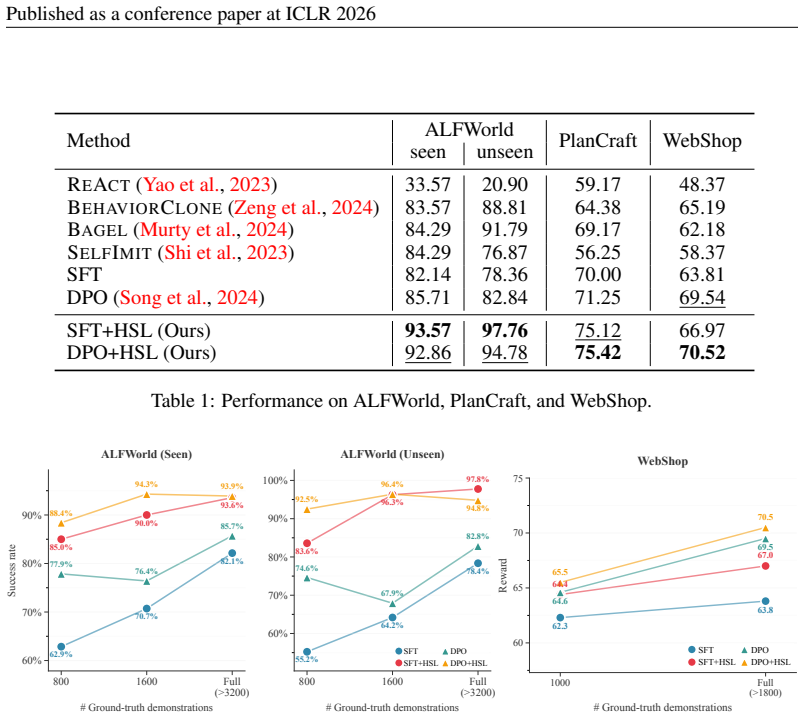
Hindsight Supervised Learning recovers successful demonstrations from ordinary agent trajectories by having an auxiliary LLM identify every natural-language goal that was actually achieved and then fine-tuning the agent on those relabeled pairs. With irrelevant-action masking and sample reweighting, the approach raises success rates for both SFT and DPO, is most helpful on long-horizon tasks with diverse goal spaces, and can outperform full-dataset baselines while using only a quarter of the ground-truth demonstrations.
What carries the argument
Hindsight Supervised Learning (HSL): an auxiliary LLM that, after a trajectory ends, lists every achieved natural-language goal and labels each action as relevant or irrelevant; the agent is then trained with masked SFT on the reweighted relabeled pairs, optionally mixed with ordinary expert data.
Load-bearing premise
That a fixed, zero-shot auxiliary language model can accurately recover every achieved goal and the relevance of each action from partial observations alone.
What would settle it
Manually audit a large sample of relabeled trajectories; if goal labels or relevance masks are systematically wrong, or if removing the relabeled buffer erases the reported gains over SFT/DPO, the central claim fails.
Editorial analysis
A structured set of objections, weighed in public.
Referee Report
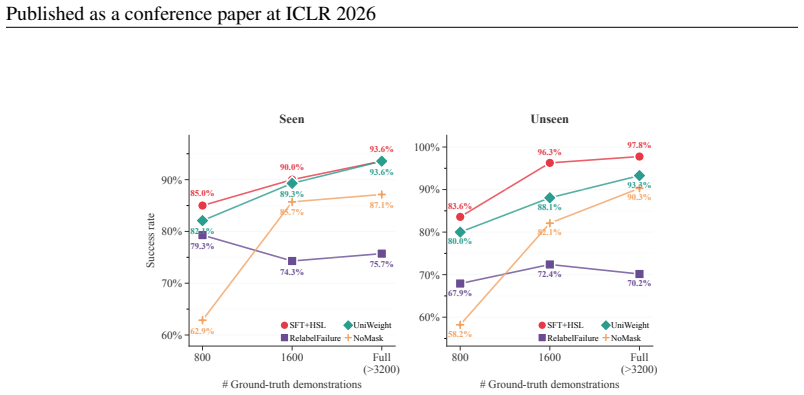
Summary. The paper introduces Hindsight Supervised Learning (HSL) for post-training LLM agents in partially observable, long-horizon settings. An auxiliary LLM reviews completed agent trajectories and relabels them with all natural-language goals the agent actually achieved (including uninstructed intermediate goals), yielding successful demonstrations for supervised fine-tuning. Two techniques—irrelevant-action masking and demonstration reweighting—address suboptimality of the hindsight data. A theoretical upper bound (Theorem 1) relates agent–expert total-variation discrepancy to SFT losses on expert and hindsight data, plus occupancy coverage κ_E←H and hindsight optimality δ_E; a corollary argues that fitting hindsight data strictly tightens the bound at equal expert fit. Empirically, HSL is added to SFT and DPO (ETO) on ALFWorld, PlanCraft, and WebShop with a Llama-3.2-1B agent and Llama-3.3-70B relabeler. It improves both pipelines (roughly 8–32% success-rate gains on ALFWorld), is more helpful on long-horizon tasks with diverse multi-goal structure, and is sample-efficient: with about one quarter of ALFWorld ground-truth demonstrations it surpasses full-data SFT/DPO baselines. Ablations (RelabelFailure, UniWeight, NoMask), multi-seed tables, goal-type analysis, and a 90% human audit of 200 ALFWorld relabels support the design choices.
Significance. If the results hold, HSL is a practical, complementary source of supervision that turns noisy agent rollouts into usable demonstrations without extra environment interaction or hand-crafted intermediate rewards. The sample-efficiency claim on ALFWorld is especially valuable given the cost of expert demos for agentic tasks. The work usefully adapts HER/GCSL-style goal relabeling to LLM agents under partial observability, multi-goal mining along full trajectories, and continuous on-policy buffer refresh—distinguishing it from fixed offline synthesis (BAGEL, BehaviorClone). Strengths that should be credited include: an explicit theory-to-technique link (masking and reweighting motivated by Theorem 1), strong baselines that also use the 70B model, ablations that remove multi-goal mining / reweighting / masking and lose gains, multi-seed reporting (Table 2), and a human audit of relabeling quality. Limitations (predefined goal templates, residual need for some expert demos, compute cost of the relabeler) are acknowledged and do not invert the reported numbers on the evaluated benchmarks.
major comments (3)
- §3.4, Theorem 1 and Corollary 1: The analysis shows that SFT on hindsight data can tighten an upper bound on Δ(θ) when expert fit is held fixed, via κ_E←H and δ_E. The manuscript never reports empirical estimates of occupancy coverage, hindsight–expert TV, or agent–expert TV before vs. after HSL (or vs. fixed-synthesis baselines). Without these diagnostics it is difficult to judge how tight the bound is or how much of the empirical gain is explained by the stated mechanism versus other factors (e.g., distillation from the 70B relabeler). A short measurement of these intermediate quantities on ALFWorld would make the theory–experiment link load-bearing rather than motivational.
- §4.4, Figures 6–7: Relabeling fidelity is the weakest assumption of the pipeline. The human audit (200 samples, 90% accuracy) is only on ALFWorld and already shows goal-type variation and incomplete-goal errors (e.g., “cool tomato” accepted without placement in the fridge). PlanCraft and WebShop have no analogous audit, yet the abstract and Table 1 treat HSL gains as general. Reporting accuracy and failure modes on the other two benchmarks (even on a smaller sample) is needed to support the claim that zero-shot hindsight recovery is reliably easier than acting.
- §4.1–4.2, Table 1 and Figure 3: All agent results use a 1B policy with a fixed 70B relabeler. Controls (REACT, BEHAVIORCLONE, BAGEL) correctly use the same 70B model, but the paper does not test (i) a weaker/cheaper relabeler or (ii) an agent closer in scale to the relabeler. The sample-efficiency and “compatible with SFT/DPO” claims are therefore demonstrated only in a large teacher / small student regime. At least one additional setting (weaker relabeler or larger agent) is needed before the central efficiency claim can be treated as pipeline-general rather than scale-asymmetric.
minor comments (6)
- Notation inconsistency: S(I′_k) in §3.3 vs. S_M(I′) in Eq. (1) and the appendix; unify the first-achievement operator.
- Figure 3 and Figure 4: axis labels and legend are dense; success-rate percentages overlaid on bars help, but the “Full (>3200)” tick is easy to misread as a continuous scale—consider categorical ticks only.
- §3.4, Eq. (3)–(4): P(d′) uses w′_d in the numerator while the text defines w_d; clarify whether reweighting is applied only to the relabeled term or also renormalized after masking.
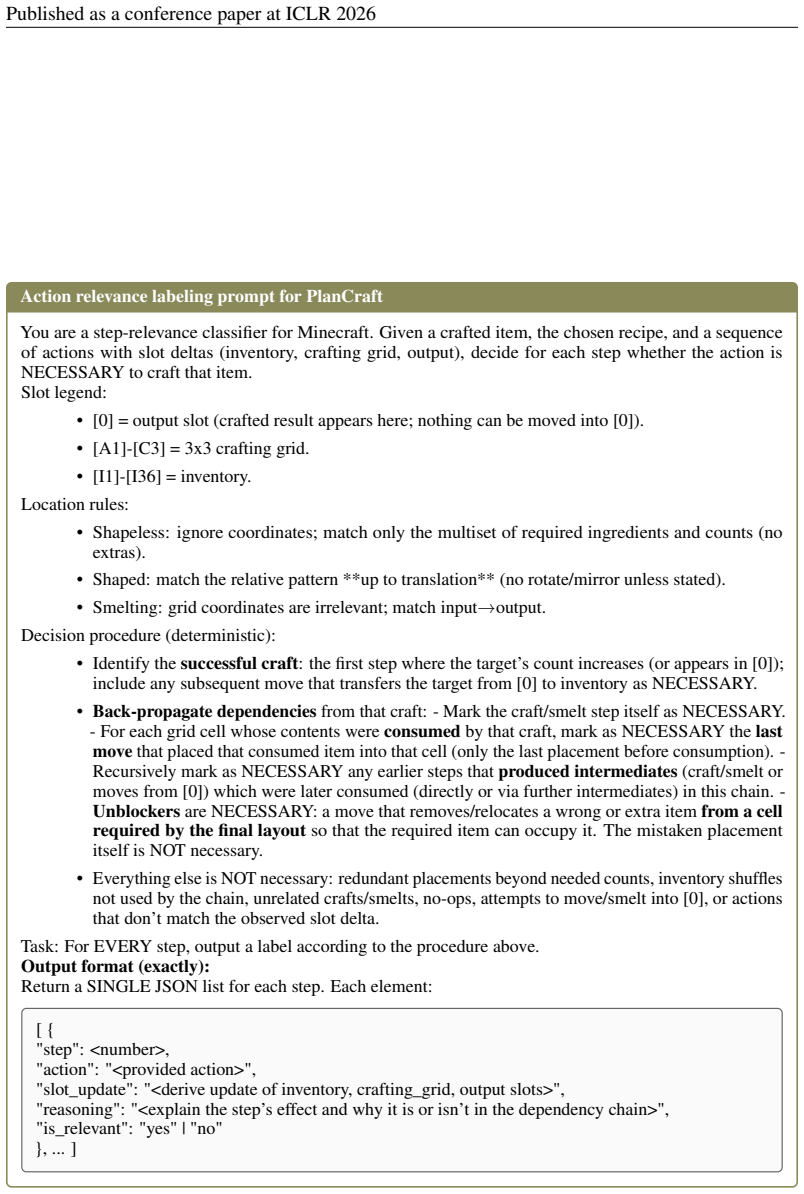
- Appendix C prompts are thorough and reproducible; consider moving a short excerpt of the ALFWorld goal templates into the main text so readers need not open the appendix to understand the allowed goal space.
- Table 2 multi-seed results are reported only for ALFWorld and WebShop; PlanCraft remains single-seed (seed 42). A one-sentence note on variance for PlanCraft would match the care given to the other two.
- Related work §2.2: GCSL and Cideron et al. are correctly distinguished; a brief pointer to more recent language-conditioned HER variants in robotics would help readers place the multi-goal, partial-observation contribution.
Circularity Check
No significant circularity: HSL is an empirical post-training method with an independent imitation-learning-style bound and external success-rate evaluation.
full rationale
The paper's central claims (sample-efficient gains of HSL over SFT/DPO on ALFWorld/PlanCraft/WebShop success rates and task scores; larger gains on long-horizon diverse-goal tasks) are measured against held-out interactive environment metrics that are independent of the training objective and of any free parameters fitted inside the paper. Theorem 1 is a standard finite-horizon occupancy/TV/KL discrepancy bound (with Pinsker and a simulation lemma) relating the agent to an expert and to a hindsight expert induced by the agent's own rollouts plus an external zero-shot relabeler; the bound is derived rather than assumed, and the corollary simply notes that matching the hindsight expert (under coverage) tightens it. Relabeling accuracy is audited by human inspection (90% on 200 samples) rather than being defined by the loss. Masking and reweighting are explicit heuristics motivated by the bound's coverage and optimality terms; they are ablated, not smuggled. On-policy buffer refresh is intentional design, not a definitional loop. No uniqueness theorem, ansatz, or fitted scalar is imported via self-citation and then re-presented as a prediction. The derivation chain is therefore self-contained against external benchmarks.
Axiom & Free-Parameter Ledger
free parameters (3)
- mixture weight λ (ground-truth vs relabeled loss) =
0.3
- reweighting exponent α =
0.8
- relabeled buffer size N and batch of new trajectories b =
N=100, b=18
axioms (4)
- domain assumption Agent tasks are finite-horizon POMDPs with natural-language instructions and a known textual description of the goal space G used in relabeler prompts.
- ad hoc to paper Zero-shot auxiliary LLM can identify all achieved goals and binary action relevance from full trajectories more easily than the agent can solve the original task.
- standard math Finite-horizon simulation / occupancy mismatch inequalities from imitation learning (Ross & Bagnell style) apply with C_T = 2(T−1).
- domain assumption Some ground-truth demonstrations remain necessary for stable learning (support alignment with the expert).
invented entities (2)
-
Hindsight expert π_H
no independent evidence
-
Hindsight Supervised Learning (HSL) pipeline
no independent evidence
read the original abstract
Large language model agents operate in partially observable, long-horizon settings where obtaining supervision remains a major bottleneck. We address this by utilizing a source of supervision overlooked in existing post-training methods: unintended yet successful goals embedded within agent rollouts. Specifically, we introduce Hindsight Supervised Learning (HSL), where an auxiliary LLM reviews each completed trajectory and relabels it with all of the natural-language goals the agent actually achieved. HSL then pairs the trajectory with its relabeled goals and uses these pairs for additional fine-tuning. To mitigate suboptimality in the relabeled data, we propose two learning techniques for HSL, irrelevant-action masking and sample reweighting. Our experiments show that HSL is flexible and compatible with existing post-training pipelines. It improves both SFT and DPO, with larger gains on long-horizon tasks with more diverse goal spaces. Moreover, HSL is sample-efficient: on ALFWorld, it surpasses baselines trained on the full dataset while using only one quarter of the ground-truth demonstrations.
Figures






Reference graph
Works this paper leans on
-
[1]
arXiv preprint arXiv:2010.03768 , year=
Alfworld: Aligning text and embodied environments for interactive learning , author=. arXiv preprint arXiv:2010.03768 , year=
Pith/arXiv arXiv 2010
-
[2]
arXiv e-prints , pages=
On the Opportunities and Risks of Foundation Models , author=. arXiv e-prints , pages=
-
[3]
International Conference on Machine Learning , pages=
GPT-4V (ision) is a Generalist Web Agent, if Grounded , author=. International Conference on Machine Learning , pages=. 2024 , organization=
2024
-
[4]
Advances in Neural Information Processing Systems , volume=
Toolqa: A dataset for llm question answering with external tools , author=. Advances in Neural Information Processing Systems , volume=
-
[5]
arXiv preprint arXiv:2310.06770 , year=
Swe-bench: Can language models resolve real-world github issues? , author=. arXiv preprint arXiv:2310.06770 , year=
-
[6]
Advances in Neural Information Processing Systems , volume=
Minedojo: Building open-ended embodied agents with internet-scale knowledge , author=. Advances in Neural Information Processing Systems , volume=
-
[7]
Advances in Neural Information Processing Systems , volume=
Embodied agent interface: Benchmarking llms for embodied decision making , author=. Advances in Neural Information Processing Systems , volume=
-
[8]
Proceedings of the 62nd Annual Meeting of the Association for Computational Linguistics (Volume 1: Long Papers) , pages=
Trial and Error: Exploration-Based Trajectory Optimization of LLM Agents , author=. Proceedings of the 62nd Annual Meeting of the Association for Computational Linguistics (Volume 1: Long Papers) , pages=
-
[9]
Advances in neural information processing systems , volume=
Direct preference optimization: Your language model is secretly a reward model , author=. Advances in neural information processing systems , volume=
-
[10]
arXiv preprint arXiv:1810.08272 , year=
Babyai: A platform to study the sample efficiency of grounded language learning , author=. arXiv preprint arXiv:1810.08272 , year=
-
[11]
Advances in Neural Information Processing Systems , volume=
Webshop: Towards scalable real-world web interaction with grounded language agents , author=. Advances in Neural Information Processing Systems , volume=
-
[12]
2024 , booktitle=
WebArena: A Realistic Web Environment for Building Autonomous Agents , author=. 2024 , booktitle=
2024
-
[13]
Advances in Neural Information Processing Systems , volume=
Osworld: Benchmarking multimodal agents for open-ended tasks in real computer environments , author=. Advances in Neural Information Processing Systems , volume=
-
[14]
Proceedings of the 63rd Annual Meeting of the Association for Computational Linguistics (Volume 1: Long Papers) , pages=
Os agents: A survey on mllm-based agents for computer, phone and browser use , author=. Proceedings of the 63rd Annual Meeting of the Association for Computational Linguistics (Volume 1: Long Papers) , pages=
-
[15]
arXiv preprint arXiv:1707.06347 , year=
Proximal policy optimization algorithms , author=. arXiv preprint arXiv:1707.06347 , year=
-
[16]
Advances in Neural Information Processing Systems , volume=
Reflexion: Language agents with verbal reinforcement learning , author=. Advances in Neural Information Processing Systems , volume=
-
[17]
Proceedings of the 2024 Conference on Empirical Methods in Natural Language Processing , pages=
Watch Every Step! LLM Agent Learning via Iterative Step-level Process Refinement , author=. Proceedings of the 2024 Conference on Empirical Methods in Natural Language Processing , pages=
2024
-
[18]
Advances in neural information processing systems , volume=
Hindsight experience replay , author=. Advances in neural information processing systems , volume=
-
[19]
arXiv preprint arXiv:1809.02070 , year=
Archer: Aggressive rewards to counter bias in hindsight experience replay , author=. arXiv preprint arXiv:1809.02070 , year=
-
[20]
Advances in neural information processing systems , volume=
Curriculum-guided hindsight experience replay , author=. Advances in neural information processing systems , volume=
-
[21]
International Conference on Learning Representations , year=
DHER: Hindsight experience replay for dynamic goals , author=. International Conference on Learning Representations , year=
-
[22]
arXiv preprint arXiv:1912.06088 , year=
Learning to reach goals via iterated supervised learning , author=. arXiv preprint arXiv:1912.06088 , year=
Pith/arXiv arXiv 1912
-
[23]
2020 IEEE Symposium Series on Computational Intelligence (SSCI) , pages=
Higher: Improving instruction following with hindsight generation for experience replay , author=. 2020 IEEE Symposium Series on Computational Intelligence (SSCI) , pages=. 2020 , organization=
2020
-
[24]
, title =
Zhang, Tianjun and Liu, Fangchen and Wong, Justin and Abbeel, Pieter and Gonzalez, Joseph E. , title =. 2023 , booktitle =
2023
-
[25]
Transactions on Machine Learning Research , issn=
Beyond the Imitation Game: Quantifying and extrapolating the capabilities of language models , author=. Transactions on Machine Learning Research , issn=. 2023 , url=
2023
-
[26]
2025 , eprint=
Agent-RLVR: Training Software Engineering Agents via Guidance and Environment Rewards , author=. 2025 , eprint=
2025
-
[27]
2023 , html =
Yao, Shunyu and Zhao, Jeffrey and Yu, Dian and Du, Nan and Shafran, Izhak and Narasimhan, Karthik and Cao, Yuan , booktitle =. 2023 , html =
2023
-
[28]
arXiv preprint arXiv:2402.03300 , year=
Deepseekmath: Pushing the limits of mathematical reasoning in open language models , author=. arXiv preprint arXiv:2402.03300 , year=
-
[29]
AISTATS , year=
Efficient reductions for imitation learning , author=. AISTATS , year=
-
[30]
AISTATS , year=
A reduction of imitation learning and structured prediction to no-regret online learning , author=. AISTATS , year=
-
[31]
International Conference on Machine Learning , pages=
BAGEL: Bootstrapping Agents by Guiding Exploration with Language , author=. International Conference on Machine Learning , pages=. 2024 , organization=
2024
-
[32]
EACL 2023-17th Conference of the European Chapter of the Association for Computational Linguistics, Proceedings of the Conference , year=
Self-imitation learning for action generation in text-based games , author=. EACL 2023-17th Conference of the European Chapter of the Association for Computational Linguistics, Proceedings of the Conference , year=
2023
-
[33]
Findings of the Association for Computational Linguistics ACL 2024 , pages=
AgentTuning: Enabling Generalized Agent Abilities for LLMs , author=. Findings of the Association for Computational Linguistics ACL 2024 , pages=
2024
-
[34]
arXiv e-prints , pages=
The llama 3 herd of models , author=. arXiv e-prints , pages=
-
[35]
Proceedings of the ACM on Web Conference 2025 , pages=
Symagent: A neural-symbolic self-learning agent framework for complex reasoning over knowledge graphs , author=. Proceedings of the ACM on Web Conference 2025 , pages=
2025
-
[36]
arXiv preprint arXiv:2503.04957 , year=
Safearena: Evaluating the safety of autonomous web agents , author=. arXiv preprint arXiv:2503.04957 , year=
-
[37]
arXiv preprint arXiv:1711.05101 , year=
Decoupled weight decay regularization , author=. arXiv preprint arXiv:1711.05101 , year=
-
[38]
arXiv preprint arXiv:2412.09605 , year=
Agenttrek: Agent trajectory synthesis via guiding replay with web tutorials , author=. arXiv preprint arXiv:2412.09605 , year=
-
[39]
arXiv preprint arXiv:2412.19723 , year=
Os-genesis: Automating gui agent trajectory construction via reverse task synthesis , author=. arXiv preprint arXiv:2412.19723 , year=
-
[40]
Advances in Neural Information Processing Systems , volume=
Learning formal mathematics from intrinsic motivation , author=. Advances in Neural Information Processing Systems , volume=
-
[41]
arXiv preprint arXiv:2412.21033 , year=
Plancraft: an evaluation dataset for planning with LLM agents , author=. arXiv preprint arXiv:2412.21033 , year=
-
[42]
Advances in neural information processing systems , volume=
Learning to summarize with human feedback , author=. Advances in neural information processing systems , volume=
-
[43]
The Twelfth International Conference on Learning Representations , year=
Let's verify step by step , author=. The Twelfth International Conference on Learning Representations , year=
-
[44]
arXiv preprint arXiv:2210.10047 , year=
From play to policy: Conditional behavior generation from uncurated robot data , author=. arXiv preprint arXiv:2210.10047 , year=
-
[45]
Conference on robot learning , pages=
Learning latent plans from play , author=. Conference on robot learning , pages=. 2020 , organization=
2020
-
[46]
ArXiv , year=
Plancraft: an evaluation dataset for planning with LLM agents , author=. ArXiv , year=
discussion (0)
Sign in with ORCID, Apple, or X to comment. Anyone can read and Pith papers without signing in.