REVIEW 3 major objections 5 minor 46 references
Fusing semantic and spatial vision features produces surgical affordance maps that let a robot act autonomously on phantoms.
Reviewed by Pith at T0; open to challenge. T0 means a machine referee read the full paper against a public rubric. the ladder, T0–T4 →
T0 review · grok-4.5
2026-07-11 19:35 UTC pith:CGQT72RQ
load-bearing objection First solid surgical affordance pipeline with real dVRK phantom closed-loop results; SAM pseudo-labels are the soft spot but do not sink the contribution. the 3 major comments →
SurgAM: Surgical Affordance Map Prediction with Multimodal Feature Fusion for Robot Autonomy
The pith
A machine-rendered reading of the paper's core claim, the machinery that carries it, and where it could break.
Core claim
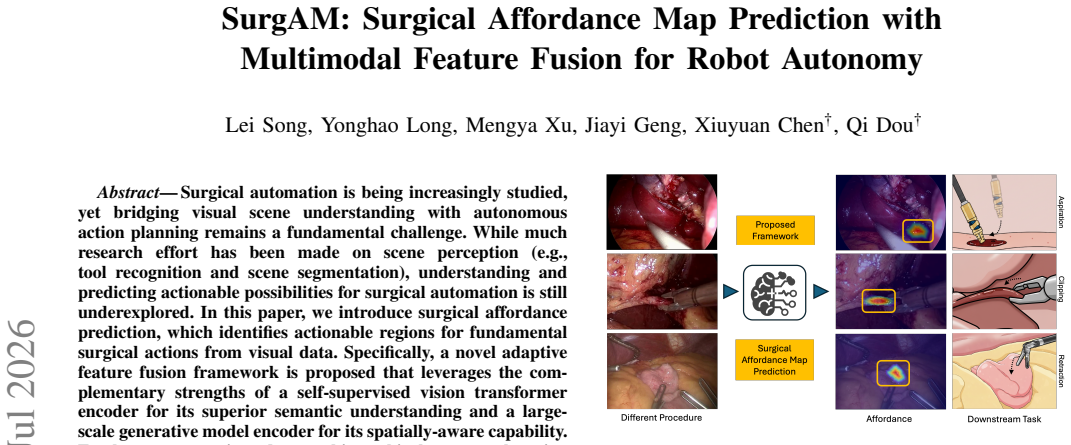
An adaptive fusion of DINOv2 semantic features and Stable Diffusion spatial features, conditioned by hierarchical surgical prompts and decoded with scene-guided attention, yields surgical affordance maps that both score highest on a new three-action dataset and successfully drive autonomous retraction and clipping on physical phantoms.
What carries the argument
Adaptive feature fusion: a learnable scalar beta mixes multi-layer DINOv2 semantic features with multi-scale Stable Diffusion spatial features; the fused map is then refined by hierarchical text prompts and a global-scene-guided cross-attention decoder to produce the final affordance heatmap.
Load-bearing premise
That expanding a single pre-contact tool-tissue point with a general segmentation model yields a faithful ground-truth region of safe and functional affordance for the intended surgical action.
What would settle it
Collect expert-annotated safe/functional tissue masks independent of the SAM pipeline; if the model trained on the original SAM-derived labels shows a large drop in KLD/SIM/NSS or fails the same phantom tasks when evaluated against the new labels, the ground-truth assumption is false.
Editorial analysis
A structured set of objections, weighed in public.
Referee Report
Summary. The paper introduces surgical affordance map prediction as a bridge from visual scene understanding to autonomous action planning for three fundamental actions (aspiration, clipping, retraction). It proposes an adaptive multimodal fusion framework that combines multi-layer semantic features from a frozen DINOv2 encoder with multi-scale spatial features from a Stable Diffusion U-Net (Eqs. 1–3), hierarchical prompt learning that extends CoOp with surgical context and action tokens (Eqs. 4–5), and a scene-guided cross-modal attention decoder that uses the global CLS token to mask background (Eqs. 6–8). A new dataset of 1,915 sequences is constructed by expanding single pre-contact points via SAM into heatmaps; quantitative results claim SOTA over five recent baselines (Table I: KLD 1.362, SIM 0.367, NSS 1.642, CLA 0.895), progressive ablations isolate each module (Tables II–III), and the maps are shown to drive autonomous lung retraction (100 % of 50 trials) and prostate vessel clipping (98 % of 50 trials) on a dVRK platform with silicone phantoms.
Significance. If the results hold, this is a genuine first step toward interpretable, action-centric perception for surgical robots, moving beyond pure segmentation or end-to-end imitation. The dual-foundation fusion insight, hierarchical surgical prompting, and closed-loop phantom validation on a real dVRK platform are concrete engineering contributions that other groups can build upon. The public-dataset-derived affordance annotations and the explicit success/failure reporting on physical hardware strengthen reproducibility and practical relevance for the surgical robotics community.
major comments (3)
- §IV-A (Dataset construction): The entire training signal and all reported metrics rest on the assumption that a single human-annotated pre-contact point expanded by SAM yields a faithful ground-truth affordance region. No inter-annotator agreement, no surgeon-rated mask quality scores, and no sensitivity analysis of the SAM step are provided. If the masks systematically include non-actionable tissue or exclude the true functional zone, both the ranking in Table I and the claim that the maps “successfully enable autonomous surgical actions” become misaligned with clinical affordance. This is load-bearing and must be addressed (e.g., by multi-surgeon validation of a subset of masks or by reporting agreement metrics).
- Tables I–III and §IV-C/D: All quantitative claims (KLD, SIM, NSS, CLA) are reported as point estimates with no standard deviations, confidence intervals, or statistical significance tests across folds or random seeds. Given the class imbalance (904 retraction / 780 aspiration / 231 clipping) and the modest absolute gains over WorldAfford and OOAL, it is impossible to judge whether the improvements are robust. Error bars or a paired statistical test are required for the SOTA claim to be credible.
- §IV-E (Phantom experiments): The 100 % / 98 % success rates are encouraging, yet the silicone lung and prostate phantoms lack the continuous deformation, bleeding, specular highlights and lighting changes of real tissue. The single reported failure mode (temporary occlusion) does not stress-test the SAM-derived label fidelity under realistic conditions. A clearer discussion of this domain gap, or at least a qualitative comparison of predicted maps on real endoscopic frames versus phantom frames, is needed to support the “practical applicability” claim.
minor comments (5)
- Fig. 3 qualitative panels would benefit from a consistent color scale and an explicit indication of the ground-truth centroid so that over-activation versus under-activation can be judged at a glance.
- Eq. (3): the learnable scalar β is introduced without stating its final learned value or its variance across runs; reporting this would help readers understand the relative contribution of the two foundation models.
- The CLA metric is newly proposed; a short formal definition and a comparison against raw ACD on a fixed-resolution subset would improve clarity.
- Several baseline citations (Cross-View-AG, WorldAfford, OOAL) are recent; ensure the exact training protocol (same data split, same number of epochs) is stated so that the comparison remains fair.
- Minor typographical issues: “a f f” subscript formatting in Eq. (8), and occasional missing spaces after citations.
Circularity Check
No significant circularity: empirical SOTA metrics and phantom success rates are measured against held-out annotations and physical trials, not forced by construction or self-defined inputs.
specific steps
-
self citation load bearing
[Section IV-E (Deployment and Validation)]
"we integrated our affordance prediction module with a visual servoing controller based on our VPPV framework [46] and deployed the overall framework on a physical surgical robot platform"
Authors cite their own prior VPPV system for the controller that executes the maps. This is ordinary engineering reuse and is not load-bearing for the central claim (map quality or SOTA metrics); the maps are independently trained and scored. Mild self-reference only.
full rationale
The paper is a standard supervised ML contribution. Affordance maps are trained on a newly annotated dataset (pre-contact points expanded by SAM into heatmaps) and evaluated with independent metrics (KLD/SIM/NSS/CLA) on held-out frames plus physical dVRK trials. No equation reduces a claimed prediction to a fitted constant by construction; the adaptive fusion (Eq. 3), hierarchical prompts (Eq. 4), and scene-guided attention (Eqs. 6-8) are architectural choices whose value is shown by ablation, not tautological. The sole self-citation ([46] VPPV controller) is used only for the downstream servoing loop and does not define or force the affordance maps themselves. Ground-truth construction via SAM is a potential label-quality risk, not circularity. Score 1 reflects only the minor non-load-bearing self-reference.
Axiom & Free-Parameter Ledger
free parameters (3)
- β (adaptive fusion weight) =
initialized 0.5, learned
- α_i (layer aggregation weights)
- learnable prompt vectors {v_1 … v_p}
axioms (3)
- domain assumption Features extracted from a frozen DINOv2 ViT and from intermediate U-Net layers of a frozen Stable Diffusion model are complementary (semantic precision vs. spatial coherence) for dense prediction tasks.
- ad hoc to paper A single human-annotated pre-contact point expanded by SAM yields a valid ground-truth affordance region for aspiration, clipping or retraction.
- ad hoc to paper Global CLS token from the fused visual features supplies a reliable attention mask that suppresses non-surgical background.
invented entities (2)
-
surgical affordance map (for aspiration / clipping / retraction)
no independent evidence
-
hierarchical surgical prompt (context + action tokens)
no independent evidence
read the original abstract
Surgical automation is being increasingly studied, yet bridging visual scene understanding with autonomous action planning remains a fundamental challenge. While much research effort has been made on scene perception (e.g., tool recognition and scene segmentation), understanding and predicting actionable possibilities for surgical automation is still underexplored. In this paper, we introduce surgical affordance prediction, which identifies actionable regions for fundamental surgical actions from visual data. Specifically, a novel adaptive feature fusion framework is proposed that leverages the complementary strengths of a self-supervised vision transformer encoder for its superior semantic understanding and a large-scale generative model encoder for its spatially-aware capability. Furthermore, we introduce a hierarchical prompt learning mechanism to adapt to varying procedural contexts. Finally, a scene-guided attention decoder is proposed to focus on critical surgical areas while suppressing background distractions. To validate the effectiveness, we established a new dataset, derived from publicly available surgical datasets with affordance annotations for three basic surgical actions: aspiration, clipping, and retraction. Extensive experiments demonstrate that our approach achieves state-of-the-art performance. Moreover, we validate our framework's applicability for downstream automation on a realistic lung and prostate phantom, and results show that the predicted affordance maps successfully enable autonomous surgical actions.
Figures


Reference graph
Works this paper leans on
-
[1]
Will your next surgeon be a robot? autonomy and ai in robotic surgery,
S. Schmidgall, J. D. Opfermann, J. W. Kim, and A. Krieger, “Will your next surgeon be a robot? autonomy and ai in robotic surgery,” Science Robotics, vol. 10, no. 104, p. eadt0187, 2025
2025
-
[2]
Concepts and trends in autonomy for robot-assisted surgery,
P. Fiorini, K. Y . Goldberg, Y . Liu, and R. H. Taylor, “Concepts and trends in autonomy for robot-assisted surgery,”Proceedings of the IEEE, vol. 110, no. 7, pp. 993–1011, 2022
2022
-
[3]
Autonomy in surgical robotics,
A. Attanasio, B. Scaglioni, E. De Momi, P. Fiorini, and P. Valdastri, “Autonomy in surgical robotics,”Annual Review of Control, Robotics, and Autonomous Systems, vol. 4, no. 1, pp. 651–679, 2021
2021
-
[4]
EndoNet: a deep architecture for recognition tasks on laparoscopic videos,
A. P. Twinanda, S. Shehata, D. Mutter, J. Marescaux, E. De Momi, and N. Padoy, “EndoNet: a deep architecture for recognition tasks on laparoscopic videos,”IEEE Transactions on Medical Imaging, vol. 36, no. 1, pp. 86–97, 2017
2017
-
[5]
Pixel- wise recognition for holistic surgical scene understanding,
N. Ayobi, S. Rodr ´ıguez, A. P´erez, I. Hern ´andez, N. Aparicio, E. Des- sevres, S. Pe˜na, J. Santander, J. I. Caicedo, N. Fern´andez,et al., “Pixel- wise recognition for holistic surgical scene understanding,”Medical Image Analysis, p. 103726, 2025
2025
-
[6]
Medical robotics—regulatory, ethical, and legal considerations for increasing levels of autonomy,
G.-Z. Yang, J. Cambias, K. Cleary, E. Daimler, J. Drake, P. E. Dupont, N. Hata, P. Kazanzides, S. Martel, R. V . Patel,et al., “Medical robotics—regulatory, ethical, and legal considerations for increasing levels of autonomy,” p. eaam8638, 2017
2017
-
[7]
Surgical robot transformer (srt): Imitation learning for surgical tasks,
J. W. Kim, T. Z. Zhao, S. Schmidgall, A. Deguet, M. Kobilarov, C. Finn, and A. Krieger, “Surgical robot transformer (srt): Imitation learning for surgical tasks,”arXiv preprint arXiv:2407.12998, 2024
Pith/arXiv arXiv 2024
-
[8]
Sufia-bc: Generating high quality demonstration data for visuomotor policy learning in surgical subtasks,
M. Moghani, N. Nelson, M. Ghanem, A. Diaz-Pinto, K. Hari, M. Az- izian, K. Goldberg, S. Huver, and A. Garg, “Sufia-bc: Generating high quality demonstration data for visuomotor policy learning in surgical subtasks,” in2025 IEEE International Conference on Robotics and Automation (ICRA). IEEE, 2025, pp. 4534–4541
2025
-
[9]
Clinical appli- cations of artificial intelligence in robotic surgery,
J. E. Knudsen, U. Ghaffar, R. Ma, and A. J. Hung, “Clinical appli- cations of artificial intelligence in robotic surgery,”Journal of robotic surgery, vol. 18, no. 1, p. 102, 2024
2024
-
[10]
J. J. Gibson,The ecological approach to visual perception: classic edition. Psychology press, 2014
2014
-
[11]
Af- fordances in robotic tasks–a survey,
P. Ard ´on, `E. Pairet, K. S. Lohan, S. Ramamoorthy, and R. Petrick, “Af- fordances in robotic tasks–a survey,”arXiv preprint arXiv:2004.07400, 2020
Pith/arXiv arXiv 2004
-
[12]
Robotic grasp detection using structure prior attention and multiscale features,
L. Chen, M. Niu, J. Yang, Y . Qian, Z. Li, K. Wang, T. Yan, and P. Huang, “Robotic grasp detection using structure prior attention and multiscale features,”IEEE Transactions on Systems, Man, and Cybernetics: Systems, 2024
2024
-
[13]
Position- aware pushing and grasping synergy with deep reinforcement learning in clutter,
M. Zhao, G. Zuo, S. Yu, D. Gong, Z. Wang, and O. Sie, “Position- aware pushing and grasping synergy with deep reinforcement learning in clutter,”CAAI Transactions on Intelligence Technology, vol. 9, no. 3, pp. 738–755, 2024
2024
-
[14]
Au- tomatic instrument segmentation in robot-assisted surgery using deep learning,
A. A. Shvets, A. Rakhlin, A. A. Kalinin, and V . I. Iglovikov, “Au- tomatic instrument segmentation in robot-assisted surgery using deep learning,” in2018 17th IEEE international conference on machine learning and applications (ICMLA). IEEE, 2018, pp. 624–628
2018
-
[15]
Automated laparoscopic colorectal surgery workflow recognition using artificial intelligence: experimental research,
D. Kitaguchi, N. Takeshita, H. Matsuzaki, T. Oda, M. Watanabe, K. Mori, E. Kobayashi, and M. Ito, “Automated laparoscopic colorectal surgery workflow recognition using artificial intelligence: experimental research,”International journal of surgery, vol. 79, pp. 88–94, 2020
2020
-
[16]
Tecno: Surgical phase recognition with multi- stage temporal convolutional networks,
T. Czempiel, M. Paschali, M. Keicher, W. Simson, H. Feussner, S. T. Kim, and N. Navab, “Tecno: Surgical phase recognition with multi- stage temporal convolutional networks,” inMedical Image Computing and Computer Assisted Intervention–MICCAI 2020: 23rd Interna- tional Conference, Lima, Peru, October 4–8, 2020, Proceedings, Part III 23. Springer, 2020, pp. 343–352
2020
-
[17]
Automating multi-throw multilateral surgical suturing with a mechan- ical needle guide and sequential convex optimization,
S. Sen, A. Garg, D. V . Gealy, S. McKinley, Y . Jen, and K. Goldberg, “Automating multi-throw multilateral surgical suturing with a mechan- ical needle guide and sequential convex optimization,” in2016 IEEE international conference on robotics and automation (ICRA). IEEE, 2016, pp. 4178–4185
2016
-
[18]
Autonomy for surgical robots: Concepts and paradigms,
T. Haidegger, “Autonomy for surgical robots: Concepts and paradigms,”IEEE Transactions on Medical Robotics and Bionics, vol. 1, no. 2, pp. 65–76, 2019
2019
-
[19]
Supervised autonomous robotic soft tissue surgery,
A. Shademan, R. S. Decker, J. D. Opfermann, S. Leonard, A. Krieger, and P. C. Kim, “Supervised autonomous robotic soft tissue surgery,” Science translational medicine, vol. 8, no. 337, pp. 337ra64–337ra64, 2016
2016
-
[20]
Srt-h: A hierarchical framework for autonomous surgery via language-conditioned imitation learning,
J. W. Kim, J.-T. Chen, P. Hansen, L. X. Shi, A. Goldenberg, S. Schmidgall, P. M. Scheikl, A. Deguet, B. M. White, D. R. Tsai, et al., “Srt-h: A hierarchical framework for autonomous surgery via language-conditioned imitation learning,”Science robotics, vol. 10, no. 104, p. eadt5254, 2025
2025
-
[21]
Tracking everything in robotic-assisted surgery,
B. Zhan, W. Zhao, Y . Fang, B. Du, F. Vasconcelos, D. Stoyanov, D. S. Elson, and B. Huang, “Tracking everything in robotic-assisted surgery,” in2025 IEEE International Conference on Robotics and Automation (ICRA). IEEE, 2025, pp. 1–7
2025
-
[22]
Affordancenet: An end-to-end deep learning approach for object affordance detection,
T.-T. Do, A. Nguyen, and I. Reid, “Affordancenet: An end-to-end deep learning approach for object affordance detection,” in2018 IEEE international conference on robotics and automation (ICRA). IEEE, 2018, pp. 5882–5889
2018
-
[23]
Affor- dancellm: Grounding affordance from vision language models,
S. Qian, W. Chen, M. Bai, X. Zhou, Z. Tu, and L. E. Li, “Affor- dancellm: Grounding affordance from vision language models,” in Proceedings of the IEEE/CVF Conference on Computer Vision and Pattern Recognition, 2024, pp. 7587–7597
2024
-
[24]
Actionclip: Adapting language-image pretrained models for video action recognition,
M. Wang, J. Xing, J. Mei, Y . Liu, and Y . Jiang, “Actionclip: Adapting language-image pretrained models for video action recognition,”IEEE Transactions on Neural Networks and Learning Systems, 2023
2023
-
[25]
On the opportunities and risks of foundation models,
R. Bommasani, D. A. Hudson, E. Adeli, R. Altman, S. Arora, S. von Arx, M. S. Bernstein, J. Bohg, A. Bosselut, E. Brunskill,et al., “On the opportunities and risks of foundation models,”arXiv preprint arXiv:2108.07258, 2021
Pith/arXiv arXiv 2021
-
[26]
A tale of two features: Stable diffusion complements dino for zero-shot semantic correspondence,
J. Zhang, C. Herrmann, J. Hur, L. Polania Cabrera, V . Jampani, D. Sun, and M.-H. Yang, “A tale of two features: Stable diffusion complements dino for zero-shot semantic correspondence,”Advances in Neural Information Processing Systems, vol. 36, pp. 45 533–45 547, 2023
2023
-
[27]
High-resolution image synthesis with latent diffusion models,
R. Rombach, A. Blattmann, D. Lorenz, P. Esser, and B. Ommer, “High-resolution image synthesis with latent diffusion models,” in Proceedings of the IEEE/CVF conference on computer vision and pattern recognition, 2022, pp. 10 684–10 695
2022
-
[28]
Dinov2: Learning robust visual features without supervision,
M. Oquab, T. Darcet, T. Moutakanni, H. V o, M. Szafraniec, V . Khali- dov, P. Fernandez, D. Haziza, F. Massa, A. El-Nouby,et al., “Dinov2: Learning robust visual features without supervision,”arXiv preprint arXiv:2304.07193, 2023
Pith/arXiv arXiv 2023
-
[29]
A review of deep learning-based information fusion techniques for multimodal medical image classification,
Y . Li, M. E. H. Daho, P.-H. Conze, R. Zeghlache, H. Le Boit ´e, R. Tadayoni, B. Cochener, M. Lamard, and G. Quellec, “A review of deep learning-based information fusion techniques for multimodal medical image classification,”Computers in Biology and Medicine, vol. 177, p. 108635, 2024
2024
-
[30]
Learning transferable visual models from natural language supervision,
A. Radford, J. W. Kim, C. Hallacy, A. Ramesh, G. Goh, S. Agarwal, G. Sastry, A. Askell, P. Mishkin, J. Clark,et al., “Learning transferable visual models from natural language supervision,” inInternational conference on machine learning. PmLR, 2021, pp. 8748–8763
2021
-
[31]
Learning to prompt for vision-language models,
K. Zhou, J. Yang, C. C. Loy, and Z. Liu, “Learning to prompt for vision-language models,”International Journal of Computer Vision, vol. 130, no. 9, pp. 2337–2348, 2022
2022
-
[32]
One-shot open affordance learning with foundation models,
G. Li, D. Sun, L. Sevilla-Lara, and V . Jampani, “One-shot open affordance learning with foundation models,” inProceedings of the IEEE/CVF Conference on Computer Vision and Pattern Recognition, 2024, pp. 3086–3096
2024
-
[33]
Segment anything,
A. Kirillov, E. Mintun, N. Ravi, H. Mao, C. Rolland, L. Gustafson, T. Xiao, S. Whitehead, A. C. Berg, W.-Y . Lo,et al., “Segment anything,” inProceedings of the IEEE/CVF international conference on computer vision, 2023, pp. 4015–4026
2023
-
[34]
Autolaparo: A new dataset of integrated multi-tasks for image-guided surgical automation in laparoscopic hysterectomy,
Z. Wang, B. Lu, Y . Long, F. Zhong, T.-H. Cheung, Q. Dou, and Y . Liu, “Autolaparo: A new dataset of integrated multi-tasks for image-guided surgical automation in laparoscopic hysterectomy,” inInternational Conference on Medical Image Computing and Computer-Assisted Intervention. Springer, 2022, pp. 486–496
2022
-
[35]
Rendezvous: Attention mechanisms for the recognition of surgical action triplets in endoscopic videos,
C. I. Nwoye, T. Yu, C. Gonzalez, B. Seeliger, P. Mascagni, D. Mutter, J. Marescaux, and N. Padoy, “Rendezvous: Attention mechanisms for the recognition of surgical action triplets in endoscopic videos,” Medical Image Analysis, vol. 78, p. 102433, 2022
2022
-
[36]
Heidelberg colorectal data set for surgical data science in the sensor operating room,
L. Maier-Hein, M. Wagner, T. Ross, A. Reinke, S. Bodenstedt, P. M. Full, H. Hempe, D. Mindroc-Filimon, P. Scholz, T. N. Tran,et al., “Heidelberg colorectal data set for surgical data science in the sensor operating room,”Scientific data, vol. 8, no. 1, p. 101, 2021
2021
-
[37]
Challenges in multi-centric generalization: phase and step recognition in roux-en-y gastric bypass surgery,
J. L. Lavanchy, S. Ramesh, D. Dall’Alba, C. Gonzalez, P. Fiorini, B. P. M¨uller-Stich, P. C. Nett, J. Marescaux, D. Mutter, and N. Padoy, “Challenges in multi-centric generalization: phase and step recognition in roux-en-y gastric bypass surgery,”International journal of computer assisted radiology and surgery, vol. 19, no. 11, pp. 2249–2257, 2024
2024
-
[38]
Video retrieval in laparoscopic video recordings with dynamic content descriptors,
K. Schoeffmann, H. Husslein, S. Kletz, S. Petscharnig, B. Muenzer, and C. Beecks, “Video retrieval in laparoscopic video recordings with dynamic content descriptors,”Multimedia Tools and Applications, vol. 77, no. 13, pp. 16 813–16 832, 2018
2018
-
[39]
2018 robotic scene segmentation challenge,
M. Allan, S. Kondo, S. Bodenstedt, S. Leger, R. Kadkhodamoham- madi, I. Luengo, F. Fuentes, E. Flouty, A. Mohammed, M. Pedersen, et al., “2018 robotic scene segmentation challenge,”arXiv preprint arXiv:2001.11190, 2020
Pith/arXiv arXiv 2018
-
[40]
The saras endoscopic surgeon action detection (esad) dataset: Challenges and methods,
V . S. Bawa, G. Singh, F. KapingA, I. Skarga-Bandurova, E. Oleari, A. Leporini, C. Landolfo, P. Zhao, X. Xiang, G. Luo,et al., “The saras endoscopic surgeon action detection (esad) dataset: Challenges and methods,”arXiv preprint arXiv:2104.03178, 2021
Pith/arXiv arXiv 2021
-
[41]
Locate: Localize and transfer object parts for weakly supervised affordance grounding,
G. Li, V . Jampani, D. Sun, and L. Sevilla-Lara, “Locate: Localize and transfer object parts for weakly supervised affordance grounding,” in Proceedings of the IEEE/CVF Conference on Computer Vision and Pattern Recognition, 2023, pp. 10 922–10 931
2023
-
[42]
Understanding 3d object interaction from a single image,
S. Qian and D. F. Fouhey, “Understanding 3d object interaction from a single image,” inProceedings of the IEEE/CVF International Conference on Computer Vision, 2023, pp. 21 753–21 763
2023
-
[43]
Learning affordance grounding from exocentric images,
H. Luo, W. Zhai, J. Zhang, Y . Cao, and D. Tao, “Learning affordance grounding from exocentric images,” inProceedings of the IEEE/CVF conference on computer vision and pattern recognition, 2022, pp. 2252–2261
2022
-
[44]
Grounded affordance from exocentric view,
——, “Grounded affordance from exocentric view,”International Journal of Computer Vision, vol. 132, no. 6, pp. 1945–1969, 2024
1945
-
[45]
Worldafford: Affordance grounding based on natural language instructions,
C. Chen, Y . Cong, and Z. Kan, “Worldafford: Affordance grounding based on natural language instructions,” in2024 IEEE 36th Interna- tional Conference on Tools with Artificial Intelligence (ICTAI). IEEE, 2024, pp. 822–828
2024
-
[46]
Surgical embodied intelligence for generalized task autonomy in laparoscopic robot-assisted surgery,
Y . Long, A. Lin, D. H. C. Kwok, L. Zhang, Z. Yang, K. Shi, L. Song, J. Fu, H. Lin, W. Wei,et al., “Surgical embodied intelligence for generalized task autonomy in laparoscopic robot-assisted surgery,” Science Robotics, vol. 10, no. 104, p. eadt3093, 2025
2025
discussion (0)
Sign in with ORCID, Apple, or X to comment. Anyone can read and Pith papers without signing in.