REVIEW 2 major objections 5 minor 45 references
Under real wall-clock budgets, cheap draft candidates beat guided intermediate search for scaling text-to-image diffusion models.
Reviewed by Pith at T0; open to challenge. T0 means a machine referee read the full paper against a public rubric. the ladder, T0–T4 →
T0 review · grok-4.5
2026-07-11 18:58 UTC pith:EHFC4BNP
load-bearing objection Wall-clock flips the NFE rankings: cheap multi-knob drafts + multi-stage selection beat guided search, and the gains hold across models and transfer to reflection and RL. the 2 major comments →
Flash-BoN: Instant Drafts for Inference-Time Scaling in Diffusion Models
The pith
A machine-rendered reading of the paper's core claim, the machinery that carries it, and where it could break.
Core claim
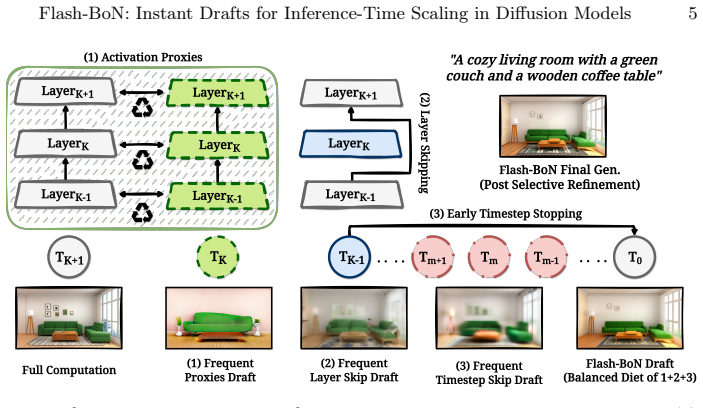
Under matched wall-clock budgets, methods that spend compute on broader exploration of independent seeds outperform guided search that verifies and steers intermediate denoising trajectories; Flash-BoN makes that exploration still cheaper by producing many low-cost drafts from a single once-per-model acceleration configuration, selecting the best draft with multi-stage verification, and refining only the winner, consistently raising quality-versus-time AUC over BoN, BFS, DFS, and ZOS.
What carries the argument
The draft configuration ϕ*—a joint setting of early timestep stopping, contiguous layer skipping, and activation-proxy frequency, optimized once per model by dual annealing for speedup subject to LPIPS similarity to full outputs—plus a multi-stage Elo-based verifier that prunes with pointwise scores then refines with sparse and dense pairwise comparisons before selective full-quality refinement.
Load-bearing premise
That one fixed draft configuration, tuned once on a small calibration set so drafts stay roughly similar to full images, is good enough that a verifier’s ranking of those drafts still picks the image that would win after full refinement.
What would settle it
On the same models and benchmarks, measure whether the top-ranked draft under the multi-stage verifier still ranks first after full refinement for most prompts; if draft rankings reverse often, or if random/unoptimized acceleration configs match Flash-BoN under wall-clock, the central transfer claim fails.
Editorial analysis
A structured set of objections, weighed in public.
Referee Report
Summary. The paper argues that NFE-based comparisons of inference-time scaling for text-to-image diffusion/flow models undercount verifier cost and can reverse method rankings under wall-clock budgets; under equal runtime, simple Best-of-N already matches or beats guided search (BFS/DFS/ZOS). It proposes Flash-BoN: a once-per-model draft configuration ϕ* combining timestep truncation, layer skipping, and activation proxies (chosen by dual annealing on a 120-prompt calibration set subject to LPIPS similarity), multi-stage pointwise-then-pairwise Elo selection of the best draft, and full-quality refinement of only that candidate. Across GenAI-Bench, GenEval, and UniGenBench on Wan2.1 1.3B/14B and FLUX.1-dev, Flash-BoN leads all baselines under fixed wall-clock budgets (gains larger at bigger scales), layers onto Reflection-Tuning and BFS, correlates with candidate diversity (Vendi, r=0.75), and accelerates Flow-GRPO via draft-guided rollouts.
Significance. If the wall-clock results hold, the paper usefully reframes inference-time scaling for T2I: compute is better spent expanding exploration via cheaper generation than on frequent intermediate verification, and NFE-only rankings can mislead. Strengths include end-to-end wall-clock accounting (generation, verification, refinement, transfer), explicit separation of verifier from evaluation metric with cross-metric heatmaps, progressive knob ablations (Tab. 2), multi-stage selection ablations, diversity analysis, modular combination with Reflection-Tuning (+AUC), and transfer of draft-guided selection to RL post-training (~10× fewer steps to match baseline). The once-per-model ϕ* design is practical. These are solid, reproducible systems contributions for the field.
major comments (2)
- [§4.1, App. C, Tab. 2] §4.1 and App. C select ϕ* by maximizing speedup subject to LPIPS similarity ≥0.6 to same-seed full-compute outputs. The load-bearing premise is that verifier rankings on these drafts transfer after refinement. Tab. 2 shows random configs collapse and progressive knobs help, but the paper does not report a direct rank-correlation (e.g., Spearman/Kendall between draft V scores and refined scores or E metrics across the candidate pool on held-out prompts). Adding that measurement would tightly validate ranking transfer rather than only absolute LPIPS fidelity.
- [Table 1, Fig. 3, §5] Table 1 and Fig. 3 report normalized AUC and score-vs-time curves without uncertainty (bootstrap CIs over prompts, or prompt-level paired tests beyond the Wilcoxon notes in Tab. 2). The central claim of consistent leadership and +8% AUC at larger scales would be stronger with prompt-level variance and significance for Flash-BoN vs BoN on each model–benchmark pair, especially given the 300-prompt subsamples of GenAI-Bench and UniGenBench.
minor comments (5)
- [Fig. 1, App. A.2] Fig. 1 and related NFE-vs-time plots mark time-to-4k-NFEs with dashed lines; stating the exact wall-clock accounting (whether verifier GPU is reserved separately, as in App. A.2) in the main caption would help readers interpret the reversal.
- [§4.2, Fig. 14] Default multi-stage parameters (ρ1=ρ2=0.5, κ=1.5) are stated in §4.2; a one-line pointer in the main text to the budget sweep in Fig. 14 would make sensitivity easier to find.
- [§5, App. A.1] For FLUX, ODE-to-SDE conversion with a=0.3 is applied only to guided baselines (App. A.1). Briefly noting in the main experiments section that Flash-BoN does not require this conversion would avoid confusion about fairness.
- [Eq. (13)] Minor notation: S vs S' for full vs draft steps is clear, but ϕ_full in Eq. (13) is introduced without restating that it disables all three knobs; a short parenthetical would help.
- [Fig. 8, §5] Fig. 8 and Fig. 18 usefully illustrate same-metric bias; ensuring figure callouts in §5 explicitly say “false positives/negatives under matched verifier–evaluator” would match the caption language.
Circularity Check
No circularity: empirical pipeline with independent calibration metric, external benchmarks, and separated verifier/evaluator.
full rationale
Flash-BoN is an empirical systems paper that combines known acceleration knobs (timestep truncation, layer skipping, activation proxies) into a once-per-model draft configuration ϕ* chosen by dual annealing on a 120-prompt calibration set to maximize wall-clock speedup subject to LPIPS similarity ≥0.6 to full-compute outputs. The resulting drafts are ranked by an off-the-shelf VLM (pointwise + multi-stage pairwise Elo) and only the winner is refined. Downstream claims are measured on held-out benchmarks (GenAI-Bench VQAScore, GenEval, UniGenBench) under matched wall-clock budgets against BoN/BFS/DFS/ZOS, with explicit separation of the inference-time verifier V from the evaluation metric E and cross-metric ablations. LPIPS is an independent perceptual proxy, not the target score; random configurations are shown to fall below BoN, confirming the optimization is not tautological. No equation equates a claimed prediction to a fitted input by construction, no uniqueness theorem is imported from overlapping authors, and no load-bearing premise reduces to self-citation. The derivation chain is therefore self-contained against external data and metrics.
Axiom & Free-Parameter Ledger
free parameters (5)
- ϕ* draft configuration (S', n_skip, L_skip, f_full) =
e.g. Wan1.3B: S'=49, n_skip=3, L_skip={22,23}, f_full=5
- multi-stage retention ratios ρ1, ρ2 and sparse comparisons κ =
0.5 / 0.5 / 1.5
- LPIPS similarity threshold for Pareto selection =
0.6
- ODE-to-SDE noise scale a for flow models =
0.3
- Flash-Flow-GRPO selection ratio and KL β =
6+2 / β=0.1
axioms (4)
- domain assumption Diffusion/flow sampling is Markovian, so a cached latent at the draft truncation point can be resumed with full computation without depending on how the latent was produced.
- domain assumption Wall-clock time (including verifier and data-transfer cost) is the correct primary efficiency metric for comparing inference-time scaling methods.
- domain assumption Off-the-shelf VLM pointwise and pairwise judgments, after multi-stage Elo filtering, are sufficiently calibrated to identify drafts whose refined versions maximize downstream benchmark metrics.
- ad hoc to paper A single configuration ϕ* optimized on a general-purpose 120-prompt calibration set generalizes across prompts and the three evaluation benchmarks without per-prompt retuning.
invented entities (2)
-
Flash-BoN draft configuration ϕ and its one-shot discrete optimization
independent evidence
-
Multi-stage pointwise + sparse-pairwise + dense-Elo selection procedure
independent evidence
read the original abstract
Inference-time scaling for text-to-image generation has progressed from simple Best-of-$N$ (BoN) sampling to guided search methods that verify and steer candidate trajectories at intermediate denoising steps. These approaches focus on when and how often to verify during denoising but largely treat the cost of generation itself as fixed. Moreover, the standard practice of comparing methods by number of function evaluations (NFEs) counts only denoising forward passes and ignores verifier overhead, which can distort efficiency rankings. We show that under wall-clock evaluation, simple BoN already matches or outperforms several guided search techniques, suggesting that compute is better spent on broader exploration than on repeated intermediate verification. This motivates Flash-BoN, which generates a large pool of inexpensive draft candidates by combining three complementary acceleration knobs: timestep truncation, layer skipping, and activation proxies into a single configuration optimized once per model. An efficient multi-stage verification procedure then identifies the most promising draft, which is refined at full quality. Across three benchmarks and three model scales, Flash-BoN consistently outperforms all baselines under fixed wall-clock budgets, with gains that grow at larger model scales (+8% AUC). We further show that our strategy combines well and improves existing orthogonal techniques such as reflection-based prompt optimization (+16% AUC). The gains correlate with increased candidate diversity, which also enables draft-guided selection to accelerate RL post-training convergence.
Figures



Reference graph
Works this paper leans on
-
[1]
Agarwal, S., Mitra, S., Chakraborty, S., Karanam, S., Mukherjee, K., Saini, S.K.: ApproximatecachingforefficientlyservingText-to-Imagediffusionmodels.In:21st USENIX Symposium on Networked Systems Design and Implementation (NSDI 24). pp. 1173–1189. USENIX Association, Santa Clara, CA (Apr 2024),https: //www.usenix.org/conference/nsdi24/presentation/agarwal-shubham
2024
-
[2]
Journal of Machine Learning Research26(209), 1–80 (2025),http://jmlr.org/papers/v26/23-1605.html
Albergo, M., Boffi, N.M., Vanden-Eijnden, E.: Stochastic interpolants: A unifying framework for flows and diffusions. Journal of Machine Learning Research26(209), 1–80 (2025),http://jmlr.org/papers/v26/23-1605.html
2025
-
[3]
Bai, S., Chen, K., Liu, X., Wang, J., Ge, W., Song, S., Dang, K., Wang, P., Wang, S., Tang, J., Zhong, H., Zhu, Y., Yang, M., Li, Z., Wan, J., Wang, P., Ding, W., Fu, Z., Xu, Y., Ye, J., Zhang, X., Xie, T., Cheng, Z., Zhang, H., Yang, Z., Xu, H., Lin, J.: Qwen2.5-vl technical report (2025),https://arxiv.org/abs/2502.13923
Pith/arXiv arXiv 2025
-
[4]
Accessed: June 28, 2026
Black Forest Labs: FLUX.1 [dev].https://huggingface.co/black-forest-labs/ FLUX.1- dev(2024), 12 billion parameter rectified flow transformer for text-to- image generation. Accessed: June 28, 2026
2024
-
[5]
In: 2025 IEEE/CVF International Conference on Computer Vision (ICCV)
Chen, G., Zhao, X., Zhou, Y., Qu, X., Chen, T., Cheng, Y.: Towards stabilized and efficient diffusion transformers through long-skip-connections with spectral constraints. In: 2025 IEEE/CVF International Conference on Computer Vision (ICCV). pp. 17708–17718 (2025).https://doi.org/10.1109/ICCV51701.2025. 01645
-
[6]
Chen, P., Shen, M., Ye, P., Cao, J., Tu, C., Bouganis, C.S., Zhao, Y., Chen, T.:δ- dit: A training-free acceleration method tailored for diffusion transformers (2024), https://arxiv.org/abs/2406.01125
Pith/arXiv arXiv 2024
-
[7]
Arco Publishing, New York (1978)
Elo, A.E.: The Rating of Chessplayers, Past and Present. Arco Publishing, New York (1978)
1978
-
[8]
Transactions on Machine Learning Research (2023),https:// openreview.net/forum?id=g97OHbQyk1
Friedman, D., Dieng, A.B.: The vendi score: A diversity evaluation metric for machine learning. Transactions on Machine Learning Research (2023),https:// openreview.net/forum?id=g97OHbQyk1
2023
-
[9]
Advances in Neural Information Processing Systems36, 52132–52152 (2023)
Ghosh, D., Hajishirzi, H., Schmidt, L.: Geneval: An object-focused framework for evaluating text-to-image alignment. Advances in Neural Information Processing Systems36, 52132–52152 (2023)
2023
-
[10]
Guo, W.M., Qian, Q., Hasan, K., Du, S.: Aesthetic alignment risks assimilation: How image generation and reward models reinforce beauty bias and ideological" censorship". arXiv preprint arXiv:2512.11883 (2025)
Pith/arXiv arXiv 2025
-
[11]
In: The Thirty-ninth Annual Conference on Neural Information Processing Systems (2025),https://openreview.net/forum?id=nqVLJTPoQC
Guo, Y., Yang, Y., Yuan, H., Wang, M.: Training-free guidance beyond differen- tiability: Scalable path steering with tree search in diffusion and flow models. In: The Thirty-ninth Annual Conference on Neural Information Processing Systems (2025),https://openreview.net/forum?id=nqVLJTPoQC
2025
-
[12]
Habibian, A., Ghodrati, A., Fathima, N., Sautiere, G., Garrepalli, R., Porikli, F., Petersen, J.: Clockwork diffusion: Efficient generation with model-step distilla- tion. In: 2024 IEEE/CVF Conference on Computer Vision and Pattern Recogni- tion(CVPR).pp.8352–8361(2024).https://doi.org/10.1109/CVPR52733.2024. 00798
-
[13]
arXiv preprint arXiv:2505.17618 (2025)
He, H., Liang, J., Wang, X., Wan, P., Zhang, D., Gai, K., Pan, L.: Scaling image and video generation via test-time evolutionary search. arXiv preprint arXiv:2505.17618 (2025)
Pith/arXiv arXiv 2025
-
[14]
Lee, G., Truong, B.N.N., Yoon, J., Lee, D., Kim, M., Bengio, Y., Ahn, S.: Adaptive inference-time scaling via cyclic diffusion search. In: The Thirty-ninth Flash-BoN: Instant Drafts for Inference-Time Scaling in Diffusion Models 17 Annual Conference on Neural Information Processing Systems (2025),https: //openreview.net/forum?id=jkCH6iwFZm
2025
-
[15]
arXiv preprint arXiv:2406.13743 (2024)
Li, B., Lin, Z., Pathak, D., Li, J., Fei, Y., Wu, K., Ling, T., Xia, X., Zhang, P., Neubig, G., et al.: Genai-bench: Evaluating and improving compositional text-to- visual generation. arXiv preprint arXiv:2406.13743 (2024)
Pith/arXiv arXiv 2024
-
[16]
In: 2023 IEEE/CVF International Conference on Computer Vision (ICCV)
Li, L., Li, H., Zheng, X., Wu, J., Xiao, X., Wang, R., Zheng, M., Pan, X., Chao, F., Ji, R.: Autodiffusion: Training-free optimization of time steps and architectures for automated diffusion model acceleration. In: 2023 IEEE/CVF International Conference on Computer Vision (ICCV). pp. 7082–7091 (2023). https://doi.org/10.1109/ICCV51070.2023.00654
-
[17]
arXiv preprint arXiv:2503.02039 (2025)
Li, X., Uehara, M., Su, X., Scalia, G., Biancalani, T., Regev, A., Levine, S., Ji, S.: Dynamic search for inference-time alignment in diffusion models. arXiv preprint arXiv:2503.02039 (2025)
Pith/arXiv arXiv 2025
-
[18]
In: Proceedings of the IEEE/CVF International Conference on Computer Vision (ICCV)
Liu, J., Zou, C., Lyu, Y., Chen, J., Zhang, L.: From reusing to forecasting: Ac- celerating diffusion models with taylorseers. In: Proceedings of the IEEE/CVF International Conference on Computer Vision (ICCV). pp. 15853–15863 (October 2025)
2025
-
[19]
In: The Thirty-ninth Annual Conference on Neural Information Processing Systems (2025),https:// openreview.net/forum?id=oCBKGw5HNf
Liu, J., Liu, G., Liang, J., Li, Y., Liu, J., Wang, X., Wan, P., ZHANG, D., Ouyang, W.: Flow-grpo: Training flow matching models via online rl. In: The Thirty-ninth Annual Conference on Neural Information Processing Systems (2025),https:// openreview.net/forum?id=oCBKGw5HNf
2025
-
[20]
arXiv preprint arXiv:2209.03003 (2022)
Liu, X., Gong, C., Liu, Q.: Flow straight and fast: Learning to generate and transfer data with rectified flow. arXiv preprint arXiv:2209.03003 (2022)
Pith/arXiv arXiv 2022
-
[21]
In: Pro- ceedings of the Computer Vision and Pattern Recognition Conference (CVPR)
Ma, N., Tong, S., Jia, H., Hu, H., Su, Y.C., Zhang, M., Yang, X., Li, Y., Jaakkola, T., Jia, X., Xie, S.: Scaling inference time compute for diffusion models. In: Pro- ceedings of the Computer Vision and Pattern Recognition Conference (CVPR). pp. 2523–2534 (June 2025)
2025
-
[22]
In: Proceedings of the IEEE/CVF International Conference on Computer Vision (ICCV)
Ma, Y., Wu, X., Sun, K., Li, H.: Hpsv3: Towards wide-spectrum human preference score. In: Proceedings of the IEEE/CVF International Conference on Computer Vision (ICCV). pp. 15086–15095 (October 2025)
2025
-
[23]
Transactions on Ma- chineLearningResearch(2024),https://openreview.net/forum?id=a68SUt6zFt, featured Certification
Oquab, M., Darcet, T., Moutakanni, T., Vo, H.V., Szafraniec, M., Khalidov, V., Fernandez, P., HAZIZA, D., Massa, F., El-Nouby, A., Assran, M., Ballas, N., Galuba, W., Howes, R., Huang, P.Y., Li, S.W., Misra, I., Rabbat, M., Sharma, V., Synnaeve, G., Xu, H., Jegou, H., Mairal, J., Labatut, P., Joulin, A., Bojanowski, P.: DINOv2: Learning robust visual feat...
2024
-
[24]
Peebles,W.,Xie,S.:Scalablediffusionmodelswithtransformers.In:Proceedingsof the IEEE/CVF international conference on computer vision. pp. 4195–4205 (2023)
2023
-
[25]
In: International Conference on Medical image computing and computer-assisted intervention
Ronneberger, O., Fischer, P., Brox, T.: U-net: Convolutional networks for biomedi- cal image segmentation. In: International Conference on Medical image computing and computer-assisted intervention. pp. 234–241. Springer (2015)
2015
-
[26]
In: Forty-second International Conference on Machine Learning (2025),https: //openreview.net/forum?id=Jp988ELppQ
Singhal,R.,Horvitz,Z.,Teehan,R.,Ren,M.,Yu,Z.,McKeown,K.,Ranganath,R.: A general framework for inference-time scaling and steering of diffusion models. In: Forty-second International Conference on Machine Learning (2025),https: //openreview.net/forum?id=Jp988ELppQ
2025
-
[27]
Rawal et al
Song,J.,Meng,C.,Ermon,S.:Denoisingdiffusionimplicitmodels.In:International Conferenceon LearningRepresentations(2021),https://openreview.net/forum? id=St1giarCHLP 18 R. Rawal et al
2021
-
[28]
In: Interna- tional Conference on Learning Representations (2021),https://openreview.net/ forum?id=PxTIG12RRHS
Song, Y., Sohl-Dickstein, J., Kingma, D.P., Kumar, A., Ermon, S., Poole, B.: Score- based generative modeling through stochastic differential equations. In: Interna- tional Conference on Learning Representations (2021),https://openreview.net/ forum?id=PxTIG12RRHS
2021
-
[29]
Tsallis, C.: Possible Generalization of Boltzmann-Gibbs Statistics. J. Statist. Phys. 52, 479–487 (1988).https://doi.org/10.1007/BF01016429
-
[30]
arXiv preprint arXiv:2501.09685 (2025)
Uehara, M., Zhao, Y., Wang, C., Li, X., Regev, A., Levine, S., Biancalani, T.: Inference-time alignment in diffusion models with reward-guided generation: Tu- torial and review. arXiv preprint arXiv:2501.09685 (2025)
Pith/arXiv arXiv 2025
-
[31]
Wan, T., Wang, A., Ai, B., Wen, B., Mao, C., Xie, C.W., Chen, D., Yu, F., Zhao, H., Yang, J., Zeng, J., Wang, J., Zhang, J., Zhou, J., Wang, J., Chen, J., Zhu, K., Zhao, K., Yan, K., Huang, L., Feng, M., Zhang, N., Li, P., Wu, P., Chu, R., Feng, R., Zhang, S., Sun, S., Fang, T., Wang, T., Gui, T., Weng, T., Shen, T., Lin, W., Wang, W., Wang, W., Zhou, W.,...
Pith/arXiv arXiv 2025
-
[32]
In: The Thirteenth Interna- tional Conference on Learning Representations (2025),https://openreview.net/ forum?id=wmmDvZGFK7
Wang, G., Cai, Y., lijiang Li, Peng, W., Su, S.Z.: PFDiff: Training-free acceleration of diffusion models combining past and future scores. In: The Thirteenth Interna- tional Conference on Learning Representations (2025),https://openreview.net/ forum?id=wmmDvZGFK7
2025
-
[33]
arXiv preprint arXiv:2508.18265 (2025)
Wang, W., Gao, Z., Gu, L., Pu, H., Cui, L., Wei, X., Liu, Z., Jing, L., Ye, S., Shao, J., et al.: Internvl3.5: Advancing open-source multimodal models in versatility, reasoning, and efficiency. arXiv preprint arXiv:2508.18265 (2025)
Pith/arXiv arXiv 2025
-
[34]
arXiv preprint arXiv:2508.20751 (2025)
Wang, Y., Li, Z., Zang, Y., Zhou, Y., Bu, J., Wang, C., Lu, Q., Jin, C., Wang, J.: Pref-grpo: Pairwise preference reward-based grpo for stable text-to-image rein- forcement learning. arXiv preprint arXiv:2508.20751 (2025)
Pith/arXiv arXiv 2025
-
[35]
In: The Fourteenth International Conference on Learning Representations (2026),https: //openreview.net/forum?id=dnJEHl6DI1
Whitehouse, C., Wang, T., Yu, P., Li, X., Weston, J.E., Kulikov, I., Saha, S.: J1: Incentivizing thinking in LLM-as-a-judge via reinforcement learning. In: The Fourteenth International Conference on Learning Representations (2026),https: //openreview.net/forum?id=dnJEHl6DI1
2026
-
[36]
In: The Thirteenth International Conference on Learning Representations (2025),https: //openreview.net/forum?id=VNckp7JEHn
Wu, Y., Sun, Z., Li, S., Welleck, S., Yang, Y.: Inference scaling laws: An em- pirical analysis of compute-optimal inference for LLM problem-solving. In: The Thirteenth International Conference on Learning Representations (2025),https: //openreview.net/forum?id=VNckp7JEHn
2025
-
[37]
Xiang, Y., Sun, D., Fan, W., Gong, X.: Generalized simulated annealing algorithm and its application to the thomson model. Physics Letters A233(3), 216–220 (1997).https://doi.org/https://doi.org/10.1016/S0375-9601(97)00474-X, https://www.sciencedirect.com/science/article/pii/S037596019700474X
-
[38]
In: Forty-second International Conference on Machine Learning (2025),https://openreview.net/ forum?id=27hOkXzy9e
Xie, E., Chen, J., Zhao, Y., YU, J., Zhu, L., Lin, Y., Zhang, Z., Li, M., Chen, J., Cai, H., Liu, B., Zhou, D., Han, S.: SANA 1.5: Efficient scaling of training- time and inference-time compute in linear diffusion transformer. In: Forty-second International Conference on Machine Learning (2025),https://openreview.net/ forum?id=27hOkXzy9e
2025
-
[39]
In: Proceedingsofthe37thInternationalConferenceonNeuralInformationProcessing Systems
Xu, J., Liu, X., Wu, Y., Tong, Y., Li, Q., Ding, M., Tang, J., Dong, Y.: Imagere- ward: learning and evaluating human preferences for text-to-image generation. In: Proceedingsofthe37thInternationalConferenceonNeuralInformationProcessing Systems. pp. 15903–15935 (2023) Flash-BoN: Instant Drafts for Inference-Time Scaling in Diffusion Models 19
2023
-
[40]
Advances in Neural Information Processing Systems36, 76806–76838 (2023)
Xu, Y., Deng, M., Cheng, X., Tian, Y., Liu, Z., Jaakkola, T.: Restart sampling for improving generative processes. Advances in Neural Information Processing Systems36, 76806–76838 (2023)
2023
-
[41]
In: Christodoulopoulos, C., Chakraborty, T., Rose, C., Peng, V
Xuan, W., Zeng, Q., Qi, H., Wang, J., Yokoya, N.: Seeing is believing, but how much? a comprehensive analysis of verbalized calibration in vision-language mod- els. In: Christodoulopoulos, C., Chakraborty, T., Rose, C., Peng, V. (eds.) Pro- ceedings of the 2025 Conference on Empirical Methods in Natural Language Processing. pp. 1408–1450. Association for ...
-
[42]
In: Forty-second International Conference on Machine Learning (2025),https://openreview.net/forum?id=XrCbBdycDc
Yoon, J., Cho, H., Baek, D., Bengio, Y., Ahn, S.: Monte carlo tree diffusion for system 2 planning. In: Forty-second International Conference on Machine Learning (2025),https://openreview.net/forum?id=XrCbBdycDc
2025
-
[43]
In: The Fourteenth International Con- ference on Learning Representations (2026),https://openreview.net/forum?id= b7Ftp6U78i
Zhang, X., Lin, H., Ye, H., Zou, J., Ma, J., Liang, Y., Du, Y.: Inference-time scaling of diffusion models through classical search. In: The Fourteenth International Con- ference on Learning Representations (2026),https://openreview.net/forum?id= b7Ftp6U78i
2026
-
[44]
In: Glober- son, A., Mackey, L., Belgrave, D., Fan, A., Paquet, U., Tomczak, J., Zhang, C
Zhu, H., Tang, D., Liu, J., Lu, M., Zheng, J., Peng, J., Li, D., Wang, Y., Jiang, F., Tian, L., Tiwari, S., Sirasao, A., Yong, J., Wang, B., Barsoum, E.: Dip-go: A diffusion pruner via few-step gradient optimization. In: Glober- son, A., Mackey, L., Belgrave, D., Fan, A., Paquet, U., Tomczak, J., Zhang, C. (eds.) Advances in Neural Information Processing ...
2024
-
[45]
yes” to the question “Does this image match the description: {prompt}?
Zhuo, L., Zhao, L., Paul, S., Liao, Y., Zhang, R., Xin, Y., Gao, P., Elhoseiny, M., Li, H.: From reflection to perfection: Scaling inference-time optimization for text- to-image diffusion models via reflection tuning. In: Proceedings of the IEEE/CVF International Conference on Computer Vision (ICCV). pp. 15329–15339 (October 2025) 20 R. Rawal et al. Flash...
arXiv 2025
discussion (0)
Sign in with ORCID, Apple, or X to comment. Anyone can read and Pith papers without signing in.