REVIEW 3 major objections 4 minor 62 references
Differentiable OPLS Force Field Parameterization for Ionic Electrolytes and High-Throughput Application to Lithium-ion Batteries
T0 review · 3 major / 4 minor · reviewed 2026-07-11 · grok-4.5
Pith's one-line read A density-tuned OPLS force field and a 10,000-formulation MD dataset open data-driven design of lithium-ion battery electrolytes.
desk verdict Solid methods-and-data paper: usable OPLS reparameterization plus a large multi-property MD library, with transferability only partial and reproducibility still open. read the letter →
The pith
A machine-rendered reading of the paper's core claim, the machinery that carries it, and where it could break.
The reading
What carries the argument
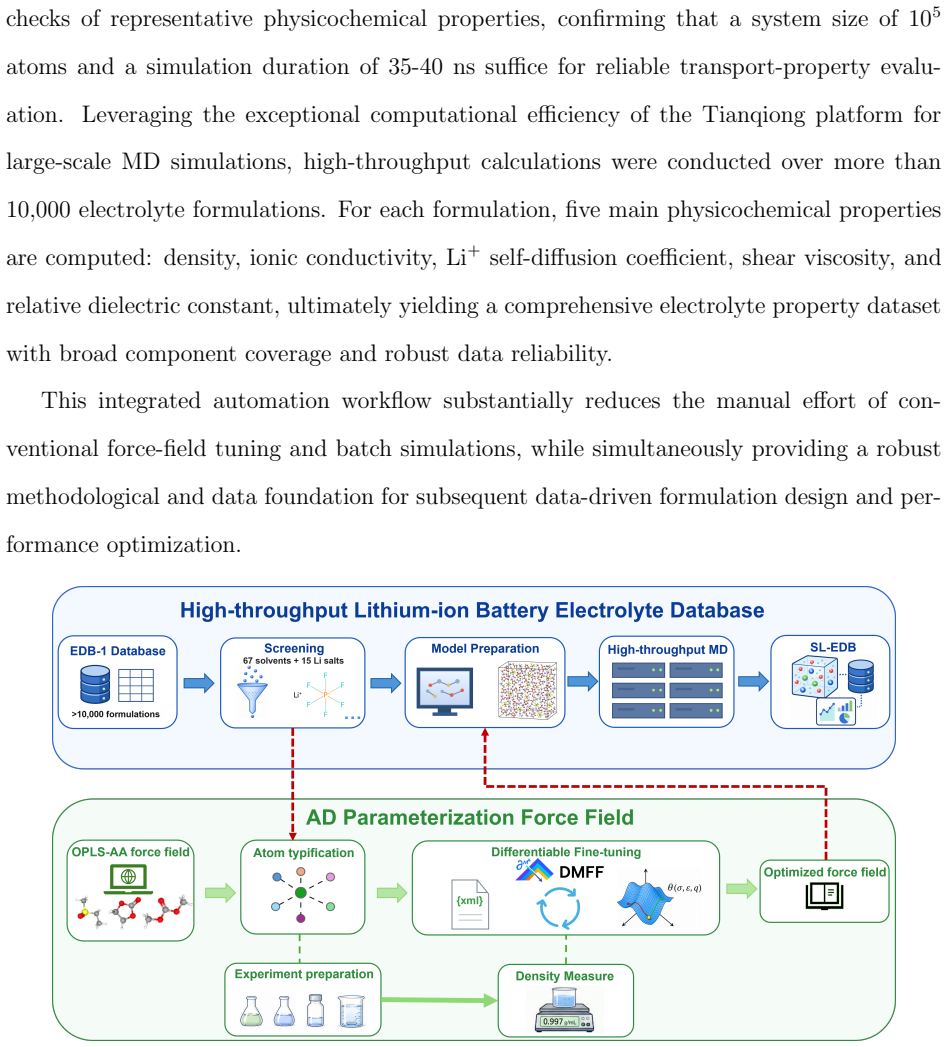
Topology-guided atom typification plus DMFF density optimization: atoms are reclassified by neighbor count, element, and hybridization so that only 136 Lennard-Jones parameters need tuning; gradients of a density-based loss are obtained by trajectory reweighting, yielding a single transferable parameter set validated on Onsager conductivity.
What would settle it
Measure density and Onsager ionic conductivity for a held-out set of multicomponent electrolytes that contain the poorly performing anions (BF4−, ClO4−) or new functional salts outside the training frequencies; systematic RMSE well above the reported ~3 mS/cm conductivity error, or clear density–transport decoupling, would falsify transferability of the density-tuned force field.
Extended reading notes
Core claim
An automated differentiable OPLS-AA parameterization—topology-guided atom typification down to 68 types (136 Lennard-Jones parameters), density-targeted optimization via DMFF, 0.7 charge scaling on salts, and conductivity as an independent check—produces a transferable electrolyte force field that, together with a ~100,000-atom / 35–40 ns protocol, enables reliable high-throughput MD of over 10,000 formulations and a self-consistent five-property dataset for data-driven electrolyte design.
Load-bearing premise
Fitting a fixed-charge OPLS model primarily to experimental density, with one global salt charge-scaling factor of 0.7, is assumed sufficient for accurate transport properties across diverse concentrated electrolytes—even though optimized parameters for some anions had to be abandoned because they produced severe aggregation.
Signed reviews
Editorial analysis
A structured set of objections, weighed in public.
Referee Report
Summary. The manuscript presents an automated workflow for refining OPLS-AA force fields for multicomponent ionic electrolytes used in lithium-ion batteries. Topology-guided reclassification reduces atom types to 68 (136 LJ parameters), which are optimized via DMFF against experimental densities under a global salt charge-scaling factor of 0.7; ionic conductivity serves as an independent check. After establishing a ~10^5-atom / 35–40 ns NVT protocol via finite-size and time-convergence tests, the authors run high-throughput MD on the Tianqiong platform for >10 000 formulations spanning 67 solvents and 15 lithium salts, producing a five-property dataset (density, dielectric constant, viscosity, Li+ diffusivity, Onsager conductivity). t-SNE embeddings are used to illustrate salt clustering, concentration/temperature gradients, and internal physical consistency.
Significance. If the force field and dataset prove sufficiently reliable, the work supplies both a practical, transferable classical model and a large, multi-property computational resource that can accelerate data-driven electrolyte screening beyond the sparse experimental conductivity tables currently available. Strengths that support this potential include the dual-property (density-fit / conductivity-validate) strategy, systematic charge-scaling and Yeh–Hummer-style size-dependence analyses, explicit platform cross-checks against GPU results, and transparent reporting of poorer performance for BF4−/ClO4− systems. The scale of the high-throughput campaign and the closed-loop coupling of parameterization to dataset construction are genuine contributions to the field.
major comments (3)
- [Results: Predictive Performance of Ionic Conductivity] Results, “Predictive Performance of Ionic Conductivity” and Fig. 5: the optimized LJ parameters for BF4− and ClO4− produced severe aggregation and numerical instability in large-scale runs, forcing reversion to original OPLS-AA parameters and yielding R as low as 0.548 (Onsager) / 0.354 (NE). Because these anions remain inside the claimed 15-salt scope, the assertion of a “general” / “transferable” force field for ionic electrolytes is only partially secured and must be qualified more carefully in the abstract, introduction and conclusion.
- [Models: Force Field Model / Optimization] Models and Computational Methods, “Force Field Model” / “Optimization” and Fig. 2: density is only weakly sensitive to the charge-scaling factor (R ≈ 0.89–0.90), while conductivity is highly sensitive. The dual-property strategy therefore rests almost entirely on a single hand-chosen global scale of 0.7 plus post-hoc conductivity checks rather than joint optimization of structure and transport. Given that density-matched LJ parameters failed for two anions, the claim that density is a sufficient primary target for transferable transport accuracy across diverse multicomponent electrolytes requires stronger justification or additional validation metrics (e.g., radial distribution functions, ion-pairing free energies).
- [Results / Fig. 5 and Fig. 6 caption] Fig. 5a and overall statistics: Onsager conductivity achieves only moderate agreement (R = 0.720, RMSE = 3.94 mS cm−1) across the single-salt benchmark; even the better-performing LiPF6 subset remains at RMSE ≈ 2.8–3.2 mS cm−1. Combined with frequent non-convergence of Green–Kubo viscosity at low T / high concentration (Fig. 6 caption), the language of an “accurate” force field that “ensures reliable quantification of the transport properties” overstates the quantitative fidelity for the full chemical space.
minor comments (4)
- [Abstract / Conclusion] Abstract and Conclusion repeatedly call the force field “accurate and transferable” while the body text already documents clear limitations for certain anions; the wording should be aligned with the actual performance metrics.
- [Fig. 6 caption] Fig. 6 caption notes that non-convergent viscosity trajectories were excluded, reducing the single-salt set from 8077 to 7868; the dual-salt set is similarly pruned. The fraction and chemical identity of excluded points should be quantified more explicitly so readers can judge coverage bias.
- [Models: Electrolyte Screening] Supporting Information screening criteria (e.g., exclusion of most boron- and phosphorus-containing salts) are reasonable but should be cross-referenced in the main-text “Electrolyte Screening” subsection for completeness.
- [Throughout] Occasional typographical inconsistencies appear (e.g., “seleted GPU nodes”, “duale-salt”, missing spaces around units). A careful proof-reading pass is needed.
Circularity Check
Density accuracy gains are partly by construction from the LJ fit; conductivity is held out as independent validation, so circularity remains moderate.
-
fitted input called prediction
[Abstract; Models and Computational Methods (Optimization); Result and Discussion (Performance of Fine-tuned Force Field, Fig. 2c)]
"optimizes Lennard-Jones parameters via the DMFF framework, with experimental density as the fitting target and ionic conductivity as an independent validation metric. ... For density prediction (Figure 2c), the fine-tuning process significantly improves the accuracy: the Pearson correlation coefficient increases from 0.917 to 0.959, and the RMSE decreases from 0.051 to 0.035 g/cm^{3}."
The 136 LJ parameters are updated by gradient descent on a loss that is the (weighted) mean-squared error between simulated and experimental densities. The subsequent claim of 'significantly improved' density accuracy is therefore the direct numerical consequence of that minimization rather than an independent prediction of a held-out structural observable.
full rationale
The paper is transparent that Lennard-Jones parameters are optimized against experimental density via DMFF (with a hand-chosen global charge scale of 0.7 selected by inspecting initial-FF conductivity). Consequently the reported post-optimization density metrics (R rising from 0.917 to 0.959, RMSE falling from 0.051 to 0.035 g cm^{-3}) are improved by construction of the loss and should not be read as pure out-of-sample prediction. Ionic conductivity is explicitly reserved as an independent validation metric and is never part of the training loss; the Onsager R = 0.720 / RMSE = 3.94 mS cm^{-1} (and the poorer BF4-/ClO4- subset) therefore constitute genuine external checks. Topology-guided typification, the standardized 10^5-atom / 35-40 ns protocol, the high-throughput dataset, and the t-SNE physical-consistency observations do not reduce to the fitted inputs. No load-bearing self-citation uniqueness theorems or ansatz smuggling appear. The only circular step is the density fit itself, yielding a modest overall score of 3.
Assumptions & free parameters
free parameters (5)
- 136 Lennard-Jones parameters (σ, ε for 68 atom types)
- Salt charge scaling factor
- Adam learning rate and optimization schedule
- Loss formulation weights ω_i
- Manual atom-type merges (e.g., fluorinated carbons → alkane quaternary carbons; Si retained as original OPLS)
assumptions (6)
- domain assumption Classical fixed-charge OPLS-AA functional form with PME electrostatics and LJ nonbonded terms can represent multicomponent ionic electrolytes after parameter adjustment.
- domain assumption Experimental density is an adequate primary target for structural/thermodynamic accuracy of the force field.
- domain assumption Onsager transport formalism (including cross-correlations) is the appropriate conductivity estimator for concentrated electrolytes; NE is a limited baseline.
- domain assumption Finite-size diffusion scales as 1/L (Yeh–Hummer); ~1e5 atoms and 35–40 ns NVT suffice for production transport properties.
- standard math Trajectory reweighting in DMFF yields usable gradients of density w.r.t. LJ parameters without full re-simulation each step.
- ad hoc to paper High-frequency EDB-1 solvents/salts define a representative commercial electrolyte chemical space after stated exclusion rules.
Cite this review
Pith. "Pith review of Differentiable OPLS Force Field Parameterization for Ionic Electrolytes and High-Throughput Application to Lithium-ion Batteries." pith.science (2026). https://pith.science/paper/CD7QV4IV
@misc{pith2026260704633,
  author       = {Pith},
  title        = {Pith review of: Differentiable OPLS Force Field Parameterization for Ionic Electrolytes and High-Throughput Application to Lithium-ion Batteries},
  year         = {2026},
  howpublished = {\url{https://pith.science/paper/CD7QV4IV}},
  note         = {Machine review of arXiv:2607.04633}
}
abstract
The rational design of ionic electrolytes for lithium-ion batteries (LIBs) is severely constrained by the vast solvent-salt combinatorial space and low efficiency of empirical trial-and-error. While molecular dynamics (MD) bridges microscopic solvation structures and macroscopic physicochemical properties, classical force fields often lack sufficient accuracy for multicomponent systems. To address these challenges, we develop an automated differentiable OPLS-AA force field parameterization workflow tailored for general ionic electrolytes. It employs topology-guided atom typification to reduce parameter redundancy and optimizes Lennard-Jones parameters via the DMFF framework, with experimental density as the fitting target and ionic conductivity as an independent validation metric. Rigorous convergence tests yield a standardized simulation protocol with $\sim$100,000-atom systems and 35-40 ns NVT runs to ensure reliable transport property quantification. High-throughput MD simulations of over 10,000 formulations spanning 67 solvents and 15 lithium salts are conducted on the Tianqiong platform, generating a comprehensive dataset covering five core properties: density, dielectric constant, viscosity, diffusion coefficient, and ionic conductivity. t-SNE visualization reveals partial clustering of distinct salt chemistries, continuous property gradients with concentration and temperature, and internal physical self-consistency, with solvent composition identified as another key performance regulator. Together, the accurate transferable force field and large-scale dataset provide a solid foundation for data-driven rational design of ionic electrolytes.
Figures


Figures from the paper (3 more)


Reference graph
Works this paper leans on
-
[1]
Journal of the American Chemical Society , author =
Development and. Journal of the American Chemical Society , author =. 1996 , pages =. doi:10.1021/ja9621760 , abstract =
-
[2]
Molecular. Chemical Reviews , author =. 2019 , pages =. doi:10.1021/acs.chemrev.8b00763 , abstract =
-
[3]
Angewandte Chemie International Edition , author =
An. Angewandte Chemie International Edition , author =. 2021 , pages =. doi:10.1002/anie.202107657 , abstract =
-
[4]
Biophysical Journal , author =
Confined lateral diffusion of membrane receptors as studied by single particle tracking (nanovid microscopy). Biophysical Journal , author =. 1993 , pages =. doi:10.1016/S0006-3495(93)81253-0 , abstract =
-
[5]
Materials Chemistry and Physics , author =
Electrolytes in. Materials Chemistry and Physics , author =. 2024 , pages =. doi:10.1016/j.matchemphys.2023.128796 , language =
-
[6]
Crystal Growth & Design , author =
Melting. Crystal Growth & Design , author =. 2025 , pages =. doi:10.1021/acs.cgd.4c01753 , abstract =
-
[7]
The Journal of Physical Chemistry B , author =
Molecular. The Journal of Physical Chemistry B , author =. 2004 , pages =. doi:10.1021/jp0476545 , language =
-
[8]
Challenges, opportunities, and roadmap for ionic liquid-based electrolytes in advancing energy storage devices , volume =. Nanoscale , author =. 2025 , pages =. doi:10.1039/D5NR00522A , language =
Show all 62 references
-
[9]
The Journal of Physical Chemistry B , author =
System-. The Journal of Physical Chemistry B , author =. 2004 , pages =. doi:10.1021/jp0477147 , language =
2004 doi
-
[10]
Molecular Simulation , author =
Molecular dynamics simulations of concentrated aqueous electrolyte solutions , volume =. Molecular Simulation , author =. 2011 , pages =. doi:10.1080/08927022.2010.525513 , abstract =
2011 doi
- [11]
-
[12]
J Chem Theory Comput , author =
100. J Chem Theory Comput , author =. 2024 , pages =. doi:10.1021/acs.jctc.4c00135 , abstract =
2024 doi
-
[13]
2023 , pages =
J Chem Theory Comput , author =. 2023 , pages =. doi:10.1021/acs.jctc.2c01297 , abstract =
2023 doi
-
[14]
Chemical Reviews , author =
Applying. Chemical Reviews , author =. 2022 , pages =. doi:10.1021/acs.chemrev.1c00904 , abstract =
2022 doi
-
[15]
Journal of Chemical Theory and Computation , author =
Revisiting. Journal of Chemical Theory and Computation , author =. 2017 , pages =. doi:10.1021/acs.jctc.7b00520 , abstract =
2017 doi
-
[16]
Angewandte Chemie International Edition , author =
Probing the. Angewandte Chemie International Edition , author =. 2023 , pages =. doi:10.1002/anie.202305331 , abstract =
2023 doi
-
[17]
The Journal of Physical Chemistry B , author =
Quantum. The Journal of Physical Chemistry B , author =. 2025 , pages =. doi:10.1021/acs.jpcb.4c08461 , abstract =
2025 doi
-
[18]
Journal of Computer-Aided Molecular Design , author =
Class. Journal of Computer-Aided Molecular Design , author =. 1995 , pages =. doi:10.1007/BF00117280 , abstract =
1995 doi
-
[19]
The Journal of Physical Chemistry B , author =
1.14*. The Journal of Physical Chemistry B , author =. 2017 , pages =. doi:10.1021/acs.jpcb.7b00272 , abstract =
2017 doi
-
[20]
ACS Macro Letters , author =
Charge. ACS Macro Letters , author =. 2024 , pages =. doi:10.1021/acsmacrolett.4c00368 , abstract =
2024 doi
-
[21]
The Journal of Physical Chemistry B , author =
Influence of. The Journal of Physical Chemistry B , author =. 2019 , pages =. doi:10.1021/acs.jpcb.9b08033 , abstract =
2019 doi
-
[22]
Journal of Chemical Theory and Computation , author =
Reliable. Journal of Chemical Theory and Computation , author =. 2015 , pages =. doi:10.1021/acs.jctc.5b00351 , abstract =
2015 doi
-
[23]
The Journal of Physical Chemistry B , author =
Charge. The Journal of Physical Chemistry B , author =. 2023 , pages =. doi:10.1021/acs.jpcb.2c08047 , abstract =
2023 doi
-
[24]
Journal of Chemical Theory and Computation , author =
Charge. Journal of Chemical Theory and Computation , author =. 2025 , pages =. doi:10.1021/acs.jctc.5c00873 , abstract =
2025 doi
-
[25]
Journal of Chemical Theory and Computation , author =
Efficient. Journal of Chemical Theory and Computation , author =. 2021 , pages =. doi:10.1021/acs.jctc.1c00268 , abstract =
2021 doi
-
[26]
Physical Chemistry Chemical Physics , author =
Competitive lithium solvation of linear and cyclic carbonates from quantum chemistry , volume =. Physical Chemistry Chemical Physics , author =. 2016 , pages =. doi:10.1039/C5CP05121E , abstract =
2016 doi
-
[27]
Journal of Molecular Liquids , author =
Simulations of dielectric constants and viscosities of organic electrolytes by quantum mechanics and molecular dynamics , volume =. Journal of Molecular Liquids , author =. 2020 , pages =. doi:10.1016/j.molliq.2020.113288 , language =
2020 doi
-
[28]
The Journal of Chemical Physics , author =
The. The Journal of Chemical Physics , author =. 1939 , pages =. doi:10.1063/1.1750343 , abstract =
1939 doi
-
[29]
The Journal of Physical Chemistry B , author =
All-. The Journal of Physical Chemistry B , author =. 1998 , pages =. doi:10.1021/jp973084f , language =
1998 doi
-
[30]
Journal of the American Chemical Society , author =
A. Journal of the American Chemical Society , author =. 1995 , pages =. doi:10.1021/ja00124a002 , abstract =
1995 doi
-
[31]
Nature Machine Intelligence , author =
A unified predictive and generative solution for liquid electrolyte formulation , volume =. Nature Machine Intelligence , author =. 2026 , pages =. doi:10.1038/s42256-025-01173-w , language =
2026 doi
-
[32]
2010 , pages =
Journal of Computational Chemistry , author =. 2010 , pages =. doi:10.1002/jcc.21367 , abstract =
2010 doi
-
[33]
Molecular Simulation , author =
On the prediction of transport properties of ionic liquid using 1-n-butylmethylpyridinium tetrafluoroborate as an example , volume =. Molecular Simulation , author =. 2017 , pages =. doi:10.1080/08927022.2017.1321760 , abstract =
2017 doi
-
[34]
Industrial & Engineering Chemistry Research , author =
Thermal and. Industrial & Engineering Chemistry Research , author =. 2012 , pages =. doi:10.1021/ie300222a , abstract =
2012 doi
-
[35]
The Journal of Chemical Physics , author =
Molecular dynamics simulation of imidazolium-based ionic liquids. The Journal of Chemical Physics , author =. 2009 , pages =. doi:10.1063/1.3042279 , abstract =
2009 doi
-
[36]
The Journal of Physical Chemistry B , author =
Transport. The Journal of Physical Chemistry B , author =. 2006 , pages =. doi:10.1021/jp062885s , language =
2006 doi
-
[37]
The Journal of Physical Chemistry B , author =
The. The Journal of Physical Chemistry B , author =. 2015 , pages =. doi:10.1021/acs.jpcb.5b00689 , abstract =
2015 doi
-
[38]
Wang, Donglin and Wang, Lei and Liu, Zijun and Wang, Tao and Pu, Zhonghua and Ding, Guangxin and Zhu, Mengchen and Yang, Lipeng and Guo, Ruoshan and Zhang, Zhiwei and Lin, Xiao and Du, Xueliang and Hao, Jie and Yang, Yongyong and Sun, Wenqin and Zhou, Fabiao and Xiao, NuoZhou ...
2016 doi
-
[39]
Journal of Chemical Theory and Computation , author =
Accelerators for. Journal of Chemical Theory and Computation , author =. 2022 , pages =. doi:10.1021/acs.jctc.1c01214 , abstract =
2022 doi
-
[40]
Journal of Chemical Theory and Computation , author =
Development of. Journal of Chemical Theory and Computation , author =. 2009 , pages =. doi:10.1021/ct900009a , abstract =
2009 doi
-
[41]
and Tildesley, Dominic J
Allen, Michael P. and Tildesley, Dominic J. , title =. 2017 , month =. doi:10.1093/oso/9780198803195.001.0001 , url =
2017 doi
-
[42]
2017 , pages =
Nucleic Acids Research , author =. 2017 , pages =. doi:10.1093/nar/gkx312 , abstract =
2017 doi
-
[43]
and McGibbon, Robert T
Eastman, Peter and Swails, Jason and Chodera, John D. and McGibbon, Robert T. and Zhao, Yutong and Beauchamp, Kyle A. and Wang, Lee-Ping and Simmonett, Andrew C. and Harrigan, Matthew P. and Stern, Chaya D. and Wiewiora, Rafal P. and Brooks, Bernard R. and Pande, Vijay S. , mo...
-
[44]
doi:10.5281/zenodo.3577986 , abstract =
Lindahl and Abraham and Hess and Spoel, van der , month = dec, year =. doi:10.5281/zenodo.3577986 , abstract =
-
[45]
1995 , keywords =
Computer Physics Communications , author =. 1995 , keywords =. doi:10.1016/0010-4655(95)00042-E , abstract =
1995 doi
-
[46]
Proceedings of the National Academy of Sciences , author =
Potential energy functions for atomic-level simulations of water and organic and biomolecular systems , volume =. Proceedings of the National Academy of Sciences , author =. 2005 , pages =. doi:10.1073/pnas.0408037102 , abstract =
2005 doi
- [47]
-
[48]
The Journal of Chemical Physics , author =
Particle mesh. The Journal of Chemical Physics , author =. 1993 , pages =. doi:10.1063/1.464397 , abstract =
1993 doi
-
[49]
Insight into physico-chemical properties of oxalatoborate-based ionic liquids through combined experimental-theoretical characterization , volume =
Palluzzi, Matteo and Mannucci, Giorgia and Tsurumaki, Akiko and Busato, Matteo and Assunta Navarra, Maria and D’Angelo, Paola , year =. Insight into physico-chemical properties of oxalatoborate-based ionic liquids through combined experimental-theoretical characterization , vo...
-
[50]
The Journal of Chemical Physics , author =
Effect of succinonitrile on ion transport in. The Journal of Chemical Physics , author =. 2022 , pages =. doi:10.1063/5.0087824 , abstract =
2022 doi
-
[51]
Journal of Molecular Liquids , author =
Fast lithium ion mobility in organic carbonates and acetonitrile: insights from ab initio and classical. Journal of Molecular Liquids , author =. 2025 , keywords =. doi:10.1016/j.molliq.2025.127736 , abstract =
2025 doi
-
[52]
Journal of Molecular Liquids , author =
Transferable potential for phase equilibrium of trialkyl borates , volume =. Journal of Molecular Liquids , author =. 2021 , keywords =. doi:10.1016/j.molliq.2021.116740 , abstract =
2021 doi
-
[53]
, month = apr, year =
Kumar, Ritesh and Vu, Minh Canh and Ma, Peiyuan and Amanchukwu, Chibueze V. , month = apr, year =. Electrolytomics:. Chemistry of Materials , publisher =. doi:10.1021/acs.chemmater.4c03196 , abstract =
-
[54]
03, 2016 , author=
Gaussian 16 Revision A. 03, 2016 , author=. Gaussian Inc. Wallingford CT , volume=
2016
-
[55]
Journal of Machine Learning Research , author =
Visualizing. Journal of Machine Learning Research , author =. 2008 , pages =
2008
-
[56]
bioRxiv , elocation-id =
Chen, Lin and Chen, Yuhan and Cheng, Ziqi and Guo, Jing and He, Ming and Li, Huan and Li, Xinyu and Li, Zhen and Ma, Jule and Ma, Shuo and Peng, Can and Qian, Cheng and Qu, Zhi and Sun, Xian-gang and Tang, Xuan and Wang, Yunfei and Yu, Bing and Zhai, Yuzhuo and Zhang, Bingyao ...
2026
-
[57]
InfoMat , volume =
Liang, Yeru and Zhao, Chen-Zi and Yuan, Hong and Chen, Yuan and Zhang, Weicai and Huang, Jia-Qi and Yu, Dingshan and Liu, Yingliang and Titirici, Maria-Magdalena and Chueh, Yu-Lun and Yu, Haijun and Zhang, Qiang , title =. InfoMat , volume =. doi:https://doi.org/10.1002/inf2.1...
-
[58]
Advanced Energy Materials , volume =
Li, Yuanqin and Liu, Mingzhu and Wang, Kang and Li, Chengfeng and Lu, Ying and Choudhary, Aditya and Ottley, Taylor and Bedrov, Dmitry and Xing, Lidan and Li, Weishan , title =. Advanced Energy Materials , volume =. doi:https://doi.org/10.1002/aenm.202300918 , url =. https://a...
-
[59]
Nature Energy , author =
Long cycle life and dendrite-free lithium morphology in anode-free lithium pouch cells enabled by a dual-salt liquid electrolyte , volume =. Nature Energy , author =. 2019 , pages =. doi:10.1038/s41560-019-0428-9 , abstract =
2019 doi
-
[60]
Energy Storage Materials , author =
Engineering the solvent-anion interactions of. Energy Storage Materials , author =. 2024 , keywords =. doi:10.1016/j.ensm.2024.103816 , abstract =
2024 doi
-
[61]
Advanced Energy Materials , author =
Lithium. Advanced Energy Materials , author =. 2020 , note =. doi:10.1002/aenm.202001440 , abstract =
2020 doi
-
[62]
Zhao, Yumeng and Hu, Zhenglin and Zhao, Zhengfei and Chen, Xinlian and Zhang, Shu and Gao, Jun and Luo, Jiayan , month = oct, year =. Strong. Journal of the American Chemical Society , publisher =. doi:10.1021/jacs.3c08313 , abstract =
Reviewed July 11, 2026 · model on record in the stance chip above.
Discussion (0). Continue with ORCID to comment.