REVIEW 3 major objections 6 minor 98 references
R-squared gravity plus a dark bosonic component raises the maximum mass of rotating mixed stars and widens the allowed mass-radius band relative to general relativity, while remaining compatible with current NICER and gravitational-wave bou
Reviewed by Pith at T0; open to challenge. T0 means a machine referee read the full paper against a public rubric. the ladder, T0–T4 →
T0 review · grok-4.5
2026-07-11 14:12 UTC pith:YGJYXBTN
load-bearing objection First rotating fermion-boson stars in R^{2} gravity; solid numerical catalog with a real but well-flagged RPV limitation. the 3 major comments →
Rotating Fermion-Boson Stars in R-squared Gravity
The pith
A machine-rendered reading of the paper's core claim, the machinery that carries it, and where it could break.
Core claim
In R-squared gravity the scalar degree of freedom modifies the spatial profiles of both the bosonic field and the fermionic energy density, expands the domain of admissible mixed-star equilibria, and raises both the static and Keplerian maximum masses relative to pure general relativity, all while the resulting sequences remain compatible with current astrophysical and gravitational-wave constraints.
What carries the argument
The RPV high-coupling approximation that replaces the complex bosonic field by an effective perfect-fluid source of compact support, solved together with the Einstein-frame scalar-tensor equations of R-squared gravity inside a modified RNS self-consistent-field code.
Load-bearing premise
The calculation discards the exponentially decaying outer tail of the bosonic field and treats the bosonic sector as a perfect fluid of compact support; if that tail or the strong-self-interaction assumption is not valid, the reported mass-radius bands are unreliable.
What would settle it
A numerical-relativity evolution of a high-mass, low-frequency model that retains the full bosonic tail would show whether the configuration remains long-lived or disperses; if it disperses while the truncated-tail equilibrium predicts stability, the maximum-mass claims fail.
Editorial analysis
A structured set of objections, weighed in public.
Referee Report
Summary. The paper constructs static and uniformly rotating equilibrium configurations of mixed fermion-boson stars in R-squared gravity, f(R)=R+aR², formulated in the Einstein frame as a scalar-tensor theory. The fermionic sector uses the tabulated AkmalPR EOS; the bosonic sector is a self-interacting complex field treated in the RPV high-coupling approximation, so that its energy-momentum tensor is replaced by an effective perfect fluid of compact support. Equilibrium models are obtained with a modified RNS/KEH code for GR and two representative values a=10 and a=10^4. The main claims are that the scalaron modifies the spatial distribution of both components, enlarges the domain of admissible equilibria, and raises static and Keplerian maximum masses relative to GR (e.g. static 2.44→2.62 M⊙ and Keplerian 2.89→3.29 M⊙ for a=10^4), while the sequences remain compatible with NICER, GW170817, and GW190814 constraints for bosonic mass fractions ≲10%.
Significance. This is, to my knowledge, the first self-consistent construction that combines a mixed fermion-boson matter sector, uniform rotation, and a viable f(R) model with a massive scalaron. Prior work treated rotating fermion-boson stars in GR or static mixed stars in f(R), but not the three ingredients together. The explicit Einstein-frame field equations (Appendices A–B), the transparent RPV implementation, and the mass–radius maps with external multimessenger bounds make the contribution useful for the strong-field modified-gravity and dark-matter-admixed compact-star communities. If the reported mass gains and enlarged solution space survive beyond the RPV truncation, the models offer a concrete, observationally testable channel for objects near the low-mass black-hole gap without requiring an extremely stiff nuclear EOS.
major comments (3)
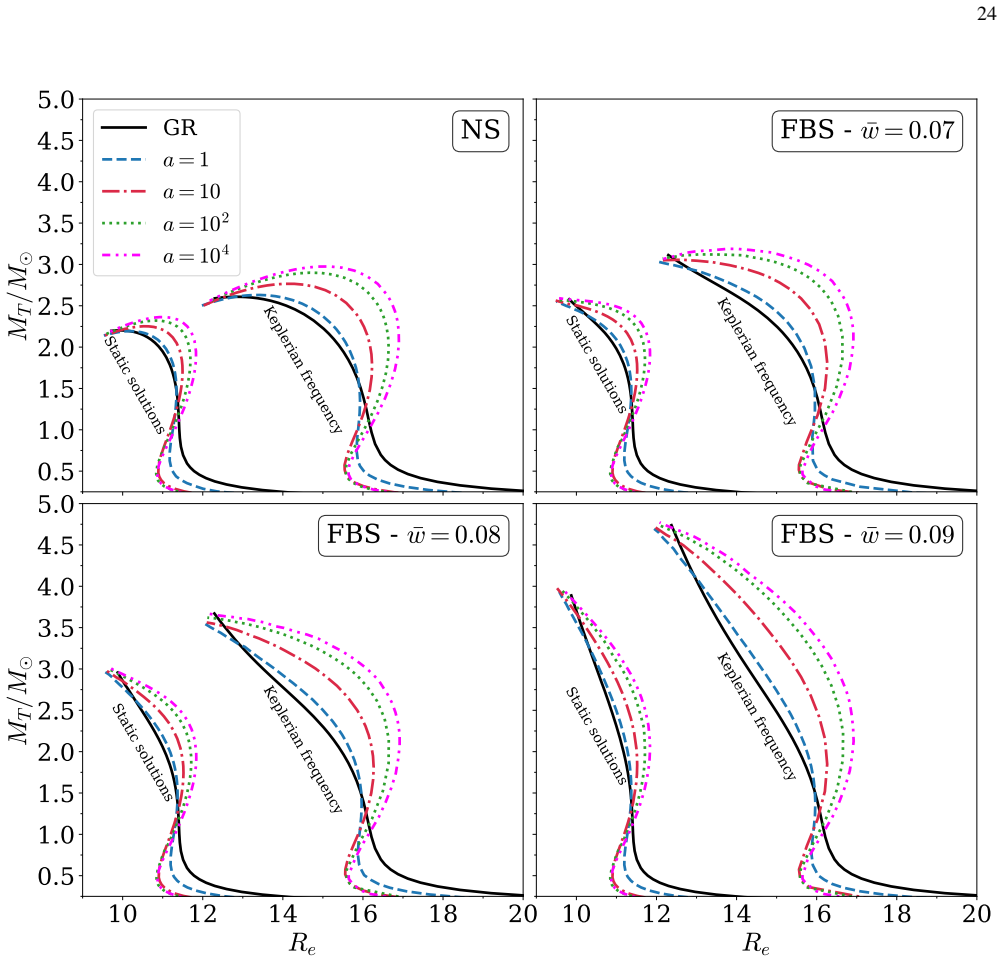
- [Section III A, Eqs. (29)–(33); Fig. 4; Sec. V C] Section III A, Eqs. (29)–(33) and the mass/angular-momentum integrals (42)–(43): the headline mass–radius bands and maximum-mass gains in Fig. 4 and Sec. V C rest on the RPV truncation of the bosonic tail and the algebraic replacement of T^b_μν by a compact-support perfect fluid. The paper itself notes (Sec. VI) that the neglected tail can become non-negligible for halo-dominated configurations (¯w ≳ 0.08–0.09), which populate a substantial fraction of the colored regions in Fig. 4 and the high-¯w columns of Figs. 1–3. Without a quantitative estimate of the truncated ADM mass/angular momentum for the adopted (μ_b, λ, ¯w, η) values—or an explicit restriction of the observational claims to the compact/core-like regime where RPV is controlled—the quoted static/Keplerian maxima and the GW190814 compatibility statement are not yet fully reliable. A short validation (e.g. order-of-magnitude ta
- [Section V C; Fig. 4] Section V C and the GW190814 discussion: the claim that a=10^4 allows a near-static mixed star with M_b/M_T ≲ 10% to sit inside the GW A band relies on the RPV sequences and on the single nuclear EOS AkmalPR. The paper correctly notes that stiff EOSs can reach ~2.6 M⊙ in GR, but the quantitative advantage attributed to R-squared gravity is not separated from (i) the RPV truncation and (ii) the fixed 10% bosonic-fraction ceiling. At minimum, the text should state how sensitive the static maximum (2.62 M⊙) is to modest changes in the bosonic fraction ceiling and to restoring a non-zero tail, and should avoid presenting the GW190814 resolution as robust until that sensitivity is shown.
- [Section V; comparison with Refs. [11, 16]] Units and physical scale of a: results are reported for a=10 and a=10^4 with no explicit statement of the unit system for a (length² in geometrized units). Prior R-squared NS literature typically quotes a in km² or relative to a gravitational radius. Without this, the claimed “near-saturation / Brans–Dicke-like” regime for a=10^4 cannot be mapped to a scalaron mass or to Solar-System/strong-field bounds. Please specify the units of a consistently with the dimensionless code variables and with the literature values used for comparison.
minor comments (6)
- [Abstract; Sec. I] Abstract and Introduction: “enlarges the domain of admissible equilibrium solutions” is used without a precise definition (parameter volume, mass–radius area, or existence of new topologies). A one-sentence operational definition would help.
- [Section III B] Eq. (36) and surrounding text: the compactified coordinate uses s, and μ=cos θ is introduced with a footnote warning against confusion with μ_b; still, several source-term symbols (S^x_T) reuse subscripts that collide with total quantities. A short notation table would reduce ambiguity.
- [Figs. 1–3] Fig. 1–3: relative-percentage panels are useful, but the vertical scales differ across columns; stating the peak percentage in the caption (as done for δφ²_max in Fig. 2) for the fermionic panels would aid comparison.
- [Appendix A; Sec. V A] Appendix A: the static metric is Schwarzschild-like while the rotating metric is quasi-isotropic; the text already warns that the static equations are not a direct coordinate limit of Eq. (24). Cross-referencing that warning again when static profiles are extracted as J_T→0 of the rotating code would avoid reader confusion.
- [Sec. V B; Introduction] Typographical: “dimentionless” (Sec. V B); “taht” in the Introduction’s appendix description; “inequivalent definitions” list is fine but “axion couplings [25]” could be checked for consistency with the reference list numbering after any revision.
- [Section III B] Bosonic microphysical parameters (μ_b ≃ 10^{-16} MeV, λ=100) are stated once in Sec. III B; a brief remark on why this ultralight scale is appropriate for the dark-matter interpretation (or that it is chosen purely to sit in the RPV regime) would help non-specialist readers.
Circularity Check
No significant circularity: mass–radius gains and profile changes are numerical outputs of the field equations under stated approximations, not forced by definition or by fitting the target observables.
full rationale
The paper’s central claims—that the scalaron in f(R)=R+aR² redistributes fermionic and bosonic matter, enlarges the equilibrium domain, and raises static/Keplerian maximum masses relative to GR—are obtained by solving the Einstein-frame field equations (Eqs. 14–15, B1–B6) with the AkmalPR EOS and the RPV algebraic bosonic source (Eqs. 29–33) for chosen a, w̄, JT, MT. Those maxima (e.g. 2.44→2.62 M⊙ static and 2.89→3.29 M⊙ Keplerian for a=10^4) are turning points of the computed sequences in Fig. 4, not quantities already encoded in the inputs. Observational bands (NICER, GW170817, GW190814, RMW/NMR) are external benchmarks overlaid after the fact; a is not fitted to them. Self-citations to prior RNS/RPV and R-squared NS work supply numerical infrastructure and context, not a uniqueness theorem that forces the headline result. The RPV tail truncation is a load-bearing modeling assumption (correctness risk), not a circular reduction of prediction to input. Derivation chain is self-contained numerical construction under explicit approximations.
Axiom & Free-Parameter Ledger
free parameters (4)
- a (R-squared coupling) =
10 and 10^4 (representative)
- bosonic mass scale and couplings (μ_b, λ, η, w̄) =
μ̄_b=0.1, η̄=0.01, λ̄=1; w̄ in [0.07,0.09] and broader scans
- bosonic mass-fraction ceiling =
≤10%
- nuclear EOS choice (AkmalPR) =
AkmalPR
axioms (5)
- domain assumption f(R)=R+aR² with a≥0 is a viable strong-field modification equivalent to a massive scalar-tensor theory with κ(φ)=-1/√3.
- domain assumption Fermionic and bosonic sectors interact only gravitationally (no direct non-gravitational coupling).
- ad hoc to paper RPV high-coupling approximation: bosonic tail may be truncated and the bosonic EMT replaced by an effective perfect fluid with compact support (Eqs. 29–33).
- domain assumption Uniform (rigid) rotation of the fermionic fluid; no enforced co-rotation with the bosonic sector.
- domain assumption Zero-temperature perfect-fluid description with tabulated AkmalPR EOS is adequate for the fermionic sector.
read the original abstract
Fermion-boson stars are compact equilibrium configurations composed of ordinary fermionic matter and a bosonic dark component interacting only through gravity. Such systems provide a natural framework for exploring deviations from standard neutron-star models, including the possible accumulation of dark matter inside neutron stars, and may be relevant for compact objects near the low-mass black-hole gap. We construct static and uniformly rotating fermion-boson stars within the framework of $R$-squared $f(R)$ gravity, characterized by the functional form $f(R)=R+aR^{2}$, where $a$ is a positive parameter governing the effective mass scale from the scalar degree of freedom. The fermionic sector is modeled as a perfect fluid described by a tabulated equation of state at zero temperature, while the bosonic component is represented by a self-interacting complex bosonic field. Our results show that the scalar degree of freedom modifies the spatial distribution of both the bosonic field and the fermionic pressure, enlarges the domain of admissible equilibrium solutions, and increases the maximum supported masses relative to general relativity. Our models remain compatible with current astrophysical and gravitational-wave constraints, suggesting that fermion-boson stars in $R$-squared gravity offer a promising framework to investigate the combined effects of dark bosonic matter, rotation, and strong-field modifications of gravity in compact objects.
Figures




Reference graph
Works this paper leans on
-
[1]
and PSR J0740+6620 (PSRB,M≈2.08M ⊙,R≈ 12.4 km) [97] anchor the mass-radius relation at low-to- intermediate and high masses respectively, providing direct simultaneous constraints on stellar radius and mass from X- ray pulse-profile modeling. The gravitational-wave event GW170817 (GWB) [92] constrains the tidal deformability of merging NSs and, through po...
-
[2]
T. P. Sotiriou and V . Faraoni, f(R) Theories Of Gravity, Rev. Mod. Phys.82, 451 (2010), arXiv:0805.1726 [gr-qc]
Pith/arXiv arXiv 2010
-
[3]
A. De Felice and S. Tsujikawa, f(R) theories, Living Rev. Rel. 13, 3 (2010), arXiv:1002.4928 [gr-qc]
Pith/arXiv arXiv 2010
-
[4]
S. Pi, Y .-l. Zhang, Q.-G. Huang, and M. Sasaki, Scalaron from R2-gravity as a heavy field, J. Cosmol. Astropart. Phys.05, 042, arXiv:1712.09896 [astro-ph.CO]
-
[5]
A. A. Starobinsky, A new type of isotropic cosmological mod- els without singularity, Phys. Lett. B91, 99 (1980)
1980
-
[6]
S. Nojiri and S. D. Odintsov, Modified Gravity with ln R Terms and Cosmic Acceleration, Gen. Relativ. Gravit.36, 1765 (2004), arXiv:hep-th/0308176 [hep-th]
Pith/arXiv arXiv 2004
-
[7]
W. Hu and I. Sawicki, Models of f(R) cosmic acceleration that evade solar system tests, Phys. Rev. D76, 064004 (2007), arXiv:0705.1158 [astro-ph]
Pith/arXiv arXiv 2007
-
[8]
M. Abdelwahab, S. Carloni, and P. K. S. Dunsby, Cosmological dynamics of ’exponential gravity’, Class. Quantum Grav.25, 135002 (2008), arXiv:0706.1375 [gr-qc]
Pith/arXiv arXiv 2008
-
[9]
L. Sagunski, J. Zhang, M. C. Johnson, L. Lehner, M. Sakellar- iadou, S. L. Liebling, C. Palenzuela, and D. Neilsen, Neutron star mergers as a probe of modifications of general relativity with finite-range scalar forces, Phys. Rev. D97, 064016 (2018), arXiv:1709.06634 [gr-qc]
Pith/arXiv arXiv 2018
-
[10]
S. S. Yazadjiev, D. D. Doneva, K. D. Kokkotas, and K. V . Staykov, Non-perturbative and self-consistent models of neu- tron stars in R-squared gravity, J. Cosmol. Astropart. Phys.06, 003, arXiv:1402.4469 [gr-qc]
-
[11]
K. V . Staykov, D. D. Doneva, S. S. Yazadjiev, and K. D. Kokko- tas, Slowly rotating neutron and strange stars in R 2 gravity, J. Cosmol. Astropart. Phys.2014(10), 006, arXiv:1407.2180 [gr- qc]
Pith/arXiv arXiv 2014
-
[12]
S. S. Yazadjiev, D. D. Doneva, and K. D. Kokkotas, Rapidly rotating neutron stars in R-squared gravity, Phys. Rev. D91, 084018 (2015), arXiv:1501.04591 [gr-qc]
Pith/arXiv arXiv 2015
-
[13]
K. Numajiri, T. Katsuragawa, and S. Nojiri, Compact star in general F(R) gravity: Inevitable degeneracy problem and non- integer power correction, Phys. Lett. B826, 136929 (2022), arXiv:2111.02660 [gr-qc]
Pith/arXiv arXiv 2022
-
[14]
K. Numajiri, Y .-X. Cui, T. Katsuragawa, and S. Nojiri, Revisit- ing compact star in F (R ) gravity: Roles of chameleon poten- tial and energy conditions, Phys. Rev. D107, 104019 (2023), arXiv:2302.03951 [gr-qc]
Pith/arXiv arXiv 2023
-
[15]
J. W. T. Hessels, S. M. Ransom, I. H. Stairs, P. C. C. Freire, V . M. Kaspi, and F. Camilo, A Radio Pulsar Spinning at 716 Hz, Science311, 1901 (2006), arXiv:astro-ph/0601337 [astro- ph]
Pith/arXiv arXiv 1901
-
[16]
E. Aranguren, J. A. Font, N. Sanchis-Gual, and R. Vera, I- Love-Q, andδM too: The role of the mass in universal re- lations of compact stars, Phys. Rev. D110, 084027 (2024), arXiv:2407.20151 [gr-qc]
Pith/arXiv arXiv 2024
-
[17]
D. D. Doneva, S. S. Yazadjiev, and K. D. Kokkotas, The I-Q re- lations for rapidly rotating neutron stars inf(R)gravity, Phys. Rev. D92, 064015 (2015), arXiv:1507.00378 [gr-qc]
Pith/arXiv arXiv 2015
-
[18]
T. P. Sotiriou, f(R) gravity and scalar tensor theory, Class. Quan- tum Grav.23, 5117 (2006), arXiv:gr-qc/0604028 [gr-qc]
Pith/arXiv arXiv 2006
-
[19]
F. A. Teppa Pannia, F. Garc´ıa, S. E. Perez Bergliaffa, M. Orel- lana, and G. E. Romero, Structure of compact stars in R- squared Palatini gravity, Gen. Relativ. Gravit.49, 25 (2017), arXiv:1607.03508 [gr-qc]
Pith/arXiv arXiv 2017
-
[20]
A. Mas ´o-Ferrando, N. Sanchis-Gual, J. A. Font, and G. J. Olmo, Boson stars in Palatinif(R)gravity, Class. Quantum Grav.38, 194003 (2021), arXiv:2103.15705 [gr-qc]
Pith/arXiv arXiv 2021
-
[21]
A. Mas ´o-Ferrando, N. Sanchis-Gual, J. A. Font, and G. J. Olmo, Birth of baby universes from gravitational collapse in a modified-gravity scenario, J. Cosmol. Astropart. Phys.2023 (6), 028, arXiv:2304.12018 [gr-qc]
Pith/arXiv arXiv 2023
-
[22]
A. Mas ´o-Ferrando, N. Sanchis-Gual, J. A. Font, and G. J. Olmo, Numerical evolutions of boson stars in Palatini f (R ) gravity, Phys. Rev. D109, 044042 (2024), arXiv:2309.14912 [gr-qc]
Pith/arXiv arXiv 2024
-
[23]
Folomeev, Anisotropic neutron stars in R 2 gravity, Phys
V . Folomeev, Anisotropic neutron stars in R 2 gravity, Phys. Rev. D97, 124009 (2018), arXiv:1802.01801 [gr-qc]
Pith/arXiv arXiv 2018
-
[24]
F. Sbis `a, P. O. Baqui, T. Miranda, S. E. Jor ´as, and O. F. Piat- tella, Neutron star masses in R 2-gravity, Phys. Dark Universe 27, 100411 (2020), arXiv:1907.08714 [gr-qc]
Pith/arXiv arXiv 2020
-
[25]
J. M. Z. Pretel, S. E. Jor ´as, R. R. R. Reis, and J. D. V . Arba˜nil, Neutron stars in f(R,T) gravity with conserved 17 energy-momentum tensor: Hydrostatic equilibrium and as- teroseismology, J. Cosmol. Astropart. Phys.2021(8), 055, arXiv:2105.07573 [gr-qc]
Pith/arXiv arXiv 2021
-
[26]
A. V . Astashenok and S. D. Odintsov, Rotating neutron stars in F(R) gravity with axions, Mon. Not. R. Astron. Soc.498, 3616 (2020), arXiv:2008.11271 [gr-qc]
Pith/arXiv arXiv 2020
-
[27]
K. V . Staykov, D. Popchev, D. D. Doneva, and S. S. Yazadjiev, Static and slowly rotating neutron stars in scalar-tensor theory with self-interacting massive scalar field, Eur. Phys. J. C.78, 586 (2018), arXiv:1805.07818 [gr-qc]
Pith/arXiv arXiv 2018
-
[28]
C. Reyes and J. Sakstein, Slowly rotating neutron stars in aether scalar-tensor theory, Phys. Rev. D112, 064073 (2025), arXiv:2505.03527 [gr-qc]
Pith/arXiv arXiv 2025
-
[29]
J. C. Olvera M., D. D. Doneva, P. Cerd ´a-Dur´an, J. A. Font, and S. S. Yazadjiev, Rapidly Rotating Neutron Star Collapse in Massive Scalar-Tensor Theories, arXiv e-prints , arXiv:2605.16506 (2026), arXiv:2605.16506 [gr-qc]
Pith/arXiv arXiv 2026
-
[31]
A. G. Abacet al.(LIGO Scientific, KAGRA, VIRGO), Ob- servation of Gravitational Waves from the Coalescence of a 2.5–4.5 M ⊙ Compact Object and a Neutron Star, Astrophys. J. Lett.970, L34 (2024), arXiv:2404.04248 [astro-ph.HE]
Pith/arXiv arXiv 2024
-
[32]
C. S. Ye, K. Kremer, S. M. Ransom, and F. A. Rasio, Lower- mass-gap Black Holes in Dense Star Clusters, Astrophys. J. 975, 77 (2024), arXiv:2408.00076 [astro-ph.HE]
Pith/arXiv arXiv 2024
- [33]
-
[34]
Henriques, A
A. Henriques, A. R. Liddle, and R. Moorhouse, Combined boson-fermion stars, Phys. Lett. B233, 99 (1989)
1989
-
[35]
A. B. Henriques, A. R. Liddle, and R. G. Moorhouse, Com- bined Boson - Fermion Stars: Configurations and Stability, Nucl. Phys. B337, 737 (1990)
1990
-
[36]
A. B. Henriques, A. R. Liddle, and R. G. Moorhouse, Stability of boson - fermion stars, Phys. Lett. B251, 511 (1990)
1990
-
[37]
S.-C. Leung, M.-C. Chu, and L.-M. Lin, Dark-matter ad- mixed neutron stars, Phys. Rev. D84, 107301 (2011), arXiv:1111.1787 [astro-ph.CO]
Pith/arXiv arXiv 2011
-
[38]
A. Das, T. Malik, and A. C. Nayak, Dark matter admixed neu- tron star properties in the light of gravitational wave observa- tions: a two fluid approach, arXiv e-prints , arXiv:2011.01318 (2020), arXiv:2011.01318 [nucl-th]
Pith/arXiv arXiv 2011
-
[39]
Kain, Fermion–charged-boson stars, Phys
B. Kain, Fermion–charged-boson stars, Phys. Rev. D104, 043001 (2021), arXiv:2108.01404 [gr-qc]
Pith/arXiv arXiv 2021
-
[40]
Kain, Dark matter admixed neutron stars, Phys
B. Kain, Dark matter admixed neutron stars, Phys. Rev. D103, 043009 (2021), arXiv:2102.08257 [gr-qc]
Pith/arXiv arXiv 2021
-
[41]
C. Jockel and L. Sagunski, Fermion Proca Stars: Vector Dark Matter Admixed Neutron Stars, Particles7, 52 (2024), arXiv:2310.17291 [gr-qc]
Pith/arXiv arXiv 2024
- [42]
-
[43]
Valdez-Alvarado, C
S. Valdez-Alvarado, C. Palenzuela, D. Alic, and L. A. Ure ˜na L´opez, Dynamical evolution of fermion-boson stars, Phys. Rev. D87, 084040 (2013)
2013
-
[44]
F. Di Giovanni, S. Fakhry, N. Sanchis-Gual, J. C. De- gollado, and J. A. Font, Dynamical formation and stability of fermion-boson stars, Phys. Rev. D102, 084063 (2020), arXiv:2006.08583 [gr-qc]
Pith/arXiv arXiv 2020
-
[45]
F. Di Giovanni, S. Fakhry, N. Sanchis-Gual, J. C. Degol- lado, and J. A. Font, A stabilization mechanism for excited fermion–boson stars, Class. Quant. Grav.38, 194001 (2021), arXiv:2105.00530 [gr-qc]
Pith/arXiv arXiv 2021
-
[46]
D. Rafiei Karkevandi, S. Shakeri, V . Sagun, and O. Ivanyt- skyi, Bosonic dark matter in neutron stars and its effect on gravitational wave signal, Phys. Rev. D105, 023001 (2022), arXiv:2109.03801 [astro-ph.HE]
Pith/arXiv arXiv 2022
-
[48]
J. E. Nyhan and B. Kain, Dynamical evolution of fermion- boson stars with realistic equations of state, Phys. Rev. D105, 123016 (2022), arXiv:2206.07715 [gr-qc]
Pith/arXiv arXiv 2022
-
[49]
I. Alvarez-Rios, F. S. Guzman, and J. Niemeyer, Fermion- Boson Stars as Attractors in Fuzzy Dark Matter and Ideal Gas Dynamics, Phys. Rev. Lett.135, 161003 (2025), arXiv:2412.13382 [astro-ph.CO]
arXiv 2025
-
[50]
C. Lazarte, N. Sanchis-Gual, and J. A. Font, Gravitational syn- chronization in bosonic dark matter admixed neutron stars, arXiv e-prints , arXiv:2512.11044 (2025), arXiv:2512.11044 [gr-qc]
arXiv 2025
-
[51]
E. Giangrandi, V . Sagun, O. Ivanytskyi, C. Provid ˆencia, and T. Dietrich, The Effects of Self-interacting Bosonic Dark Mat- ter on Neutron Star Properties, Astrophys. J.953, 115 (2023), arXiv:2209.10905 [astro-ph.HE]
Pith/arXiv arXiv 2023
-
[52]
V . Sagun, E. Giangrandi, O. Ivanytskyi, C. Provid ˆencia, and T. Dietrich, How does dark matter affect compact star proper- ties and high density constraints of strongly interacting matter, inEuropean Physical Journal Web of Conferences, European Physical Journal Web of Conferences, V ol. 274 (EDP, 2022) p. 07009, arXiv:2211.10510 [astro-ph.HE]
Pith/arXiv arXiv 2022
-
[53]
E. Giangrandi, H. R. R ¨uter, N. Kunert, M. Emma, A. Abac, A. Adhikari, T. Dietrich, V . Sagun, W. Tichy, and C. Provid ˆencia, Numerical Relativity Simulations of Dark Matter Admixed Binary Neutron Stars, arXiv e-prints , arXiv:2504.20825 (2025), arXiv:2504.20825 [astro-ph.HE]
Pith/arXiv arXiv 2025
-
[54]
P. Thakur, T. Malik, A. Das, T. K. Jha, B. K. Sharma, and C. Providˆencia, Feasibility study of a dark matter admixed neu- tron star based on recent observational constraints, Astron. As- trophys.697, A220 (2025), arXiv:2408.03780 [nucl-th]
Pith/arXiv arXiv 2025
-
[55]
F. Di Giovanni, N. Sanchis-Gual, D. Guerra, M. Miravet- Ten´es, P. Cerd ´a-Dur´an, and J. A. Font, Impact of ultralight bosonic dark matter on the dynamical bar-mode instability of rotating neutron stars, Phys. Rev. D106, 044008 (2022), arXiv:2206.00977 [gr-qc]
Pith/arXiv arXiv 2022
-
[56]
J. C. Mourelle, C. Adam, J. Calder ´on Bustillo, and N. Sanchis- Gual, Rotating fermion-boson stars, Phys. Rev. D110, 123019 (2024), arXiv:2403.13052 [gr-qc]
Pith/arXiv arXiv 2024
-
[57]
A. Kumar and H. Sotani, Slowly rotating two-fluid neutron stars: Coupled frame-dragging, inertia splitting, and universal relations, Phys. Rev. D113, 063055 (2026), arXiv:2603.12613 [astro-ph.HE]
arXiv 2026
-
[58]
A. Konstantinou, The Effect of a Dark Matter Core on the Struc- ture of a Rotating Neutron Star, Astrophys. J.968, 83 (2024), arXiv:2405.01487 [astro-ph.HE]
Pith/arXiv arXiv 2024
-
[59]
L. Cipriani, E. Giangrandi, V . Sagun, D. D. Doneva, and S. S. Yazadjiev, Rapidly spinning dark matter-admixed neutron stars, Phys. Rev. D111, 123005 (2025), arXiv:2502.17948 [astro- ph.HE]
Pith/arXiv arXiv 2025
-
[60]
S. Shawqi, A. Konstantinou, and S. M. Morsink, Rotating neu- tron stars with dark matter halos, J. Cosmol. Astropart. Phys. 04, 011, arXiv:2508.18434 [astro-ph.HE]. 18
-
[61]
L. Cipriani, V . Sagun, K. V . Staykov, D. D. Doneva, and S. S. Yazadjiev, Differentially rotating neutron stars with dark matter cores, arXiv e-prints , arXiv:2512.05898 (2025), arXiv:2512.05898 [astro-ph.HE]
arXiv 2025
-
[62]
A. G. Abac, C. C. Bernido, and J. P. H. Esguerra, Stability of neutron stars with dark matter core using three crustal types and the impact on mass-radius relations, Phys, Dark Universe 40, 101185 (2023), arXiv:2104.04969 [nucl-th]
Pith/arXiv arXiv 2023
-
[63]
P. Thakur, A. Kumar, V . B. Thapa, V . Parmar, and M. Sinha, Exploring non-radial oscillation modes in dark matter admixed neutron stars, J. Cosmol. Astropart. Phys.2024(12), 042, arXiv:2406.07470 [astro-ph.HE]
Pith/arXiv arXiv 2024
- [64]
-
[65]
H. Sotani and A. Kumar, Emergence of new oscillation modes in dark matter admixed neutron stars, Phys. Rev. D111, 123013 (2025), arXiv:2505.18800 [astro-ph.HE]
arXiv 2025
-
[66]
X.-D. Zhou, T.-S. Chen, S.-M. Wu, and K. Zhang, Stability of Neutron-Dark Matter Mixed Stars and Hybrid Stars, arXiv e-prints , arXiv:2512.01641 (2025), arXiv:2512.01641 [astro- ph.HE]
Pith/arXiv arXiv 2025
-
[67]
A. Kumar, D. A. Caballero, H. Sotani, and N. Yunes, Non- radial pulsations of gravitationally coupled two-fluid neutron stars in general relativity, arXiv e-prints , arXiv:2605.03305 (2026), arXiv:2605.03305 [gr-qc]
Pith/arXiv arXiv 2026
-
[68]
F. Di Giovanni, N. Sanchis-Gual, P. Cerd ´a-Dur´an, and J. A. Font, Can fermion-boson stars reconcile multimessenger obser- vations of compact stars?, Phys. Rev. D105, 063005 (2022), arXiv:2110.11997 [gr-qc]
Pith/arXiv arXiv 2022
-
[69]
I. Lopes and G. Panotopoulos, Dark matter admixed strange quark stars in the Starobinsky model, Phys. Rev. D97, 024030 (2018), arXiv:1801.05031 [gr-qc]
Pith/arXiv arXiv 2018
-
[70]
T. L. Boyadjiev, M. D. Todorov, P. P. Fiziev, and S. S. Yazadjiev, New Numerical Algorithm for Modeling of Boson- Fermion Stars in Dilatonic Gravity, arXiv Mathematics e-prints , math/0004108 (2000), arXiv:math/0004108 [cs.NA]
arXiv 2000
-
[71]
A. A. Roque and L. A. Ure ˜na-L´opez, Horndeski fermion- boson stars, Class. Quantum Grav.39, 044001 (2022), arXiv:2109.14747 [gr-qc]
Pith/arXiv arXiv 2022
-
[72]
F. Rahimi and Z. Rezaei, Effects of dark matter on the spon- taneous scalarization in neutron stars, Eur. Phys. J. C.84, 994 (2024), arXiv:2409.07328 [astro-ph.HE]
arXiv 2024
-
[73]
Tangphati, A
T. Tangphati, A. Banerjee, A. Pradhan, and M. Zeyauddin, Dark-energy-dark-matter admixed compact stars in 4D Ein- stein–Gauss–Bonnet gravity: constraints from recent observa- tions, Eur. Phys. J. C.86, 0 (2026)
2026
-
[74]
A. Akmal, V . R. Pandharipande, and D. G. Ravenhall, Equation of state of nucleon matter and neutron star structure, Phys. Rev. C58, 1804 (1998), arXiv:nucl-th/9804027 [nucl-th]
Pith/arXiv arXiv 1998
-
[75]
D. J. Kaup, Klein-gordon geon, Phys. Rev.172, 1331 (1968)
1968
-
[76]
RUFFINI and S
R. RUFFINI and S. BONAZZOLA, Systems of self-gravitating particles in general relativity and the concept of an equation of state, Phys. Rev.187, 1767 (1969)
1969
-
[77]
Bonazzola and F
S. Bonazzola and F. Pacini, Equilibrium of a large assembly of particles in general relativity, Phys. Rev.148, 1269 (1966)
1966
-
[78]
S. L. Liebling and C. Palenzuela, Dynamical Boson Stars, Liv- ing Rev. Rel.15, 6 (2012), arXiv:1202.5809 [gr-qc]
Pith/arXiv arXiv 2012
-
[79]
Lai,A Numerical study of boson stars, Other thesis (2004), arXiv:gr-qc/0410040
C.-W. Lai,A Numerical study of boson stars, Other thesis (2004), arXiv:gr-qc/0410040
Pith/arXiv arXiv 2004
-
[80]
F. E. Schunck and E. W. Mielke, General relativistic boson stars, Class. Quant. Grav.20, R301 (2003), arXiv:0801.0307 [astro-ph]
Pith/arXiv arXiv 2003
- [81]
-
[82]
F. D. Ryan, Spinning boson stars with large selfinteraction, Phys. Rev. D55, 6081 (1997)
1997
discussion (0)
Sign in with ORCID, Apple, or X to comment. Anyone can read and Pith papers without signing in.