REVIEW 2 major objections 5 minor 23 references
A single lightweight hybrid network fuses local texture matching with global semantics to raise slate-tile re-identification AUC by 15.4 percent and quarry classification accuracy by 10.9 points.
Reviewed by Pith at T0; open to challenge. T0 means a machine referee read the full paper against a public rubric. the ladder, T0–T4 →
T0 review · grok-4.5
2026-07-11 13:09 UTC pith:IG4J5ORV
load-bearing objection Solid industrial engineering paper with a real slate dataset and useful matching gains; the headline +10.9% classification claim is overstated against a weak baseline, but residual fusion value and the dual-task setup still hold. the 2 major comments →
Hybrid Deep Learning for Traceability and Classification of Industrial Slate Tiles
The pith
A machine-rendered reading of the paper's core claim, the machinery that carries it, and where it could break.
Core claim
Fusing projected dense descriptors from an XFeat backbone with MobileNetV3 embeddings, while routing the same XFeat features through a reduced LightGlue matcher, produces a hybrid model that improves relative-pose AUC at 10 degrees by 15.4 points on MegaDepth-1500 and lifts held-out quarry classification accuracy from 84.5 percent to 95.4 percent on the authors’ six-class slate dataset.
What carries the argument
The hybrid dual-branch architecture: XFeat supplies dense 64-dimensional descriptors and keypoints that feed both a six-layer LightGlue matcher (for cross-view re-identification) and a projection head that is concatenated with MobileNetV3 embeddings before a two-layer fusion classifier (for quarry origin).
Load-bearing premise
The results rest on the premise that freezing both pretrained backbones and training only the small projection and fusion heads on roughly 800 images per fold is sufficient to capture the full visual variability of industrial slate without catastrophic domain shift.
What would settle it
Photograph a fresh, larger set of tiles under actual production-line lighting, wear and cutting conditions; if hybrid classification accuracy then falls below the plain MobileNet baseline or top-1 cross-view matching drops below 80 percent, the claimed gains do not generalise.
If this is right
- Returned or misplaced tiles can be re-identified from a single top-down or side photograph without physical tags or RFID.
- Quarry origin can be assigned automatically at accuracy that exceeds unaided expert visual inspection on the most ambiguous adjacent deposits.
- One shared backbone pair supports both matching and classification, simplifying deployment on resource-limited industrial cameras.
- Edge devices become practical hosts for real-time quality and traceability checks along the production line.
Where Pith is reading between the lines
- The same local-texture-plus-global-semantics fusion is likely to transfer to other natural materials (wood, leather, stone) whose class boundaries are geologically soft.
- Unfreezing later backbone layers on larger slate collections, or adding the acoustic channel the authors themselves flag, would probably close the residual confusion between neighbouring quarries.
- Rotation-invariant steerers mentioned as future work could remove the current need for careful orientation of tiles before matching.
Editorial analysis
A structured set of objections, weighed in public.
Referee Report
Summary. The paper proposes a hybrid lightweight architecture for industrial slate-tile re-identification and quarry-origin classification. An XFeat backbone supplies dense descriptors and keypoints that feed a reduced LightGlue matcher for instance matching; the same XFeat descriptors are projected and fused with MobileNetV3-small embeddings for six-class quarry classification. Both backbones remain frozen; only projection and fusion heads are trained. Evaluation uses MegaDepth-1500 (AUC@5/10/20°) and a new 2,610-image industrial dataset (top-down + side views from six Spanish deposits). Reported gains are +15.4 AUC@10° versus original XFeat and +10.9% held-out accuracy (95.4% vs 84.5%) versus a single-layer MobileNetV3 baseline; the hybrid also exceeds a human expert on two visually ambiguous classes.
Significance. The work addresses a genuine industrial need—traceability and quality control of natural slate—where visual ambiguity and edge-device constraints matter. The new paired-view industrial dataset, the explicit expert comparison (Table III), and the edge-device timing numbers (Table VII) are concrete contributions. The matching-branch improvement on MegaDepth is solid and capacity-matched. If the residual classification gain after fair baselines is real, the hybrid design offers a practical dual-task model for resource-constrained production lines. The paper is therefore of applied interest to industrial computer vision, even if the headline classification delta is overstated.
major comments (2)
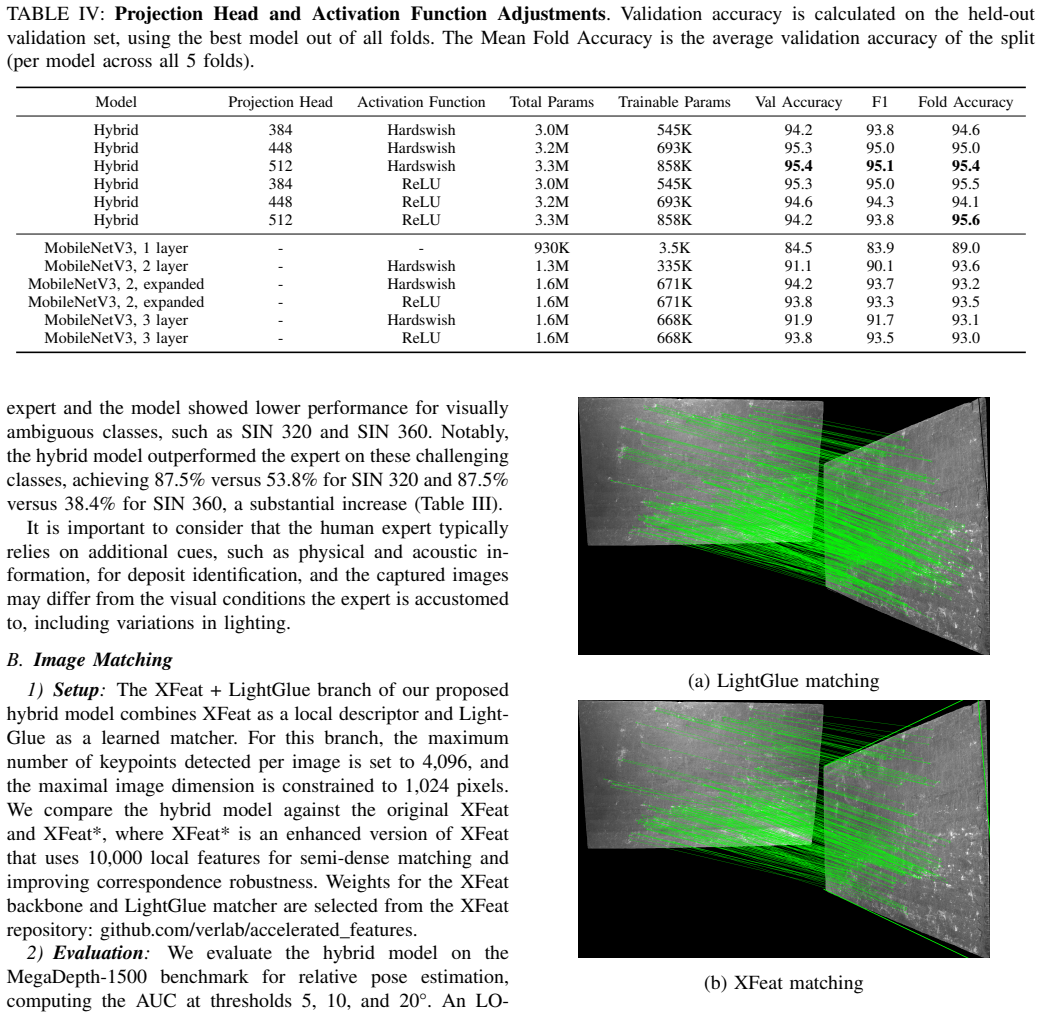
- Abstract and §IV-A3 claim a “+10.9% accuracy improvement over a standard MobileNetV3 model” (95.4% vs 84.5%). Table IV shows that 84.5% is the single linear-layer MobileNet (3.5k trainable parameters). Capacity-matched MobileNet heads already reach 94.2% (2-layer expanded HardSwish, 671k trainable), leaving only a ~1.2-point residual over the best hybrid (95.4%, 858k trainable). The central fusion-credit claim therefore does not survive a fair baseline comparison; the abstract and strongest claim must be revised to report the residual gain against the strongest MobileNet head, or an ablation that isolates complementarity after capacity matching must be added.
- §IV-A1 freezes both pretrained backbones and trains only the projection/fusion heads on 837 images per fold. No unfrozen or partially-unfrozen ablation is reported, nor is any domain-shift analysis (lighting, wear, cutting artifacts) provided. Because every accuracy number rests on this protocol, the paper needs either (a) an unfrozen-backbone control or (b) an explicit statement that the reported gains are conditional on frozen ImageNet/MegaDepth features and may not generalize under full fine-tuning or larger domain shift.
minor comments (5)
- Table IV “Fold Accuracy” column is not defined in the caption or text; clarify whether it is mean or max over the five folds.
- §II-D and Table I describe a reduced LightGlue (6 layers, 1 head) but give no ablation versus the original 9-layer/4-head configuration on either MegaDepth or the slate set.
- Fig. 2 caption and §II-D state that features are “shared and fused,” yet the matching branch never uses MobileNet features; the wording should distinguish shared XFeat descriptors from true bidirectional fusion.
- Typographical inconsistencies: “evolutions” (p. 2), “Hardswish” vs “HardSwish,” and missing spaces before units in Table VII.
- The human-expert protocol (§III-B) is valuable but underspecified: were images shown at full resolution, with or without the black background, and under the same lighting as training?
Circularity Check
No significant circularity: empirical hybrid model with external pretrained backbones evaluated on held-out data and public benchmarks.
full rationale
This is a standard empirical computer-vision methods paper. The hybrid architecture fuses frozen pretrained XFeat descriptors with MobileNetV3 embeddings (plus a LightGlue head) and trains only the projection/fusion layers on the authors' slate dataset. Reported gains (+15.4 % AUC@10° on MegaDepth-1500 versus the original XFeat matcher; +10.9 % accuracy versus a single-layer MobileNetV3 baseline on the held-out slate validation set) are ordinary supervised-learning measurements against independent test sets. No quantity is fitted to data and then re-presented as a 'prediction' of a closely related quantity; no uniqueness theorem or ansatz is imported via self-citation; no definitional identity equates an input to an output. Self-references are limited to describing the authors' own architecture, which is normal and non-circular for a methods contribution. The paper is therefore self-contained against external benchmarks and free of the six circularity patterns.
Axiom & Free-Parameter Ledger
free parameters (4)
- projection-head output dimension =
512 (best)
- LightGlue layers/heads =
6 layers, 1 head
- learning rate / weight decay / dropout =
0.001 / 0.999 / 0.2
- max keypoints / image size for matching =
4096 / 1024
axioms (3)
- domain assumption ImageNet-pretrained MobileNetV3 and MegaDepth-pretrained XFeat features remain sufficiently domain-transferable when only the fusion/matching heads are trained on slate images.
- domain assumption Top-down and side-view pairs of the same physical plate constitute valid positive matches for re-identification evaluation.
- standard math Cross-entropy loss on 6-class labels plus standard geometric/photometric augmentations yields a meaningful ranking of architectures.
invented entities (1)
-
Hybrid XFeat–MobileNetV3 fusion head with shared projection + two-layer classifier
no independent evidence
read the original abstract
Applying deep learning to instance-aware reidentification of slate tiles and extraction site classification can improve production efficiency and quality control in the slate tile industry. These tasks are particularly important for handling natural materials where visual variability can make manual inspection costly and error-prone. We present a lightweight, hybrid deep learning approach that combines image matching and classification within a single framework. The system integrates a feature-matching branch based on XFeat with a MobileNetV3- based classification branch. The XFeat branch, combined with a LightGlue matching head, improves instance matching performance by +15.4% AUC. For classification, features from both backbones are shared and fused, resulting in a +10.9% accuracy improvement over a standard MobileNetV3 model. Our approach is evaluated on a newly created industrial dataset consisting of 2,610 slate tile images from six extraction sites. The results demonstrate the effectiveness of the proposed approach for object re-identification and classification in an industrial setting.
Figures


Reference graph
Works this paper leans on
-
[1]
Understanding the Benefits of Natural Slate |Slate Association,
T. Cotney, “Understanding the Benefits of Natural Slate |Slate Association,” Nov. 2022
2022
-
[2]
C406C406M-15 Standard Specification For Roofing Slate|PDF|Roof|Slate
“C406C406M-15 Standard Specification For Roofing Slate|PDF|Roof|Slate.” https://www.scribd.com/document/977268380/C406C406M- 15-Standard-Specification-for-Roofing-Slate
-
[3]
Tacit knowledge elicitation process for industry 4.0,
E. Fenoglio, E. Kazim, H. Latapie, and A. Koshiyama, “Tacit knowledge elicitation process for industry 4.0,” Discover Artificial Intelligence, vol. 2, p. 6, Mar. 2022
2022
-
[4]
How and why we need to capture tacit knowledge in man- ufacturing: Case studies of visual inspection,
T. Johnson, S. Fletcher, W. Baker, and R. Charles, “How and why we need to capture tacit knowledge in man- ufacturing: Case studies of visual inspection,”Applied Ergonomics, vol. 74, pp. 1–9, Jan. 2019
2019
-
[5]
Slate detection in orthophotos of building roof panels,
J. Li, F. Bosche, C. X. Lu, L. Wilson, and B. Tao, “Slate detection in orthophotos of building roof panels,” 2025
2025
-
[6]
Deep learning-based automated tile defect detection system for Portuguese cultural heritage buildings,
N. Karimi, M. Mishra, and P. B. Lourenc ¸o, “Deep learning-based automated tile defect detection system for Portuguese cultural heritage buildings,”Journal of Cultural Heritage, vol. 68, pp. 86–98, July 2024
2024
-
[7]
RoMa: Robust Dense Feature Matching,
J. Edstedt, Q. Sun, G. B ¨okman, M. Wadenb ¨ack, and M. Felsberg, “RoMa: Robust Dense Feature Matching,” inCVPR 2024, arXiv, Dec. 2023
2024
-
[8]
SuperGlue: Learning Feature Matching with Graph Neural Networks,
P.-E. Sarlin, D. DeTone, T. Malisiewicz, and A. Ra- binovich, “SuperGlue: Learning Feature Matching with Graph Neural Networks,” inCVPR 2020, arXiv, Mar. 2020
2020
-
[9]
Deep Residual Learning for Image Recognition,
K. He, X. Zhang, S. Ren, and J. Sun, “Deep Residual Learning for Image Recognition,” Dec. 2015
2015
-
[10]
XFeat: Accelerated Features for Lightweight Image Matching,
G. Potje, F. Cadar, A. Araujo, R. Martins, and E. R. Nascimento, “XFeat: Accelerated Features for Lightweight Image Matching,” inCVPR 2024, no. arXiv:2404.19174, Apr. 2024
Pith/arXiv arXiv 2024
-
[11]
Searching for MobileNetV3,
A. Howard, M. Sandler, G. Chu, L.-C. Chen, B. Chen, M. Tan, W. Wang, Y . Zhu, R. Pang, V . Vasudevan, Q. V . Le, and H. Adam, “Searching for MobileNetV3,”ICCV 2019, Nov. 2019
2019
-
[12]
Light- Glue: Local Feature Matching at Light Speed,
P. Lindenberger, P.-E. Sarlin, and M. Pollefeys, “Light- Glue: Local Feature Matching at Light Speed,” inICCV 2023, no. arXiv:2306.13643, June 2023
Pith/arXiv arXiv 2023
-
[13]
MegaDepth: Learning Single- View Depth Prediction from Internet Photos,
Z. Li and N. Snavely, “MegaDepth: Learning Single- View Depth Prediction from Internet Photos,” inCVPR 2018, arXiv, Nov. 2018
2018
-
[14]
Gradient-based learning applied to document recogni- tion,
Y . Lecun, L. Bottou, Y . Bengio, and P. Haffner, “Gradient-based learning applied to document recogni- tion,”Proceedings of the IEEE, vol. 86, pp. 2278–2324, Nov. 1998
1998
-
[15]
Microsoft COCO: Common Objects in Context,
T.-Y . Lin, M. Maire, S. Belongie, L. Bourdev, R. Gir- shick, J. Hays, P. Perona, D. Ramanan, C. L. Zitnick, and P. Doll ´ar, “Microsoft COCO: Common Objects in Context,” Feb. 2015
2015
-
[16]
Su- perPoint: Self-Supervised Interest Point Detection and Description,
D. DeTone, T. Malisiewicz, and A. Rabinovich, “Su- perPoint: Self-Supervised Interest Point Detection and Description,” inCVPR 2018, arXiv, Apr. 2018
2018
-
[17]
ImageNet classification with deep convolutional neural networks,
A. Krizhevsky, I. Sutskever, and G. E. Hinton, “ImageNet classification with deep convolutional neural networks,” Communications of the ACM, vol. 60, pp. 84–90, May 2017
2017
-
[18]
MobileNetV2: Inverted Residuals and Linear Bottlenecks,
M. Sandler, A. Howard, M. Zhu, A. Zhmoginov, and L.- C. Chen, “MobileNetV2: Inverted Residuals and Linear Bottlenecks,” inCVPR 2018, arXiv, Mar. 2019
2018
-
[19]
MobileNets: Efficient Convolutional Neural Networks for Mobile Vision Applications,
A. G. Howard, M. Zhu, B. Chen, D. Kalenichenko, W. Wang, T. Weyand, M. Andreetto, and H. Adam, “MobileNets: Efficient Convolutional Neural Networks for Mobile Vision Applications,” Apr. 2017
2017
-
[20]
MnasNet: Platform-Aware Neural Architecture Search for Mobile,
M. Tan, B. Chen, R. Pang, V . Vasudevan, M. Sandler, A. Howard, and Q. V . Le, “MnasNet: Platform-Aware Neural Architecture Search for Mobile,” inCVPR 2019, arXiv, May 2019
2019
-
[21]
GlueStick: Robust Image Matching by Sticking Points and Lines Together,
R. Pautrat, I. Su ´arez, Y . Yu, M. Pollefeys, and V . Larsson, “GlueStick: Robust Image Matching by Sticking Points and Lines Together,” inICCV 2023, Oct. 2023
2023
-
[22]
SAM 2: Segment Any- thing in Images and Videos,
N. Ravi, V . Gabeur, Y .-T. Hu, R. Hu, C. Ryali, T. Ma, H. Khedr, R. R¨adle, C. Rolland, L. Gustafson, E. Mintun, J. Pan, K. V . Alwala, N. Carion, C.-Y . Wu, R. Girshick, P. Doll´ar, and C. Feichtenhofer, “SAM 2: Segment Any- thing in Images and Videos,” Oct. 2024
2024
-
[23]
Steerers: A framework for rotation equivariant keypoint descriptors,
G. B ¨okman, J. Edstedt, M. Felsberg, and F. Kahl, “Steerers: A framework for rotation equivariant keypoint descriptors,” inCVPR 2024, arXiv, Apr. 2024
2024
discussion (0)
Sign in with ORCID, Apple, or X to comment. Anyone can read and Pith papers without signing in.