REVIEW 4 major objections 7 minor 45 references
Buffering ambiguous unlabeled samples with temporary virtual categories lets continual open-world vision systems discover new classes without locking in early label noise.
Reviewed by Pith at T0; open to challenge. T0 means a machine referee read the full paper against a public rubric. the ladder, T0–T4 →
T0 review · grok-4.5
2026-07-11 10:31 UTC pith:YUNTGA2J
load-bearing objection Solid empirical C-GCD method paper: VCL adaptation plus expanded-neighborhood contrastive learning beats Happy et al. on the usual benchmarks, but the advertised “adaptive margin” never appears in the equations. the 4 major comments →
Virtual Category-Guided Continual Generalized Category Discovery
The pith
A machine-rendered reading of the paper's core claim, the machinery that carries it, and where it could break.
Core claim
Assigning ambiguous unlabeled samples to temporary virtual categories, instead of hard known/novel pseudo-labels, lets a C-GCD model safely exploit uncertain data across sessions; when this Virtual Category Learning is paired with Expanded Neighborhood Contrastive Learning, the resulting representations remain more discriminative for both old and emerging classes and consistently outperform prior C-GCD methods.
What carries the argument
Virtual Category Learning (VCL): a Potential Category set is formed from the top-2 probability gap and teacher-student disagreement; samples with multiple candidates are supervised toward a temporary virtual classifier weight rather than any real class, so they contribute structure without noisy hard labels. Expanded Neighborhood Contrastive Learning then regularizes the evolving features by treating neighbors-of-neighbors as positives under an adaptive margin.
Load-bearing premise
The rule that flags a sample as confusing (top-2 gap plus teacher-student disagreement at a fixed threshold) correctly identifies which unlabeled points should be buffered by a virtual category rather than hard-assigned, and that this rule stays reliable as features drift across sessions with no replay of past data.
What would settle it
On the same C-GCD splits, replace the Potential Category construction with a simple confidence threshold or random selection of virtual-category samples; if overall accuracy, novel-class discovery (Md) and forgetting (Mf) then match or exceed the reported results, the claim that the specific ambiguity buffer is necessary collapses.
Editorial analysis
A structured set of objections, weighed in public.
Referee Report
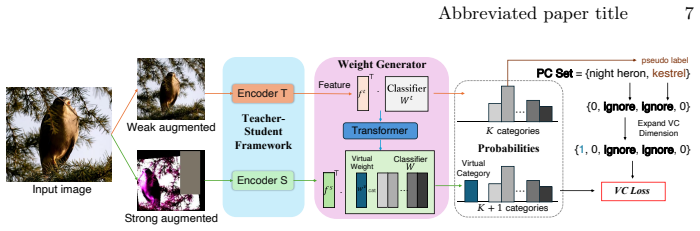
Summary. The paper proposes Virtual Category-Guided Continual Generalized Category Discovery (VC-CGCD). After an offline labeled initialization, the model processes sequential unlabeled sessions that mix old and novel classes without rehearsal. The core idea is to adapt Virtual Category Learning (VCL) so that ambiguous unlabeled samples—identified via top-2 prediction competition (Eq. 1) and teacher–student label inconsistency—are assigned to temporary virtual categories rather than hard pseudo-labels (Eqs. 2–5), thereby reducing confirmation bias and improving unlabeled-data utilization. This is combined with Expanded Neighborhood Contrastive Learning (ENCL), which expands k-NN positives to neighbors-of-neighbors (Eqs. 6–9) and is claimed to use an adaptive margin for better old/new separation. The joint objective (Eq. 10) is instantiated on a C-GCD baseline. Experiments on CIFAR-100, Tiny-ImageNet, and ImageNet-100 (plus CUB and recent baselines in the supplement) report consistent gains in All/Old/New accuracy, discovery metric Md, and competitive forgetting Mf over Happy, MetaGCD, GM, and others, with ablations attributing gains to both modules.
Significance. C-GCD is a practically relevant open-world setting, and the paper correctly identifies brittle pseudo-labeling of boundary samples as a central failure mode under non-rehearsal continual streams. Adapting virtual categories as a soft buffer for uncertain samples is a coherent and transferable idea; the empirical package is relatively strong for the area (session-wise tables, Md/Mf, 10-session extension, component ablations, sensitivity, stds, MetaGCD plug-in, fine-grained CUB, and a public code link). If the method is fully specified and the gains hold under independent reimplementation, this is a solid incremental contribution to continual open-set recognition rather than a foundational theoretical advance. Credit is due for the breadth of empirical checks and for making the training loop explicit in the supplement (Algorithm 1).
major comments (4)
- Abstract, Introduction, and §3.3: ENCL is repeatedly described as using “an adaptive margin” (also attributed to AMEND [2]) to improve separation of old and emerging classes. In the actual formalization (Eqs. 6–9 and the total loss Eq. 10), only temperature-scaled expanded-neighborhood InfoNCE with weight β appears; no margin term, adaptive schedule, or hyperparameter is defined, listed in Implementation Details, or ablated. This is a load-bearing claim–method mismatch: either the adaptive margin must be written into the equations and training protocol (and preferably ablated), or the abstract/intro/contribution bullets must be revised so that reported gains are not attributed to a component that is not present.
- §3.2, Potential Category Set and Eq. (1): The construction of the PC set is under-specified for reproducibility. D_top2 is defined, and teacher–student label disagreement is mentioned, but the manuscript does not give the exact decision rule (e.g., whether D_top2 is thresholded at the default 0.15 from Table 5, how the two cues are combined, which labels enter the PC set, and whether PC membership is recomputed every iteration). Because VCL’s safety claim rests on correctly buffering only confusing samples, an algorithmic definition (or pseudocode expansion of Algorithm 1’s top_k_candidates) is needed; Table 5 alone does not substitute for the rule used in the main runs.
- §3.2, Eqs. (2)–(5) and Fig. 3: How the virtual category interacts with the expanding label space across sessions is incomplete. The classifier is extended by a virtual weight wv from a self-attention transformer, and ℓ_VC excludes PC categories while supervising the virtual logit; it is unclear (i) whether one virtual class is shared or session-/sample-specific, (ii) how K (number of predicted categories) is obtained or updated when novel classes appear, and (iii) the mechanism by which samples “graduate” from virtual to semantic categories rather than remaining buffered. Without this, the claimed progressive consolidation of ambiguous samples under continual drift is hard to verify or reimplement.
- Table 1 / Table 4 / §4.2: Causal attribution of New accuracy and Md gains to “VCL + ENCL” is only partially supported. Ablations show both modules help, but ENCL as written is ordinary expanded-neighbor contrastive learning; several strong baselines already use neighborhood or contrastive terms. A controlled comparison that isolates expanded neighborhood vs. standard k-NN contrastive (and, if retained, vs. adaptive margin) on the same baseline would make the mechanism claim proportionate to the empirical superiority over Happy.
minor comments (7)
- Eq. (12) / (A2): “ACC^t_noval” is a typo for “novel”; fix consistently in main text and supplement.
- Fig. 1 caption and pipeline: symbols (L_baseline, L_s, L_EN, L_VC) are hard to read in the rendered figure; align notation with Eq. (10).
- §3.4: L_baseline is deferred to [15] without even a one-line statement of what is retained (e.g., debiasing / pseudo-label CE). A short restatement would help readers who do not have Happy open.
- Table 1: Offline All for “Ours” sometimes differs slightly from baselines that share the same backbone (e.g., C100 90.64 vs 90.36/90.82); briefly note whether offline training is identical or re-run.
- Related Work / citations: AMEND [2] is the stated inspiration for ENCL; make explicit which components were kept vs. dropped to avoid implying full method transfer.
- Supplement Algorithm 1: uses Adam lr=1e-3 while §4.1 states lr=0.01; reconcile implementation details.
- Writing: occasional spacing artifacts (“ContinualGeneralized”, “unlabeledcontinualupdates”) and “Abbreviated paper title” running headers should be cleaned for camera-ready.
Circularity Check
Empirical C-GCD method with no derivation that reduces by construction; only a minor descriptive mismatch on the advertised adaptive margin.
specific steps
-
other
[Abstract; §1 (intro); §3.3 Eqs. 6–9 and Eq. 10]
"we augment VCL with Expanded Neighborhood Contrastive Learning (ENCL), which exploits extended neighborhood relations and an adaptive margin to learn more discriminative and well-separated representations... LEN = ∑i∈B (ℓN + β ℓEN). ... L = LVC + λ1 LEN + λ2 Lbaseline"
Not a true circular derivation: the paper never claims a mathematical prediction that reduces to a fitted margin. It simply advertises an “adaptive margin” (citing AMEND) while the written ENCL equations and training objective contain only neighborhood expansion and temperature-scaled contrastive terms. The empirical gains are still measured against held-out baselines and ablations; the mismatch is incomplete specification of the second module, not a self-definitional or fitted-input loop. Flagged only for completeness under the reader/skeptic note.
full rationale
The paper is an empirical systems contribution: it adapts Virtual Category Learning (VCL) from semi-supervised dense prediction and Expanded Neighborhood Contrastive Learning (inspired by AMEND) to Continual Generalized Category Discovery, then evaluates held-out session accuracies (All/Old/New), forgetting Mf, and discovery Md against external baselines (Happy, MetaGCD, GM, etc.) on CIFAR-100, Tiny-ImageNet, and ImageNet-100. The strongest claims are comparative performance numbers, not first-principles predictions. Hyperparameters (ambiguity threshold 0.15, neighborhood size 3, β/λ1/λ2) are selected via validation and held fixed; the reported metrics are not algebraic restatements of those choices. Ablations (Table 4, Table D6) and sensitivity (Table 5) further separate the contribution of each module from the tuning. There is no self-definitional loop, no fitted parameter renamed as a prediction, no uniqueness theorem imported from the authors, and no load-bearing self-citation chain. The sole minor issue is that the abstract and introduction advertise ENCL as using “an adaptive margin,” yet §3.3 (Eqs. 6–9) and the overall objective (Eq. 10) contain only expanded-neighborhood contrastive terms with temperature τ and weight β; no margin term appears. That is incomplete description / over-claim of mechanism, not circularity of derivation. Score 1 reflects this single non-load-bearing descriptive gap; the empirical chain itself is self-contained against external benchmarks.
Axiom & Free-Parameter Ledger
free parameters (4)
- ambiguity threshold for PC set (top-2 gap) =
0.15
- ENCL neighborhood size / expansion factor m =
3
- loss weights β, λ1, λ2 =
β=0.1, λ1=0.8, λ2=1.0
- temperature τ and k for k-NN
axioms (4)
- domain assumption C-GCD protocol: offline labeled init on 50% classes (80% samples), then sequential unlabeled sessions mixing old and new without rehearsal.
- ad hoc to paper Teacher-student prediction inconsistency plus top-2 competition are sufficient cues to mark samples that should not receive hard pseudo-labels.
- domain assumption Temporary virtual classifier weights generated by a self-attention transformer can absorb ambiguous samples without harming known/novel separation long-term.
- domain assumption Neighbors-of-neighbors remain valid positives under continual representation drift.
invented entities (3)
-
Potential Category (PC) set for C-GCD
no independent evidence
-
Virtual category weight wv (session-wise temporary class)
no independent evidence
-
Expanded neighborhood EM(xi)
no independent evidence
read the original abstract
Continual Generalized Category Discovery (C-GCD) aims to incrementally identify novel categories from sequential unlabeled data while preserving recognition of known classes, which is an essential capability for open-world visual learning. A major bottleneck lies in ambiguous unlabeled samples that cannot be confidently assigned to known classes nor reliably grouped as novel ones, making pseudo-labeling brittle and often biasing learning toward familiar categories. In this work, we introduce Virtual Category-Guided Continual Generalized Category Discovery by adapting Virtual Category Learning (VCL) to the continual setting. Our method identifies uncertain samples and assigns them to temporary virtual categories, enabling safe and informative learning from unlabeled streams without injecting noisy labels, while improving unlabeled data utilization and mitigating prediction bias. To further stabilize discovery across sessions and enhance class separation, we augment VCL with Expanded Neighborhood Contrastive Learning (ENCL), which exploits extended neighborhood relations and an adaptive margin to learn more discriminative and well-separated representations for both old and emerging classes. Extensive experiments on CIFAR-100, Tiny ImageNet, and ImageNet-100 demonstrate that our approach consistently outperforms state-of-the-art methods, establishing a scalable and effective solution for C-GCD.
Figures




Reference graph
Works this paper leans on
-
[1]
Technical report, University of Toronto , year=
Learning multiple layers of features from tiny images , author=. Technical report, University of Toronto , year=
-
[2]
CS 231N , volume=
Tiny imagenet visual recognition challenge , author=. CS 231N , volume=
-
[3]
2009 IEEE Conference on Computer Vision and Pattern Recognition , pages=
Imagenet: A large-scale hierarchical image database , author=. 2009 IEEE Conference on Computer Vision and Pattern Recognition , pages=. 2009 , organization=
2009
-
[4]
Advances in Neural Information Processing Systems , volume=
Happy: A debiased learning framework for continual generalized category discovery , author=. Advances in Neural Information Processing Systems , volume=
-
[5]
Advances in Neural Information Processing Systems , volume=
Grow and merge: A unified framework for continuous categories discovery , author=. Advances in Neural Information Processing Systems , volume=
-
[6]
arXiv preprint arXiv:2010.11929 , year=
An image is worth 16x16 words: Transformers for image recognition at scale , author=. arXiv preprint arXiv:2010.11929 , year=
Pith/arXiv arXiv 2010
-
[7]
Proceedings of the IEEE/CVF International Conference on Computer Vision , pages=
Learning to discover novel visual categories via deep transfer clustering , author=. Proceedings of the IEEE/CVF International Conference on Computer Vision , pages=
-
[8]
Proceedings of the IEEE/CVF Conference on Computer Vision and Pattern Recognition , pages=
Generalized category discovery , author=. Proceedings of the IEEE/CVF Conference on Computer Vision and Pattern Recognition , pages=
-
[9]
European Conference on Computer Vision , pages=
Self-cooperation knowledge distillation for novel class discovery , author=. European Conference on Computer Vision , pages=. 2024 , organization=
2024
-
[10]
Proceedings of the IEEE/CVF Conference on Computer Vision and Pattern Recognition , pages=
icarl: Incremental classifier and representation learning , author=. Proceedings of the IEEE/CVF Conference on Computer Vision and Pattern Recognition , pages=
-
[11]
Advances in Neural Information Processing Systems , volume=
Gradient episodic memory for continual learning , author=. Advances in Neural Information Processing Systems , volume=
-
[12]
arXiv preprint arXiv:2504.04804 , year=
Debgcd: Debiased learning with distribution guidance for generalized category discovery , author=. arXiv preprint arXiv:2504.04804 , year=
-
[13]
Proceedings of the IEEE/CVF Winter Conference on Applications of Computer Vision , pages=
Amend: Adaptive margin and expanded neighborhood for efficient generalized category discovery , author=. Proceedings of the IEEE/CVF Winter Conference on Applications of Computer Vision , pages=
-
[14]
IEEE Transactions on Pattern Analysis and Machine Intelligence , year=
Protogcd: Unified and unbiased prototype learning for generalized category discovery , author=. IEEE Transactions on Pattern Analysis and Machine Intelligence , year=
-
[15]
Proceedings of the IEEE/CVF International Conference on Computer Vision , pages=
Metagcd: Learning to continually learn in generalized category discovery , author=. Proceedings of the IEEE/CVF International Conference on Computer Vision , pages=
-
[16]
European Conference on Computer Vision , pages=
Class-incremental novel class discovery , author=. European Conference on Computer Vision , pages=. 2022 , organization=
2022
-
[17]
Some methods of classification and analysis of multivariate observations , author=. Proc. of 5th Berkeley Symposium on Math. Stat. and Prob. , pages=
-
[18]
Proceedings of the IEEE/CVF International Conference on Computer Vision , pages=
Parametric classification for generalized category discovery: A baseline study , author=. Proceedings of the IEEE/CVF International Conference on Computer Vision , pages=
-
[19]
Proceedings of the IEEE/CVF Conference on Computer Vision and Pattern Recognition , pages=
Deep residual learning for image recognition , author=. Proceedings of the IEEE/CVF Conference on Computer Vision and Pattern Recognition , pages=
-
[20]
arXiv preprint arXiv:1409.1556 , year=
Very deep convolutional networks for large-scale image recognition , author=. arXiv preprint arXiv:1409.1556 , year=
-
[21]
Advances in Neural Information Processing Systems , volume=
Meta-learning representations for continual learning , author=. Advances in Neural Information Processing Systems , volume=
-
[22]
Psychology of Learning and Motivation , volume=
Catastrophic interference in connectionist networks: The sequential learning problem , author=. Psychology of Learning and Motivation , volume=
-
[23]
Advances in Neural Information Processing Systems , volume=
Acil: Analytic class-incremental learning with absolute memorization and privacy protection , author=. Advances in Neural Information Processing Systems , volume=
-
[24]
IEEE Transactions on Pattern Analysis and Machine Intelligence , volume=
Virtual category learning: A semi-supervised learning method for dense prediction with extremely limited labels , author=. IEEE Transactions on Pattern Analysis and Machine Intelligence , volume=
-
[25]
arXiv preprint arXiv:2208.02764 , year=
Opencon: Open-world contrastive learning , author=. arXiv preprint arXiv:2208.02764 , year=
-
[26]
arXiv preprint arXiv:1807.03748 , year=
Representation learning with contrastive predictive coding , author=. arXiv preprint arXiv:1807.03748 , year=
-
[27]
Proceedings of the IEEE/CVF Conference on Computer Vision and Pattern Recognition , pages=
Neighborhood contrastive learning for novel class discovery , author=. Proceedings of the IEEE/CVF Conference on Computer Vision and Pattern Recognition , pages=
-
[28]
Proceedings of the IEEE/CVF Conference on Computer Vision and Pattern Recognition , pages=
Dynamic conceptional contrastive learning for generalized category discovery , author=. Proceedings of the IEEE/CVF Conference on Computer Vision and Pattern Recognition , pages=
-
[29]
Proceedings of the IEEE/CVF Conference on Computer Vision and Pattern Recognition , pages=
Promptcal: Contrastive affinity learning via auxiliary prompts for generalized novel category discovery , author=. Proceedings of the IEEE/CVF Conference on Computer Vision and Pattern Recognition , pages=
-
[30]
Proceedings of the IEEE/CVF International Conference on Computer Vision , pages=
Joint representation learning and novel category discovery on single-and multi-modal data , author=. Proceedings of the IEEE/CVF International Conference on Computer Vision , pages=
-
[31]
IEEE Transactions on Cybernetics , volume=
Progressive self-supervised clustering with novel category discovery , author=. IEEE Transactions on Cybernetics , volume=. 2021 , publisher=
2021
-
[32]
Proceedings of the AAAI Conference on Artificial Intelligence , volume=
Self-labeling framework for novel category discovery over domains , author=. Proceedings of the AAAI Conference on Artificial Intelligence , volume=
-
[33]
Proceedings of the IEEE/CVF International Conference on Computer Vision , pages=
Boosting novel category discovery over domains with soft contrastive learning and all in one classifier , author=. Proceedings of the IEEE/CVF International Conference on Computer Vision , pages=
-
[34]
Proceedings of the AAAI Conference on Artificial Intelligence , volume=
Generalized category discovery with decoupled prototypical network , author=. Proceedings of the AAAI Conference on Artificial Intelligence , volume=
-
[35]
arXiv preprint arXiv:2401.05353 , year=
ImbaGCD: Imbalanced generalized category discovery , author=. arXiv preprint arXiv:2401.05353 , year=
-
[36]
Proceedings of the IEEE/CVF International Conference on Computer Vision , pages=
Parametric information maximization for generalized category discovery , author=. Proceedings of the IEEE/CVF International Conference on Computer Vision , pages=
-
[37]
Proceedings of the IEEE/CVF Winter Conference on Applications of Computer Vision , pages=
Guided cluster aggregation: A hierarchical approach to generalized category discovery , author=. Proceedings of the IEEE/CVF Winter Conference on Applications of Computer Vision , pages=
-
[38]
European Conference on Computer Vision , pages=
Openldn: Learning to discover novel classes for open-world semi-supervised learning , author=. European Conference on Computer Vision , pages=. 2022 , organization=
2022
-
[39]
arXiv preprint arXiv:2002.07394 , year=
Dividemix: Learning with noisy labels as semi-supervised learning , author=. arXiv preprint arXiv:2002.07394 , year=
Pith/arXiv arXiv 2002
-
[40]
arXiv preprint arXiv:2101.06329 , year=
In defense of pseudo-labeling: An uncertainty-aware pseudo-label selection framework for semi-supervised learning , author=. arXiv preprint arXiv:2101.06329 , year=
-
[41]
Advances in neural information processing systems , volume=
Flexmatch: Boosting semi-supervised learning with curriculum pseudo labeling , author=. Advances in neural information processing systems , volume=
-
[42]
Expert Systems with Applications , volume=
Multi-view contrastive learning with maximal mutual information for continual generalized category discovery , author=. Expert Systems with Applications , volume=. 2025 , publisher=
2025
-
[43]
Proceedings of the 33rd ACM International Conference on Multimedia , pages=
Tree of Prompts: Aligning Hierarchical Visual Prior for Continual Generalized Category Discovery , author=. Proceedings of the 33rd ACM International Conference on Multimedia , pages=
-
[44]
The caltech-ucsd birds-200-2011 dataset , author=
2011
-
[45]
IEEE Transactions on Image Processing , volume=
Data-Free Class-Incremental Gesture Recognition With Prototype-Guided Pseudo-Feature Replay , author=. IEEE Transactions on Image Processing , volume=. 2026 , publisher=
2026
discussion (0)
Sign in with ORCID, Apple, or X to comment. Anyone can read and Pith papers without signing in.