REVIEW 2 major objections 4 minor 20 references
Overlaying green traversable and red non-traversable regions on camera images cuts far-waypoint error in vision-language-action navigation by 27–44% without retraining the policy.
Reviewed by Pith at T0; open to challenge. T0 means a machine referee read the full paper against a public rubric. the ladder, T0–T4 →
T0 review · grok-4.5
2026-07-11 08:28 UTC pith:VNSNXO7A
load-bearing objection Clean first empirical look at green/red SegFormer grounding for a navigation VLA; the length-regularizer diagnosis is the real finding, but the evaluation is open-loop on one cleaned indoor episode. the 2 major comments →
Green for Go, Red for No: Visual Grounding via Semantic Segmentation for VLA Navigation Policies
The pith
A machine-rendered reading of the paper's core claim, the machinery that carries it, and where it could break.
Core claim
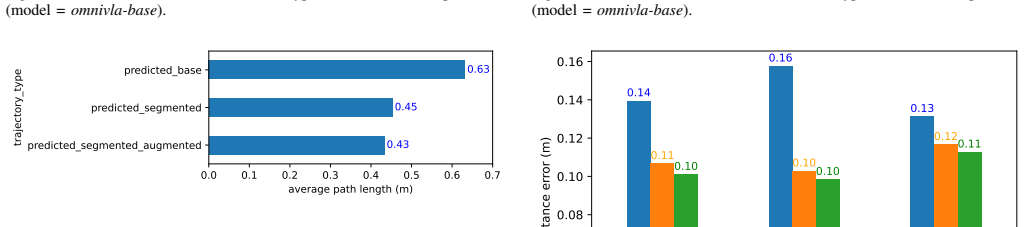
On the Grand Tour indoor episode with OmniVLA, segmentation-based visual grounding reduces mean Euclidean error at the farthest of seven waypoints by 27–44% relative to the ungrounded baseline, with larger gains for long language instructions than short ones and almost none for image goals. Normalized by path length the advantage vanishes, showing that the overlays primarily regularize trajectory length downward by roughly 30% rather than improving spatial reasoning per unit distance. The same grounding cannot force a zero-displacement trajectory for the out-of-distribution command “stop.”
What carries the argument
Real-time SegFormer binary segmentation that paints traversable pixels green and non-traversable pixels red, then feeds the overlaid observation (and optionally an augmented goal) into an otherwise frozen VLA policy.
Load-bearing premise
That open-loop waypoint-error cuts measured on one cleaned indoor episode will hold for closed-loop driving, unseen places, and dynamic obstacles.
What would settle it
Run the same green/red pipeline closed-loop on several held-out Grand Tour or outdoor episodes that retain stairs, moving people, and explicit “stop” goals; if task success and far-waypoint error do not improve, or if normalized error stays worse than baseline, the central claim fails.
If this is right
- Language-goal VLA navigation can be improved at deployment time by a single off-the-shelf segmenter, without any gradient updates.
- Image-goal navigation gains almost nothing from the same overlay, so grounding effort should be concentrated on language modalities.
- Longer, more descriptive instructions already lower error; grounding amplifies that advantage rather than replacing it.
- Atomic commands missing from training data (especially “stop”) remain broken even after perfect visual cues, so data coverage is still required.
Where Pith is reading between the lines
- If the length-regularization effect is the main benefit, simpler non-semantic cues (edge maps, free-space distance fields) might deliver similar gains at lower cost.
- The failure on stationary goals suggests future VLA training sets should deliberately include zero-motion and “wait” demonstrations rather than only forward trajectories.
- Color-coded overlays that work for one vision encoder may invert or vanish for another; a systematic encoder sweep would reveal how general the green/red heuristic really is.
Editorial analysis
A structured set of objections, weighed in public.
Referee Report
Summary. The paper presents the first empirical evaluation of visual grounding for vision-language-action (VLA) navigation policies. It proposes a real-time SegFormer-based pipeline that overlays green (traversable) and red (non-traversable) masks on egocentric observations, with two variants: observation-only grounding and joint observation-goal augmentation (language append or image overlay). Using OmniVLA on the Grand Tour ETH-2 episode, the authors report 27–44% reductions in mean Euclidean error at the farthest waypoint (WP7) for language goals (larger for long instructions), little benefit for image goals, and a ~30% shortening of predicted trajectories. Normalized-error analysis shows that grounding primarily acts as a trajectory-length regularizer rather than improving per-unit-distance spatial reasoning. The “stop” instruction failure mode is identified as unsolved by grounding.
Significance. If the open-loop gains hold under closed-loop evaluation, the work supplies a simple, training-free, real-time intervention that improves existing VLA navigation policies without retraining. The honest length-regularizer diagnosis, the instruction-length disaggregation (Table I), and the explicit documentation of the “stop” failure are useful contributions to the VLA literature. The method satisfies the practical constraints of real-time inference, open-vocabulary generalization, and multimodal goals, and therefore has clear engineering value even if the scientific claim remains provisional.
major comments (2)
- §V-A/B and abstract/conclusion: The central claim that grounding “improves VLA navigation” rests solely on open-loop Euclidean waypoint error on a single indoor episode (ETH-2) after post-hoc removal of all stair segments (SegFormer marks them non-traversable) and all “stop” segments. No closed-loop collision rate, goal-reaching success, or recovery metric is reported. Because the evaluation deliberately excludes the cases the method fails on, the 27–44% WP7 reductions cannot yet be taken as evidence of improved navigation; they may be an artifact of the static, floor-only subset. At minimum the abstract and conclusion must be rephrased to “open-loop waypoint error on static floor segments,” and a closed-loop experiment (or a clear statement that none was performed) is required for the navigation claim.
- §V-B, Fig. 3–4 and Table I: The normalized-error analysis correctly shows that absolute gains disappear once path length is controlled for, and that grounded trajectories are ~30% shorter. This length-regularizer mechanism is load-bearing for the interpretation of the result. The manuscript should quantify whether the shorter paths remain goal-directed (e.g., progress toward the language/image goal) or simply become more conservative; otherwise the practical navigation benefit remains ambiguous even under the open-loop metric.
minor comments (4)
- §IV: The free parameters of the overlay (exact green/red hues, blending opacity) and the precise wording of the appended language phrase are not specified; a short reproducibility note would help.
- Fig. 2 vs. Fig. 4: Axis labels and captions could more clearly distinguish absolute versus length-normalized error so that the regularizer diagnosis is immediately visible.
- Table II: Several language goals contain minor grammatical inconsistencies (“Go forward between the pillar”); cleaning them would improve readability of the appendix.
- §VI: The limitation that “results … are limited to a single indoor episode” is stated, yet the abstract still generalizes; aligning the two statements would avoid over-claim.
Circularity Check
No circularity: purely empirical open-loop evaluation of pretrained models on a public dataset with no fitted parameters re-labeled as predictions and no self-referential derivations.
full rationale
The paper's central claims are measured Euclidean waypoint errors (and path lengths) of OmniVLA trajectories under three input conditions (base, observation-only SegFormer overlay, joint observation+goal augmentation) on segments of the public Grand Tour ETH-2 episode. Equations (1)–(3) simply define the input–output map of a frozen pretrained VLA; they do not derive any quantity from another by construction. No parameters are fitted to a subset of the evaluation data and then re-presented as predictions. Citations (OmniVLA, SegFormer, Set-of-Marks, etc.) are to independent prior work by other authors and supply only the models and baselines; none is a uniqueness theorem or ansatz that forces the reported error reductions. Segment omissions (stairs, “stop”) are acknowledged post-hoc limitations, not definitional identities. The work is therefore self-contained against external benchmarks and exhibits none of the six circularity patterns.
Axiom & Free-Parameter Ledger
free parameters (2)
- red/green overlay color mapping and blending opacity
- appended language phrase for goal augmentation
axioms (3)
- domain assumption Traversability is a static binary 2-D property that SegFormer can label correctly for the environments of interest.
- domain assumption An off-the-shelf VLA vision encoder will correctly interpret red/green overlays as traversability cues without any fine-tuning.
- ad hoc to paper Open-loop Euclidean waypoint error on a single indoor episode is a sufficient proxy for navigation improvement.
read the original abstract
Vision-language-action (VLA) models enable robot navigation from natural language and visual goals, but remain susceptible to perceptual distractions and ambiguous scene interpretations. This paper presents the first empirical evaluation of visual grounding for VLA navigation policies. We propose a real-time segmentation-based grounding method that highlights traversable areas in green and non-traversable areas in red using SegFormer. Two variants are evaluated: observation-only segmentation and joint observation-goal augmentation. Using OmniVLA on the Grand Tour dataset, we show that visual grounding reduces the mean waypoint error by 27-44% at the farthest waypoint, depending on the instruction length. The benefits are greater for long instructions than for short instructions, and grounding provides little improvement for image goals. Normalized error analysis indicates that grounding primarily acts as a trajectory length regularizer, reducing the predicted path length by 30% without improving per-unit-distance reasoning. Our results indicate that visual grounding offers a simple, computationally inexpensive method to improve VLA navigation without model retraining, although it cannot compensate for missing training signals in out-of-distribution instructions.
Figures




Reference graph
Works this paper leans on
-
[1]
Contrastive variational autoencoder enhances salient features.arXiv preprint arXiv:1902.04601, 2019
Abubakar Abid and James Zou. Contrastive variational autoencoder enhances salient features.arXiv preprint arXiv:1902.04601, 2019
Pith/arXiv arXiv 1902
-
[2]
Gpt-4 technical report.arXiv preprint arXiv:2303.08774, 2023
Josh Achiam, Steven Adler, Sandhini Agarwal, Lama Ahmad, Ilge Akkaya, Florencia Leoni Aleman, Diogo Almeida, Janko Altenschmidt, Sam Altman, Shyamal Anadkat, et al. Gpt-4 technical report.arXiv preprint arXiv:2303.08774, 2023
Pith/arXiv arXiv 2023
-
[3]
An-Chieh Cheng, Yandong Ji, Zhaojing Yang, Zaitian Gongye, Xueyan Zou, Jan Kautz, Erdem Bıyık, Hongxu Yin, Sifei Liu, and Xiaolong Wang. Navila: Legged robot vision-language-action model for navigation.arXiv preprint arXiv:2412.04453, 2024
Pith/arXiv arXiv 2024
-
[4]
Hao-Tien Lewis Chiang, Zhuo Xu, Zipeng Fu, Mithun George Jacob, Tingnan Zhang, Tsang-Wei Ed- ward Lee, Wenhao Yu, Connor Schenck, David Rendle- man, Dhruv Shah, et al. Mobility vla: Multimodal instruction navigation with long-context vlms and topo- logical graphs.arXiv preprint arXiv:2407.07775, 2024
Pith/arXiv arXiv 2024
-
[5]
Gpt-3: Its nature, scope, limits, and consequences.Minds and machines, 30(4):681–694, 2020
Luciano Floridi and Massimo Chiriatti. Gpt-3: Its nature, scope, limits, and consequences.Minds and machines, 30(4):681–694, 2020
2020
-
[6]
Jonas Frey, Turcan Tuna, Frank Fu, Katharine Patterson, Tianao Xu, Maurice Fallon, Cesar Cadena, and Marco Hutter. Grandtour: A legged robotics dataset in the wild for multi-modal perception and state estimation.arXiv preprint arXiv:2602.18164, 2026
Pith/arXiv arXiv 2026
-
[7]
Catherine Glossop, William Chen, Arjun Bhorkar, Dhruv Shah, and Sergey Levine. Cast: Counterfactual labels improve instruction following in vision-language-action models.arXiv preprint arXiv:2508.13446, 2025
Pith/arXiv arXiv 2025
-
[8]
Run-time observation interventions make vision- language-action models more visually robust
Asher J Hancock, Allen Z Ren, and Anirudha Majum- dar. Run-time observation interventions make vision- language-action models more visually robust. In2025 IEEE International Conference on Robotics and Automa- tion (ICRA), pages 9499–9506. IEEE, 2025
2025
-
[9]
Noriaki Hirose, Catherine Glossop, Dhruv Shah, and Sergey Levine. Omnivla: An omni-modal vision- language-action model for robot navigation.arXiv preprint arXiv:2509.19480, 2025
arXiv 2025
-
[10]
Visual language maps for robot navigation
Chenguang Huang, Oier Mees, Andy Zeng, and Wolfram Burgard. Visual language maps for robot navigation. In 2023 IEEE International Conference on Robotics and Automation (ICRA), pages 10608–10615. IEEE, 2023
2023
-
[11]
Language is not all you need: Aligning perception with language models.Advances in Neural Information Processing Systems, 36:72096–72109, 2023
Shaohan Huang, Li Dong, Wenhui Wang, Yaru Hao, Saksham Singhal, Shuming Ma, Tengchao Lv, Lei Cui, Owais Khan Mohammed, Barun Patra, et al. Language is not all you need: Aligning perception with language models.Advances in Neural Information Processing Systems, 36:72096–72109, 2023
2023
-
[12]
Segment anything
Alexander Kirillov, Eric Mintun, Nikhila Ravi, Hanzi Mao, Chloe Rolland, Laura Gustafson, Tete Xiao, Spencer Whitehead, Alexander C Berg, Wan-Yen Lo, et al. Segment anything. InProceedings of the IEEE/CVF international conference on computer vision, pages 4015–4026, 2023
2023
-
[13]
Soroush Nasiriany, Fei Xia, Wenhao Yu, Ted Xiao, Jacky Liang, Ishita Dasgupta, Annie Xie, Danny Driess, Ayzaan Wahid, Zhuo Xu, et al. Pivot: Iterative visual prompting elicits actionable knowledge for vlms.arXiv preprint arXiv:2402.07872, 2024
Pith/arXiv arXiv 2024
-
[14]
Learning transferable visual models from natural lan- guage supervision
Alec Radford, Jong Wook Kim, Chris Hallacy, Aditya Ramesh, Gabriel Goh, Sandhini Agarwal, Girish Sastry, Amanda Askell, Pamela Mishkin, Jack Clark, et al. Learning transferable visual models from natural lan- guage supervision. InInternational conference on ma- chine learning, pages 8748–8763. PmLR, 2021
2021
-
[15]
Lm- nav: Robotic navigation with large pre-trained models of language, vision, and action
Dhruv Shah, Bła ˙zej Osi ´nski, Sergey Levine, et al. Lm- nav: Robotic navigation with large pre-trained models of language, vision, and action. InConference on robot learning, pages 492–504. pmlr, 2023
2023
-
[16]
Vl-tgs: Trajectory generation and selection using vision language models in mapless outdoor envi- ronments.IEEE Robotics and Automation Letters, 2025
Daeun Song, Jing Liang, Xuesu Xiao, and Dinesh Manocha. Vl-tgs: Trajectory generation and selection using vision language models in mapless outdoor envi- ronments.IEEE Robotics and Automation Letters, 2025
2025
-
[17]
A comprehensive review of yolo architectures in computer vision: From yolov1 to yolov8 and yolo-nas.Machine learning and knowledge extraction, 5(4):1680–1716, 2023
Juan Terven, Diana-Margarita C ´ordova-Esparza, and Julio-Alejandro Romero-Gonz ´alez. A comprehensive review of yolo architectures in computer vision: From yolov1 to yolov8 and yolo-nas.Machine learning and knowledge extraction, 5(4):1680–1716, 2023
2023
-
[18]
Segformer: Sim- ple and efficient design for semantic segmentation with transformers.Advances in neural information processing systems, 34:12077–12090, 2021
Enze Xie, Wenhai Wang, Zhiding Yu, Anima Anandku- mar, Jose M Alvarez, and Ping Luo. Segformer: Sim- ple and efficient design for semantic segmentation with transformers.Advances in neural information processing systems, 34:12077–12090, 2021
2021
-
[19]
Jianwei Yang, Hao Zhang, Feng Li, Xueyan Zou, Chun- yuan Li, and Jianfeng Gao. Set-of-mark prompting unleashes extraordinary visual grounding in gpt-4v.arXiv preprint arXiv:2310.11441, 2023
Pith/arXiv arXiv 2023
-
[20]
Segment everything everywhere all at once.Advances in neural information processing sys- tems, 36:19769–19782, 2023
Xueyan Zou, Jianwei Yang, Hao Zhang, Feng Li, Linjie Li, Jianfeng Wang, Lijuan Wang, Jianfeng Gao, and Yong Jae Lee. Segment everything everywhere all at once.Advances in neural information processing sys- tems, 36:19769–19782, 2023. APPENDIX segment id start s language goal 0 0 Stop 1 6 Go up the middle of the stairs 2 16 Stop 3 33 Go up the middle of th...
2023
discussion (0)
Sign in with ORCID, Apple, or X to comment. Anyone can read and Pith papers without signing in.