REVIEW 2 major objections 8 minor 63 references
For accurate streamer simulations, the flux scheme and outer Poisson-transport correctors matter more than Courant or dielectric-relaxation limits alone, and a matrix-level wall condition fixes the drift-dominated failure of mixed boundary
Reviewed by Pith at T0; open to challenge. T0 means a machine referee read the full paper against a public rubric. the ladder, T0–T4 →
T0 review · grok-4.5
2026-07-11 08:13 UTC pith:FG2STROD
load-bearing objection Solid open multi-region AMR plasma solver with three transferable numerical results that hold up under the same LFA model used by the community benchmarks. the 2 major comments →
SoPlasmaFoam: an OpenFOAM-based solver for streamer and dielectric barrier discharges with adaptive mesh refinement
The pith
A machine-rendered reading of the paper's core claim, the machinery that carries it, and where it could break.
Core claim
The central claim is that three methodological choices dominate streamer and dielectric-barrier accuracy: use ROUNDF for the drift flux rather than Scharfetter-Gummel or standard TVD limiters; keep outer fixed-point Poisson-transport correctors even under semi-implicit Poisson and sub-unity Courant/dielectric-relaxation numbers; and enforce wall fluxes by writing thermal-plus-outward-drift terms into the matrix coefficients instead of mapping them onto a mixed boundary condition that fails at high cell Péclet number.
What carries the argument
Drift-robust wall boundary condition on matrix coefficients: instead of prescribing a face value fraction in a mixed BC, the outward drift and thermal fluxes are inserted as implicit contributions to the boundary-cell diagonal, so the correct wall flux is recovered even when diffusion is negligible relative to drift.
Load-bearing premise
Transport and ionization rates depend only on the local reduced electric field (local-field approximation), with no electron energy equation and no photoionization, so the reported agreement holds only while that local-equilibrium picture remains valid.
What would settle it
Re-run the Bagheri positive-streamer Case A and Case B with the same meshes and time steps but a local-mean-energy model plus photoionization; if maximum field and reduced streamer length then diverge systematically from the ROUNDF multi-corrector results, the local-field plus pure-transport claim is false for those regimes.
If this is right
- Streamer codes should default to ROUNDF (or an equivalent high-resolution ROUND limiter) rather than Scharfetter-Gummel on anything coarser than a few micrometres.
- Stability criteria based only on Courant and dielectric-relaxation numbers are insufficient; outer Poisson-transport corrector counts must be reported and converged separately.
- Semi-implicit Poisson formulations still require those outer loops; they buy larger time steps but do not replace tight coupling.
- Wall BCs for ions and electrons in the drift-dominated sheath should be implemented at matrix-coefficient level, not as mixed face-value maps.
- With adaptive mesh refinement the same OpenFOAM-based framework reaches wall-clock times competitive with the fastest published streamer codes on the standard benchmark.
Where Pith is reading between the lines
- The same matrix-coefficient wall treatment should transfer to other finite-volume plasma codes that still use mixed BCs and would otherwise under-predict ion collection at high Péclet number.
- If photoionization and an electron energy equation are added, the paper’s corrector-loop study should be repeated: non-local ionization may change how many outer iterations are needed per time step.
- The finding that semi-implicit Poisson does not remove outer loops suggests similar fixed-point requirements will appear in multiphysics couplings (plasma-flow, plasma-chemistry) built on the same modular stack.
- Memory-bound single-node scaling implies that GPU PETSc backends and load-balanced AMR will matter more than raw core count for 3-D streamer trees and surface DBDs.
Editorial analysis
A structured set of objections, weighed in public.
Referee Report
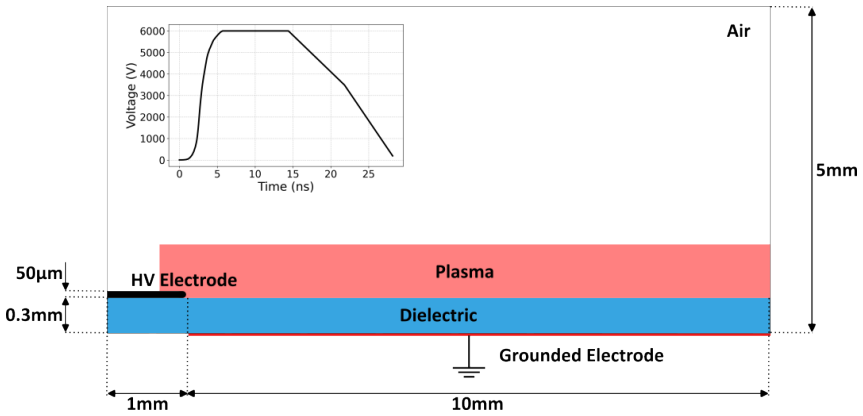
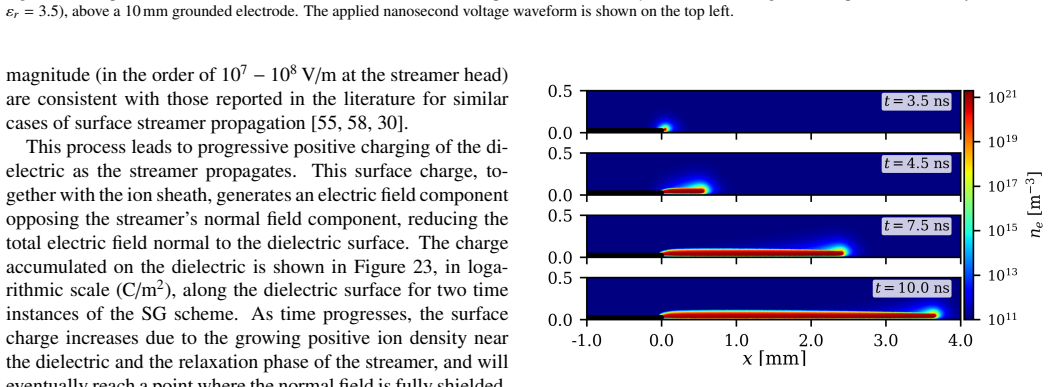
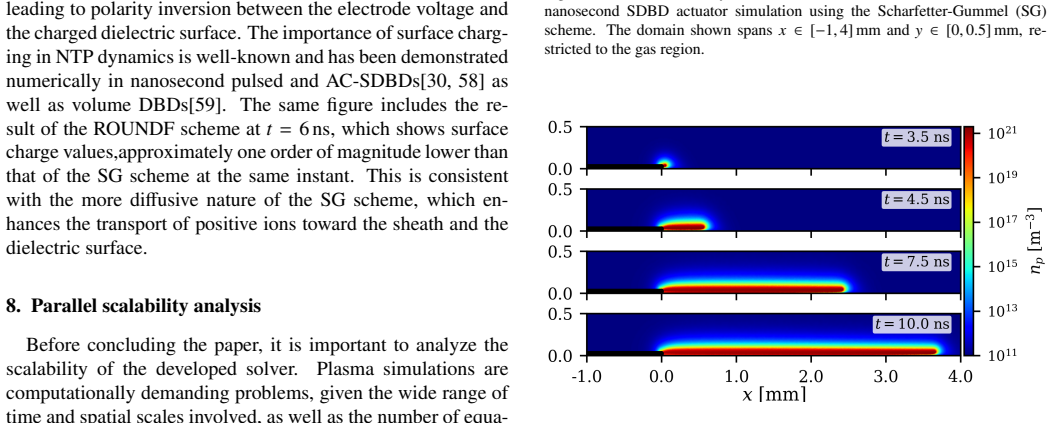
Summary. SoPlasmaFoam is an open-source OpenFOAM multi-region drift-diffusion–Poisson solver for streamers and dielectric-barrier discharges, with PETSc (CPU/GPU), blastAMR (hex/polyhedral, 1D–3D/axisymmetric), ROUND convective schemes, and monolithic plasma–dielectric Poisson coupling. The paper’s three methodological claims are: (i) on a stiff 1D advection problem and the Bagheri et al. positive-streamer benchmark, Scharfetter–Gummel is stable but overly diffusive on coarse meshes while ROUNDF outperforms standard TVD limiters; (ii) outer fixed-point (PIMPLE) Poisson–transport correctors critically control accuracy even when Courant and dielectric-relaxation numbers are well below unity, and a semi-implicit Poisson formulation does not remove that need; (iii) a wall boundary condition that writes thermal/drift fluxes into matrix coefficients remains well-posed in the drift-dominated (high cell-Péclet) limit where the conventional mixed-boundary mapping fails. Validation covers a low-pressure DC glow (Derzsi et al.), the positive-streamer benchmark (Cases A/B), a nanosecond SDBD multi-region demonstration, and single-node strong scaling with and without AMR.
Significance. If the scheme ranking, coupling analysis, and wall-BC formulation hold, the paper supplies transferable numerical guidance for the plasma-fluid community, not only another OpenFOAM solver. The controlled corrector-loop study (explicit and semi-implicit, several Δt and mesh sizes) is particularly useful: it quantifies a practice that is often left as folklore. Open release with modular run-time selection, monolithic multi-region Poisson, and blastAMR on non-Cartesian meshes is a concrete infrastructure contribution for streamer/DBD and multiphysics work (flow control, PAC). Performance with AMR is competitive with the fastest codes reported on the same benchmark. Strengths include external multi-code validation (Bagheri et al., Derzsi et al.), systematic scheme and corrector experiments, and an explicit derivation of the mixed-BC failure mode.
major comments (2)
- §3.3 (Eqs. 20–33) and Abstract contribution (iii): the mixed-boundary failure in the drift-dominated limit is derived carefully, and the matrix-coefficient wall BC is well motivated. However, none of the validation cases (§5–7) isolates this BC with a controlled comparison (mixed vs matrix-coefficient) under high cell Péclet number. The DC-glow BCs differ from the thermal-drift wall model; the freestream streamer does not exercise walls; the SDBD uses dielectric surface charging without a side-by-side BC test. Because this is listed as one of three main contributions and the abstract asserts that the BC “remains accurate” where mixed mappings fail, a short 1D or quasi-1D drift-dominated wall test (or a wall-bounded streamer/sheath comparison) is needed to substantiate the claim, not only the algebraic argument.
- §6.3.1 / Figs. 11–13: the conclusion that outer correctors remain necessary under semi-implicit Poisson and for Co and Cε well below unity is central and well supported for Case A with ROUNDF. The manuscript should state more explicitly the recommended practical rule (e.g., minimum correctors vs max Co and Cε) and whether the same corrector counts apply under Scharfetter–Gummel or on Case B, where gradients are steeper. Without that, readers may over-generalize the 1–4 corrector findings from a single scheme and background density.
minor comments (8)
- Section 4 title: “Assessement” → “Assessment”.
- §3.4: typo “assembilng” → “assembling”.
- Eq. (40): analytical solution n(x,t)=n0(x e^{At}) e^{At} is hard to parse in the text rendering; clarify the composition (argument of n0 vs multiplicative factor).
- Table 2 / §6.3.3: performance comparisons mix different processors, core counts, Δt policies, and corrector counts. A short caveat paragraph (already partly present) should state that wall times are indicative, not a strict ranking.
- §7: SDBD surface-charge comparison (SG vs ROUNDF, Fig. 23) is interesting; note briefly whether the same outer-corrector and time-step criteria were used for both schemes so the order-of-magnitude charge difference is not confounded by coupling settings.
- Naming: SoPLASMA suite vs SoPlasmaFoam solver is clear in the introduction but could be stated once in the abstract for discoverability.
- Photoionization and LMEA are correctly scoped out; a one-sentence forward pointer in §6 that Case B (low background) is the regime where photoionization usually matters most would help non-specialist readers interpret residual mesh sensitivity.
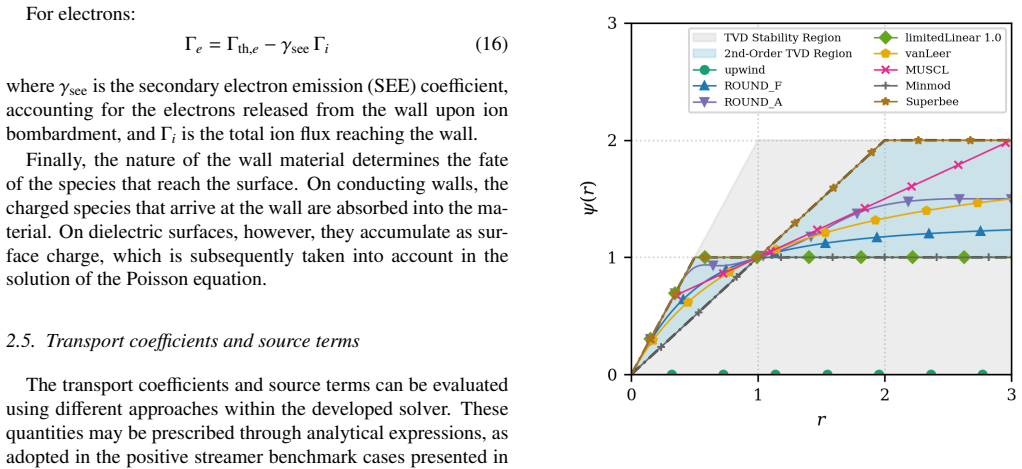
- Figure 1 TVD diagram: ensure the blue second-order region and Superbee/ROUNDF loci remain legible in grayscale print.
Circularity Check
No significant circularity: scheme rankings, coupling requirements, and wall BC are obtained by direct numerical experiment and first-principles matrix analysis against external analytical/community benchmarks, not by construction from fitted inputs or load-bearing self-citations.
full rationale
The three central claims rest on controlled comparative experiments (stiff 1-D advection with known analytical solution Eq. 40; Bagheri et al. multi-code positive-streamer benchmark [19]; Derzsi glow-discharge data [53]) and an explicit algebraic demonstration that the conventional mixed BC value-fraction fails in the high-Péclet limit while the new matrix-coefficient form recovers the prescribed wall flux by construction. Transport coefficients and source terms are taken from external analytical expressions or BOLSIG+ tables; no free parameters are fitted to the target quantities being ranked or predicted. Self-citations (e.g., prior COPAIER/SDBD work by one co-author) appear only for qualitative consistency of surface-charge magnitudes and are not used to justify uniqueness, force an ansatz, or close any derivation loop. The paper is therefore self-contained against independent external evidence; the minor self-references do not elevate circularity beyond a negligible level.
Axiom & Free-Parameter Ledger
axioms (5)
- domain assumption Drift-diffusion approximation for charged-species transport (Eq. 10–11)
- domain assumption Local Field Approximation: transport coefficients and ionization rates are instantaneous functions of local |E|/N only
- domain assumption Ions immobile on streamer time scales (Case A/B)
- domain assumption Analytical or BOLSIG+ lookup tables for µ, D, α, η taken from literature without re-fitting
- standard math Finite-volume discretization with second-order backward time and least-squares gradients is adequate
read the original abstract
SoPlasmaFoam is an open-source, multi-region plasma-dielectric solver built on OpenFOAM, integrated with the PETSc linear-algebra suite (CPU and GPU back-ends), the blastAMR adaptive-mesh-refinement library (hexahedral and polyhedral meshes), and the ROUND family of high-resolution convective schemes. It solves drift-diffusion-reaction transport for charged species, coupled self-consistently to Poisson's equation explicitly or semi-implicitly, with plasma and dielectric regions joined by a monolithic multi-domain coupling for arbitrary curved interfaces. This work makes three contributions. First, a systematic assessment of convective schemes on a stiff scalar-advection problem and the positive-streamer benchmark shows that Scharfetter-Gummel is stable but excessively diffusive on coarse meshes, while ROUNDF outperforms all tested TVD limiters and is recommended for streamer transport. Second, an analysis of Poisson-transport coupling shows that fixed-point correction loops critically control accuracy, that a semi-implicit Poisson formulation does not remove this requirement, and that coupling must be tightened even when Courant and dielectric-relaxation numbers are well below unity. Third, a drift-robust wall boundary condition acting on discretized matrix coefficients is introduced, remaining accurate in the drift-dominated limit where conventional mixed-boundary mappings fail. The solver is validated against a low-pressure DC glow discharge and the positive-streamer benchmark, and its multi-region capability is demonstrated on a nanosecond surface dielectric barrier discharge. Performance analysis confirms memory-bound finite-volume scaling and shows that with AMR the solver is competitive with the fastest reported plasma codes. The framework provides a modular foundation for multiphysics simulations in plasma-assisted combustion, plasma processing, and plasma-based flow control.
Figures




Reference graph
Works this paper leans on
-
[1]
J. E. Thomas, K. Stapelmann, Plasma control: A review of developments and applications of plasma medicine con- trol mechanisms, Plasma 7 (2) (2024) 386–426.doi: 10.3390/plasma7020022
-
[2]
P. Sreedevi, K. Suresh, Cold atmospheric plasma me- diated cell membrane permeation and gene delivery- empirical interventions and pertinence, Advances in Col- loid and Interface Science 320 (2023) 102989.doi: https://doi.org/10.1016/j.cis.2023.102989
-
[3]
K. Peng, F. Avallone, M. Kotsonis, Plasma-based base flow modification on swept-wing boundary layers: depen- dence on flow parameters, Journal of Fluid Mechanics 997 (2024) A13.doi:10.1017/jfm.2024.714
-
[4]
P. Svarnas, E. Giannakopoulos, I. Kalavrouziotis, C. Kro- ntiras, S. Georga, R. Pasolari, P. Papadopoulos, I. Apos- tolou, D. Chrysochoou, Sanitary effect of fe-dbd cold plasma in ambient air on sewage biosolids, Science of The Total Environment 705 (2020) 135940.doi:https: //doi.org/10.1016/j.scitotenv.2019.135940
-
[5]
Y . Bao, C. Kong, J. Ravelid, J. Sun, S. Nilsson, E. Kris- tensson, A. Ehn, Effect of a single nanosecond pulsed dis- charge on a flat methane–air flame, Applications in En- ergy and Combustion Science 16 (2023) 100198.doi: https://doi.org/10.1016/j.jaecs.2023.100198
-
[6]
N. Barléon, B. Cuenot, O. Vermorel, Large-eddy simu- lation of swirled flame stabilisation using nrp discharges at atmospheric pressure, Applications in Energy and Combustion Science 15 (2023) 100163.doi:https: //doi.org/10.1016/j.jaecs.2023.100163
-
[7]
A. S. Chiper, G. Borcia, Stable surface modification by cold atmospheric-pressure plasma: Comparative study on cellulose-based and synthetic polymers, Polymers 15 (20) (2023).doi:10.3390/polym15204172
-
[8]
Orlov, T
D. Orlov, T. Corke, M. Patel, Electric Circuit Model for Aerodynamic Plasma Actuator, 2006.doi:10.2514/ 6.2006-1206
2006
-
[9]
X. Shao, D. A. Lacoste, H. G. Im, Chemplaskin: A general-purpose program for unified gas and plasma ki- netics simulations, Applications in Energy and Combus- tion Science 19 (2024) 100280.doi:https://doi.org/ 10.1016/j.jaecs.2024.100280
-
[10]
Dufour, F
G. Dufour, F. Rogier, Numerical modeling of dielectric barrier discharge based plasma actuators for flow control : the copaier/cedre example (12 2015).doi:10.12762/ 2015.AL10-05
2015
-
[11]
G. J. M. Hagelaar, G. M. W. Kroesen, A monte carlo modelling study of the electrons in the microdischarges in plasma addressed liquid crystal displays, Plasma Sources Science and Technology 9 (4) (2000) 605–614.doi: 10.1088/0963-0252/9/4/318
-
[12]
M. Tian, Z. Chen, Z. Chen, Y . Wang, X. Li, Z. Chen, Y . Ding, D. Xia, W. Jiang, Y . Zhang, Two-dimensional pic/mcc modeling of inductively coupled plasma: A benchmark study in the gec configuration, Physics of Plas- mas 33 (1) (2026) 013502.doi:10.1063/5.0285526
-
[13]
E. Eylenceo ˘glu, I. Rafatov, A. A. Kudryavtsev, Two- dimensional hybrid monte carlo–fluid modelling of dc glow discharges: Comparison with fluid models, relia- bility, and accuracy, Physics of Plasmas 22 (1) (2015) 013509.doi:10.1063/1.4906361. 28
-
[14]
Crispel, P
P. Crispel, P. Degond, M.-H. Vignal, An asymptotic pre- serving scheme for the two-fluid euler–poisson model in the quasineutral limit, Journal of Computational Physics 223 (1) (2007) 208–234
2007
-
[15]
Hagelaar, G
G. Hagelaar, G. Fubiani, J.-P. Boeuf, Model of an induc- tively coupled negative ion source: I. general model de- scription, Plasma Sources Science and Technology 20 (1) (2011) 015001
2011
-
[16]
P. L. Ventzek, T. J. Sommerer, R. J. Hoekstra, M. J. Kush- ner, Two-dimensional hybrid model of inductively cou- pled plasma sources for etching, Applied physics letters 63 (5) (1993) 605–607
1993
-
[17]
J. Teunissen, U. Ebert, Simulating streamer discharges in 3d with the parallel adaptive afivo framework, Journal of Physics D: Applied Physics 50 (47) (2017) 474001.doi: 10.1088/1361-6463/aa8faf
-
[18]
Teunissen, U
J. Teunissen, U. Ebert, afivo-streamer: A framework for 2d and 3d streamer simulations with adaptive mesh refinement,https://gitlab.com/MD-CWI-NL/afivo- streamer, accessed: 2024-05-22 (2023)
2024
-
[19]
B. Bagheri, J. Teunissen, U. Ebert, M. M. Becker, S. Chen, O. Ducasse, O. Eichwald, D. Loffhagen, A. Luque, D. Mi- hailova, J. M. Plewa, J. V . Dijk, M. Yousfi, Compari- son of six simulation codes for positive streamers in air, Plasma Sources Science and Technology 27 (9 2018). doi:10.1088/1361-6595/aad768
-
[20]
D. Bouwman, J. Teunissen, U. Ebert, 3d particle simula- tions of positive air–methane streamers for combustion, Plasma Sources Science and Technology 31 (4) (2022) 045023.doi:10.1088/1361-6595/ac64bf
-
[21]
S. Nijdam, J. Teunissen, U. Ebert, The physics of streamer discharge phenomena, Plasma Sources Science and Technology 29 (10 2020).doi:10.1088/1361- 6595/abaa05
doi:10.1088/1361- 2020
-
[22]
R. Marskar, chombo-discharge: An amr code for gas discharge simulations in complex geometries, Journal of Open Source Software 8 (85) (2023) 5335.doi: 10.21105/joss.05335
-
[23]
R. Marskar, Stochastic and self-consistent 3d modeling of streamer discharge trees with kinetic monte carlo, Jour- nal of Computational Physics 504 (2024) 112858.doi: https://doi.org/10.1016/j.jcp.2024.112858
-
[24]
A. K. Verma, A. Venkattraman, Somafoam: An open- foam based solver for continuum simulations of low- temperature plasmas, Computer Physics Communications 263 (6 2021).doi:10.1016/j.cpc.2021.107855
-
[25]
H. Sitaraman, N. Deak, T. Taneja, Vidyut3d: A gpu accelerated fluid solver for non-equilibrium plasmas on adaptive grids, Computer Physics Communications 326 (2026) 110236.doi:https://doi.org/10.1016/ j.cpc.2026.110236
arXiv 2026
-
[26]
X. Shao, D. A. Lacoste, H. G. Im, A unified fluid model for nonthermal plasmas and reacting flows, Plasma Sources Science and Technology 34 (8) (2025) 085016. doi:10.1088/1361-6595/adfc0b
-
[27]
L. Cheng, N. Barleon, O. Vermorel, B. Cuenot, A. Bour- don, Avip: a low temperature plasma code (9 2022). URLhttp://arxiv.org/abs/2201.01291
Pith/arXiv arXiv 2022
-
[28]
Y . Zhu, X. Chen, Y . Wu, S. Starikovskaia, PASSKEy code, Science and Technology of Plasma Dynamics Lab- oratory, Xi’an, China and Laboratoire de Physique des Plasmas, Paris, France, software. Available fromhttp: //www.plasma-tech.net/passkey/(2021). URLhttp://www.plasma-tech.net/passkey/
2021
-
[29]
G. Dufour, F. Rogier, Numerical Modeling of Dielec- tric Barrier Discharge Based Plasma Actuators for Flow Control : the COPAIER/CEDRE Example, Aerospace Lab (10) (2015).doi:10.12762/2015.AL10-05
-
[30]
Kourtzanidis, G
K. Kourtzanidis, G. Dufour, F. Rogier, Self-consistent modeling of a surface ac dielectric barrier discharge ac- tuator: in-depth analysis of positive and negative phases, Journal of Physics D: Applied Physics 54 (4) (2021) 045203
2021
-
[31]
M. J. Kushner, Hybrid modelling of low temperature plas- mas for fundamental investigations and equipment design, Journal of Physics D: Applied Physics 42 (19) (2009) 194013.doi:10.1088/0022-3727/42/19/194013
-
[32]
S. A. Norberg, E. Johnsen, M. J. Kushner, Formation of reactive oxygen and nitrogen species by repetitive neg- atively pulsed helium atmospheric pressure plasma jets propagating into humid air, Plasma Sources Science and Technology 24 (3) (2015) 035026.doi:10.1088/0963- 0252/24/3/035026
-
[33]
I. Simonovi ´c, D. Bošnjakovi ´c, J. Teunissen, S. Dujko, Axisymmetric fluid streamer model in the amrex library, Plasma Sources Science and Technology 33 (8) (2024) 085012.doi:10.1088/1361-6595/ad6fce
-
[34]
I. Simonovi ´c, D. Bošnjakovi ´c, S. Dujko, Axisymmet- ric fluid simulations of negative streamers in sf6 and in co2–c4f7n mixtures in the pin-to-plane electrode config- uration, Plasma Sources Science and Technology 34 (12) (2025) 125004.doi:10.1088/1361-6595/ae2209
-
[35]
N. Babaeva, G. Naidis, Dynamics of positive and nega- tive streamers in air in weak uniform electric fields, IEEE Transactions on Plasma Science 25 (2) (1997) 375–379. doi:10.1109/27.602514
-
[37]
A. Komuro, R. Ono, T. Oda, Behaviour of oh radi- cals in an atmospheric-pressure streamer discharge stud- ied by two-dimensional numerical simulation, Journal of Physics D: Applied Physics 46 (17) (2013) 175206.doi: 10.1088/0022-3727/46/17/175206
-
[38]
A. Komuro, S. Matsuyuki, A. Ando, Simulation of pulsed positive streamer discharges in air at high temperatures, Plasma Sources Science and Technology 27 (10) (2018) 105001.doi:10.1088/1361-6595/aadf5c
-
[39]
Nishida, T
H. Nishida, T. Nonomura, T. Abe, Three-dimensional simulations of discharge plasma evolution on a dielec- tric barrier discharge plasma actuator, Journal of Ap- plied Physics 115 (13) (2014) 133301.doi:10.1063/ 1.4870384
2014
-
[40]
J. van Dijk, K. S. C. Peerenboom, M. Jimenez-Diaz, D. B. Mihailova, J. J. A. M. van der Mullen, The plasma modelling toolkit Plasimo, Journal of Physics D: Applied Physics 42 (19) (2009) 194012.doi:10.1088/0022- 3727/42/19/194012
doi:10.1088/0022- 2009
-
[41]
URLhttps://www.comsol.com
COMSOL AB, COMSOL Multiphysics ®, stockholm, Sweden (2025). URLhttps://www.comsol.com
2025
-
[42]
Levko, R
D. Levko, R. Upadhyay, K. Suzuki, C. Shukla, L. Raja, VizGlow-MPS: a multi-fidelity process simulator for fast, yet accurate, semiconductor process design and optimiza- tion, in: J. Bannister, N. Mohanty (Eds.), Advanced Etch Technology and Process Integration for Nanopatterning XI, V ol. PC12056, International Society for Optics and Photonics, SPIE, 2022...
2022
-
[43]
S. Bnà, I. Spisso, M. Olesen, G. Rossi, Partnership for ad- vanced computing in europe PETSc4FOAM: A library to plug-in PETSc into the OpenFOAM framework, Techni- cal report, PRACE. URLhttp://www.prace-ri.eu
-
[44]
blastAMR: Load-balanced adaptive mesh refinement libraries from blastfoam ported to ESI OpenFOAM, https://github.com/STFS-TUDa/blastAMR, ac- cessed: July 7, 2026(2023)
2026
-
[45]
Deng, A unified framework for non-linear recon- struction schemes in a compact stencil
X. Deng, A unified framework for non-linear recon- struction schemes in a compact stencil. part 1: Be- yond second order, Journal of Computational Physics 481 (2023) 112052.doi:https://doi.org/10.1016/ j.jcp.2023.112052
arXiv 2023
-
[46]
X. Deng, A new open-source library based on novel high- resolution structure-preserving convection schemes, Jour- nal of Computational Science 74 (2023) 102150.doi: https://doi.org/10.1016/j.jocs.2023.102150
-
[47]
D. L. Scharfetter, H. K. Gummel, Large-signal analysis of a silicon Read diode oscillator, IEEE Transactions on Electron Devices 16 (1) (1969) 64–77.doi:10.1109/T- ED.1969.16566
doi:10.1109/t- 1969
-
[48]
G. Chourdakis, D. Schneider, B. Uekermann, OpenFOAM-preCICE: Coupling OpenFOAM with exter- nal solvers for multi-physics simulations, OpenFOAM® Journal 3 (2023) 1–25.doi:10.51560/ofj.v3.88
-
[49]
A. Villa, L. Barbieri, M. Gondola, R. Malgesini, An asymptotic preserving scheme for the streamer simula- tion, Journal of Computational Physics 242 (2013) 86– 102.doi:10.1016/j.jcp.2013.02.016
-
[50]
G. J. M. Hagelaar, Modelling methods for low- temperature plasmas, Habilitation à diriger des recherches, Université Toulouse III – Paul Sabatier, Toulouse, France, hAL Id: tel-02864696 (2008). URLhttps://hal.science/tel-02864696v1
2008
-
[51]
Ferraris, Implicit treatment of coupled boundary conditions, accessed: July 7, 2026(2021)
S. Ferraris, Implicit treatment of coupled boundary conditions, accessed: July 7, 2026(2021). URLhttps://develop.openfoam.com/ Development/openfoam/-/merge_requests/477
2026
-
[52]
Balay, S
S. Balay, S. Abhyankar, M. F. Adams, J. Brown, P. Brune, K. Buschelman, L. Dalcin, V . Eijkhout, W. D. Gropp, D. Kaushik, M. G. Knepley, L. C. McInnes, K. Rupp, B. F. Smith, S. Zampini, H. Zhang, PETSc web page, http://www.mcs.anl.gov/petsc(2015)
2015
-
[53]
A. Derzsi, P. Hartmann, I. Korolov, J. Karácsony, G. Bánó, Z. Donkó, On the accuracy and limitations of fluid models of the cathode region of dc glow discharges, Journal of Physics D: Applied Physics 42 (22) (2009) 225204.doi: 10.1088/0022-3727/42/22/225204
-
[54]
A. V . Phelps, Z. L. Petrovic, Cold-cathode discharges and breakdown in argon: surface and gas phase production of secondary electrons, Plasma Sources Science and Tech- nology 8 (3) (1999) R21.doi:10.1088/0963-0252/8/ 3/201
-
[55]
Y . Zhu, S. Shcherbanev, B. Baron, S. Starikovskaia, Nanosecond surface dielectric barrier discharge in atmo- spheric pressure air: I. measurements and 2d modeling of morphology, propagation and hydrodynamic pertur- bations, Plasma sources science and technology 26 (12) (2017) 125004
2017
-
[56]
G. J. M. Hagelaar, L. C. Pitchford, Solving the boltz- mann equation to obtain electron transport coefficients and rate coefficients for fluid models, Plasma Sources Sci- ence and Technology 14 (4) (2005) 722.doi:10.1088/ 0963-0252/14/4/011
2005
-
[57]
J. Teunissen, Improvements for drift-diffusion plasma fluid models with explicit time integration, Plasma Sources Science and Technology 29 (1) (2020) 015010. doi:10.1088/1361-6595/ab6757. 30
-
[58]
Kourtzanidis, L
K. Kourtzanidis, L. L. Raja, Three-electrode sliding nanosecond dielectric barrier discharge actuator: model- ing and physics, AIAA Journal 55 (4) (2017) 1393–1404
2017
-
[59]
K. Kourtzanidis, Full cycle, self-consistent, two- dimensional analysis of a packed bed dbd reactor for plasma-assisted co 2 splitting: spatiotemporal inhomoge- neous, glow to streamer to surface discharge transitions, Plasma Sources Science and Technology 32 (10) (2023) 105016
2023
-
[60]
Morrow, N
R. Morrow, N. Sato, The discharge current induced by the motion of charged particles in time-dependent elec- tric fields; sato’s equation extended, Journal of Physics D: Applied Physics 32 (5) (1999) L20–L22
1999
-
[61]
D. G. Goodwin, H. K. Moffat, I. Schoegl, R. L. Speth, B. W. Weber, Cantera: An object-oriented soft- ware toolkit for chemical kinetics, thermodynamics, and transport processes,https://www.cantera.org, version 3.2.0 (2025).doi:10.5281/zenodo.17620923
-
[62]
D. Zhou, H. Zhang, S. Yang, A robust reacting flow solver with computational diagnostics based on openfoam and cantera, Aerospace 9 (2) (2022).doi:10.3390/ aerospace9020102. URLhttps://www.mdpi.com/2226-4310/9/2/102
2022
-
[63]
R. Mao, M. Lin, Y . Zhang, T. Zhang, Z.-Q. J. Xu, Z. X. Chen, DeepFlame: A deep learning empowered open-source platform for reacting flow simulations, Com- puter Physics Communications 291 (2023) 108842.doi: 10.1016/j.cpc.2023.108842
-
[64]
A. G. Özbay, A. Hamzehloo, S. Laizet, P. Tzirakis, G. Ri- zos, B. Schuller, Poisson CNN: Convolutional neural net- works for the solution of the Poisson equation on a Carte- sian mesh, Data-Centric Engineering 2 (2021) e6.doi: 10.1017/dce.2021.7. 31
discussion (0)
Sign in with ORCID, Apple, or X to comment. Anyone can read and Pith papers without signing in.