REVIEW 2 major objections 4 minor 74 references
Bosonizing the 2+1d Fermi liquid of noncritical M-theory yields a family of coupled chiral bosons whose density correlators match the exact theory semiclassically.
Reviewed by Pith at T0; open to challenge. T0 means a machine referee read the full paper against a public rubric. the ladder, T0–T4 →
T0 review · grok-4.5
2026-07-11 08:07 UTC pith:VPPYP72X
load-bearing objection Solid coadjoint-orbit EFT for the Hořava-Keeler Fermi liquid; light-cone correlators match exactly, eigenvalue three-points only in support so far. the 2 major comments →
Effective Field Theory of Noncritical M-theory from Bosonization
The pith
A machine-rendered reading of the paper's core claim, the machinery that carries it, and where it could break.
Core claim
Applying coadjoint-orbit bosonization to the double-scaled 2+1d inverted-harmonic-oscillator Fermi liquid produces an effective action of continuously labeled chiral bosons; selected tree-level density correlators of this action reproduce the semiclassical limits of the corresponding exact Fermi-liquid correlators.
What carries the argument
The coadjoint orbit of the semiclassical w_∞ algebra of phase-space functions, parametrized by a bosonic field φ that deforms the ground-state distribution; after gauge fixing, the action and density operators are expanded order-by-order in φ and evaluated on the Fermi surface.
Load-bearing premise
Agreement of a finite set of tree-level density correlators in the semiclassical regime is taken as evidence that the truncated bosonized action correctly captures the low-energy physics of noncritical M-theory.
What would settle it
An exact three-point eigenvalue-density correlator computed in the Fermi liquid that fails to match the full functional form (not merely the support) of the corresponding tree-level bosonized expression at large separation and large radius.
Editorial analysis
A structured set of objections, weighed in public.
Referee Report
Summary. The paper applies the coadjoint-orbit bosonization of Delacretaz–Du–Mehta–Son to the double-scaled 2+1d inverted-harmonic-oscillator Fermi liquid that defines noncritical M-theory (Hořava–Keeler). After recovering the Das–Jevicki collective field theory as a 1+1d check (Sec. 4), it constructs the effective action of a continuous family of chiral bosons labeled by classical constants of motion, first in p-gauge (quadratic + cubic WZW and Hamiltonian terms, Sec. 5.2) and then in h-gauge (Sec. 5.3). Tree-level correlators of two classes of density operators are compared with exact Fermi-liquid Wick contractions and resolvent saddles: light-cone densities match to all orders (connected n≥3 vanish identically, Sec. 6.4); eigenvalue one- and two-point functions agree asymptotically at large |λ| and large Euclidean separation (Secs. 6.1–6.2); the three-point eigenvalue function is shown to share the same δ-function support on classical trajectories (Sec. 6.3).
Significance. If the truncated bosonized action is a reliable low-energy description, the work supplies a concrete, integrable EFT for the canonical vacuum of noncritical M-theory and a systematic starting point for seeking a 3d gravitational dual. The clean recovery of Das–Jevicki theory, the exact algebraic vanishing of light-cone n≥3 correlators on both sides, and the parameter-free asymptotic match of the eigenvalue two-point function via the resolvent saddle are genuine technical strengths. The construction also makes the residual continuous labels (m,φ) or (φ_σ,ℓ) explicit, clarifying how the higher-dimensional Fermi surface organizes into a continuous family of 1+1d chiral bosons.
major comments (2)
- Sec. 6.3 (especially Eqs. (6.29)–(6.45) and the comparison with (3.77)): the three-point eigenvalue correlator is matched only in causal support (δ(s) forcing the three insertions onto a common classical trajectory). The remaining integrals over trajectory parameters (τ_i,m,φ) that would fix the functional prefactor are never evaluated. Because the cubic WZW term (5.31), the new cubic Hamiltonian piece proportional to t_ξ·∂_λ p_F (5.35), and the quadratic density correction ρ^(2) (6.28) are precisely the interactions that distinguish the 2+1d theory from free chiral bosons, agreement of support alone does not yet confirm that those terms are correctly normalized. A leading-order evaluation of the prefactor (or an explicit statement that it is left for future work together with a clear assessment of what is thereby left untested) is needed before the truncated action can be trusted as a s
- Secs. 1.2, 6 and 7: the claim that the EFT “correctly captures, at least in the semiclassical regime, the physics of the exact Fermi liquid” rests on tree-level correlators of a weak-field truncation. While the light-cone sector is under complete control and the one- and two-point eigenvalue functions match asymptotically, the paper does not quantify the size of omitted higher-order vertices or loop corrections in the 1/p_F expansion of Appendix D for the three-point (or higher) functions. A short discussion of the regime of validity of the truncation, or an estimate of the first omitted contribution, would strengthen the central claim.
minor comments (4)
- Fig. 8 and the accompanying power-counting discussion in Appendix D are helpful but could be cross-referenced more explicitly in Sec. 6.3 so that the reader immediately sees which diagrams are leading at large λ_r.
- Notation for the two distinct density operators (ρ(x,λ) versus ρ(u_σ,φ_σ)) is introduced carefully in Sec. 3, yet a short reminder table or sentence at the opening of Sec. 6 would reduce the risk of confusion when the bosonized versions appear.
- The Schwarzian tadpole that appears in the Gross–Klebanov Hamiltonian is discarded without comment when comparing to the coadjoint-orbit action in Sec. 4.3; a one-sentence remark on its origin (normal-ordering) would be useful.
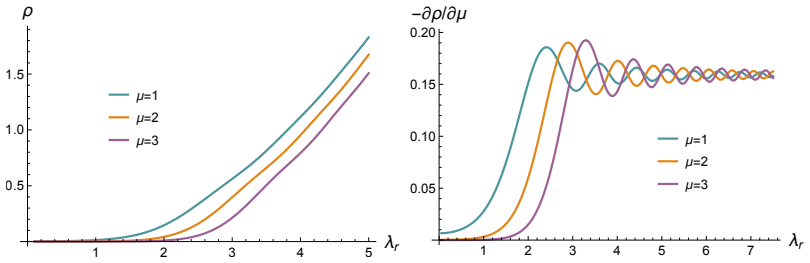
- Several figures (e.g., Figs. 5, 7, 10) compare exact, saddle, and bosonized results; adding a brief quantitative measure of agreement (relative error or similar) in the captions would make the visual claims more precise.
Circularity Check
No significant circularity: bosonized correlators are computed independently from the coadjoint-orbit action and compared to exact free-fermion Wick contractions and resolvent saddles that do not presuppose the EFT.
full rationale
The derivation chain is self-contained. The coadjoint-orbit action (Secs. 4–5) is obtained by applying the external method of Delacretaz–Du–Mehta–Son to the free inverted-oscillator Fermi liquid of Hořava–Keeler; the resulting chiral-boson action (quadratic + cubic WZW/Hamiltonian terms in p-gauge, free in h-gauge) is then used to evaluate tree-level density correlators. These are compared, order by order, to the exact Fermi-liquid correlators obtained from Wick’s theorem on the free fermions (Sec. 3) and the saddle-point resolvent (3.41). No parameters are fitted; the light-cone n-point functions vanish identically on both sides by independent algebraic arguments (Vandermonde degree vs. angular-momentum delta functions); the eigenvalue one- and two-point functions match asymptotically via the same classical action-angle kinematics; the three-point match is only in support (δ(s)), which the paper itself states without claiming a full functional identity. Shared use of action-angle coordinates is a kinematic fact of the integrable single-particle Hamiltonian, not a definitional loop. No self-citation is load-bearing for the central claim, and no uniqueness theorem or ansatz is imported from the authors’ prior work.
Axiom & Free-Parameter Ledger
axioms (4)
- domain assumption The low-energy dynamics of a Fermi liquid are completely captured by coadjoint orbits of the semiclassical w_∞ algebra of canonical transformations on phase space.
- domain assumption The double-scaled non-relativistic free-fermion Hamiltonian with inverted harmonic oscillator potential defines noncritical M-theory (Hořava-Keeler).
- ad hoc to paper Tree-level correlators of the truncated weak-field bosonized action are sufficient to test the EFT against the exact Fermi liquid in the semiclassical regime.
- standard math Standard free-fermion Wick theorem and the existence of a well-defined Euclidean propagator for the inverted oscillator.
invented entities (2)
-
Continuous family of 1+1d chiral bosons labeled by classical constants of motion (m,φ) or (φ_σ,ℓ)
no independent evidence
-
Cubic WZW interaction involving the Reeb vector field on the Fermi surface
no independent evidence
read the original abstract
We extend the coadjoint orbit approach to bosonization systematized by Delacretaz-Du-Mehta-Son to double-scaled non-relativistic Fermi liquids with central inverted harmonic oscillator potential. In 1+1d, this reproduces the Das-Jevicki collective field theory describing quasiparticle excitations of the $c=1$ matrix model. In 2+1d, this yields an effective field theory for noncritical M-theory, namely the 2+1d Fermi liquid proposed by Ho\v{r}ava and Keeler as a unified framework for characterizing noncritical string vacua. With a suitable gauge choice this theory reduces to a continuous family of 1+1d chiral bosons resembling Das-Jevicki collective fields coupled by additional interactions. Utilizing the underlying integrability of noncritical M-theory, we compute select fermion density correlation functions order-by-order in perturbation theory, and provide evidence that they agree with their Fermi liquid counterparts in a suitable semiclassical limit. This represents a step toward an effective spacetime gravity description of noncritical M-theory, which we expect to shed light on both the landscape of 2d noncritical strings and 3d quantum gravity in general.
Figures




Reference graph
Works this paper leans on
-
[1]
The eleven-dimensional supermembrane revisited,
P. K. Townsend, “The eleven-dimensional supermembrane revisited,”Phys. Lett. B350 (1995) 184–187,arXiv:hep-th/9501068
Pith/arXiv arXiv 1995
-
[2]
String theory dynamics in various dimensions,
E. Witten, “String theory dynamics in various dimensions,”Nucl. Phys. B443(1995) 85–126,arXiv:hep-th/9503124
Pith/arXiv arXiv 1995
-
[3]
Heterotic and Type I string dynamics from eleven dimensions,
P. Horava and E. Witten, “Heterotic and Type I string dynamics from eleven dimensions,” Nucl. Phys. B460(1996) 506–524,arXiv:hep-th/9510209
Pith/arXiv arXiv 1996
-
[4]
Unity of superstring dualities,
C. M. Hull and P. K. Townsend, “Unity of superstring dualities,”Nucl. Phys. B438(1995) 109–137,arXiv:hep-th/9410167
Pith/arXiv arXiv 1995
-
[5]
M theory as a matrix model: A Conjecture,
T. Banks, W. Fischler, S. H. Shenker, and L. Susskind, “M theory as a matrix model: A Conjecture,”Phys. Rev. D55(1997) 5112–5128,arXiv:hep-th/9610043
Pith/arXiv arXiv 1997
-
[6]
Supergravity and the large N limit of theories with sixteen supercharges,
N. Itzhaki, J. M. Maldacena, J. Sonnenschein, and S. Yankielowicz, “Supergravity and the large N limit of theories with sixteen supercharges,”Phys. Rev. D58(1998) 046004, arXiv:hep-th/9802042. 79
Pith/arXiv arXiv 1998
-
[7]
Strings in flat space and pp waves from N=4 superYang-Mills,
D. E. Berenstein, J. M. Maldacena, and H. S. Nastase, “Strings in flat space and pp waves from N=4 superYang-Mills,”JHEP04(2002) 013,arXiv:hep-th/0202021
Pith/arXiv arXiv 2002
-
[8]
N=6 superconformal Chern-Simons-matter theories, M2-branes and their gravity duals,
O. Aharony, O. Bergman, D. L. Jafferis, and J. Maldacena, “N=6 superconformal Chern-Simons-matter theories, M2-branes and their gravity duals,”JHEP10(2008) 091, arXiv:0806.1218
Pith/arXiv arXiv 2008
-
[9]
The Large N limit of superconformal field theories and supergravity,
J. M. Maldacena, “The Large N limit of superconformal field theories and supergravity,” Adv. Theor. Math. Phys.2(1998) 231–252,arXiv:hep-th/9711200
Pith/arXiv arXiv 1998
-
[10]
Quantum Geometry of Bosonic Strings,
A. M. Polyakov, “Quantum Geometry of Bosonic Strings,”Phys. Lett. B103(1981) 207–210
1981
-
[11]
Quantum Geometry of Fermionic Strings,
A. M. Polyakov, “Quantum Geometry of Fermionic Strings,”Phys. Lett. B103(1981) 211–213
1981
-
[12]
Strings in Less Than One-Dimension,
M. R. Douglas and S. H. Shenker, “Strings in Less Than One-Dimension,”Nucl. Phys. B 335(1990) 635
1990
-
[13]
Unitary and complex matrix models as 1-d type 0 strings,
I. R. Klebanov, J. M. Maldacena, and N. Seiberg, “Unitary and complex matrix models as 1-d type 0 strings,”Commun. Math. Phys.252(2004) 275–323,arXiv:hep-th/0309168
Pith/arXiv arXiv 2004
-
[14]
Flux vacua and branes of the minimal superstring,
N. Seiberg and D. Shih, “Flux vacua and branes of the minimal superstring,”JHEP01 (2005) 055,arXiv:hep-th/0412315
Pith/arXiv arXiv 2005
-
[15]
A Matrix model dual of type 0B string theory in two-dimensions,
T. Takayanagi and N. Toumbas, “A Matrix model dual of type 0B string theory in two-dimensions,”JHEP07(2003) 064,arXiv:hep-th/0307083
Pith/arXiv arXiv 2003
-
[16]
A New hat for the c=1 matrix model,
M. R. Douglas, I. R. Klebanov, D. Kutasov, J. M. Maldacena, E. J. Martinec, and N. Seiberg, “A New hat for the c=1 matrix model,” inFrom Fields to Strings: Circumnavigating Theoretical Physics: A Conference in Tribute to Ian Kogan, pp. 1758–1827. 7, 2003.arXiv:hep-th/0307195
Pith/arXiv arXiv 2003
-
[17]
Strings from tachyons: The c=1 matrix reloaded,
J. McGreevy and H. L. Verlinde, “Strings from tachyons: The c=1 matrix reloaded,”JHEP 12(2003) 054,arXiv:hep-th/0304224
Pith/arXiv arXiv 2003
-
[18]
Fermionic string field theory of c = 1 two-dimensional quantum gravity,
D. J. Gross and I. R. Klebanov, “Fermionic string field theory of c = 1 two-dimensional quantum gravity,”Nucl. Phys. B352(1991) 671–688
1991
-
[19]
String theory in two-dimensions,
I. R. Klebanov, “String theory in two-dimensions,” inSpring School on String Theory and Quantum Gravity (to be followed by Workshop). 7, 1991.arXiv:hep-th/9108019
Pith/arXiv arXiv 1991
-
[20]
J. Polchinski, “What is string theory?,” inNATO Advanced Study Institute: Les Houches Summer School, Session 62: Fluctuating Geometries in Statistical Mechanics and Field Theory. 11, 1994.arXiv:hep-th/9411028
Pith/arXiv arXiv 1994
-
[21]
Lectures on 2-D gravity and 2-D string theory,
P. H. Ginsparg and G. W. Moore, “Lectures on 2-D gravity and 2-D string theory,” in Theoretical Advanced Study Institute (TASI 92): From Black Holes and Strings to Particles, pp. 277–469. 10, 1993.arXiv:hep-th/9304011
Pith/arXiv arXiv 1993
-
[22]
Matrix models and 2D string theory,
E. J. Martinec, “Matrix models and 2D string theory,” inNATO Advanced Study Institute: Marie Curie Training Course: Applications of Random Matrices in Physics, pp. 403–457. 10, 2004.arXiv:hep-th/0410136
Pith/arXiv arXiv 2004
-
[23]
Genus one path integral in two-dimensional quantum gravity,
M. Bershadsky and I. R. Klebanov, “Genus one path integral in two-dimensional quantum gravity,”Phys. Rev. Lett.65(1990) 3088–3091. 80
1990
-
[24]
One-dimensional string theory on a circle,
D. J. Gross and I. R. Klebanov, “One-dimensional string theory on a circle,”Nucl. Phys. B 344(1990) 475–498
1990
-
[25]
From loops to states in two-dimensional quantum gravity,
G. W. Moore, N. Seiberg, and M. Staudacher, “From loops to states in two-dimensional quantum gravity,”Nucl. Phys. B362(1991) 665–709
1991
-
[26]
World sheet and space-time physics in two-dimensional (Super)string theory,
P. Di Francesco and D. Kutasov, “World sheet and space-time physics in two-dimensional (Super)string theory,”Nucl. Phys. B375(1992) 119–170,arXiv:hep-th/9109005
Pith/arXiv arXiv 1992
-
[27]
Exact S matrix for 2-D string theory,
G. W. Moore, M. R. Plesser, and S. Ramgoolam, “Exact S matrix for 2-D string theory,” Nucl. Phys. B377(1992) 143–190,arXiv:hep-th/9111035
Pith/arXiv arXiv 1992
-
[28]
D-brane decay in two-dimensional string theory,
I. R. Klebanov, J. M. Maldacena, and N. Seiberg, “D-brane decay in two-dimensional string theory,”JHEP07(2003) 045,arXiv:hep-th/0305159
Pith/arXiv arXiv 2003
-
[29]
Thec= 1 string theory S-matrix revisited,
B. Balthazar, V. A. Rodriguez, and X. Yin, “Thec= 1 string theory S-matrix revisited,” JHEP04(2019) 145,arXiv:1705.07151 [hep-th]
Pith/arXiv arXiv 2019
-
[30]
Zz instantons and the non-perturbative dual of c = 1 string theory,
B. Balthazar, V. A. Rodriguez, and X. Yin, “Zz instantons and the non-perturbative dual of c = 1 string theory,”JHEP05(2023) 048,arXiv:1907.07688
Pith/arXiv arXiv 2023
-
[31]
Multi-instanton calculus in c = 1 string theory,
B. Balthazar, V. A. Rodriguez, and X. Yin, “Multi-instanton calculus in c = 1 string theory,”JHEP05(2023) 050,arXiv:1912.07170
Pith/arXiv arXiv 2023
-
[32]
Fixing an ambiguity in two dimensional string theory using string field theory,
A. Sen, “Fixing an ambiguity in two dimensional string theory using string field theory,” JHEP03(2020) 005,arXiv:1908.02782
Pith/arXiv arXiv 2020
-
[33]
Divergent− →complex amplitudes in two dimensional string theory,
A. Sen, “Divergent− →complex amplitudes in two dimensional string theory,”JHEP02 (2021) 086,arXiv:2003.12076
Pith/arXiv arXiv 2021
-
[34]
D-instantons, string field theory and two dimensional string theory,
A. Sen, “D-instantons, string field theory and two dimensional string theory,”JHEP11 (2021) 061,arXiv:2012.11624
Pith/arXiv arXiv 2021
-
[35]
Normalization of d-instanton amplitudes,
A. Sen, “Normalization of d-instanton amplitudes,”JHEP11(2021) 077, arXiv:2101.08566
Pith/arXiv arXiv 2021
-
[36]
Instantons in sine-liouville theory,
S. Alexandrov, R. Mahajan, and A. Sen, “Instantons in sine-liouville theory,”JHEP01 (2024) 141,arXiv:2311.04969
Pith/arXiv arXiv 2024
-
[37]
c= 1 strings as a matrix integral,
S. Collier, L. Eberhardt, and V. A. Rodriguez, “c= 1 strings as a matrix integral,” arXiv:2604.06301 [hep-th]
-
[38]
Noncritical M-theory in 2+1 dimensions as a nonrelativistic Fermi liquid,
P. Horava and C. A. Keeler, “Noncritical M-theory in 2+1 dimensions as a nonrelativistic Fermi liquid,”JHEP07(2007) 059,arXiv:hep-th/0508024
Pith/arXiv arXiv 2007
-
[39]
Thermodynamics of noncritical M-theory and the topological A-model,
P. Horava and C. A. Keeler, “Thermodynamics of noncritical M-theory and the topological A-model,”Nucl. Phys. B745(2006) 1–28,arXiv:hep-th/0512325
Pith/arXiv arXiv 2006
-
[40]
Strings on AdS(2) and the High-Energy Limit of Noncritical M-Theory,
P. Horava and C. A. Keeler, “Strings on AdS(2) and the High-Energy Limit of Noncritical M-Theory,”JHEP06(2007) 031,arXiv:0704.2230 [hep-th]
Pith/arXiv arXiv 2007
-
[41]
Luttinger’s Theorem and Bosonization of the Fermi Surface,
F. D. M. Haldane, “Luttinger’s Theorem and Bosonization of the Fermi Surface,”arXiv e-prints(May, 2005) cond–mat/0505529,arXiv:cond-mat/0505529 [cond-mat.str-el]
arXiv 2005
-
[42]
Bosonization of nonrelativistic fermions and W infinity algebra,
S. R. Das, A. Dhar, G. Mandal, and S. R. Wadia, “Bosonization of nonrelativistic fermions and W infinity algebra,”Mod. Phys. Lett. A7(1992) 71–84,arXiv:hep-th/9111021. 81
Pith/arXiv arXiv 1992
-
[43]
Nonlinear bosonization of Fermi surfaces: The method of coadjoint orbits,
L. V. Delacretaz, Y.-H. Du, U. Mehta, and D. T. Son, “Nonlinear bosonization of Fermi surfaces: The method of coadjoint orbits,”Phys. Rev. Res.4no. 3, (2022) 033131, arXiv:2203.05004 [cond-mat.str-el]
Pith/arXiv arXiv 2022
-
[44]
Effective field theory for ersatz Fermi liquids,
X. Huang, A. Lucas, U. Mehta, and M. Qi, “Effective field theory for ersatz Fermi liquids,” Phys. Rev. B110no. 3, (2024) 035102,arXiv:2402.14066 [cond-mat.str-el]
Pith/arXiv arXiv 2024
-
[45]
Quantizing bosonized Fermi surfaces,
S. Chen and L. V. Delacretaz, “Quantizing bosonized Fermi surfaces,”Phys. Rev. B113 no. 12, (2026) 125150,arXiv:2510.07583 [cond-mat.str-el]
arXiv 2026
-
[46]
Development in 2-d string theory,
A. Jevicki, “Development in 2-d string theory,” inWorkshop on String Theory, Gauge Theory and Quantum Gravity. 9, 1993.arXiv:hep-th/9309115
Pith/arXiv arXiv 1993
-
[47]
Matrix quantum mechanics and two-dimensional string theory in nontrivial backgrounds,
S. Alexandrov, “Matrix quantum mechanics and two-dimensional string theory in nontrivial backgrounds,” other thesis, 9, 2003
2003
-
[48]
Liouville field theory: A Decade after the revolution,
Y. Nakayama, “Liouville field theory: A Decade after the revolution,”Int. J. Mod. Phys. A 19(2004) 2771–2930,arXiv:hep-th/0402009
Pith/arXiv arXiv 2004
-
[49]
String Field Theory and Physical Interpretation ofD= 1 Strings,
S. R. Das and A. Jevicki, “String Field Theory and Physical Interpretation ofD= 1 Strings,”Mod. Phys. Lett. A5(1990) 1639–1650
1990
-
[50]
Classical limit of (1+1)-dimensional string theory,
J. Polchinski, “Classical limit of (1+1)-dimensional string theory,”Nucl. Phys. B362(1991) 125–140
1991
-
[51]
Gravitational scattering in the c = 1 matrix model,
M. Natsuume and J. Polchinski, “Gravitational scattering in the c = 1 matrix model,”Nucl. Phys. B424(1994) 137–154,arXiv:hep-th/9402156
Pith/arXiv arXiv 1994
-
[52]
Discrete state moduli of string theory from the C=1 matrix model,
A. Dhar, G. Mandal, and S. R. Wadia, “Discrete state moduli of string theory from the C=1 matrix model,”Nucl. Phys. B454(1995) 541–560,arXiv:hep-th/9507041
Pith/arXiv arXiv 1995
-
[53]
Nonrelativistic fermions, coadjoint orbits of W(infinity) and string field theory at c = 1,
A. Dhar, G. Mandal, and S. R. Wadia, “Nonrelativistic fermions, coadjoint orbits of W(infinity) and string field theory at c = 1,”Mod. Phys. Lett. A7(1992) 3129–3146, arXiv:hep-th/9207011
Pith/arXiv arXiv 1992
-
[54]
Double scaled field theory at c = 1,
G. W. Moore, “Double scaled field theory at c = 1,”Nucl. Phys. B368(1992) 557–590
1992
-
[55]
The exact s matrix of the deformed c = 1 matrix model,
K. Demeterfi, I. R. Klebanov, and J. P. Rodrigues, “The exact s matrix of the deformed c = 1 matrix model,”Phys. Rev. Lett.71(1993) 3409–3412,arXiv:hep-th/9308036
Pith/arXiv arXiv 1993
-
[56]
JT gravity as a matrix integral,
P. Saad, S. H. Shenker, and D. Stanford, “JT gravity as a matrix integral,” arXiv:1903.11115 [hep-th]
Pith/arXiv arXiv 1903
-
[57]
M. C. Gutzwiller,Chaos in Classical and Quantum Mechanics, vol. 1 ofInterdisciplinary Applied Mathematics. Springer, New York, 1990
1990
-
[58]
Structure of phenomenological Lagrangians. 1.,
S. R. Coleman, J. Wess, and B. Zumino, “Structure of phenomenological Lagrangians. 1.,” Phys. Rev.177(1969) 2239–2247
1969
-
[59]
Structure of phenomenological Lagrangians. 2.,
C. G. Callan, Jr., S. R. Coleman, J. Wess, and B. Zumino, “Structure of phenomenological Lagrangians. 2.,”Phys. Rev.177(1969) 2247–2250
1969
-
[60]
Topological strings and integrable hierarchies,
M. Aganagic, R. Dijkgraaf, A. Klemm, M. Marino, and C. Vafa, “Topological strings and integrable hierarchies,”Commun. Math. Phys.261(2006) 451–516,arXiv:hep-th/0312085
Pith/arXiv arXiv 2006
-
[61]
The Quantum Collective Field Method and Its Application to the Planar Limit,
A. Jevicki and B. Sakita, “The Quantum Collective Field Method and Its Application to the Planar Limit,”Nucl. Phys. B165(1980) 511. 82
1980
-
[62]
Field Theory of Strings as a Collective Field Theory of U(N) Gauge Field,
B. Sakita, “Field Theory of Strings as a Collective Field Theory of U(N) Gauge Field,” Phys. Rev. D21(1980) 1067
1980
-
[63]
Selfdual Fields as Charge Density Solitons,
R. Floreanini and R. Jackiw, “Selfdual Fields as Charge Density Solitons,”Phys. Rev. Lett. 59(1987) 1873
1987
-
[64]
Wen,Quantum Field Theory of Many-Body Systems
X.-G. Wen,Quantum Field Theory of Many-Body Systems. Oxford University Press, 9, 2007
2007
-
[65]
Definition and classification of Fermi surface anomalies,
D.-C. Lu, J. Wang, and Y.-Z. You, “Definition and classification of Fermi surface anomalies,” Phys. Rev. B109no. 4, (2024) 045123,arXiv:2302.12731 [cond-mat.str-el]
Pith/arXiv arXiv 2024
-
[66]
Excitations and interactions in d = 1 string theory,
A. M. Sengupta and S. R. Wadia, “Excitations and interactions in d = 1 string theory,”Int. J. Mod. Phys. A6(1991) 1961–1984
1991
-
[67]
A Deformed matrix model and the black hole background in two-dimensional string theory,
A. Jevicki and T. Yoneya, “A Deformed matrix model and the black hole background in two-dimensional string theory,”Nucl. Phys. B411(1994) 64–96,arXiv:hep-th/9305109
Pith/arXiv arXiv 1994
-
[68]
A. Strominger, “A Matrix model for AdS(2),”JHEP03(2004) 066,arXiv:hep-th/0312194
Pith/arXiv arXiv 2004
-
[69]
Isometry of ads 2 and the c= 1 matrix model,
P.-M. Ho, “Isometry of ads 2 and the c= 1 matrix model,”Journal of High Energy Physics 2004no. 05, (2004) 008–008
2004
-
[70]
The Conformal limit of the 0A matrix model and string theory on AdS(2),
O. Aharony and A. Patir, “The Conformal limit of the 0A matrix model and string theory on AdS(2),”JHEP11(2005) 052,arXiv:hep-th/0509221
Pith/arXiv arXiv 2005
-
[71]
Chern-Simons theory and topological strings,
M. Marino, “Chern-Simons theory and topological strings,”Rev. Mod. Phys.77(2005) 675–720,arXiv:hep-th/0406005
Pith/arXiv arXiv 2005
-
[72]
Nonabelian Bosonization in Two-Dimensions,
E. Witten, “Nonabelian Bosonization in Two-Dimensions,”Commun. Math. Phys.92(1984) 455–472
1984
-
[73]
E. H. Fradkin,Field Theories of Condensed Matter Physics, vol. 82. Cambridge Univ. Press, Cambridge, UK, 2, 2013
2013
-
[74]
P. A. M. Dirac,The Principles of Quantum Mechanics. The International Series of Monographs on Physics. Clarendon Press, Oxford, 4th ed., 1958. 83
1958
discussion (0)
Sign in with ORCID, Apple, or X to comment. Anyone can read and Pith papers without signing in.