Platonic Projection Structures: Operator-Induced Observability in Representation Learning
Reviewed by Pith T0 review T1 audit T2 compute T3 formal T4 kernel 2026-07-08 01:06 UTCglm-5.2pith:SFDEIH5Wrecord.jsonopen to challenge →
The pith
Observability in neural networks is governed by operator geometry, not latent states alone
A machine-rendered reading of the paper's core claim, the machinery that carries it, and where it could break.
Core claim
The paper identifies the quotient space H/ker(Π) induced by a self-adjoint positive semidefinite observation operator Π as the fundamental object governing what is observable in a representation learning system. The key structural insight is that any two latent states differing only by a component in ker(Π) produce identical observables, making them observationally indistinguishable. This means the effective observable dimension is determined by the rank and spectral structure of Π rather than the ambient latent dimension. The paper demonstrates this through controlled experiments showing kernel-invariant observability, rank-controlled predictive behavior, and projection-induced attribution盲
What carries the argument
Q: What is the quotient geometry H/ker(Π)? A: The space of equivalence classes of latent states that produce identical observables under the observation operator Π. Two states are equivalent if their difference lies in the kernel of Π.
If this is right
- Knowledge distillation can be regularized by explicitly minimizing operator inconsistency between teacher and student models, providing a geometric alternative to purely output-distribution-matching objectives.
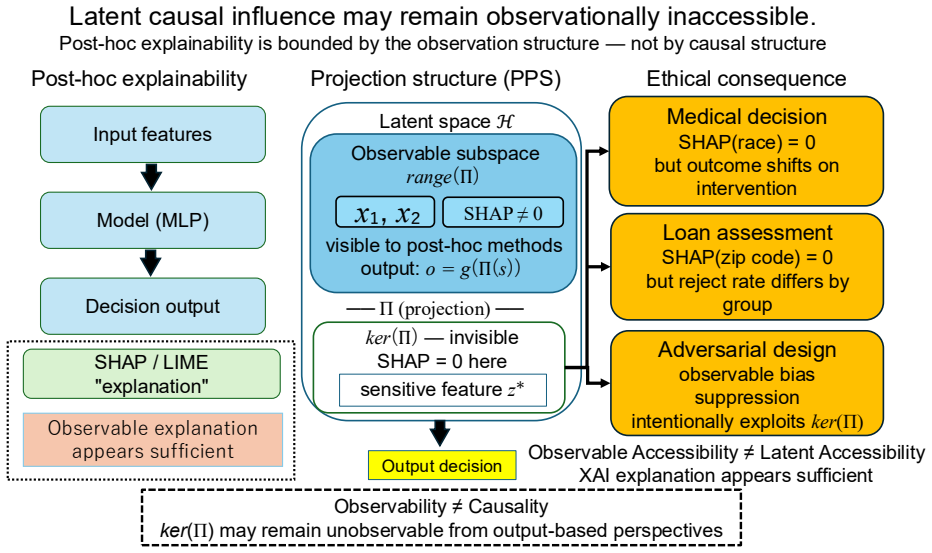
- Attribution methods like SHAP, LIME, and GradCAM inherit structural blindness: they cannot detect the influence of latent directions that lie in or near the kernel of the observation operator, even if those directions are causally relevant.
- The effective observable dimension of a neural network's latent space is governed by the rank of its readout operator, not the raw number of latent dimensions, which has direct consequences for understanding model capacity and compression.
- Interpretability guarantees may require analyzing or constraining the observation operator itself rather than relying solely on post-hoc explanation methods applied to outputs.
- The structural correspondence between quantum measurement and linear-readout neural networks suggests that tools from quantum measurement theory may be applicable to analyzing representation learning systems.
Load-bearing premise
The entire framework depends on the assumption that the observation geometry of a neural network can be adequately captured by a fixed linear positive semidefinite operator, specifically Π = W^T W where W is the output-layer weight matrix. Real neural networks use nonlinear readouts such as softmax, and the Jacobian-based extension for nonlinear cases is only sketched as future work. If the effective observation geometry is not well-approximated by a fixed linear operator, it
What would settle it
Construct a neural network with a nonlinear readout where the effective observation geometry cannot be well-approximated by any fixed positive semidefinite operator, and demonstrate that the quotient structure H/ker(Π) fails to predict which latent perturbations are observationally distinguishable.
Figures




read the original abstract
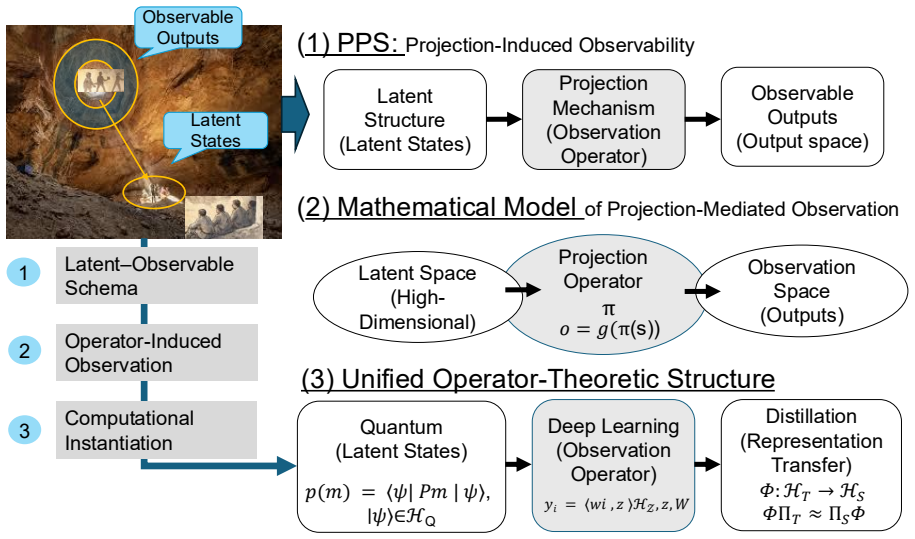
We characterize observability in representation learning through Platonic Projection Structures (PPS), an operator-theoretic framework for analyzing representation accessibility under partial observation. Rather than treating observable outputs as direct reflections of latent representations, PPS models observation through a self-adjoint positive semidefinite operator acting on a latent representation space. A system is represented as a triple $(H, \Pi, O)$, where $H$ is a latent representation space, $\Pi \succeq 0$ is an observation operator, and $O(v)=\langle v,\Pi v\rangle$ defines an induced scalar observable. Observability is characterized by the quotient geometry $H/\ker(\Pi)$, representing equivalence classes of latent states indistinguishable under observation. We show that quantum measurement and representation inference under linear observation models share this operator-theoretic structure while differing in the algebraic properties of their observation operators; the correspondence is structural rather than physical. Representation transfer and knowledge distillation can likewise be interpreted as approximate preservation of observable geometry through $\Phi \Pi_T \approx \Pi_S \Phi$. PPS also reveals a structural limitation of output-based interpretability: latent components in $\ker(\Pi)$ are inaccessible from induced observables, imposing intrinsic constraints on attribution and explanation methods. Controlled empirical validations demonstrate kernel-invariant observability, projection-induced attribution gaps, and rank-controlled observable geometry in latent representation spaces. PPS thus provides an explicit characterization of observability through operator-induced quotient geometry and a unified perspective on representation accessibility, interpretability, and projection-mediated inference.
Editorial analysis
A structured set of objections, weighed in public.
Referee Report
Summary. The manuscript introduces Platonic Projection Structures (PPS), an operator-theoretic framework that models observability in representation learning via a self-adjoint positive semidefinite observation operator Π acting on a latent Hilbert space H. The central object is the quotient geometry H/ker(Π), which characterizes equivalence classes of latent states indistinguishable under the induced observable O(v)=⟨v,Πv⟩. The framework is applied to knowledge distillation (via an approximate intertwining condition ΦΠ_T≈Π_SΦ), interpretability limits (kernel components are structurally inaccessible), and a structural analogy between quantum measurement and neural-network inference. Three experiments are provided: synthetic kernel-invariance verification, synthetic rank-controlled classification, and a CIFAR-10 distillation experiment.
Significance. The paper is transparent that its mathematical ingredients are classical (PSD operators, quotient spaces, spectral decomposition). The potential service to the community is a unified vocabulary linking observability, distillation, and interpretability. However, the framework's central mathematical content (Proposition 1) is a direct consequence of the definition of a kernel, and the empirical validations largely confirm definitions rather than test non-trivial predictions. The distillation experiment adds a regularization term to the loss and then reports that it decreases, without demonstrating a downstream benefit. The linearity assumption (Π=W^TW) is acknowledged but limits applicability to real architectures with nonlinear readouts; the Jacobian-based extension is only sketched. No machine-checked proofs, reproducible code (stated as available 'upon acceptance'), or falsifiable novel predictions are provided.
major comments (4)
- §5.2, Proposition 1: The claim that O(v_1)=O(v_2) when v_1−v_2∈ker(Π) is a one-line proof following directly from Π(v_1−v_2)=0. The manuscript acknowledges this is 'algebraically straightforward,' but Proposition 1 is the sole formal theorem and the basis for all three experiments. Without at least one non-trivial theoretical result—for example, bounds on the intertwining approximation error in §4.3, or conditions under which the linear quotient geometry H/ker(Π) provably approximates a nonlinear readout's effective observation geometry—the framework's mathematical contribution does not extend beyond standard spectral linear algebra.
- §6.1, Eqs. (25)–(26): The kernel-invariance experiment verifies Proposition 1 by confirming that perturbations in ker(Π) leave O(v) invariant. Since Proposition 1 is true by definition of the kernel, this experiment is tautological. Similarly, §6.2 confirms that classification accuracy depends on rank(Π), which is true by construction when the signal is placed in range(Π). For the framework to demonstrate scientific value beyond confirming its own definitions, at least one experiment must test a non-trivial prediction—e.g., that PPS-based regularization yields measurably better transfer, robustness, or OOD generalization compared to standard methods.
- §4.4, Eq. (21): The distillation experiment adds L_PPS=||ΦΠ_T−Π_SΦ||²_F to the training objective and then reports (Fig. 2a,c) that this quantity decreases during training and is lower than in the unregularized baseline. This is expected by construction of gradient descent. The paper states accuracy is 'comparable' (not better) and explicitly notes that no downstream benefit is measured. Without a metric on which PPS-regularized distillation outperforms the baseline, the experiment does not support the claim that the framework provides an 'actionable characterization of observability.'
- §3.2, Eq. (16): The framework's core assumption is that observation operators Π=W^TW adequately capture the observation geometry of representation learning. Real neural networks use nonlinear readouts (softmax, etc.), and the Jacobian-based extension (§7.5) is only sketched. The distillation experiment (§4.4) and all interpretability claims (§5) inherit this limitation: if the effective observation geometry is not well-approximated by a fixed PSD operator, the quotient structure H/ker(Π) does not characterize what is actually observable. This is load-bearing for the central claim and needs either empirical validation or a theorem bounding the approximation error.
minor comments (7)
- §1: The phrase 'Platonic' is used to emphasize the distinction between latent structure and observable projection. The connection to the Platonic Representation Hypothesis [40] is discussed in §7.4 but remains loose; a clearer justification for the naming would help readers.
- Figure 1: The schematic contains dense text labels that are difficult to read. Consider simplifying or enlarging for clarity.
- Figure 4: The bottom panel makes claims about medical decisions, loan assessment, and adversarial design that go beyond what the framework formally establishes. Consider softening or removing these speculative examples.
- §4.4: The student architecture is described as 'a lightweight CNN with two convolutional blocks followed by two fully connected layers' but specific channel counts, kernel sizes, and other hyperparameters are not provided. These should be included for reproducibility.
- §6.1: The attribution experiment uses SHAP but does not specify the model architecture, training procedure, or dataset. More detail is needed to reproduce the results.
- References [4]: The SHAP citation lists the venue as NeurIPS 2023, but the original publication is NeurIPS 2017. Please correct.
- §2.5: The statement that the Hilbert space formulation is retained 'primarily to emphasize the generality' is honest but may mislead readers about the actual scope. Consider stating upfront that all results are finite-dimensional.
Simulated Author's Rebuttal
We thank the referee for a careful and substantive reading of our manuscript. The report identifies genuine weaknesses that we take seriously. Below we respond to each major comment, indicating where we agree and what revisions we commit to, and where we respectfully maintain our position.
read point-by-point responses
-
Referee: §5.2, Proposition 1: The claim that O(v_1)=O(v_2) when v_1−v_2∈ker(Π) is a one-line proof following directly from Π(v_1−v_2)=0. Without at least one non-trivial theoretical result, the framework's mathematical contribution does not extend beyond standard spectral linear algebra.
Authors: We agree that Proposition 1 is algebraically straightforward, and the manuscript already acknowledges this. We also agree that the paper would be substantially strengthened by at least one non-trivial theoretical result beyond Proposition 1. In the revision, we will add a formal result on the intertwining approximation error in §4.3. Specifically, we will prove a bound relating the operator-consistency gap ||ΦΠ_T − Π_SΦ||_F to the distortion of observable quotient geometry, showing that under exact intertwining the quotient structures H_T/ker(Π_T) and H_S/ker(Π_S) are isometrically related, and that approximate intertwining induces a bounded distortion proportional to the gap. This provides a non-trivial connection between the algebraic condition (6) and the geometric content of the framework. We will also state and prove a result characterizing conditions under which the linear quotient geometry H/ker(Π) approximates the effective observation geometry of a smooth nonlinear readout, using the Jacobian-based local operator and providing an explicit error bound in terms of the second derivative of the readout map. This addresses both suggestions the referee raises. revision: yes
-
Referee: §6.1, Eqs. (25)–(26): The kernel-invariance experiment verifies Proposition 1 by confirming that perturbations in ker(Π) leave O(v) invariant. Since Proposition 1 is true by definition of the kernel, this experiment is tautological. Similarly, §6.2 confirms that classification accuracy depends on rank(Π), which is true by construction. At least one experiment must test a non-trivial prediction.
Authors: We partially agree. The referee is correct that the synthetic experiments in §6.1 and §6.2 confirm structural properties that follow from the definitions. We do not claim these experiments test non-trivial predictions; the manuscript explicitly frames them as 'theory-validation studies' intended to visualize the framework's consequences under controlled conditions. However, we accept the referee's broader point that the paper needs at least one experiment testing a genuinely non-trivial prediction. In the revision, we will add an experiment evaluating whether PPS-regularized distillation yields measurable benefits on a downstream transfer task (e.g., fine-tuning the student on a shifted distribution or auxiliary task), testing the prediction that improved operator consistency should correlate with better transfer. We will also add an experiment testing the Jacobian-based local observation operator on a network with nonlinear (softmax) readout, examining whether the local linear quotient geometry predicts attribution behavior on a real architecture. These additions will move the empirical content beyond definition-confirmation. revision: yes
-
Referee: §4.4, Eq. (21): The distillation experiment adds L_PPS to the training objective and then reports that this quantity decreases during training. This is expected by construction of gradient descent. Without a metric on which PPS-regularized distillation outperforms the baseline, the experiment does not support the claim that the framework provides an 'actionable characterization of observability.'
Authors: We agree. The current distillation experiment demonstrates that the operator-consistency objective can be optimized without degrading accuracy, but it does not establish a downstream benefit. The referee is correct that showing a regularizer decreases when directly optimized is not a meaningful empirical result. In the revision, we will (1) reframe the current experiment as a feasibility study rather than evidence of benefit, (2) add a downstream evaluation measuring transfer performance, robustness under input perturbation, and OOD generalization for PPS-regularized versus standard distillation, and (3) report whether reduced operator inconsistency correlates with any of these metrics. If no benefit is found, we will state this transparently and adjust the claims accordingly. We will also remove or substantially soften the phrase 'actionable characterization of observability' unless the new experiments support it. revision: yes
-
Referee: §3.2, Eq. (16): The framework's core assumption is that observation operators Π=W^TW adequately capture the observation geometry. Real neural networks use nonlinear readouts, and the Jacobian-based extension (§7.5) is only sketched. This is load-bearing for the central claim and needs either empirical validation or a theorem bounding the approximation error.
Authors: We agree that the linearity assumption is load-bearing and that the current treatment of nonlinear readouts is insufficient. The manuscript acknowledges this limitation in §7.5 but does not provide the needed validation or bounds. In the revision, we will address this in two ways. First, we will add a theorem (as mentioned in our response to the first comment) providing an explicit error bound on the Jacobian-based local approximation Π_local = J_f(z_0)^T J_f(z_0) in terms of the second-order Taylor remainder of the readout, characterizing when the linear quotient geometry is a faithful local approximation. Second, we will add an empirical experiment validating the Jacobian-based operator on a real architecture with softmax readout, comparing the predicted observable subspace (from the local Jacobian) against measured attribution behavior. This will provide direct evidence for or against the adequacy of the linear approximation in practice. We acknowledge that a complete treatment of nonlinear observation geometry remains open, but the revision will provide both theoretical and empirical grounding for the local approximation that is currently missing. revision: yes
- We respectfully maintain that the conceptual contribution of PPS—formalizing observability as an operator-induced quotient geometry and unifying observability, distillation, and interpretability under a common vocabulary—has value even though its mathematical ingredients are classical. We do not claim novelty of the operator-theoretic machinery itself, and the manuscript states this explicitly. However, we believe that identifying and explicitly formulating this structure in the representation-learning context constitutes a legitimate contribution, provided the revision adds the non-trivial theoretical and empirical content the referee rightly demands. We note that many influential framework papers (e.g., the information bottleneck formulation of representation learning) initially introduced conceptual reformulations using classical mathematical tools, with deeper theoretical results dev
Circularity Check
All three 'empirical validations' reduce to tautologies or loss-minimization by construction; the theoretical framework is standard linear algebra repackaged with new terminology.
specific steps
-
self definitional
[§6.1, Proposition 1 (Eq. 23), and Figure 6b]
"Proposition 1 (Observable Equivalence Under Projection). Let the observable functional be defined as in Equation (2), where Π is a self-adjoint positive semidefinite operator. If v1 ∼Π v2 under Equation (3), then O(v1) = O(v2). ... Proof. Let u = v1 − v2 with u ∈ ker(Π). Then Πu = 0, and hence Πv1 = Π(v2 + u) = Πv2. Substituting this into Equation (2) yields Equation (23). ... Figure 6b demonstrates that perturbations generated through Equation (25) leave observables numerically invariant up to machine precision."
Proposition 1 is a one-line consequence of the definition of kernel: if u ∈ ker(Π), then Πu = 0 by definition, so O(v+u) = ⟨v+u, Π(v+u)⟩ = ⟨v, Πv⟩. The 'empirical validation' in §6.1 constructs perturbations explicitly in ker(Π) and confirms O(v) doesn't change. This is verifying a mathematical tautology numerically. The paper itself acknowledges this: 'Although algebraically straightforward, Proposition 1 formalizes observational indistinguishability.' The experiment adds no empirical content beyond the definition.
-
self definitional
[§6.2, Eq. 9, and Figure 7a]
"Accordingly, the effective observable dimension is governed by rank(Π). (9) ... Figure 7a shows that predictive performance increases systematically with rank(Π) and saturates near the intrinsic signal rank r∗ = 8. Accuracy increases from approximately 0.61 at rank 1 to approximately 0.94 at rank 8, after which additional observable dimensions produce minimal improvement."
Equation 9 defines 'effective observable dimension' as rank(Π) by construction. The experiment in §6.2 constructs observation operators Π_r with progressively truncated eigenspectra (i.e., varying rank by construction) and then measures classification accuracy. The 'prediction' that 'observable behavior depends on rank(Π)' is Eq. 9 itself — the experiment confirms that truncating observable dimensions reduces available information, which is true by construction of the truncation. The saturation at r*=8 occurs because the synthetic signal was placed in 8 dimensions by experimental design. The result is forced by the setup.
-
fitted input called prediction
[§4.4/§6.3, Eq. 21, and Figure 2a/c]
"LPPS = ||ΦΠ_T − Π_SΦ||²_F. (21) ... Panel (a) shows the evolution of the commutativity gap induced by Equation (21) ... (c) Final operator inconsistency after training. The PPS-regularized formulation consistently reduces operator inconsistency between teacher and student systems while maintaining comparable predictive performance."
The PPS regularization term L_PPS = ||ΦΠ_T - Π_SΦ||²_F is added to the training loss (with λ=0.5). The paper then reports that this quantity decreases during training (Fig. 2a) and is lower than the unregularized baseline (Fig. 2c). This is expected by construction: gradient descent minimizes terms in the loss function. Reporting that a loss term decreases when it is explicitly optimized is tautological. The paper reports accuracy as 'comparable' (not better), and no downstream benefit (transfer, robustness, OOD generalization) is measured. The only real-data experiment thus demonstrates that minimizing a quantity makes it smaller.
full rationale
The paper's three empirical validations — its only experimental evidence — all reduce to their inputs by construction. §6.1 numerically verifies Proposition 1, which is a one-line consequence of the definition of ker(Π). §6.2 confirms that truncating an operator's eigenspectrum reduces available information, which is Eq. 9 (rank = observable dimension) by construction. §6.3 adds L_PPS to the loss and reports it decreases, which is what gradient descent does. The theoretical framework itself uses entirely classical linear algebra (PSD operators, spectral decomposition, quotient spaces) and the paper acknowledges this ('the mathematical ingredients of PPS... are classical'). No self-citation chain is present — all citations are to standard external references. The circularity is concentrated in the empirical claims, not the theoretical reframing. The score of 6 reflects that multiple central 'predictions' reduce by construction, but the framework is not purely definitional — it organizes known concepts in a way that could have independent utility if validated with non-tautological experiments.
Axiom & Free-Parameter Ledger
free parameters (3)
- λ (PPS regularization coefficient) =
0.5
- ε (eigenvalue threshold for numerical rank) =
1e-6
- T (distillation temperature) =
4.0
axioms (3)
- domain assumption Observation operators in representation learning are adequately modeled as bounded self-adjoint positive semidefinite operators on a Hilbert space.
- domain assumption The transfer map Φ between teacher and student latent spaces is linear.
- ad hoc to paper Observable quantities in representation learning are captured by the quadratic functional O(v) = ⟨v, Πv⟩.
invented entities (1)
-
Platonic Projection Structures (PPS)
no independent evidence
Reference graph
Works this paper leans on
-
[1]
Representation Learning: A Review and New Perspectives
Bengio, Y.; Courville, A.; Vincent, P. Representation Learning: A Review and New Perspectives. IEEE Trans. Pattern Anal. Mach. Intell.2013,35, 1798–1828.https://doi.org/10.1109/ TPAMI.2013.50
work page 2013
-
[2]
Towards A Rigorous Science of Interpretable Machine Learning
Doshi-Velez, F.; Kim, B. Towards A Rigorous Science of Interpretable Machine Learning. arXiv2017, arXiv:1702.08608.https://doi.org/10.48550/arXiv.1702.08608. 26
work page internal anchor Pith review Pith/arXiv arXiv doi:10.48550/arxiv.1702.08608
-
[3]
Nature Machine Intelligence1, 206–215 (2019) https://doi.org/10.1038/s42256-019-0048-x
Rudin, C. Stop Explaining Black Box Machine Learning Models for High Stakes Decisions and Use Interpretable Models Instead.Nat. Mach. Intell.2019,1, 206–215.https://doi.or g/10.1038/s42256-019-0048-x
-
[4]
A Unified Approach to Interpreting Model Predictions
Lundberg, S.M.; Lee, S.I. A Unified Approach to Interpreting Model Predictions. In Proceedings of the Advances in Neural Information Processing Systems (NeurIPS), New Orleans, LA, USA, 10–16 December 2023.https://doi.org/10.48550/arXiv.1705.07874
work page internal anchor Pith review Pith/arXiv arXiv doi:10.48550/arxiv.1705.07874 2023
-
[5]
Grad-CAM: Visual Explanations from Deep Networks via Gradient-Based Localization
Selvaraju, R.R.; Cogswell, M.; Das, A.; Vedantam, R.; Parikh, D.; Batra, D. Grad-CAM: Visual Explanations from Deep Networks via Gradient-Based Localization. In Proceedings of the IEEE International Conference on Computer Vision (ICCV), Venice, Italy, 22–29 October 2017. https://doi.org/10.1109/ICCV.2017.74
-
[6]
Axiomatic Attribution for Deep Networks
Sundararajan, M.; Taly, A.; Yan, Q. Axiomatic Attribution for Deep Networks. In Proceedings of the International Conference on Machine Learning (ICML), Sydney, Australia, 6–11 August 2017. https://doi.org/10.48550/arXiv.1703.01365
work page internal anchor Pith review Pith/arXiv arXiv doi:10.48550/arxiv.1703.01365 2017
-
[7]
"Why Should I Trust You?": Explaining the Predictions of Any Classifier
Ribeiro, M.T.; Singh, S.; Guestrin, C. "Why Should I Trust You?": Explaining the Predictions of Any Classifier. In Proceedings of the ACM SIGKDD International Conference on Knowledge Discovery and Data Mining (KDD), San Francisco, CA, USA, 13–17 August 2016. https://doi.org/10.48550/arXiv.1602.04938
work page internal anchor Pith review Pith/arXiv arXiv doi:10.48550/arxiv.1602.04938 2016
-
[8]
The Information Bottleneck Method
Tishby, N.; Pereira, F.C.; Bialek, W. The Information Bottleneck Method. InProceedings of the 37th Annual Allerton Conference on Communication, Control and Computing; Technion-Israel Institute of Technology: Haifa, Israel, 1999.https://doi.org/10.48550/arXiv.physics/0 004057
-
[9]
Opening the Black Box of Deep Neural Networks via Information
Shwartz-Ziv, R.; Tishby, N. Opening the Black Box of Deep Neural Networks via Information. arXiv2017, arXiv:1703.00810.https://doi.org/10.48550/arXiv.1703.00810
work page internal anchor Pith review Pith/arXiv arXiv doi:10.48550/arxiv.1703.00810
-
[10]
Deep Variational Information Bottleneck
Alemi, A.A.; Fischer, I.; Dillon, J.V.; Murphy, K. Deep Variational Information Bottleneck. In Proceedings of the International Conference on Learning Representations (ICLR), Toulon, France, 24–26 April 2017.https://doi.org/10.48550/arXiv.1612.00410
work page internal anchor Pith review Pith/arXiv arXiv doi:10.48550/arxiv.1612.00410 2017
-
[11]
MINE: Mutual Information Neural Estimation
Belghazi, M.I.; Baratin, A.; Rajeshwar, S.; Ozair, S.; Bengio, Y.; Courville, A.; Hjelm, D. MINE: Mutual Information Neural Estimation. In Proceedings of the International Conference on Machine Learning (ICML), Stockholm, Sweden, 10–15 July 2018.https: //doi.org/10.48550/arXiv.1801.04062
work page internal anchor Pith review Pith/arXiv arXiv doi:10.48550/arxiv.1801.04062 2018
-
[12]
Halmos, P.R.Introduction to Hilbert Space; AMS Chelsea Publishing: New York, NY, USA, 1957
work page 1957
-
[13]
Reed, M.; Simon, B.Methods of Modern Mathematical Physics I; Academic Press: Cambridge, MA, USA, 1980
work page 1980
-
[14]
Bhatia, R.Positive Definite Matrices; Princeton University Press: Princeton, NJ, USA, 2007
work page 2007
-
[15]
Sch"olkopf, B.; Smola, A.J.Learning with Kernels; MIT Press: Cambridge, MA, USA, 2002
work page 2002
-
[16]
Theory of Reproducing Kernels.Trans
Aronszajn, N. Theory of Reproducing Kernels.Trans. Am. Math. Soc.1950,68, 337–404. https://doi.org/10.1090/S0002-9947-1950-0051437-7. 27
-
[17]
Jolliffe, I.T.Principal Component Analysis; Springer: Berlin/Heidelberg, Germany, 2002
work page 2002
-
[18]
A Tutorial on Spectral Clustering.Stat
von Luxburg, U. A Tutorial on Spectral Clustering.Stat. Comput.2007,17, 395–416. https://doi.org/10.1007/s11222-007-9033-z
-
[19]
On Spectral Clustering: Analysis and an Algorithm
Ng, A.Y.; Jordan, M.I.; Weiss, Y. On Spectral Clustering: Analysis and an Algorithm. In Proceedings of the Advances in Neural Information Processing Systems (NeurIPS); NeurIPS: San Diego, CA, USA, 2001
work page 2001
-
[20]
Amari, S.i.Information Geometry and Its Applications; Springer: Berlin/Heidelberg, Germany, 2016
work page 2016
-
[21]
von Neumann, J.Mathematical Foundations of Quantum Mechanics; Princeton University Press: Princeton, NJ, USA, 2018.https://doi.org/10.23943/princeton/9780691178561 .001.0001
-
[22]
Nielsen, M.A.; Chuang, I.L.Quantum Computation and Quantum Information; Cambridge University Press: Cambridge, UK, 2010
work page 2010
-
[23]
Circuit-Centric Quantum Classifiers.Phys
Schuld, M.; Bocharov, A.; Svore, K.; Wiebe, N. Circuit-Centric Quantum Classifiers.Phys. Rev. A2020,101, 032308.https://doi.org/10.1103/PhysRevA.101.032308
-
[24]
Quantum Machine Learning.Nature2017,549, 195–202.https://doi.org/10.1038/nature23474
Biamonte, J.; Wittek, P.; Pancotti, N.; Rebentrost, P.; Wiebe, N.; Lloyd, S. Quantum Machine Learning.Nature2017,549, 195–202.https://doi.org/10.1038/nature23474
-
[25]
Quantum Machine Learning in Feature Hilbert Spaces.Phys
Schuld, M.; Killoran, N. Quantum Machine Learning in Feature Hilbert Spaces.Phys. Rev. Lett.2019,122, 040504.https://doi.org/10.1103/PhysRevLett.122.040504
-
[26]
Supervised Learning with Quantum-Enhanced Feature Spaces.Nature2019,567, 209–212
Havlíček, V.; Córcoles, A.D.; Temme, K.; Harrow, A.W.; Kandala, A.; Chow, J.M.; Gambetta, J.M. Supervised Learning with Quantum-Enhanced Feature Spaces.Nature2019,567, 209–212. https://doi.org/10.1038/s41586-019-0980-2
-
[27]
Distilling the Knowledge in a Neural Network
Hinton, G.; Vinyals, O.; Dean, J. Distilling the Knowledge in a Neural Network.arXiv2015, arXiv:1503.02531.https://doi.org/10.48550/arXiv.1503.02531
work page internal anchor Pith review Pith/arXiv arXiv doi:10.48550/arxiv.1503.02531
-
[28]
FitNets: Hints for Thin Deep Nets
Romero, A.; Ballas, N.; Kahou, S.E.; Chassang, A.; Gatta, C.; Bengio, Y. FitNets: Hints for Thin Deep Nets. In Proceedings of the International Conference on Learning Representations (ICLR), San Diego, CA, USA, 7–9 May 2015.https://doi.org/10.48550/arXiv.1412.6550
work page internal anchor Pith review Pith/arXiv arXiv doi:10.48550/arxiv.1412.6550 2015
-
[29]
Relational Knowledge Distillation
Park, W.; Kim, D.; Lu, Y.; Cho, M. Relational Knowledge Distillation. In Proceedings of the IEEE Conference on Computer Vision and Pattern Recognition (CVPR), Long Beach, CA, USA, 15–20 June 2019.https://doi.org/10.48550/arXiv.1904.05068
work page internal anchor Pith review Pith/arXiv arXiv doi:10.48550/arxiv.1904.05068 2019
-
[30]
Contrastive Representation Distillation
Tian, Y.; Krishnan, D.; Isola, P. Contrastive Representation Distillation. In Proceedings of the International Conference on Learning Representations (ICLR), Addis Ababa, Ethiopia, 26–30 April 2020.https://doi.org/10.48550/arXiv.1910.10699
work page internal anchor Pith review Pith/arXiv arXiv doi:10.48550/arxiv.1910.10699 2020
-
[31]
Zagoruyko, S.; Komodakis, N. Paying More Attention to Attention: Improving the Performance of Convolutional Neural Networks via Attention Transfer. In Proceedings of the International Conference on Learning Representations (ICLR), Toulon, France, 24–26 April 2017.https: //doi.org/10.48550/arXiv.1612.03928
work page internal anchor Pith review Pith/arXiv arXiv doi:10.48550/arxiv.1612.03928 2017
-
[32]
A Mathematical Theory of Communication.Bell Syst
Shannon, C.E. A Mathematical Theory of Communication.Bell Syst. Tech. J.1948,27, 379– 423.https://doi.org/10.1002/j.1538-7305.1948.tb01338.x. 28
-
[33]
Koh, P.W.; Nguyen, T.; Tang, Y.S.; Mussmann, S.; Pierson, E.; Kim, B.; Liang, P. Concept Bottleneck Models. In Proceedings of the International Conference on Machine Learning (ICML), Online, 13–18 July 2020.https://doi.org/10.48550/arXiv.2007.04612
work page internal anchor Pith review Pith/arXiv arXiv doi:10.48550/arxiv.2007.04612 2020
-
[34]
Kim, B.; Wattenberg, M.; Gilmer, J.; Cai, C.; Wexler, J.; Viegas, F.; Sayres, R. Interpretability Beyond Feature Attribution: Quantitative Testing with Concept Activation Vectors (TCAV). In Proceedings of the International Conference on Machine Learning (ICML), Stockholm, Sweden, 10–15 July 2018.https://doi.org/10.48550/arXiv.1711.11279
work page internal anchor Pith review Pith/arXiv arXiv doi:10.48550/arxiv.1711.11279 2018
-
[35]
Arjovsky, M.; Bottou, L.; Gulrajani, I.; Lopez-Paz, D. Invariant Risk Minimization.arXiv 2019, arXiv:1907.02893.https://doi.org/10.48550/arXiv.1907.02893
work page internal anchor Pith review Pith/arXiv arXiv doi:10.48550/arxiv.1907.02893 2019
-
[36]
Towards Causal Representation Learning
Sch"olkopf, B.; Locatello, F.; Bauer, S.; Ke, N.R.; Kalchbrenner, N.; Goyal, A.; Bengio, Y. Toward Causal Representation Learning.Proc. IEEE2021,109, 612–634. https: //doi.org/10.48550/arXiv.2102.11107
work page internal anchor Pith review Pith/arXiv arXiv doi:10.48550/arxiv.2102.11107
-
[37]
On the General Theory of Control Systems.IRE Trans
Kalman, R.E. On the General Theory of Control Systems.IRE Trans. Autom. Control1960, 4, 110–110
-
[38]
Exact Matrix Completion via Convex Optimization.J
Candès, E.J.; Recht, B. Exact Matrix Completion via Convex Optimization.J. ACM2011, 58, 1–37
-
[39]
Pearl, J.Causality; Cambridge University Press: Cambridge,UK, 2009.https://doi.org/10 .1017/CBO9780511803161
work page 2009
-
[40]
The Platonic Representation Hypothesis
Huh, M.; Cheung, B.; Wang, T.; Isola, P. Position: The Platonic Representation Hypothesis. In Proceedings of the 41st International Conference on Machine Learning (ICML 2024), PMLR, Vienna, Austria, 21–27 July 2024; Volume 235,pp. 20617–20642.https://doi.org/10.485 50/arXiv.2405.07987
work page internal anchor Pith review Pith/arXiv arXiv 2024
-
[41]
Hotelling, H., Relations Between Two Sets of Variates. InBreakthroughs in Statistics: Methodology and Distribution; Springer: Berlin/Heidelberg, Germany, 1992; pp. 162–190. https://doi.org/10.1093/biomet/28.3-4.321. 29
discussion (0)
Sign in with ORCID, Apple, or X to comment. Anyone can read and Pith papers without signing in.