REVIEW 2 major objections 6 minor 87 references
Logical spectroscopy gives Abelian lifted-product codes a complete addressable conjugate basis of logical operators.
Reviewed by Pith at T0; open to challenge. T0 means a machine referee read the full paper against a public rubric. the ladder, T0–T4 →
T0 review · grok-4.5
2026-07-11 07:06 UTC pith:O4PUNMCW
load-bearing objection Clean algebraic fix for the missing addressable logical basis on Abelian LP codes; odd-order theory is solid and usable, even-order is coarser but honest. the 2 major comments →
Logical Spectroscopy: Lifted-Product Codes with Addressable Bases
The pith
A machine-rendered reading of the paper's core claim, the machinery that carries it, and where it could break.
Core claim
For a finite Abelian lifted-product code LP(A,B) with odd-order lift group, the binary logical dimension equals the sum over Frobenius packets of the packet Künneth dimensions, and choosing finite-field bases of the packet homology spaces, lifting them by the primitive idempotents, and pairing reciprocal packets by trace and kernel/quotient dualities produces a complete addressable conjugate logical basis after binary expansion, with the verified Gram identity ZX^T = I.
What carries the argument
Logical spectroscopy: the Chinese-remainder decomposition of the group algebra into Frobenius packets (orbits of characters under squaring), which converts the module problem into ordinary finite-field linear algebra packet by packet, with reciprocal-packet trace duality for X/Z pairing and primitive-idempotent projectors for lifting back to physical binary representatives.
Load-bearing premise
The clean addressable-basis construction needs the lift group to have odd order so the group algebra splits completely into fields; even-order lifts still work but only with coarser primary-packet labels and binary Gram inversion instead of field-trace pairing.
What would settle it
Exhibit an odd-order Abelian LP(A,B) for which the packetwise procedure either fails to produce a conjugate Gram identity ZX^T = I after binary expansion, or produces a basis whose packet and Künneth labels do not match the actual homology of the expanded CSS code.
If this is right
- Every logical qubit of an odd-order Abelian LP code can be labeled by a canonical packet, Künneth summand, and deterministic indices, with an explicit conjugate partner and binary support.
- The code's own translation symmetry acts block-diagonally on these labels in closed form, so one stored representative template serves an entire coefficient block under cyclic shifts.
- Packet ranks, basis-width certificates, and whole-orbit erasure dimensions become algebraic prefilters for high-rate seed search before full-code distance or decoder simulations.
- The same decomposition extends to even-order lifts via primary packets and nilpotent Smith profiles, covering bivariate-bicycle codes among others.
- Structured measurement and surgery protocols that need addressable logicals can be designed on LP codes the way they already are on hypergraph products.
Where Pith is reading between the lines
- Packet labels may let lattice-surgery or code-deformation gadgets be laid out once per orbit and transported by global translation, cutting ancilla overhead for high-rate memories.
- If sparse parity-skeleton tuning can systematically raise the trivial-packet rank without inflating check weight, high-rate LP families with both large distance and small basis-width certificates become designable rather than accidental.
- Whole-orbit erasure attribution suggests hardware layouts that assign each lift orbit to one addressable channel so that channel loss maps exactly onto the packet diagnostics already used for the basis.
- Extending the same spectral bookkeeping to non-Abelian lifts would be the natural next barrier for asymptotically good qLDPC constructions that currently lack addressable bases.
Editorial analysis
A structured set of objections, weighed in public.
Referee Report
Summary. The paper introduces logical spectroscopy: for odd-order finite Abelian lift groups, the Chinese remainder theorem decomposes the group algebra into finite-field Frobenius packets; ordinary packetwise linear algebra, primitive-idempotent lifts, and reciprocal-packet trace duality then produce a complete conjugate logical basis for LP(A,B) that is addressable by packet, Künneth summand, and deterministic within-block indices (Theorem 5, Algorithm 1). Translation symmetry acts block-diagonally on these labels (Corollary 5.1). The same packet data yield basis-width certificates, verified distance upper bounds, and exact whole-orbit erasure attribution. Even-order lifts are treated via primary packets, nilpotent Smith profiles, and Bockstein recursions (Theorem 6, Appendix D). The construction is exercised on quasi-cyclic and two-variable examples up to roughly 5000 physical qubits, with binary Gram and stabilizer checks reported for the constructed bases.
Significance. If correct, this supplies the missing HGP-style logical coordinate system for the high-rate Abelian lifted-product families that currently lack one. Addressable packet labels, closed-form translation action, and packet-resolved erasure diagnostics are concrete algebraic outputs that lattice-surgery, code-deformation, and qLDPC measurement schemes can build on; the odd-order basis theorem is parameter-free and verified by binary Gram identity on the reported representatives. The even-order extension and the seed-level prefilter toolkit (Cramer/minor, quotient-lift, orbit-erasure) further make the paper a usable design interface rather than only a dimension formula. Strengths include explicit proofs from standard commutative algebra, deterministic implementation conventions, and large-scale binary verification of ZX^T = I.
major comments (2)
- Abstract and Sec. I state that the result is a complete addressable conjugate basis for finite Abelian LP codes and that the decomposition extends to even-order lifts. Theorem 5 and the addressability convention (packet + Künneth + trace-dual pairing with verified Gram identity) are proved only for odd |G|. Theorem 6 and the E14_3,4 row of Table I replace field trace duality by primary-packet binary Gram inversion; the resulting labels are coarser and W_cert_full = 168 is far from D_ub_best = 14. Please state the scope of “addressable” explicitly in the abstract and introduction so that the even-order extension is not read as carrying the same finite-field certificate quality as Theorem 5.
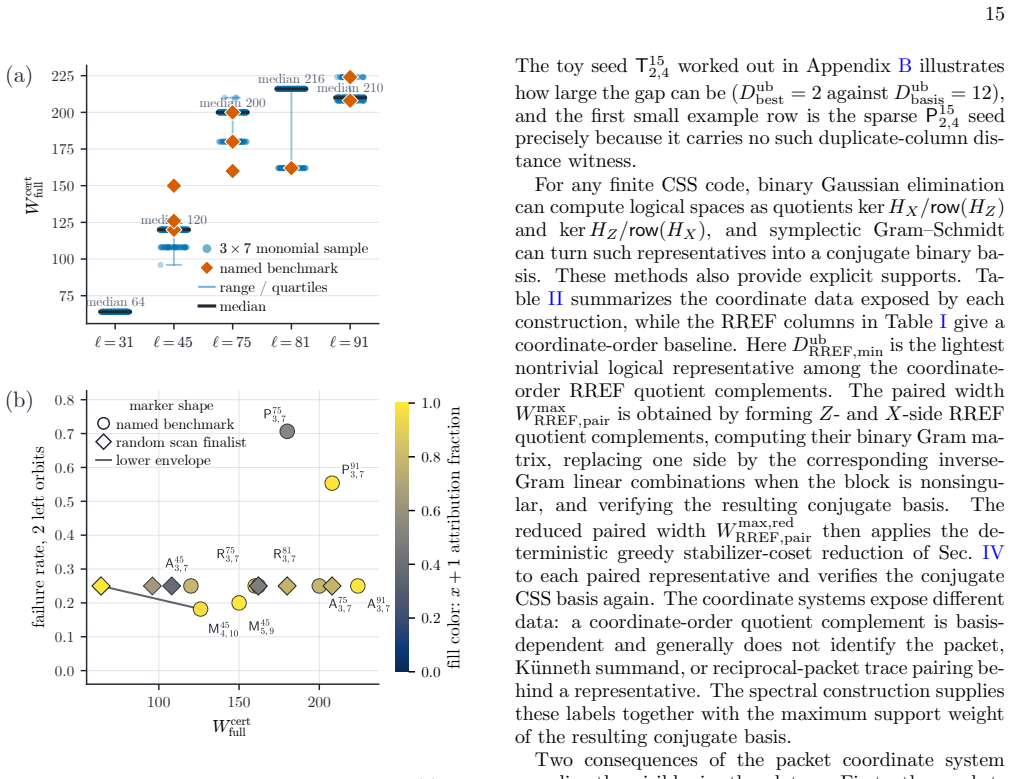
- Sec. IV D and Table I correctly separate d(C) ≤ B(C) ≤ W_cert_full and report D_ub_basis / W_cert_full as properties of the constructed basis. In several high-rate or monomial rows (e.g. R81_3,7: D_ub_wit = 16 vs W_cert_full = 162; M45_5,9: 50 vs 150), the constructed supports are much heavier than the best distance witness. The operational claim that addressable bases make LP memories “usable” for measurement or surgery (Introduction; Sec. VI) needs a short, explicit discussion of when large W_cert relative to d remains useful—e.g. via template reuse under Corollary 5.1—versus when stabilizer-coset or hybrid bases are required before protocol design.
minor comments (6)
- Data and code availability: the manuscript states that seeds, scripts, and figure inputs “will be collected in a companion repository” and are available on request. For a construction paper whose tables rest on binary Gram checks and distance witnesses, a public or archival snapshot at acceptance would strengthen reproducibility.
- Table I is dense (many D_ub and W columns). A one-sentence reading guide in the caption—e.g. which column enters the [[n,k,d]] parameter and that most d entries are upper bounds—would help non-specialist readers.
- Fig. 1 is informative but crowded; the five-step pipeline is clear in the caption, yet the embedded matrix examples are hard to parse at print scale. Consider moving the full toy matrices to Appendix B and keeping only the schematic flow in the main figure.
- Notation: both † (group-algebra adjoint) and T (index transpose) appear early; a single reminder near Eq. (18) that ρ(M†)=ρ(M)^T after binary expansion would reduce confusion for readers coming from the HGP literature.
- Sec. V A: the exact d=9 claim for P15_2,4 via information-set enumeration is valuable; a brief note on the computational cost or the kernel dimension (180) already given would make the verification easier to re-run.
- Related work: radial, univariate-bicycle, and bivariate-bicycle logical-operator results are cited; a short sentence on how packet labels relate to the geometric code-copy/ring labels of radial codes would clarify complementarity.
Circularity Check
No significant circularity: Theorem 5 is a self-contained algebraic construction from CRT/semisimplicity, packet Künneth, and trace duality, not a fit or self-citation chain.
full rationale
The load-bearing claim (Theorem 5) derives the binary logical dimension as a sum of packetwise Künneth dimensions and assembles an addressable conjugate basis by: (i) CRT decomposition of the odd-order group algebra into finite fields (Frobenius packets), (ii) ordinary finite-field homology in each packet, (iii) same-packet tensor contributions, (iv) primitive-idempotent lifts, and (v) reciprocal-packet trace-dual pairing with verified Gram identity ZX^T=I. These steps are standard commutative algebra and finite-field linear algebra applied to the seed matrices; they do not define the output in terms of a fitted target, nor do they import a uniqueness theorem or ansatz from the author's prior work as a forcing premise. Example seeds, W_cert_full certificates, and distance upper bounds are applications and construction-level diagnostics of the same algebraic pipeline, not inputs renamed as predictions. Self-citations ([50], [56]) defer follow-up search and surgery work and are not load-bearing for the odd-order basis theorem. Even-order extensions (Theorem 6) are separately proved via primary packets and Smith profiles. The derivation is therefore self-contained and parameter-free with respect to the claimed result.
Axiom & Free-Parameter Ledger
axioms (4)
- standard math Chinese remainder theorem decomposes F2[G] for odd-order finite Abelian G into a product of finite fields indexed by Frobenius orbits of characters.
- standard math Künneth formula for the degree-one homology of a product of chain complexes of vector spaces over a field (no Tor term).
- domain assumption The physical CSS commutation pairing on binary expansions is the reciprocal-trace pairing that pairs packet Ω only with Ω∨.
- domain assumption Lifted-product code LP(A,B) is the CSS code obtained from the product complex of two seed maps over the group algebra (Panteleev–Kalachev).
invented entities (1)
-
Logical spectroscopy / Frobenius packets as address labels
no independent evidence
read the original abstract
Quantum LDPC memories can encode many logical qubits, but that alone does not make them usable: applications need to know where the logical operators are supported, how they are labeled, and how conjugate $X/Z$ partners pair. For hypergraph-product codes this information follows from row reduction over $\mathbb{F}_2$. For Abelian lifted-product codes, which include prominent high-rate constructions, it does not: the entries of the defining seed matrices live in a group algebra rather than a field, so pivots need not be invertible and row reduction can fail. To address this problem, we introduce \emph{logical spectroscopy}. For an odd-order Abelian lift group, the Chinese remainder theorem splits the group algebra into finite fields, one for each Frobenius orbit of characters; we call these orbits packets. Packet by packet, we solve ordinary finite-field linear algebra, lift the answers back to the physical code with the associated packet projectors, and pair $X$ and $Z$ logicals between reciprocal packets by trace duality. The result is a complete conjugate logical basis for a finite Abelian lifted product code that is addressable: every logical coordinate carries canonical packet and K\"unneth-summand labels, deterministic within-block indices, a conjugate partner, and an explicit binary representative. The code's own translation symmetry then acts on these coordinates in closed form. We apply the construction to examples with up to 5000 physical qubits, including high-rate examples whose distance-witness is reported explicitly. We further extend the decomposition to even-order lifts. Logical spectroscopy thus equips Abelian lifted products with an explicit logical coordinate system and an algebraic toolkit for high-rate code search.
Figures


Reference graph
Works this paper leans on
-
[1]
LetR=F 2[G], where Gis a finite Abelian group, and let A:R nA →R rA , B:R nB →R rB (A1) be two one-step chain complexes
Lifted Product Codes The lifted-product (LP) construction starts from two seed maps over a group algebra. LetR=F 2[G], where Gis a finite Abelian group, and let A:R nA →R rA , B:R nB →R rB (A1) be two one-step chain complexes. Each entry of a seed matrix is an element ofR, expanded asa= P g aggwith ag ∈F 2 andg∈G. After choosing the regular represen- tati...
-
[2]
Thus, the logical operators are represented by the degree-one homology LZ = ker∂ 1/Im∂ 2,L X = ker∂ † 2/Im∂ † 1.(A8) For non-AbelianG, the same binary expansion via the regular representation still produces group-algebra LDPC matrices [18], but the tensor-product description requires compatible left and rightR-module conventions; we restrict here to Abeli...
-
[3]
Using the K¨ unneth formula, the logical space can be obtained as H1(A⊗B) =H 1(A)⊗ H 0(B)⊕ H 0(A)⊗ H 1(B)
Hypergraph product logical bases The above construction contains the usual hypergraph product codeHGP(A, B) as a special case, whereR= F2. Using the K¨ unneth formula, the logical space can be obtained as H1(A⊗B) =H 1(A)⊗ H 0(B)⊕ H 0(A)⊗ H 1(B). (A9) Note thatH 0(B) =F rB 2 /ImB=: cokerB; for full row- rankB,H 0(B) = 0. A nonzero K¨ unneth summand require...
-
[4]
A 1×1 example already shows the problem
Failure in lifted-product codes The ringR ℓ can contain nonzero elements that are not invertible, and such an element is not a valid pivot. A 1×1 example already shows the problem. InR= F2[x]/(x3 + 1) one has (x+ 1)(x 2 +x+ 1) =x 3 + 1 = 0,(A21) with neither factor zero, sox+1 is a zero divisor and has no inverse. The 1×1 matrixM= (x+ 1) is nonzero, yet M...
-
[5]
Frobenius packets overF 2 Why should factoringx ℓ +1 be the analogue of Fourier analysis? Over the complex numbers, the cyclic shift ma- trixSis diagonalized by the discrete Fourier transform. Diagonalization is useful because each Fourier vector is an eigenvector: Svα =αv α, α ℓ = 1.(A22) Then any polynomial in the shift acts on that mode by scalar evalu...
-
[6]
The Chi- nese remainder theorem (CRT) says Rℓ =F 2[x]/(xℓ + 1) ∼= Y g h F2[x]/(g) i ,(A34) whereK g =F 2[x]/(g) is the packet field
Packet projectors and packet evaluation Supposex ℓ + 1 =Q g g(x) is the factorization into dis- tinct irreducible polynomials and square-free. The Chi- nese remainder theorem (CRT) says Rℓ =F 2[x]/(xℓ + 1) ∼= Y g h F2[x]/(g) i ,(A34) whereK g =F 2[x]/(g) is the packet field. For each irre- ducible factorg, there is a unique elemente g ∈R ℓ, the primitive ...
-
[7]
Deterministic implementation conventions Theorem 5 is basis-independent. For a reproducible certificate, however, the implementation must fix repre- sentatives for kernels, quotients, coefficient bases, trace- dual bases in reciprocal packets, idempotent lifts, and final binary row storage. This subsection documents the convention used by the companion co...
-
[8]
A multicyclic lift uses several independent shift variables, for example F2[x, y]/(xL + 1, yM + 1),(A59) which corresponds to the groupZ L ×Z M
What changes for multicyclic Abelian lifts? The single-variable quasi-cyclic setting uses the cyclic groupZ ℓ and the ringF 2[x]/(xℓ + 1). A multicyclic lift uses several independent shift variables, for example F2[x, y]/(xL + 1, yM + 1),(A59) which corresponds to the groupZ L ×Z M. A monomial xayb is a displacement by (a, b) on a two-dimensional periodic...
-
[9]
IV E is explicit for this seed: since the third and fourth columns ofA T coincide,u=e 3 +e 4 satisfiesA T u= 0 with wt R(u) = 2
Duplicate-column distance witness The seed-level distance-witness mechanism of Sec. IV E is explicit for this seed: since the third and fourth columns ofA T coincide,u=e 3 +e 4 satisfiesA T u= 0 with wt R(u) = 2. Taking the monomial coordinate q=e 3, the induced representativeZ= (u⊗q,0) is verified after binary expansion to be a nontrivial logical operato...
-
[10]
The weight-two distance witness of T15 2,4 therefore comes from the chosen exponent pattern, not from the mere use of a 2×4 seed atℓ= 15
Clean comparison seed A same-size monomial comparison seed isolates the de- fect above: Acmp = 1 1 1 1 1x x 3 x7 ∈R 2×4.(B12) It has the same packet-rank profile 1,2,2,2,2 asT 15 2,4, hence the same self-adjoint parametersn= 300,k= 66, andW cert full = 30, but no monomial-equivalence distance witness:D ub basis = 18, the generic binary RREF quotient basis...
-
[11]
Seed-kernel distance witnesses The simplest diagnostic subclass uses a sparse kernel vector of the seed map through theZ-type cycleZ= (u⊗ q,0) of Sec. IV E. LetU A be the set of nonzerou∈kerA for which some monomial coordinateqgives a verified nonzero product class. Define Dub seed(A) = min u∈UA wtR(u),(F3) with the convention that the value is unavailabl...
-
[12]
IfA ij =x aij and two columnsj, k 31 TABLE VII
Monomial-equivalent rows and columns For monomial seeds this candidate test becomes ex- tremely inexpensive. IfA ij =x aij and two columnsj, k 31 TABLE VII. Seed-level diagnostics before QDist. The entries are prefilters or ranking metrics whose purpose is to reject obvious failures and identify seeds worth expensive distance and decoder studies. Diagnost...
-
[13]
LetAbe anr×n seed overR ℓ
Minor and permanent distance witnesses The duplicate-column test is the smallest case of a more general seed-kernel candidate. LetAbe anr×n seed overR ℓ. For any subsetS⊂ {1, . . . , n}with |S|=r+ 1, define a vectoru S ∈R n ℓ supported onS by (uS)j = detA S\j , j∈S,(F9) (uS)j = 0, j /∈S,(F10) whereA S\j is ther×rsubmatrix obtained by deleting columnjfromA...
-
[14]
Letmbe a proper divisor ofℓ, and reduce the seed modulox m + 1: A(m) =Amod (x m + 1) overR m =F 2[x]/(xm + 1)
Proper-divisor quotient-lift witnesses There is another inexpensive source of distance wit- nesses that is not captured by the Cramer/minor spec- trum. Letmbe a proper divisor ofℓ, and reduce the seed modulox m + 1: A(m) =Amod (x m + 1) overR m =F 2[x]/(xm + 1). (F15) Define Pℓ,m = 1 +x m +x 2m +· · ·+x ℓ−m ∈R ℓ.(F16) If ¯u∈kerA (m) andeuis its coefficien...
-
[15]
For anr×nseed, every (r+ 1)-column subset gives a canonical Cramer/minor candidateu S ∈kerA whose entries are ther×rminors in Eq
Cramer/minor spectra in the highlighted example rows The minor construction also explains, before any full- code distance search, one peculiarity of the highlighted example rows in Table I: they do not show the toy-scale determinantal distance witnesses seen in several compari- son seeds. For anr×nseed, every (r+ 1)-column subset gives a canonical Cramer/...
-
[16]
More generally, one can search for bounded sparse polynomial syzygies
Sparse syzygy and seed-code searches Minor distance witnesses only user+1 columns. More generally, one can search for bounded sparse polynomial syzygies. If sparse polynomialsp j(x) supported on a small column setSsatisfy X j∈S pj(x)A·,j = 0,(F29) then u= X j∈S pj(x)ej (F30) lies in kerA, and wtR(u)≤ X j∈S wt(pj).(F31) When the induced product class is ve...
-
[17]
Packet ranks de- termine logical dimensions, but they do not measure the minimum support of packet-local kernel vectors
Structural and decoder scores The remaining prefilters are structural scores rather than standalone distance statements. Packet ranks de- termine logical dimensions, but they do not measure the minimum support of packet-local kernel vectors. A useful refinement is the packet dependency size cg(A) = min |S|: rank Kg Ag,S <|S| ,(F33) possibly computed only ...
-
[18]
They should be read as bounded algebraic tests rather than polynomial-time solutions to distance
Computability and diagnostic summary Most of the filters above are efficient in the intended search regime: bounded seed shape, bounded group- basis support, and bounded distance-witness size. They should be read as bounded algebraic tests rather than polynomial-time solutions to distance. Shifted-duplicate filters use hashed exponent differences, minor f...
-
[19]
Gottesman,Stabilizer Codes and Quantum Error Cor- rection, Ph.D
D. Gottesman,Stabilizer Codes and Quantum Error Cor- rection, Ph.D. thesis, California Institute of Technology (1997), arXiv:quant-ph/9705052
Pith/arXiv arXiv 1997
-
[20]
N. P. Breuckmann and J. N. Eberhardt, Quantum low- density parity-check codes, PRX Quantum2, 040101 (2021), arXiv:2103.06309 [quant-ph]
Pith/arXiv arXiv 2021
-
[21]
D. Horsman, A. G. Fowler, S. Devitt, and R. Van Meter, Surface code quantum computing by lattice surgery, New Journal of Physics14, 123011 (2012), arXiv:1111.4022 [quant-ph]
Pith/arXiv arXiv 2012
-
[22]
D. Litinski, A game of surface codes: Large-scale quan- tum computing with lattice surgery, Quantum3, 128 (2019), arXiv:1808.02892 [quant-ph]
Pith/arXiv arXiv 2019
-
[23]
C. Vuillot, L. Lao, B. Criger, C. G. Almud´ ever, K. Ber- tels, and B. M. Terhal, Code deformation and lattice surgery are gauge fixing, New Journal of Physics21, 033028 (2019), arXiv:1810.10037 [quant-ph]
Pith/arXiv arXiv 2019
-
[24]
L. Z. Cohen, I. H. Kim, S. D. Bartlett, and B. J. Brown, Low-overhead fault-tolerant quantum computing using long-range connectivity, Science Advances8, eabn1717 (2022), arXiv:2110.10794 [quant-ph]
Pith/arXiv arXiv 2022
-
[25]
Q. Xu, H. Zhou, G. Zheng, D. Bluvstein, J. P. Bonilla Ataides, M. D. Lukin, and L. Jiang, Fast and parallelizable logical computation with homological product codes, Physical Review X15, 021065 (2025), arXiv:2407.18490 [quant-ph]
Pith/arXiv arXiv 2025
-
[26]
D. J. Williamson and T. J. Yoder, Low-overhead fault- tolerant quantum computation by gauging logical opera- tors, Nature Physics22, 598–603 (2026)
2026
-
[27]
Swaroop, T
E. Swaroop, T. Jochym-O’Connor, and T. J. Yoder, Universal adapters between quantum low-density parity check codes, PRX Quantum7, 010324 (2026)
2026
-
[28]
Cowtan, Z
A. Cowtan, Z. He, D. J. Williamson, and T. J. Yoder, Parallel logical measurements via quantum code surgery, PRX Quantum7, 020325 (2026)
2026
- [29]
- [30]
-
[31]
B. Gu, A. Z. Liu, A. O. Quintavalle, Q. Xu, J. Eisert, and J. Roffe, QGPU: Parallel logic in quantum LDPC codes (2026), arXiv:2603.05398 [quant-ph]
arXiv 2026
-
[32]
A. R. Calderbank and P. W. Shor, Good quantum error-correcting codes exist, Physical Review A54, 1098 (1996), arXiv:quant-ph/9512032
Pith/arXiv arXiv 1996
-
[33]
A. M. Steane, Error correcting codes in quantum theory, Physical Review Letters77, 793 (1996)
1996
-
[34]
J.-P. Tillich and G. Z´ emor, Quantum LDPC codes with positive rate and minimum distance proportional to the square root of the blocklength, IEEE Transactions on Information Theory60, 1193 (2014), arXiv:0903.0566 [cs.IT]
Pith/arXiv arXiv 2014
-
[35]
Selected exact orbit-erasure diagnostics used in the code-design comparison
This is evident from the fact that, for two classical in- put codes with parameters [n 1, k1, d1] and [n 2, k2, d2], the hypergraph product in the standard convention has k=k 1k2 +k T 1 kT 2 , wherek T i =k i +r i −n i is the num- ber of logical bits of the transpose code defined by the transposedr i-row check matrix; see Appendix A for the 36 TABLE VIII....
-
[36]
P. Panteleev and G. Kalachev, Quantum LDPC codes with almost linear minimum distance, IEEE Transactions on Information Theory68, 213 (2022), arXiv:2012.04068 [cs.IT]
Pith/arXiv arXiv 2022
-
[37]
P. Panteleev and G. Kalachev, Asymptotically good quantum and locally testable classical LDPC codes, in Proceedings of the 54th Annual ACM SIGACT Sym- posium on Theory of Computing, STOC 2022 (Asso- ciation for Computing Machinery, 2022) pp. 375–388, arXiv:2111.03654 [cs.IT]
Pith/arXiv arXiv 2022
-
[38]
M. M. Wilde, Logical operators of quantum codes, Phys. Rev. A79, 062322 (2009)
2009
-
[39]
Ling and P
S. Ling and P. Sol´ e, On the algebraic structure of quasi- cyclic codes I: Finite fields, IEEE Transactions on Infor- mation Theory47, 2751 (2001)
2001
-
[40]
Lidl and H
R. Lidl and H. Niederreiter,Finite Fields, 2nd ed., En- cyclopedia of Mathematics and its Applications, Vol. 20 (Cambridge University Press, 1997)
1997
-
[41]
M. Cain, Q. Xu, R. King, L. R. B. Picard, H. Levine, M. Endres, J. Preskill, H.-Y. Huang, and D. Bluvstein, Shor’s algorithm is possible with as few as 10,000 recon- figurable atomic qubits (2026), arXiv:2603.28627 [quant- ph]
Pith/arXiv arXiv 2026
-
[42]
Zhou and N
H. Zhou and N. Maskara, (2026), private communica- tion
2026
-
[43]
G¨ uneri, S
C. G¨ uneri, S. Ling, and B.¨Ozkaya, Quasi-cyclic codes, in A Concise Encyclopedia of Coding Theory(CRC Press,
-
[44]
arXiv version posted in 2020, arXiv:2007.16029 [cs.IT]
Pith/arXiv arXiv 2020
-
[45]
J. H. van Lint, Repeated-root cyclic codes, IEEE Trans- actions on Information Theory37, 343 (1991)
1991
-
[46]
H. Q. Dinh and S. R. L´ opez-Permouth, Cyclic and ne- gacyclic codes over finite chain rings, IEEE Transactions on Information Theory50, 1728 (2004)
2004
-
[47]
Ling and P
S. Ling and P. Sol´ e, On the algebraic structure of quasi- cyclic codes II: Chain rings, Designs, Codes and Cryp- tography30, 113 (2003)
2003
-
[48]
M. P. C. Fossorier, Quasi-cyclic low-density parity-check codes from circulant permutation matrices, IEEE Trans- actions on Information Theory50, 1788 (2004)
2004
-
[49]
Smarandache and P
R. Smarandache and P. O. Vontobel, On regular quasi- cyclic LDPC codes from binomials, inProceedings of the IEEE International Symposium on Information Theory (IEEE, 2004) p. 277, iSIT 2004, Chicago, USA
2004
-
[50]
R. Smarandache and P. O. Vontobel, Quasi-cyclic LDPC codes: Influence of proto- and tanner-graph structure on minimum Hamming distance upper bounds, IEEE Transactions on Information Theory58, 585 (2012), arXiv:0901.4129 [cs.IT]
Pith/arXiv arXiv 2012
-
[51]
S. Bravyi and M. B. Hastings, Homological product codes, inProceedings of the Forty-Sixth Annual ACM Symposium on Theory of Computing, STOC ’14 (As- sociation for Computing Machinery, 2014) pp. 273–282, arXiv:1311.0885 [quant-ph]
Pith/arXiv arXiv 2014
-
[52]
P. Panteleev and G. Kalachev, Degenerate quantum LDPC codes with good finite length performance, Quan- tum5, 585 (2021), arXiv:1904.02703 [quant-ph]
Pith/arXiv arXiv 2021
-
[53]
M. B. Hastings, J. Haah, and R. O’Donnell, Fiber bun- dle codes: Breaking theN 1/2 polylog(N) barrier for quantum LDPC codes, inProceedings of the 53rd An- nual ACM SIGACT Symposium on Theory of Comput- ing, STOC 2021 (Association for Computing Machinery,
2021
-
[54]
1276–1288, arXiv:2009.03921 [quant-ph]
pp. 1276–1288, arXiv:2009.03921 [quant-ph]
Pith/arXiv arXiv 2009
-
[55]
N. P. Breuckmann and J. N. Eberhardt, Balanced prod- uct quantum codes, IEEE Transactions on Information Theory67, 6653 (2021), arXiv:2012.09271 [quant-ph]
Pith/arXiv arXiv 2021
-
[56]
A. Leverrier and G. Z´ emor, Quantum tanner codes, in Proceedings of the 63rd IEEE Symposium on Foundations of Computer Science, FOCS 2022 (IEEE, 2022) pp. 872– 883, arXiv:2202.13641 [quant-ph]
Pith/arXiv arXiv 2022
-
[57]
A. A. Kovalev and L. P. Pryadko, Quantum Kro- necker sum-product low-density parity-check codes with finite rate, Physical Review A88, 012311 (2013), arXiv:1212.6703 [quant-ph]
Pith/arXiv arXiv 2013
-
[58]
H.-K. Lin and L. P. Pryadko, Quantum two-block group algebra codes, Physical Review A109, 022407 (2024), arXiv:2306.16400 [quant-ph]
Pith/arXiv arXiv 2024
-
[59]
S. Bravyi, A. W. Cross, J. M. Gambetta, D. Maslov, P. Rall, and T. J. Yoder, High-threshold and low- overhead fault-tolerant quantum memory, Nature627, 778 (2024), arXiv:2308.07915 [quant-ph]
Pith/arXiv arXiv 2024
-
[60]
T. R. Scruby, T. Hillmann, and J. Roffe, High-threshold, low-overhead and single-shot decodable fault-tolerant quantum memory, PRX Quantum7, 020310 (2026), arXiv:2406.14445 [quant-ph]. 37
Pith/arXiv arXiv 2026
-
[61]
L. Voss, S. J. Xian, T. Haug, and K. Bharti, Multivariate bicycle codes, Physical Review A111, L060401 (2025), arXiv:2406.19151 [quant-ph]
Pith/arXiv arXiv 2025
-
[62]
J. N. Eberhardt and V. Steffan, Logical operators and fold-transversal gates of bivariate bicycle codes, IEEE Transactions on Information Theory71, 1140 (2025), arXiv:2407.03973 [quant-ph]
Pith/arXiv arXiv 2025
-
[63]
S. Rabeti and H. Mahdavifar, Univariate bicycle quan- tum LDPC codes: Explicit logical structure and distance bounds (2026), arXiv:2605.14173 [cs.IT]
Pith/arXiv arXiv 2026
-
[64]
A. Davenport, J. Blue, and I. Chuang, Generalized bicy- cle codes as cyclic submodules and their automorphism structure (2026), arXiv:2606.05044 [quant-ph]
Pith/arXiv arXiv 2026
-
[65]
Z. Li, Y. Shao, F. Wei, Y. Li, and Z.-W. Liu, Theory of (Co)homological invariants on quantum LDPC codes (2026), arXiv:2603.25831 [quant-ph]
arXiv 2026
-
[66]
D. S. Dummit and R. M. Foote,Abstract Algebra, 3rd ed. (John Wiley and Sons, 2004)
2004
-
[67]
von zur Gathen and J
J. von zur Gathen and J. Gerhard,Modern Computer Algebra, 3rd ed. (Cambridge University Press, 2013)
2013
-
[68]
C. A. Weibel,An Introduction to Homological Algebra, Cambridge Studies in Advanced Mathematics, Vol. 38 (Cambridge University Press, 1994)
1994
-
[69]
L. P. Pryadko, V. A. Shabashov, and V. K. Kozin, QDis- tRnd: A GAP package for computing the distance of quantum error-correcting codes, Journal of Open Source Software7, 4120 (2022), arXiv:2308.15140 [quant-ph]
Pith/arXiv arXiv 2022
-
[70]
J. Y. Leeet al., Spectral scorecards for abelian lifted- product code search (2026), in preparation
2026
-
[71]
K. Sahay, J. Jin, J. Claes, J. D. Thompson, and S. Puri, High-threshold codes for neutral-atom qubits with biased erasure errors, Physical Review X13, 041013 (2023), arXiv:2302.03063 [quant-ph]
Pith/arXiv arXiv 2023
-
[72]
S. Ma, G. Liu, P. Peng, B. Zhang, S. Jandura, J. Claes, A. P. Burgers, G. Pupillo, S. Puri, and J. D. Thompson, High-fidelity gates and mid-circuit erasure conversion in an atomic qubit, Nature622, 279–284 (2023)
2023
-
[73]
L. Pecorari and G. Pupillo, Quantum low-density parity-check codes for erasure-biased atomic quantum processors, Physical Review A112, 052417 (2025), arXiv:2502.20189 [quant-ph]
arXiv 2025
-
[74]
C. Zhao, C. Duckering, A. Gu, N. Maskara, and H. Zhou, Towards ultra-high-rate quantum error correction with reconfigurable atom arrays (2026), arXiv:2604.16209 [quant-ph]
Pith/arXiv arXiv 2026
-
[75]
M. Wang and F. Mueller, Coprime bivariate bicycle codes and their layouts on cold atoms, Quantum10, 2009 (2026), arXiv:2408.10001 [quant-ph]
arXiv 2009
-
[76]
Hirasaki and J
Y. Hirasaki and J. Y. Lee, Lifting lifted-product codes (2026), in preparation
2026
-
[77]
Roffe, LDPC: Python tools for low density parity check codes,https://pypi.org/project/ldpc/(2022), soft- ware package
J. Roffe, LDPC: Python tools for low density parity check codes,https://pypi.org/project/ldpc/(2022), soft- ware package
2022
-
[78]
Roffe, D
J. Roffe, D. R. White, S. Burton, and E. Campbell, De- coding across the quantum low-density parity-check code landscape, Physical Review Research2, 043423 (2020)
2020
-
[79]
F. J. MacWilliams and N. J. A. Sloane,The Theory of Error-Correcting Codes, North-Holland Mathematical Library, Vol. 16 (North-Holland, Amsterdam, 1977)
1977
-
[80]
J. A. Wood, Duality for modules over finite rings and ap- plications to coding theory, American Journal of Mathe- matics121, 555 (1999)
1999
discussion (0)
Sign in with ORCID, Apple, or X to comment. Anyone can read and Pith papers without signing in.