REVIEW 2 major objections 5 minor
Scene graphs let multimodal models navigate visual scenes instead of hunting isolated objects.
Reviewed by Pith at T0; open to challenge. T0 means a machine referee read the full paper against a public rubric. the ladder, T0–T4 →
T0 review · grok-4.5
2026-07-11 03:11 UTC pith:LZNX5N5M
load-bearing objection Solid systems paper: hierarchical scene-graph data + node-as-proxy GRPO delivers large, ablated gains on fine-grained and spatial MLLM benchmarks; residual risk is teacher-graph bias, already partly audited. the 2 major comments →
Scene Graph Thinking: Reinforcing Structured Visual Reasoning for Multimodal Large Language Models
The pith
A machine-rendered reading of the paper's core claim, the machinery that carries it, and where it could break.
Core claim
An automated pipeline that turns flat image–text pairs into hierarchical, depth-aware scene graphs, followed by supervised fine-tuning on 120K graph-sampled chain-of-thought traces and GRPO reinforcement with node-grounded and node-relevance rewards, internalizes structured visual reasoning so that even 3B- and 7B-parameter models substantially outperform their baselines and several larger or tool-using systems on fine-grained and spatial benchmarks.
What carries the argument
Node-as-proxy graph rewards: instead of supervising ambiguous edges, the method rewards trajectories that visit visually grounded, query-relevant nodes (node-grounded reward checks crop–description match; node-relevance reward scores semantic support of anchored nodes), thereby consolidating efficient graph exploration.
Load-bearing premise
The hybrid automatic graphs (large teacher MLLM plus depth and segmentation models, then two-round filtering) are accurate and complete enough that the sampled traces and LLM-as-judge rewards teach real structured navigation rather than artifacts of the teachers.
What would settle it
Replace the graph-derived cold-start data and node rewards with equal-volume ordinary VQA or random-crop traces; if the VStarBench and CVBench gains largely disappear, the structured-graph claim fails.
Editorial analysis
A structured set of objections, weighed in public.
Referee Report
Summary. The paper proposes Scene Graph Thinking (SaGe), a paradigm that equips MLLMs with structured visual reasoning by converting flat image–text pairs into hierarchical scene graphs (compositional nodes with attributes/bboxes/depth, multi-type edges), sampling 120K node- and edge-centric CoT traces, and applying two-stage post-training: SFT cold-start followed by GRPO with complementary node-as-proxy rewards (node-grounded visual alignment and node-relevance to query intent). Built on Qwen2.5-VL-3B/7B, SaGe reports large gains on high-resolution fine-grained benchmarks (VStarBench to 89.0, +12–13 over baselines; HRBench-4K/8K), spatial tasks (CVBench-2D/3D), and modest gains on MMStar, RefCOCO, and ChartQA, with ablations isolating SFT, CoT tags, and each reward component, plus a teacher-surpassing comparison.
Significance. If the gains hold under independent re-implementation, the work supplies a practical, scalable recipe for injecting relational structure into MLLM reasoning without multi-turn tool loops. Strengths include a fully automated hybrid graph engine, publicly released code, systematic ablations (Tables 3–5) that isolate SFT, GRPO, CoT tags and NGR/NRR, monotonic data-scale/composition curves (Fig. 6), and the result that SaGe-7B exceeds its Qwen2.5-VL-72B teacher on several metrics (Table 6). The node-as-proxy design is a clean alternative to brittle edge-level supervision and is of clear interest to the fine-grained multimodal community.
major comments (2)
- §3.2–3.3 and Appendix B: node/edge precision under Gemini-3-Pro is high (94.5%/92.9%), yet open-vocabulary recall and hierarchical completeness remain unquantified. Because the central claim is that the model learns genuine structured navigation rather than teacher artifacts, a short recall or coverage analysis (e.g., fraction of human-annotated entities recovered on a held-out subset) would strengthen the weakest assumption without altering the experimental design.
- §3.4 Eqs. (5)–(7) and Appendix D: both NGR and NRR rely on external LLM/MLLM judges (Qwen3 family). While Table 5 shows complementarity and Table 6 shows student > teacher, a brief sensitivity check (different judge model or human agreement on a reward subsample) would confirm that the reported gains are not judge-specific.
minor comments (5)
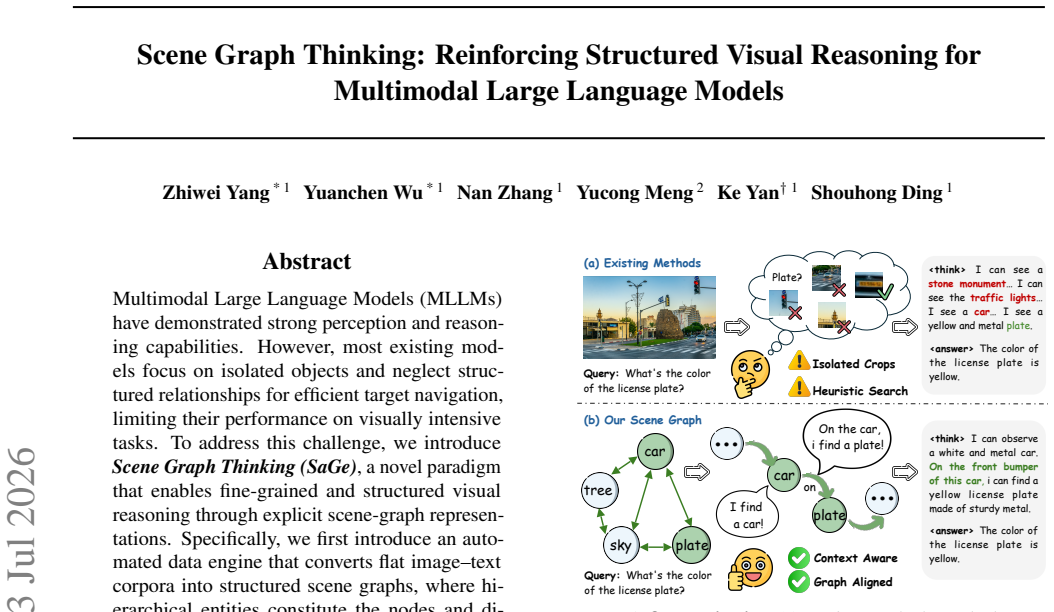
- Figure 1 caption and §1: the contrast with “isolated crops + heuristic search” is clear, but a short quantitative comparison of navigation length or number of hops versus DeepEyes/Pixel-Reasoner would make the efficiency claim more concrete.
- Table 1: FSP/FCP columns for proprietary models are often blank; a note explaining missing entries would avoid the appearance of selective reporting.
- §4.1 Implementation: the 26K RL mix (2K grounding + 4K chart + 20K V*) is reasonable, yet the exact sampling ratios and whether any V* test leakage is possible should be stated explicitly.
- Appendix C multi-criteria caption filter (Fig. 14): the eight binary rules are useful; reporting the fraction of captions discarded at each stage would help readers gauge data-construction cost.
- Notation: vt is defined with ct, at, bt, dt in Eq. (3), yet later text sometimes uses “entity” interchangeably; a single glossary of tags (<entity>, <bbox>, <depth>) would improve readability.
Circularity Check
No significant circularity: empirical ML method with external data generation and independent public-benchmark evaluation.
full rationale
This is a standard empirical multimodal training paper. Scene graphs are constructed via an automated hybrid pipeline (Qwen2.5-VL-72B + Depth-Anything + SAM), 120K CoT samples are LLM-sampled from those graphs, SFT + GRPO with node-as-proxy (LLM-as-judge) rewards are applied, and gains are reported on eight held-out public benchmarks (VStarBench, HRBench-4K/8K, CVBench-2D/3D, MMStar, RefCOCO, ChartQA). None of the load-bearing performance claims reduce by construction to fitted constants, self-defined quantities, or self-citation uniqueness theorems. Teacher-model artifacts are a validity concern (addressed by the authors via Gemini-3-Pro audit, two-round filtering, and Table 6 teacher-surpassing results) but do not constitute circularity under the defined patterns. Self-citations (e.g., prior Yang et al. CLIP/Depth works) are peripheral and non-load-bearing. The derivation chain is self-contained against external metrics; score 0 is the correct honest finding.
Axiom & Free-Parameter Ledger
free parameters (4)
- SFT learning rate / batch size
- RL learning rate / batch / rollouts
- Node-relevance reward tiers (1.0 / 0.8 / 0.5 / 0.2 / 0.0)
- KL coefficient β and clip ε in GRPO
axioms (3)
- domain assumption Qwen2.5-VL-72B + Depth-Anything + SAM produce sufficiently accurate hierarchical nodes and multi-type edges for training data.
- domain assumption LLM/MLLM judges can reliably score node-grounded visual alignment and node-relevance to query intent.
- ad hoc to paper Node sequences are an adequate proxy for valid graph trajectories; edge-level supervision is unnecessary.
invented entities (2)
-
Scene Graph Thinking (SaGe) paradigm
no independent evidence
-
Node-as-proxy graph rewards (NGR + NRR)
no independent evidence
read the original abstract
Multimodal Large Language Models (MLLMs) have demonstrated strong perception and reasoning capabilities. However, most existing models focus on isolated objects and neglect structured relationships for efficient target navigation, limiting their performance on visually intensive tasks. To address this challenge, we introduce Scene Graph Thinking (SaGe), a novel paradigm that enables fine-grained and structured visual reasoning through explicit scene-graph representations. Specifically, we first introduce an automated data engine that converts flat image-text corpora into structured scene graphs, where hierarchical entities constitute the nodes and diverse visual relations define the edges. Building upon this, we construct 120K high-quality training data by sampling reasoning traces from scene graphs. Then, two-stage graph-aligned post-training paradigms are introduced, where supervised fine-tuning internalizes MLLMs with structured reasoning, and subsequent reinforcement fine-tuning proposes node-as-proxy graph rewards to consolidate efficient graph exploration. With curated data and graph-aligned training, our approach achieves significant improvements across eight multimodal benchmarks, demonstrating strong effectiveness on fine-grained perception and reasoning tasks. Code is available at https://github.com/zwyang6/SaGe.
Figures







discussion (0)
Sign in with ORCID, Apple, or X to comment. Anyone can read and Pith papers without signing in.