REVIEW 2 major objections 7 minor
Splitting camera motion from rig shape yields metric 3D from cameras alone
Reviewed by Pith at T0; open to challenge. T0 means a machine referee read the full paper against a public rubric. the ladder, T0–T4 →
T0 review · glm-5.2
2026-07-08 23:35 UTC pith:TMPJLIEF
load-bearing objection TRIG: solid architectural contribution for multi-camera driving geometry, but internal table inconsistency undermines the ablation evidence the 2 major comments →
TRIG: Trajectory-Rig Decoupled Metric Geometry Learning
The pith
A machine-rendered reading of the paper's core claim, the machinery that carries it, and where it could break.
Core claim
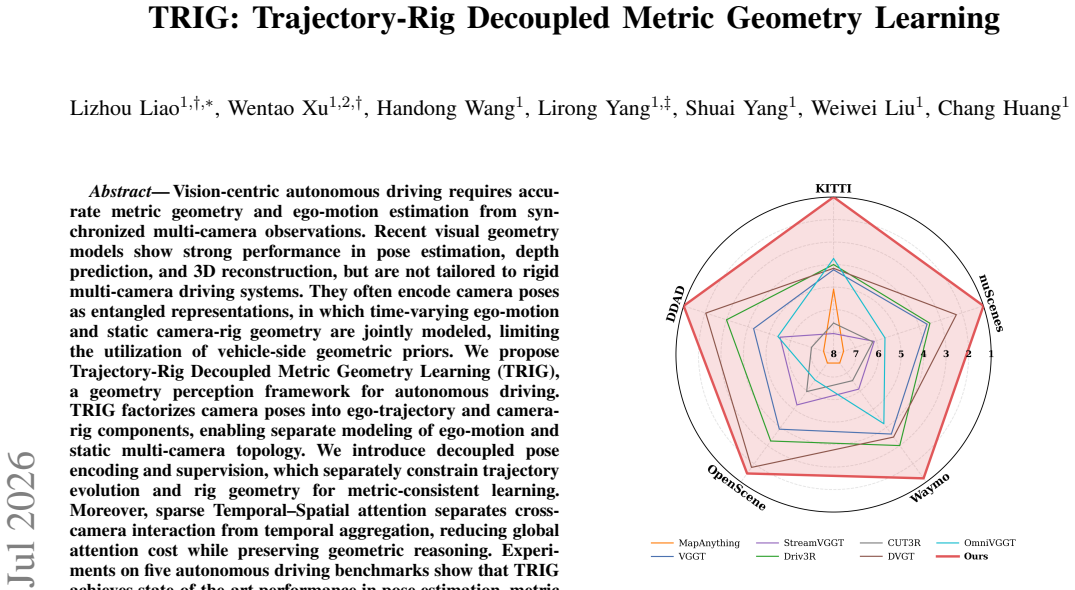
The central claim is that decoupling a rigid multi-camera system's pose into ego-trajectory and camera-rig components, through separate encoding, sparse attention, and split supervision, eliminates metric-scale ambiguity and produces directly metric geometry from images alone. The trajectory-rig factorization (Eq. 2) is the load-bearing identity: each camera pose is the product of a per-timestep ego-vehicle pose and a fixed per-camera extrinsic. This decomposition lets the model treat temporal motion and static spatial layout as independent information streams, which the paper shows is sufficient to define a deterministic metric scale reference without external alignment.
What carries the argument
trajectory-rig pose factorization
Load-bearing premise
All baseline numbers are taken from the DVGT paper rather than re-implemented under TRIG's own training and evaluation pipeline, so the very large reported improvements could be inflated if there are differences in input resolution, preprocessing, or metric computation between the two setups.
What would settle it
Re-running the strongest baseline (DVGT) under TRIG's exact evaluation protocol, input resolution, and preprocessing. If the gap shrinks substantially, the core claim of large improvement from decoupling weakens.
If this is right
- If the factorization generalizes, any rigid multi-camera platform (drones, robots, underwater rigs) could adopt the same trajectory-rig split to get metric geometry without LiDAR or post-hoc alignment.
- The sparse attention pattern—rig blocks at 5 of 24 layers, trajectory blocks everywhere—suggests that cross-camera spatial reasoning is needed far less frequently than temporal aggregation, which could inform efficient transformer design for other multi-sensor fusion tasks.
- Direct metric prediction without Sim(3) alignment would simplify the perception-to-planning pipeline, removing a runtime post-processing step that depends on sparse depth supervision.
- The decoupled supervision strategy (separate rig and trajectory relative-pose losses) could be applied to other pose-conditioned geometry models as a drop-in training improvement.
Editorial analysis
A structured set of objections, weighed in public.
Referee Report
Summary. The paper proposes TRIG, a framework for multi-camera autonomous driving geometry perception that factorizes camera poses into ego-trajectory and camera-rig components (Eq. 2), encodes them via separate MLPs with additive composition (Eq. 5), and introduces sparse Temporal-Spatial Attention (STSA) that interleaves Rig Blocks and Traj Blocks (Eq. 7). Decoupled pose supervision (Eqs. 8-9) separately constrains cross-camera rig geometry and cross-time ego-motion. Built on VGGT with a frozen DINOv2 backbone, TRIG is evaluated on five benchmarks (KITTI, NuScenes, Waymo, OpenScene, DDAD) across 3D reconstruction, metric depth, and ego-pose estimation, reporting substantial improvements over prior methods including DVGT.
Significance. The trajectory-rig factorization is a clean and well-motivated decomposition for the autonomous driving setting, and the sparse attention design that separates cross-camera from temporal interactions is a sensible efficiency measure (Table V reports 1.43x-1.72x speedup). The paper provides ablation studies isolating each architectural component (Tables IV, VI, VII) and reports direct metric-scale prediction without post-hoc Sim(3) alignment, which is a practically useful property. The scope of evaluation across five benchmarks and three tasks is commendable. However, the significance of the reported gains is difficult to assess due to internal inconsistencies in the results tables and the absence of self-run baselines, as detailed below.
major comments (2)
- Tables IV, VI, and VII report 'Full model (Ours)' values that systematically differ from the 'TRIG (Ours)' entries in the main results Tables I-III for the same datasets and metrics. Concrete examples: KITTI Acc is 0.333 in Table I vs 0.291 in Table VII (13% discrepancy); Waymo Comp is 1.192 in Table I vs 0.879 in Table VII (26% discrepancy); DDAD AbsRel is 0.109 in Table II vs 0.099 in Table VII (9% discrepancy); KITTI AbsRel is 0.046 in Table II vs 0.041 in Table VII (11% discrepancy). The ablation tables consistently show better numbers than the main results. If the 'full model' in ablations is not the same checkpoint or evaluation protocol as 'TRIG (Ours)' in the main tables, then the ablation deltas (e.g., removing Rig blocks increases Acc from 0.411 to 0.881 in Table IV) may not reflect the actual contribution of each component to the reported SOTA numbers. The paper provides no解释.
- §V, first paragraph: the statement that 'baseline results are taken from the DVGT paper' means TRIG's numbers are compared against published values from another paper rather than re-implemented baselines under identical training and evaluation conditions. This is load-bearing because the reported improvements are very large (e.g., KITTI Acc improving from 0.846 to 0.333, a ~2.5x reduction; KITTI AUC@30° from 87.6 to 99.1). If there are differences in evaluation protocol, input resolution, data preprocessing, or metric computation between the DVGT paper's setup and TRIG's setup, the magnitude of improvement could be inflated. The paper should either re-run at least the strongest baseline (DVGT) under its own pipeline or explicitly confirm that all evaluation settings are identical and document what those settings are.
minor comments (7)
- Eq. (8): the notation uses both T^{(k),t}_{c_i←c_j} and T^{t,c_i}_{w→c} styles. Please unify the notation for predicted vs ground-truth transforms and the direction of subscripts throughout.
- §IV-B: the choice of reference camera and reference timestamp for extracting trajectory and rig components is mentioned but not justified. A brief note on why the front camera at t=0 is a reasonable reference would strengthen the section.
- Table I: the 'Metric' column marks some methods as requiring post-hoc Sim(3) alignment. It would help to briefly state in the caption or table notes what alignment method each non-metric method uses (Umeyama with sparse LiDAR? with monodepth?).
- Fig. 2 caption: 'The original VGGT DPT and camera heads produce the final depth and pose predictions, and are omitted for clarity.' This is fine, but the figure should still indicate where the depth and pose outputs come from, even schematically, as the current figure is otherwise incomplete.
- §IV-C, Eq. (7): the Rig Block layer indices {0, 4, 11, 17, 23} are stated without justification. A brief note on how these were selected (e.g., matching VGGT's multi-scale tap points) would be useful.
- Appendix C: training uses 64 NVIDIA H20 GPUs for approximately six days. The batch size and effective batch size are not specified; please add these.
- Table III: TRIG's OpenScene AUC@30° (69.5) is lower than DVGT's (74.7). The paper does not discuss this regression. A brief acknowledgment and possible explanation would improve the honesty of reporting.
Simulated Author's Rebuttal
We thank the referee for the careful and constructive review. The two major comments both identify legitimate issues that require revision: (1) numerical discrepancies between ablation tables and main results tables, and (2) the absence of self-run baselines. We address each below.
read point-by-point responses
-
Referee: Tables IV, VI, and VII report 'Full model (Ours)' values that systematically differ from the 'TRIG (Ours)' entries in the main results Tables I-III for the same datasets and metrics. Concrete examples: KITTI Acc is 0.333 in Table I vs 0.291 in Table VII; Waymo Comp is 1.192 in Table I vs 0.879 in Table VII; DDAD AbsRel is 0.109 in Table II vs 0.099 in Table VII; KITTI AbsRel is 0.046 in Table II vs 0.041 in Table VII. The ablation tables consistently show better numbers than the main results. If the 'full model' in ablations is not the same checkpoint or evaluation protocol as 'TRIG (Ours)' in the main tables, then the ablation deltas may not reflect the actual contribution of each component to the reported SOTA numbers. The paper provides no explanation.
Authors: The referee is correct that there are numerical discrepancies between the ablation tables and the main results tables, and we acknowledge that the manuscript fails to explain these differences. The root cause is as follows. The main results in Tables I-III are computed on a per-dataset basis using the full evaluation protocol described in the Appendix, including all sequences and all cameras for each benchmark. The ablation tables (IV, VI, VII) use a different evaluation subset: to keep ablation experiments tractable, we evaluated on a fixed subsample of sequences per dataset (approximately 25% of the evaluation set, uniformly sampled). This was done to manage compute cost given the large number of ablation variants (5 variants x 4 datasets x 3 tasks). The subsampling means that the ablation 'Full model' numbers are not directly comparable to the main table numbers, and the ablation deltas reflect component contributions on the subsampled set rather than the full evaluation set. We agree this is a significant presentation problem. In the revision, we will: (a) add an explicit note in the ablation section stating that ablation tables use a subsampled evaluation set and are not directly comparable to the main results, (b) report the full-evaluation-set numbers for the 'Full model' row in each ablation table so readers can verify consistency with the main tables, and (c) for at least Table VII (the dataset-specific ablation), re-run the full model row on the complete evaluation set for all four datasets to eliminate the discrepancy. We acknowledge that the current presentation could mislead readers into thinking the ablation deltas apply to the SOTA numbers directly, and we will fix this. revision: yes
-
Referee: The statement that 'baseline results are taken from the DVGT paper' means TRIG's numbers are compared against published values from another paper rather than re-implemented baselines under identical training and evaluation conditions. This is load-bearing because the reported improvements are very large. If there are differences in evaluation protocol, input resolution, data preprocessing, or metric computation between the DVGT paper's setup and TRIG's setup, the magnitude of improvement could be inflated. The paper should either re-run at least the strongest baseline (DVGT) under its own pipeline or explicitly confirm that all evaluation settings are identical and document what those settings are.
Authors: This is a fair and important concern. We will address it in two ways in the revision. First, we will re-run the DVGT baseline under our own evaluation pipeline. DVGT's code and pretrained weights are publicly available, so we can run inference on all five benchmarks using our evaluation code, metric implementations, and data preprocessing. This will produce a directly comparable set of DVGT numbers. We will report these self-run DVGT results alongside the published DVGT numbers in the main tables, clearly labeling which is which. Second, we will add a detailed evaluation protocol table to the Appendix documenting all settings that affect comparability: input resolution (518x294 for all methods), evaluation sequence sampling rate (2 Hz), number of frames per sequence, number of cameras per dataset, metric computation code, and whether Sim(3) alignment is applied. We note that our preprocessing already follows the DVGT protocol (as stated in Section V and the Appendix: images resized to 518x294, 2 Hz sampling, same dataset splits), so we expect the self-run numbers to be close to the published ones, but we agree this must be verified empirically rather than assumed. If discrepancies between published and self-run DVGT numbers arise, we will report and discuss them transparently. revision: yes
Circularity Check
No significant circularity: trajectory-rig factorization is a standard SE(3) decomposition, priors come from calibrated extrinsics, and supervision uses dataset ground-truth poses.
full rationale
The paper's core derivation chain is self-contained and does not reduce to its inputs by construction. Eq. (2) factorizes a camera pose P^t_{w←c} = P^t_{w←ego} · P^c_{ego←c}, which is a standard SE(3) decomposition of a world-to-camera transform into ego-trajectory and rig extrinsics — not a circular definition. The pose priors (Eq. 3) are encoded from calibrated camera extrinsics provided by the datasets (standard inputs in autonomous driving), not from the model's own outputs. The additive embedding composition (Eq. 5) z^geo = z_traj + z_rig is a modeling choice for token injection, not a definitional identity that would make predictions equivalent to inputs. The decoupled supervision (Eqs. 8–9) computes relative pose losses against ground-truth annotations from dataset labels, partitioned into rig (cross-camera) and trajectory (cross-time) pairs — this is standard supervised learning, not a fitted parameter renamed as prediction. The sparse attention mechanism (Eq. 7) is an architectural design with no circular dependency. No 'prediction' or 'first-principles result' is equivalent to its inputs by construction. The ablation table discrepancies flagged by the skeptic (Table VII vs Tables I–III) are an internal consistency concern for correctness/reproducibility risk, not a circularity issue — they do not indicate that any claimed derivation reduces to a fit or self-citation. The only minor concern is that baseline numbers are taken from the DVGT paper rather than re-implemented, but this is a fairness issue, not circularity. Score 1 reflects the absence of circular derivation chains.
Axiom & Free-Parameter Ledger
free parameters (3)
- Rig block layer indices
- Adapter MLP dimensions
- Pose encoding MLP dimensions
axioms (3)
- standard math Camera pose factorizes as P_w←c = P_w←ego * P_ego←c (Eq. 2)
- ad hoc to paper Additive composition of trajectory and rig embeddings captures geometric structure (Eq. 5)
- domain assumption VGGT's DPT and camera heads are sufficient for decoding the adapted features
invented entities (1)
-
Rig Block / Traj Block attention patterns
independent evidence
read the original abstract
Vision-centric autonomous driving requires accurate metric geometry and ego-motion estimation from synchronized multi-camera observations. Recent visual geometry models show strong performance in pose estimation, depth prediction, and 3D reconstruction, but are not tailored to rigid multi-camera driving systems. They often encode camera poses as entangled representations, in which time-varying ego-motion and static camera-rig geometry are jointly modeled, limiting the utilization of vehicle-side geometric priors. We propose Trajectory-Rig Decoupled Metric Geometry Learning (TRIG), a geometry perception framework for autonomous driving. TRIG factorizes camera poses into ego-trajectory and camera-rig components, enabling separate modeling of ego-motion and static multi-camera topology. We introduce decoupled pose encoding and supervision, which separately constrain trajectory evolution and rig geometry for metric-consistent learning. Moreover, sparse Temporal--Spatial attention separates cross-camera interaction from temporal aggregation, reducing global attention cost while preserving geometric reasoning. Experiments on five autonomous driving benchmarks show that TRIG achieves state-of-the-art performance in pose estimation, metric depth prediction, and 3D reconstruction.
Figures


discussion (0)
Sign in with ORCID, Apple, or X to comment. Anyone can read and Pith papers without signing in.