REVIEW 2 major objections 6 minor 26 references
Reviewed by Pith at T0; open to challenge.
T0 means a machine referee read the full paper against a public rubric. The mark states how deep the mechanical check went, never who wrote it. the ladder, T0–T4 →
load-bearing objection New diagnostic shows DreamerV3 imagines kinematically, not dynamically — but a 5-step conditioning prefix leaves the central claim plausible rather than definitive the 2 major comments →
Imagined Rollouts are Kinematic, Not Dynamic: A Diagnosis of Long-Horizon World-Model Failure
The pith
A machine-rendered reading of the paper's core claim, the machinery that carries it, and where it could break.
Core claim
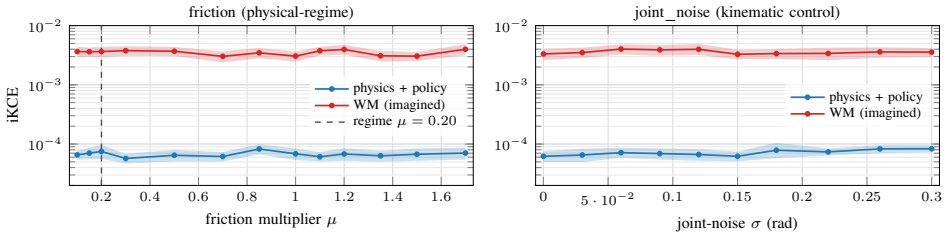
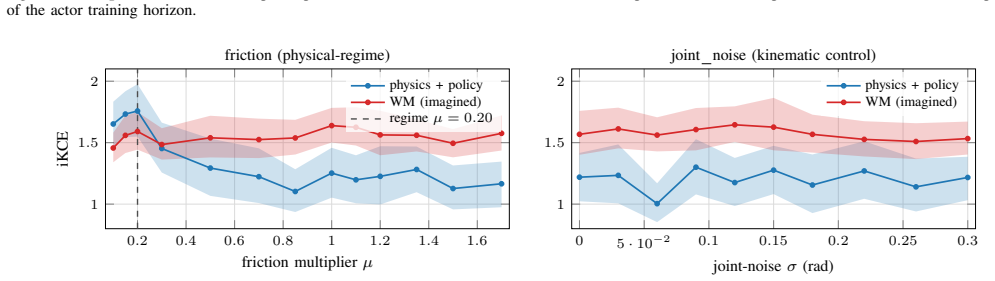
The central object is the imagined Kinematic-Consistency Error (iKCE), a per-step diagnostic measuring deviation from a closed-form kinematic null along an imagined rollout, paired with a physical-regime perturbation protocol. The core discovery is the kinematic-not-dynamic signature: across a friction sweep crossing the gait-collapse boundary, DreamerV3's imagined iKCE is statistically flat (slope CI contains zero across three seeds and a domain-randomization control), while matched real-physics iKCE responds (slope excludes zero). The world model responds to kinematic perturbations (joint noise) but not to dynamic ones (friction). This flatness persists even when the world model is trained
What carries the argument
iKCE: per-step deviation of imagined rollout states from a constant-velocity kinematic extrapolation. Friction sweep: perturbation of MuJoCo friction across 13 values crossing the empirical gait-collapse boundary. Joint-noise sweep: kinematic positive control adding Gaussian noise to joint-position observations. Log-log regression slope: falsifiable statistic testing whether iKCE responds to friction. Horizon-emergence test: re-integration of per-step traces at T=8,16,32,64 showing the physics-side dynamic signature emerges with horizon while the WM side remains flat at all horizons.
Load-bearing premise
The diagnostic conditions the world model on only five observed steps (125 milliseconds, under one gait period) before free imagination begins. If the world model cannot extract enough regime information from this short prefix to know what friction level it is operating in, its flatness across the friction sweep could reflect an information bottleneck rather than a structural inability to imagine dynamically.
What would settle it
Extend the conditioning prefix from 5 steps to 32-64 steps of observed data, or explicitly append a friction indicator to the world model's observation. If the world model's iKCE then begins responding to the friction sweep, the kinematic-imagination diagnosis would be weakened in favor of an information-bottleneck explanation.
Editorial analysis
A structured set of objections, weighed in public.
Referee Report
Summary. The paper proposes a kinematic-vs-dynamic reframing of long-horizon world-model failure, introducing the imagined Kinematic-Consistency Error (iKCE) as a diagnostic metric. The central claim is that world models imagine kinematically—extrapolating position-velocity-acceleration trajectories consistent with linear kinematic update rules but inconsistent with physical constraints. The diagnostic is instantiated on a DreamerV3 checkpoint trained on DMC walker-walk, with two predicted signatures: (H1) iKCE elevated above matched real-physics rollouts, and (H2) statistical invariance of imagined iKCE across a friction sweep that crosses the gait-collapse boundary. The experimental suite includes three seeds, a domain-randomization control, an actor-horizon ablation, a kinematic-state robustness check, and a joint-noise positive control. The falsifiable regression framework (β with bootstrap CIs) is well-executed.
Significance. The paper makes a genuine conceptual contribution by distinguishing kinematic imagination from dynamic imagination as a structural failure mode, separate from compounding-error and representation-engineering accounts. The iKCE diagnostic is clearly defined, falsifiable, and embodiment-agnostic in principle. The experimental instantiation is thorough: three independent seeds with bootstrap CIs, a domain-randomization control that closes the training-distribution loophole, an actor-horizon ablation, a per-step temporal-structure decomposition, robustness to kinematic-state choice, and a joint-noise positive control that confirms the WM is not insensitive to all perturbations. The release of code, checkpoints, and data is commendable and strengthens reproducibility. The horizon-emergence test (Fig. 3) is a particularly clean result showing the physics-side friction sensitivity grows with measurement horizon while the WM side remains flat at all horizons.
major comments (2)
- §IV (H2) and §V, limitation (ii): The 5-step conditioning prefix (125ms, under one gait period) is a load-bearing confound for the central claim. The paper argues in §III-B that friction effects 'accumulate over multiple footfalls' and become detectable only at horizons longer than the gait period—this argument is applied to the measurement horizon T=64 but not to the conditioning prefix. If 5 steps do not carry enough friction signal for even a dynamically capable WM to infer the regime, then the WM's flatness across friction is uninformative: it would hold for any WM regardless of whether it imagines kinematically or dynamically. The domain-randomization control (Appendix B2) addresses the training-distribution loophole (the DR WM has seen friction variation during training), but it does not address the evaluation-time bottleneck: the DR WM still conditions on only 5 steps at test time
- §II: The four motivating observations are drawn from the driving VLM/VLA setting, but the diagnostic is instantiated only on DMC walker-walk (a 2D 9-DOF planar system). The paper asserts these observations 'converge on a single structural deficit' but does not test whether the iKCE diagnostic reproduces the kinematic-not-dynamic signature on any driving world model. The connection between §II and §IV is therefore an asserted analogy rather than a demonstrated one. This is acknowledged as a limitation (§V, limitation i) and proposed as future work (Vista, DriveDreamer), but it weakens the bridge between the motivation and the experimental contribution. The paper should either scope the central claim to locomotion world models or provide stronger justification for why the driving-VLM observations necessarily imply the same deficit in DreamerV3.
minor comments (6)
- Table I: The ratio narrowing from ~180× at T=16 to ~30× at T=64 is attributed to 'per-step dilution from the WM's smooth long-horizon tail.' It would help to clarify whether this dilution is a property of the integrated metric (averaging over more steps where per-step displacement decays) or a genuine change in the WM's per-step behavior at longer horizons.
- Fig. 2 caption: 'iKCE diverges in physics, stays flat in imagination' is slightly misleading given that the physics-side elevation is modest (1.04–1.30×10⁻⁴ in low-µ vs. 0.70–0.92×10⁻⁴ in high-µ). Consider 'iKCE shows friction sensitivity in physics, remains flat in imagination' or similar.
- §III-A, Eq. (1): The kinematic predictor kin(·) is defined as 'any closed-form kinematic predictor (e.g., constant-velocity or constant-acceleration).' The choice of predictor is embodiment-specific and could affect the diagnostic's sensitivity. The paper uses constant-velocity throughout but does not discuss how the choice of null model interacts with the diagnostic signature. A brief remark on this would strengthen the diagnostic.
- Appendix A2: The three-seed regression is reported only for the WM side; the physics-side regression uses seed 0 only ('as physics is not a learned model'). While this is reasonable, a brief note on the physics-side variability across seeds (even if not a learned model, the policy is) would be informative.
- §V, limitation (iii): The per-step displacement decay over the rollout horizon is noted but not quantified. A simple plot of mean per-step |Δx| over t for both channels would let the reader assess how much of the long-horizon iKCE reduction is a motion-magnitude artifact vs. genuinely cleaner imagination. This could be deferred to the appendix.
- The paper uses 'kinematic' and 'dynamic' in a specific sense (§I) that differs from some robotics conventions where 'kinematic' refers to forward/inverse kinematics. A brief note that this is the classical-mechanics usage would prevent reader confusion.
Simulated Author's Rebuttal
We thank the referee for a careful and constructive report. Both major comments identify genuine limitations of the current manuscript. We agree that the 5-step conditioning prefix is a load-bearing confound that weakens the H2 claim, and that the bridge from driving-VLM motivation to the DMC instantiation is presently an asserted analogy rather than a demonstrated one. We propose concrete revisions for both.
read point-by-point responses
-
Referee: §IV (H2) and §V, limitation (ii): The 5-step conditioning prefix (125ms, under one gait period) is a load-bearing confound for the central claim. The paper argues in §III-B that friction effects 'accumulate over multiple footfalls' and become detectable only at horizons longer than the gait period—this argument is applied to the measurement horizon T=64 but not to the conditioning prefix. If 5 steps do not carry enough friction signal for even a dynamically capable WM to infer the regime, then the WM's flatness across friction is uninformative: it would hold for any WM regardless of whether it imagines kinematically or dynamically. The domain-randomization control (Appendix B2) addresses the training-distribution loophole (the DR WM has seen friction variation during training), but it does not address the evaluation-time bottleneck: the DR WM still conditions on only 5 steps at test time
Authors: The referee is correct that the 5-step conditioning prefix is a load-bearing confound, and we agree this weakens the H2 claim in its current form. We acknowledge this honestly in §V, limitation (ii), but the referee is right that the paper does not adequately confront the implication: if 5 steps (125ms, under one gait period) cannot carry enough friction signal for any WM to infer the regime, then the WM's flatness is uninformative because it would hold for a dynamically capable WM as well. We cannot fully resolve this confound within the revision cycle because a conditioning-prefix-length sweep (5–64 observed steps) requires new rollouts and is listed in our own open directions. However, we can and will do the following: (1) Promote the prefix-length limitation from a secondary caveat to a primary bound on the H2 claim, explicitly stating that H2 is established only up to the regime evidence a 5-step prefix can carry. (2) Add the horizon-emergence argument as partial mitigation: the physics-side friction sensitivity grows with measurement horizon T (Fig. 3, β_phys crossing zero between T=32 and T=64), which is consistent with friction signal accumulating over the rollout itself, not just the prefix. This means the WM has 64 steps of its own imagined trajectory in which friction-conditional deviations could appear if the model had learned any friction-conditional latent dynamics—and it does not, even under the DR control where the WM was trained on the full friction range. (3) Reframe the H2 claim as a conditional result: given a 5-step prefix, the DR-trained WM (which has seen friction variation and could in principle encode it) produces friction-invariant rollouts. This is informative about the WM's rollout dynamics even if it does not rule out the possibility that a revision: partial
-
Referee: §II: The four motivating observations are drawn from the driving VLM/VLA setting, but the diagnostic is instantiated only on DMC walker-walk (a 2D 9-DOF planar system). The paper asserts these observations 'converge on a single structural deficit' but does not test whether the iKCE diagnostic reproduces the kinematic-not-dynamic signature on any driving world model. The connection between §II and §IV is therefore an asserted analogy rather than a demonstrated one. This is acknowledged as a limitation (§V, limitation i) and proposed as future work (Vista, DriveDreamer), but it weakens the bridge between the motivation and the experimental contribution. The paper should either scope the central claim to locomotion world models or provide stronger justification for why the driving-VLM observations necessarily imply the same deficit in DreamerV3.
Authors: The referee is correct that the connection between §II and §IV is an asserted analogy, not a demonstrated one, and we agree the paper should be more honest about this. We cannot run the iKCE diagnostic on a driving world model (Vista, DriveDreamer) within the revision cycle because these models do not expose the ego-pose/state heads needed to compute iKCE, as we note in §V. We will therefore take the referee's first suggestion and scope the central claim. Specifically: (1) The central claim in §I will be revised to state that the kinematic-not-dynamic hypothesis is motivated by observations in the driving-VLM/VLA setting and instantiated on a locomotion world model, and that the claim of kinematic imagination is demonstrated only for the locomotion case. (2) §II will be reframed as motivating evidence—four independent observations that are consistent with the kinematic-fallback hypothesis—rather than as evidence that converges on a single structural deficit that has been demonstrated across embodiments. (3) The abstract will be adjusted to scope the experimental claim to DreamerV3 on DMC walker-walk, with the driving-VLM observations presented as motivation for the diagnostic framework, not as validated instances of it. (4) We will add an explicit statement that the iKCE diagnostic is embodiment-agnostic in principle (the protocol requires only a kinematic state vector and a perturbation axis) but has been demonstrated on only one embodiment. We believe this scoping is honest and does not diminish the paper's contribution, which is the diagnostic framework and its falsifiable instantiation, not a claim of universality. revision: yes
- The 5-step conditioning prefix confound cannot be fully resolved in this revision. A prefix-length sweep (5–64 observed steps) requires new rollouts and is listed in our open directions. We can bound the claim and provide partial mitigation via the horizon-emergence test and DR control, but we cannot eliminate the confound that a 5-step prefix may not carry enough friction signal for any WM to infer the regime.
- The driving-WM cross-anchor (Vista, DriveDreamer) cannot be completed in this revision because these models do not expose the ego-pose/state heads needed to compute iKCE. The bridge from §II motivation to §IV experiments remains an asserted analogy rather than a demonstrated one.
Circularity Check
No significant circularity: the diagnostic is structurally non-circular, with only minor self-citations used as motivating evidence rather than derivation inputs.
full rationale
The paper's central derivation chain is self-contained against external benchmarks. iKCE (Eq. 1) measures deviation from a constant-velocity kinematic null that is defined independently of the world model — it is a standard physics formula, not a fitted parameter or a self-referential definition. The friction sweep is an external physical perturbation (MuJoCo geom_friction scaling), and the WM's response to it is an empirical finding that could have falsified the claim (the WM could have shown friction-sensitive iKCE). The two self-citations to overlapping-author work — Gao et al. [2] for the KCE mathematical form and Schäfer et al. [11] for EgoDyn-Bench — are used as motivating evidence in §II, not as load-bearing derivation inputs. The KCE formula from [2] is a standard kinematic extrapolation residual (next state minus constant-velocity prediction), not a novel result requiring independent verification; the paper's contribution is repurposing it from a training loss to a test-time diagnostic. The trivial-WM anchor (Appendix A4) is transparently presented as a lower bound (iKCE=0 by construction for a trivially kinematic predictor), not as a prediction. The domain-randomization control (Appendix B2) provides independent evidence that the flatness is not a training-distribution artifact, and the paper honestly acknowledges the remaining 5-step-prefix limitation (§V, limitation ii). No step in the derivation chain reduces to its own inputs by construction. Score 1 reflects the minor self-citations that are non-load-bearing.
Axiom & Free-Parameter Ledger
free parameters (4)
- K (rollouts per cell) =
20
- T (measurement horizon) =
16, 64
- Conditioning prefix length =
5 observations
- Regime boundary µ =
0.20
axioms (3)
- domain assumption Constant-velocity kinematic predictor is the appropriate null model for walker-walk root-vertical motion.
- domain assumption Friction sensitivity of iKCE at T≥64 is a valid signature of dynamic imagination.
- ad hoc to paper The four driving-VLM observations (§II) reflect the same structural deficit as the DreamerV3 walker experiment.
invented entities (2)
-
iKCE (imagined Kinematic-Consistency Error)
independent evidence
-
Kinematic-fallback failure mode
independent evidence
read the original abstract
Long-horizon failure in world models is conventionally attributed to compounding error, a generic framing that does not distinguish what kind of error compounds. We propose a kinematic-vs-dynamic reframing: world models tend to imagine kinematically rather than dynamically. We operationalize this as the imagined Kinematic-Consistency Error, a per-step diagnostic that measures how far a rollout departs from a closed-form kinematic null, paired with a perturbation protocol that tests whether iKCE responds when physical conditions cross a regime boundary. We instantiate the diagnostic on a released DreamerV3 checkpoint trained on DMC walker-walk, where imagined iKCE runs roughly two orders of magnitude above that of matched real-physics rollouts. Across a friction sweep that crosses the gait-collapse boundary, the model's iKCE stays statistically flat even as the trained policy's reward collapses through the same range, providing the kinematic-not-dynamic signature. The diagnostic distinguishes kinematic from dynamic imagination at horizons longer than the embodiment's gait period.
Figures




Reference graph
Works this paper leans on
-
[1]
Vista: A Generalizable Driving World Model with High Fidelity and Versatile Controllability
Shenyuan Gao, Jiazhi Yang, Li Chen, Kashyap Chitta, Yihang Qiu, Andreas Geiger, Jun Zhang, and Hongyang Li. Vista: A generalizable driving world model with high fidelity and versatile controllability, 2024. URL https: //arxiv.org/abs/2405.17398
work page internal anchor Pith review Pith/arXiv arXiv 2024
-
[2]
Yuan Gao, Dengyuan Hua, Mattia Piccinini, Finn Ras- mus Sch ¨afer, Korbinian Moller, Lin Li, and Johannes Betz. StyleVLA: Driving style-aware vision language action model for autonomous driving.arXiv preprint arXiv:2603.09482, 2026
-
[3]
Recurrent world models facilitate policy evolution
David Ha and J¨ urgen Schmidhuber. Recurrent world models facilitate policy evolution. InAdvances in Neural Information Processing Systems (NeurIPS), 2018
work page 2018
-
[4]
Learning latent dynamics for planning from pixels
Danijar Hafner, Timothy Lillicrap, Ian Fischer, Ruben Villegas, David Ha, Honglak Lee, and James Davidson. Learning latent dynamics for planning from pixels. In 0.2 0.4 0.6 0.8 1 1.2 1.4 1.6 10−4 10−3 10−2 friction multiplierµ iKCE friction (physical-regime) physics + policy WM (imagined) regimeµ= 0.20 0 5·10 −2 0.1 0.15 0.2 0.25 0.3 10−4 10−3 10−2 joint-...
work page 2019
-
[5]
Mastering diverse domains through world models.Nature, 640:647–653, 2025
Danijar Hafner, Jurgis Pasukonis, Jimmy Ba, and Timo- thy Lillicrap. Mastering diverse domains through world models.Nature, 640:647–653, 2025
work page 2025
-
[6]
Model-based im- itation learning for urban driving
Anthony Hu, Gianluca Corrado, Nicolas Griffiths, Zak Murez, Corina Gurau, Hudson Yeo, Alex Kendall, Roberto Cipolla, and Jamie Shotton. Model-based im- itation learning for urban driving. InAdvances in Neural Information Processing Systems (NeurIPS), 2022
work page 2022
-
[7]
GAIA-1: A Generative World Model for Autonomous Driving
Anthony Hu, Lloyd Russell, Hudson Yeo, Zak Murez, George Fedoseev, Alex Kendall, Jamie Shotton, and Gianluca Corrado. Gaia-1: A generative world model for autonomous driving, 2023. URL https://arxiv.org/abs/ 2309.17080
work page internal anchor Pith review Pith/arXiv arXiv 2023
-
[8]
When to trust your model: Model-based policy optimization
Michael Janner, Justin Fu, Marvin Zhang, and Sergey Levine. When to trust your model: Model-based policy optimization. InAdvances in Neural Information Pro- cessing Systems (NeurIPS), 2019
work page 2019
-
[9]
R2-dreamer: Redundancy-reduced world models without decoders or augmentation, 2026
Naoki Morihira, Amal Nahar, Kartik Bharadwaj, Ya- suhiro Kato, Akinobu Hayashi, and Tatsuya Harada. R2-dreamer: Redundancy-reduced world models without decoders or augmentation, 2026. URL https://arxiv.org/ abs/2603.18202
-
[10]
Lost in Fog: Sensor Perturbations Expose Reasoning Fragility in Driving VLAs
Abhinaw Priyadershi and Jelena Frtunikj. Lost in fog: Sensor perturbations expose reasoning fragility in driving VLAs.arXiv preprint arXiv:2605.21446, 2026
work page internal anchor Pith review Pith/arXiv arXiv 2026
-
[11]
Finn Rasmus Sch ¨afer, Yuan Gao, Dingrui Wang, Thomas Stauner, Stephan G¨ unnemann, Mattia Piccinini, Sebastian Schmidt, and Johannes Betz. Egodyn-bench: Evaluating ego-motion understanding in vision-centric foundation models for autonomous driving, 2026. URL https://arxiv. org/abs/2604.22851
work page internal anchor Pith review Pith/arXiv arXiv 2026
-
[12]
Drivedreamer: Towards real-world-driven world models for autonomous driving,
Xiaofeng Wang, Zheng Zhu, Guan Huang, Xinze Chen, Jiagang Zhu, and Jiwen Lu. Drivedreamer: Towards real-world-driven world models for autonomous driving,
-
[13]
URL https://arxiv.org/abs/2309.09777
work page internal anchor Pith review Pith/arXiv arXiv
-
[14]
Rethinking the Open-Loop Evaluation of End-to-End Autonomous Driving in nuScenes
Jiang-Tian Zhai, Ze Feng, Jinhao Du, Yongqiang Mao, Jiang-Jiang Liu, Zichang Tan, Yifu Zhang, Xiaoqing Ye, and Jingdong Wang. Rethinking the open-loop evaluation of end-to-end autonomous driving in nuscenes, 2023. URL https://arxiv.org/abs/2305.10430. Appendix This appendix documents (i) the experimental configura- tion (Table II), (ii) the methodological...
work page internal anchor Pith review Pith/arXiv arXiv 2023
-
[15]
Regime-boundary determination.:The boundary µ=0.20referenced in Fig. 2 (dashed line) and Fig. 1 is not chosen a priori. It is determined empirically from the policy’s reward collapse. We roll out the trained actor forK=10 episodes at each of 12 friction multipliersµ∈[0.1,1.5], compute the mean episodic reward and a95%bootstrap CI per cell, and define the ...
-
[16]
Flatness test for H2.:We make the “statistically flat” claim falsifiable by regressinglog(iKCE)onlog(µ)across theT=64friction sweep, with each of theK=20rollouts at each of the 13µvalues contributing one observation (n=260 per seed). To rule out a seed-dependent artifact, we repeat the regression for three independently-trained DreamerV3 walker- walk chec...
-
[17]
Horizon-emergence test.:Section III-B argues that the diagnostic should be applied at horizons longer than the embodiment’s gait period. We sharpen this claim quantitatively by repeating the flatness regression of the preceding paragraph at four sub-horizonsT∈ {8,16,32,64}, re-integrating each rollout’s saved per-step iKCE trace from the existingT=64 swee...
-
[18]
Trivial-WM scale anchor.:The iKCE scale has an an- alytic lower bound that anchors the magnitudes in Table I. A trivial “WM” that imagines by applying the kinematic predictor to its own current state,ˆxWM t+1 = kin(ˆxWM t ), produces iKCE= 0by construction: each predicted next state is identically the kinematic continuation of its predecessor, so every re...
-
[19]
Actor-training-horizon control.:A natural concern is that the WM’s friction-invariance atT=64reflects the default actor operating out-of-distribution from its training horizon (imag horizon= 15) rather than a structural property of WM imagination. To rule this out, we retrain an identical checkpoint atimag horizon= 64, matching the measure- ment horizon, ...
-
[20]
Domain-randomization control.:Limitation (ii) in§V names the most consequential confound of the physics-side H2 signature: the evaluation policy acted only atµ=1.0during training, so the elevated low-µphysics iKCE may reflect an in- distribution policy slipping under out-of-distribution friction rather than a genuine friction response of the contact dynam...
-
[21]
Per-step structure decomposition.:The integrated iKCE of Table I and Fig. 2 averages over the rollout horizon and so does not reveal whether the WM’s imagined residual has the same temporal structure as physics. Fig. 6 decomposes per- step iKCE at three friction valuesµ∈ {0.15,1.0,1.5}: physics exhibits sparse contact-event spikes whose positions shift wi...
-
[22]
Figure 4 reports the integrated iKCE under the retrained h=64actor
Per-step structure under the actor-ablation checkpoint.: Figure 6 reports the per-step decomposition under the default actor. Figure 4 reports the integrated iKCE under the retrained h=64actor. Figure 7 combines the two controls: per-step WM iKCE under both the default (h=15) and retrained (h=64) actor, at the same three friction valuesµ∈ {0.15,1.0,1.5}. ...
-
[23]
The main result uses the root-vertical-motion slice(z, v z)
Robustness to the kinematic-state choice.:iKCE depends on a chosen kinematic state vectorˆx t (Definition 1). The main result uses the root-vertical-motion slice(z, v z). Figure 8 repeats the protocol with a richer representation, the walker’s gait degrees of freedom. The qualitative pattern of Fig. 2 reappears: WM iKCE is flat across friction, while phys...
-
[24]
7.Per-step actor ablation.WM per-step iKCE at three friction values for both actor checkpoints
Joint-noise as a kinematic positive control.:The friction sweep is a dynamic perturbation (physically-grounded, regime- 0 10 20 30 40 50 60 10−4 10−2 imagined stept per-step iKCE WM, actorh=15 µ= 0.15 µ= 1.0 µ= 1.5 0 10 20 30 40 50 60 10−4 10−2 imagined stept WM, actorh=64 µ= 0.15 µ= 1.0 µ= 1.5 Fig. 7.Per-step actor ablation.WM per-step iKCE at three fric...
-
[25]
Code and data availability.:The diagnostic pipeline, trained checkpoints, perturbation-sweep CSVs, and PGFPlots figure sources for this paper are released at https://github. com/TUM-A VS/iKCE. The DreamerV3 implementation is the NM512 PyTorch port at commit6ef8646. The upstream al- gorithm is [5]. Checkpoints are released at https://huggingface. co/fnc190...
-
[26]
Implementation specifics.:For the identity view, the kinematic predictor is constant-velocity on the root ver- tical state:kin([z t,˙zt]) = [z t + ∆t˙z t,˙zt]with∆t= 25ms (the DMC physics timestep). For the gait view,ˆx t stacks the unit-circle embedding(cosθ j,sinθ j)of each walker joint angle, andkin(·)applies one-step extrapola- tion per joint. Frictio...
discussion (0)
Sign in with ORCID, Apple, or X to comment. Anyone can read and Pith papers without signing in.