Thermodynamic phase transitions in lattice spin systems with severe kinetic constraints: Numerical simulation results
Reviewed by Pith T0 review T1 audit T2 compute T3 formal T4 kernel 2026-07-08 13:13 UTCglm-5.2pith:WOQKDHNPrecord.jsonopen to challenge →
The pith
Frozen neighbors fracture lattice into percolating and glassy phases
A machine-rendered reading of the paper's core claim, the machinery that carries it, and where it could break.
Core claim
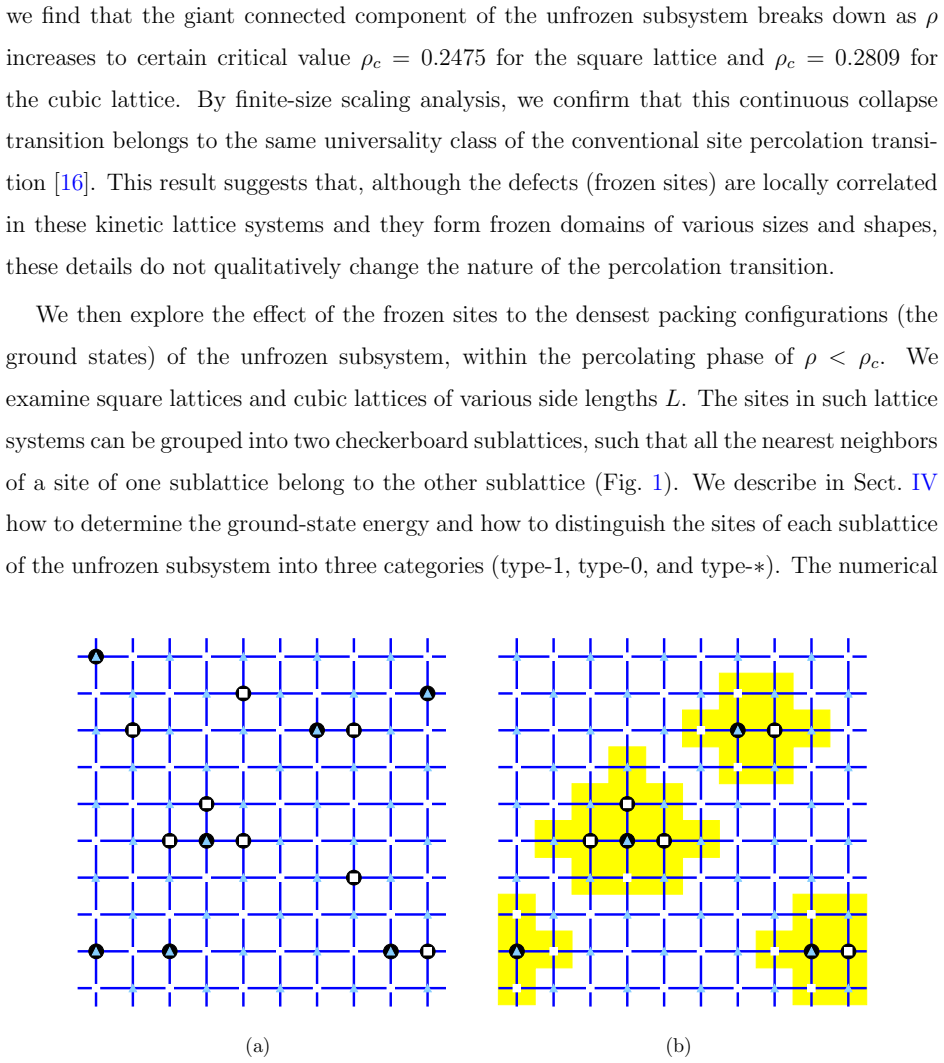
The central discovery is that a purely local kinetic rule — blocking any site that has an occupied neighbor — generates two distinct thermodynamic phase transitions in finite-dimensional lattices. The percolation collapse of the unfrozen subsystem falls in the conventional site percolation universality class despite the spatial correlations of frozen sites. The ground-state crystal-to-glass transition separates a regime where one checkerboard sublattice dominates from a regime where local regions choose different sublattices, producing a mosaic of ordered domains. The dimension matters: in 3D the ordered phase survives up to a finite defect density ρ* ≈ 0.1423, while in 2D the Imry-Ma-type失衡
What carries the argument
The unfrozen subsystem is the central object: after removing all kinetically frozen sites from the lattice, the remaining sites form a bipartite graph whose ground states are maximum independent sets. The type-1/type-0/type-* classification of unfrozen sites (always occupied, always empty, or flexible) tracks how frozen defects propagate their local sublattice preference. The imbalance order parameter m_I measures the degree to which one checkerboard sublattice dominates over the other.
If this is right
- The mapping to the random-field Ising model suggests that the ground-state transition in 3D may share the RFIM universality class, but the correlated nature of frozen defects (they form connected domains, not independent random fields) could shift the universality class — this is testable by computing additional critical exponents.
- The crystal-to-glass transition is established at zero temperature (chemical potential μ → -∞). At finite μ, type-1 and type-0 sites become thermally excitable, and whether the transition persists as a true phase transition or becomes a crossover is an open question with direct relevance to understanding the glass transition.
- The K=2 case, where frozen occupied sites form closed loops and unfrozen sites must organize into tree structures, may exhibit qualitatively different ground-state physics due to the higher entropy of tree packings.
- The full phase diagram in (ρ, μ) space likely contains a tricritical point where the crystalline, glass, and disordered gas phases meet, analogous to mixed-order transitions in random-bond Ising systems.
Where Pith is reading between the lines
- The fact that the percolation transition falls in the standard site percolation universality class despite correlated defects suggests that the frozen domains are effectively uncorrelated at the length scales relevant to percolation. This could be tested by measuring the pair-correlation function of frozen sites at the percolation threshold.
- The extremely small β ≈ 0.03 in 3D, combined with the authors' note that fixing β = 0 gives a worse fit, hints that the transition might be an unusually sharp crossover rather than a conventional continuous transition — larger system sizes and Binder-cumulant analysis could resolve this.
- The Imry-Ma argument predicting ρ* = 0 in 2D is supported numerically but not rigorously proven for this specific non-equilibrium system. The marginal dimension for this class of problem is D = 2, and finite-size effects there are notoriously slow to converge — the authors' own FSS fit with χ² = 1.39 reflects this difficulty.
Load-bearing premise
The 2D argument for ρ* = 0 relies on an Imry-Ma-type energy balance: the number imbalance Δ between sublattices in a region of side L scales as L^(D/2), which is verified numerically but not rigorously proven for this specific kinetic system. The finite-size scaling data in 2D only covers ρ ≥ 0.08 and extrapolates to a critical point at ρ* ≈ 0.077, which the authors themselves note may shift to zero only in the infinite-size limit.
What would settle it
If the number imbalance Δ in 2D were shown to scale sub-extensively (slower than L^(D/2)) for large system sizes, the Imry-Ma argument for ρ* = 0 would fail, and a finite ρ* in 2D could not be ruled out.
Figures


read the original abstract
The Fredrickson-Andersen model with hyperparameter $K=1$ is a severely constrained kinetic lattice spin system, such that any site is temporarily blocked from changing its packing state (empty or occupied) if there is one or more occupied nearest neighbors. Starting from a completely random initial configuration with a fraction $\rho$ of sites being occupied, some of the sites may be permanently frozen to their initial state under this severe kinetic constraint. The remaining sites can switch states at least occasionally, and they form the unfrozen subsystem associated with the given initial configuration. In the present work we investigate thermodynamic phase transitions in such unfrozen subsystems of the two-dimensional square lattice and the three-dimensional cubic lattice by extensive numerical simulations. We demonstrate that the giant connected component of the unfrozen subsystem collapses at certain critical value $\rho_{c}$ of initial packing density, with $\rho_c = 0.2475$ for the square lattice and $\rho_c = 0.2809$ for the cubic lattice. This phase transition belongs to the same universality class of the conventional site percolation. We also observe that the ground states (densest packing configurations) experience a continuous crystal-to-glass phase transition at the critical value $\rho^* = 0.1423$ of initial packing density for the cubic lattice. For the two-dimensional square lattice we argue that long-range crystalline order is destroyed in the ground states as long as the initial packing density $\rho$ is positive.
Editorial analysis
A structured set of objections, weighed in public.
Referee Report
Summary. This manuscript studies the K=1 Fredrickson-Andersen (FA) kinetically constrained spin model on 2D square and 3D cubic lattices. In this model, sites with occupied neighbors are frozen, and the remaining unfrozen sites form a subsystem with effective hard-core interactions. The authors demonstrate two main results: (1) the giant connected component of the unfrozen subsystem undergoes a collapse transition at critical densities ρ_c = 0.2475 (2D) and ρ_c = 0.2809 (3D), belonging to the conventional site percolation universality class; and (2) the ground states (densest packings) of the 3D cubic lattice exhibit a continuous crystal-to-glass transition at ρ* = 0.1423, while in 2D, long-range order is argued to be destroyed for any ρ > 0 (i.e., ρ* = 0). The percolation results are supported by clean finite-size scaling (FSS) analyses with excellent χ² values. The 3D ground-state transition is also well-supported by FSS with ρ* within the data window. The 2D ground-state claim (ρ* = 0) relies on an Imry-Ma-type argument and an FSS extrapolation outside the data range.
Significance. The paper presents a clear and well-executed numerical study of thermodynamic phase transitions induced by kinetic constraints in finite-dimensional lattices. The percolation FSS analyses are of high quality, with critical exponents matching known universality classes to excellent precision (χ² ≈ 1.02 in 2D, χ² ≈ 0.97 in 3D). The identification of a crystal-to-glass transition in 3D ground states, with ρ* well within the simulated data window and good FSS quality (χ² ≈ 1.01), is a solid and interesting result. The connection to the random-field Ising model (RFIM) is physically motivated. The 2D argument for ρ* = 0, while resting on a heuristic Imry-Ma argument with acknowledged numerical limitations, is clearly framed as a conjecture with a forthcoming rigorous proof. The authors provide reproducible code and data (Ref. [66]).
major comments (1)
- §V.B, Fig. 7: The FSS analysis for the 2D ground-state transition yields ρ* = 0.0774 with χ² = 1.39, but this value lies below all simulated data points (ρ ≥ 0.08), making it an extrapolation rather than an interpolation. The authors acknowledge this, noting it offers 'only an upper bound' and is 'only valid for relatively small system sizes.' This is the weakest numerical result in the paper. While the Imry-Ma argument in §VI provides theoretical support for ρ* = 0, the FSS fit with q ≈ 12 polynomial order on 260 degrees of freedom risks overfitting, and the elevated χ² suggests the scaling form is not yet strongly supported by the data. The authors should more clearly delineate this as a conjecture supported by a heuristic argument rather than a numerically established result, and perhaps reduce the emphasis on the FSS extrapolation in the abstract and conclusion.
minor comments (7)
- Abstract and §I: The abstract states ρ* = 0.1423 for the 3D transition, while §I states ρ* = 0.1429, and §VII and Fig. 9 report ρ* = 0.14226. These should be made consistent.
- §VII: The text states 'From we see that' (first sentence after the reference to Fig. 10), which appears to be a typo with missing words.
- §VIII: 'consqeuences' should be 'consequences' and 'sties' should be 'sites'.
- §IV.A: 'For ample, the edge set' should be 'For example, the edge set'.
- Fig. 2(c) caption: The chi-square is written as χ²_ν ≈ 1.02, but the subscript ν is non-standard here since the reduced χ² is already divided by degrees of freedom. This notation appears inconsistently across figure captions.
- §III.C: The Fisher exponent τ ≈ 1.93 estimated from Fig. 2(b) differs from the value τ ≈ 2.0549 obtained via Eq. (12) using the FSS exponents. The authors briefly note the roughness of the estimate, but a sentence reconciling these two values would improve clarity.
- §VI, Eq. (20): The Imry-Ma argument assumes Δ follows a Gaussian distribution. While the central limit theorem supports this for large L, it would strengthen the argument to briefly justify this assumption given the spatial correlations among frozen sites.
Simulated Author's Rebuttal
We thank the referee for a careful and constructive report. The referee's assessment of the percolation results and the 3D ground-state transition as well-supported is appreciated. The sole major comment concerns the 2D ground-state FSS extrapolation (ρ* = 0.0774, χ² = 1.39), which lies below all simulated data points and relies on a high-order polynomial fit. We agree with the substance of this comment and will revise the manuscript accordingly.
read point-by-point responses
-
Referee: §V.B, Fig. 7: The FSS analysis for the 2D ground-state transition yields ρ* = 0.0774 with χ² = 1.39, but this value lies below all simulated data points (ρ ≥ 0.08), making it an extrapolation rather than an interpolation. The authors acknowledge this, noting it offers 'only an upper bound' and is 'only valid for relatively small system sizes.' This is the weakest numerical result in the paper. While the Imry-Ma argument in §VI provides theoretical support for ρ* = 0, the FSS fit with q ≈ 12 polynomial order on 260 degrees of freedom risks overfitting, and the elevated χ² suggests the scaling form is not yet strongly supported by the data. The authors should more clearly delineate this as a conjecture supported by a heuristic argument rather than a numerically established result, and perhaps reduce the emphasis on the FSS extrapolation in the abstract and conclusion.
Authors: We agree with the referee's assessment. The 2D ground-state FSS result is indeed the weakest numerical result in the paper, and we accept that it should be presented more cautiously. We will make the following revisions in the next version of the manuscript: (1) In the abstract, we will reframe the 2D claim explicitly as a conjecture supported by the Imry-Ma-type argument of §VI, rather than as a result established by the FSS analysis. The FSS extrapolation will be mentioned only as providing a finite-size upper bound on ρ*. (2) In §V.B, we will add a sentence at the beginning of the discussion of the FSS fit stating plainly that the fitted ρ* = 0.0774 lies below all simulated data points and therefore constitutes an extrapolation, not an interpolation, and that the elevated χ² = 1.39 relative to the other fits in the paper indicates that the scaling form is not strongly supported by the data at the accessible system sizes. (3) In the conclusion (§VIII), we will state that the 2D result ρ* = 0 rests on the theoretical argument of §VI (and the forthcoming rigorous proof), with the FSS analysis serving only as a consistency check that does not contradict this conjecture but does not independently establish it. (4) We will add a brief remark on the overfitting risk associated with the q ≈ 12 polynomial order, noting that the high polynomial degree is necessitated by the broad scaling function shape but that the resulting fit should not be over-interpreted given the extrapolation. We note that the manuscript already contains several of these caveats (e.g., the statement that the FSS result 'only offers an upper bound' and is 'only valid for relatively small system sizes'), but we agree they should be more prominent and that the abstract and conclusion should not give the FS revision: no
Circularity Check
No significant circularity; the paper is self-contained with simulation data analyzed by standard methods and compared against external benchmarks.
full rationale
The paper's central claims are derived from numerical simulation data analyzed via standard finite-size scaling (FSS) and compared against external benchmarks. The percolation critical densities (ρ_c = 0.2475 in 2D, ρ_c = 0.2809 in 3D) and critical exponents (ν, β) are extracted by fitting simulation data to the scaling ansatz (Eq. 8) and then compared to known site-percolation universality class values from external references [30–34, 35–39]. The ground-state energy computation uses the König theorem (cited to Rizzi [43], an external source) applied to maximum matchings on bipartite graphs — a standard combinatorial optimization method. The 3D crystal-to-glass transition at ρ* = 0.1423 is obtained via FSS within the data window (χ² ≈ 1.01) and the exponents are compared to RFIM literature values [54–58]. The 2D claim ρ* = 0 rests on an Imry-Ma argument (Sect. VI) using the standard Imry-Ma reference [50] and a numerically verified scaling ⟨Δ²⟩ = σ₀(ρ)L^D (Eq. 19); the authors honestly acknowledge the FSS extrapolation (ρ* ≈ 0.0774 from data at ρ ≥ 0.08) is only an upper bound with χ² = 1.39. Self-citations ([10], [11], [14], [40], [46]) provide background context on k-core constraints, vertex-cover methods, and type classification, but none of these form a load-bearing chain where a central claim reduces to a self-cited unverified result. The reference to a forthcoming rigorous proof [17] (a self-citation by overlapping authors) is mentioned as future work and does not serve as the sole justification for any claim in the present paper — the Imry-Ma argument in Sect. VI is presented self-contained. No prediction reduces to its inputs by construction, no fitted parameter is renamed as a prediction, and no uniqueness theorem from the authors' prior work is invoked to forbid alternatives. The derivation chain is clean.
Axiom & Free-Parameter Ledger
free parameters (5)
- ρ (initial packing density)
- ρ_c (percolation critical density) =
0.247521(2) for 2D, 0.280942(4) for 3D
- ρ* (ground-state transition density, 3D) =
0.14226(4)
- ν, β (critical exponents) =
Various, e.g., ν=1.3375(27), β=0.1395(16) for 2D percolation
- q (polynomial order for FSS fitting function) =
q≈4 for percolation, q≈12 for 2D ground-state
axioms (4)
- standard math The finite-size scaling ansatz (Eq. 8, 17) holds near the transition points.
- domain assumption The Imry-Ma argument for random-field systems applies to the kinetic defect system, specifically that the number imbalance ∆ scales as L^{D/2}.
- domain assumption The K=1 FA kinetic rule induces excluded-volume interactions equivalent to the vertex cover / independent set problem on the unfrozen subsystem.
- standard math König's theorem (Eq. 15) correctly gives the ground-state energy of the bipartite unfrozen subsystem.
Reference graph
Works this paper leans on
-
[1]
Glassy dynamics of kinetically constrained models,
F. Ritort and P. Sollich, “Glassy dynamics of kinetically constrained models,” Adv. Phys.52, 219–342 (2003). 33
work page 2003
-
[2]
Giulio Biroli and Juan P. Garrahan, “The glass transition,” The Journal of Chemical Physics 138, 12A301 (2013)
work page 2013
-
[3]
Dynamical facilitation governs the equilibration dynamics of glasses,
Rahul N. Chacko, F. P. Landes, Giulio Biroli, Olivier Dauchot, Andrea J. Liu, and David R. Reichman, “Dynamical facilitation governs the equilibration dynamics of glasses,” Phys. Rev. X14, 031012 (2024)
work page 2024
-
[4]
Kinetic Ising model of the glass transition,
Glenn H. Fredrickson and Hans C. Andersen, “Kinetic Ising model of the glass transition,” Physical Review Letters53, 1244–1247 (1984)
work page 1984
-
[5]
Theory of kinetically-constrained-models dynam- ics,
Gianmarco Perrupato and Tommaso Rizzo, “Theory of kinetically-constrained-models dynam- ics,” SciPost Physics18, 020 (2025)
work page 2025
-
[6]
Proof of straley’s argument for bootstrap percolation,
Aernout C. D. van Enter, “Proof of straley’s argument for bootstrap percolation,” J. Stat. Phys.48, 943–945 (1987)
work page 1987
-
[7]
Critical points of two-dimensional bootstrap percolation-like cellular automata,
Roberto H. Schonmann, “Critical points of two-dimensional bootstrap percolation-like cellular automata,” J. Stat. Phys.58, 1239–1244 (1990)
work page 1990
-
[8]
On the behavior of some cellular automata related to bootstrap percolation,
Roberto H. Schonmann, “On the behavior of some cellular automata related to bootstrap percolation,” Ann. Prob.20, 174–193 (1992)
work page 1992
-
[9]
Clarification of the bootstrap percolation paradox,
Paolo De Gregorio, Aonghus Lawlor, Phil Bradley, and Kenneth A. Dawson, “Clarification of the bootstrap percolation paradox,” Phys. Rev. Lett.93, 025501 (2004)
work page 2004
-
[10]
k-core attack, equilibriumk-core, and kinetically constrained spin system,
Hai-Jun Zhou, “k-core attack, equilibriumk-core, and kinetically constrained spin system,” Chinese Physics B33, 066402 (2024)
work page 2024
-
[11]
Spin glass approach to the feedback vertex set problem,
H.-J. Zhou, “Spin glass approach to the feedback vertex set problem,” Eur. Phys. J. B86, 455 (2013)
work page 2013
-
[12]
Spin-glass phase transitions and minimum energy of the random feedback vertex set problem,
Shao-Meng Qin, Ying Zeng, and Hai-Jun Zhou, “Spin-glass phase transitions and minimum energy of the random feedback vertex set problem,” Phys. Rev. E94, 022146 (2016)
work page 2016
-
[13]
Minimal contagious sets in random regular graphs,
A. Guggiola and G. Semerjian, “Minimal contagious sets in random regular graphs,” J. Stat. Phys.158, 300–358 (2015)
work page 2015
-
[14]
Cycle-tree guided attack of randomk-core: Spin glass model and efficient message-passing algorithm,
Hai-Jun Zhou, “Cycle-tree guided attack of randomk-core: Spin glass model and efficient message-passing algorithm,” Sci. China-Phys. Mech. Astron.65, 230511 (2022)
work page 2022
-
[15]
Thermodynamics of the Fredrickson-Andersen model on the Bethe lattice,
Gianmarco Perrupato and Tommaso Rizzo, “Thermodynamics of the Fredrickson-Andersen model on the Bethe lattice,” Phys. Rev. E110, 044312 (2024)
work page 2024
-
[16]
(CRC Press, Boca Raton, Florida, 1994)
Dietrich Stauffer and Amnon Aharony,Introduction to percolation theory, 2nd ed. (CRC Press, Boca Raton, Florida, 1994). 34
work page 1994
-
[17]
The stability of long-range order in disordered systems: A generalized Ding-Zhuang argument
Yejia Chen, Jianwen Zhou, Ruifeng Liu, and Hai-Jun Zhou, “The stability of long-range order in disordered systems: A generalized Ding-Zhuang argument,” eprint arXiv:2507.11445 [math-phy] (2025)
work page internal anchor Pith review Pith/arXiv arXiv 2025
-
[18]
Statistical mechanics of the vertex-cover problem,
A. K. Hartmann and M. Weigt, “Statistical mechanics of the vertex-cover problem,” J. Phys. A: Math. Gen.36, 11069–11093 (2003)
work page 2003
-
[19]
Xin-Yi Fan and Hai-Jun Zhou, “Planted vertex cover problem on regular random graphs and nonmonotonic temperature-dependence in the supercooled region,” Physical Review E111, 034107 (2025)
work page 2025
-
[20]
Glass models on bethe lattice,
O. Rivoire, G. Biroli, O. C. Martin, and M. M´ ezard, “Glass models on bethe lattice,” Eur. Phys. J. B37, 55–78 (2004)
work page 2004
-
[21]
Hard-sphere lattice gases i. plane-square lattice,
David S. Gaunt and Michael E. Fisher, “Hard-sphere lattice gases i. plane-square lattice,” Journal of Chemical Physics43, 2840–2863 (1965)
work page 1965
-
[22]
Hard-sphere lattice gases ii. plane-triangular and three-dimensional lattices,
David S. Gaunt, “Hard-sphere lattice gases ii. plane-triangular and three-dimensional lattices,” Journal of Chemical Physics46, 3237–3259 (1967)
work page 1967
-
[23]
Phase transitions in two-dimensional lattice gases of hard- square molecules,
A. Bellemans and R. K. Nigam, “Phase transitions in two-dimensional lattice gases of hard- square molecules,” Journal of Chemical Physics46, 2922–2935 (1967)
work page 1967
-
[24]
Hard hexagons: Exact solution,
R J Baxter, “Hard hexagons: Exact solution,” Journal of Physics A: Mathematical and Gen- eral13, L61–L70 (1980)
work page 1980
-
[25]
Finite size scaling analysis of Ising model block distribution functions,
K. Binder, “Finite size scaling analysis of Ising model block distribution functions,” Z. Phys. B - Condensed Matter43, 119–140 (1981)
work page 1981
-
[26]
Short-range correlations in percolation at criticality,
Hao Hu, Henk W. J. Bl¨ ote, and Youjin Deng, “Short-range correlations in percolation at criticality,” Physical Review E90, 042106 (2014)
work page 2014
-
[27]
Yong Zhu, Zi-Qing Yang, Xin Zhang, and Xiao-Song Chen, “Critical behaviors and univer- sality classes of percolation phase transitions on two-dimensional square lattice,” Commun. Theor. Phys.64, 231–236 (2015)
work page 2015
-
[28]
A method for the solution of certain non-linear problems in least squares,
Kenneth Levenberg, “A method for the solution of certain non-linear problems in least squares,” Quarterly of Applied Mathematics2, 164–168 (1944)
work page 1944
-
[29]
An algorithm for least-squares estimation of nonlinear parameters,
Donald W. Marquardt, “An algorithm for least-squares estimation of nonlinear parameters,” Journal of the Society for Industrial and Applied Mathematics11, 431–441 (1963)
work page 1963
-
[30]
First- and second-order phase transitions in Potts models: Renormalization-group solution,
B. Nienhuis, A. N. Berker, Eberhard K. Riedel, and M. Schick, “First- and second-order phase transitions in Potts models: Renormalization-group solution,” Physical Review Letters 35 43, 737–740 (1979)
work page 1979
-
[31]
A relation between the temperature exponents of the eight-vertex and q-state Potts model,
M. P. M. den Nijs, “A relation between the temperature exponents of the eight-vertex and q-state Potts model,” Journal of Physics A: Mathematical and General12, 1857–1868 (1979)
work page 1979
-
[32]
Conjecture for the extended Potts model magnetic eigenvalue,
Robert B. Pearson, “Conjecture for the extended Potts model magnetic eigenvalue,” Physical Review B22, 2579–2580 (1980)
work page 1980
-
[33]
Spanning lengths of percolation clusters,
Ralph J. Harrison, George H. Bishop, and George D. Quinn, “Spanning lengths of percolation clusters,” Journal of Statistical Physics19, 53–64 (1978)
work page 1978
-
[34]
Scaling theory of percolation clusters,
D. Stauffer, “Scaling theory of percolation clusters,” Physics Reports54, 1–74 (1979)
work page 1979
-
[35]
Monte Carlo studies of percolation phenomena for a simple cubic lattice,
Amit Sur, Joel L. Lebowitz, J. Marro, M. H. Kalos, and S. Kirkpatrick, “Monte Carlo studies of percolation phenomena for a simple cubic lattice,” Journal of Statistical Physics15, 345–353 (1976)
work page 1976
-
[36]
Series study of percolation moments in general dimension,
Joan Adler, Yigal Meir, Amnon Aharony, and A. B. Harris, “Series study of percolation moments in general dimension,” Phys. Rev. B41, 9183–9206 (1990)
work page 1990
-
[37]
Simultaneous analysis of three- dimensional percolation models,
Xiao Xu, Junfeng Wang, Jian-Ping Lv, and Youjin Deng, “Simultaneous analysis of three- dimensional percolation models,” Frontiers of Physics9, 113–119 (2014)
work page 2014
-
[38]
M. Borinsky, J. A. Gracey, M. V. Kompaniets, and O. Schnetz, “Five-loop renormalization ofϕ 3 theory with applications to the lee-yang edge singularity and percolation theory,” Phys. Rev. D103, 116024 (2021)
work page 2021
-
[39]
M.C. Gimenez, L. Reinaudi, and P.M. Centres, “Percolation threshold and critical exponent analysis in equilibrium systems on simple cubic and BCC lattices,” Physica A: Statistical Mechanics and its Applications668, 130562 (2025)
work page 2025
-
[40]
Long-range frustration in a spin-glass model of the vertex-cover problem,
H.-J. Zhou, “Long-range frustration in a spin-glass model of the vertex-cover problem,” Phys. Rev. Lett.94, 217203 (2005)
work page 2005
-
[41]
Integer optimization and zero-temperature fixed point in Ising random- field systems,
Andrew T. Ogielski, “Integer optimization and zero-temperature fixed point in Ising random- field systems,” Physical Review Letters57, 1251–1254 (1986)
work page 1986
-
[42]
Alexander K. Hartmann, “Ground states of two-dimensional Ising spin glasses: Fast algo- rithms, recent developments and a ferromagnet-spin glass mixture,” Journal of Statistical Physics144, 519–540 (2011)
work page 2011
-
[43]
A short proof of K¨ onig’s matching theorem,
Romeo Rizzi, “A short proof of K¨ onig’s matching theorem,” Journal of Graph Theory33, 138–139 (2000). 36
work page 2000
-
[44]
An$nˆ{5/2}$algorithm for maximum matchings in bipartite graphs,
John E. Hopcroft and Richard M. Karp, “An$nˆ{5/2}$algorithm for maximum matchings in bipartite graphs,” SIAM Journal on Computing2, 225–231 (1973)
work page 1973
-
[45]
Maximum matching on random graphs,
H.-J. Zhou and Z.-C. Ou-Yang, “Maximum matching on random graphs,” e-print arXiv: cond- mat/0309348 (2003)
-
[46]
Re- search on solution space of bipartite graph vertex-cover by maximum matchings,
Wei Wei, Yunjia Zhang, Ting Wang, Baifeng Li, Baolong Niu, and Zhiming Zheng, “Re- search on solution space of bipartite graph vertex-cover by maximum matchings,” Journal of Statistical Mechanics: Theory and Experiment2015, P11027 (2015)
work page 2015
-
[47]
Long-range frustration in minimal vertex cover problem on random graphs,
Yu-Tao Li, Chun-Yan Zhao, and Jin-Hua Zhao, “Long-range frustration in minimal vertex cover problem on random graphs,” Communications in Theoretical Physics78, 085603 (2026)
work page 2026
-
[48]
Ground-state entropy of the random vertex-cover problem,
Jie Zhou and Haijun Zhou, “Ground-state entropy of the random vertex-cover problem,” Phys. Rev. E79, 020103(R) (2009)
work page 2009
-
[49]
Organization mechanism and counting algorithm on vertex-cover solutions,
Wei Wei, Renquan Zhang, Baolong Niu, Binghui Guo, and Zhiming Zheng, “Organization mechanism and counting algorithm on vertex-cover solutions,” Journal of Statistical Mechan- ics: Theory and Experiment , P04002 (2015)
work page 2015
-
[50]
Random-field instability of the ordered state of continuous symmetry,
Yoseph Imry and Shang-keng Ma, “Random-field instability of the ordered state of continuous symmetry,” Physical Review Letters35, 1399–1401 (1975)
work page 1975
-
[51]
Rounding effects of quenched randomness on first-order phase transitions,
Michael Aizenman and Jan Wehr, “Rounding effects of quenched randomness on first-order phase transitions,” Communications in Mathematical Physics130, 489–528 (1990)
work page 1990
-
[52]
Long range order for random field Ising and Potts models,
Jian Ding and Zijie Zhuang, “Long range order for random field Ising and Potts models,” Communications on Pure and Applied Mathematics77, 37–51 (2024)
work page 2024
-
[53]
Phase transition in the 3d random field Ising model,
J. Bricmont and A. Kupiainen, “Phase transition in the 3d random field Ising model,” Com- munications in Mathematical Physics116, 539–572 (1988)
work page 1988
-
[54]
Specific-heat exponent of random-field systems via ground- state calculations,
A. K. Hartmann and A. P. Young, “Specific-heat exponent of random-field systems via ground- state calculations,” Physical Review B64, 214419 (2001)
work page 2001
-
[55]
Critical slowing down in polynomial time algorithms,
A. Alan Middleton, “Critical slowing down in polynomial time algorithms,” Physical Review Letters88, 017202 (2001)
work page 2001
-
[56]
Ground-state numerical study of the three-dimensional random- field Ising model,
I. Dukovski and J. Machta, “Ground-state numerical study of the three-dimensional random- field Ising model,” Physical Review B67, 014413 (2003)
work page 2003
-
[57]
Numerical study of the three-dimensional random-field Ising model at zero and positive temperature,
Yong Wu and Jonathan Machta, “Numerical study of the three-dimensional random-field Ising model at zero and positive temperature,” Physical Review B74, 064418 (2006). 37
work page 2006
-
[58]
Nikolaos G. Fytas and V´ ıctor Mart´ ın-Mayor, “Efficient numerical methods for the random- field Ising model: Finite-size scaling, reweighting extrapolation, and computation of response functions,” Physical Review E93, 063308 (2016)
work page 2016
-
[59]
Yi Liu, Ding Wang, Xin Wang, Dao-Xin Yao, and Lei-Han Tang, “Magnetization-resolved density of states and mixed-order transition in the two-dimensional random bond ising model: an entropic sampling study,” Commun. Theor. Phys.77, 125603 (2025)
work page 2025
-
[60]
Critical behavior of hard-core lattice gases: Wang– Landau sampling with adaptive windows,
A.G. Cunha-Netto and R. Dickman, “Critical behavior of hard-core lattice gases: Wang– Landau sampling with adaptive windows,” Computer Physics Communications182, 719–725 (2011)
work page 2011
-
[61]
Thermodynamic properties of lattice hard-sphere models,
A. Z. Panagiotopoulos, “Thermodynamic properties of lattice hard-sphere models,” Journal of Chemical Physics123, 104504 (2005)
work page 2005
-
[62]
The simple-cubic lattice gas with nearest-neighbour ex- clusion: Ising universality,
J. R. Heringa and H. W. J. Bl¨ ote, “The simple-cubic lattice gas with nearest-neighbour ex- clusion: Ising universality,” Physica A232, 369–374 (1996)
work page 1996
-
[63]
Fate of the hybrid transition of bootstrap percolation in physical dimension,
T. Rizzo, “Fate of the hybrid transition of bootstrap percolation in physical dimension,” Phys. Rev. Lett.122, 108301 (2019)
work page 2019
-
[64]
BetaM-layer construction for the percolation problem,
Maria Chiara Angelini, Saverio Palazzi, Tommaso Rizzo, and Marco Tarzia, “BetaM-layer construction for the percolation problem,” SciPost Phys.18, 030 (2025)
work page 2025
-
[65]
Critical expo- nents of the spin-glass transition in a field at zero temperature,
Maria Chiara Angelini, Saverio Palazzi, Giorgio Parisi, and Tommaso Rizzo, “Critical expo- nents of the spin-glass transition in a field at zero temperature,” Proc. Natl. Acad. Sci. USA 122, e2511882122 (2025)
work page 2025
-
[66]
This is the link to our data sets and codes: https://github.com/ZHOU2088/Kinetically- Constrained-Model-Project. 38
discussion (0)
Sign in with ORCID, Apple, or X to comment. Anyone can read and Pith papers without signing in.