REVIEW 1 major objections 6 minor 90 references
Machine learning cuts Wigner tomography cost from d² to log d
Reviewed by Pith at T0; open to challenge. T0 means a machine referee read the full paper against a public rubric. the ladder, T0–T4 →
T0 review · glm-5.2
2026-07-08 12:32 UTC pith:XL3LXYQW
load-bearing objection PAC learning framework for Wigner function reconstruction from displaced-parity measurements is new and correct; the DNN model is useful but lacks theory. the 1 major comments →
Learning to Reconstruct Wigner Functions in Phase Space
The pith
A machine-rendered reading of the paper's core claim, the machinery that carries it, and where it could break.
Core claim
The central mechanism is that Wigner-function reconstruction can be cast as a supervised learning problem where the sample complexity is governed not by the Hilbert-space dimension d but by structural properties of the target state. For the regression model, the key insight is that the Wigner function's linearity (Eq. 3) decomposes it into a sparse linear combination of elementary Wigner functions, enabling Lasso regression with a sample complexity bound of O(s⁴ log d) that depends on the sparsity s rather than d². The proof for Fock-sparse states uses a Laguerre-polynomial feature map with bounded sup-norm (2/π) and ℓ₁-norm constraint O(√2 s), yielding generalization error via standard Lass
What carries the argument
Sparse regression with Lasso on Laguerre-polynomial feature maps (Fock-sparse states) and Gabor-frame feature maps (coherent-state-sparse states); deep neural network with residual CNN encoder and coordinate-conditioned MLP decoder for implicit neural representation; self-supervised training on paired low/medium-resolution grid resamplings; spectral decomposition of density matrices reconstructed via MLE to extract logical and error subspaces
Load-bearing premise
The theoretical guarantees depend on the target state being genuinely sparse in a known basis (Fock or coherent-state), and the DNN model implicitly assumes that the Wigner function has smooth structure amenable to neural implicit representation — an assumption that fails for highly oscillatory states like binomial code states and cat-state interference fringes, where the DNN underperforms the regression model.
What would settle it
If a state claimed to be s²-sparse in the Fock basis required measurement complexity scaling faster than O(s⁴ log d) in practice, or if the DNN consistently failed to reconstruct GKP Wigner functions from sparse data with overlap exceeding 0.99 on experimental measurements, the central claims would be undermined.
If this is right
- For experimentally relevant states with constant sparsity (Fock or coherent-state), Wigner tomography cost drops from quadratic to logarithmic in Hilbert-space dimension, potentially enabling characterization of high-photon-number bosonic states that are currently intractable.
- The DNN's ability to identify dominant error processes from sparse data could become a practical diagnostic tool for bosonic quantum error correction experiments, reducing the measurement overhead of routine QEC validation.
- The regression framework extends PAC learning from discrete qubit systems to continuous phase-space representations, suggesting that classical surrogates for quantum state characterization can arise whenever the target representation has exploitable low-complexity structure.
- The separation between regression (optimal for oscillatory Wigner functions) and DNN (optimal for smooth Wigner functions) suggests a hybrid strategy where the model is selected based on the expected phase-space structure of the target state.
Where Pith is reading between the lines
- The logarithmic scaling for sparse states implies that the information-theoretic bottleneck in Wigner tomography is not the Hilbert-space dimension per se but the number of independent degrees of freedom in the phase-space representation — a compressed-sensing-like separation that could extend to other quasi-probability distributions (Husimi Q, P functions).
- The DNN's spectral bias toward low-frequency patterns, while a limitation for cat-state interference fringes, may be an asset for experimental data where high-frequency features are often dominated by shot noise rather than genuine quantum structure — the model may act as an implicit denoiser.
- The gap between the theoretical O(log d) prediction and the empirical O(d^0.6) scaling for cat states suggests that the separation condition (Eq. 19) may not fully capture the practical difficulty of resolving closely spaced coherent-state amplitudes, and that tighter bounds incorporating phase-space resolution constraints could close this gap.
- Multi-mode Wigner function reconstruction, where the dimension scales as d^(2n) for n modes, would make the log d vs d² separation even more dramatic, potentially making structure-aware learning essential rather than optional for multi-mode bosonic systems.
Editorial analysis
A structured set of objections, weighed in public.
Referee Report
Summary. This paper develops two machine learning approaches for reconstructing Wigner functions of continuous-variable quantum states from sparse pointwise phase-space measurements. The first is a sparse regression model with PAC-learning guarantees: for states that are s²-sparse in the Fock basis, Theorem 1 gives sample complexity N = O(s⁴ log d / ε²) for expected L² risk ≤ ε; for s-sparse coherent-state superpositions, Theorem 2 gives N = Õ(s⁴ κ⁻⁴ log R / ε²). The second is a self-supervised deep neural network (DNN) with an encoder-decoder architecture that learns a neural implicit representation of the Wigner function, applicable to states beyond the sparse regime (e.g., GKP states). The DNN model is validated on simulated GKP states and on experimental circuit-QED data from a beyond-break-even quantum error correction experiment, where it reconstructs Wigner functions from 27×27 sparse grids and identifies the dominant photon-addition error process. The regression proofs use standard Lasso generalization theory (Mohri et al., Theorem 11.16) combined with explicit feature maps (Laguerre polynomials for Fock sparsity, Gabor frames for coherent-state sparsity).
Significance. The paper makes a genuine contribution by introducing PAC-learning guarantees for Wigner function reconstruction from displaced-parity measurements, a setting not covered by prior CV state learning results that focus on homodyne/heterodyne data. The parameter-free derivations in Theorems 1–2 (with t = √2s, r∞ = 2/π, M = 4√2s/π) are clean and the sparsity-to-sample-complexity connection is well-motivated. The Gabor frame construction for coherent-state sparse support, including the truncation error analysis via Gelfand–Shilov decay (Proposition 1), is technically nontrivial. The experimental demonstration on circuit-QED GKP data—including identification of the dominant error subspace from sparse measurements—is a practically valuable result. The honest comparison between regression and DNN models (Sec. VII), acknowledging that the DNN's spectral bias causes it to underperform on oscillatory Wigner functions, is commendable.
major comments (1)
- §V.A.2, Fig. 5a, and Theorems 1–2: The theorems bound the expected L² risk R(cW) = E_{α∼D}[|cW(α)−W(α)|²] ≤ ε for fixed ε, while the experiments threshold on fidelity F ≥ 0.99 (Eq. 30–31). The paper does not address the translation between these metrics. For a pure state, 1−F ≈ (π/4)∫|cW−W|² dα. If D is uniform over the phase-space support region of area A, then R(cW) ≤ ε implies ∫|cW−W|² ≤ Aε, so achieving F ≥ 0.99 requires ε = O(1/A). For cat states, the support area A = O(|α|) = O(√d), yielding an effective sample complexity N = O(s⁴ A² log d) = O(s⁴ d log d) for fixed fidelity—polynomial, not logarithmic. This metric mismatch naturally explains the empirical O(d^{0.6}) scaling for cat states (Fig. 5a) and the near-flat scaling for binomial code states (Fig. 4a), whose support grows slowly with d. The paper should explicitly discuss this translation, clarify in the abstract and §I–IVA
minor comments (6)
- §IV.A.2, Eq. (192) in the proof of Theorem 2: the derived sample complexity reads N = O(s⁴/(ε²κ⁴) · log⁴(R + log(s/(κ√ε)))/(8√δ)), which appears inconsistent with the theorem statement N = Õ(s⁴/(ε²κ⁴) log R / δ). Based on the derivation via Lemma 1, the dependence should be log(d_f) = O(log(R + log(s/(κ√ε)))), not log⁴. Please verify and correct Eq. (192).
- §IV.A.1, line after Eq. (16): the phrase 'exponential improvement in the d-dependent scaling' is slightly misleading; the improvement is from O(d²) to O(log d), which is super-polynomial but not typically described as 'exponential.' Consider rephrasing.
- §IV.B: the DNN model's 'smooth structure' assumption is stated informally. While the paper acknowledges its limitations in §VII, a brief formal characterization (e.g., bounded Hessian or band-limitedness) would help readers understand the regime of applicability.
- Fig. 5a: the distinction between 'total' and 'non-zero' sampled points is important but could be clearer in the figure caption. Consider explicitly defining what constitutes a 'non-zero' point (threshold on |W|).
- §IX.B, Eq. (66): the total measurement cost includes a factor of log(s⁴/(ε²δ)) from the per-point shot count M. This is correct but the distinction between 'number of phase-space points' N and 'total number of measurement shots' M·N should be stated more prominently in the main text, as the abstract and introduction refer to 'measurement complexity' without specifying which quantity.
- References: the paper cites arXiv:2603.18136 (2026) and arXiv:2512.14831 (2026), which appear to be future-dated. Please verify these citations.
Simulated Author's Rebuttal
We thank the referee for the careful reading and the insightful observation regarding the metric mismatch between our theoretical guarantees (expected L² risk) and our experimental evaluation (fidelity). The referee's analysis is essentially correct, and we will revise the manuscript to explicitly address this translation and its implications for the scaling results.
read point-by-point responses
-
Referee: §V.A.2, Fig. 5a, and Theorems 1–2: The theorems bound the expected L² risk R(cW) = E_{α∼D}[|cW(α)−W(α)|²] ≤ ε for fixed ε, while the experiments threshold on fidelity F ≥ 0.99 (Eq. 30–31). The paper does not address the translation between these metrics. For a pure state, 1−F ≈ (π/4)∫|cW−W|² dα. If D is uniform over the phase-space support region of area A, then R(cW) ≤ ε implies ∫|cW−W|² ≤ Aε, so achieving F ≥ 0.99 requires ε = O(1/A). For cat states, the support area A = O(|α|) = O(√d), yielding an effective sample complexity N = O(s⁴ A² log d) = O(s⁴ d log d) for fixed fidelity—polynomial, not logarithmic. This metric mismatch naturally explains the empirical O(d^{0.6}) scaling for cat states (Fig. 5a) and the near-flat scaling for binomial code states (Fig. 4a), whose support grows slowly with d. The paper should explicitly discuss this translation, clarify in the abstract and §I–IVA
Authors: We thank the referee for this incisive and entirely correct observation. The metric mismatch between the theoretical guarantee (expected L² risk R(cW) ≤ ε) and the experimental evaluation metric (fidelity F ≥ 0.99) is a genuine gap in the current presentation, and the referee's analysis of the translation between these metrics is accurate. revision: yes
-
Referee: (continued) The paper should explicitly discuss this translation, clarify in the abstract and §I–IVA
Authors: We will incorporate the following revisions in the next version of the manuscript: (1) We will add a dedicated discussion (in §V or §VII) explicitly deriving the relationship between expected L² risk and fidelity for pure states. As the referee notes, for a pure state, 1−F ≈ (π/4)∫|cW−W|² dα, and when D is uniform over a support region of area A, the bound R(cW) ≤ ε translates to ∫|cW−W|² ≤ Aε, so achieving F ≥ 0.99 requires ε = O(1/A). This yields an effective sample complexity of N = O(s⁴ A² log d) for fixed fidelity rather than fixed ε. (2) We will clarify in the abstract, §I, and §IV.A that the O(log d) scaling in Theorems 1–2 applies to fixed expected L² risk ε, and that when the target metric is fidelity at a fixed threshold, the effective sample complexity acquires an additional factor of A², where A is the phase-space support area. For states whose support area grows with d (such as cat states, where A = O(|α|) = O(√d)), this yields an effective scaling of O(s⁴ d log d) rather than O(s⁴ log d). (3) We will explicitly note that this translation provides a natural explanation for the empirical scaling observed in Figs. 4a and 5a: the near-flat scaling for binomial code states with fixed sparsity (Fig. 4a) is consistent with the fact that their phase-space support area grows slowly with d, while the O(d^{0.6}) scaling for cat states (Fig. 5a) is consistent with the polynomial-in-d dependence introduced by the growing support area, with the sublinear exponent reflecting that the worst-case bound is not tight in practice. We note that the theoretical results themselves (Theorems 1–2) are correctly stated as bounds on expected L² risk; the issue is solely that the manuscript did not previously discuss the translation to the fidelity metric used in experiments. We are, revision: yes
Circularity Check
No circularity found; theorems derive from standard PAC learning theory and Gabor frame analysis without self-citation chains
full rationale
The paper's two theoretical results (Theorems 1 and 2) are derived from standard, externally verifiable tools: Lasso generalization bounds from Mohri et al. [73], Hoeffding's inequality, Cauchy-Schwarz, and Gabor frame theory from Gröchenig [46] and Heil [47]. No step in either proof reduces to a self-citation. The self-citations present (Refs [18, 25, 32, 56]) appear only in the introduction and related-work sections for context, and none are invoked in the proofs of Theorems 1–2 or Proposition 1. The feature maps (Laguerre polynomials for Fock-sparse states, Gabor frames for coherent-state-sparse states) are natural consequences of the sparsity assumptions and the linearity of Wigner functions (Eq. 3), not definitions that secretly encode the target result. The sample complexity bounds N = O(s⁴ log d / ε²) and N = Õ(s⁴ κ⁻⁴ log R / ε²) follow from inserting problem-specific parameters (t = √2s, r∞ = 2/π, M = O(s/κ)) into the standard Lasso generalization bound (Lemma 1), which is a textbook result. The DNN model is trained self-supervised on measurement data and evaluated against held-out experimental or simulated ground truth, which is a standard paradigm with no circular structure. The skeptic's concern about the L²-risk vs. fidelity metric mismatch is a correctness/interpretation issue, not circularity: the paper does not claim that fixed-ε L² risk directly implies fixed-fidelity scaling, and the theorems are stated honestly in terms of R(cW) ≤ ε. Score 1 (not 0) only because several self-citations exist in the framing, though none are load-bearing.
Axiom & Free-Parameter Ledger
free parameters (5)
- Lasso regularization parameter λ (or equivalently constraint radius t) =
t = √2s (Theorem 1), t = O(s/κ) (Theorem 2); λ chosen empirically in numerics
- Gabor frame lattice parameters a, b =
Chosen with ab < 1 to ensure frame condition; specific values not stated
- Gabor frame truncation parameters N, K =
N, K = O(R + log(s/(κ√ε))) per Corollary 2
- DNN architecture hyperparameters =
4-layer residual CNN, channels 64/128/256, latent dim 256, MLP decoder
- DNN training hyperparameters =
Adam optimizer, cosine LR schedule with warmup, MSE loss
axioms (6)
- domain assumption Bounded energy assumption: the CV state has bounded average energy, permitting Hilbert-space truncation to dimension d
- domain assumption Sparsity condition: the target state is s²-sparse in the Fock basis (Eq. 13) or s-sparse in coherent-state support (Eq. 17)
- domain assumption Coherent-state separation condition: |α_j - α_ℓ| ≥ Δ_α for all j ≠ ℓ (Eq. 19)
- standard math Lasso generalization bound (Lemma 1, from Mohri et al. Theorem 11.16)
- standard math Gabor frame completeness: G(g,a,b) forms a frame for L²(ℝ²) when ab < 1
- ad hoc to paper Wigner function smoothness for DNN model
Cite this review
Pith. "Pith review of Learning to Reconstruct Wigner Functions in Phase Space." pith.science (2026). https://pith.science/paper/XL3LXYQW
@misc{pith2026260706232,
  author       = {Pith},
  title        = {Pith review of: Learning to Reconstruct Wigner Functions in Phase Space},
  year         = {2026},
  howpublished = {\url{https://pith.science/paper/XL3LXYQW}},
  note         = {Machine review of arXiv:2607.06232}
}
read the original abstract
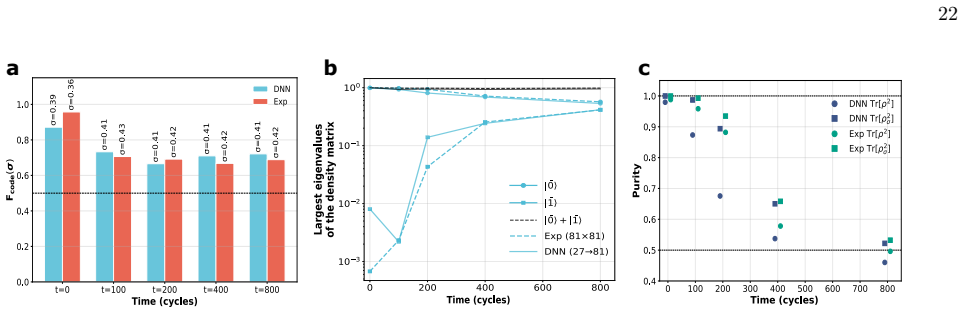
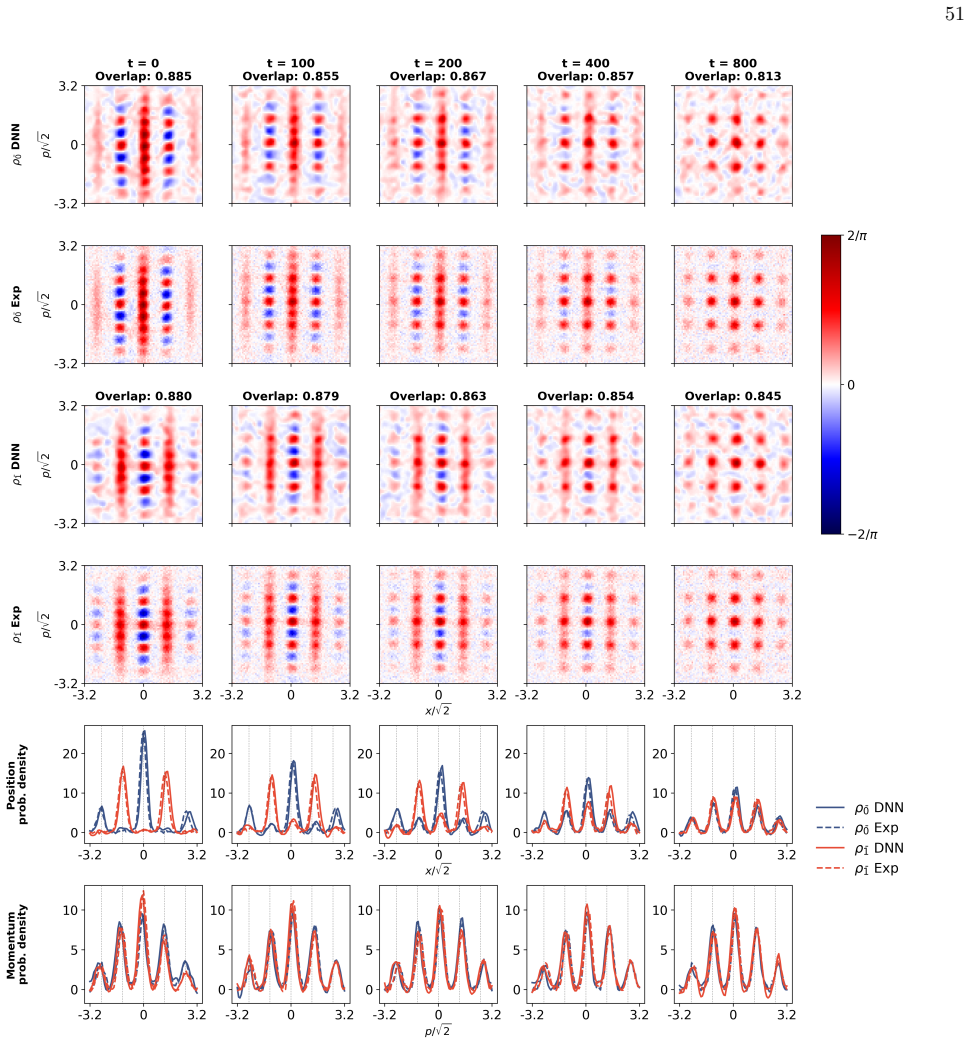
Wigner function learning is a central tool for characterizing continuous variable quantum systems. A fundamental challenge in this setting is to infer a continuous phase-space function from sparse pointwise measurement data, a task that becomes increasingly demanding as the effective dimension enlarges. Here, we develop a general machine learning framework to reconstruct Wigner functions directly as continuous functions from sparse phase-space data. For states with sparse Fock-space or coherent-state representations, such as binomial code states and cat states, we devise provably efficient regression models whose measurement complexity scales only logarithmically with the effective Hilbert-space dimension. For more general states, such as the Gottesman-Kitaev-Preskill (GKP) states, we design a deep learning model that reconstructs the Wigner function from sparse measurements and generalizes to arbitrary phase-space resolution. We demonstrate the broad applicability of our framework on both simulated data and experimental data from a circuit quantum electrodynamic (circuit-QED) system. Interestingly, on experimental data, we find that our model reconstructs Wigner functions of GKP code states across multiple rounds of quantum error correction and identifies the dominant error process using significantly fewer measurements than conventional estimation techniques.
Figures






Reference graph
Works this paper leans on
-
[1]
Frame theory Here, we present a minimal introduction to frame theory. See Refs. [47, 74] for more on frame theory. Frames can be regarded as an overcomplete basis in a Hilbert space. Some important frames in finite-dimensional quantum computing include mutually unbiased bases (MUBs) and symmetric-informationally complete POVM (SIC-POVMs) [74]. We start by...
-
[2]
An excellent reference to the Gabor frame and the short-time Fourier transform is given by Ref
Gabor frame and STFT Before diving into the Gabor frame, it is expedient to introduce the central objects in time-frequency analysis: translation and modulation operators, and collect a few important properties of theirs along the way. An excellent reference to the Gabor frame and the short-time Fourier transform is given by Ref. [46]. Formally, forx, ω∈R...
-
[3]
Lemmas for Proposition 1 In this section, we provide four lemmas for the proof of Proposition 1. It is advised to first follow the proof of Proposition 1 and reference it accordingly with the appropriate context. The first concern the decay of the STFT. Since we are dealing with well-behaved window functions like the Gaussians, it turns out that we can pr...
-
[4]
5, we need to separately show|γ(x)|≲e −k|x| and|bγ(ξ)|≲e −h|ξ| for somek, h >0
From Def. 5, we need to separately show|γ(x)|≲e −k|x| and|bγ(ξ)|≲e −h|ξ| for somek, h >0. Writing the Frame operator forG(g, a, b) asS g,a,b, we haveγ=S −1 g,a,bg. Notice that the Gaussian window satisfies|g(x)|≲e −λ|x| for someλ >0 trivially. The result from Ref. [77] then states that the canonical dual window also satisfies|γ(x)|≲e −k|x| for somek >0. N...
-
[5]
The lemmas needed can be referenced in Sec
Proposition 1: Truncation error with Gabor frame Having introduced the relevant concepts of frame theory for Gabor frames and STFT, we are now in a position to bound the approximation error using a finite number of Gabor atoms. The lemmas needed can be referenced in Sec. IX C 3. Proposition 1(Truncation error bound).LetW ψ ∈L 2(R2)be the Wigner function o...
-
[6]
Corollaries of Proposition 1 Two implications resulting from Proposition 1 are crucial to the generalization bound in Theorem 4. Specifically, they determine the value oftand the truncation parameter forNandKsuch that the empirical error can be made arbitrarily small. Corollary 1.Define the hypothesis classH N,K as HN,K = h(r) = X (n,k)∈ΛN,K ηn,kMbnT...
-
[7]
We first motivate the choice of this feature map by inspecting the Wigner function state
Proof of Theorem 2 In this section, we provide a rigorous guarantee for learning states with sparse coherent state support using Gabor frame. We first motivate the choice of this feature map by inspecting the Wigner function state. The setup and the main theorem are then introduced. Finally, we prove Theorem 2 with the help of Corollary 2 and Corollary 1....
-
[8]
Dense sampling A straightforward way to approximately reconstruct the Wigner function of an unknown state over a finite region Ω over the phase space is to first discretize the region Ω, for example, into a grid of squaresQ j of equal sizeh 2. Then, at each center of the square, one can estimate the Wigner function valueW ρ(cj) by measuring displaced pari...
-
[9]
Interpolation Here we briefly explain how the number of phase-space points required to reconstruct Wigner functions through polynomial interpolation scales at least faster than linearly with the truncation dimensiond. Proposition 3.SupposeW(α)is the Wigner function of a CV state supported within the regionΩ⊂R 2 such that it is differential at leastn+ 1tim...
-
[10]
Learning simulated states with regression models The numerical study of the regression model is organized around a simple experimental question: how many phase- space sample points are needed for precise reconstruction, and how sensitive is the fit to finite shot noise at each sample point? We answer this question in two stages. We first test the feature ...
-
[11]
Learning simulated states with DNN models We first test the DNN model on the same family of simulated even cat states described above. For each value of the coherent amplitudeα, we train the implicit neural representation from sparse phase-space data and record the minimum number of training points required to achieveF ≥0.99. As shown in Fig. 13, the requ...
-
[12]
Learning experimental states with DNN model Having explored the DNN model on simulated Wigner functions in the preceding subsection, we now test it on experimental states. We use the same pipeline as in the main text: the implicit architecture and self-supervised super-resolution training of Sec. IV B, with a sparse measured grid as input and the full exp...
-
[13]
Y. Liu, S. Singh, K. C. Smith, E. Crane, J. M. Martyn, A. Eickbusch, A. Schuckert, R. D. Li, J. Sinanan-Singh, M. B. Soley, T. Tsunoda, I. L. Chuang, N. Wiebe, and S. M. Girvin, Hybrid oscillator-qubit quantum processors: Instruction set architectures, abstract machine models, and applications, PRX Quantum7, 010201 (2026)
work page 2026
-
[14]
P. Campagne-Ibarcq, A. Eickbusch, S. Touzard, E. Zalys-Geller, N. E. Frattini, V. V. Sivak, P. Reinhold, S. Puri, S. Shankar, R. J. Schoelkopf,et al., Quantum error correction of a qubit encoded in grid states of an oscillator, Na- ture584, 368 (2020)
work page 2020
-
[15]
Y. Ma, Y. Xu, X. Mu, W. Cai, L. Hu, W. Wang, X. Pan, H. Wang, Y. Song, C.-L. Zou,et al., Error-transparent operations on a logical qubit protected by quantum error correction, Nature Physics16, 827 (2020)
work page 2020
-
[16]
V. V. Sivak, A. Eickbusch, B. Royer, S. Singh, I. Tsioutsios, S. Ganjam, A. Miano, B. L. Brock, A. Z. Ding, L. Frunzio, et al., Real-time quantum error correction beyond break-even, Nature616, 50 (2023)
work page 2023
-
[17]
Z. Ni, S. Li, X. Deng, Y. Cai, L. Zhang, W. Wang, Z.-B. Yang, H. Yu, F. Yan, S. Liu,et al., Beating the break-even point with a discrete-variable-encoded logical qubit, Nature616, 56 (2023)
work page 2023
-
[18]
B. L. Brock, S. Singh, A. Eickbusch, V. V. Sivak, A. Z. Ding, L. Frunzio, S. M. Girvin, and M. H. Devoret, Quantum error correction of qudits beyond break-even, Nature641, 612 (2025)
work page 2025
-
[19]
Serafini,Quantum continuous variables: a primer of theoretical methods(CRC press, 2017)
A. Serafini,Quantum continuous variables: a primer of theoretical methods(CRC press, 2017)
work page 2017
-
[20]
B. Vlastakis, G. Kirchmair, Z. Leghtas, S. E. Nigg, L. Frunzio, S. M. Girvin, M. Mirrahimi, M. H. Devoret, and R. J. Schoelkopf, Deterministically encoding quantum information using 100-photon schr¨ odinger cat states, Science342, 607 (2013)
work page 2013
-
[21]
A. Eickbusch, V. Sivak, A. Z. Ding, S. S. Elder, S. R. Jha, J. Venkatraman, B. Royer, S. Girvin, R. J. Schoelkopf, and 55 M. H. Devoret, Fast universal control of an oscillator with weak dispersive coupling to a qubit, Nature Phys.18, 1464 (2022)
work page 2022
-
[22]
W. Cai, X. Mu, W. Wang, J. Zhou, Y. Ma, X. Pan, Z. Hua, X. Liu, G. Xue, H. Yu,et al., Protecting entanglement between logical qubits via quantum error correction, Nature Physics20, 1022 (2024)
work page 2024
- [23]
-
[24]
C. Fl¨ uhmann and J. P. Home, Direct characteristic-function tomography of quantum states of the trapped-ion motional oscillator, Phys. Rev. Lett.125, 043602 (2020)
work page 2020
-
[25]
H. Jeon, J. Kang, W. Choi, K. Kim, J. You, and T. Kim, Two-mode bosonic state tomography with single-shot joint-parity measurement of a trapped ion, PRX Quantum6, 040352 (2025)
work page 2025
-
[26]
U. Von L¨ upke, Y. Yang, M. Bild, L. Michaud, M. Fadel, and Y. Chu, Parity measurement in the strong dispersive regime of circuit quantum acoustodynamics, Nature physics18, 794 (2022)
work page 2022
-
[27]
L. G. Lutterbach and L. Davidovich, Method for direct measurement of the wigner function in cavity qed and ion traps, Phys. Rev. Lett.78, 2547 (1997)
work page 1997
-
[28]
V. V. Sivak, A. Eickbusch, H. Liu, B. Royer, I. Tsioutsios, and M. H. Devoret, Model-free quantum control with reinforce- ment learning, Phys. Rev. X12, 011059 (2022)
work page 2022
-
[29]
V. Gebhart, R. Santagati, A. A. Gentile, E. M. Gauger, D. Craig, N. Ares, L. Banchi, F. Marquardt, L. Pezze, and C. Bonato, Learning quantum systems, Nature Reviews Physics5, 141 (2023)
work page 2023
-
[30]
Y. Du, Y. Zhu, Y.-H. Zhang, M.-H. Hsieh, P. Rebentrost, W. Gao, Y.-D. Wu, J. Eisert, G. Chiribella, D. Tao,et al., Artificial intelligence for representing and characterizing quantum systems, arXiv preprint arXiv:2509.04923 (2025)
work page internal anchor Pith review Pith/arXiv arXiv 2025
-
[31]
Continuous-variable quantum compressed sensing
M. Ohliger, V. Nesme, D. Gross, Y.-K. Liu, and J. Eisert, Continuous-variable quantum compressed sensing, arXiv preprint arXiv:1111.0853 (2011)
work page internal anchor Pith review Pith/arXiv arXiv 2011
-
[32]
S. Gandhari, V. V. Albert, T. Gerrits, J. M. Taylor, and M. J. Gullans, Precision bounds on continuous-variable state tomography using classical shadows, PRX Quantum5, 010346 (2024)
work page 2024
-
[33]
F. A. Mele, A. A. Mele, L. Bittel, J. Eisert, V. Giovannetti, L. Lami, L. Leone, and S. F. Oliviero, Learning quantum states of continuous-variable systems, Nature Physics , 1 (2025)
work page 2025
-
[34]
X. Zhao, P. Liao, F. A. Mele, U. Chabaud, and Q. Zhuang, Complexity of quantum tomography from genuine non-gaussian entanglement, Nature Communications (2025)
work page 2025
- [35]
- [36]
-
[37]
Y.-D. Wu, Y. Zhu, G. Chiribella, and N. Liu, Efficient learning of continuous-variable quantum states, Phys. Rev. Res.6, 033280 (2024)
work page 2024
-
[38]
E. S. Tiunov, V. Tiunova, A. E. Ulanov, A. Lvovsky, and A. K. Fedorov, Experimental quantum homodyne tomography via machine learning, Optica7, 448 (2020)
work page 2020
- [39]
- [40]
-
[41]
X. Gao, M. Isoard, F. Sun, C. E. Lopetegui, Y. Xiang, V. Parigi, Q. He, and M. Walschaers, Correlation-pattern-based continuous variable entanglement detection through neural networks, Phys. Rev. Lett.132, 220202 (2024)
work page 2024
-
[42]
X. Gao, M. Tian, F.-X. Sun, Y.-D. Wu, Y. Xiang, and Q. He, Classifying multipartite continuous variable entanglement structures through data-augmented neural networks, arXiv:2409.07909 (2024)
work page internal anchor Pith review Pith/arXiv arXiv 2024
- [43]
-
[44]
Y.-D. Wu, Y. Zhu, G. Bai, Y. Wang, and G. Chiribella, Quantum similarity testing with convolutional neural networks, Phys. Rev. Lett.130, 210601 (2023)
work page 2023
-
[45]
S. Aaronson, The learnability of quantum states, Proceedings of the Royal Society A: Mathematical, Physical and Engi- neering Sciences463, 3089 (2007)
work page 2007
-
[46]
A. Anshu and S. Arunachalam, A survey on the complexity of learning quantum states, Nature Reviews Physics6, 59 (2024)
work page 2024
-
[47]
B. M. Terhal, Quantum error correction for quantum memories, Reviews of Modern Physics87, 307 (2015)
work page 2015
-
[48]
T. L. Curtright, D. B. Fairlie, and C. K. Zachos,A concise treatise on quantum mechanics in phase space(World Scientific Publishing Company, 2013)
work page 2013
-
[49]
A. Kenfack and K. ˙Zyczkowski, Negativity of the wigner function as an indicator of non-classicality, Journal of Optics B: Quantum and Semiclassical Optics6, 396 (2004)
work page 2004
-
[50]
O. Landon-Cardinal, L. C. G. Govia, and A. A. Clerk, Quantitative tomography for continuous variable quantum systems, Phys. Rev. Lett.120, 090501 (2018)
work page 2018
-
[51]
X. Deng, S. Li, Z.-J. Chen, Z. Ni, Y. Cai, J. Mai, L. Zhang, P. Zheng, H. Yu, C.-L. Zou,et al., Quantum-enhanced metrology with large fock states, Nature Physics20, 1874 (2024)
work page 2024
- [52]
-
[53]
Linear Regression with Limited Observation
E. Hazan and T. Koren, Linear regression with limited observation (2012), arXiv:1206.4678 [cs.LG]
work page internal anchor Pith review Pith/arXiv arXiv 2012
- [54]
-
[55]
F. J. Schreiber, J. Eisert, and J. J. Meyer, Classical surrogates for quantum learning models, Phys. Rev. Lett.131, 100803 (2023)
work page 2023
- [56]
-
[57]
W.-Y. Liao, Y. Du, X. Wang, T.-C. Tian, Y. Luo, B. Du, D. Tao, and H.-L. Huang, Demonstration of efficient predictive surrogates for large-scale quantum processors, arXiv preprint arXiv:2507.17470 (2025)
work page internal anchor Pith review Pith/arXiv arXiv 2025
-
[58]
Gr¨ ochenig,Foundations of Time-Frequency Analysis, edited by J
K. Gr¨ ochenig,Foundations of Time-Frequency Analysis, edited by J. J. Benedetto, Applied and Numerical Harmonic Analysis (Birkh¨ auser Boston, Boston, MA, 2001)
work page 2001
-
[59]
C. Heil,A Basis Theory Primer: Expanded Edition, Applied and Numerical Harmonic Analysis (Birkh¨ auser Boston, Boston, 2011)
work page 2011
-
[60]
Z. Leghtas, G. Kirchmair, B. Vlastakis, R. J. Schoelkopf, M. H. Devoret, and M. Mirrahimi, Hardware-efficient autonomous quantum memory protection, Phys. Rev. Lett.111, 120501 (2013)
work page 2013
-
[61]
M. Mirrahimi, Z. Leghtas, V. V. Albert, S. Touzard, R. J. Schoelkopf, L. Jiang, and M. H. Devoret, Dynamically protected cat-qubits: a new paradigm for universal quantum computation, New Journal of Physics16, 045014 (2014)
work page 2014
-
[62]
V. Sitzmann, J. Martel, A. Bergman, D. Lindell, and G. Wetzstein, Implicit neural representations with periodic activation functions, Advances in neural information processing systems33, 7462 (2020)
work page 2020
-
[63]
Y. Chen, S. Liu, and X. Wang, Learning continuous image representation with local implicit image function, inProceedings of the IEEE/CVF conference on computer vision and pattern recognition(2021) pp. 8628–8638
work page 2021
- [64]
- [65]
-
[66]
J. Carrasquilla, G. Torlai, R. G. Melko, and L. Aolita, Reconstructing quantum states with generative models, Nature Mach. Intell.1, 155 (2019)
work page 2019
-
[67]
H. Wang, M. Weber, J. Izaac, and C. Y.-Y. Lin, Predicting properties of quantum systems with conditional generative models, arXiv:2211.16943 (2022)
work page internal anchor Pith review Pith/arXiv arXiv 2022
- [68]
-
[69]
M. H. Michael, M. Silveri, R. T. Brierley, V. V. Albert, J. Salmilehto, L. Jiang, and S. M. Girvin, New class of quantum error-correcting codes for a bosonic mode, Phys. Rev. X6, 031006 (2016)
work page 2016
-
[70]
A. L. Grimsmo, J. Combes, and B. Q. Baragiola, Quantum computing with rotation-symmetric bosonic codes, Phys. Rev. X10, 011058 (2020)
work page 2020
-
[71]
M. Kudra, M. Kervinen, I. Strandberg, S. Ahmed, M. Scigliuzzo, A. Osman, D. P. Lozano, M. O. Thol´ en, R. Borgani, D. B. Haviland, G. Ferrini, J. Bylander, A. F. Kockum, F. Quijandr´ ıa, P. Delsing, and S. Gasparinetti, Robust preparation of wigner-negative states with optimized snap-displacement sequences, PRX Quantum3, 030301 (2022)
work page 2022
-
[72]
D. Gottesman, A. Kitaev, and J. Preskill, Encoding a qubit in an oscillator, Phys. Rev. A64, 012310 (2001)
work page 2001
-
[73]
R. W. Heeres, B. Vlastakis, E. Holland, S. Krastanov, V. V. Albert, L. Frunzio, L. Jiang, and R. J. Schoelkopf, Cavity state manipulation using photon-number selective phase gates, Phys. Rev. Lett.115, 137002 (2015)
work page 2015
-
[74]
Walschaers, Non-gaussian quantum states and where to find them, PRX Quantum2, 030204 (2021)
M. Walschaers, Non-gaussian quantum states and where to find them, PRX Quantum2, 030204 (2021)
work page 2021
-
[75]
N. Rahaman, A. Baratin, D. Arpit, F. Draxler, M. Lin, F. Hamprecht, Y. Bengio, and A. Courville, On the spectral bias of neural networks, inInternational conference on machine learning(PMLR, 2019) pp. 5301–5310
work page 2019
-
[76]
C. Shen, R. W. Heeres, P. Reinhold, L. Jiang, Y.-K. Liu, R. J. Schoelkopf, and L. Jiang, Optimized tomography of continuous variable systems using excitation counting, Phys. Rev. A94, 052327 (2016)
work page 2016
-
[77]
T. Krisnanda, C. Y. Fontaine, A. Copetudo, P. Song, K. X. Lee, N.-N. Huang, F. Valadares, T. C. Liew, and Y. Y. Gao, Demonstrating efficient and robust bosonic state reconstruction via optimized excitation counting, PRX Quantum 6, 010303 (2025)
work page 2025
-
[78]
C. Oh, S. Chen, Y. Wong, S. Zhou, H.-Y. Huang, J. A. Nielsen, Z.-H. Liu, J. S. Neergaard-Nielsen, U. L. Andersen, L. Jiang,et al., Entanglement-enabled advantage for learning a bosonic random displacement channel, arXiv preprint arXiv:2402.18809 (2024)
work page internal anchor Pith review Pith/arXiv arXiv 2024
-
[79]
Z.-H. Liu, R. Brunel, E. E. Østergaard, O. Cordero, S. Chen, Y. Wong, J. A. Nielsen, A. B. Bregnsbo, S. Zhou, H.-Y. Huang,et al., Quantum learning advantage on a scalable photonic platform, Science389, 1332 (2025)
work page 2025
- [80]
discussion (0)
Sign in with ORCID, Apple, or X to comment. Anyone can read and Pith papers without signing in.