REVIEW 1 major objections 7 minor 33 references
Reviewed by Pith at T0; open to challenge.
T0 means a machine referee read the full paper against a public rubric. The mark states how deep the mechanical check went, never who wrote it. the ladder, T0–T4 →
T0 review · glm-5.2
Latent Motion Prior Guides Real-World Dexterous Hand Learning to 98.75% Success
2026-07-08 09:48 UTC pith:Z4MPCSFY
load-bearing objection Solid real-robot system paper with a genuine action-space contribution; the main concern is that the visual classifier serves double duty as both reward signal and evaluation metric without reported accuracy. the 1 major comments →
LAMP: Latent Motion Prior-Guided Real-World Learning for Dexterous Hand Manipulation
The pith
A machine-rendered reading of the paper's core claim, the machinery that carries it, and where it could break.
Core claim
The core discovery is that compressing high-dimensional hand actions through a history-conditioned continuous latent prior—rather than through a fixed linear projection or a discrete codebook—produces a structured action space where both supervised learning and online reinforcement learning operate more stably on physical hardware. The latent bottleneck (d_z=2 for a 6-DoF hand) and the history-conditioned prior center are the two load-bearing design choices: the bottleneck makes the coupled arm-hand learning problem tractable, and the history conditioning gives the policy a local motion-phase reference so that residual exploration remains on the demonstrated contact-consistent manifold. Abln
What carries the argument
Latent Motion Prior Module (LMPM): a VAE-style encoder-decoder trained on offline hand-motion trajectories. The encoder maps an 8-step hand-target history to a 2-D Gaussian latent prior; the decoder maps latent samples back to 6-D absolute hand targets. After pretraining, LMPM is frozen and used in three stages: (1) LMPM pretraining from demonstrations, (2) behavior cloning where the policy predicts arm commands natively and hand commands as latent offsets decoded through LMPM, (3) residual SAC/RLPD where the actor adds corrections in the same latent hand space before decoding.
Load-bearing premise
The LMPM is trained from task-specific offline hand-motion data (20-50 demonstrations per task) with a fixed latent dimensionality of d_z=2 for a 6-DoF hand, and the paper assumes this small, task-specific latent space is sufficient to capture the contact-consistent motion manifold needed for both imitation learning initialization and RL exploration. The ablation showing that d_z=6 causes severe degradation confirms the pipeline is sensitive to this specific architectural cho
What would settle it
Deploy LAMP on a higher-DoF hand (e.g., 15-DoF or 20-DoF) or on a task requiring substantially different contact patterns from the training demonstrations. If the 2-D latent space cannot represent the needed motion diversity, or if a new task requires retraining the prior from scratch with no transfer from previously learned priors, the scalability claim is tested.
If this is right
- If the latent prior approach generalizes, dexterous hand learning could shift from requiring large demonstration sets to needing only 20-50 task-specific trajectories plus online refinement, making real-world RL practical for contact-rich manipulation.
- The history-conditioned prior mechanism suggests that action-space structure for manipulation should encode temporal context, not just instantaneous posture—a principle that could extend to bimanual or whole-body robot learning.
- The finding that removing the 2-D bottleneck causes severe degradation implies that the optimal latent dimensionality for a given hand DoF is a critical hyperparameter that may need automatic tuning rather than manual specification.
- If LMPM-style priors could be trained on cross-task or cross-embodiment hand-motion data, the need for task-specific prior pretraining could be eliminated, enabling plug-and-play deployment on new tasks.
Where Pith is reading between the lines
- The paper validates on a 6-DoF hand with d_z=2. Cited biomechanics literature suggests higher-DoF hands (e.g., 15-DoF) may also admit compact representations (4 PCs explaining 95% of variance), but whether a single fixed latent dimensionality scales across DoF counts remains an open empirical question.
- The off-manifold exploration metric (ΔNN/Disp) could serve as a general diagnostic for any latent-action RL method: if one can measure how much exploration leaves the demonstrated data manifold, one can predict RL sample efficiency before committing to expensive real-world training.
- The failure-mode taxonomy (arm-error vs. hand-error vs. stall) reveals that a poorly structured hand action space degrades arm performance too, because the policy learns arm and hand commands jointly. This coupling effect may be underappreciated in pipelines that treat hand-action compression as independent from arm control.
- If the visual reward classifier requires task-specific operator-labeled data, the total human supervision cost of LAMP is not just demonstrations but also classifier training data—a hidden cost that could limit scalability to new tasks without automated reward labeling.
Editorial analysis
A structured set of objections, weighed in public.
Referee Report
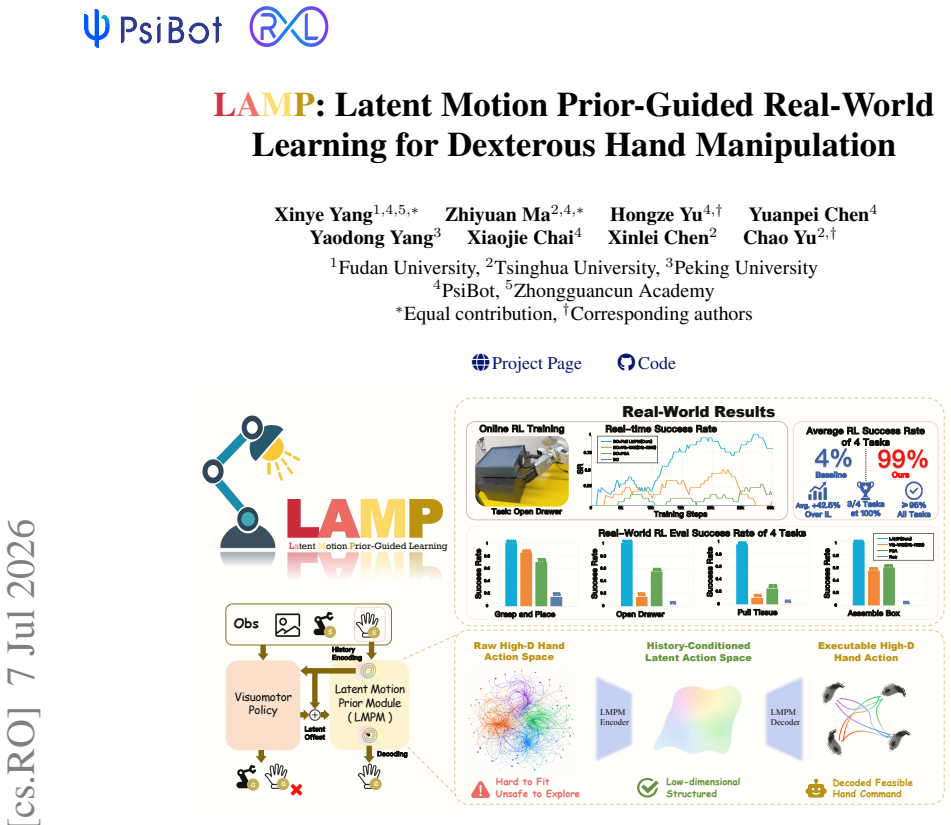
Summary. The paper introduces LAMP, a three-stage real-world learning framework for dexterous hand manipulation. The core contribution is a Latent Motion Prior Module (LMPM) that maps recent hand-action histories to a compact (d_z=2 for a 6-DoF hand) continuous latent space, shared across both imitation learning (IL) and residual reinforcement learning (RL). The LMPM is pretrained on offline demonstrations and frozen during downstream policy training. In Stage 2, a visuomotor policy predicts native arm commands and latent hand-action offsets decoded through the frozen LMPM decoder. In Stage 3, a residual SAC/RLPD agent adds corrections in the same latent space, keeping exploration near contact-consistent motion manifolds. Experiments on four real-robot tasks compare LAMP against raw, PCA, and VQ-VAE (DQ-RISE) hand-action interfaces under an identical IL+RL pipeline, reporting an average final success rate of 98.75% (100% on three tasks, 95% on one). Ablations isolate the contributions of the low-dimensional bottleneck and the history-conditioned encoder.
Significance. The paper addresses a practically important problem: making real-world RL for high-DoF dexterous hands safer and more sample-efficient by constraining exploration to a learned motion manifold. The experimental design is solid—four real-robot tasks, three alternative action interfaces under the same pipeline, and ablations isolating architectural components. The off-manifold exploration analysis (Appendix A) and the action-smoothness analysis (Appendix F) provide useful mechanistic evidence for why the continuous latent interface helps. The framework is falsifiable: the ablation in Table 1 shows that removing the low-dimensional bottleneck causes severe degradation (e.g., Assemble Box drops from 100% to 20% after RL), confirming the design choice is load-bearing. Code and project page are mentioned as available.
major comments (1)
- Appendix C, Eq. (C.2): The visual reward classifier serves as both the RL reward signal (r_t = 1[p_cls(o_{t+1}) > 0.90]) and the evaluation success metric used to compute all reported success rates, including the headline 98.75%. This dual role creates a self-referential loop: if the classifier has systematic false positives on certain visual configurations, both the RL agent (which optimizes for classifier approval) and the evaluation (which measures classifier approval) would be biased in the same direction. The paper does not report classifier precision/recall on a human-verified held-out set, nor does it cross-check any evaluation episodes with human judgment. While relative comparisons across methods are less affected (all four methods use the same classifier), the absolute numbers—especially the near-perfect 100% on three tasks—depend entirely on unverified classifier quality. The
minor comments (7)
- Section 3.1, Eq. (2): The notation uses z_t ~ q_phi(.|H_t) for sampling during training, but it is unclear whether sampling is used during inference or only the mean mu_phi(H_t) is used. Clarify.
- Figure 4: The bar chart y-axis labels show 'Episodes' but the text refers to success rates as percentages. The figure would benefit from clearer labeling or a dual axis showing both counts and percentages.
- Appendix A, Figure A.1: VQ-VAE is omitted from the off-manifold analysis because its discrete action space 'cannot realise a controllable displacement budget.' A brief note on how VQ-VAE exploration behavior was assessed (even qualitatively) would make the comparison more complete.
- Section 4.1: The 20-episode evaluation protocol per task is small but standard for real-robot work. However, given that the paper reports near-perfect success rates, reporting confidence intervals or bootstrap estimates would strengthen the claims.
- References [5], [21], [29], [30], [31] are dated 2025-2026; ensure all are publicly available and correctly cited at the time of submission.
- Table B.3: The VQ-VAE interface is described as '16-way residual-VQ code, two residual quantizers with four codes each,' but the codebook size and training procedure are not detailed. Additional implementation details would aid reproducibility.
- Section 5: The limitations discussion is brief. Extending it to discuss the sensitivity to d_z=2 (given the severe degradation when d_z=6) and the potential need for task-specific tuning of this hyperparameter would strengthen the discussion.
Simulated Author's Rebuttal
We thank the referee for the careful reading and the constructive assessment of our experimental design and ablations. The referee raises one major concern: the visual reward classifier serves as both the RL reward signal and the evaluation success metric, creating a potential self-referential loop that could inflate absolute success rates, especially the near-perfect 100% on three tasks. We agree this is a legitimate methodological concern. In our response, we explain why the relative comparisons across methods are robust to this issue (as the referee also acknowledges), describe the additional human-verification checks we will add to the revised manuscript, and note one honest limitation regarding the scope of what we can retroactively verify.
read point-by-point responses
-
Referee: Appendix C, Eq. (C.2): The visual reward classifier serves as both the RL reward signal and the evaluation success metric, creating a self-referential loop. The paper does not report classifier precision/recall on a human-verified held-out set, nor does it cross-check evaluation episodes with human judgment. Absolute numbers—especially near-perfect 100% on three tasks—depend entirely on unverified classifier quality.
Authors: We agree with the referee that using the same visual classifier for both reward and evaluation creates a potential self-referential loop, and that reporting classifier precision/recall against human-verified labels would strengthen the paper. We will address this in revision along three axes. (1) We will add a human-verified held-out evaluation set: for each task, we will sample evaluation episodes (including both classifier-positive and classifier-negative outcomes), have human annotators label them as success or failure from the RGB video, and report classifier precision and recall against these labels. (2) We will report final success rates computed from human judgment on this held-out set alongside the classifier-based numbers, so readers can assess any systematic bias. (3) We will add an explicit discussion of this limitation in the main text. We note that the referee's own observation—that relative comparisons across the four methods are less affected because all use the same classifier—is correct: the core scientific claim of the paper is that the LMPM latent action interface improves over raw, PCA, and VQ-VAE alternatives under an identical pipeline, and this comparative result holds regardless of classifier bias. The absolute numbers (especially 100% on three tasks) should indeed be interpreted with the caveat that they reflect classifier-approved states, and we will make this explicit. One honest limitation: because the real-robot evaluation episodes were not all video-recorded with human-review in mind, our human-verified set will be a newly collected sample rather than a retroactive re-labeling of every originally reported episode. We believe the precision/recall analysis on the new sample will still provide a meaningful upper bound on classifier quality and revision: yes
- We cannot retroactively re-label every evaluation episode from the original experiments with human judgment, because not all episodes were video-recorded in a format suitable for frame-level human review. The human-verified precision/recall analysis will therefore be conducted on a newly collected held-out sample rather than on the exact episodes underlying the reported 98.75% headline number. This means the absolute success rates in the original Table 1 and Figure 4 cannot be independently re-verified episode-by-episode; we can only provide a statistical estimate of classifier reliability on a comparable sample.
Circularity Check
No significant circularity in the derivation chain; one methodological concern about classifier dual-role is a correctness risk, not circularity.
full rationale
The paper's derivation chain is self-contained and not circular. LMPM is pretrained on demonstration hand-motion data via a standard VAE objective (Eq. 3: reconstruction + KL), then frozen. The BC policy (Eq. 6) is trained against demonstrated targets decoded through the frozen LMPM decoder — a standard supervised loss, not self-referential. Residual RL (Eqs. 7–10) uses standard SAC/RLPD losses with the same frozen decoder; the reward comes from a separately trained visual classifier (Appendix C, Eq. C.2), not from the LMPM or the policy itself. No step in the chain reduces to its own inputs by construction. The visual classifier does serve dual roles as both RL reward signal and evaluation success metric, and its accuracy on human-verified labels is not reported — but this is a correctness/validity concern (potential systematic false positives inflating both training and evaluation), not a circularity in the derivation chain. The paper does not claim classifier accuracy as a derived or predicted result, and the relative comparison across methods (Raw, PCA, VQ-VAE, LAMP) uses the same classifier for all, so relative rankings are not forced by construction. No self-citations are load-bearing for the central claims. Score 2 reflects the minor methodological concern without any actual circular reduction.
Axiom & Free-Parameter Ledger
free parameters (5)
- Latent dimension d_z =
2
- KL weight β =
1e-3
- History length K =
8
- Residual scales s_arm, s_z =
Not specified
- Classifier threshold =
0.90
axioms (3)
- domain assumption Dexterous hand motion admits a compact low-dimensional structure that can be captured by a 2D VAE latent space.
- domain assumption A visual binary classifier can reliably produce sparse task rewards for online RL.
- domain assumption Residual exploration in the latent space preserves contact consistency better than exploration in raw joint space.
invented entities (1)
-
Latent Motion Prior Module (LMPM)
independent evidence
read the original abstract
Real-world learning for dexterous hands remains brittle because high-dimensional hand actions amplify imitation errors and make reinforcement-learning exploration prone to contact-breaking motion. While combining imitation learning (IL) with online reinforcement learning (RL) can reduce manual supervision, unconstrained exploration in raw hand-action spaces is sample-inefficient and risky for physical hardware. We introduce a latent motion prior module (\prior{}) that maps recent hand-action histories to a compact, history-conditioned latent prior and decodes continuous latent commands into executable high-dimensional hand targets. Built on this prior, \method{} is a three-stage real-world dexterous learning framework: it pretrains \prior{} from demonstrations, trains a visuomotor policy that predicts native arm commands and latent hand-action offsets, and improves the policy with online residual RL in the same latent hand-action space. This shared, decodable interface lets residual exploration make local corrections near demonstrated, contact-consistent hand motions rather than perturbing every finger joint independently. We evaluate \method{} on four real-robot dexterous manipulation tasks against raw, linear, and discrete hand-action interfaces. Starting from small task-specific demonstration sets, \method{} achieves a 56.25\% average IL success rate and raises it to 98.75\% after online RL, reaching 100\% final success on three tasks and 95\% on the remaining task.
Figures


Reference graph
Works this paper leans on
-
[1]
T. Lin, K. Sachdev, L. Fan, J. Malik, and Y . Zhu. Sim-to-real reinforcement learning for vision-based dexterous manipulation on humanoids, 2025. Published at CoRL 2025
work page 2025
-
[2]
T. Z. Zhao, V . Kumar, S. Levine, and C. Finn. Learning fine-grained bimanual manipulation with low-cost hardware. InRobotics: Science and Systems, 2023
work page 2023
-
[3]
C. Chi, S. Feng, Y . Du, Z. Xu, E. Cousineau, B. Burchfiel, and S. Song. Diffusion policy: Visuomotor policy learning via action diffusion. InRobotics: Science and Systems, 2023
work page 2023
-
[4]
Y . Ze, G. Zhang, K. Zhang, C. Hu, M. Wang, and H. Xu. 3D diffusion policy: Generalizable visuomotor policy learning via simple 3D representations. InRobotics: Science and Systems, 2024
work page 2024
- [5]
-
[6]
C. von Hofsten. An action perspective on motor development.Trends in Cognitive Sciences, 8 (6):266–272, 2004. doi:10.1016/j.tics.2004.04.002
-
[7]
E. Thelen. Motor development: A new synthesis.American Psychologist, 50(2):79–95, 1995. doi:10.1037/0003-066X.50.2.79
-
[8]
M. Santello, M. Flanders, and J. F. Soechting. Postural hand synergies for tool use.Journal of Neuroscience, 18(23):10105–10115, 1998
work page 1998
-
[9]
M. T. Ciocarlie and P. K. Allen. Hand posture subspaces for dexterous robotic grasping.The International Journal of Robotics Research, 28(7):851–867, 2009
work page 2009
-
[10]
W. Zhou, S. Bajracharya, and D. Held. PLAS: Latent action space for offline reinforcement learning. InConference on Robot Learning, 2020
work page 2020
-
[11]
A. Allshire, M. Mittal, V . Lodaya, V . Makoviychuk, D. Makoviichuk, F. Widmaier, M. Wuthrich, S. Bauer, A. Handa, and A. Garg. LASER: Learning a latent action space for efficient reinforce- ment learning. InIEEE International Conference on Robotics and Automation, 2021
work page 2021
-
[12]
S. Lee, Y . Wang, H. Etukuru, H. J. Kim, N. M. M. Shafiullah, and L. Pinto. Behavior generation with latent actions, 2024. URLhttps://arxiv.org/abs/2403.03181
work page internal anchor Pith review Pith/arXiv arXiv 2024
-
[13]
C. Puang et al. PCHands: PCA-based hand pose synergy representation on manipulators, 2025
work page 2025
-
[14]
K. Pertsch, Y . Lee, and J. J. Lim. Accelerating reinforcement learning with learned skill priors,
-
[15]
URLhttps://arxiv.org/abs/2010.11944
work page internal anchor Pith review Pith/arXiv arXiv 2010
-
[16]
C. Lynch and P. Sermanet. Learning latent plans from play. InConference on Robot Learning, 2019
work page 2019
-
[17]
J. Liang et al. CLAM: Continuous latent action models for robot learning from unlabeled demonstrations, 2025
work page 2025
-
[18]
B. Bauer et al. Latent action diffusion for cross-embodiment manipulation, 2025
work page 2025
- [19]
-
[20]
K. Pertsch et al. FAST: Efficient action tokenization for vision-language-action models, 2025
work page 2025
-
[21]
J. Yang et al. VQ-ACE: Efficient policy search for dexterous robotic manipulation via action chunking embedding, 2024. 9
work page 2024
-
[22]
Cross-Hand Latent Representation for Vision-Language-Action Models
G. Jiang, Y . Liang, J. Ye, J.-Y . Huang, C. Jing, R. Duan, P. Abbeel, X. Wang, and X. Zou. Cross-hand latent representation for vision-language-action models, 2026. URL https:// arxiv.org/abs/2603.10158
- [23]
- [24]
-
[25]
M. J. Kim, K. Pertsch, S. Karamcheti, T. Xiao, A. Balakrishna, S. Nair, R. Rafailov, E. Foster, T. Lampe, P. Sanketi, et al. OpenVLA: An open-source vision-language-action model. In Conference on Robot Learning, 2024
work page 2024
-
[26]
Octo: An open-source generalist robot policy
Octo Model Team. Octo: An open-source generalist robot policy. InRobotics: Science and Systems, 2024
work page 2024
-
[27]
P. J. Ball, L. Smith, I. Kostrikov, and S. Levine. Efficient online reinforcement learning with offline data. InInternational Conference on Machine Learning, 2023
work page 2023
- [28]
- [29]
-
[30]
Y . Zang et al. RLinf-USER: A unified and extensible system for real-world online policy learning in embodied AI, 2026
work page 2026
-
[31]
Y . Zang et al. RLinf-VLA: A unified and efficient framework for reinforcement learning of vision-language-action models, 2025
work page 2025
-
[32]
D. Yu, K. Lei, Z. Jiang, J. Pan, and H. Xu. Beyond action residuals: Real-world robot policy steering via bottleneck latent reinforcement learning, 2026
work page 2026
-
[33]
N. Jarrass ´e, A. T. Ribeiro, A. Sahbani, W. Bachta, and A. Roby-Brami. Analysis of hand synergies in healthy subjects during bimanual manipulation of various objects.Journal of NeuroEngineering and Rehabilitation, 11(1):113, 2014. doi:10.1186/1743-0003-11-113. 10 A Off-Manifold Exploration Analysis Online residual RL should explore near the demonstrated ...
discussion (0)
Sign in with ORCID, Apple, or X to comment. Anyone can read and Pith papers without signing in.