REVIEW 2 major objections 8 minor 76 references
Reviewed by Pith at T0; open to challenge.
T0 means a machine referee read the full paper against a public rubric. The mark states how deep the mechanical check went, never who wrote it. the ladder, T0–T4 →
T0 review · glm-5.2
Salt stabilises soap films at 5 nm, preventing rupture
2026-07-08 08:15 UTC pith:KTVHUEG2
load-bearing objection Salt stabilises Newton black films at ~5 nm in dynamic vertical soap films, extending lifetime across all humidities tested the 2 major comments →
Stabilising Evaporating Soap Films with Salt
The pith
A machine-rendered reading of the paper's core claim, the machinery that carries it, and where it could break.
Core claim
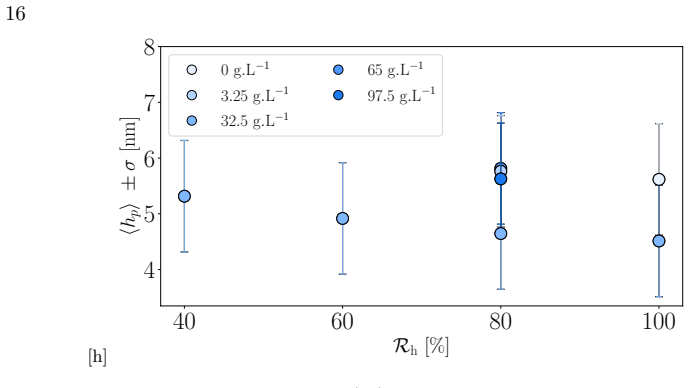
The addition of NaCl at 32.5 g/L to TTAB soap films causes a stable Newton black film to form at approximately 5 nm thickness, observable as a thickness plateau that persists across all humidities tested (40 to 100 percent). Without salt, no such plateau forms and films rupture at about 10 nm. Salt has no measurable effect on drainage or evaporation rates down to 100 nm, so the stabilisation is purely a nanoscale structural effect: the transition from electrostatically stabilised common black films to sterically stabilised Newton black films, driven by the known critical electrolyte concentration for this surfactant system.
What carries the argument
The central object is the Newton black film (NBF), a roughly 5 nm thick soap film stabilised by steric repulsion between surfactant head groups at the two air-water interfaces. The paper identifies its formation via interferometric thickness measurements showing a plateau at 5 nm, and connects it to the DLVO framework's distinction between common black films (electrostatically stabilised, tens of nm thick) and NBFs (sterically stabilised, ~5 nm), with the transition governed by a critical electrolyte concentration.
Load-bearing premise
The evaporation model assumes that the drainage rate inside the film does not depend on atmospheric humidity, which allows the authors to subtract the saturated-atmosphere curve to isolate evaporation. This is physically reasonable but not independently verified for this system. It does not affect the central Newton black film observation, which is a direct thickness measurement, but it does influence the quantitative evaporation rates and salt concentration trajectories the纸
What would settle it
If interferometric measurements at the 5 nm plateau were shown to be artefacts of the single-layer optical model rather than genuine thickness stabilisation, or if the plateau were demonstrated to be a transient kinetic arrest rather than a thermodynamically stable Newton black film, the central claim would be undermined.
Editorial analysis
A structured set of objections, weighed in public.
Referee Report
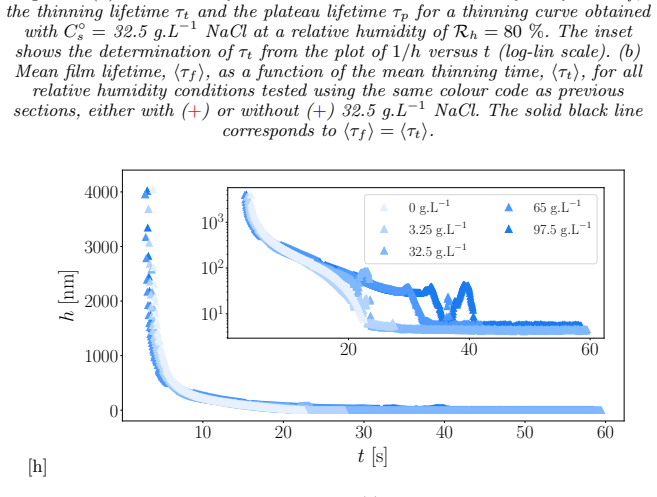
Summary. This manuscript investigates the effect of NaCl (32.5 g/L) on the stability, thinning dynamics, and rupture of vertical TTAB soap films under controlled humidity. The central experimental finding is that salt enables the formation of a stable Newton Black Film (NBF) at a thickness plateau of approximately 5 nm, whereas salt-free films rupture at ~10 nm without forming any stable plateau. This NBF plateau is observed across all humidities tested (Rh = 40–100%) and multiple salt concentrations. The authors further develop an evaporation model (§5.2–5.3) that couples drainage with buoyancy-driven convective evaporation and salt-concentration-dependent vapor pressure, showing that salt has negligible effect on thinning dynamics down to 100 nm. Film lifetime statistics (N > 400 per condition) and a return-map analysis of rupture stochasticity (§5.1) are also presented.
Significance. The paper addresses a well-defined and physically relevant problem: how salt influences the stability of dynamically generated foam films, with direct motivation from ocean-atmosphere bubble rupture. The central NBF observation is a direct interferometric measurement, not a model-derived result, which is a significant strength. The authors provide reproducibility checks (10 films per condition), use a three-layer Duyvis model to cross-validate the plateau thickness against neutron scattering data (Simister et al. 1992), and confirm film survival during the plateau via an independent force sensor. The evaporation model uses physically grounded expressions (Eq. 5.7, 5.10) with O(1) fitting prefactors, and the extracted evaporation rates (je = [21, 13, 5] nm/s) are consistent with prior measurements by Champougny et al. (2018). The systematic variation of humidity and salt concentration, combined with the salt-concentration evolution model (Fig. 7b), adds quantitative depth. The finding that no CBF forms in the absence of salt is unexpected and stimulates further investigation.
major comments (2)
- §4.1, Fig. 3(b): The central claim of NBF stabilisation at ~5 nm rests on interferometric thickness measurements at the stated lower limit of the method (5 nm, σ = ±1 nm). At h ≈ 5 nm, the round-trip optical path difference is ~10 nm, corresponding to λ/45–λ/80 of the measured wavelength range (450–800 nm), where reflectance spectra become nearly flat and thickness extraction is ill-conditioned. The paper mitigates this with the three-layer Duyvis model (Eq. 4.1) yielding h† ≈ 0.52 nm consistent with neutron scattering, and the force sensor independently confirms film survival during the plateau. However, the concern is not fully resolved: if the spectrometer returns near-constant reflectance below some threshold, the fitting pipeline could produce an apparent plateau at a fixed thickness that is actually a measurement floor. To fully close this issue, the authors should include at least
- one representative raw reflectance spectrum from the plateau phase (alongside the fitted model spectrum) in a supplementary figure, demonstrating that meaningful spectral variation is present at h ≈ 5 nm and that the thickness extraction is not degenerate. This is the single most load-bearing point for the central claim and should be addressable within the manuscript scope.
minor comments (8)
- §5.2, Eq. (5.5): The assumption that drainage rate jd is independent of atmospheric humidity is physically motivated but unverified for this system. The authors should add a brief discussion of potential coupling mechanisms (e.g., temperature gradients from evaporative cooling affecting viscosity, Marangoni stresses) and an estimate of their magnitude. This does not affect the central NBF observation but does bear on the quantitative evaporation rates je = [21, 13, 5] nm/s.
- §4, Fig. 3: The practice of displaying only the longest film from each condition (of 10 measured) is reasonable given the stated reproducibility, but the selection criterion should be more transparent. Were the 10 curves overlaid for all conditions, or only for the representative cases shown? A brief statement of the collapse quality (e.g., RMS deviation) would strengthen the representativeness claim.
- §5.3, Fig. 7(b): The salt concentration evolution Cs(t) is derived from the model and not independently measured. The authors are appropriately cautious (stating the model is invalid below 100 nm), but the crosses marking Cs(t*) at h* = 100 nm are presented without uncertainty estimates. A brief note on the sensitivity of Cs(t*) to the fitting parameter a' would help readers gauge the reliability of these values.
- Table 2: The fitting parameters a and a' vary across humidities (a: 0.74, 0.67, 0.55; a': 1, 0.7, 0.7, 0.7) without a clear physical explanation for the trend. The authors note that a accounts for deviations from the idealised model, but the systematic decrease of a with increasing humidity is unexplained. A brief comment on whether this trend is physically meaningful or an artifact would be helpful.
- §5.1, Eqs. (5.1)–(5.4): The return-map analysis of rupture stochasticity is interesting but somewhat tangential to the central NBF claim. The observation of a negative correlation (315°–135° direction) is reported but not mechanistically interpreted. If the authors cannot offer a physical explanation, a brief acknowledgment that this observation remains unexplained would suffice.
- Fig. 9: For Cs° ∈ [65, 97.5] g/L, the authors note that most films attain the 81 mm translation limit, so the displayed curves are not the longest but the longest within this limit. This selection difference should be noted more prominently in the figure caption, not only in the main text.
- §4.1: The notation h_p (plateau thickness from single-layer model) vs. h_tot (three-layer total thickness) vs. h† (core thickness) could be confusing. A summary table of the different thickness definitions and their values would improve readability.
- The acknowledgment of LLM use is appropriate for transparency. The specific scope (figure style, sentence fluidity) is adequately disclosed.
Simulated Author's Rebuttal
The referee raises a single major comment concerning whether the ~5 nm thickness plateau attributed to Newton Black Film formation could be an artifact of the interferometric measurement reaching its sensitivity floor at low optical path differences. We agree this is a legitimate and important concern and will address it by including representative raw reflectance spectra from the plateau phase alongside fitted model spectra in a supplementary figure.
read point-by-point responses
-
Referee: §4.1, Fig. 3(b): The central claim of NBF stabilisation at ~5 nm rests on interferometric thickness measurements at the stated lower limit of the method (5 nm, σ = ±1 nm). At h ≈ 5 nm, the round-trip optical path difference is ~10 nm, corresponding to λ/45–λ/80 of the measured wavelength range (450–800 nm), where reflectance spectra become nearly flat and thickness extraction is ill-conditioned. The paper mitigates this with the three-layer Duyvis model (Eq. 4.1) yielding h† ≈ 0.52 nm consistent with neutron scattering, and the force sensor independently confirms film survival during the plateau. However, the concern is not fully resolved: if the spectrometer returns near-constant reflectance below some threshold, the fitting pipeline could produce an apparent plateau at a fixed thickness that is actually a measurement floor. To fully close this issue, the authors should include at least
Authors: We thank the referee for this careful and well-taken comment. The concern that the ~5 nm plateau could reflect a measurement floor rather than a genuine physical thickness is entirely legitimate, and we agree it should be addressed directly with raw spectral data. revision: yes
-
Referee: one representative raw reflectance spectrum from the plateau phase (alongside the fitted model spectrum) in a supplementary figure, demonstrating that meaningful spectral variation is present at h ≈ 5 nm and that the thickness extraction is not degenerate. This is the single most load-bearing point for the central claim and should be addressable within the manuscript scope.
Authors: We will include a representative raw reflectance spectrum acquired during the plateau phase, alongside the fitted model spectrum, in a supplementary figure. We can confirm that meaningful spectral variation is present at h ≈ 5 nm: the reflectance spectrum is not flat across the 450–800 nm range, and the fitting pipeline extracts a well-defined thickness from genuine spectral features rather than returning a constant floor value. We will also include, for comparison, a spectrum from the thinning phase at a thickness well above the plateau (e.g., h ≈ 50 nm) to make the spectral contrast clear. We note that several independent lines of evidence already support the physical reality of the plateau: (1) the three-layer Duyvis model yields a core thickness h† ≈ 0.52 nm consistent with neutron scattering data (Simister et al. 1992), which would not be the case if the fitting pipeline were simply returning a degenerate floor value; (2) the force sensor independently confirms that the film remains intact during the plateau phase rather than having ruptured; (3) the plateau thickness of ~5 nm is consistent with NBF thicknesses reported in TFPB measurements (Exerowa et al. 1981; Schulze-Schlarmann et al. 2006); and (4) the plateau is observed across all humidities and multiple salt concentrations, with the plateau lifetime (not just its thickness) varying systematically with humidity. Nevertheless, we agree that the raw spectral evidence is the most direct way to close this issue and will add it as requested. revision: yes
Circularity Check
No significant circularity. The central NBF observation is a direct experimental measurement, and the evaporation model uses physically-derived expressions with O(1) fit parameters.
full rationale
The paper's central claim — that salt stabilises a Newton black film at ~5 nm — is a direct interferometric observation (Fig. 3b, Fig. 10), not a quantity derived from a fitted model. The evaporation model (§5.2–5.3, Eqs. 5.5–5.10) uses physically-derived expressions for the evaporation rate j_e based on the Grashof number and natural convection (Boulogne & Dollet 2018), with a single O(1) prefactor a (or a') as a fit parameter. The drainage rate j_d is extracted directly from the saturated-atmosphere experimental curve (where j_e = 0 by definition), not from a self-referential definition. The salt concentration evolution C_s(t) (Eq. 5.8) is derived from a mass balance and solved numerically; it is not defined in terms of the output it claims to predict. The three-layer Duyvis model (Eq. 4.1) refines the plateau thickness using independently measured refractive indices and literature values for surfactant layer thickness (Simister et al. 1992), yielding h† ≈ 0.52 nm consistent with neutron scattering — an external check. The self-citation to Ziapkoff et al. (2026) for the optifik thickness measurement method is a methodological reference, not a load-bearing premise for the physical conclusions; the method's validity rests on its own independent calibration. No step in the derivation chain reduces to its inputs by construction. The model's predictions (thinning curves in Fig. 6, 7) are compared against experimental data rather than being definitions of that data. The one minor concern is that the humidity-independent drainage assumption (§5.2) is an unverified approximation, but this is a modeling assumption, not a circularity. Score 2 reflects the methodological self-citation which is not load-bearing for the central claim.
Axiom & Free-Parameter Ledger
free parameters (4)
- a =
0.74, 0.67, 0.55 for Rh = 40, 60, 80%
- a' =
1.0, 0.7, 0.7, 0.7 for Rh = 40, 60, 80, 100%
- L =
20 mm
- h_initial =
3.2 μm
axioms (4)
- domain assumption Drainage rate jd is independent of atmospheric humidity.
- domain assumption Film thickness is uniform at the measurement point.
- domain assumption Natural convection dominates evaporative transport (Gr >> 1).
- standard math The 5 nm plateau corresponds to a Newton Black Film stabilised by steric repulsion.
read the original abstract
We investigate the effect of a high concentration (32.5 g.L$^{-1}$) of sodium chloride (NaCl) on TTAB (tetradecyltrimethylammonium bromide) vertical soap films also called foam films, pulled out of a bath under controlled humidity conditions. We observe that the film lifetime increases with relative humidity, both in the presence and absence of salt. At any given humidity, the presence of NaCl systematically enhances film stability. Our film thickness measurements show that the thinning dynamics with or without salt are nearly identical down to 100 nm. Down to that thickness, the effect of evaporation can be rationalised by a constant evaporation rate, which becomes non-negligible compared to the drainage rate at film thicknesses below 400 nm. The main effect of salt is the stabilisation of a Newton black film at a thickness of approximately 5~nm, whereas in the absence of salt, the film ruptures upon reaching a critical thickness of about 10 nm.
Figures



Reference graph
Works this paper leans on
-
[1]
Journal of fluid mechanics , volume=
On the thickness of soap films: an alternative to Frankel's law , author=. Journal of fluid mechanics , volume=. 2008 , publisher=
work page 2008
-
[2]
Physical Review Letters , volume=
Measurement of the temperature decrease in evaporating soap films , author=. Physical Review Letters , volume=. 2022 , publisher=
work page 2022
-
[3]
Physical Review Letters , volume=
Velocity field in a vertical foam film , author=. Physical Review Letters , volume=. 2017 , publisher=
work page 2017
-
[4]
Marginal regeneration-induced drainage of surface bubbles
Marginal regeneration-induced drainage of surface bubbles , author=. arXiv preprint arXiv:2109.07966 , year=
work page internal anchor Pith review Pith/arXiv arXiv
-
[5]
Mysels, K. J. and Shinoda, K. and Frankel, S. , title =. 1959 , pages =
work page 1959
-
[6]
Journal of fluid mechanics , volume=
Ageing and burst of surface bubbles , author=. Journal of fluid mechanics , volume=. 2018 , publisher=
work page 2018
-
[7]
Exerowa, D. and Nikolov, A. and Zacharieva, M. , title =. Journal of Colloid and Interface Science , year =
- [8]
- [9]
-
[10]
Schulze-Schlarmann, J. and Buchavzov, N. and Stubenrauch, C. , title =. Soft Matter , year =
-
[11]
Bergeron, V , title =. Langmuir , year =. doi:10.1021/la970004q , publisher =
- [12]
-
[13]
Sedev, R. and Exerowa, D. , title =. Advances in Colloid and Interface Science , year =
- [14]
- [15]
-
[16]
Chang, C. H. and Franses, E. I. , title =. Colloids and Surfaces , year =
-
[17]
Reinold, A.W. and Rücker, A.W. , title =. Philosophical Transactions of the Royal Society of London , volume =. 1881 , month =
-
[18]
Reinold, A.W. and Rücker, A.W. , title =. Philosophical Transactions of the Royal Society A , year =. doi:, url =
-
[19]
Journal de Physique Th\'eorique et Appliqu\'ee , author =
Sur la constitution de la charge \'electrique \`a la surface d'un \'electrolyte , volume =. Journal de Physique Th\'eorique et Appliqu\'ee , author =. 1910 , pages =. doi:10.1051/jphystap:019100090045700 , number =
-
[20]
Li, X. and Liu, L. and Zhao, J. and Tan, J. , title =. Appl. Spectrosc. , volume =. 2015 , doi =
work page 2015
-
[21]
Debye, Peter and H. Zur Theorie der Elektrolyte. I. Gefrierpunktserniedrigung und verwandte Erscheinungen , journal =
-
[22]
Ziapkoff, V. and Boulogne, F. and Salonen, A. and Rio, E. , title =. European Physical Journal E , volume =. 2026 , doi =
work page 2026
-
[23]
Savitzky, Abraham and Golay, M. J. E. , title =. Analytical Chemistry , year =
- [24]
-
[25]
The London, Edinburgh, and Dublin Philosophical Magazine and Journal of Science , author =. 1913 , pages =. doi:10.1080/14786440408634187 , number =
-
[26]
Studien über electrische. Annalen der Physik , author =. 1879 , pages =. doi:10.1002/andp.18792430702 , number =
-
[27]
Majeed, T. and Sølling, T. I. and Kamal, M. S. , title =. Journal of Petroleum Science and Engineering , year =
- [28]
-
[29]
Amani, P. and Karakashev, S. I. and Grozev, N. A. and Simeonova, S. S. and Miller, R. and Rudolph, V. and Firouzi, M. , title =. Advances in Colloid and Interface Science , year =
-
[30]
Firouzi, M. and Nguyen, A. V. , title =. Advanced Powder Technology , year =
- [31]
-
[32]
J. Umemura and M. Matsumoto and T. Kawai and T. Takenaka , title =. Canadian Journal of Chemistry , volume =. 1985 , doi =
work page 1985
- [33]
- [34]
-
[35]
Jones, G. and Ray, W. A. , title =. Journal of the American Chemical Society , year =. doi:10.1021/ja01280a048 , url =
-
[36]
Definitions, Terminology, and Symbols in Colloid and Surface Chemistry , journal =. 1971 , volume =. doi:10.1515/ci.2003.25.1.18c , url =
-
[37]
Qazi, Muhammad J. and Schlegel, Sandra J. and Backus, Ellen H. G. and Bonn, Mischa and Bonn, Daniel and Shahidzadeh, Noushine , title =. Langmuir , year =. doi:10.1021/acs.langmuir.0c01211 , url =
-
[38]
Roy, J. C. and Islam, Md. N. and Aktaruzzaman, G. , title =. Journal of Surfactants and Detergents , year =
-
[39]
White light interferometry analysis for measuring thin film thickness down to few nanometers , author=. 2025 , eprint=
work page 2025
-
[40]
O'Brien, F. E. M. , title =. J. Sci. Instrum. , year =. doi:10.1088/0950-7671/25/3/305 , url =
-
[41]
and Chen, Yujie and Wilkins, David M
Okur, Hamza I. and Chen, Yujie and Wilkins, David M. and Roke, Sylvie , title =. Chemical Physics Letters , year =. doi:10.1016/j.cplett.2017.06.018 , url =
-
[42]
Mysels, K. J. and Shinoda, K. and Frankel, S. , title =
-
[43]
Roy, J. C. and Das, S. and Islam, Md. N. , title =. J. Solution Chem. , year =. doi:10.1007/s10953-019-00879-x , url =
-
[44]
Mysels, K. J. and Cox, M. C. , title =. Journal of Colloid Science , year =
-
[45]
Jones, G. and Ray, W. A. , title =. Journal of the American Chemical Society , year =. doi:10.1021/ja01308a506 , url =
-
[46]
Simister, E. A. and Lee, E. M. and Thomas, R. K. and Penfold, J. , title =. Journal of Physical Chemistry , year =
-
[47]
López-Borrell, A. and Lora-García, J. and Cardona, S. C. and López-Pérez, M.-F. and Fombuena, V. , title =. Polymers , year =
-
[48]
Chatzigiannakis, E. and Vermant, J. , title =. Physical Review Letters , year =
-
[49]
Lifetime of Vertical Giant Soap Films: Role of the Relative Humidity and Film Dimensions , volume =. Soft Matter , author =. 2024 , pages =. doi:10.1039/D3SM01629C , language =
-
[50]
Generous, M. M. and Qasem, N. A. A. and Qureshi, B. A. and Zubair, S. M. , title =. Arabian Journal for Science and Engineering , year =
- [51]
-
[52]
Jones, F. E. , title =. Journal of Research of the National Bureau of Standards , year =
- [53]
-
[54]
E. Schmidt and W. Beckmann , title =. Technische Mechanik und Thermodynamik , volume =
-
[55]
S. T. Tobin and A. J. Meagher and B. Bulfin and M. Möbius and S. Hutzler , title =. American Journal of Physics , year =
-
[56]
Prud’homme, Robert K. and Warr, Gregory G. , title =. Foams: Theory, Measurements, and Applications , pages =. 2017 , publisher =
work page 2017
-
[57]
Derjaguin, B.V. and Landau, L.D. , title =. Acta Physicochimica URSS , year =
-
[58]
Verwey, E.J.W. and Overbeek, J.Th.G. , title =. 1948 , urldate =
work page 1948
-
[59]
Onsager, L. and Samaras, N. N. T. , title =. The Journal of Chemical Physics , year =
-
[60]
Faria-Silva, C. and Scavone, D. and Marto, J. and Carvalheiro, M. and Sim\ oes, S. , title =. Journal of Drug Delivery Science and Technology , year =
-
[61]
Behroozi, F. , title =. American Journal of Physics , year =. doi:10.1119/1.2973049 , url =
-
[62]
Bowler, M. G. and Bowler, D. R. and Bowler, M. W. , title =. Journal of Applied Crystallography , year =
-
[63]
Drainage and lifetime of thin liquid films: the role of salinity and convective evaporation
Drainage and Lifetime of Thin Liquid Films: The Role of Salinity and Convective Evaporation , url =. arXiv , author =. 2024 , month =. doi:10.48550/arXiv.2411.03908 , urldate =
work page internal anchor Pith review Pith/arXiv arXiv doi:10.48550/arxiv.2411.03908 2024
- [64]
-
[65]
Handbook of Chemistry and Physics , edition =
-
[66]
Journal de Physique I , author =
X-Ray Reflectivity Investigation of Newton and Common Black Films , volume =. Journal de Physique I , author =. 1992 , pages =. doi:10.1051/jp1:1992190 , number =
-
[67]
Duyvis, E. M. , school =. 1962 , type =
work page 1962
-
[68]
A study of generation and rupture of soap films , volume =. Soft Matter , author =. 2014 , pages =. doi:10.1039/c3sm52433g , number =
-
[69]
A disjoining pressure study of foam films stabilized by tetradecyl trimethyl ammonium bromide. Soft Matter , author =. 2006 , pages =. doi:10.1039/b602975b , number =
-
[70]
The European Physical Journal E , author =
Cheap and Versatile Humidity Regulator for Environmentally Controlled Experiments , volume =. The European Physical Journal E , author =. 2019 , pages =. doi:10.1140/epje/i2019-11813-0 , number =
-
[71]
Physical Review Letters , author =
Droplet Coalescence Is Initiated by Thermal Motion , volume =. Physical Review Letters , author =. 2019 , pages =. doi:10.1103/PhysRevLett.122.104501 , number =
-
[72]
Physical Review Letters , author =
Coalescence in Two-Dimensional Foams: A Purely Statistical Process , volume =. Physical Review Letters , author =. 2019 , pages =. doi:10.1103/PhysRevLett.122.088002 , language =
- [73]
-
[74]
Monier, A. and Gauci, F.-X. and Claudet, C. and Celestini, F. and Brouzet, C. and Raufaste, C. , year =. Self-Similar and Universal Dynamics in Drainage of Mobile Soap Films , url =. doi:10.48550/arXiv.2401.03931 , journal =
-
[75]
Influence of evaporation on soap film rupture , volume =. Langmuir , author =. 2018 , keywords =. doi:10.1021/acs.langmuir.7b04235 , number =
-
[76]
Journal of Colloid and Interface Science , volume =
Foams and foam films stabilized by. Journal of Colloid and Interface Science , volume =. 2005 , issn =. doi:10.1016/j.jcis.2005.01.107 , author =
discussion (0)
Sign in with ORCID, Apple, or X to comment. Anyone can read and Pith papers without signing in.