REVIEW 4 major objections 7 minor 44 references
Speech AI's internal layers follow a predictable geometry
Reviewed by Pith at T0; open to challenge. T0 means a machine referee read the full paper against a public rubric. the ladder, T0–T4 →
T0 review · glm-5.2
2026-07-08 07:13 UTC pith:NNNMDLXU
load-bearing objection Solid diagnostic toolkit for speech SSL with one load-bearing interpretive gap the 4 major comments →
InsideSSL: Understanding Self-Supervised Speech Representations using a Model-Centric Perspective
The pith
A machine-rendered reading of the paper's core claim, the machinery that carries it, and where it could break.
Core claim
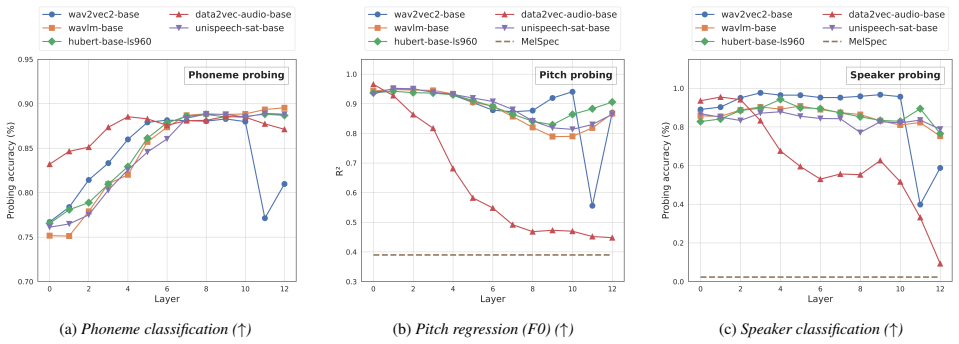
The central finding is that the internal geometry of self-supervised speech models follows a predictable trajectory—early layers build complex, high-dimensional representations (high entropy, high curvature), while deeper layers compress and linearize them—and that this trajectory directly dictates which layers are optimal for different downstream tasks. Phoneme recognition peaks at mid-to-deep layers where curvature transitions from high to low (marking a shift from local acoustic detail to linearly separable abstractions), while pitch and speaker identity rely on the high-entropy, high-curvature states of early layers. The paper also shows that training objectives create distinct regimes:W
What carries the argument
von Neumann entropy of the Gram matrix (measuring informational density), average curvature of token transition vectors (measuring manifold smoothness), InfoNCE-based robustness metric, and the Generative Compatibility Matrix (cross-layer decoder transferability).
Load-bearing premise
The paper assumes that von Neumann entropy of the Gram matrix faithfully measures 'informational density' and that average curvature of token transitions faithfully measures 'manifold unfolding' in the speech domain, without independently validating that these mathematical proxies correspond to the semantic phenomena they are claimed to capture.
What would settle it
If the entropy and curvature metrics were replaced with alternative measures of compression and geometry, the correlations with downstream task performance (Figure 9) would likely weaken or vanish.
If this is right
- Speech model architectures could be designed with task-specific layer extraction points rather than defaulting to the final layer, improving efficiency for applications like speaker verification (early layers) vs. speech recognition (mid layers).
- Pre-training objectives could be evaluated by their effect on internal geometry (entropy stability, curvature linearization) rather than only downstream task scores, potentially guiding the design of objectives that avoid undesirable phenomena like Wav2Vec2's late-stage entropy collapse.
- The Generative Compatibility Matrix methodology could be applied to other modalities (vision, language) to map cross-layer functional dependencies in foundation models.
Where Pith is reading between the lines
- If entropy and curvature are indeed faithful proxies for informational density and manifold linearization, then one could predict optimal probing layers for novel tasks without running expensive probing experiments, simply by inspecting the curvature transition point.
- The finding that scaling model size (WavLM-LARGE) has a stronger structural effect than increasing training data suggests that architectural capacity, not data volume, is the primary driver of internal representational geometry in these models.
- The asymmetry of the GCM (deep-layer decoders generalize to early layers but not vice versa) implies a one-way information bottleneck that could constrain the design of multi-layer feature fusion methods.
Editorial analysis
A structured set of objections, weighed in public.
Referee Report
Summary. The paper proposes InsideSSL, a model-centric framework for analyzing self-supervised speech representation (SSL) models across their Transformer layers. The framework has two components: (1) three per-layer intrinsic metrics—von Neumann entropy of the Gram matrix (compression), average curvature of token transitions (geometry), and InfoNCE-based invariance to perturbations (robustness)—and (2) a cross-layer Generative Compatibility Matrix (GCM) that trains per-layer CFM+DiT decoders and evaluates their cross-layer transferability. The authors apply these tools to Wav2Vec2, HuBERT, WavLM, Data2Vec, and UniSpeech at BASE/PLUS/LARGE scales, and connect the intrinsic metrics to downstream phoneme, pitch, and speaker probing. The central claims are that training objectives induce distinct compression and manifold-unfolding regimes, and that phoneme recognition benefits from deep-layer compression/linearization while pitch and speaker tasks rely on early high-entropy, high-curvature states.
Significance. The paper provides a systematic and broad-coverage empirical study: five model families, three scales, fine-tuning data ablations, training-dynamics tracking, and a novel cross-layer GCM methodology. The GCM is a genuinely new contribution for audio SSL, moving beyond isolated per-layer probes to quantify inter-layer functional relationships. The provision of a project page with code and interactive audio is a positive for reproducibility. The connection of intrinsic, task-agnostic metrics to downstream probing via Pearson correlations is a reasonable bridging strategy. The paper's scope and the novelty of the GCM make it a solid contribution to the SSL interpretability literature.
major comments (4)
- §2.2 (Compression, Eq. 1) and §3.5: The paper interprets von Neumann entropy of the Gram matrix as 'informational density' and frames its decrease as beneficial 'compression.' However, this entropy measures spectral spread (effective rank), not information content in the Information Bottleneck sense (I(Z;X) or I(Z;Y)). A decrease in effective rank can indicate either beneficial compression (noise removal with signal preservation) or destructive collapse (loss of task-relevant information). The paper does not distinguish these cases. This is load-bearing for the central claim that 'phoneme recognition benefits from deep-layer compression and linearization.' The authors should either (a) add an independent measure of task-relevant information (e.g., mutual information estimates or probing-based proxies) to validate that the entropy decrease preserves phoneme-relevant signal, or (b) soften'
- Figure 9a, Wav2Vec2 row: The entropy-phoneme correlation for Wav2Vec2 is +0.33, which is positive—meaning higher entropy is associated with better phoneme accuracy. This is opposite to the paper's general claim that phoneme recognition benefits from low entropy (compression). The paper's take-away states phonemes require 'deep-layer compression,' but Wav2Vec2—the model with the most dramatic entropy collapse—shows the opposite trend. This inconsistency should be explicitly addressed. If the claim is model-dependent, the take-away should be qualified accordingly.
- Figure 9 and §3.5: The Pearson correlations between intrinsic metrics and probing accuracy assume a linear relationship. However, Figure 8a shows that phoneme accuracy is non-monotonic (peaking in mid-layers and declining in deep layers for most models). A linear correlation coefficient may mischaracterize a non-monotonic relationship. The authors should discuss this limitation and consider whether rank-based or non-monotonic measures would be more appropriate for the reported correlations.
- §3.1–§3.5: No error bars, confidence intervals, or significance tests are reported for any of the intrinsic metrics, GCM entries, or probing results. Given that the central claims rest on comparing layer-wise trajectories and correlation values across models, some quantification of variance is needed to assess whether the observed differences (e.g., Wav2Vec2's entropy collapse vs. WavLM's stability) are statistically reliable. At minimum, bootstrap confidence intervals on the entropy and curvature averages, or standard deviations across the test set, would strengthen the reported patterns.
minor comments (7)
- §2.2, Eq. (2): The curvature formula uses v_n^(l) but the text defines l as the layer index elsewhere. The superscript notation switches between (l) and (ℓ); consistent notation would help.
- §2.3: The GCM definition uses M(D^(ℓ)(Z^(k)), x) but does not specify what x is in this context (waveform? Mel-spectrogram?) at the point of definition. This is clarified later in §3.4 but should be stated at the point of definition.
- Table 1: The 'Task' column uses P/C/D abbreviations but UniSpeech is marked as both P and C. A brief note on UniSpeech's dual objective would help readers unfamiliar with this model.
- Figure 2: The y-axis label 'Average Normalized Entropy' in Fig. 2a does not specify the normalization scheme. The text mentions maxEntropy normalization in §3.1, but the figure caption should clarify this.
- §3.3, Figure 6: The caption says 'first training iteration of a HuBERT model, utilizing labels extracted from MFCCs.' It is unclear whether this refers to the first iteration of pre-training or the first iteration of a specific training stage. Clarification is needed.
- §3.4: The GCM is described as 'structurally asymmetric, strongly favoring the lower triangular region.' The text should clarify the matrix convention (row = training layer, column = evaluation layer) at this point to make the asymmetry claim more precise.
- References [18] and [19] appear to be the same arXiv preprint (arXiv:2501.05310) cited twice with slightly different author lists. This should be corrected.
Simulated Author's Rebuttal
We thank the referee for the thorough and constructive report. The referee correctly identifies the GCM as a novel contribution and acknowledges the breadth of our study. The four major comments raise substantive points about (1) the interpretation of von Neumann entropy as 'compression,' (2) the Wav2Vec2 sign inconsistency in entropy-phoneme correlation, (3) the appropriateness of linear Pearson correlation for non-monotonic relationships, and (4) the absence of error bars and significance tests. We address each below and commit to revisions for all four points.
read point-by-point responses
-
Referee: §2.2 (Compression, Eq. 1) and §3.5: The paper interprets von Neumann entropy of the Gram matrix as 'informational density' and frames its decrease as beneficial 'compression.' However, this entropy measures spectral spread (effective rank), not information content in the Information Bottleneck sense (I(Z;X) or I(Z;Y)). A decrease in effective rank can indicate either beneficial compression (noise removal with signal preservation) or destructive collapse (loss of task-relevant information). The paper does not distinguish these cases. This is load-bearing for the central claim that 'phoneme recognition benefits from deep-layer compression and linearization.' The authors should either (a) add an independent measure of task-relevant information (e.g., mutual information estimates or probing-based proxies) to validate that the entropy decrease preserves phoneme-relevant signal, or (b) soften.
Authors: The referee is correct that von Neumann entropy of the Gram matrix measures spectral spread (effective rank) rather than mutual information in the Information Bottleneck sense, and that a decrease in effective rank is ambiguous between beneficial compression and destructive collapse. We agree this distinction is important and that our current framing overstates what the entropy metric alone can establish. We will revise the manuscript in two ways. First, we will soften the language throughout: 'informational density' will be replaced with 'effective dimensionality' or 'spectral spread,' and we will explicitly state that entropy decrease is consistent with—but does not prove—beneficial compression. Second, we will note that our linear probing results (Section 3.5, Figure 8a) serve as an independent, task-relevant proxy: phoneme accuracy does not catastrophically decline in the deep layers for HuBERT, WavLM, and UniSpeech, which is consistent with beneficial rather than destructive compression for those models. However, we acknowledge that for Wav2Vec2, the entropy collapse coincides with a decline in phoneme accuracy in the final layers, which may indeed reflect partial destructive collapse. We will state this explicitly. We will not claim that entropy alone validates beneficial compression. revision: yes
-
Referee: Figure 9a, Wav2Vec2 row: The entropy-phoneme correlation for Wav2Vec2 is +0.33, which is positive—meaning higher entropy is associated with better phoneme accuracy. This is opposite to the paper's general claim that phoneme recognition benefits from low entropy (compression). The paper's take-away states phonemes require 'deep-layer compression,' but Wav2Vec2—the model with the most dramatic entropy collapse—shows the opposite trend. This inconsistency should be explicitly addressed. If the claim is model-dependent, the take-away should be qualified accordingly.
Authors: The referee has identified a genuine inconsistency that we had not adequately addressed. The +0.33 correlation for Wav2Vec2 is indeed opposite in sign to the negative average correlation (-0.46) and to the trends observed for HuBERT (-0.82), Data2Vec (-0.74), and UniSpeech (-0.72). This is not a minor discrepancy: Wav2Vec2 is the model with the most dramatic entropy collapse, and it is the one model where higher entropy is associated with better phoneme accuracy. We agree that the take-away should be qualified. In the revised manuscript, we will explicitly discuss this Wav2Vec2 exception, noting that the entropy collapse in Wav2Vec2's final layers may represent destructive rather than beneficial compression—consistent with the concurrent decline in phoneme accuracy and the GCM's semantic rupture at layer 11. The general claim will be restated as model-dependent: for masked-prediction models (HuBERT, WavLM, UniSpeech), phoneme accuracy correlates negatively with entropy, but for Wav2Vec2's contrastive objective, the relationship reverses. The take-away will be revised to reflect this qualification. revision: yes
-
Referee: Figure 9 and §3.5: The Pearson correlations between intrinsic metrics and probing accuracy assume a linear relationship. However, Figure 8a shows that phoneme accuracy is non-monotonic (peaking in mid-layers and declining in deep layers for most models). A linear correlation coefficient may mischaracterize a non-monotonic relationship. The authors should discuss this limitation and consider whether rank-based or non-monotonic measures would be more appropriate for the reported correlations.
Authors: This is a valid methodological concern. The phoneme accuracy curves in Figure 8a are indeed non-monotonic—peaking in mid-layers and declining in deep layers—so Pearson correlation, which captures only linear association, can mischaracterize the relationship between entropy/curvature and phoneme accuracy. We will address this in two ways. First, we will add an explicit discussion of this limitation in Section 3.5, noting that Pearson correlations may understate or misrepresent non-monotonic relationships. Second, we will compute Spearman rank correlations as a supplementary measure and report them alongside the Pearson values. We expect that rank-based measures will better capture the monotonic component of the relationship (e.g., the general trend that lower entropy layers tend to have higher phoneme accuracy for masked-prediction models), while also being more honest about the non-monotonic structure. If the Spearman correlations differ substantially from the Pearson values, we will report both and discuss the discrepancy. revision: yes
-
Referee: §3.1–§3.5: No error bars, confidence intervals, or significance tests are reported for any of the intrinsic metrics, GCM entries, or probing results. Given that the central claims rest on comparing layer-wise trajectories and correlation values across models, some quantification of variance is needed to assess whether the observed differences (e.g., Wav2Vec2's entropy collapse vs. WavLM's stability) are statistically reliable. At minimum, bootstrap confidence intervals on the entropy and curvature averages, or standard deviations across the test set, would strengthen the reported patterns.
Authors: The referee is right that the absence of variance estimates is a weakness, particularly given that the central claims rest on comparing layer-wise trajectories across models. We will add bootstrap confidence intervals for the intrinsic metrics (entropy, curvature, InfoNCE) computed over the test-clean set. For the GCM entries, we will report standard deviations across the evaluation set. For the linear probing results, we will report standard deviations across multiple random seeds for probe training. We note that for the intrinsic metrics, the patterns we report (e.g., Wav2Vec2's entropy collapse, the curvature transition point) are visually dramatic and consistent across the 2,620 utterances in test-clean, so we expect the confidence intervals to be narrow and the patterns to remain significant. However, we agree that this should be verified empirically rather than assumed, and we will include the variance estimates in the revised figures. revision: yes
Circularity Check
No significant circularity: metrics are computed from embeddings without fitting to target results, and the central derivation is self-contained against external benchmarks.
full rationale
The paper's derivation chain is largely self-contained. The three per-layer metrics (entropy Eq. 1, curvature Eq. 2, InfoNCE Eq. 3) are computed directly from the SSL model embeddings Z^(l) without fitting any parameters to the downstream task results they are later correlated with. The GCM decoders (Section 2.3) are trained on reconstruction loss (L1, SpeechBERTScore, etc.), not on phoneme/pitch/speaker task performance. The linear probes (Section 3.5) are standard and independent — trained on frozen embeddings to predict external labels. The Pearson correlations in Figure 9 are post-hoc statistical relationships between independently computed quantities, not predictions forced by construction. The main external citation is to Skean et al. [20] ('Layer by layer'), from which the implementation of intrinsic metrics is adapted; this is a methodological adaptation of published, externally-available tools, not a self-citation. The paper's authors (Sadok, Alameda-Pineda) do not appear in the author list of [20]. The interpretive claims (entropy as 'informational density,' curvature decrease as 'manifold unfolding') are assumptions that could be questioned on correctness grounds — the von Neumann entropy of the Gram matrix measures spectral diversity rather than information-theoretic mutual information — but this is a validity concern, not circularity. No step in the derivation chain reduces to its own inputs by definition or by fitted parameter. The framework computes intrinsic metrics, computes task performance, and correlates them; none of these steps is tautological.
Axiom & Free-Parameter Ledger
free parameters (4)
- InfoNCE temperature τ =
0.1
- Augmentation trigger probability p =
0.7
- DiT hidden dimension =
512
- DiT number of layers =
6
axioms (4)
- domain assumption Von Neumann entropy of the Gram matrix is a faithful proxy for representational information density/diversity.
- domain assumption Average curvature of token transitions is a faithful proxy for manifold unfolding and linear separability.
- domain assumption InfoNCE loss between augmented views approximates mutual information and thus measures robustness/invariance.
- standard math Linear probing accuracy reflects the immediate accessibility of task-relevant information in a layer.
read the original abstract
Self-supervised learning (SSL) models, such as Wav2Vec2, HuBERT, and WavLM, have become foundational across a wide range of speech and audio tasks. Despite their success, understanding their internal layer-wise dynamics remains an ongoing challenge. To address this, we propose a two-part model-centric framework called InsideSSL. First, we establish a task-agnostic analysis from three intrinsic per-layer perspectives: compression (entropy), geometry (curvature), and robustness to perturbations. We show that varying training objectives induce distinct regimes of acoustic compression and manifold unfolding. Second, we introduce the cross-layer Generative Compatibility Matrix (GCM) to evaluate functional transferability, exposing stable phonetic cores, identity volatility, and deep-layer semantic pruning. In addition to these evaluations, linear probing connects the model-centric perspective to downstream tasks, demonstrating how layer topology dictates phoneme, pitch, and speaker encoding.
Figures



Reference graph
Works this paper leans on
-
[1]
Introduction Self-supervised speech representation learning (SSL) has be- come a cornerstone of modern audio processing [1, 2], with models such as WAVLM [3], WAV2VEC2 [4], and HUBERT
-
[2]
InsideSSL: Understanding Self-Supervised Speech Representations using a Model-Centric Perspective
achieving remarkable performance across speech recogni- tion [4, 3], speaker verification [6, 3, 7], emotion recognition [8, 9, 7] and speech enhancement tasks [10, 11]. By leveraging unlabeled audio data, these models learn representations that capture meaningful semantic and acoustic information with- out relying on explicit supervision. However, despit...
work page internal anchor Pith review Pith/arXiv arXiv 2026
-
[3]
P” for predictive (masked prediction), “C
Experiments 3.1. Per-Layer Analysis: Experimental Setup We evaluate our model-centric perspective on several widely used SSL models. For each model, we extract hidden represen- tations at every layer and analyze them according to the three perspectives described in Section 2. Models.All self-supervised learning models examined in this study utilize a bidi...
-
[4]
The results show that scaling model size has a stronger struc- tural effect than simply increasing the amount of training data: the trajectories ofWAVLM-BASEandWAVLM-BASE-PLUSare closely aligned, whereasWAVLM-LARGEexhibits a markedly different behavior. In terms of entropy,WAVLM-LARGEex- hibits a distinct trajectory: starting at a value of0.70in layer 1, ...
-
[5]
for semantic content, Resemblyzer similarity [35] for speaker identity, STOI for audio quality, andL1loss for Mel-spectrogram reconstruction. In terms of phonetic content (SpeechBERTScore), both SSL models display a broad region of high SpeechBERTScore values, indicating a stable phonetic encoding. For instance, in WAV2VEC2, layers1through10 consistently ...
-
[6]
Conclusion In this work, we introduced theINSIDESSL framework, a uni- fied,task-agnostic and model-centricapproach to analyze SSL speech representations first through three per-layer lenses: com- pression, geometry, and robustness. Our analysis revealed dis- tinct optimization regimes, notably the late-stageentropy col- lapsein Wav2Vec2, contrasting with ...
-
[7]
Acknowledgments This work was granted access to the HPC resources of IDRIS under the allocation Grant 2025-A0181016041 made by GENCI
work page 2025
-
[8]
They did not contribute to the scientific content, analyses, or conclusions of this work
Generative AI Use Disclosure Generative AI tools were used exclusively for language edit- ing and stylistic improvements. They did not contribute to the scientific content, analyses, or conclusions of this work. All au- thors take full responsibility for the manuscript, have approved its submission, and confirm that no generative AI system is listed as a ...
-
[9]
Audio self-supervised learning: A survey,
S. Liu, A. Mallol-Ragolta, E. Parada-Cabaleiro, K. Qian, X. Jing, A. Kathan, B. Hu, and B. W. Schuller, “Audio self-supervised learning: A survey,”Patterns, vol. 3, no. 12, 2022
work page 2022
-
[10]
Self-supervised speech representation learning: A review,
A. Mohamed, H.-y. Lee, L. Borgholt, J. D. Havtorn, J. Edin, C. Igel, K. Kirchhoff, S.-W. Li, K. Livescu, L. Maaløeet al., “Self-supervised speech representation learning: A review,”IEEE Journal of Selected Topics in Signal Processing, vol. 16, no. 6, pp. 1179–1210, 2022
work page 2022
-
[11]
Wavlm: Large-scale self- supervised pre-training for full stack speech processing,
S. Chen, C. Wang, Z. Chen, Y . Wu, S. Liu, Z. Chen, J. Li, N. Kanda, T. Yoshioka, X. Xiaoet al., “Wavlm: Large-scale self- supervised pre-training for full stack speech processing,”IEEE Journal of Selected Topics in Signal Processing, vol. 16, no. 6, pp. 1505–1518, 2022
work page 2022
-
[12]
wav2vec 2.0: A framework for self-supervised learning of speech repre- sentations,
A. Baevski, Y . Zhou, A. Mohamed, and M. Auli, “wav2vec 2.0: A framework for self-supervised learning of speech repre- sentations,”Advances in neural information processing systems, vol. 33, pp. 12 449–12 460, 2020
work page 2020
-
[13]
Hubert: Self-supervised speech represen- tation learning by masked prediction of hidden units,
W.-N. Hsu, B. Bolte, Y .-H. H. Tsai, K. Lakhotia, R. Salakhutdi- nov, and A. Mohamed, “Hubert: Self-supervised speech represen- tation learning by masked prediction of hidden units,”IEEE/ACM transactions on audio, speech, and language processing, vol. 29, pp. 3451–3460, 2021
work page 2021
-
[14]
Exploring wav2vec 2.0 on speaker verification and language identification
Z. Fan, M. Li, S. Zhou, and B. Xu, “Exploring wav2vec 2.0 on speaker verification and language identification,”arXiv preprint arXiv:2012.06185, 2020
work page internal anchor Pith review Pith/arXiv arXiv 2012
-
[15]
Y . Wang, A. Boumadane, and A. Heba, “A fine-tuned wav2vec 2.0/hubert benchmark for speech emotion recognition, speaker verification and spoken language understanding,”arXiv preprint arXiv:2111.02735, 2021
work page internal anchor Pith review Pith/arXiv arXiv 2021
-
[16]
Emotion Recognition from Speech Using Wav2vec 2.0 Embeddings
L. Pepino, P. Riera, and L. Ferrer, “Emotion recognition from speech using wav2vec 2.0 embeddings,”arXiv preprint arXiv:2104.03502, 2021
work page internal anchor Pith review Pith/arXiv arXiv 2021
-
[17]
Exploring wav2vec 2.0 fine tuning for improved speech emotion recognition,
L.-W. Chen and A. Rudnicky, “Exploring wav2vec 2.0 fine tuning for improved speech emotion recognition,” inICASSP 2023-2023 IEEE international conference on acoustics, speech and signal processing (ICASSP). IEEE, 2023, pp. 1–5
work page 2023
-
[18]
Boosting Self-Supervised Embeddings for Speech Enhancement
K.-H. Hung, S.-w. Fu, H.-H. Tseng, H.-T. Chiang, Y . Tsao, and C.-W. Lin, “Boosting self-supervised embeddings for speech en- hancement,”arXiv preprint arXiv:2204.03339, 2022
work page internal anchor Pith review Pith/arXiv arXiv 2022
-
[19]
Investigating self-supervised learning for speech enhancement and separation,
Z. Huang, S. Watanabe, S.-w. Yang, P. Garc´ıa, and S. Khudanpur, “Investigating self-supervised learning for speech enhancement and separation,” inICASSP 2022-2022 IEEE International Con- ference on Acoustics, Speech and Signal Processing (ICASSP). IEEE, 2022, pp. 6837–6841
work page 2022
-
[20]
Layer-wise analysis of a self-supervised speech representation model,
A. Pasad, J.-C. Chou, and K. Livescu, “Layer-wise analysis of a self-supervised speech representation model,” in2021 IEEE Auto- matic Speech Recognition and Understanding Workshop (ASRU). IEEE, 2021, pp. 914–921
work page 2021
-
[21]
J. Shah, Y . K. Singla, C. Chen, and R. R. Shah, “What all do audio transformer models hear? probing acoustic represen- tations for language delivery and its structure,”arXiv preprint arXiv:2101.00387, 2021
work page internal anchor Pith review Pith/arXiv arXiv 2021
-
[22]
Phone and speaker spatial organization in self-supervised speech represen- tations,
P. Riera, M. Cerdeiro, L. Pepino, and L. Ferrer, “Phone and speaker spatial organization in self-supervised speech represen- tations,” in2023 IEEE International Conference on Acoustics, Speech, and Signal Processing Workshops (ICASSPW). IEEE, 2023, pp. 1–5
work page 2023
-
[23]
Exploration of a self- supervised speech model: A study on emotional corpora,
Y . Li, Y . Mohamied, P. Bell, and C. Lai, “Exploration of a self- supervised speech model: A study on emotional corpora,” in2022 IEEE Spoken Language Technology Workshop (SLT). IEEE, 2023, pp. 868–875
work page 2023
-
[24]
T. Ashihara, M. Delcroix, T. Moriya, K. Matsuura, T. Asami, and Y . Ijima, “What do self-supervised speech and speaker mod- els learn? new findings from a cross model layer-wise analysis,” inICASSP 2024-2024 IEEE International Conference on Acous- tics, Speech and Signal Processing (ICASSP). IEEE, 2024, pp. 10 166–10 170
work page 2024
-
[25]
Comparative layer-wise anal- ysis of self-supervised speech models,
A. Pasad, B. Shi, and K. Livescu, “Comparative layer-wise anal- ysis of self-supervised speech models,” inICASSP 2023-2023 IEEE International Conference on Acoustics, Speech and Signal Processing (ICASSP). IEEE, 2023, pp. 1–5
work page 2023
-
[27]
A. Y . F. Chiu, K. C. Fung, R. T. Y . Li, J. Li, and T. Lee, “A large-scale probing analysis of speaker-specific at- tributes in self-supervised speech representations,”arXiv preprint arXiv:2501.05310, 2025
-
[28]
Layer by Layer: Uncovering Hidden Representations in Language Models
O. Skean, M. R. Arefin, D. Zhao, N. Patel, J. Naghiyev, Y . LeCun, and R. Shwartz-Ziv, “Layer by layer: Uncovering hidden repre- sentations in language models,”arXiv preprint arXiv:2502.02013, 2025
work page internal anchor Pith review Pith/arXiv arXiv 2025
-
[29]
The information bottleneck method
N. Tishby, F. C. Pereira, and W. Bialek, “The information bottle- neck method,”arXiv preprint physics/0004057, 2000
work page internal anchor Pith review Pith/arXiv arXiv 2000
-
[30]
Opening the Black Box of Deep Neural Networks via Information
R. Shwartz-Ziv and N. Tishby, “Opening the black box of deep neural networks via information,”arXiv preprint arXiv:1703.00810, 2017
work page internal anchor Pith review Pith/arXiv arXiv 2017
-
[31]
To compress or not to compress—self-supervised learning and information theory: A review,
R. Shwartz Ziv and Y . LeCun, “To compress or not to compress—self-supervised learning and information theory: A review,”Entropy, vol. 26, no. 3, p. 252, 2024
work page 2024
-
[32]
E. Hosseini and E. Fedorenko, “Large language models implic- itly learn to straighten neural sentence trajectories to construct a predictive representation of natural language.”Advances in Neu- ral Information Processing Systems, vol. 36, pp. 43 918–43 930, 2023
work page 2023
-
[33]
Representation Learning with Contrastive Predictive Coding
A. v. d. Oord, Y . Li, and O. Vinyals, “Representation learning with contrastive predictive coding,”arXiv preprint arXiv:1807.03748, 2018
work page internal anchor Pith review Pith/arXiv arXiv 2018
-
[34]
LiDAR: Sensing Linear Probing Performance in Joint Embedding SSL Architectures
V . Thilak, C. Huang, O. Saremi, L. Dinh, H. Goh, P. Nakkiran, J. M. Susskind, and E. Littwin, “Lidar: Sensing linear probing performance in joint embedding ssl architectures,”arXiv preprint arXiv:2312.04000, 2023
work page internal anchor Pith review Pith/arXiv arXiv 2023
-
[35]
DiME: Maximizing Mutual Information by a Difference of Matrix-Based Entropies
O. Skean, J. K. H. Osorio, A. J. Brockmeier, and L. G. S. Gi- raldo, “Dime: Maximizing mutual information by a difference of matrix-based entropies,”arXiv preprint arXiv:2301.08164, 2023
work page internal anchor Pith review Pith/arXiv arXiv 2023
-
[36]
Multivari- ate extension of matrix-based r ´enyi’s alpha-order entropy func- tional,
S. Yu, L. G. S. Giraldo, R. Jenssen, and J. C. Principe, “Multivari- ate extension of matrix-based r ´enyi’s alpha-order entropy func- tional,”IEEE transactions on pattern analysis and machine intel- ligence, vol. 42, no. 11, pp. 2960–2966, 2019
work page 2019
-
[37]
Data2vec: A general framework for self-supervised learning in speech, vision and language,
A. Baevski, W.-N. Hsu, Q. Xu, A. Babu, J. Gu, and M. Auli, “Data2vec: A general framework for self-supervised learning in speech, vision and language,” inInternational conference on ma- chine learning. PMLR, 2022, pp. 1298–1312
work page 2022
-
[38]
Lib- rispeech: an asr corpus based on public domain audio books
V . Panayotov, G. Chen, D. Povey, and S. Khudanpur, “Lib- rispeech: an asr corpus based on public domain audio books.” IEEE, 2015, pp. 5206–5210
work page 2015
-
[39]
Flow Matching for Generative Modeling
Y . Lipman, R. T. Chen, H. Ben-Hamu, M. Nickel, and M. Le, “Flow matching for generative modeling,”arXiv preprint arXiv:2210.02747, 2022
work page internal anchor Pith review Pith/arXiv arXiv 2022
-
[40]
Scalable diffusion models with transform- ers,
W. Peebles and S. Xie, “Scalable diffusion models with transform- ers,” inProceedings of the IEEE/CVF international conference on computer vision, 2023, pp. 4195–4205
work page 2023
-
[41]
Hifi-GAN: Generative adversarial networks for efficient and high fidelity speech synthesis,
J. Kong, J. Kim, and J. Bae, “Hifi-GAN: Generative adversarial networks for efficient and high fidelity speech synthesis,” 2020
work page 2020
-
[42]
T. Saeki, S. Maiti, S. Takamichi, S. Watanabe, and H. Saruwatari, “Speechbertscore: Reference-aware automatic evaluation of speech generation leveraging nlp evaluation metrics,”arXiv preprint arXiv:2401.16812, 2024
work page internal anchor Pith review Pith/arXiv arXiv 2024
-
[43]
Generalized end- to-end loss for speaker verification,
L. Wan, Q. Wang, A. Papir, and I. L. Moreno, “Generalized end- to-end loss for speaker verification,” 2018
work page 2018
-
[44]
High-fidelity neural phonetic posteriorgrams,
C. Churchwell, M. Morrison, and B. Pardo, “High-fidelity neural phonetic posteriorgrams,” inICASSPW, 2024
work page 2024
-
[45]
Crepe: A convo- lutional representation for pitch estimation,
J. W. Kim, J. Salamon, P. Li, and J. P. Bello, “Crepe: A convo- lutional representation for pitch estimation,” in2018 IEEE Inter- national Conference on Acoustics, Speech and Signal Processing (ICASSP). IEEE, 2018, pp. 161–165
work page 2018
discussion (0)
Sign in with ORCID, Apple, or X to comment. Anyone can read and Pith papers without signing in.