EgoPolice: A Benchmark for Egocentric Video Understanding in High-Stakes Police Body-Worn Camera Footage
Reviewed by Pith T0 review T1 audit T2 compute T3 formal T4 kernel 2026-07-08 04:40 UTCglm-5.2pith:K55YYDGOrecord.jsonopen to challenge →
The pith
Even the best AI can't reliably flag weapons in police body-cam footage
A machine-rendered reading of the paper's core claim, the machinery that carries it, and where it could break.
Core claim
The central finding is that police body-worn camera footage poses a qualitatively different challenge from existing egocentric video datasets, and current state-of-the-art models are not adequate for it. The paper quantifies this in two ways. First, optical flow analysis shows that during annotated action segments, EgoPolice exhibits a heavy-tailed distribution of camera motion, unlike Ego4D or EPIC-KITCHENS where motion drops during actions. Second, CLIP embedding analysis reveals that inter-class visual separability in EgoPolice is extremely low, with a Total Variation Distance of 0.150 between same-class and different-class frame-pair similarity distributions, compared to 0.573 for Kin-50
What carries the argument
The paper's argument rests on three constructed objects: (1) the EgoPolice dataset itself, built through a two-stage annotation pipeline with objective, intent-free action definitions and a mean inter-annotator agreement (Krippendorff's alpha) of 79.4%; (2) two evaluation tasks, a linear-probing classification protocol using frozen features from models like VideoMAE V2, CLIP, and DINOv2, and a zero-shot multiple-choice question-answering protocol for video-language models; and (3) two quantitative diagnostic measures that explain why the domain is hard, optical flow magnitude during action segments and CLIP-based inter-class TVD. Together these establish both the benchmark and the structural
If this is right
- Commercial vendors selling BWC analysis tools can now be stress-tested against a public, independently curated benchmark, exposing whether their systems can distinguish a weapon from a flashlight or a red shirt from an injury.
- The low inter-class TVD finding suggests that models relying on scene-level appearance shortcuts, which work well on Kinetics or ActivityNet, will systematically fail on BWC footage, motivating architectures that prioritize fine-grained temporal and motion reasoning.
- The per-second annotation granularity and case-level data splits enable future work on temporal action localization and cross-jurisdictional generalization in a way that clip-level datasets cannot.
- The human-in-the-loop deployment sketch, though preliminary, outlines a concrete path where model predictions surface candidate segments for human review rather than replacing human judgment, which may be the only viable deployment paradigm given current error rates.
Load-bearing premise
The paper claims EgoPolice can serve as a foundation for scalable police oversight tools, but the only evidence for real-world transferability is a brief description of a preliminary deployment on a single action class with no quantitative results, no false-negative analysis, and no comparison to a baseline without model assistance.
What would settle it
If a model trained on EgoPolice could not outperform a random or simple heuristic baseline at surfacing action segments in an uncurated BWC repository, or if the low inter-class TVD were an artifact of annotation noise rather than genuine visual similarity between classes, the paper's claim that BWC footage is qualitatively harder and that EgoPolice captures that difficulty would be undermined.
Figures




read the original abstract
We introduce EgoPolice, a carefully curated dataset of real, egocentric police-civilian interactions, sourced from publicly available body-worn camera videos. We select police-civilian action labels that are critical for police behavioral research and annotate them at a second-by-second granularity. The videos feature rapid and irregular camera motion, dense human interactions, and rare high-stakes events, making the dataset a challenging benchmark for motion-robust and context-aware egocentric perception. We provide two different tasks, classification and multiple-choice question-answering, and benchmark both open-source and closed-source models. We find that even the best video models like Gemini 2.5 Pro still struggle to accurately predict high-risk actions such as "Weapon Out". Beyond serving as a benchmark, EgoPolice provides a foundation for developing models capable of identifying events of interest in large-scale body-worn camera video repositories, enabling more efficient downstream human review.
Editorial analysis
A structured set of objections, weighed in public.
Referee Report
Summary. This paper introduces EgoPolice, a dataset of approximately 185 hours of real police body-worn camera (BWC) footage annotated with nine action classes at second-by-second granularity. The dataset is sourced from multiple U.S. police departments, with the primary data coming from Chicago's Civilian Office of Police Accountability (COPA). The annotation pipeline uses a two-stage process with objective, intent-free definitions, achieving a mean Krippendorff's alpha of 79.4%. The paper benchmarks both supervised linear-probing classifiers (using frozen features from CLIP, DINOv2, VideoMAE V2, etc.) and zero-shot video-language models (e.g., Gemini 2.5 Pro, GPT-4.1) on classification and multiple-choice question-answering tasks. Results show that even the best models struggle, particularly on high-stakes actions like 'Weapon Out' and 'Handcuffing.' The paper also includes a preliminary discussion of a real-world deployment in Section 6.
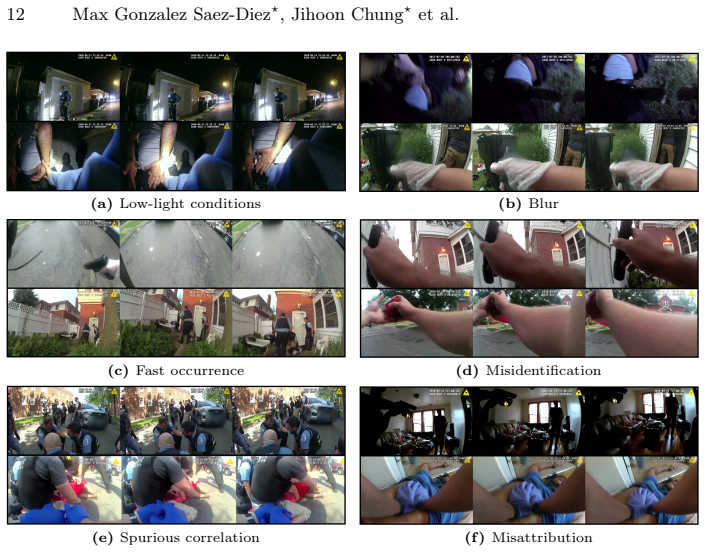
Significance. The dataset fills a genuine gap: there is no existing public benchmark for video understanding in police BWC footage, despite commercial tools already being deployed in this domain. The annotation pipeline is well-designed, with objective definitions, case-level splits to prevent leakage, and 25% manual verification. The optical flow and CLIP-similarity analyses (Figure 3) quantitatively demonstrate that EgoPolice is harder than standard datasets due to severe camera motion and low inter-class visual separability (TVD 0.150 vs. 0.573 for Kinetics). The benchmarking is thorough, covering 6-fold cross-validation with OOD-time and OOD-location splits, multiple clip durations, and a broad set of open- and closed-source VLMs. The per-class breakdowns and failure mode analysis (Figure 4) are informative. The annotator management section, including vicarious traumatization mitigation, is a valuable contribution to best practices for high-stakes data collection.
major comments (1)
- §6 and Contributions (§1): The paper lists 'Demonstrating real-world transferability' as one of three primary contributions and the abstract states EgoPolice 'provides a foundation for developing models capable of identifying events of interest in large-scale body-worn camera video repositories.' However, Section 6 describes an ongoing deployment on a single action class ('BWC Wearer-Physical Interaction') with no quantitative results: no recall, precision, false-negative rate, baseline comparison, or measure of reviewer time savings. The section explicitly defers evidence to 'a forthcoming companion paper.' This makes the transferability claim a stated contribution that is currently unsupported by evidence in the manuscript. The benchmark contribution (dataset + evaluation) stands independently and is well-constructed. The authors should either (a) remove the deployment claim from the贡献
minor comments (8)
- Reference [6] (Attia et al.) appears to be about liver transplantation prioritization, not AI failures in high-stakes settings. Please verify.
- §5.2 states '12,000 questions, with 500 questions per action ... on 1-second and 10-second-long clips and 200 questions per action on 1-minute-long clips.' With 10 actions (including 'None of the above'), this yields 500×10×2 + 200×10 = 12,000. Please clarify the counting in the text for readers.
- Figure 3: The legend in panels (a-b) lists datasets including 'EPIC-KITCHENS' but the text does not discuss it. Consider adding a brief mention or adjusting the legend.
- Table 4: The 'Random Baseline' description in §D.1 says it 'always predicts 1' with 'Recall is 100.' This is a reasonable baseline but the F1 values in Table 4 vary across splits (e.g., 7.9 for ID vs. 13.9 for OT at 1s). A footnote explaining why the random baseline F1 differs across splits (due to different class prevalence) would help readers.
- §3.2: The 10-second buffer around Stage 1 interaction windows is mentioned without justification. A brief note on why 10 seconds was chosen would strengthen the methodology.
- §D.11: The MCQ prompt example shows options A–E but the per-class accuracy table (Table 18) lists 9 action classes plus 'None of the above.' It would help to clarify how the 5-option MCQ maps to the 9-class taxonomy (i.e., one correct answer and four random distractors from the other 8 classes + 'None of the above').
- The paper uses 'EgoPolice' and 'EgoPolice (Ours)' in figures. Consider defining the abbreviation 'EP' if used, or consistently use the full name.
- §7: The ethical discussion is thoughtful but brief. Given that the dataset includes footage of civilians who died in police custody, a sentence on whether any faces were redacted or whether there are plans for controlled access would strengthen this section.
Simulated Author's Rebuttal
We thank the referee for the careful and constructive review. We address the major comment below.
read point-by-point responses
-
Referee: §6 and Contributions (§1): The paper lists 'Demonstrating real-world transferability' as one of three primary contributions and the abstract states EgoPolice 'provides a foundation for developing models capable of identifying events of interest in large-scale body-worn camera video repositories.' However, Section 6 describes an ongoing deployment on a single action class ('BWC Wearer-Physical Interaction') with no quantitative results: no recall, precision, false-negative rate, baseline comparison, or measure of reviewer time savings. The section explicitly defers evidence to 'a forthcoming companion paper.' This makes the transferability claim a stated contribution that is currently unsupported by evidence in the manuscript. The benchmark contribution (dataset + evaluation) stands independently and is well-constructed. The authors should either (a) remove the deployment claim from the [
Authors: The referee is correct. As the manuscript currently stands, Section 6 describes an ongoing deployment but provides no quantitative evidence—no precision, recall, false-negative rate, baseline comparison, or reviewer time-savings analysis. Listing 'Demonstrating real-world transferability' as a primary contribution in Section 1 and making the corresponding claim in the abstract overstates what the paper actually demonstrates. We agree that the benchmark contribution (dataset + evaluation) stands on its own and does not require the deployment claim to be compelling. In the revised manuscript, we will implement option (a): we will remove 'Demonstrating real-world transferability' from the list of primary contributions in Section 1 and will revise the abstract to remove the sentence 'Beyond serving as a benchmark, EgoPolice provides a foundation for developing models capable of identifying events of interest in large-scale body-worn camera video repositories, enabling more efficient downstream human review.' Section 6 will be retained but repositioned as a preliminary discussion of ongoing deployment work rather than a contribution claim, with the framing made explicit that no quantitative deployment results are presented in this paper and that a full evaluation is deferred to a forthcoming companion paper. We believe this accurately reflects the manuscript's actual contributions while preserving the value of the deployment discussion as motivation for future work. revision: yes
Circularity Check
No circularity found: self-contained dataset/benchmark paper with externally sourced data and externally trained models
full rationale
This is a dataset and benchmark paper. The dataset is constructed from external sources (COPA, Pasadena PD, and other police departments). Annotations are produced by human annotators using objective, intent-free definitions (Table 1). The benchmark results (Tables 4–5) are obtained by evaluating off-the-shelf, externally developed models (CLIP, DINOv2, VideoMAE V2, X-CLIP, Hiera, Gemini 2.5 Pro, GPT-4.1, InternVL3, etc.) on this data using a standard linear-probing protocol from DINOv2 [57] and a zero-shot MCQ protocol. No model parameter is fitted to a subset of data and then 'predicted' on a closely related quantity. The optical flow analysis (Section 4, Figure 3a–b) uses FastFlowNet-v2 [43] as an external tool to characterize motion statistics. The CLIP-similarity analysis (Section 4, Figure 3c–f) uses CLIP [62] embeddings to compute intra/inter-class TVD scores — an external model applied to characterize dataset properties, not a self-referential derivation. The one self-citation ([20], MERV by Chung et al.) is merely one of many models evaluated and is not load-bearing for any central claim. The deployment claim in Section 6 is unsupported by quantitative evidence (no recall, precision, or baseline comparison is provided, and the paper defers analysis to a 'forthcoming companion paper'), but this is an overclaim/unsupported-assertion problem, not circularity — the claim is not derived from itself or from a fitted parameter. No step in the paper's chain reduces to its own inputs by construction. The derivation is self-contained against external benchmarks, so the circularity score is 0.
Axiom & Free-Parameter Ledger
free parameters (4)
- 10-second buffer around Stage 1 interaction windows =
10 seconds
- Linear probing learning rate grid =
[1e-4, 2e-4, 5e-4, 1e-3, 2e-3, 5e-3, 1e-2, 2e-2, 5e-2, 0.1, 0.2, 0.5]
- MCQ clip durations =
1s, 10s, 1min
- Number of MCQ questions =
12000 total (500/action for 1s and 10s, 200/action for 1min)
axioms (4)
- domain assumption Second-by-second binary labels based on visual observability are sufficient for training and evaluating action recognition models on BWC footage.
- domain assumption Objective, intent-free action definitions can be reliably annotated by non-experts without policing knowledge.
- domain assumption COPA footage (critical incidents, firearm discharges) is representative enough to serve as the primary train/test distribution for BWC action recognition.
- domain assumption Linear probing on frozen features is an adequate proxy for evaluating representation quality in the BWC domain.
Reference graph
Works this paper leans on
-
[1]
Abel Police: Abel police: Automating police paperwork (2026),https : / / abelpolice.com/, accessed: 2026-02-09
work page 2026
-
[2]
Achiam, J., Adler, S., Agarwal, S., Ahmad, L., Akkaya, I., Aleman, F.L., Almeida, D., Altenschmidt, J., Altman, S., Anadkat, S., et al.: Gpt-4 technical report. arXiv preprint arXiv:2303.08774 (2023)
work page internal anchor Pith review Pith/arXiv arXiv 2023
-
[3]
In: International Conference on Machine Learning and Appli- cations (2020)
Almadan, A., Krishnan, A., Rattani, A.: Bwcface: Open-set face recognition using body-worn camera. In: International Conference on Machine Learning and Appli- cations (2020)
work page 2020
-
[4]
Arnab, A., Dehghani, M., Heigold, G., Sun, C., Lucic, M., Schmid, C.: Vivit: A video vision transformer. In: ICCV (2021)
work page 2021
-
[5]
Using Large Language Models for Qualitative Analysis can Introduce Serious Bias
Ashwin, J., Chhabra, A., Rao, V.: Using large language models for qualitative analysis can introduce serious bias. arXiv:2309.17147 (2023)
work page internal anchor Pith review Pith/arXiv arXiv 2023
-
[6]
The Lancet Healthy Longevity (2024)
Attia, A., Webb, J., Connor, K., Johnston, C.J., Williams, M., Gordon-Walker, T., Rowe, I.A., Harrison, E.M., Stutchfield, B.M.: Effect of recipient age on prioritisa- tion for liver transplantation in the uk: a population-based modelling study. The Lancet Healthy Longevity (2024)
work page 2024
-
[7]
Axon Enterprise, Inc.: Axon draft one (2026),https://www.axon.com/products/ draft-one, accessed: 2026-02-09
work page 2026
-
[8]
Bai, S., Chen, K., Liu, X., Wang, J., Ge, W., Song, S., Dang, K., Wang, P., Wang, S., Tang, J., et al.: Qwen2. 5-vl technical report. arXiv:2502.13923 (2025)
work page internal anchor Pith review Pith/arXiv arXiv 2025
-
[9]
Introducing HOT3D: An Egocentric Dataset for 3D Hand and Object Tracking
Banerjee, P., Shkodrani, S., Moulon, P., Hampali, S., Zhang, F., Fountain, J., Miller, E., Basol, S., Newcombe, R., Wang, R., et al.: Introducing hot3d: An ego- centric dataset for 3d hand and object tracking. arXiv:2406.09598 (2024)
work page internal anchor Pith review Pith/arXiv arXiv 2024
-
[10]
Bansal, S., Arora, C., Jawahar, C.V.: My view is the best view: Procedure learning from egocentric videos. In: ECCV (2022)
work page 2022
-
[11]
Barrett, D.P., Xu, R., Yu, H., Siskind, J.M.: Collecting and annotating the large continuous action dataset. Mach. Vis. Appl. (2016)
work page 2016
-
[12]
Bertasius, G., Wang, H., Torresani, L.: Is space-time attention all you need for video understanding? In: Meila, M., Zhang, T. (eds.) ICML (2021)
work page 2021
-
[13]
Braga, A.A., MacDonald, J.M., McCabe, J.: Body-worn cameras, lawful police stops, and nypd officer compliance: A cluster randomized controlled trial. Crimi- nology (2022)
work page 2022
-
[14]
Journal of Criminal Law and Criminology (2018) 16 Max Gonzalez Saez-Diez ⋆, Jihoon Chung⋆ et al
Braga, A.A., Sousa, W.H., Coldren Jr, J.R., Rodriguez, D.: The effects of body- worn cameras on police activity and police-citizen encounters: A randomized con- trolled trial. Journal of Criminal Law and Criminology (2018) 16 Max Gonzalez Saez-Diez ⋆, Jihoon Chung⋆ et al
work page 2018
-
[15]
Behavioral Science & Policy (2024)
Camp, N.P., Voigt, R.: Body camera footage as data: Using natural language pro- cessing to monitor policing at scale & in depth. Behavioral Science & Policy (2024). https://doi.org/10.1177/23794607241308636
-
[16]
PNAS Nexus (2024).https://doi.org/10.1093/pnasnexus/ pgae359
Camp, N.P., Voigt, R., Hamedani, M.G., Jurafsky, D., Eberhardt, J.L.: Leveraging body-worn camera footage to assess the effects of training on officer communication during traffic stops. PNAS Nexus (2024).https://doi.org/10.1093/pnasnexus/ pgae359
-
[17]
Carreira, J., Zisserman, A.: Quo vadis, action recognition? A new model and the kinetics dataset. In: CVPR (2017)
work page 2017
-
[18]
Chen, T., Siarohin, A., Menapace, W., Deyneka, E., Chao, H., Jeon, B.E., Fang, Y., Lee, H., Ren, J., Yang, M., Tulyakov, S.: Panda-70m: Captioning 70m videos with multiple cross-modality teachers. In: CVPR (2024)
work page 2024
-
[19]
Chen, Z., Asadi Shamsabadi, E., Jiang, S., Shen, L., Dias-da Costa, D.: Integration of large vision language models for efficient post-disaster damage assessment and reporting. Nature Communications (2026)
work page 2026
-
[20]
Chung, J., Zhu, T., Saez-Diez, M.G., Niebles, J.C., Zhou, H., Russakovsky, O.: Unifying specialized visual encoders for video language models. In: ICML (2025)
work page 2025
-
[21]
Damen, D., Doughty, H., Farinella, G.M., Fidler, S., Furnari, A., Kazakos, E., Moltisanti, D., Munro, J., Perrett, T., Price, W., et al.: Scaling egocentric vision: The epic-kitchens dataset. In: ECCV (2018)
work page 2018
-
[22]
Damen, D., Doughty, H., Farinella, G.M., Furnari, A., Kazakos, E., Ma, J., Molti- santi, D., Munro, J., Perrett, T., Price, W., et al.: Rescaling egocentric vision: Collection, pipeline and challenges for epic-kitchens-100. IJCV (2022)
work page 2022
-
[23]
Davani, A.M., Díaz, M., Prabhakaran, V.: Dealing with disagreements: Looking beyond the majority vote in subjective annotations. Trans. Assoc. Comput. Lin- guistics (2022)
work page 2022
-
[24]
Dyno Public Safety: Dyno public safety (2026),https://www.dynopublicsafety. com/, accessed: 2026-02-09
work page 2026
-
[25]
Fan, H., Xiong, B., Mangalam, K., Li, Y., Yan, Z., Malik, J., Feichtenhofer, C.: Multiscale vision transformers. In: ICCV (2021)
work page 2021
-
[26]
Feichtenhofer, C., Fan, H., Malik, J., He, K.: Slowfast networks for video recogni- tion. In: ICCV (2019)
work page 2019
-
[27]
Gemini Team, Google: Gemini 2.5: Pushing the frontier with advanced rea- soning, multimodality, long context, and next generation agentic capabilities. arXiv:2507.06261 (2025)
work page internal anchor Pith review Pith/arXiv arXiv 2025
-
[28]
Grauman, K., Westbury, A., Byrne, E., Chavis, Z., Furnari, A., Girdhar, R., Ham- burger, J., Jiang, H., Liu, M., Liu, X., et al.: Ego4d: Around the world in 3,000 hours of egocentric video. In: CVPR (2022)
work page 2022
-
[29]
In: Proceedings of the IEEE/CVF Conference on Computer Vision and Pattern Recognition (2024)
Grauman, K., Westbury, A., Torresani, L., Kitani, K., Malik, J., Afouras, T., Ashutosh, K., Baiyya, V., Bansal, S., Boote, B., et al.: Ego-exo4d: Understanding skilled human activity from first-and third-person perspectives. In: Proceedings of the IEEE/CVF Conference on Computer Vision and Pattern Recognition (2024)
work page 2024
-
[30]
National Institute of Standards and Technology (2019)
Grother, P., Ngan, M., Hanaoka, K.: Face Recognition Vendor Test Part 3: Demographic Effects. National Institute of Standards and Technology (2019). https://doi.org/https://doi.org/10.6028/NIST.IR.8280
-
[31]
Gu, C., Sun, C., Ross, D.A., Vondrick, C., Pantofaru, C., Li, Y., Vijayanarasimhan, S., Toderici, G., Ricco, S., Sukthankar, R., Schmid, C., Malik, J.: AVA: A video dataset of spatio-temporally localized atomic visual actions. In: CVPR (2018)
work page 2018
-
[32]
arXiv:2510.21798 (2026) EgoPolice: A Benchmark for Egocentric Video Understanding
Gutiérrez,J.,Gutiérrez,V.,ÁngelMora,Rodriguez,S.,Blanco,J.L.:Anevaluation of hybrid annotation workflows on high-ambiguity spatiotemporal video footage. arXiv:2510.21798 (2026) EgoPolice: A Benchmark for Egocentric Video Understanding... 17
-
[33]
Hara, K., Kataoka, H., Satoh, Y.: Learning spatio-temporal features with 3d resid- ual networks for action recognition. In: ICCV (2017)
work page 2017
-
[34]
IEEE Transactions on Visualization and Computer Graphics30(1), 87–97 (2023)
He, J., Wang, X., Wong, K.K., Huang, X., Chen, C., Chen, Z., Wang, F., Zhu, M., Qu, H.: Videopro: A visual analytics approach for interactive video programming. IEEE Transactions on Visualization and Computer Graphics30(1), 87–97 (2023)
work page 2023
-
[35]
Heilbron, F.C., Escorcia, V., Ghanem, B., Niebles, J.C.: Activitynet: A large-scale video benchmark for human activity understanding. In: CVPR (2015)
work page 2015
-
[36]
Hejabi, P., Padte, A.K., Golazizian, P., Hebbar, R., Trager, J., Chochlakis, G., Kommineni, A., Graeden, E., Narayanan, S., Graham, B.A., Dehghani, M.: Cvat- bwv: a web-based video annotation platform for police body-worn video. In: IJCAI (2024)
work page 2024
-
[37]
Hong, W., Cheng, Y., Yang, Z., Wang, W., Wang, L., Gu, X., Huang, S., Dong, Y., Tang, J.: Motionbench: Benchmarking and improving fine-grained video motion understanding for vision language models. In: CVPR (2025)
work page 2025
-
[38]
CogVLM2: Visual Language Models for Image and Video Understanding
Hong, W., Wang, W., Ding, M., Yu, W., Lv, Q., Wang, Y., Cheng, Y., Huang, S., Ji, J., Xue, Z., et al.: Cogvlm2: Visual language models for image and video understanding. arXiv:2408.16500 (2024)
work page internal anchor Pith review Pith/arXiv arXiv 2024
-
[39]
Idrees, H., Zamir, A.R., Jiang, Y., Gorban, A., Laptev, I., Sukthankar, R., Shah, M.: The THUMOS challenge on action recognition for videos "in the wild". Com- put. Vis. Image Underst. (2017)
work page 2017
-
[40]
Jaided AI: Easyocr: Ready-to-use ocr with 80+ supported languages and all pop- ular writing scripts.https://github.com/JaidedAI/EasyOCR(2020)
work page 2020
-
[41]
Journal of Criminal Justice (2015)
Jennings, W.G., Lynch, M.D., Fridell, L.A.: Evaluating the impact of police of- ficer body-worn cameras (bwcs) on response-to-resistance and serious external complaints: Evidence from the orlando police department (opd) experience uti- lizing a randomized controlled experiment. Journal of Criminal Justice (2015). https://doi.org/https://doi.org/10.1016/j....
-
[42]
The Kinetics Human Action Video Dataset
Kay, W., Carreira, J., Simonyan, K., Zhang, B., Hillier, C., Vijayanarasimhan, S., Viola, F., Green, T., Back, T., Natsev, P., Suleyman, M., Zisserman, A.: The kinetics human action video dataset. arXiv:1705.06950 (2017)
work page internal anchor Pith review Pith/arXiv arXiv 2017
- [43]
-
[44]
Krippendorff, K.: Content analysis: An introduction to its methodology. Sage pub- lications (2018)
work page 2018
-
[45]
Li, K., Wang, Y., Zhang, J., Gao, P., Song, G., Liu, Y., Li, H., Qiao, Y.: Uniformer: Unifying convolution and self-attention for visual recognition. IEEE Trans. Pattern Anal. Mach. Intell. (2023)
work page 2023
-
[46]
Li, Y., Wu, C., Fan, H., Mangalam, K., Xiong, B., Malik, J., Feichtenhofer, C.: Mvitv2: Improved multiscale vision transformers for classification and detection. In: CVPR (2022)
work page 2022
-
[47]
Li, Y., Wang, C., Jia, J.: Llama-vid: An image is worth 2 tokens in large language models. In: ECCV (2024)
work page 2024
-
[48]
Lin, B., Ye, Y., Zhu, B., Cui, J., Ning, M., Jin, P., Yuan, L.: Video-llava: Learning united visual representation by alignment before projection. In: EMNLP (2024)
work page 2024
-
[49]
Lin, T.Y., Maire, M., Belongie, S., Hays, J., Perona, P., Ramanan, D., Dollár, P., Zitnick, C.L.: Microsoft coco: Common objects in context. In: ECCV (2014)
work page 2014
-
[50]
Nature (2024) 18 Max Gonzalez Saez-Diez ⋆, Jihoon Chung⋆ et al
Lu, M.Y., Chen, B., Williamson, D.F., Chen, R.J., Zhao, M., Chow, A.K., Ikemura, K., Kim, A., Pouli, D., Patel, A., et al.: A multimodal generative ai copilot for human pathology. Nature (2024) 18 Max Gonzalez Saez-Diez ⋆, Jihoon Chung⋆ et al
work page 2024
-
[51]
Campbell systematic reviews (2020)
Lum, C., Koper, C.S., Wilson, D.B., Stoltz, M., Goodier, M., Eggins, E., Higgin- son, A., Mazerolle, L.: Body-worn cameras’ effects on police officers and citizen behavior: A systematic review. Campbell systematic reviews (2020)
work page 2020
-
[52]
Ma, L., Ye, Y., Hong, F., Guzov, V., Jiang, Y., Postyeni, R., Pesqueira, L., Gamino, A., Baiyya, V., Kim, H.J., Bailey, K., Fosas, D.S., Liu, C.K., Liu, Z., Engel, J.J., De Nardi, R., Newcombe, R.A.: Nymeria: A massive collection of multimodal ego- centric daily motion in the wild. In: ECCV (2024)
work page 2024
-
[53]
Ma, Y., Xu, G., Sun, X., Yan, M., Zhang, J., Ji, R.: X-CLIP: end-to-end multi- grained contrastive learning for video-text retrieval. In: ACM (2022)
work page 2022
-
[54]
Maaz, M., Rasheed, H., Khan, S., Khan, F.: Video-chatgpt: Towards detailed video understanding via large vision and language models. In: Proceedings of the 62nd Annual Meeting of the Association for Computational Linguistics (Volume 1: Long Papers) (2024)
work page 2024
-
[55]
MacMillan, D., Ovalle, D., Schaffer, A.: Arrested by ai: Police ignore stan- dards after facial recognition matches. The Washington Post (2025),https: //www.washingtonpost.com/business/interactive/2025/police-artificial- intelligence-facial-recognition, accessed: 2025-10-20
work page 2025
-
[56]
Mangalam, K., Akshulakov, R., Malik, J.: Egoschema: A diagnostic benchmark for very long-form video language understanding. NeurIPS (2023)
work page 2023
-
[57]
Oquab, M., Darcet, T., Moutakanni, T., Vo, H.V., Szafraniec, M., Khalidov, V., Fernandez, P., Haziza, D., Massa, F., El-Nouby, A., Assran, M., Ballas, N., Galuba, W., Howes, R., Huang, P., Li, S., Misra, I., Rabbat, M., Sharma, V., Synnaeve, G., Xu, H., Jégou, H., Mairal, J., Labatut, P., Joulin, A., Bojanowski, P.: Dinov2: Learning robust visual features...
work page 2024
-
[58]
Pan, X., Charron, N., Yang, Y., Peters, S., Whelan, T., Kong, C., Parkhi, O.M., Newcombe, R.A., Ren, C.Y.: Aria digital twin: A new benchmark dataset for ego- centric 3d machine perception. In: ICCV (2023)
work page 2023
-
[59]
Patterson, Q., White, M.D.: Is there a civilizing effect on citizens? testing the pre-conditions for body worn camera-induced behavior change. Police Quarterly (2021)
work page 2021
-
[60]
Polis Solutions, Inc.: Polis solutions: Public safety technology and training (2026), https://www.polis-solutions.ai/, accessed: 2026-02-09
work page 2026
-
[61]
Transactions of the Association for Computational Linguistics (2018).https://doi.org/10
Prabhakaran, V., Griffiths, C., Su, H., Verma, P., Morgan, N., Eberhardt, J.L., Jurafsky, D.: Detecting institutional dialog acts in police traffic stops. Transactions of the Association for Computational Linguistics (2018).https://doi.org/10. 1162/tacl_a_00031
work page 2018
-
[62]
Radford, A., Kim, J.W., Hallacy, C., Ramesh, A., Goh, G., Agarwal, S., Sastry, G., Askell, A., Mishkin, P., Clark, J., Krueger, G., Sutskever, I.: Learning transferable visual models from natural language supervision. In: ICML (2021)
work page 2021
-
[63]
Ravi, N., Gabeur, V., Hu, Y., Hu, R., Ryali, C., Ma, T., Khedr, H., Rädle, R., Rolland, C., Gustafson, L., Mintun, E., Pan, J., Alwala, K.V., Carion, N., Wu, C., Girshick, R.B., Dollár, P., Feichtenhofer, C.: SAM 2: Segment anything in images and videos. In: ICLR (2025)
work page 2025
-
[64]
Russakovsky, O., Deng, J., Su, H., Krause, J., Satheesh, S., Ma, S., Huang, Z., Karpathy, A., Khosla, A., Bernstein, M., et al.: Imagenet large scale visual recog- nition challenge. IJCV (2015)
work page 2015
-
[65]
In: ICML (2023) EgoPolice: A Benchmark for Egocentric Video Understanding
Ryali, C., Hu, Y., Bolya, D., Wei, C., Fan, H., Huang, P., Aggarwal, V., Chowd- hury, A., Poursaeed, O., Hoffman, J., Malik, J., Li, Y., Feichtenhofer, C.: Hiera: A hierarchical vision transformer without the bells-and-whistles. In: ICML (2023) EgoPolice: A Benchmark for Egocentric Video Understanding... 19
work page 2023
-
[66]
Salehi, M.R., Park, J.S., Kusupati, A., Krishna, R., Choi, Y., Hajishirzi, H., Farhadi, A.: Actionatlas: A videoqa benchmark for domain-specialized action recognition. NeurIPS (2024)
work page 2024
-
[67]
In: Findings of the Association for Computational Linguistics: ACL 2025 (2025)
Schroeder, H., Roy, D., Kabbara, J.: Just put a human in the loop? investigating LLM-assisted annotation for subjective tasks. In: Findings of the Association for Computational Linguistics: ACL 2025 (2025)
work page 2025
-
[68]
Sigurdsson, G.A., Varol, G., Wang, X., Farhadi, A., Laptev, I., Gupta, A.: Hol- lywood in homes: Crowdsourcing data collection for activity understanding. In: ECCV (2016)
work page 2016
-
[69]
Cyberpsychology: Journal of Psychosocial Research on Cyberspace (2023)
Spence, R., Bifulco, A., Bradbury, P., Martellozzo, E., DeMarco, J.: The psycho- logical impacts of content moderation on content moderators: A qualitative study. Cyberpsychology: Journal of Psychosocial Research on Cyberspace (2023)
work page 2023
-
[70]
Srbinovska, A., Srbinovska, A., Senthil, V., Martin, A., McCluskey, J., Fokoué, E.: Towards ai-driven policing: Interdisciplinary knowledge discovery from police body-worn camera footage. arxiv:2504.20007 (2025)
work page internal anchor Pith review Pith/arXiv arXiv 2025
-
[71]
Tezcan, O., Duan, Z., Cokbas, M., Ishwar, P., Konrad, J.: Wepdtof: A dataset and benchmark algorithms for in-the-wild people detection and tracking from overhead fisheye cameras. In: CVPR (2022)
work page 2022
-
[72]
Tran, D., Bourdev, L., Fergus, R., Torresani, L., Paluri, M.: Learning spatiotem- poral features with 3d convolutional networks. In: CVPR (2015)
work page 2015
-
[73]
Truleo,Inc.:Truleo:Bodycameraanalytics(2026),https://truleo.co/,accessed: 2026-02-09
work page 2026
-
[74]
Tschannen, M., Gritsenko, A., Wang, X., Naeem, M.F., Alabdulmohsin, I., Parthasarathy, N., Evans, T., Beyer, L., Xia, Y., Mustafa, B., et al.: Siglip 2: Multilingual vision-language encoders with improved semantic understanding, lo- calization, and dense features. arXiv:2502.14786 (2025)
work page internal anchor Pith review Pith/arXiv arXiv 2025
-
[75]
Uma, A., Fornaciari, T., Hovy, D., Paun, S., Plank, B., Poesio, M.: Learning from disagreement: A survey. J. Artif. Intell. Res. (2021)
work page 2021
-
[76]
Proceedings of the National Academy of Sciences (2017).https://doi.org/10.1073/pnas.1702413114
Voigt, R., Camp, N.P., Prabhakaran, V., Hamilton, W.L., Hetey, R.C., Griffiths, C.M., Jurgens, D., Jurafsky, D., Eberhardt, J.L.: Language from police body cam- era footage shows racial disparities in officer respect. Proceedings of the National Academy of Sciences (2017).https://doi.org/10.1073/pnas.1702413114
-
[77]
Vondrick, C., Patterson, D., Ramanan, D.: Efficiently scaling up crowdsourced video annotation. IJCV (2013)
work page 2013
-
[78]
Wang, L., Huang, B., Zhao, Z., Tong, Z., He, Y., Wang, Y., Wang, Y., Qiao, Y.: Videomae V2: scaling video masked autoencoders with dual masking. In: CVPR (2023)
work page 2023
-
[79]
Wang, L., Xiong, Y., Wang, Z., Qiao, Y., Lin, D., Tang, X., Van Gool, L.: Temporal segment networks for action recognition in videos. TPAMI (2019)
work page 2019
-
[80]
Yeung, S., Russakovsky, O., Jin, N., Andriluka, M., Mori, G., Fei-Fei, L.: Every moment counts: Dense detailed labeling of actions in complex videos. IJCV (2018)
work page 2018
discussion (0)
Sign in with ORCID, Apple, or X to comment. Anyone can read and Pith papers without signing in.