REVIEW 2 major objections 7 minor 77 references
Phonon-Mediated Thermal Transport in Nanocrystalline Silicon Using Machine-Learning Interatomic Potentials
T0 review · 2 major / 7 minor · reviewed 2026-07-08 · glm-5.2
Pith's one-line read Machine-learned potentials predict 50% higher thermal resistance at rough grain boundaries
desk verdict MLIPs applied to grain-boundary thermal transport in nanocrystalline Si — bulk validation is solid, but the headline TBR comparison rests on a GAP model whose transferability to grain-boundary environments is never validated against DFT. read the letter →
The pith
A machine-rendered reading of the paper's core claim, the machinery that carries it, and where it could break.
The reading
What carries the argument
The load-bearing machinery is the combination of (1) MLIP-derived harmonic and anharmonic force constants fed into a Phonopy/Phono3py lattice-dynamical workflow for phonon dispersions, lifetimes, and thermal conductivity, and (2) MLIP-driven non-equilibrium molecular dynamics (NEMD) with controlled sinusoidal roughness amplitudes at grain boundaries to extract thermal boundary resistance from the steady-state temperature discontinuity. The MACE model trained on GAP-generated grain-boundary configurations serves as the bridge for lattice-dynamical calculations at interfaces.
What would settle it
If direct DFT calculations of phonon properties at a silicon grain boundary disagree substantially with the MACE-predicted lifetimes or mean free paths reported in Figures 6–7, the grain-boundary lattice-dynamical results would be shown to reflect GAP's extrapolation rather than first-principles physics. Similarly, if experimental TBR measurements for roughness-controlled silicon grain boundaries fall closer to the SW/Tersoff predictions than to the GAP value of 1.66 m²K/GW, the central claim that MLIPs are more predictive at disordered interfaces would be undermined.
Extended reading notes
Core claim
The paper's central discovery is that machine-learning interatomic potentials, trained on first-principles reference data, predict substantially stronger phonon scattering at disordered silicon grain boundaries than classical empirical potentials do, and that this difference becomes dramatic as interfacial roughness increases. At a roughness amplitude of 3 Å, the GAP model yields a thermal boundary resistance of 1.66 m²K/GW versus 1.08–1.17 for the classical potentials — a gap of roughly 50 percent that places the MLIP prediction closer to experimental measurements for structurally complex interfaces. The paper also establishes that once a grain-boundary core becomes structurally disordered,
Load-bearing premise
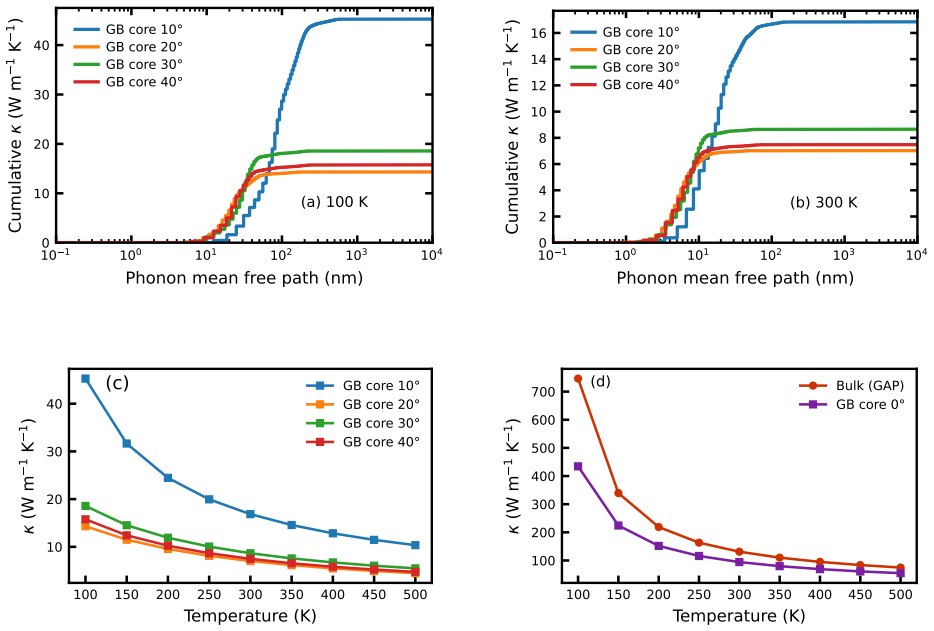
The grain-boundary phonon properties computed via the MACE model (Figures 5–9) are derived from a MACE potential trained on GAP-generated data for grain-boundary configurations, not on independent first-principles reference data. If GAP's description of grain-boundary bonding is inaccurate, MACE inherits that inaccuracy, and the reported phonon lifetimes and thermal conductivities for the grain-boundary core cannot be considered independently validated.
Editorial extensions
If this is right
- Thermal management simulations for nanocrystalline silicon devices that still rely on SW or Tersoff potentials may systematically underestimate grain-boundary thermal resistance, leading to overly optimistic heat-dissipation predictions.
- The framework can be extended to other polycrystalline semiconductors (e.g., germanium, SiGe alloys) where grain-boundary scattering limits thermal conductivity and where classical potentials are known to be unreliable.
- The demonstrated sensitivity of TBR to interfacial roughness at the atomic scale suggests that grain-boundary engineering — controlling roughness and misorientation — could be used as a tuning knob for thermal transport in nanocrystalline materials.
- The unified MLIP + NEMD + lattice-dynamical workflow could be applied to other interfaces (heterojunctions, phase boundaries) where the interplay of harmonic and anharmonic phonon physics controls heat flow.
Reading between the lines
- The MACE model used for grain-boundary lattice-dynamical calculations (phonon DOS, lifetimes, MFP, thermal conductivity in Figs. 5–9) is trained on energies and forces generated by the GAP model itself, not on independent DFT reference data for grain-boundary configurations. This means the reported grain-boundary phonon properties reflect GAP's extrapolation to these environments and are not indep
- The NEMD thermal boundary resistance results (Table I, Fig. 11) use GAP directly, not the MACE surrogate, so the TBR comparison with classical potentials stands on more independent ground — though it still rests on GAP's accuracy for grain-boundary bonding, which is validated here only against bulk silicon benchmarks and experimental TBR ranges, not against DFT-level grain-boundary reference data.
- The weak dependence of grain-boundary phonon lifetimes on misorientation angle (above 10°) suggests a saturation of disorder-induced scattering, but the limited set of four angles (10°–40°) and finite system size (~550 atoms in the GB core) leave open whether this saturation is a physical effect or a consequence of the simulation geometry.
Signed reviews
Editorial analysis
A structured set of objections, weighed in public.
Referee Report
Summary. This manuscript combines Gaussian Approximation Potential (GAP) and MACE machine-learning interatomic potentials with lattice-dynamical calculations (Phonopy/Phono3py) and non-equilibrium molecular dynamics (NEMD) to study phonon-mediated thermal transport in bulk and nanocrystalline silicon. The bulk validation (Figs. 1–3) demonstrates that the retrained GAP and MACE models reproduce experimental phonon dispersions, lifetimes, and thermal conductivity more faithfully than Stillinger–Weber and Tersoff potentials. The paper then proceeds to grain-boundary (GB) phonon properties (Figs. 5–9) computed via a MACE model trained on GAP-generated GB data, and to NEMD thermal boundary resistance (TBR) calculations (Table I, Fig. 11) using the retrained GAP directly. The headline finding is that GAP predicts substantially higher TBR (1.66 m²K/GW at A=3 Å) than SW (1.08) and Tersoff (1.17), bringing predictions closer to experimental values for rough interfaces.
Significance. The integrated framework combining MLIP-derived force constants with both lattice dynamics and NEMD for interfacial thermal transport is timely and addresses a genuine gap in the literature. The bulk silicon benchmarking (Figs. 1–3) is well executed, with both GAP and MACE showing good agreement with experimental phonon dispersions and thermal conductivity. The systematic study of TBR as a function of roughness amplitude across multiple potentials (Table I) provides useful comparative data. The provision of the trained potential file (Si_Phonon.xml) supports reproducibility. However, the significance of the interfacial results is diminished by the training-data lineage issues identified below.
major comments (2)
- Section II (paragraph beginning 'Atomic configurations extracted from the equilibrated trajectories') and Section III (paragraph beginning 'Atomistic simulations of both near-GB and GB regions'): The retrained GAP (Si_Phonon.xml) used for all grain-boundary simulations and NEMD TBR calculations (Table I, Fig. 11) is trained exclusively on configurations from 300 K MD of bulk crystalline silicon. The original GAP of Bartók et al. [54] was trained on DFT data spanning crystalline and amorphous configurations, but the retrained model sees only bulk crystalline environments filtered through that original GAP. When applied to grain-boundary structures with significant structural disorder (roughness amplitudes up to 3 Å, misorientation angles up to 40°), this model is extrapolating beyond its training distribution. No validation against DFT energies, forces, or stresses for any grain-boundary,
- Section III (paragraph beginning 'Atomic positions, forces, and per-atom energies were recorded'): The MACE model used for all grain-boundary lattice-dynamical results (phonon DOS, lifetimes, mean free paths, thermal conductivity in Figs. 5–9) is trained on energies and forces generated by the retrained GAP (Si_Phonon.xml), not on DFT reference data. This creates a dependency chain: the GB phonon properties reflect the retrained GAP's extrapolation to GB environments, not independent first-principles-level predictions. If the retrained GAP's description of GB bonding is inaccurate (see comment 1), MACE inherits that inaccuracy. The manuscript does not acknowledge this limitation. At minimum, the authors should (a) explicitly state that the GB MACE training labels come from GAP, not DFT, (b) provide DFT validation for a subset of GB configurations to assess the fidelity of the GAP-derived
minor comments (7)
- The relationship between the original GAP [54] and the retrained GAP (Si_Phonon.xml) should be stated more explicitly. A reader could easily miss that the retrained model has a narrower training domain than the original.
- Table I: the experimental TBR ranges are listed without specific references in the table footnote. The text cites Ref. [30] (Isotta et al.) in the paragraph following Table I, but the table itself should cite its sources.
- Figure 9(d): the label 'GB core 0°' is somewhat confusing since the text describes this as a reference system without a true grain boundary. A clearer label such as '0° (no misorientation)' would help.
- Section IV, Eq. (1): the notation T_R(x_GB) and T_L(x_GB) is introduced but the subscripts R and L are not defined at that point. Adding 'right' and 'left' would improve readability.
- The SOAP descriptor parameters (nmax=7, lmax=6, ζ=2, 800 sparse points) are given in Section II, but the two-body descriptor parameters and regularization values are not specified. These should be included or referenced in the Supplementary Material.
- Supplementary Material S2: the MACE training convergence is shown only for energy RMSE (Fig. S5). Force RMSE curves would provide a more complete picture of model quality, especially for the GB-core configurations.
- The NEMD production run of 2 ns (Section IV) is relatively short for convergence of thermal conductivity. The κ(t) curves in Fig. 11(a) and Figs. S9–S10 show ongoing fluctuations. A brief discussion of statistical uncertainty (error bars on the TBR values in Table I) would strengthen the quantitative claims.
Simulated Author's Rebuttal
We thank the referee for a careful reading and for identifying two important limitations of the manuscript regarding the training-data lineage of the retrained GAP and the GB MACE model. Both comments are substantively correct: the retrained GAP (Si_Phonon.xml) was trained exclusively on bulk crystalline configurations, and the GB MACE model was trained on GAP-derived labels rather than DFT data. We will revise the manuscript to explicitly acknowledge these limitations and will add DFT validation for a subset of grain-boundary configurations to quantify the fidelity of the GAP-derived labels. We also note that the original Bartók et al. GAP, from which our training labels were generated, was itself trained on DFT data spanning crystalline and amorphous environments, which provides partial coverage of disordered bonding motifs.
read point-by-point responses
-
Referee: The retrained GAP (Si_Phonon.xml) used for all grain-boundary simulations and NEMD TBR calculations is trained exclusively on configurations from 300 K MD of bulk crystalline silicon. The original GAP of Bartók et al. was trained on DFT data spanning crystalline and amorphous configurations, but the retrained model sees only bulk crystalline environments filtered through that original GAP. When applied to grain-boundary structures with significant structural disorder, this model is extrapolating beyond its training distribution. No validation against DFT energies, forces, or stresses for any grain-boundary configuration is provided.
Authors: The referee is correct that the retrained GAP (Si_Phonon.xml) was trained on configurations sampled from 300 K MD of bulk crystalline silicon, and that direct DFT validation for grain-boundary configurations is not provided in the current manuscript. We will address this in two ways. First, we will add an explicit statement in the revised manuscript acknowledging that the retrained GAP's training distribution is limited to bulk crystalline environments and that application to grain-boundary structures constitutes extrapolation beyond this distribution. Second, we will perform DFT calculations (PBEsol or similar) on a representative subset of the grain-boundary configurations used in this work—including the 20° and 40° misorientation angles and the A = 3 Å roughness case—to validate the retrained GAP's energies and forces against first-principles reference data. We note that the training labels for Si_Phonon.xml were themselves generated using the original Bartók et al. GAP [Ref. 54], which was trained on DFT data spanning crystalline and amorphous silicon configurations including liquid and defected structures. The amorphous and liquid training environments in the original GAP's DFT dataset include under-coordinated atoms and distorted bonding geometries that partially overlap with grain-boundary local environments. This provides a degree of indirect coverage of disordered bonding motifs through the teacher model, though we agree it does not substitute for direct DFT validation of GB structures. We will report the DFT validation results in the revised manuscript and Supplementary Material. revision: yes
-
Referee: The MACE model used for all grain-boundary lattice-dynamical results is trained on energies and forces generated by the retrained GAP (Si_Phonon.xml), not on DFT reference data. This creates a dependency chain: the GB phonon properties reflect the retrained GAP's extrapolation to GB environments, not independent first-principles-level predictions. If the retrained GAP's description of GB bonding is inaccurate, MACE inherits that inaccuracy. The manuscript does not acknowledge this limitation. At minimum, the authors should (a) explicitly state that the GB MACE training labels come from GAP, not DFT, (b) provide DFT validation for a subset of GB configurations to assess the fidelity of the GAP-derived labels.
Authors: The referee is correct on both points. The GB MACE model was trained on energies and forces generated by the retrained GAP, not on DFT data, and the manuscript does not currently acknowledge this dependency chain. We will revise the manuscript to: (a) explicitly state in Section III that the MACE model used for grain-boundary lattice-dynamical calculations was trained on labels from the retrained GAP (Si_Phonon.xml), not from DFT, and that this creates a teacher–student dependency in which any inaccuracy in the GAP's description of GB bonding is inherited by MACE; (b) provide DFT validation for a subset of GB configurations, comparing DFT energies and forces against both the retrained GAP and the GB MACE model. This will allow us to quantify the fidelity of the GAP-derived labels and the extent to which the MACE model reproduces them. We will add these validation results to the revised manuscript and Supplementary Material. We note that the GB lattice-dynamical results (Figs. 5–9) and the NEMD TBR results (Table I, Fig. 11) are based on different models: the former use the GB MACE model trained on GAP labels, while the latter use the retrained GAP directly. The DFT validation we add will cover configurations relevant to both sets of results. revision: yes
Circularity Check
Grain-boundary MACE is trained on GAP-generated data; GB phonon properties (Figs. 5–9) inherit GAP's extrapolation rather than providing independent DFT-level validation.
-
fitted input called prediction
[Section III, paragraph describing GB MACE training; Supplementary Material S2]
"Atomic positions, forces, and per-atom energies were recorded separately within the near-GB and interfacial regions to construct datasets representative of their distinct local environments. These data were used to train a MACE-based interatomic potential specifically for grain-boundary configurations, which was subsequently employed to calculate the phonon properties of the grain-boundary structures."
The MACE model for grain-boundary configurations is trained on energies and forces generated by the GAP model (Si_Phonon.xml), which was itself trained only on bulk crystalline Si configurations (Section II). The phonon DOS, lifetimes, mean free paths, and thermal conductivities for GB regions (Figs. 5–9) are then computed from MACE force constants. These results are not independent predictions—they reflect GAP's extrapolation to grain-boundary environments. If GAP's description of GB bonding is inaccurate, MACE inherits that inaccuracy. The GB phonon properties thus reduce to GAP's force field applied to GB structures, not to DFT-level reference data. However, the headline NEMD TBR results (Table I, Fig. 11) use GAP directly, not the MACE-trained-on-GAP model, so the central TBR claim is
-
self citation load bearing
[Section II, paragraph on GAP training; Section III, GB simulations]
"The GAP model was trained on density functional theory (DFT) data covering crystalline and amorphous configurations [54]. It describes Si–Si interactions using a many-body framework based on local atomic environments, enabling an accurate representation of both bulk and defected structures, including grain boundaries."
The paper states the original GAP of Bartók et al. [54] was trained on DFT data covering crystalline and amorphous configurations, giving transferability to defected environments. But the retrained GAP (Si_Phonon.xml) used for all GB simulations is trained only on configurations from 300 K MD of bulk crystalline silicon (Section II: 'Atomic configurations extracted from the equilibrated trajectories... were stored... and used as the reference dataset for subsequent model training'). The paper claims this retrained GAP 'enables an accurate representation of both bulk and defected structures, including grain boundaries' by citing the original GAP's training domain, but the retrained model has a narrower training domain. No DFT validation for GB configurations is presented. This is a transfer
full rationale
The paper has two distinct MLIP training chains. (1) The bulk GAP/MACE models are trained on DFT-derived data (via the original GAP of Bartók et al. [54]) and validated against experimental phonon dispersions, lifetimes, and thermal conductivity—this chain is not circular. (2) The grain-boundary MACE model is trained on energies and forces recorded from GAP simulations of GB structures, and then used to compute GB phonon properties (Figs. 5–9). This second chain is partially circular: the GB phonon DOS, lifetimes, MFPs, and thermal conductivities reduce to GAP's extrapolation to GB environments, not to independent DFT reference data. However, the headline TBR results (Table I, Fig. 11) are computed using GAP directly in NEMD, not the MACE-trained-on-GAP model, so the central TBR claim (GAP TBR = 1.66 vs SW 1.08 vs Tersoff 1.17 at A=3 Å) is not circular by construction—it is a direct NEMD simulation result. The concern about whether the retrained GAP (trained only on bulk crystalline data) is accurate for GB environments is a correctness/transferability concern, not a circularity concern per se. The partial circularity is confined to the GB lattice-dynamical results (Figs. 5–9), which are secondary to the paper's central TBR claim. Score 3 reflects this partial, non-central circularity.
Assumptions & free parameters
free parameters (10)
- SOAP nmax =
7
- SOAP lmax =
6
- SOAP zeta =
2
- SOAP sparse points =
800
- MACE cutoff radius =
5.5 Å
- MACE validation fraction =
0.20
- MACE EMA decay =
0.99
- Roughness amplitudes A =
1, 2, 3 Å
- Sinusoidal wavelength L =
12 Å
- Displacement amplitudes =
0.01 Å (harmonic), 0.03 Å (anharmonic)
assumptions (5)
- domain assumption The GAP model from Bartók et al. (Ref. 54) accurately represents the Si potential energy surface for bulk and defected configurations including grain boundaries
- domain assumption Phonopy/Phono3py finite-displacement method with the chosen supercell size (3×3×3, 216 atoms) and displacement amplitudes yields converged force constants
- domain assumption 2 ns NEMD production time is sufficient for steady-state convergence of thermal boundary resistance
- ad hoc to paper The sinusoidal roughness model (Eq. S1) adequately represents realistic grain-boundary morphology
- ad hoc to paper Training MACE on GAP-generated data for grain-boundary configurations preserves DFT-level accuracy
Cite this review
Pith. "Pith review of Phonon-Mediated Thermal Transport in Nanocrystalline Silicon Using Machine-Learning Interatomic Potentials." pith.science (2026). https://pith.science/paper/3QHROLTF
@misc{pith2026260706470,
  author       = {Pith},
  title        = {Pith review of: Phonon-Mediated Thermal Transport in Nanocrystalline Silicon Using Machine-Learning Interatomic Potentials},
  year         = {2026},
  howpublished = {\url{https://pith.science/paper/3QHROLTF}},
  note         = {Machine review of arXiv:2607.06470}
}
read the original abstract
Understanding phonon-mediated heat transport in structurally complex materials remains a central challenge for next-generation electronic and nanomechanical devices, where grain boundaries and interfacial disorder strongly limit thermal dissipation. Although classical interatomic potentials enable large-scale simulations, their limited transferability can lead to inaccuracies in vibrational properties and interfacial phonon scattering. In this work, we develop a machine-learning based framework for modeling thermal transport in bulk and nanocrystalline silicon by combining Gaussian approximation potential (GAP) and multi-atomic cluster expansion (MACE) models with lattice-dynamical calculations and non-equilibrium molecular dynamics (NEMD). Harmonic and anharmonic force constants derived from machine-learning interatomic potentials (MLIPs) are used within a unified Phonopy/Phono3py workflow to compute phonon dispersions, lifetimes, and lattice thermal conductivity, providing an internally consistent description of vibrational properties. In nanocrystalline silicon, NEMD simulations directly quantify the thermal boundary resistance associated with grain boundaries and reveal its sensitivity to interfacial roughness and the underlying interatomic description. Compared with the Stillinger-Weber and Tersoff potentials, the MLIPs provide a more accurate and internally consistent description of bulk and interfacial phonon transport, enabling more predictive modeling of nanoscale thermal transport in low-dimensional materials.
Figures


Figures from the paper (8 more)




Reference graph
Works this paper leans on
-
[54]
A. P. Bart´ ok, S. De, C. Poelking, N. Bernstein, J. R. Kermode, and G. Cs´ anyi, Physical Review X8, 041048 (2018)
work page 2018
-
[1]
C. Yang, X. Wei, J. Sheng, and H. Wu, Nature Communications11, 4656 (2020)
work page 2020
- [2]
-
[3]
H. Jia, F. Ye, and P. X.-L. Feng, Science Advances12, eads5668 (2026)
work page 2026
-
[4]
D. G. Cahill, P. V. Braun, G. Chen, D. R. Clarke, S. Fan, K. E. Goodson, P. Keblinski, W. P. King, G. D. Mahan, A. Majumdar, H. J. Maris, S. R. Phillpot, E. Pop, and L. Shi, Applied Physics Reviews1, 011305 (2014)
work page 2014
- [5]
-
[6]
Chen, Nature Reviews Physics3, 555 (2021)
G. Chen, Nature Reviews Physics3, 555 (2021)
work page 2021
-
[7]
Chen,Nanoscale Energy Transport and Conversion(Oxford University Press, 2005)
G. Chen,Nanoscale Energy Transport and Conversion(Oxford University Press, 2005)
work page 2005
Show all 77 references
-
[8]
A. J. Minnich, J. A. Johnson, A. J. Schmidt, K. Esfarjani, M. S. Dresselhaus, K. A. Nelson, and G. Chen, Physical Review Letters107, 095901 (2011)
2011
-
[9]
Y. Guo, D. Jou, and M. Wang, Physical Review B98, 104304 (2018)
2018
-
[10]
D. A. Broido, M. Malorny, G. Birner, N. Mingo, and D. A. Stewart, Applied Physics Letters 91, 231922 (2007). 25
2007
-
[11]
J. Lee, A. K. Roy, and B. L. Farmer, Phys. Rev. E83, 056706 (2011)
2011
-
[12]
N. H. Protik, C. Li, M. Pruneda, D. Broido, and P. Ordej´ on, npj Computational Materials8, 28 (2022)
2022
-
[13]
Esfarjani, G
K. Esfarjani, G. Chen, and H. T. Stokes, Physical Review B84, 085204 (2011)
2011
-
[14]
Mingo, Physical Review B68, 113308 (2003)
N. Mingo, Physical Review B68, 113308 (2003)
2003
-
[15]
Chaput, Phys
L. Chaput, Phys. Rev. Lett.110, 265506 (2013)
2013
-
[16]
C. Hua, X. Chen, N. K. Ravichandran, and A. J. Minnich, Physical Review B95, 205423 (2017)
2017
-
[17]
Zhang and L
C. Zhang and L. Wu, Applied Physics Letters126, 032201 (2025)
2025
-
[18]
Y. Li, Y. Chen, G. Tang, L. Gibelli, and M. K. Borg, Phys. Rev. B113, 205304 (2026)
2026
-
[19]
H. R. Shanks, P. D. Maycock, P. H. Sidles, and G. C. Danielson, Physical Review130, 1743 (1963)
1963
-
[20]
C. J. Glassbrenner and G. A. Slack, Physical Review134, A1058 (1964)
1964
-
[21]
W. Li, N. Mingo, L. Lindsay, D. A. Broido, D. A. Stewart, and N. A. Katcho, Physical Review B85, 195436 (2012)
2012
-
[22]
K. T. Regner, D. P. Sellan, Z. Su, C. H. Amon, A. J. H. McGaughey, and J. A. Malen, Nature Communications4, 1640 (2013)
2013
-
[23]
J. A. Johnson, A. A. Maznev, J. Cuffe, J. K. Eliason, A. J. Minnich, T. Kehoe, C. M. S. Torres, G. Chen, and K. A. Nelson, Phys. Rev. Lett.110, 025901 (2013)
2013
-
[24]
Sledzinska, B
M. Sledzinska, B. Graczykowski, J. Maire, E. Chavez-Angel, C. M. Sotomayor-Torres, and F. Alzina, Advanced Functional Materials30, 1904434 (2020)
2020
-
[25]
Saleta Reig, S
D. Saleta Reig, S. Varghese, R. Farris, A. Block, J. D. Mehew, O. Hellman, P. Wo´ zniak, M. Sledzinska, A. El Sachat, E. Ch´ avez-´Angel, S. O. Valenzuela, N. F. van Hulst, P. Ordej´ on, Z. Zanolli, C. M. Sotomayor Torres, M. J. Verstraete, and K.-J. Tielrooij, Advanced Materi...
2022
-
[26]
Dudde, M
K. Dudde, M. Elhajhasan, G. W¨ ursch, J. Themann, J. Lierath, D. Paul, N. H. Protik, G. Romano, and G. Callsen, Materials Today Physics57, 101784 (2025)
2025
-
[27]
Raciti, B
G. Raciti, B. Abad, R. Dettori, R. Sen, A. K. Sivan, J. M. Sojo-Gordillo, N. Vast, R. Rurali, C. Melis, J. Sjakste, and I. Zardo, Advanced Science , e15470 (2025)
2025
-
[28]
Bodapati, P
A. Bodapati, P. K. Schelling, S. R. Phillpot, and P. Keblinski, Physical Review B74, 245207 (2006). 26
2006
-
[29]
Gordiz and A
K. Gordiz and A. Henry, New Journal of Physics17, 103002 (2015)
2015
-
[30]
Isotta, S
E. Isotta, S. Jiang, R. Bueno-Villoro, R. Nagahiro, K. Maeda, D. A. Mattlat, A. R. Odufisan, A. Zevalkink, J. Shiomi, S. Zhang, C. Scheu, G. J. Snyder, and O. Balogun, Advanced Functional Materials34, 2405413 (2024)
2024
-
[31]
Termentzidis, P
K. Termentzidis, P. Chantrenne, and P. Keblinski, Physical Review B79, 214307 (2009)
2009
-
[32]
Maire, E
J. Maire, E. Ch´ avez-´Angel, G. Arregui, M. F. Colombano, N. E. Capuj, A. Griol, A. Mart´ ınez, D. Navarro-Urrios, J. Ahopelto, and C. M. Sotomayor-Torres, Advanced Functional Materials 32, 2105767 (2022)
2022
-
[33]
Yang and A
L. Yang and A. J. Minnich, Scientific Reports7, 44254 (2017)
2017
-
[34]
Henry and G
A. Henry and G. Chen, Physical Review B79, 144305 (2009)
2009
-
[35]
Watanabe, B
T. Watanabe, B. Ni, S. R. Phillpot, P. K. Schelling, and P. Keblinski, Journal of Applied Physics102, 063503 (2007)
2007
-
[36]
B. Haas, T. M. Boland, C. Els¨ asser, A. K. Singh, K. March, J. Barthel, C. T. Koch, and P. Rez, Nano Letters23, 5975 (2023)
2023
-
[37]
Plimpton, Journal of Computational Physics117, 1 (1995)
S. Plimpton, Journal of Computational Physics117, 1 (1995)
1995
-
[38]
F. H. Stillinger and T. A. Weber, Physical Review B31, 5262 (1985)
1985
-
[39]
Tersoff, Physical Review B37, 6991 (1988)
J. Tersoff, Physical Review B37, 6991 (1988)
1988
-
[40]
Maiti, G
A. Maiti, G. D. Mahan, and S. T. Pantelides, Solid State Communications102, 517 (1997)
1997
-
[41]
S. G. Volz and G. Chen, Physical Review B61, 2651 (1999)
1999
-
[42]
Albrigi and R
T. Albrigi and R. Rurali, Applied Physics Letters124, 102203 (2024)
2024
-
[43]
Farzadian, K
O. Farzadian, K. Sekerbayev, Y. Wang, and Z. N. Utegulov, Applied Physics Letters124, 232203 (2024)
2024
-
[44]
Yang and B.-Y
H.-A. Yang and B.-Y. Cao, Journal of Applied Physics134, 155302 (2023)
2023
-
[45]
Fujii and A
S. Fujii and A. Seko, Computational Materials Science204, 111137 (2022)
2022
-
[46]
K. Khot, B. Xiao, Z. Han, Z. Guo, Z. Xiong, and X. Ruan, Journal of Applied Physics137, 115301 (2025)
2025
-
[47]
Corradini, G
A. Corradini, G. Marini, and M. Calandra, npj Computational Materials11, 151 (2025)
2025
-
[48]
V. L. Deringer, M. A. Caro, and G. Cs´ anyi, Advanced Materials31, 1902765 (2019)
2019
-
[49]
S. Shan, Z. Zhang, S. Lu, S. Volz, and J. Chen, Physical Review B112, 155302 (2025)
2025
-
[50]
L. Guo, Y. Liu, L. Yang, and B. Cao, Journal of Applied Physics137, 081101 (2025). 27
2025
-
[51]
Y. Wang, Z. Fan, P. Qian, M. A. Caro, and T. Ala-Nissila, Physical Review B107, 054303 (2023)
2023
-
[52]
Behler and M
J. Behler and M. Parrinello, Physical Review Letters98, 146401 (2007)
2007
-
[53]
A. P. Bart´ ok, M. C. Payne, R. Kondor, and G. Cs´ anyi, Phys. Rev. Lett.104, 136403 (2010)
2010
-
[55]
Zhang, J
L. Zhang, J. Han, H. Wang, R. Car, and W. E, Physical Review Letters120, 143001 (2018)
2018
-
[56]
W. Wang, X. Wu, Y. Wu, S. Volz, T. Takagi, and M. Nomura, Materials Today Physics62, 102057 (2026)
2026
-
[57]
Batatia, D
I. Batatia, D. P. Kov´ acs, G. N. C. Simm, C. Ortner, and G. Cs´ anyi, Advances in Neural Information Processing Systems35, 11423 (2022)
2022
-
[58]
D. P. Kov´ acs, I. Batatia, E. S. Arany, and G. Cs´ anyi, The Journal of Chemical Physics159, 044118 (2023)
2023
-
[59]
A. P. Bart´ ok, R. Kondor, and G. Cs´ anyi, Physical Review B87, 184115 (2013)
2013
-
[60]
M. A. Caro, Physical Review B100, 024112 (2019)
2019
-
[61]
V. L. Deringer, A. P. Bart´ ok, N. Bernstein, D. M. Wilkins, M. Ceriotti, and G. Cs´ anyi, Chemical Reviews121, 10073 (2021)
2021
-
[62]
Y. Guo, M. Bescond, Z. Zhang, M. Luisier, M. Nomura, and S. Volz, Phys. Rev. B102, 195412 (2020)
2020
-
[63]
Rajabpour, B
A. Rajabpour, B. Mortazavi, P. Mirchi, J. El Hajj, Y. Guo, X. Zhuang, and S. Merabia, International Journal of Thermal Sciences214, 109876 (2025)
2025
-
[64]
J. Q. Broughton and X. P. Li, Phys. Rev. B35, 9120 (1987)
1987
-
[65]
Tadano, Y
T. Tadano, Y. Gohda, and S. Tsuneyuki, Journal of Physics: Condensed Matter26, 225402 (2014)
2014
-
[66]
Cheng, R
Z. Cheng, R. Li, X. Yan, G. Jernigan, J. Shi, M. E. Liao, N. J. Hines, C. A. Gadre, J. C. Idrobo, E. Lee, K. D. Hobart, M. S. Goorsky, X. Pan, T. Luo, and S. Graham, Nature Communications 12, 6901 (2021)
2021
-
[67]
Hirel, Computer Physics Communications197, 212 (2015)
P. Hirel, Computer Physics Communications197, 212 (2015)
2015
-
[68]
A. P. Thompson, H. M. Aktulga, R. Berger, D. S. Bolintineanu, W. M. Brown, P. S. Crozier, P. J. in ’t Veld, A. Kohlmeyer, S. G. Moore, T. D. Nguyen, R. Shan, M. J. Stevens, J. Tranchida, C. Trott, and S. J. Plimpton, Computer Physics Communications271, 108171 (2022). 28
2022
-
[69]
J. R. Kermode, J. Phys. Condens. Matter 10.1088/1361-648X/ab82d2 (2020)
2020 doi
-
[70]
Nos´ e, The Journal of Chemical Physics81, 511 (1984)
S. Nos´ e, The Journal of Chemical Physics81, 511 (1984)
1984
-
[71]
W. G. Hoover, Phys. Rev. A31, 1695 (1985)
1985
-
[72]
A. Togo, J. Phys. Soc. Jpn.92, 012001 (2023)
2023
-
[73]
A. Togo, L. Chaput, T. Tadano, and I. Tanaka, J. Phys. Condens. Matter35, 353001 (2023)
2023
-
[74]
Hjorth Larsen, J
A. Hjorth Larsen, J. J. Mortensen, J. Blomqvist,et al., Journal of Physics: Condensed Matter 29, 273002 (2017)
2017
-
[75]
Z. Wang, J. E. Alaniz, W. Jang, J. E. Garay, and C. Dames, Nano Letters11, 2206 (2011)
2011
-
[76]
Ju and X.-G
S.-H. Ju and X.-G. Liang, Journal of Applied Physics113, 053513 (2013)
2013
-
[77]
Li and Z
C. Li and Z. Tian, Frontiers in Physics7, 3 (2019). 29 SUPPLEMENT AR Y MA TERIAL This Supplementary Material details the computational methodology, validation pro- cedures, and additional analyzes supporting the main manuscript. It outlines the bulk and grain-boundary workflow...
2019
Reviewed July 8, 2026 · model on record in the stance chip above.
Discussion (0). Continue with ORCID to comment.