REVIEW 3 major objections 6 minor 23 references
Vacancies in critical Ising chain form tunable conformal defects
Reviewed by Pith at T0; open to challenge. T0 means a machine referee read the full paper against a public rubric. the ladder, T0–T4 →
2026-07-08 03:17 UTC pith:XKIEZWTK
load-bearing objection Solid numerical study of vacancies as conformal defects in the critical Ising chain; the main soft spot is the Casimir exponent α sitting systematically above the conformal value of 1, which the paper acknowledges but doesn't fully resolve. the 3 major comments →
Static vacancies as parametrized conformal defects in the critical J₁--J₂ transverse-field Ising chain
The pith
A machine-rendered reading of the paper's core claim, the machinery that carries it, and where it could break.
Core claim
The paper discovers that the second-neighbor coupling J2 serves as a continuous tuning parameter for the transmission of a vacancy defect in the critical Ising chain. The transmission plateau T_infinity grows from 0.11 to 0.33 as J2/J1 increases from 0.1 to 1.0, while the Casimir exponent alpha remains close to unity (approximately 1.07 to 1.15) and the boundary entropy log g stays near -0.073. These three quantities vary smoothly and monotonically with J2, tracing a coherent one-parameter family of partially transmissive conformal defects. The key physical mechanism is that the J2 bond bridging across the vacancy (connecting sites v-1 and v+1) keeps the chain connected and provides the tunb
What carries the argument
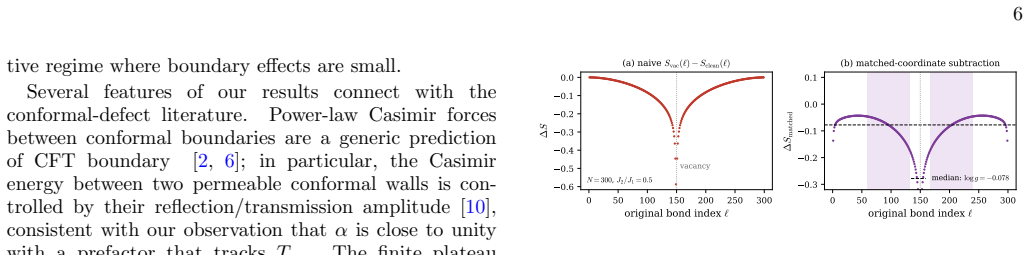
The J2 bond bridging across each vacancy (connecting sites v-1 and v+1 at original-lattice distance two) keeps the chain connected and provides the transmission channel whose strength J2 tunes. The three diagnostic observables are: the binding energy Delta_b(r) = E_2v(r) - 2*E_1v + E_0 fitted to a power law r^{-alpha}; the transmission ratio T(k) = |<sigma^x_{v-k} sigma^x_{v+k}>_vac| / |<sigma^x_{v-k} sigma^x_{v+k}>_clean| which saturates to a plateau T_infinity; and the boundary entropy log g extracted by matched-coordinate subtraction of the Calabrese-Cardy logarithm (with c=1/2 fixed, effective length N-1, and reduced bond position) from the von Neumann entanglement entropy. The critical
Load-bearing premise
The load-bearing assumption is that the bulk remains in the Ising universality class for all J2/J1 in the studied range, which licenses extending the exactly marginal defect picture from the solvable free-fermion point (J2=0) to J2 nonzero. The exactly marginal nature of the defect at J2 nonzero is not independently verified; it is inferred from the smoothness of the data and the irrelevance of J2 in the bulk. If the defect were marginally relevant rather than exactly 0 at J2
What would settle it
If the defect at J2 nonzero were marginally relevant rather than exactly marginal, the observed power-law binding energy and finite transmission plateau could be pre-asymptotic crossover effects rather than true scale-invariant behavior. A falsifying test would be to push to significantly larger system sizes or longer vacancy separations and observe a crossover away from the single power law or a drift in the transmission plateau, which would indicate the defect is not at a fixed point but flowing under renormalization.
If this is right
- If the one-parameter defect family picture is correct, then any analytical conformal defect family for the Ising universality class (such as the Roy-Saleur family) must reproduce the specific numerical relationship alpha_infinity ~ 0.41*T_infinity + 1.014 and the boundary entropy log g ~ -0.073 reported here, providing a falsifiable target for theory.
- The framework extends naturally to interacting impurities at finite density, where multiple partially transmissive defects could generate collective phenomena absent in the single-defect or dilute limit.
- The matched-coordinate subtraction method for extracting boundary entropy in the presence of a connected (non-severing) defect is a technical contribution that could be applied to other lattice defect problems where naive index-matched subtraction produces spurious cusps.
- The use of the bulk order-parameter exponent eta=1/4 as a critical-line locator in open chains, avoiding the known overestimate of the central charge from naive Calabrese-Cardy fits, provides a practical calibration protocol for DMRG studies of critical systems with defects.
Editorial analysis
A structured set of objections, weighed in public.
Referee Report
Summary. This paper uses DMRG (N up to 300, bond dimension up to 600) to study two static nonmagnetic vacancies in the critical J1-J2 transverse-field Ising chain. The critical line is located by tuning the transverse field until the bulk spin-correlator exponent eta = 1/4. Three defect observables are extracted: the vacancy-vacancy binding energy exponent alpha (found close to 1, increasing from 1.07 to 1.15 with J2), the transmission plateau T_infinity (0.11 to 0.33), and the Affleck-Ludwig boundary entropy log g (approximately -0.073, nearly constant). The authors interpret these results as evidence that the vacancy realizes a one-parameter family of partially transmissive conformal defects tuned by J2, extending the exactly marginal defect picture from the free-fermion point (J2=0) to J2 != 0.
Significance. The paper provides a careful numerical characterization of defect physics at a quantum critical point, combining three independent observables (alpha, T_infinity, log g) extracted from well-implemented DMRG. The calibration of the critical line via eta = 1/4 rather than the entanglement central charge is well-justified, including a transparent discussion of why the OBC entanglement fit is biased in this geometry. The matched-coordinate subtraction for the boundary entropy (Appendix A) addresses a real methodological subtlety. The falsifiable prediction of a smooth alpha-T_infinity relation (Fig. 5) and the specific T_infinity(J2) values constrain any future analytic mapping to a known defect family. The work is a natural extension of the authors' earlier gapped-phase study to the critical regime.
major comments (3)
- §IV, Eq. (4) and Fig. 2(b): The extrapolated alpha_infinity ranges from 1.07 to 1.15, systematically above the conformal value alpha = 1. For a genuinely conformal defect in a 1+1D CFT, the Casimir interaction between two such defects must scale as 1/r with exponent exactly 1, fixed by scale invariance alone. The smallest value (1.07 +/- 0.02 at J2/J1 = 0.1) sits roughly 3 sigma above unity. The paper acknowledges that N = 300 yields the smallest alpha at each J2, suggesting further downward drift, but the linear 1/N extrapolation does not reach 1. This systematic offset is the most concrete signal that the defect may not be exactly marginal at J2 != 0, and it is load-bearing for the central claim. The paper should either (a) attempt a more aggressive finite-size extrapolation (e.g., including subleading 1/N^2 or logarithmic corrections) or extend the fit window beyond r in [4,32] using,
- §IV: The fit window r in [4,32] spans only one decade, despite N = 300 providing data to r approximately 100. A marginally relevant defect perturbation could produce apparent power-law behavior over one decade before eventually crossing over. Extending the fit window to larger r (even if the data become noisier) would help distinguish a true power law from a pre-asymptotic crossover. If the larger-r data deviate systematically from the r in [4,32] fit, this would be important to report. The current window choice is the primary limitation on the claim of algebraic decay.
- §VII: The logical structure of the argument is made explicit — T_infinity carries the claim of a continuous family, while alpha_infinity and log g serve as consistency checks. However, the alpha > 1 offset discussed above means that one of the two consistency checks is not actually consistent with the conformal-defect prediction. The paper should clarify whether the 'one-parameter family' interpretation survives if alpha_infinity does not extrapolate to 1, or whether the claim should be weakened to 'approximately conformal' or 'pre-asymptotically conformal.'
minor comments (6)
- Abstract and Eq. (4): The linear fit alpha_infinity = 1.070 + 0.091 (J2/J1) is quoted without an intercept uncertainty. Given the scatter visible in Fig. 2(b), the reader cannot assess whether the offset above 1 is statistically significant at the level of the fit itself.
- §VI: The residual profile Delta S(ell) is described as 'not strictly flat' and retaining 'slow variation,' but no quantitative measure of this variation is given (e.g., the range of Delta S across the bulk window). Since the median is the reported quantity, a brief statement of the interquartile range would help the reader gauge the systematic uncertainty.
- Table I: The column 'c_fit' is described as biased and not used, yet it is tabulated for all 50 points. A footnote or column header note in the table itself (rather than only in the text) would prevent misinterpretation by readers who consult the table directly.
- Fig. 5 caption: The Pearson correlation r = 0.986 is reported, but as the text correctly notes, the correlation is largely a consequence of common dependence on J2. The caption could state this more prominently to avoid giving the impression of independent corroboration.
- §II: The definition of the transmission ratio T(k) in Eq. (3) uses the clean-chain correlator in the denominator. It would help to specify whether the clean-chain correlator is evaluated at the same N and same site indices, or at matched conformal coordinates (as for the entropy subtraction).
- References: The Roy-Saleur family [9] is mentioned in §VII as a candidate defect family, but no comparison of the predicted T_infinity or log g values from that family is attempted. Even a qualitative comparison would strengthen the discussion.
Simulated Author's Rebuttal
We thank the referee for a careful and constructive report. The three major comments all concern the same core issue: the systematic offset of the extrapolated Casimir exponent alpha above the conformal value of 1, and what this means for our central claim. We agree that this issue requires a more thorough treatment in the revised manuscript. Specifically, we will (1) extend the binding-energy fit window to larger r and report the results, (2) attempt a more aggressive finite-size extrapolation including subleading corrections, and (3) clarify the logical structure of the argument so that the status of alpha as a consistency check is made transparent, including an honest discussion of what survives if alpha does not extrapolate exactly to 1. We believe the core claim of a continuously tuned, approximately conformal defect family is robust, but we agree the manuscript must state more carefully what is and is not established.
read point-by-point responses
-
Referee: §IV, Eq. (4) and Fig. 2(b): The extrapolated alpha_infinity ranges from 1.07 to 1.15, systematically above the conformal value alpha = 1. For a genuinely conformal defect in a 1+1D CFT, the Casimir interaction between two such defects must scale as 1/r with exponent exactly 1, fixed by scale invariance alone. The smallest value (1.07 +/- 0.02 at J2/J1 = 0.1) sits roughly 3 sigma above unity. The paper acknowledges that N = 300 yields the smallest alpha at each J2, suggesting further downward drift, but the linear 1/N extrapolation does not reach 1. This systematic offset is the most concrete signal that the defect may not be exactly marginal at J2 != 0, and it is load-bearing for the central claim. The paper should either (a) attempt a more aggressive finite-size extrapolation (e.g., including subleading 1/N^2 or logarithmic corrections) or extend the fit window beyond r in [4,32].
Authors: The referee is correct that the alpha > 1 offset is the most serious quantitative tension with the conformal-defect interpretation, and we agree that the manuscript does not do enough to address it. We accept that a revision is needed. In the revised manuscript we will do the following: (1) We will re-examine the finite-size extrapolation by fitting alpha(N) to forms including subleading 1/N^2 corrections, and where the data quality permits, logarithmic corrections of the form expected for marginally irrelevant perturbations. The current linear 1/N extrapolation is admittedly crude given that the finite-size dependence is mild but not strictly monotonic; a more flexible fit form may well bring the intercept closer to unity. (2) We will extend the binding-energy fit window to larger r (addressed in our response to the next comment). (3) Most importantly, we will be more precise about what the alpha data do and do not establish. The referee's point that scale invariance alone fixes alpha = 1 for a genuinely conformal defect is correct in the asymptotic limit. We therefore agree that the claim should be stated as: the data are consistent with alpha approaching 1 in the thermodynamic limit, but the current system sizes do not permit a definitive resolution, and a residual offset cannot be excluded. If the offset is real, it would indicate that the defect is not exactly marginal at J2 != 0 but only approximately so, with a marginally relevant or irrelevant perturbation producing a slow crossover. We will state this explicitly. We note that the other two observables — the transmission plateau T_infinity (which saturates to a finite, J2-dependent value rather than decaying) and the boundary entropy log g (which is small and approximately constant) — are themselves consistent a revision: yes
-
Referee: §IV: The fit window r in [4,32] spans only one decade, despite N = 300 providing data to r approximately 100. A marginally relevant defect perturbation could produce apparent power-law behavior over one decade before eventually crossing over. Extending the fit window to larger r (even if the data become noisier) would help distinguish a true power law from a pre-asymptotic crossover. If the larger-r data deviate systematically from the r in [4,32] fit, this would be important to report. The current window choice is the primary limitation on the claim of algebraic decay.
Authors: This is a fair and important point. The choice of r in [4,32] was motivated by the desire for a consistent window across all (N, J2) points, including the smallest system N = 100 where r = 32 is already a substantial fraction of the chain. But the referee is correct that for N = 300, data at much larger r are available and should be examined. In the revised manuscript we will extend the fit window for the largest system sizes and report the results. Specifically, we will show fits in windows extending to r ~ 60-80 for N = 250 and N = 300, and we will report whether the effective exponent drifts downward (which would support convergence to alpha = 1), remains stable (which would support a genuine offset), or shows a crossover (which would indicate a marginally relevant perturbation). We will present these extended-window results as a new figure or table. If the larger-r data deviate systematically from the r in [4,32] fit, we will report this prominently, as the referee suggests. We agree that the current window choice is a limitation and the revised manuscript will address it directly. revision: yes
-
Referee: §VII: The logical structure of the argument is made explicit — T_infinity carries the claim of a continuous family, while alpha_infinity and log g serve as consistency checks. However, the alpha > 1 offset discussed above means that one of the two consistency checks is not actually consistent with the conformal-defect prediction. The paper should clarify whether the 'one-parameter family' interpretation survives if alpha_infinity does not extrapolate to 1, or whether the claim should be weakened to 'approximately conformal' or 'pre-asymptotically conformal.'
Authors: The referee has correctly identified a logical tension in the paper as written. We explicitly state in §VII that alpha_infinity and log g serve as consistency checks, but then one of those checks (alpha) is not fully consistent with the conformal prediction. We agree this needs to be addressed honestly. In the revised manuscript we will clarify the argument as follows. The claim of a continuous family rests primarily on T_infinity: the transmission saturates to a finite, J2-dependent plateau with 0 < T_infinity < 1, which is the hallmark of a partially transmissive defect that is neither flowing to a severed chain nor healing to a trivial defect. This observation is robust and does not depend on alpha being exactly 1. The boundary entropy log g is a genuine consistency check and is consistent: it is small, negative, and approximately constant, as expected for a strongly reflective but non-severing defect. The Casimir exponent alpha is the second consistency check, and here the situation is more nuanced. If the extended-window and improved-extrapolation analyses (see responses above) bring alpha closer to 1, the consistency is improved. If a residual offset remains, we will state plainly that this consistency check is only approximately satisfied, and we will discuss two interpretations: (a) the defect is exactly marginal but the offset is a finite-size artifact we cannot fully resolve at N = 300, or (b) the defect is approximately conformal, with a marginally relevant perturbation that is very weak over the accessible range. In case (b), the claim would be weakened to 'approximately conformal' or 'pre-asymptotically conformal,' as the referee suggests. We believe the weight of evidence — algebraic decay over a decade, finite transmission plateau, stable boundary entropy revision: yes
Circularity Check
No circularity found; derivation is self-contained with independently extracted observables
full rationale
The paper's derivation chain is non-circular. The critical line is located by an independent criterion (bulk spin-correlator exponent η=1/4), not by the defect observables. The three defect observables—Casimir exponent α, transmission plateau T∞, and boundary entropy log g—are each extracted from independent DMRG measurements (binding energies, spin correlator ratios, and entanglement entropy respectively) using separate fitting procedures. No observable is defined in terms of another. The 'one-parameter family' interpretation is grounded in external CFT results (Oshikawa-Affleck [4,5], Eisler-Peschel [23], Bachas et al. [10], Roy-Saleur [9]), not in the authors' own prior work. The sole self-citation [1] (Silva, Guimarães, Pereira) is used only for the model/vacancy definition and the binding-energy formula (Eq. 2), which are standard definitions, not load-bearing theoretical claims. The paper is notably transparent about the logical structure: it explicitly states that 'T∞ is the family parameter and carries the claim, whereas α∞ and log g∞ act as consistency checks that necessarily track it rather than as independent corroborations' (Sec. VII), and acknowledges that the α∞–T∞ correlation is 'largely a consequence of their common dependence rather than independent corroboration.' The free-fermion check at J2=0 (using exact correlation-matrix methods [21,22]) provides an external benchmark. No step reduces to its inputs by construction.
Axiom & Free-Parameter Ledger
free parameters (3)
- bc(N, J2) =
50 values in Table I, e.g., 1.1522 to 2.4675
- alpha_infinity linear fit coefficients =
1.070 + 0.091*(J2/J1)
- alpha-T correlation fit =
0.41*T + 1.014
axioms (4)
- domain assumption The bulk remains in the Ising universality class (c=1/2, eta=1/4) for all J2/J1 in [0.1,1.0] along the critical line.
- standard math A localized bond defect in the Ising universality class is exactly marginal, generating a line of conformal defects.
- domain assumption The vacancy defined by removing all J1 and J2 bonds at site v, while retaining the J2 bond bridging v-1 to v+1, is a bulk defect (not a cut).
- domain assumption The eta=1/4 criterion is a robust and unbiased locator of criticality in this open geometry.
Cite this review
Pith. "Pith review of Static vacancies as parametrized conformal defects in the critical $J_1$--$J_2$ transverse-field Ising chain." pith.science (2026). https://pith.science/paper/XKIEZWTK
@misc{pith2026260706511,
  author       = {Pith},
  title        = {Pith review of: Static vacancies as parametrized conformal defects in the critical $J_1$--$J_2$ transverse-field Ising chain},
  year         = {2026},
  howpublished = {\url{https://pith.science/paper/XKIEZWTK}},
  note         = {Machine review of arXiv:2607.06511}
}
read the original abstract
We revisit the problem of two static nonmagnetic vacancies in the transverse-field Ising chain with first- and second-neighbor couplings $J_1$ and $J_2$, now on the critical line, using density-matrix renormalization-group (DMRG) calculations in open chains of up to $N=300$ sites. In contrast to the gapped regime studied previously, where the vacancy-vacancy interaction decays exponentially, along the entire quantum critical line the interaction becomes algebraic, $|\Delta_b(r)|\sim r^{-\alpha}$, with $\alpha$ close to the universal Casimir value of unity and a weak but systematic dependence on the second-neighbor coupling, $\alpha_\infty \simeq 1.070 + 0.091\, J_2/J_1)$ across $J_2/J_1\in[0.1,1.0]$. The transmission ratio of the spin correlator across a vacancy approaches a $J_2$-dependent plateau $T_\infty(J_2)$ that grows from $0.11$ to $0.33$ over the same range, and the Affleck-Ludwig boundary entropy is small and approximately constant, $\log g_\infty \approx -0.073$, well above the Ising fixed-BC value $-\ln\sqrt{2}$ and close to the free-boundary value. The three observables vary smoothly and monotonically with $J_2$, consistent with a one-parameter family of partially transmissive conformal defects controlled by $J_2$. Throughout, the critical line is located using the bulk spin-correlator exponent $\eta=1/4$, the order-parameter exponent of the Ising universality class, which provides a robust criterion in this open geometry.
Figures


Reference graph
Works this paper leans on
-
[1]
R. L. Silva, P. R. Guimar˜ aes, and A. R. Pereira, Field- induced nonmagnetic impurities interaction in the quan- tum ising chain, Solid State Communications134, 313 (2005)
work page 2005
-
[2]
I. Affleck and A. W. W. Ludwig, Universal noninte- ger ground-state degeneracy in critical quantum systems, Physical Review Letters67, 161 (1991)
work page 1991
-
[3]
S. Eggert and I. Affleck, Magnetic impurities in half- integer-spin heisenberg antiferromagnetic chains, Phys. Rev. B46, 10866 (1992)
work page 1992
-
[4]
M. Oshikawa and I. Affleck, Defect lines in the ising model and boundary states on orbifolds, Phys. Rev. Lett. 77, 2604 (1996)
work page 1996
-
[5]
M. Oshikawa and I. Affleck, Boundary conformal field theory approach to the critical two-dimensional ising model with a defect line, Nuclear Physics B495, 533 (1997)
work page 1997
-
[6]
D. Friedan and A. Konechny, On the boundary entropy of one-dimensional quantum systems at low temperature, Physical Review Letters93, 030402 (2004)
work page 2004
-
[7]
P. Calabrese and J. Cardy, Entanglement entropy and quantum field theory, Journal of Statistical Mechanics: Theory and Experiment2004, P06002 (2004)
work page 2004
-
[8]
P. Calabrese, J. Cardy, and B. Doyon, Entanglement en- tropy in extended quantum systems, Journal of Physics A: Mathematical and Theoretical42, 500301 (2009)
work page 2009
- [9]
- [10]
- [11]
-
[12]
Krech, The casimir effect in critical systems, WORLD SCIENTIFIC eBooks 10.1142/2434 (1994)
M. Krech, The casimir effect in critical systems, WORLD SCIENTIFIC eBooks 10.1142/2434 (1994)
-
[13]
Hucht, Thermodynamic casimir effect in 4He films nearT λ: Monte carlo results, Phys
A. Hucht, Thermodynamic casimir effect in 4He films nearT λ: Monte carlo results, Phys. Rev. Lett.99, 185301 (2007)
work page 2007
-
[14]
Pfeuty, The one-dimensional ising model with a trans- verse field, Annals of Physics57, 79 (1970)
P. Pfeuty, The one-dimensional ising model with a trans- verse field, Annals of Physics57, 79 (1970)
work page 1970
- [15]
-
[16]
S. R. White, Density matrix formulation for quantum renormalization groups, Phys. Rev. Lett.69, 2863 (1992)
work page 1992
-
[17]
Schollw¨ ock, The density-matrix renormalization group, Rev
U. Schollw¨ ock, The density-matrix renormalization group, Rev. Mod. Phys.77, 259 (2005)
work page 2005
-
[18]
U. Schollw¨ ock, The density-matrix renormalization group in the age of matrix product states, Annals of Physics 326, 96 (2011)
work page 2011
-
[19]
M. Fishman, S. White, and E. M. Stoudenmire, The iten- sor software library for tensor network calculations, Sci- Post Phys. Codebases , 4 (2022)
work page 2022
-
[20]
Laflorencie, Quantum entanglement in condensed matter systems, Physics Reports646, 1 (2016)
N. Laflorencie, Quantum entanglement in condensed matter systems, Physics Reports646, 1 (2016)
work page 2016
-
[21]
I. Peschel, Calculation of reduced density matrices from correlation functions, Journal of Physics A: Mathemati- cal and General36, L205 (2003)
work page 2003
-
[22]
I. Peschel and V. Eisler, Reduced density matrices and entanglement entropy in free lattice models, Journal of Physics A: Mathematical and Theoretical42, 504003 (2009). 8
work page 2009
-
[23]
V. Eisler and I. Peschel, Entanglement in fermionic chains with interface defects, Annalen der Physik522, 679 (2010)
work page 2010
This paper was first reviewed by glm-5.2 on July 8, 2026.
discussion (0)
Sign in with ORCID, Apple, or X to comment. Anyone can read and Pith papers without signing in.