Neural-ESO: A Dual-Pathway Architecture for Provably Robust Learning-Based Control
Reviewed by Pith T0 review T1 audit T2 compute T3 formal T4 reserved 2026-07-08 02:23 UTCglm-5.2pith:7SQ5J7ZXrecord.jsonopen to challenge →

The pith
Lipschitz-Bounded Neural Nets Keep Learning-Based Robot Control Stable
A machine-rendered reading of the paper's core claim, the machinery that carries it, and where it could break.
Core claim
The paper's core discovery is that enforcing a Lipschitz bound on the neural network learning component is a sufficient condition for closed-loop stability of a learning-based observer-controller system. Specifically, the interconnection gains between the tracking-error and observer-error subsystems are shown to be proportional to the Lipschitz constant L_N of the network, so by constraining L_N via spectral normalization and selecting appropriate controller/observer gains to satisfy a small-gain inequality, the composite Lyapunov function derivative becomes negative outside a bounded region, proving UUB. This transforms the Lipschitz constant into a single tuning knob that trades learning表达
What carries the argument
The central mechanism is the dual-pathway disturbance decomposition: the total disturbance estimate is split as f_hat = f_N + Delta_f_hat, where f_N is the Lipschitz-bounded neural network prediction and Delta_f_hat is the ESO's online estimate of the residual. This decomposition ensures the tracking error is driven only by the residual estimation error, and the observer error dynamics are driven by the derivative of the residual, which is bounded via the Lipschitz property. The small-gain condition (inequalities 33) links L_N to required stabilization gains.
If this is right
- The Lipschitz constant L_N serves as a principled design parameter: decreasing it reduces required control/observer gains and improves OOD robustness, while increasing it improves in-distribution accuracy but demands higher stabilization gains.
- The dual-pathway architecture enables safe data collection in new domains: even when the neural prior is inaccurate under OOD conditions, the ESO corrective pathway maintains stability, allowing the reconstructed total disturbance to be used as a training label for domain adaptation (Total Disturbance Retraining).
- The stability guarantee holds during training transients when the neural network has not yet converged, addressing a gap in prior learning-based control methods that assume a converged model.
- The framework applies to general Euler-Lagrange systems, suggesting transferability beyond quadrotors to other robotic platforms with lumped time-varying disturbances.
Where Pith is reading between the lines
- The stability guarantee depends on the true disturbance derivative being bounded (Assumption 1), which may not hold for discontinuous aerodynamic phenomena like sudden wind gusts or sharp ground-effect transitions—this limits the class of disturbances for which the UUB guarantee is valid.
- The small-gain inequalities (33) implicitly impose an upper bound on L_N relative to the controller and observer gains; if the network requires a large Lipschitz constant to approximate a highly nonlinear disturbance, the required stabilization gains may become impractically high.
- The Total Disturbance Retraining mechanism assumes that the ESO compensation accurately reconstructs the true disturbance in the new domain; if the ESO bandwidth is insufficient for the new disturbance characteristics, the retraining labels will be noisy or biased.
- The proof structure—decomposing into ISS subsystems and bounding interconnection gains via the Lipschitz property—could potentially extend to other function approximators (e.g., Gaussian processes, kernel methods) where a Lipschitz or gradient bound is available.
Load-bearing premise
The proof requires that the time derivative of the true disturbance is bounded, which rules out discontinuous disturbances such as sudden wind gusts or abrupt aerodynamic transitions. If the real disturbance changes faster than this bound allows, the observer's input-to-state stability breaks down and the UUB guarantee no longer holds.
What would settle it
Deploy the Neural-ESO on a system where the disturbance derivative exceeds the assumed bound L_1 (e.g., a quadrotor encountering a sharp wind gust or ground-effect discontinuity), and verify whether the closed-loop error exceeds the predicted UUB bound or becomes unstable.
Figures


read the original abstract
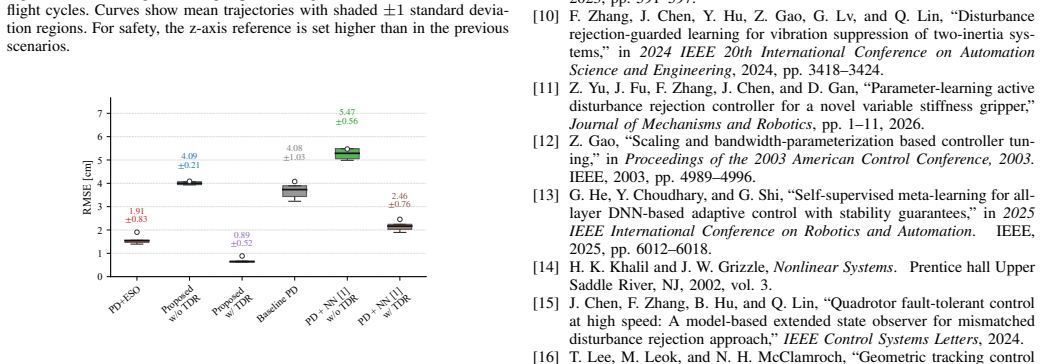
A learning-enabled disturbance-rejection framework based on a Neural Extended State Observer (Neural-ESO) is presented in this letter. Unlike existing learning-based control methods that largely rely on the learned model once deployed, Neural-ESO adopts a dual-pathway architecture: a predictive pathway uses a neural network to provide a feedforward disturbance estimate that accelerates convergence, while a corrective pathway employs a conventional ESO to compensate prediction errors and prevent over-reliance on the neural component. Using Lyapunov theory and a small-gain analysis, we show that enforcing a Lipschitz bound on the learning component guarantees uniform ultimate boundedness of the closed-loop error dynamics. The proposed framework is validated on a quadrotor landing task subject to strong ground-effect disturbances across normal and out-of-distribution scenarios, demonstrating accuracy-robustness trade-off and greater operational reliability during training, deployment, and transfer compared with state-of-the-art baselines.
Editorial analysis
A structured set of objections, weighed in public.
Referee Report
Summary. This letter proposes Neural-ESO, a dual-pathway disturbance-rejection architecture combining a Lipschitz-bounded neural network feedforward pathway with a conventional ESO corrective pathway. The authors derive a UUB stability guarantee via composite Lyapunov analysis and a small-gain condition, showing that the Lipschitz constant L_N governs the interconnection gain between tracking and observer error subsystems. The framework is validated on a quadrotor landing task under ground-effect disturbances, including in-distribution, OOD, and high-speed maneuver scenarios, with comparisons against PD, PD+ESO, PD+NN, and a neural-observer baseline. Code and data are publicly available.
Significance. The paper makes a solid contribution by providing an explicit, falsifiable connection between the neural network Lipschitz constant and closed-loop stability requirements via a small-gain condition (Eq. 33). The dual-pathway architecture is well-motivated, and the total disturbance retraining (TDR) mechanism for OOD adaptation is a practical and interesting design choice. The release of reproducible code and example datasets is a notable strength. The experimental validation across three scenarios with statistical reporting (5 trials each) and an ablation on L_N provides concrete evidence for the accuracy-robustness trade-off. The stability analysis correctly leverages standard tools (ISS, Young's inequality) and the interconnection gain quantification in Lemma 1 is clean.
major comments (2)
- §IV.D, Theorem 1 statement: The theorem states that UUB follows from Assumptions 1–3 and an L_N-Lipschitz network, but the proof derives an explicit small-gain condition (Eq. 33: λ_e > δ_e + c_o and λ_o > ε_o + c_e) that is not included in the theorem's hypotheses. Since c_o and ε_o both depend on L_N (through γ_e and γ_˜e), and the dissipation terms λ_e, λ_o depend on the control and observer gains, the small-gain condition is an additional load-bearing requirement beyond the Lipschitz bound alone. The theorem statement should be revised to explicitly include the small-gain condition (Eq. 33) as a hypothesis, or the proof should demonstrate that the condition is automatically satisfied for any choice of L_N and gains. As stated, the claim that enforcing a Lipschitz bound is 'sufficient' for UUB is only true conditional on the small-gain inequalities holding.
- §IV.D, after Eq. (33): The paper asserts that 'the gains can be selected to satisfy the above bounds without requiring either high-gain control or high-gain observer,' but provides no constructive proof of existence, no numerical verification for the experimental quadrotor system, and no explicit relationship between L_N and the minimum required gains. This matters because the central sufficiency claim depends on the feasibility of satisfying Eq. (33). The experimental results in Table III (L_N = 2.0 causes instability) are consistent with the small-gain condition being violated, but the paper does not confirm that L_N = 1.0 actually satisfies it for the deployed gains (k_p, k_d, ω_o). Adding a numerical check—computing the terms in Eq. (33) for the experimental parameters—would substantially strengthen the claim and close the gap between theory and experiment.
minor comments (6)
- §IV.C, Eq. (22): The term λ_c is defined as obtained from control gains satisfying ||k_p e|| + ||k_d ė|| ≤ λ_c ||e_state||, but the explicit expression for λ_c in terms of k_p and k_d is not given. Providing this would aid reproducibility.
- §IV.D, Eq. (32): The notation ε_o is introduced as 2c_pb γ_˜e + δ_o + δ_c, but the symbol ε_o does not appear in the final small-gain condition (33) in a way that makes the correspondence with λ_o > ε_o + c_e immediately clear. A brief clarifying sentence would help readers follow the derivation.
- §V.F, Table III: The caption states results are across 5 trials, but the table does not specify which rows correspond to the nominal setup versus the OOD setup. Adding row labels or splitting the table would improve clarity.
- §III.A.2: The network architecture is described as 4 fully connected layers with dimensions 5→20→25→10→1, but the input vector z_k in §V.C has 6 components (q_k, q̇_k, T_{k-1}, ϕ_k, θ_k). This discrepancy should be clarified—either the architecture description or the input dimension is incorrect.
- §II.B, Eq. (6): The observer gains β_1, β_2, β_3 are stated to be chosen as diagonal matrices with eigenvalues at −ω_o, but the specific relationship between β_i and ω_o (e.g., β_1 = 3ω_o, β_2 = 3ω_o², β_3 = ω_o³ for a third-order ESO) is not given. Specifying this would aid reproducibility.
- The video and code links in the abstract are a valuable addition. For the final version, please ensure the repository includes the specific L_N values and observer bandwidth ω_o used in experiments.
Simulated Author's Rebuttal
We thank the referee for the careful reading and constructive feedback. Both major comments are well-taken and identify genuine gaps between the theorem statement and the proof, and between theory and experiment. We will revise the manuscript accordingly.
read point-by-point responses
-
Referee: §IV.D, Theorem 1 statement: The theorem states that UUB follows from Assumptions 1–3 and an L_N-Lipschitz network, but the proof derives an explicit small-gain condition (Eq. 33) that is not included in the theorem's hypotheses. The theorem statement should be revised to explicitly include the small-gain condition as a hypothesis.
Authors: The referee is correct. The small-gain inequalities in Eq. (33) — namely λ_e > δ_e + c_o and λ_o > ε_o + c_e — are load-bearing requirements in the proof: they ensure that the composite Lyapunov derivative is negative definite outside a bounded region. As the referee notes, c_o and ε_o both depend on L_N (through γ_e and γ_˜e), so the small-gain condition is not automatically satisfied by the Lipschitz bound alone; it also constrains the control and observer gains. The current theorem statement is therefore imprecise in claiming that the Lipschitz bound alone is 'sufficient' for UUB. We will revise Theorem 1 to explicitly include the small-gain condition (Eq. 33) as a hypothesis. The revised statement will read approximately as: 'Given Assumptions 1–3, an L_N-Lipschitz network f_N(z), and control/observer gains satisfying the small-gain condition (33), the closed-loop error state E is UUB.' We will also adjust the surrounding text (including the abstract and contributions) to state that the Lipschitz bound is necessary but not alone sufficient — it must be paired with gains satisfying the small-gain inequalities. This is a correction of the theorem statement, not a change to the proof itself, which already derives and uses Eq. (33). revision: yes
-
Referee: §IV.D, after Eq. (33): The paper asserts that gains can be selected to satisfy the bounds without high-gain control or observer, but provides no constructive proof, no numerical verification for the experimental quadrotor, and no explicit relationship between L_N and minimum required gains. Adding a numerical check computing the terms in Eq. (33) for the experimental parameters would strengthen the claim.
Authors: The referee raises a valid point. The assertion that the small-gain condition is feasible 'without requiring either high-gain control or high-gain observer' is currently unsupported by either a constructive argument or numerical verification. We agree that this gap should be addressed. In the revision, we will take the following steps: (1) We will add a numerical computation of the terms in Eq. (33) using the experimental quadrotor parameters (mass m_v, control gains k_p, k_d, observer bandwidth ω_o, and the trained network's L_N = 1.0) to verify that the small-gain inequalities are satisfied for the deployed configuration. This involves computing λ_e = λ_min(Q_e), λ_o = λ_min(Q_obs), and the interconnection gains c_o, c_e, ε_o, δ_e from the Lyapunov equation solutions and the expressions in the proof. (2) We will also compute these terms for L_N = 2.0 (which caused instability in Table III) to check whether the small-gain condition is violated, providing a concrete link between the theoretical condition and the experimental observation. (3) We will soften the claim about 'not requiring high-gain control or observer' to a more precise statement: the small-gain condition can be satisfied with moderate gains for sufficiently small L_N, and we will report the specific numerical margins for our system. We acknowledge that we cannot provide a fully constructive proof of gain feasibility for arbitrary systems and arbitrary L_N — the feasibility depends on system-specific quantities. The numerical verification for our experimental platform is the most honest and useful contribution we can make here. revision: yes
Circularity Check
No significant circularity; stability proof uses standard Lyapunov/small-gain theory with no self-citation chain.
full rationale
The paper's central claim — that a Lipschitz-bounded neural network preserves UUB closed-loop stability — is derived from standard, self-contained Lyapunov analysis and small-gain arguments (Khalil [14]). The proof chain proceeds through independently verifiable steps: (1) tracking error dynamics (Eq. 12) and observer error dynamics (Eq. 16) are derived from the system equations; (2) the interconnection gain is bounded in Lemma 1 (Eq. 18) using the Lipschitz property and Assumptions 1-3; (3) the composite Lyapunov analysis (Eqs. 24-34) applies standard ISS and Young's inequality to establish UUB conditional on the small-gain condition (Eq. 33). No step reduces to its inputs by construction. The Lipschitz constant L_N is a design parameter, not a fitted value renamed as a prediction. Self-citations ([10], [11], [15]) are to prior experimental/applicational work and are not load-bearing for the proof. The small-gain condition (Eq. 33) is an explicit requirement, not assumed away. The skeptic's concern about whether Eq. 33 is satisfiable for the experimental system is a correctness/completeness issue, not a circularity issue — the paper does not hide the condition or derive it from itself. The derivation is self-contained against external mathematical benchmarks (standard Lyapunov theory, Khalil textbook). Score 1 reflects one minor self-citation ([10]) that is not load-bearing for the central theoretical claim.
Axiom & Free-Parameter Ledger
free parameters (3)
- L_N (Lipschitz constant) =
1.0
- Observer gains (beta_1, beta_2, beta_3) =
N/A (tuned)
- PD gains (k_p, k_d) =
N/A (tuned)
axioms (3)
- domain assumption The derivative of the true disturbance is bounded: ||f_dot|| <= L_1.
- domain assumption The derivative of the control input is bounded: ||u_dot(t)|| <= L_u.
- standard math The desired reference trajectory and its derivatives are bounded.
Reference graph
Works this paper leans on
-
[1]
Neural lander: Stable drone landing control using learned dynamics,
G. Shi, X. Shi, M. O’Connell, R. Yu, K. Azizzadenesheli, A. Anand- kumar, Y . Yue, and S.-J. Chung, “Neural lander: Stable drone landing control using learned dynamics,” in2019 International Conference on Robotics and Automation, 2019, pp. 9784–9790
work page 2019
-
[2]
Neural-fly enables rapid learning for agile flight in strong winds,
M. O’Connell, G. Shi, X. Shi, K. Azizzadenesheli, A. Anandkumar, Y . Yue, and S.-J. Chung, “Neural-fly enables rapid learning for agile flight in strong winds,”Science Robotics, vol. 7, no. 66, p. eabm6597, 2022
work page 2022
-
[3]
Neurobem: Hybrid aerodynamic quadrotor model,
L. Bauersfeld, E. Kaufmann, P. Foehn, S. Sun, and D. Scaramuzza, “Neurobem: Hybrid aerodynamic quadrotor model,”Proceedings of Robotics: Science and Systems XVII, p. 42, 2021
work page 2021
-
[4]
Safe learning in robotics: From learning-based control to safe reinforcement learning,
L. Brunke, M. Greeff, A. W. Hall, Z. Yuan, S. Zhou, J. Panerati, and A. P. Schoellig, “Safe learning in robotics: From learning-based control to safe reinforcement learning,”Annual Review of Control, Robotics, and Autonomous Systems, vol. 5, no. 1, pp. 411–444, 2022
work page 2022
-
[5]
C. Dawson, S. Gao, and C. Fan, “Safe control with learned certificates: A survey of neural Lyapunov, barrier, and contraction methods for robotics and control,”IEEE Transactions on Robotics, vol. 39, no. 3, pp. 1749– 1767, 2023
work page 2023
-
[6]
An active disturbance rejection control solution for the two-mass-spring benchmark problem,
H. Zhang, S. Zhao, and Z. Gao, “An active disturbance rejection control solution for the two-mass-spring benchmark problem,” in2016 American Control Conference. IEEE, 2016, pp. 1566–1571
work page 2016
-
[7]
From PID to active disturbance rejection control,
J. Han, “From PID to active disturbance rejection control,”IEEE Transactions on Industrial Electronics, vol. 56, no. 3, pp. 900–906, 2009
work page 2009
-
[8]
Cascade ADRC with neural network-based ESO for hypersonic vehicle,
L. Liu, Y . Liu, L. Zhou, B. Wang, Z. Cheng, and H. Fan, “Cascade ADRC with neural network-based ESO for hypersonic vehicle,”Journal of the Franklin Institute, vol. 360, no. 12, pp. 9115–9138, 2023
work page 2023
-
[9]
T. Li, A. Badre, H. D. Taghirad, and M. Tavakoli, “Neural network learning of robot dynamic uncertainties and observer-based external disturbance estimation for impedance control,” in2023 IEEE/ASME International Conference on Advanced Intelligent Mechatronics. IEEE, 2023, pp. 591–597
work page 2023
-
[10]
Disturbance rejection-guarded learning for vibration suppression of two-inertia sys- tems,
F. Zhang, J. Chen, Y . Hu, Z. Gao, G. Lv, and Q. Lin, “Disturbance rejection-guarded learning for vibration suppression of two-inertia sys- tems,” in2024 IEEE 20th International Conference on Automation Science and Engineering, 2024, pp. 3418–3424
work page 2024
-
[11]
Parameter-learning active disturbance rejection controller for a novel variable stiffness gripper,
Z. Yu, J. Fu, F. Zhang, J. Chen, and D. Gan, “Parameter-learning active disturbance rejection controller for a novel variable stiffness gripper,” Journal of Mechanisms and Robotics, pp. 1–11, 2026
work page 2026
-
[12]
Scaling and bandwidth-parameterization based controller tun- ing,
Z. Gao, “Scaling and bandwidth-parameterization based controller tun- ing,” inProceedings of the 2003 American Control Conference, 2003. IEEE, 2003, pp. 4989–4996
work page 2003
-
[13]
Self-supervised meta-learning for all- layer DNN-based adaptive control with stability guarantees,
G. He, Y . Choudhary, and G. Shi, “Self-supervised meta-learning for all- layer DNN-based adaptive control with stability guarantees,” in2025 IEEE International Conference on Robotics and Automation. IEEE, 2025, pp. 6012–6018
work page 2025
-
[14]
H. K. Khalil and J. W. Grizzle,Nonlinear Systems. Prentice hall Upper Saddle River, NJ, 2002, vol. 3
work page 2002
-
[15]
J. Chen, F. Zhang, B. Hu, and Q. Lin, “Quadrotor fault-tolerant control at high speed: A model-based extended state observer for mismatched disturbance rejection approach,”IEEE Control Systems Letters, 2024
work page 2024
-
[16]
Geometric tracking control of a quadrotor UA V on SE(3),
T. Lee, M. Leok, and N. H. McClamroch, “Geometric tracking control of a quadrotor UA V on SE(3),” in49th IEEE Conference on Decision and Control. IEEE, 2010, pp. 5420–5425
work page 2010
discussion (0)
Sign in with ORCID, Apple, or X to comment. Anyone can read and Pith papers without signing in.