REVIEW 2 major objections 5 minor 61 references
A short electric pulse permanently restructures the shear of a cyclotron trajectory bundle, encoding memory without changing focusing times.
Reviewed by Pith at T0; open to challenge. T0 means a machine referee read the full paper against a public rubric. the ladder, T0–T4 →
T0 review · grok-4.5
2026-07-11 06:30 UTC pith:FFGO2TU3
load-bearing objection Clean application of classical ESR kinematics to a known cyclotron pulse memory; shear carries a permanent phase rotation while focusing does not, under idealized rectangular homogeneous E. the 2 major comments →
Memory-like effects and kinematics of trajectories in Cyclotron motion
The pith
A machine-rendered reading of the paper's core claim, the machinery that carries it, and where it could break.
Core claim
The geometric imprint of a short electric pulse on a congruence of cyclotron trajectories survives after the pulse vanishes and is carried entirely by a permanent restructuring of the shear components. Explicitly, the complex shear transforms as Σ_after(t) = Σ_before(t) e^{i θ_D}, where the dynamical phase θ_D is proportional to the integrated electric-field strength and equals the oriented area swept by the guiding-center displacement. Expansion and rotation are essentially unaffected, so focusing times remain unchanged; the memory resides only in the shear sector and is equivalent to a large gauge transformation of the vector potential.
What carries the argument
The ESR (expansion-shear-rotation) decomposition of the velocity-gradient tensor for a two-dimensional trajectory congruence, specialized to pure magnetic cyclotron motion and matched across a rectangular electric pulse. The complex shear Σ = σ_{+} + i σ× then evolves by a pure phase rotation once the pulse ends.
Load-bearing premise
The electric pulse is taken to be perfectly uniform in space and strictly rectangular in time, so that its only lasting effect is a pure guiding-center drift that can be absorbed into a single dynamical phase.
What would settle it
In a low-energy cyclotron or modified Penning trap, prepare a localized bunch with known initial ESR values, apply a single timed transverse electric pulse, and stroboscopically record the beam's transverse aspect ratio and orientation once per cyclotron period before and after the pulse; extract the denominator constants C and D of the rational-trigonometric shear fit in each region. Absence of the predicted permanent shift (C,D)_I o (C,D)_III, or appearance of an expansion-driven change in focusing time, would falsify the claim.
If this is right
- Memory of a transient electric kick can be read out from beam-envelope ellipticity and orientation rather than from focal-plane locations.
- The same shear-phase diagnostic can be used to program or detect caustics by deliberately tuning the initial invariant I across zero.
- Electromagnetic memory in cyclotron systems appears as a permanent phase-space timing shift, the direct analogue of gravitational velocity memory.
- Large gauge transformations generated by the pulse become experimentally accessible through the measurable rotation of the shear vector.
Where Pith is reading between the lines
- If the pulse acquires a mild spatial gradient, residual expansion terms should appear; their absence or presence would cleanly separate pure shear memory from focusing memory.
- The quarter-period phase lock between σ_{+} and σ× that survives the pulse offers a continuous, non-destructive monitor of beam health in storage rings.
- Extending the congruence analysis to relativistic cyclotron orbits would test whether the same dynamical-phase memory persists when radiation reaction is non-negligible.
Editorial analysis
A structured set of objections, weighed in public.
Referee Report
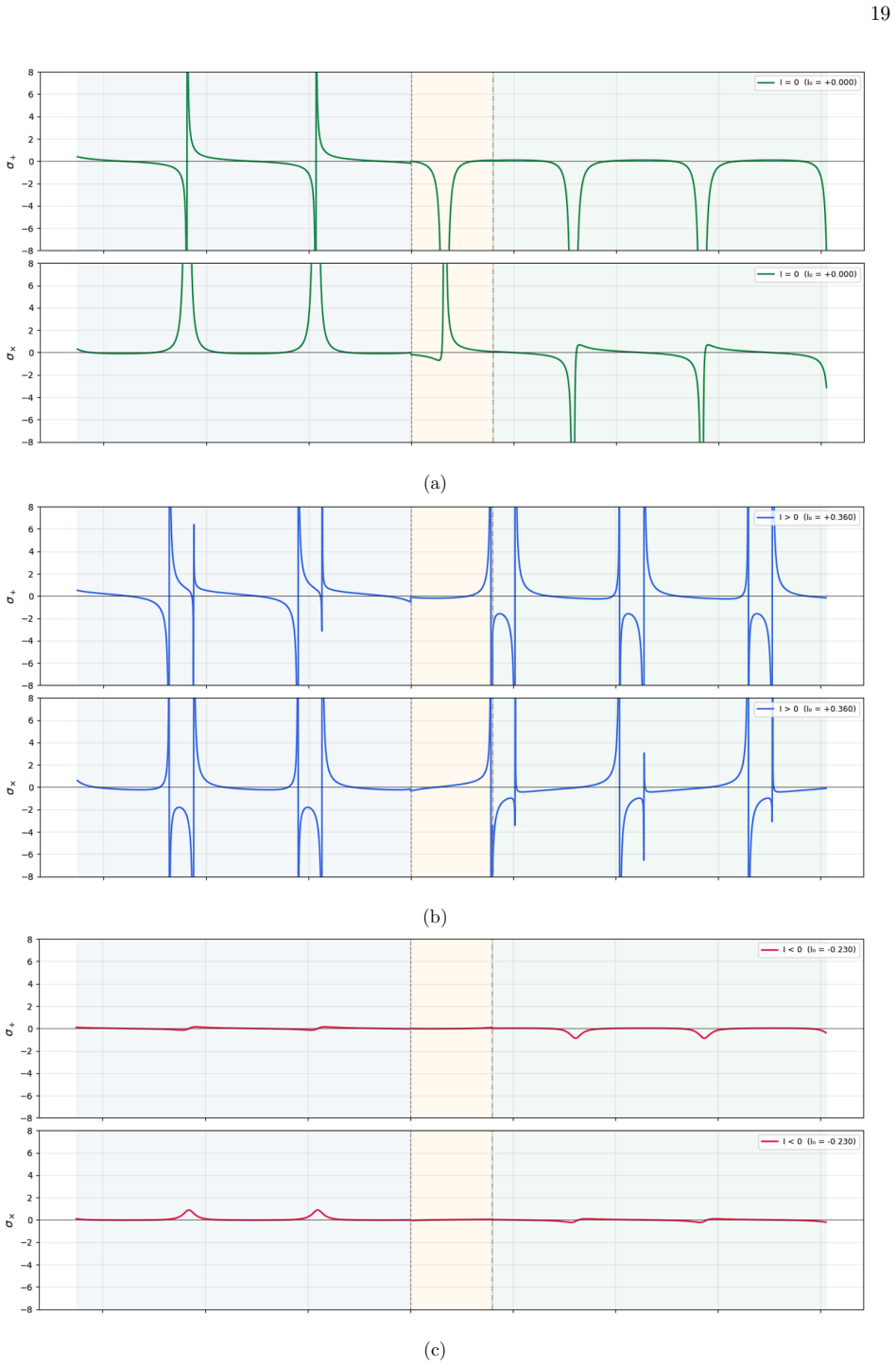
Summary. The paper studies a congruence of charged-particle trajectories in a uniform magnetic field subjected to a short, spatially homogeneous rectangular electric pulse. Using the two-dimensional ESR (expansion–shear–rotation) formalism of classical trajectory congruences, the authors solve the Raychaudhuri-type equations in the three temporal regions (pre-pulse, during-pulse, post-pulse) for the three signs of the invariant I = σ₊^{2} + σ×^{2} − ω̄^{2}. They show that the focusing time of the pure-magnetic congruence is unaffected by the pulse history once the kinematic initial data at the start of each region are fixed, while the complex shear Σ = σ₊ + i σ× acquires a permanent phase rotation Σ_after(t) = Σ_before(t) e^{i θ_D}, where the dynamical phase θ_D is proportional to the integrated pulse strength and is equivalent to a large gauge transformation of the vector potential. Analytic solutions are supplemented by rational-trigonometric regression on synthetic data that recovers R^{2} = 1 when no focusing singularity lies inside the fitting window, and by a discussion of possible laboratory signatures in beam-envelope observables.
Significance. If the derivation holds under the stated idealizations, the work supplies a clean classical-mechanical illustration of a memory-like effect that is carried by shear rather than by focusing, thereby complementing the gravitational-wave and electromagnetic-memory literature. The closed-form ESR solutions for pure cyclotron motion, the explicit map from guiding-center drift to a dynamical phase, and the regression verification of the analytic constants are concrete, reproducible contributions. The proposed experimental translation (turn-by-turn aspect-ratio and orientation measurements in a Penning trap or storage ring) is falsifiable and therefore useful even if the idealized rectangular-pulse assumption must later be relaxed.
major comments (2)
- Section V.A–B and Eqs. (52)–(55): the identification Σ_after = Σ_before e^{i θ_D} is derived under the assumption that the pulse leaves the denominator D(t) (and therefore the invariant I and the expansion) unchanged up to a redefinition of constants. While this is correct for a spatially homogeneous rectangular pulse, the manuscript never demonstrates that the same phase-only restructuring survives when the electric field has a realistic spatial gradient or a non-rectangular envelope. A short calculation or numerical example with a smooth, localized pulse would establish whether the memory remains purely shear-phase or acquires additional expansion/shear source terms; without it the central claim is limited to an idealized model that the authors themselves flag but do not stress-test.
- Section IV.B and Figs. 9–11: the regression analysis is performed exclusively on synthetic data generated from the same closed-form solutions that are being verified. Consequently R^{2} = 1 (or catastrophic failure at a known singularity) is a consistency check rather than an independent validation. The experimental proposal in the same subsection is therefore essential; the manuscript should either (i) supply a concrete numerical protocol that could be applied to real beam-profile data or (ii) clearly label the regression as a self-consistency diagnostic so that readers do not over-interpret its confirmatory power.
minor comments (5)
- Eqs. (31)–(38): the constants C, D, E, F, G are written with slightly different normalizations for I > 0 and I < 0; a single table collecting all three cases would improve readability.
- Figure 8 caption and surrounding text: the claimed interchange “σ₊ (Region I) ~ σ× (Region III) with a sign flip” is visible by eye but never quantified; a short statement of the residual phase offset after the pulse would make the visual claim precise.
- Section III.A: the redefinition ω̄ = ω − ω_c/2 is introduced without a sentence explaining why the cyclotron contribution is subtracted; a one-line remark would help non-specialist readers.
- References: the arXiv preprint [50] that first noted the single-particle memory-like effect is cited, but a brief comparison of the single-particle versus congruence viewpoints would clarify the incremental contribution of the present work.
- Typographical: “amemory-likeobservable” (p. 3), “eletric” (p. 3), and occasional missing spaces around equation numbers should be corrected.
Circularity Check
No significant circularity: analytic ESR solutions and dynamical-phase rotation of complex shear follow from Lorentz force + velocity-gradient definitions; regression is a consistency check on synthetic data generated from those same closed forms.
specific steps
-
self citation load bearing
[Sec. II (ESR setup) and Sec. IV B (regression)]
"the formalism developed in [48], especially for classical dynamics, offers a systematic framework… To rigorously verify that the numerically computed shear variables σ_{+} and σ imes are consistent with the analytic ESR solution, we employ a rational-trigonometric regression model."
The kinematic decomposition and Raychaudhuri-type equations are taken from the authors’ prior ESR paper [48]. The regression is then run on synthetic data generated from the closed-form solutions of those same equations, so the perfect R^{2} merely reconfirms the analytic expressions already used to produce the data. The circularity is minor: the memory claim itself (phase rotation of Σ) is derived independently from the Lorentz force and does not rest on the regression.
full rationale
The derivation chain is self-contained. The ESR evolution equations (9–12) and their pure-magnetic specializations (27–30) are obtained from the convective derivative of the velocity-gradient tensor B^i_j = abla_j u^i together with the Lorentz force; the three closed-form solution families (31, 34, 36) follow by direct integration once the invariant I is fixed. The pulse enters only by resetting the initial data at the boundaries of Region II; the post-pulse complex shear is then shown to equal the pre-pulse shear multiplied by a pure phase e^{i heta_D} whose value is computed from the guiding-center drift (52–55). That identity is an algebraic consequence of the solutions, not an input. The rational-trigonometric regression is performed on synthetic trajectories generated from the same closed forms and is therefore a numerical consistency check (R^{2} = 1 when no singularity lies inside the window), not an independent prediction. Self-citations to the ESR framework [48] and to Kar’s single-particle memory paper [50] supply the geometric language and the single-orbit observation, but the multi-trajectory calculation and the shear-phase result are derived afresh. No fitted parameter is later re-labeled a prediction, and no uniqueness theorem is imported to forbid alternatives. Score 1 reflects only the minor, non-load-bearing self-citation of the ESR setup.
Axiom & Free-Parameter Ledger
axioms (3)
- domain assumption Lorentz force law for a charged particle in uniform B and a spatially homogeneous rectangular E pulse (Eqs. 22–26).
- standard math Decomposition of the velocity-gradient tensor B^i_j into expansion, shear and rotation (Eqs. 4–8) and the resulting classical Raychaudhuri system (Eqs. 9–12).
- standard math The invariant I = σ₊^{2} + σ×^{2} − ω̄^{2} controls focusing and remains constant in pure magnetic field.
invented entities (1)
-
complex shear Σ = σ₊ + i σ× and dynamical phase heta_D
no independent evidence
read the original abstract
We investigate the collective dynamics of a bundle of charged particles undergoing cyclotron motion in a uniform magnetic field when subjected to a short-duration electric pulse. Using the geometric framework based on the evolution of trajectory congruences, we analyze how the pulse affects the expansion, shear, and rotation of a small family of trajectories. We show that the geometric imprint persists after the pulse has vanished, manifesting as a memory of the transient perturbation. Unlike gravitational memory effects, this does not manifest itself in focusing behaviour of the trajectories, and instead implies a restructuring of the shear component before and after the pulse. We offer direct analytic and regression based arguments for the same.
Figures




Reference graph
Works this paper leans on
-
[1]
Case 1:I >0 The solutions for ESR variables in this case reads: θ(t) = ωc √ 1 +C 2 cos(ωct+D) C+ √ 1 +C 2 sin(ωct+D) , σ+(t) = Esin(ω ct) +Fcos(ω ct) C+ √ 1 +C 2 sin(ωct+D) , σ×(t) = Ecos(ω ct)−Fsin(ω ct) C+ √ 1 +C 2 sin(ωct+D) , ω(t) = ωc 2 + G C+ √ 1 +C 2 sin(ωct+D) ,(31) 11 with constants depending on initial values: C= √I0 ωc −1 + θ2 0 4I0 + ω2 c 4I0 ...
-
[2]
Thus, focusing occurs at finite time for the marginal case as well
Case 2:I= 0 In this case, solutions are: θ(t) =ω c tan ωc C− t 2 , σ+(t) = sec2 ωc C− t 2 Esin(ω ct) +Fcos(ω ct) , σ×(t) = sec2 ωc C− t 2 Ecos(ω ct)−Fsin(ω ct) , ω(t) = ωc 2 +Gsec 2 ωc C− t 2 ,(34) where C= 1 ωc tan−1 θ0 ωc ,{E, F, G}= {σ+0, σ ×0, ω 0 −ω c/2} 1 + (θ0/ωc)2 .(35) These functions diverge at a time when tf = 2C+ (2n+ 1)π ωc , n∈Z. Thus, focus...
-
[3]
Therefore, the denominator of ESR variables never vanish, and the trajectories never meet at a finite time
Case 3:I <0 Solutions in this case mirrors the ones in the Case 1, with some juxtaposition: θ(t) = ωcCcos(ω ct+D)√ 1 +C 2 +Csin(ω ct+D) , σ+(t) = Esin(ω ct) +Fcos(ω ct)√ 1 +C 2 +Csin(ω ct+D) , σ×(t) = Ecos(ω ct)−Fsin(ω ct)√ 1 +C 2 +Csin(ω ct+D) , ω(t) = ωc 2 + G√ 1 +C 2 +Csin(ω ct+D) ,(36) However with some different constants: C= s − I0 ω2c 1− θ2 0 4I0 −...
-
[4]
The electric pulse thus influences the focusing time only indirectly, through its effect on the initial values at the moment of injection
This universality means that, once the initial kinematic variables are fixed, the subsequent focusing behavior depends only on the magnetic field strength, not on the detailed history of how those initial conditions were produced. The electric pulse thus influences the focusing time only indirectly, through its effect on the initial values at the moment o...
-
[5]
Y. B. Zel’dovich and A. G. Polnarev. Radiation of gravitational waves by a cluster of superdense stars. Sov. Astron., 18:17, 1974
1974
-
[6]
V. B. Braginsky and L. P. Grishchuk. Kinematic Resonance and Memory Effect in Free Mass Gravitational Antennas.Sov. Phys. JETP, 62:427–430, 1985
1985
-
[7]
Christodoulou
D. Christodoulou. Nonlinear nature of gravitation and gravitational wave experiments.Phys. Rev. Lett., 67:1486–1489, 1991
1991
-
[8]
Perturbative and gauge invariant treatment of gravitational wave memory
Lydia Bieri and David Garfinkle. Perturbative and gauge invariant treatment of gravitational wave memory. Phys. Rev. D, 89:084039, Apr 2014
2014
-
[9]
Alexander Tolish, Lydia Bieri, David Garfinkle, and Robert M. Wald. Examination of a simple example of gravitational wave memory.Phys. Rev. D, 90:044060, Aug 2014
2014
-
[10]
Alexander Tolish and Robert M. Wald. Retarded Fields of Null Particles and the Memory Effect.Phys. Rev. D, 89(6):064008, 2014
2014
-
[11]
The sky pattern of the linearized gravitational memory effect.Class
Thomas M¨ adler and Jeffrey Winicour. The sky pattern of the linearized gravitational memory effect.Class. Quant. Grav., 33(17):175006, 2016
2016
-
[12]
Radiation Memory, Boosted Schwarzschild Spacetimes and Super- translations.Class
Thomas M¨ adler and Jeffrey Winicour. Radiation Memory, Boosted Schwarzschild Spacetimes and Super- translations.Class. Quant. Grav., 34(11):115009, 2017
2017
-
[13]
Gravitational Memory, BMS Supertranslations and Soft Theorems.JHEP, 01:086, 2016
Andrew Strominger and Alexander Zhiboedov. Gravitational Memory, BMS Supertranslations and Soft Theorems.JHEP, 01:086, 2016
2016
-
[14]
Princeton University Press, 2018
Andrew Strominger.Lectures on the Infrared Structure of Gravity and Gauge Theory. Princeton University Press, 2018. 29
2018
-
[15]
M Zhang, C
P. M Zhang, C. Duval, G. W. Gibbons, and P. A. Horvathy. The Memory Effect for Plane Gravitational Waves.Phys. Lett. B, 772:743–746, 2017
2017
-
[16]
P. M. Zhang, C. Duval, G. W. Gibbons, and P. A. Horvathy. Soft gravitons and the memory effect for plane gravitational waves.Phys. Rev. D, 96(6):064013, 2017
2017
-
[17]
P. M. Zhang, C. Duval, and P. A. Horvathy. Memory effect for impulsive gravitational waves.Class. Quant. Grav., 35(6):065011, 2018
2018
-
[18]
P. M. Zhang, C. Duval, G. W. Gibbons, and P. A. Horvathy. Velocity Memory Effect for Polarized Gravitational Waves.JCAP, 05:030, 2018
2018
-
[19]
P. M. Zhang, M. Elbistan, G. W. Gibbons, and P. A. Horvathy. Sturm–Liouville and Carroll: at the heart of the memory effect.Gen. Rel. Grav., 50(9):107, 2018
2018
-
[20]
Graham M. Shore. Memory, Penrose Limits and the Geometry of Gravitational Shockwaves and Gyratons. JHEP, 12:133, 2018
2018
-
[21]
Flanagan, Alexander M
´Eanna ´E. Flanagan, Alexander M. Grant, Abraham I. Harte, and David A. Nichols. Persistent gravitational wave observables: Nonlinear plane wave spacetimes.Phys. Rev. D, 101(10):104033, 2020
2020
-
[22]
Geodesic congruences, impulsive gravitational waves and gravitational memory.Phys
Martin O’Loughlin and Hovhannes Demirchian. Geodesic congruences, impulsive gravitational waves and gravitational memory.Phys. Rev. D, 99(2):024031, 2019
2019
-
[23]
Geodesic congruences in exact plane wave spacetimes and the memory effect.Phys
Indranil Chakraborty and Sayan Kar. Geodesic congruences in exact plane wave spacetimes and the memory effect.Phys. Rev. D, 101(6):064022, 2020
2020
-
[24]
Memory effects in Kundt wave spacetimes.Phys
Indranil Chakraborty and Sayan Kar. Memory effects in Kundt wave spacetimes.Phys. Lett. B, 808:135611, 2020
2020
-
[25]
Kundt geometries and memory effects in the Brans-Dicke theory of gravity.Eur
Siddhant Siddhant, Indranil Chakraborty, and Sayan Kar. Kundt geometries and memory effects in the Brans-Dicke theory of gravity.Eur. Phys. J. C, 81(4):350, 2021
2021
-
[26]
Divakarla and Bernard F
Atul K. Divakarla and Bernard F. Whiting. First-order velocity memory effect from compact binary coalescing sources.Phys. Rev. D, 104(6):064001, 2021
2021
-
[27]
A simple analytic example of the gravitational wave memory effect
Indranil Chakraborty and Sayan Kar. A simple analytic example of the gravitational wave memory effect. The European Physical Journal Plus, 137(4):1–14, 2022
2022
-
[28]
Memory effect of the pp waves with torsion.Eur
Branislav Cvetkovi´ c and Dejan Simi´ c. Memory effect of the pp waves with torsion.Eur. Phys. J. C, 82(2):127, 2022
2022
-
[29]
Grant and David A
Alexander M. Grant and David A. Nichols. Persistent gravitational wave observables: Curve deviation in asymptotically flat spacetimes.Phys. Rev. D, 105(2):024056, 2022. [Erratum: Phys.Rev.D 107, 109902 (2023)]
2022
-
[30]
P. M. Zhang and P. A. Horvathy. Displacement within velocity effect in gravitational wave memory.Annals Phys., 470:169784, 2024
2024
-
[31]
Displacement versus velocity memory effects from a gravita- tional plane wave.JCAP, 08:004, 2024
Jibril Ben Achour and Jean-Philippe Uzan. Displacement versus velocity memory effects from a gravita- tional plane wave.JCAP, 08:004, 2024
2024
-
[32]
Hadi, Amin Rezaei Akbarieh, and David F
H. Hadi, Amin Rezaei Akbarieh, and David F. Mota. Gravitational wave pulse and memory effects for hairy Kiselev black hole and its analogy with Bondi–Sachs formalism.Class. Quant. Grav., 41(10):105005, 2024
2024
-
[33]
P. M. Zhang, Q. L. Zhao, J. Balog, and P. A. Horvathy. Displacement memory for flyby.Annals Phys., 30 473:169890, 2025
2025
-
[34]
Frequency space derivation of linear and nonlinear memory gravitational wave signals from eccentric binary orbits.Phys
Arpan Hait, Subhendra Mohanty, and Suraj Prakash. Frequency space derivation of linear and nonlinear memory gravitational wave signals from eccentric binary orbits.Phys. Rev. D, 109(8):084037, 2024
2024
-
[35]
The curious case of parabolic encounters: gravitational waves with linear & non-linear memory
Samik Dutta, Ankur Chhabra, Aritra Banerjee, Sajal Mukherjee, and Subhendra Mohanty. The curious case of parabolic encounters: gravitational waves with linear & non-linear memory. 11 2025
2025
-
[36]
The gravitational-wave memory effect.Class
Marc Favata. The gravitational-wave memory effect.Class. Quant. Grav., 27:084036, 2010
2010
-
[37]
A review of gravitational memory and BMS frame fixing in numerical relativity.Class
Keefe Mitman et al. A review of gravitational memory and BMS frame fixing in numerical relativity.Class. Quant. Grav., 41(22):223001, 2024
2024
-
[38]
Gravitational Waves from a Quantum Field Theory Perspective
Subhendra Mohanty. Gravitational Waves from a Quantum Field Theory Perspective. 12 2022
2022
-
[39]
Enhancement of electromagnetic memory effects.Phys
Jann Zosso. Enhancement of electromagnetic memory effects.Phys. Rev. Lett., 135:201602, Nov 2025
2025
-
[40]
L. P. Grishchuk and A. G. Polnarev. Gravitational wave pulses with ’velocity coded memory.’.Sov. Phys. JETP, 69:653–657, 1989
1989
-
[41]
An electromagnetic analogue of gravitational wave memory.Class
Lydia Bieri and David Garfinkle. An electromagnetic analogue of gravitational wave memory.Class. Quant. Grav., 30:195009, 2013
2013
-
[42]
Winicour
J. Winicour. Global aspects of radiation memory.Class. Quant. Grav., 31:205003, 2014
2014
-
[43]
Asymptotic Symmetries and Electromagnetic Memory.JHEP, 09:154, 2017
Sabrina Pasterski. Asymptotic Symmetries and Electromagnetic Memory.JHEP, 09:154, 2017
2017
-
[44]
Electromagnetic Duality and the Electric Memory Effect
Yuta Hamada, Min-Seok Seo, and Gary Shiu. Electromagnetic Duality and the Electric Memory Effect. JHEP, 02:046, 2018
2018
-
[45]
Gravitational wave memory and the wave equation.Class
David Garfinkle. Gravitational wave memory and the wave equation.Class. Quant. Grav., 39(13):135010, 2022
2022
-
[46]
An experiment to measure electromagnetic memory.Class
Lydia Bieri and David Garfinkle. An experiment to measure electromagnetic memory.Class. Quant. Grav., 41(22):225009, 2024
2024
-
[47]
Relativistic cosmology
Amalkumar Raychaudhuri. Relativistic cosmology. i.Phys. Rev., 98:1123–1126, May 1955
1955
-
[48]
Hawking and George F
Stephen W. Hawking and George F. R. Ellis.The Large Scale Structure of Space-Time. Cambridge Monographs on Mathematical Physics. Cambridge University Press, 2 2023
2023
-
[49]
The Raychaudhuri equations: A Brief review.Pramana, 69:49, 2007
Sayan Kar and Soumitra SenGupta. The Raychaudhuri equations: A Brief review.Pramana, 69:49, 2007
2007
-
[50]
Gravitational collapse and space-time singularities.Phys
Roger Penrose. Gravitational collapse and space-time singularities.Phys. Rev. Lett., 14:57–59, 1965
1965
-
[51]
S. W. Hawking and R. Penrose. The Singularities of gravitational collapse and cosmology.Proc. Roy. Soc. Lond. A, 314:529–548, 1970
1970
-
[52]
Kinematics of trajectories in classical mechanics.The European Physical Journal Plus, 129(5):90, 2014
Rajibul Shaikh, Sayan Kar, and Anirvan DasGupta. Kinematics of trajectories in classical mechanics.The European Physical Journal Plus, 129(5):90, 2014
2014
-
[53]
Evolution of geodesic congruences in a gravitationally collapsing scalar field background.Phys
Rajibul Shaikh, Sayan Kar, and Anirvan DasGupta. Evolution of geodesic congruences in a gravitationally collapsing scalar field background.Phys. Rev. D, 90(12):124069, 2014
2014
-
[54]
Pulse-induced memory-like effect in cyclotron motion?arXiv preprint arXiv:2412.19460, 2024
Sayan Kar. Pulse-induced memory-like effect in cyclotron motion?arXiv preprint arXiv:2412.19460, 2024
Pith/arXiv arXiv 2024
-
[55]
Harte, Thomas B
Abraham I. Harte, Thomas B. Mieling, Marius A. Oancea, and Elisabeth Steininger. Gravitational wave memory and its effects on particles and fields.Phys. Rev. D, 111(2):024034, 2025
2025
-
[56]
Cambridge University Press, 12 2009
Eric Poisson.A Relativist’s Toolkit: The Mathematics of Black-Hole Mechanics. Cambridge University Press, 12 2009
2009
-
[57]
Kinematics of deformable media.Annals Phys., 31 323:1621–1643, 2008
Anirvan Dasgupta, Hemwati Nandan, and Sayan Kar. Kinematics of deformable media.Annals Phys., 31 323:1621–1643, 2008
2008
-
[58]
Kinematics of geodesic flows in stringy black hole backgrounds.Phys
Anirvan Dasgupta, Hemwati Nandan, and Sayan Kar. Kinematics of geodesic flows in stringy black hole backgrounds.Phys. Rev. D, 79:124004, 2009
2009
-
[59]
Kinematics of flows on curved, deformable media
Anirvan Dasgupta, Hemwati Nandan, and Sayan Kar. Kinematics of flows on curved, deformable media. Int. J. Geom. Meth. Mod. Phys., 6:645–666, 2009. [Erratum: Int.J.Geom.Meth.Mod.Phys. 07, 517–518 (2010)]
2009
-
[60]
Geodesic congruences in warped spacetimes.Phys
Suman Ghosh, Anirvan Dasgupta, and Sayan Kar. Geodesic congruences in warped spacetimes.Phys. Rev. D, 83:084001, 2011
2011
-
[61]
Geodesic flows in rotating black hole backgrounds
Anirvan Dasgupta, Hemwati Nandan, and Sayan Kar. Geodesic flows in rotating black hole backgrounds. Phys. Rev. D, 85:104037, 2012
2012
discussion (0)
Sign in with ORCID, Apple, or X to comment. Anyone can read and Pith papers without signing in.