REVIEW 2 major objections 5 minor 20 references
ORAN-DEFEND: Subspace Detection and Sanitization of Backdoor DRL xApps in Open RAN
T0 review · 2 major / 5 minor · reviewed 2026-07-11 · grok-4.5
Pith's one-line read A frozen DRL xApp can be sanitized against backdoor triggers by projecting KPI telemetry onto a safe subspace learned from a handful of clean rollouts.
desk verdict Solid engineering paper: SVD wrapper restores full return against four DRL backdoors on real COLORAN KPIs when the trigger lives in E⊥, and the η_E⊥ geometry ablation is the real takeaway. read the letter →
The pith
A machine-rendered reading of the paper's core claim, the machinery that carries it, and where it could break.
The reading
What carries the argument
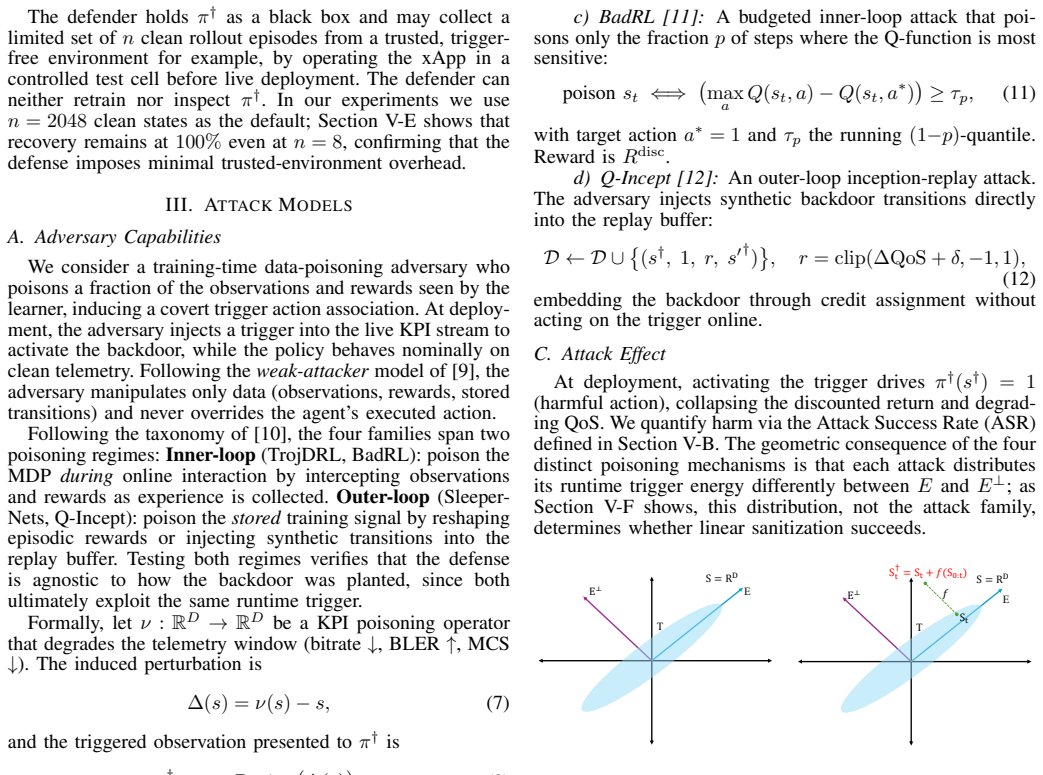
The safe-subspace projector obtained by thin SVD of clean KPI windows: each centered observation is replaced by its projection onto the top-d principal directions, annihilating any trigger component that lives in the orthogonal complement E⊥. The E⊥ energy fraction η_E⊥ of the trigger is the single scalar that predicts whether linear sanitization will succeed.
What would settle it
Replace the orthogonal trigger with a full in-subspace KPI poison that places most of its energy inside the estimated safe subspace, then verify that return recovery falls in lock-step with the measured E⊥ energy fraction while a nonlinear KPI classifier still separates clean from triggered windows with perfect AUROC.
Extended reading notes
Core claim
ORAN-DEFEND shows that a frozen, potentially compromised DRL xApp can be sanitized at inference by projecting each KPI window onto a safe subspace estimated via SVD from only a few trusted clean rollouts. When the trigger energy concentrates in the orthogonal complement of that subspace, the defense recovers 100 percent of the return and at least 99.5 percent defense success rate across TrojDRL, SleeperNets, BadRL and Q-Incept; recovery is governed monotonically by the measurable E⊥ energy fraction of the trigger, and that boundary is intrinsic to any linear projection defense.
Load-bearing premise
The defense works only when most of the adversary’s trigger energy lies outside the low-dimensional subspace that normal clean KPI traffic occupies.
Editorial extensions
If this is right
- Operators can wrap third-party DRL xApps without white-box access or retraining, using only a short trusted calibration period of clean rollouts.
- A single measurable scalar—the trigger’s energy fraction outside the safe subspace—becomes an operational criterion for whether linear sanitization will work.
- When that fraction is near one, residual energy after projection also supplies a high-AUROC detector of the trigger.
- Any purely linear telemetry sanitizer will fail against in-subspace poisons, so operators must plan a nonlinear reconstruction or detection tier for that regime.
- Calibration overhead is minimal: as few as eight clean episodes already yield full recovery under the subspace assumption.
Reading between the lines
- The same clean-occupancy-subspace idea may apply to other black-box RL controllers whose state streams are similarly low-rank, without needing to inspect the policy binary.
- Because the linear residual detector collapses exactly when the trigger is in-subspace, operators should pair residual monitoring with a lightweight nonlinear KPI-feature check rather than relying on residual alone.
- An acceptance test for new claimed backdoors follows immediately: measure the trigger’s E⊥ energy fraction on the target telemetry’s clean subspace before asserting that linear sanitization cannot stop it.
- Keeping the subspace estimate refreshed from trusted E2 telemetry could adapt the projector under non-stationary traffic without reopening a training surface.
Editorial analysis
A structured set of objections, weighed in public.
Referee Report
Summary. The paper proposes ORAN-DEFEND, a retraining-free telemetry wrapper that defends frozen DRL xApps against backdoor policies in O-RAN. A safe subspace En is estimated offline via SVD from a small set of trusted clean KPI rollouts; each online window is projected onto En before being fed to the black-box policy, annihilating triggers that lie in the orthogonal complement E⊥. The authors inherit a PAC-style value guarantee from Bharti et al. and introduce the measurable quantity η_E⊥ (trigger energy fraction in E⊥) as the governing recovery condition. On the Colosseum COLORAN dataset they evaluate four DRL backdoor families (TrojDRL, SleeperNets, BadRL, Q-Incept) spanning inner- and outer-loop poisoning. Under E⊥-confined triggers they report 100% return recovery and ≥99.5% DSR with residual-detector AUROC ∈ [0.98,1.00]. A geometry ablation shows recovery collapsing monotonically with η_E⊥ and the linear residual detector falling to chance while a nonlinear MLP retains perfect separability.
Significance. The work addresses a timely supply-chain threat for O-RAN: third-party DRL xApps that can be backdoored. The multi-family evaluation, the clean isolation of the geometric boundary via η_E⊥, and the demonstration that a few clean episodes (n=8) already suffice for full recovery are concrete contributions. The paper is explicit that success is conditional on the subspace assumption and that any linear projector shares the same limit; this honesty strengthens rather than weakens the claim. The result is therefore a useful, theoretically grounded first-line defense for the stated threat model, with clear operator-facing metrics and low online cost (O(Dd)).
major comments (2)
- [II-D, Eq. (8), Table II] Section II-D and Eq. (8) impose the subspace assumption by construction (trigger = Proj_E⊥(Δ(s))). Table II therefore evaluates the defense under the exact condition that makes linear projection succeed by design. While the geometry ablation (Table VI) correctly shows the failure mode when the assumption is dropped, the primary claim of “100% recovery across four families” is demonstrated only for the confined-trigger track. The manuscript should state more prominently in the abstract and introduction that the multi-family result is conditional on η_E⊥ ≈ 1, and should report the empirical η_E⊥ values realized by each attack under the primary track so readers can verify the assumption held.
- [IV-D, Eq. (20)] The PAC bound (20) is inherited from Bharti et al. without re-derivation or verification of the Lipschitz constant L of the DQN policies used on COLORAN. Because the bound is the sole analytic guarantee offered, the paper should either (a) estimate L empirically for the trained networks or (b) clearly label (20) as an existence result whose constants are not instantiated on the O-RAN data. Without this, the claim of a “provably grounded” defense rests on an unquantified transfer of assumptions.
minor comments (5)
- [Abstract / throughout] Notation for the orthogonal complement is rendered inconsistently (Eperp, E⊥, Eperp in the abstract vs. body). Standardize on E⊥ throughout.
- [Table I] Table I lists symbols but omits η_E⊥, which is the central diagnostic quantity introduced in the paper; add it.
- [Abstract] The phrase “like TrojDRL, SleeperNets…” in the abstract should be “namely” or simply a colon; “like” is informal.
- [Fig. 1] Figure 1 caption refers to support T; the symbol is not defined in the caption or nearby text. Clarify or remove.
- [V-A] Section V-A states d = arg max_d(σ̂_d − σ̂_{d+1}) yet later fixes d = 20; report the realized eigengap and whether the automatic rule selected 20.
Circularity Check
No significant circularity: recovery is an empirical measurement under a disclosed geometric assumption, not a quantity forced by fit or self-definition.
full rationale
The load-bearing analytical step is the elementary identity that Proj_En annihilates any Δ confined to E⊥ (Eq. 18), which is the definition of an orthogonal projector rather than a circular derivation. The paper does not fit η_E⊥ (or any free parameter) to the recovery metric and then re-label that fit as a prediction; η_E⊥ is measured post hoc as an explanatory coordinate, and recovery is reported as the held-out return ratio (J_C3−J_C2)/(J_C1−J_C2) on COLORAN episodes under four independently implemented attack families. The PAC-style value bound (Eq. 20) is imported from Bharti et al. [16] (non-overlapping authors) as an external black-box guarantee under stated assumptions, not re-derived from the present data or used to forbid alternatives. Primary results (Table II) use track-matched E⊥ triggers by design of the threat model (Eq. 8), while the geometry ablation (Table VI) deliberately violates that confinement and shows recovery collapsing with η_E⊥—so the boundary is disclosed rather than smuggled. Calibration of En from clean rollouts is ordinary SVD estimation, not a fitted input renamed as prediction. No self-definitional loop, no uniqueness theorem from the same authors, and no ansatz smuggled via self-citation appear in the derivation chain.
Assumptions & free parameters
free parameters (3)
- subspace dimension d =
20 (default)
- calibration size n =
2048 (default)
- residual threshold τ =
0.99 quantile
assumptions (4)
- domain assumption Adversarial trigger energy concentrates in the orthogonal complement E⊥ of the safe subspace (subspace assumption).
- domain assumption Clean discounted state occupancy concentrates in a low-dimensional subspace of the KPI feature space.
- domain assumption Backdoor policy is L-Lipschitz and agrees with the expert on the support of the clean occupancy.
- standard math PAC-style value guarantee of Bharti et al. (2022) holds under the above assumptions.
invented entities (1)
-
η_E⊥ (E⊥ energy fraction of the trigger)
independent evidence
Cite this review
Pith. "Pith review of ORAN-DEFEND: Subspace Detection and Sanitization of Backdoor DRL xApps in Open RAN." pith.science (2026). https://pith.science/paper/2QQY3MBI
@misc{pith2026260706647,
  author       = {Pith},
  title        = {Pith review of: ORAN-DEFEND: Subspace Detection and Sanitization of Backdoor DRL xApps in Open RAN},
  year         = {2026},
  howpublished = {\url{https://pith.science/paper/2QQY3MBI}},
  note         = {Machine review of arXiv:2607.06647}
}
abstract
Open Radio Access Networks (O-RAN) increasingly delegate near-real-time control to deep reinforcement learning (DRL) xApps obtained from third-party vendors, creating a new supply-chain attack surface. A backdoor policy behaves optimally until an adversary injects a covert trigger into the observed key performance indicator (KPI) telemetry, at which point it issues harmful control actions that degrade quality of service (QoS). We present ORAN-DEFEND, a retraining-free wrapper that sanitizes a frozen, potentially compromised xApp by projecting each KPI window onto a safe subspace estimated from a small number of trusted clean rollouts via singular value decomposition (SVD). We establish, both analytically and empirically, a precise recovery condition: the defense succeeds if the trigger energy concentrates in the orthogonal complement of the safe subspace, and we quantify this boundary through the trigger's $\Eperp$ energy fraction. On the Colosseum COLORAN dataset, we evaluate four structurally distinct DRL backdoor attacks, like TrojDRL, SleeperNets, BadRL, and Q-Incept, spanning inner-loop and outer-loop poisoning regimes and demonstrate $100\%$ return recovery and $\geq99.5\%$ defense success rate across all four when the subspace assumption holds. A geometry ablation reveals an intrinsic and previously uncharacterized limit of any linear projection defense: when the trigger collocates with the legitimate signal, the $\Eperp$ energy fraction governs recovery monotonically, and the linear residual detector collapses to chance even while a nonlinear classifier retains perfect separability.
Figures
Reference graph
Works this paper leans on
-
[1]
Under- standing o-ran: Architecture, interfaces, algorithms, security, and re- search challenges,
M. Polese, L. Bonati, S. D’oro, S. Basagni, and T. Melodia, “Under- standing o-ran: Architecture, interfaces, algorithms, security, and re- search challenges,”IEEE Communications Surveys & Tutorials, vol. 25, no. 2, pp. 1376–1411, 2023
work page 2023
-
[2]
A. Lacava, S. Maxenti, L. Bonati, S. D’Oro, A. Oprea, T. Melodia, and F. Restuccia, “How to poison an xapp: Dissecting backdoor attacks to deep reinforcement learning in open radio access networks,”Computer Networks, p. 111727, 2025
work page 2025
-
[3]
DORA: Dynamic O-RAN Resource Allocation for Multi-Slice 5G Networks
A. E. Dorcheh, T. Seyfi, and F. Afghah, “Dora: Dynamic o-ran resource allocation for multi-slice 5g networks,” 2025. [Online]. Available: https://arxiv.org/abs/2509.07242
work page Pith review arXiv 2025
-
[4]
R. Barker, A. E. Dorcheh, T. Seyfi, and F. Afghah, “Real: Reinforcement learning-enabled xapps for experimental closed-loop optimization in o- ran with osc ric and srsran,” in2025 IEEE International Commmunica- tion Conference (ICC), 2025
work page 2025
-
[5]
Meta reinforcement learning approach for adaptive resource optimization in o-ran,
F. Lotfi and F. Afghah, “Meta reinforcement learning approach for adaptive resource optimization in o-ran,” in2025 IEEE Wireless Com- munications and Networking Conference (WCNC), 2025
work page 2025
-
[6]
MORPH: Multi-Environment Orchestrated Reinforcement Learning for PRB Handling in O-RAN
A. E. Dorcheh, T. Seyfi, R. Barker, and F. Afghah, “Morph: Multi-environment orchestrated reinforcement learning for prb handling in o-ran,” 2026. [Online]. Available: https://arxiv.org/abs/2605.01128
work page Pith review arXiv 2026
-
[7]
Badnets: Evaluating backdooring attacks on deep neural networks,
T. Gu, K. Liu, B. Dolan-Gavitt, and S. Garg, “Badnets: Evaluating backdooring attacks on deep neural networks,”Ieee Access, vol. 7, pp. 47 230–47 244, 2019
work page 2019
-
[8]
Trojaning attack on neural networks,
Y . Liu, S. Ma, Y . Aafer, W.-C. Lee, J. Zhai, W. Wang, and X. Zhang, “Trojaning attack on neural networks,” in25th Annual Network And Distributed System Security Symposium (NDSS 2018). Internet Soc, 2018
work page 2018
Show all 20 references
-
[9]
Trojdrl: evaluation of back- door attacks on deep reinforcement learning,
P. Kiourti, K. Wardega, S. Jha, and W. Li, “Trojdrl: evaluation of back- door attacks on deep reinforcement learning,” in2020 57th ACM/IEEE Design Automation Conference (DAC). IEEE, 2020, pp. 1–6
2020
-
[10]
Sleepernets: Universal backdoor poisoning attacks against reinforcement learning agents,
E. Rathbun, C. Amato, and A. Oprea, “Sleepernets: Universal backdoor poisoning attacks against reinforcement learning agents,”Advances in Neural Information Processing Systems, vol. 37, pp. 111 994–112 024, 2024
2024
-
[11]
Badrl: Sparse targeted backdoor attack against reinforcement learning,
J. Cui, Y . Han, Y . Ma, J. Jiao, and J. Zhang, “Badrl: Sparse targeted backdoor attack against reinforcement learning,” inProceedings of the AAAI Conference on Artificial Intelligence, vol. 38, no. 10, 2024, pp. 11 687–11 694
2024
-
[12]
Adversarial inception backdoor attacks against reinforcement learning,
E. Rathbun, A. Oprea, and C. Amato, “Adversarial inception backdoor attacks against reinforcement learning,”arXiv preprint arXiv:2410.13995, 2024
2024 arXiv
-
[13]
Neural cleanse: Identifying and mitigating backdoor attacks in neural networks,
B. Wang, Y . Yao, S. Shan, H. Li, B. Viswanath, H. Zheng, and B. Y . Zhao, “Neural cleanse: Identifying and mitigating backdoor attacks in neural networks,” in2019 IEEE symposium on security and privacy (SP). IEEE, 2019, pp. 707–723
2019
-
[14]
Fine-pruning: Defending against backdooring attacks on deep neural networks,
K. Liu, B. Dolan-Gavitt, and S. Garg, “Fine-pruning: Defending against backdooring attacks on deep neural networks,” inInternational sympo- sium on research in attacks, intrusions, and defenses. Springer, 2018, pp. 273–294
2018
-
[15]
Adapt under attack and domain shift: Unified adversarial meta-learning and domain adaptation for robust automatic modulation classification,
A. Owfi, A. Bamdad, T. Seyfi, and F. Afghah, “Adapt under attack and domain shift: Unified adversarial meta-learning and domain adaptation for robust automatic modulation classification,” 2025. [Online]. Available: https://arxiv.org/abs/2511.01172
2025
-
[16]
Provable defense against backdoor policies in reinforcement learning,
S. Bharti, X. Zhang, A. Singla, and J. Zhu, “Provable defense against backdoor policies in reinforcement learning,”Advances in Neural Infor- mation Processing Systems, vol. 35, pp. 14 704–14 714, 2022
2022
-
[17]
Kpi poisoning: An attack in open ran near real-time control loop,
H. Alimohammadi, S. Chatzimiltis, S. Mayhoub, M. Shojafar, S. A. Soleymani, A. Akbas, and C. H. Foh, “Kpi poisoning: An attack in open ran near real-time control loop,” in2024 IEEE Future Networks World Forum (FNWF). IEEE, 2024, pp. 712–718
2024
-
[18]
Anomaly detection and mitigation in o-ran networks using an lstm-rnn autoencoder and secure slicing,
J. Moore, A. S. Abdalla, Z. Reshi, and V . Marojevic, “Anomaly detection and mitigation in o-ran networks using an lstm-rnn autoencoder and secure slicing,” inMILCOM 2025-2025 IEEE Military Communications Conference (MILCOM). IEEE, 2025, pp. 1–6
2025
-
[19]
Mitigating ml-driven adversarial attacks on xapps using dynamic defense mechanisms,
P. K. Kakani, M. A. Habibi, M. R. C. Balannagari, X. Costa-P ´erez, and H. D. Schotten, “Mitigating ml-driven adversarial attacks on xapps using dynamic defense mechanisms,”IEEE Open Journal of the Communica- tions Society, 2025
2025
-
[20]
Colo- ran: Developing machine learning-based xapps for open ran closed-loop control on programmable experimental platforms,
M. Polese, L. Bonati, S. D’Oro, S. Basagni, and T. Melodia, “Colo- ran: Developing machine learning-based xapps for open ran closed-loop control on programmable experimental platforms,”IEEE Transactions on Mobile Computing, vol. 22, no. 10, pp. 5787–5800, 2022
2022
Reviewed July 11, 2026 · model on record in the stance chip above.
Discussion (0). Sign in to comment.