REVIEW 2 major objections 5 minor 295 references
Rotation alone barely changes explosion energy, blast shape, or yields for a low-mass supernova that explodes early.
Reviewed by Pith at T0; open to challenge. T0 means a machine referee read the full paper against a public rubric. the ladder, T0–T4 →
T0 review · grok-4.5
2026-07-10 23:50 UTC pith:EBHYKVB7
load-bearing objection Solid, carefully scoped Fornax continuum: pure rotation is muted for this early-exploding 9 M☉ model except at the fastest spin, where T/|W| spirals and spin-kick alignment appear. the 2 major comments →
Effects of Rotation on 3D Core-Collapse Supernova Models for Low-Mass Progenitors
The pith
A machine-rendered reading of the paper's core claim, the machinery that carries it, and where it could break.
Core claim
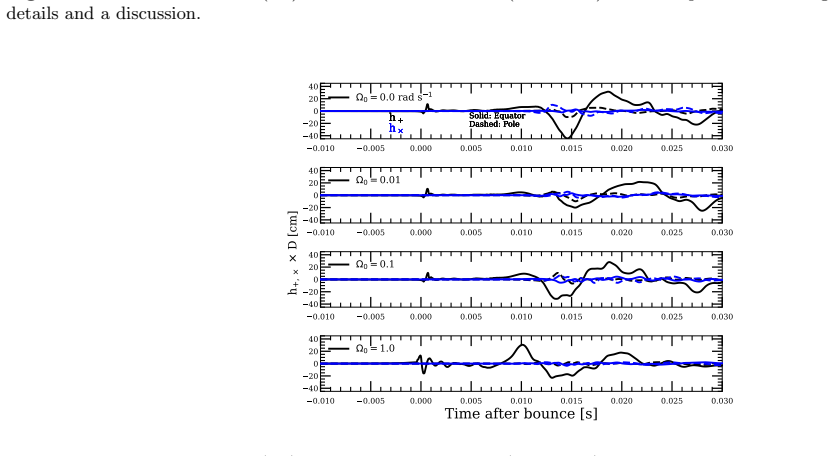
For a low-mass, low-compactness progenitor that explodes early, the effects of pure rotation on explosion energy, blast asymmetries, neutrino heating, nucleosynthetic yields, and residual neutron-star mass remain small and non-monotonic across two orders of magnitude in initial spin; only the most rapid rotator develops T/|W| ~ 0.05 corotation instabilities, spiral arms, spin-kick alignment, and elevated gravitational-wave emission.
What carries the argument
A controlled sequence of long-term 3D multi-group radiation-hydrodynamics runs of the same 9-solar-mass progenitor, differing only in the Eriguchi-Müller cylindrical rotation profile (Ω₀ = 0, 0.01, 0.1, 1.0 rad s⁻¹), carried to saturation so that asymptotic observables can be compared directly.
Load-bearing premise
The claim that rotation is muted for most supernova cores rests on a single early-exploding low-mass progenitor and on the deliberate exclusion of magnetic fields.
What would settle it
Repeat the same rotation sequence for a higher-compactness progenitor that explodes later; if that model shows large monotonic changes in explosion energy or strong spin-kick alignment already at moderate spins, the generalization fails.
If this is right
- For low-mass early-exploding progenitors, pure rotation can be treated as a small correction to non-rotating models when predicting energy, yields, and residual mass.
- Observed radio-pulsar birth periods of hundreds of milliseconds imply typical pre-collapse core periods of minutes rather than seconds.
- Clear spin-kick alignment and strong low-T/|W| spiral modes appear only above a high spin threshold, so most ordinary pulsars need not show them.
- Gravitational-wave signals from ordinary core-collapse events should lack the cascade of discrete T/|W| bands seen only in the fastest rotator.
- Nucleosynthetic differences driven by rotation alone are smaller than those already produced by modest convective seed perturbations.
Where Pith is reading between the lines
- Magnetized versions of the same rapid rotator would likely convert the modest rotational reservoir into jet-like morphology and higher energy, recovering the classic magnetorotational channel.
- If more massive or binary-stripped progenitors retain higher core spins, the spin-kick correlation observed in some pulsars may be explained without invoking post-explosion mechanisms.
- The factor-of-4000 spin-up sets a quantitative target for asteroseismic and white-dwarf spin measurements that can be checked against the same angular-momentum-transport physics.
- A denser grid of intermediate spins would locate the sharp threshold between random and aligned kicks, testing whether alignment is a continuous or threshold phenomenon.
Editorial analysis
A structured set of objections, weighed in public.
Referee Report
Summary. The paper presents four long-term 3D multi-group radiation-hydrodynamics simulations (Fornax, SFHo EOS, 12 energy groups) of the Sukhbold et al. (2016) 9-M⊙ progenitor, varying only the initial central angular frequency Ω0 = 0, 0.01, 0.1, and 1.0 rad s−1 under the Eriguchi & Müller cylindrical rotation law (A = 1000 km) and deliberately omitting magnetic fields. The runs are carried to asymptotic saturation of explosion energy, residual mass, kicks, nucleosynthesis, and gravitational-wave emission. The central claim is that, for this early-exploding low-mass model, rotation alone produces only weak, non-monotonic changes (≲20 %) in explosion energy, modest increases in blast asymmetry, negligible pole–equator heating anisotropy during the launch phase, and little change in yields; only the fastest rotator develops a T/|W| ≈ 0.05 corotation instability with spiral arms, stronger GW emission, and clear spin–kick alignment, while the initial-to-final core spin-period ratio is measured to be ∼4000.
Significance. If the reported trends hold, the work supplies a clean, systematically varied benchmark isolating pure hydrodynamic rotational effects for an early-exploding progenitor. The long-term (≳2 s) multi-messenger diagnostics—explosion energy, residual mass, recoil kicks, Ye–entropy distributions, production factors, and both matter and neutrino GW spectrograms—are valuable for the community. The clear detection of low-T/|W| spiral modes and the measured spin amplification factor ∼4000 are concrete, falsifiable results that constrain progenitor spin models and GW templates. The careful scoping to one low-compactness progenitor and the explicit omission of magnetic fields are strengths of scientific honesty rather than weaknesses.
major comments (2)
- [Table 1, §3] Table 1 and §3: the final spin periods (and therefore the quoted initial-to-final ratio ∼4000) are obtained from L/I_NS with the spherical Breu & Rezzolla (2016) formula and a fixed R_NS = 12 km. For the Ω0 = 1 model (T/|W| ≈ 0.0475 at 2 s) the spherical approximation underestimates the true moment of inertia; a short quantification of the resulting period error (or a non-spherical I estimate) is needed before the ratio is used to infer that “most supernova cores” are born slowly rotating.
- [§2, §9] §2 and §9: the Eriguchi & Müller cylindrical law with fixed scale A = 1000 km is adopted without a sensitivity test. Because the paper’s strongest claim is that rotation effects remain muted “across a wide range of initial spins,” at least a brief discussion (or one additional run) of how changing A by a factor of a few alters the early gain-region centrifugal support and the final T/|W| would strengthen the robustness of that claim.
minor comments (5)
- [Abstract, §3] Abstract and §3: “a T/|W| corotation instabilities” is grammatically incorrect; change to “a T/|W| corotation instability” or “T/|W| corotation instabilities.”
- [Figure 1, §3, §8] Figure 1 caption and several places in the text use inconsistent spacing (“T /|W|”, “T/|W|”); standardize to T/|W|.
- [§1] §1: “motive this work” should be “motivate this work.”
- [Figure 9, §4] Figure 9 and text: model labels occasionally appear as “9-rot0.0” or “9-rot0.1” without the hyphen; keep the consistent “9-rot-0.0” form used in Table 1.
- [§8] §8: the statement that the hydro dump cadence is 1000 Hz (Nyquist-limited to 500 Hz) while GW data are written at 25–50 kHz is useful; a single sentence noting that a higher hydro cadence will be required for a full modal decomposition of the spiral arms would help the reader.
Circularity Check
No significant circularity: observables are direct numerical outputs of independent 3D Fornax runs, not rearrangements of fitted inputs or self-citation chains.
full rationale
This is a standard computational survey. Four 3D radiation-hydrodynamics simulations of the Sukhbold et al. (2016) 9-M⊙ progenitor are evolved with prescribed initial cylindrical rotation profiles (Eriguchi & Müller 1985 form, A=1000 km, Ω0 = 0, 0.01, 0.1, 1.0 rad s−1). Explosion energy, shock multipoles, neutrino luminosities/heating rates, recoil kicks, PNS convection, nucleosynthetic yields, and GW strains are extracted by post-processing the time-dependent fields (Table 1, Figs. 1–26). The reported initial-to-final spin-period ratio ∼4000 is simply the ratio of the input central period to the final L/I (I from the external Breu & Rezzolla 2016 formula). Self-citations supply the Fornax code description, prior non-rotating 9a/9b comparison runs, and methodological context; none of them is used as a uniqueness theorem or as the sole warrant for the rotation-dependence claims. No parameter is fitted to a subset of the present data and then re-labeled a prediction, and no algebraic identity equates an output to an input by construction. The paper’s own caveats (single low-mass progenitor, no magnetic fields) are scope limitations, not circularities. Score 0 is therefore required.
Axiom & Free-Parameter Ledger
free parameters (4)
- Initial angular frequencies Ω0 =
0, 0.01, 0.1, 1.0 rad s−1
- Cylindrical rotation scale A =
1000 km
- Spatial grid and neutrino groups =
1024×128×256; 12 groups
- Cold NS radius in I_NS formula =
12 km
axioms (5)
- domain assumption SFHo nuclear equation of state adequately describes the PNS and shock thermodynamics for this study.
- domain assumption Magnetic fields can be omitted when isolating pure rotational hydro/radiation effects.
- domain assumption Sukhbold et al. (2016) 9-M⊙ solar-metallicity progenitor structure at collapse is representative of low-mass early-exploding CCSNe.
- ad hoc to paper Eriguchi & Müller (1985) cylindrical rotation law is an acceptable proxy for unknown true core spin profiles.
- domain assumption Multi-group neutrino transport and gravity treatment in Fornax are sufficient for asymptotic explosion energy, kicks, and yields.
read the original abstract
We explore the dependence upon rotation rate alone of various supernova observables simulated to their saturation for the explosion of a 9-$M_{\odot}$ progenitor. We find that the explosion energy is non-monotonic with, and weakly dependent upon, spin across a broad range of initial spins. The asymmetries of the blast depend weakly on spin, with faster spins leading to only slightly greater asymmetries. There is little significant pole-equator neutrino heating asymmetry during explosion, even for rapid rotation, and only for the fastest rotator does the neutrino heating rate diminish noticeably. Hence, the effects of rotation alone on all salient aspects of supernova dynamics are not large. We find that the recoil kick and spin are clearly aligned only for the most rapidly rotating model. Interestingly, for the fastest rotator, we witness a $T/|W|$ corotation instabilities near a value of 0.05 and spiral arm modes emerge. We find that the nucleosynthetic yields depend little upon the rotation rate and determine that the ratio of initial to final core spin period is near $\sim$4000, implying, given the modest inferred radio pulsar periods at birth, that the initial spin periods of most supernova cores are likely quite long. However, we focus on only one progenitor and do not include magnetic fields. Nevertheless, at least for low-mass progenitors which explode early, we find muted consequences of rotation in most major particulars across a wide range of initial spins.
Figures




Reference graph
Works this paper leans on
-
[1]
, archivePrefix = "arXiv", eprint =
IceCube sensitivity for low-energy neutrinos from nearby supernovae. , archivePrefix = "arXiv", eprint =. doi:10.1051/0004-6361/201117810 , adsurl =
work page internal anchor Pith review doi:10.1051/0004-6361/201117810
-
[2]
Letter of Intent: The Hyper-Kamiokande Experiment --- Detector Design and Physics Potential ---. arXiv e-prints , keywords =. 2011
work page 2011
-
[3]
Real-Time Supernova Neutrino Burst Monitor at Super-Kamiokande
Real-time supernova neutrino burst monitor at Super-Kamiokande. Astroparticle Physics , keywords =. 2016. doi:10.1016/j.astropartphys.2016.04.003 , archivePrefix =. 1601.04778 , primaryClass =
work page internal anchor Pith review Pith/arXiv arXiv 2016
-
[4]
Hyper-Kamiokande Design Report. arXiv e-prints , keywords =. 2018
work page 2018
-
[5]
Observation of Gravitational Waves from a Binary Black Hole Merger
Observation of Gravitational Waves from a Binary Black Hole Merger. , keywords =. 2016. doi:10.1103/PhysRevLett.116.061102 , archivePrefix =. 1602.03837 , primaryClass =
work page internal anchor Pith review Pith/arXiv arXiv 2016
-
[6]
, archivePrefix = "arXiv", eprint =
Astrophysical Implications of the Binary Black-hole Merger GW150914. , archivePrefix = "arXiv", eprint =. doi:10.3847/2041-8205/818/2/L22 , adsurl =
-
[7]
Physical Review Letters , archivePrefix = "arXiv", eprint =
GW170817: Observation of Gravitational Waves from a Binary Neutron Star Inspiral. Physical Review Letters , archivePrefix = "arXiv", eprint =. doi:10.1103/PhysRevLett.119.161101 , adsurl =
-
[8]
New Precision Limit on the Strange Vector Form Factors of the Proton , author =. Phys. Rev. Lett. , volume =. 2012 , month =. doi:10.1103/PhysRevLett.108.102001 , url =
-
[9]
, archivePrefix = "arXiv", eprint =
Shock-turbulence interaction in core-collapse supernovae. , archivePrefix = "arXiv", eprint =. doi:10.1093/mnras/stw1604 , adsurl =
-
[10]
Gravitational Wave Signals from 3D Neutrino Hydrodynamics Simulations of Core-Collapse Supernovae
Gravitational wave signals from 3D neutrino hydrodynamics simulations of core-collapse supernovae. , keywords =. 2017. doi:10.1093/mnras/stx618 , archivePrefix =. 1607.05199 , primaryClass =
work page internal anchor Pith review Pith/arXiv arXiv 2017
-
[11]
Gravitational waves from 3D core-collapse supernova models: The impact of moderate progenitor rotation. , keywords =. 2019. doi:10.1093/mnras/stz990 , archivePrefix =. 1810.07638 , primaryClass =
work page internal anchor Pith review Pith/arXiv arXiv 2019
-
[12]
Supernova Physics at DUNE. arXiv e-prints , keywords =. 2016
work page 2016
-
[13]
The Missing Link in Gravitational-Wave Astronomy: Discoveries waiting in the decihertz range
The missing link in gravitational-wave astronomy: discoveries waiting in the decihertz range. Classical and Quantum Gravity , keywords =. doi:10.1088/1361-6382/abb5c1 , archivePrefix =. 1908.11375 , primaryClass =
work page internal anchor Pith review Pith/arXiv arXiv 1908
-
[14]
Revival of a stalled supernova shock by neutrino heating. , keywords =. doi:10.1086/163343 , adsurl =
-
[15]
ArXiv e-prints , archivePrefix = "arXiv", eprint =
Production of Mo and Ru isotopes in neutrino-driven winds: implications for solar abundances and presolar grains. ArXiv e-prints , archivePrefix = "arXiv", eprint =
-
[16]
Stability of Standing Accretion Shocks, with an Eye toward Core-Collapse Supernovae. , eprint =. doi:10.1086/345812 , adsurl =
-
[17]
Journal of Physics Conference Series , year = 2005, series =
Discovering new dynamics of core-collapse supernova shock waves. Journal of Physics Conference Series , year = 2005, series =. doi:10.1088/1742-6596/16/1/051 , adsurl =
-
[18]
Linear Growth of Spiral SASI Modes in Core-Collapse Supernovae. , eprint =. doi:10.1086/510614 , adsurl =
-
[19]
Physical Review Letters , archivePrefix = "arXiv", eprint =
Muon Creation in Supernova Matter Facilitates Neutrino-Driven Explosions. Physical Review Letters , archivePrefix = "arXiv", eprint =. doi:10.1103/PhysRevLett.119.242702 , adsurl =
-
[20]
Self-consistent 3D Supernova Models From -7 Minutes to +7 s: A 1-bethe Explosion of a 19 M _ Progenitor. , keywords =. doi:10.3847/1538-4357/abf82e , archivePrefix =. 2010.10506 , primaryClass =
-
[21]
Results From Core-Collapse Simulations with Multi-Dimensional, Multi-Angle Neutrino Transport
Results from Core-collapse Simulations with Multi-dimensional, Multi-angle Neutrino Transport. , keywords =. 2011. doi:10.1088/0004-637X/728/1/8 , archivePrefix =. 1009.4654 , primaryClass =
work page internal anchor Pith review Pith/arXiv arXiv 2011
-
[22]
Stellar core collapse - Numerical model and infall epoch. , keywords =. doi:10.1086/191056 , adsurl =
-
[23]
The Role of Doubly Diffusive Instabilities in the Core-Collapse Supernova Mechanism. , keywords =. doi:10.1086/309921 , adsurl =
-
[24]
General Relativistic Effects in the Core Collapse Supernova Mechanism. , eprint =. doi:10.1086/322319 , adsurl =
-
[25]
, archivePrefix = "arXiv", eprint =
Axisymmetric Ab Initio Core-collapse Supernova Simulations of 12-25 M _ ⊙ Stars. , archivePrefix = "arXiv", eprint =. doi:10.1088/2041-8205/767/1/L6 , adsurl =
work page internal anchor Pith review doi:10.1088/2041-8205/767/1/l6 2041
-
[26]
, archivePrefix = "arXiv", eprint =
The Development of Explosions in Axisymmetric Ab Initio Core-collapse Supernova Simulations of 12-25 M Stars. , archivePrefix = "arXiv", eprint =. doi:10.3847/0004-637X/818/2/123 , adsurl =
-
[27]
Electron Neutrino Pair Annihilation: A New Source for Muon and Tau Neutrinos in Supernovae
Electron Neutrino Pair Annihilation: A New Source for Muon and Tau Neutrinos in Supernovae. , keywords =. 2003. doi:10.1086/368015 , archivePrefix =. astro-ph/0205006 , primaryClass =
work page internal anchor Pith review Pith/arXiv arXiv 2003
-
[28]
Two-dimensional hydrodynamic core-collapse supernova simulations with spectral neutrino transport. I. Numerical method and results for a 15 M star. , eprint =. doi:10.1051/0004-6361:20053783 , adsurl =
-
[29]
Convection and the mechanism of type II supernovae. , keywords =. doi:10.1086/184937 , adsurl =
-
[30]
A Convective Trigger for Supernova Explosions. , keywords =. doi:10.1086/187109 , adsurl =
-
[31]
A Theory of Supernova Explosions. , keywords =. doi:10.1086/187074 , adsurl =
-
[32]
On the Nature of Core-Collapse Supernova Explosions. , eprint =. doi:10.1086/176188 , adsurl =
work page internal anchor Pith review doi:10.1086/176188
-
[33]
Effects of correlations on neutrino opacities in nuclear matter. , eprint =. doi:10.1103/PhysRevC.58.554 , adsurl =
-
[34]
Many-body corrections to charged-current neutrino absorption rates in nuclear matter. , eprint =. doi:10.1103/PhysRevC.59.510 , adsurl =
-
[35]
ArXiv Astrophysics e-prints , eprint =
Neutrino-Matter Interaction Rates in Supernovae: The Essential Microphysics of Core Collapse. ArXiv Astrophysics e-prints , eprint =
-
[36]
Astrophysics and Space Science Library , year = 2004, series =
Neutrino-Matter Interaction Rates in Supernovae. Astrophysics and Space Science Library , year = 2004, series =. doi:10.1007/978-0-306-48599-2_5 , adsurl =
-
[37]
Neutrino opacities in nuclear matter. Nuclear Physics A , eprint =. doi:10.1016/j.nuclphysa.2004.06.012 , adsurl =
-
[39]
Multi-dimensional explorations in supernova theory. , eprint =. doi:10.1016/j.physrep.2007.02.001 , adsurl =
-
[40]
Features of the Acoustic Mechanism of Core-Collapse Supernova Explosions. , eprint =. doi:10.1086/509773 , adsurl =
-
[41]
Supernova 1987A: 20 Years After: Supernovae and Gamma-Ray Bursters , year = 2007, series =
The Multi-Dimensional Character and Mechanisms of Core-Collapse Supernovae. Supernova 1987A: 20 Years After: Supernovae and Gamma-Ray Bursters , year = 2007, series =. doi:10.1063/1.3682931 , adsurl =
-
[42]
, archivePrefix = "arXiv", eprint =
An Investigation into the Character of Pre-explosion Core-collapse Supernova Shock Motion. , archivePrefix = "arXiv", eprint =. doi:10.1088/0004-637X/759/1/5 , adsurl =
-
[43]
Reviews of Modern Physics , archivePrefix = "arXiv", eprint =
Colloquium: Perspectives on core-collapse supernova theory. Reviews of Modern Physics , archivePrefix = "arXiv", eprint =. doi:10.1103/RevModPhys.85.245 , adsurl =
-
[44]
Burrows, A. and Vartanyan, D. and Dolence, J. C. and Skinner, M. A. and Radice, D. Crucial Physical Dependencies of the Core-Collapse Supernova Mechanism. Space Science Reviews. 2018. doi:10.1007/s11214-017-0450-9
-
[45]
Three-Dimensional Supernova Explosion Simulations of 9-, 10-, 11-, 12-, and 13-M$_{\odot}$ Stars
Three-dimensional supernova explosion simulations of 9-, 10-, 11-, 12-, and 13-M _ ☉ stars. , keywords =. 2019. doi:10.1093/mnras/stz543 , archivePrefix =. 1902.00547 , primaryClass =
work page internal anchor Pith review Pith/arXiv arXiv 2019
-
[46]
Core-Collapse Supernova Explosion Theory
Core-collapse supernova explosion theory. , keywords =. doi:10.1038/s41586-020-03059-w , archivePrefix =. 2009.14157 , primaryClass =
work page internal anchor Pith review Pith/arXiv arXiv 2009
-
[47]
, archivePrefix = "arXiv", eprint =
Gravitational Wave Signatures in Black Hole Forming Core Collapse. , archivePrefix = "arXiv", eprint =. doi:10.1088/2041-8205/779/2/L18 , adsurl =
work page internal anchor Pith review doi:10.1088/2041-8205/779/2/l18 2041
-
[48]
, year = 1966, month = mar, volume = 143, pages =
The Hydrodynamic Behavior of Supernovae Explosions. , year = 1966, month = mar, volume = 143, pages =. doi:10.1086/148549 , adsurl =
-
[49]
, archivePrefix = "arXiv", eprint =
On the Impact of Three Dimensions in Simulations of Neutrino-driven Core-collapse Supernova Explosions. , archivePrefix = "arXiv", eprint =. doi:10.1088/0004-637X/775/1/35 , adsurl =
-
[50]
, archivePrefix = "arXiv", eprint =
The Three-dimensional Evolution to Core Collapse of a Massive Star. , archivePrefix = "arXiv", eprint =. doi:10.1088/2041-8205/808/1/L21 , adsurl =
-
[51]
, archivePrefix = "arXiv", eprint =
Revival of the Stalled Core-collapse Supernova Shock Triggered by Precollapse Asphericity in the Progenitor Star. , archivePrefix = "arXiv", eprint =. doi:10.1088/2041-8205/778/1/L7 , adsurl =
-
[52]
, archivePrefix = "arXiv", eprint =
High-resolution Three-dimensional Simulations of Core-collapse Supernovae in Multiple Progenitors. , archivePrefix = "arXiv", eprint =. doi:10.1088/0004-637X/785/2/123 , adsurl =
-
[53]
, archivePrefix = "arXiv", eprint =
The Role of Turbulence in Neutrino-driven Core-collapse Supernova Explosions. , archivePrefix = "arXiv", eprint =. doi:10.1088/0004-637X/799/1/5 , adsurl =
-
[54]
Multidimensional Radiation/Hydrodynamic Simulations of Proto-Neutron Star Convection. , eprint =. doi:10.1086/504068 , adsurl =
-
[55]
, archivePrefix = "arXiv", eprint =
Dimensional Dependence of the Hydrodynamics of Core-collapse Supernovae. , archivePrefix = "arXiv", eprint =. doi:10.1088/0004-637X/765/2/110 , adsurl =
-
[56]
, archivePrefix = "arXiv", eprint =
Two-dimensional Core-collapse Supernova Models with Multi-dimensional Transport. , archivePrefix = "arXiv", eprint =. doi:10.1088/0004-637X/800/1/10 , adsurl =
-
[57]
The intrinsic luminosity and initial period of pulsars. , keywords =. doi:10.1086/167963 , adsurl =
-
[58]
A general computational method for obtaining equilibria of self-gravitating and rotating gases. , keywords =
-
[59]
, archivePrefix = "arXiv", eprint =
A Two-parameter Criterion for Classifying the Explodability of Massive Stars by the Neutrino-driven Mechanism. , archivePrefix = "arXiv", eprint =. doi:10.3847/0004-637X/818/2/124 , adsurl =
-
[60]
Birth and Evolution of Isolated Radio Pulsars. , eprint =. doi:10.1086/501516 , adsurl =
-
[61]
Radio Pulsars: The Neutron Star Population & Fundamental Physics. arXiv e-prints , keywords =
-
[62]
Magnetars. , keywords =. doi:10.1146/annurev-astro-081915-023329 , archivePrefix =. 1703.00068 , primaryClass =
work page internal anchor Pith review Pith/arXiv arXiv
-
[63]
On The Development of Multidimensional Progenitor Models For Core-collapse Supernovae
On the Development of Multidimensional Progenitor Models for Core-collapse Supernovae. , keywords =. doi:10.3847/1538-4357/abada7 , archivePrefix =. 2008.04266 , primaryClass =
work page internal anchor Pith review Pith/arXiv arXiv 2008
-
[64]
Impact on the protoneutron star deleptonization
The role of medium modifications for neutrino-pair processes from nucleon-nucleon bremsstrahlung. Impact on the protoneutron star deleptonization. , archivePrefix = "arXiv", eprint =. doi:10.1051/0004-6361/201628991 , adsurl =
-
[65]
Non-radial instabilities of isothermal Bondi accretion with a shock: Vortical-acoustic cycle vs. post-shock acceleration. , eprint =. doi:10.1051/0004-6361:20020912 , adsurl =
-
[66]
Instability of a Stalled Accretion Shock: Evidence for the Advective-Acoustic Cycle. , eprint =. doi:10.1086/509612 , adsurl =
-
[67]
Physical Review Letters , archivePrefix = "arXiv", eprint =
Shallow Water Analogue of the Standing Accretion Shock Instability: Experimental Demonstration and a Two-Dimensional Model. Physical Review Letters , archivePrefix = "arXiv", eprint =. doi:10.1103/PhysRevLett.108.051103 , adsurl =
-
[68]
ArXiv e-prints , archivePrefix = "arXiv", eprint =
From Nuclei to the Cosmos: Tracing Heavy-Element Production with the Oldest Stars. ArXiv e-prints , archivePrefix = "arXiv", eprint =
-
[69]
Physical Review Letters , eprint =
Neutrino-Induced Nucleosynthesis of A 64 Nuclei: The p Process. Physical Review Letters , eprint =. doi:10.1103/PhysRevLett.96.142502 , adsurl =
-
[70]
Mass Limits For Black Hole Formation
Mass Limits For Black Hole Formation. , keywords =. 1999. doi:10.1086/307647 , archivePrefix =. astro-ph/9902315 , primaryClass =
work page internal anchor Pith review Pith/arXiv arXiv 1999
-
[71]
Modeling Core-Collapse Supernovae in Three Dimensions. , eprint =. doi:10.1086/342258 , adsurl =
-
[72]
The Collapse of Rotating Massive Stars in Three Dimensions. , eprint =. doi:10.1086/380193 , adsurl =
-
[73]
The impact of asymmetric neutrino emissions on nucleosynthesis in core-collapse supernovae. arXiv e-prints , keywords =. 2019
work page 2019
-
[74]
Effects of LESA in Three-dimensional Supernova Simulations with Multidimensional and Ray-by-ray-plus Neutrino Transport. , keywords =. doi:10.3847/1538-4357/ab275c , archivePrefix =. 1809.10150 , primaryClass =
work page internal anchor Pith review doi:10.3847/1538-4357/ab275c
-
[75]
Three-dimensional Core-collapse Supernova Simulations with Multidimensional Neutrino Transport Compared to the Ray-by-ray-plus Approximation. , keywords =. 2019. doi:10.3847/1538-4357/ab0423 , archivePrefix =. 1809.10146 , primaryClass =
work page internal anchor Pith review Pith/arXiv arXiv 2019
-
[76]
, archivePrefix = "arXiv", eprint =
Up, down, and strange nucleon axial form factors from lattice QCD. , archivePrefix = "arXiv", eprint =. doi:10.1103/PhysRevD.95.114502 , adsurl =
-
[77]
, archivePrefix = "arXiv", eprint =
Angular momentum redistribution by SASI spiral modes and consequences for neutron star spins. , archivePrefix = "arXiv", eprint =. doi:10.1093/mnras/stu718 , adsurl =
-
[78]
Toward Connecting Core-collapse Supernova Theory with Observations. I. Shock Revival in a 15 M _ ⊙ Blue Supergiant Progenitor with SN 1987A Energetics. , archivePrefix = "arXiv", eprint =. doi:10.1088/0004-637X/783/2/125 , adsurl =
-
[79]
, archivePrefix = "arXiv", eprint =
Is Strong SASI Activity the Key to Successful Neutrino-driven Supernova Explosions?. , archivePrefix = "arXiv", eprint =. doi:10.1088/0004-637X/755/2/138 , adsurl =
-
[80]
, archivePrefix = "arXiv", eprint =
SASI Activity in Three-dimensional Neutrino-hydrodynamics Simulations of Supernova Cores. , archivePrefix = "arXiv", eprint =. doi:10.1088/0004-637X/770/1/66 , adsurl =
-
[81]
Circular polarization of gravitational waves from non-rotating supernova cores: a new probe into the pre-explosion hydrodynamics. , keywords =. 2018. doi:10.1093/mnrasl/sly055 , archivePrefix =. 1802.03842 , primaryClass =
work page internal anchor Pith review Pith/arXiv arXiv 2018
discussion (0)
Sign in with ORCID, Apple, or X to comment. Anyone can read and Pith papers without signing in.