REVIEW 1 major objections 7 minor 47 references
A "squeezed polaron" variational wavefunction for the spin boson model
T0 review · 1 major / 7 minor · reviewed 2026-07-10 · glm-5.2
Pith's one-line read Squeezed polaron captures bath correlations near quantum localization
desk verdict Gaussian polaron ansatz captures deep sub-Ohmic critical scaling and scattering physics; non-mean-field exponents for s>0.5 are derived on a non-physical branch read the letter →
The pith
A machine-rendered reading of the paper's core claim, the machinery that carries it, and where it could break.
The reading
What carries the argument
The self-consistent integral equation for m(y) [Eq. (5)], which replaces the trivial m=1 of coherent-state polarons and encodes all bath-bath correlations induced by the spin impurity. The parameter b = alpha_D (cos theta)^{3-s} serves as the control parameter; its critical value b_c where m_0 vanishes determines the transition point.
What would settle it
If the true ground state near the transition requires non-Gaussian bath correlations (beyond two-point functions) to correctly capture the critical behavior — which is suggested by the spurious first-order jump and the acknowledged need for cat-state superpositions — then the squeezed polaron's critical exponents for s > 0.5 are artifacts of the Gaussian restriction rather than genuine physical predictions.
Extended reading notes
Core claim
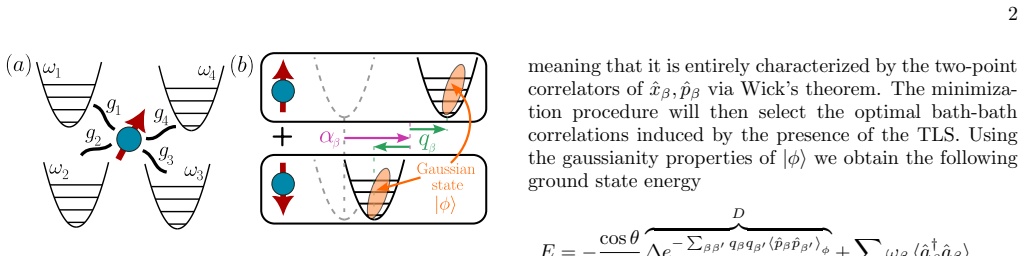
The squeezed polaron's key object is the function m(y), determined self-consistently by an integral equation [Eq. (5)], which encodes how the spin impurity modifies low-frequency bath correlations beyond what coherent-state displacements can achieve. When m(y) departs from its trivial value of 1 at low frequencies, it generates the correct power-law scaling of displacement and squeezing amplitudes [Eq. (9)] that standard polaron ansatzes miss entirely. The vanishing of m at zero frequency (m_0 -> 0) signals the localization transition, and the scaling function r(omega/omega*) that interpolates between critical and non-critical regimes yields the correlation-length exponent nu^{-1} = min(s, 1
Load-bearing premise
The ansatz restricts the bosonic bath to a Gaussian state, meaning all bath correlations are fully determined by two-point functions. Near the localization transition, the true ground state develops non-Gaussian cat-like fluctuations that this restriction cannot represent, which likely causes the spurious first-order jump between branches for s > 0.5 and may bias the critical exponents in the non-mean-field regime.
Editorial extensions
If this is right
- The scattering phase shift phi = pi*s in the critical regime is a directly measurable signature of the localization transition, testable in waveguide-QED or circuit-QED experiments where a bosonic mode scatters off an impurity spin.
- Adding Gaussian fluctuations to multi-polaron ansatzes could remove the spurious first-order jump between localized and delocalized branches that appears for s > 0.5, potentially yielding quantitatively accurate critical exponents in the non-mean-field regime.
- The squeezed-polaron framework extends naturally to the Ohmic case (s=1) and to finite temperature, where bath correlations are expected to play an equally important role.
- The emergence of an energy scale omega* << D that governs low-frequency physics suggests a separation of scales that could be exploited in perturbative or renormalization-group treatments beyond the variational ansatz.
Reading between the lines
- The Gaussian restriction on the bath state means the ansatz captures all two-point but no higher-order correlations. Since the true ground state near criticality develops non-Gaussian cat-like structure, the squeezed polaron may systematically underestimate the critical coupling and distort exponents for s > 0.5 — exactly where the spurious first-order jump appears. A non-Gaussian extension (e.g.,
- The connection between the variational phase shift phi = pi*s and the CFT result S(E) = e^{i*pi*s} suggests that the squeezed polaron, despite being a variational approximation, captures exact conformal data in the critical regime for s < 0.5 where the underlying CFT is Gaussian. For s > 0.5, multiparticle production corrections would modify the plateau value of the reflection coefficient.
- The integral equation for m(y) has the structure of a self-consistent screening equation, analogous to Dyson equations in many-body theory. This suggests the squeezed polaron can be understood as a variational realization of a self-energy approximation, where m(y) plays the role of a frequency-dependent screening function for the spin-bath interaction.
Editorial analysis
A structured set of objections, weighed in public.
Referee Report
Summary. The manuscript introduces a 'squeezed polaron' variational wavefunction for the sub-Ohmic spin-boson model that extends the standard coherent-state polaron ansatz by allowing the bosonic bath to be in a generic Gaussian state. This permits the variational principle to select optimal boson-boson correlations induced by the spin impurity. The central technical result is a self-consistent integral equation [Eq. (5)] for a correlation function m(y), from which the authors derive the correct critical power-law scaling of bath observables [Eq. (9)], critical exponents that transition from mean-field (ν−1=s for s<0.5) to non-mean-field (ν−1=1−s for s>0.5), and critical couplings α_c that compare favorably with numerically exact methods (Fig. 3, Table S2). The paper also derives boson scattering phase shifts from the variational background and shows they encode an emergent energy scale ω* that vanishes at the transition. The variational derivation is internally consistent: the energy functional Eq. (3) is minimized systematically via resolvent methods (Appendix A), the critical scaling is verified both analytically (Appendix E) and numerically (Fig. S3), and the correlation-length exponent is derived from a controlled perturbation analysis of the scaling function (Appendix G).
Significance. The paper makes a genuine contribution to the analytical theory of the spin-boson model. Standard coherent-state polaron ansatzes (Silbey-Harris, Chin) are known to be unable to capture the boson-boson correlations that develop at low frequencies near the localization transition. This work provides the first analytical variational treatment that incorporates generic Gaussian bath correlations and demonstrates that they are sufficient to recover the correct critical scaling laws previously accessible only through diagrammatic or numerical methods. The derivation of scattering phase shifts and their connection to the emergent scale ω* via both variational and CFT methods (Appendix I) is a nice addition that provides experimentally falsifiable predictions. The critical coupling values (Table S2) represent a systematic improvement over the coherent-state polaron and are within a few percent of QMC and VMPS benchmarks across the full sub-Ohmic regime. These are concrete, verifiable results.
major comments (1)
- Abstract and main-text framing of non-mean-field exponents for s>0.5: The abstract states the ansatz 'displays non-mean-field critical exponents in the shallow sub-Ohmic regime,' and the strongest claims of the paper echo this. However, as the authors themselves acknowledge in the 'Delocalized branch near b_c' section, for s≳0.4 the delocalized branch at b=b_c (where m₀→0 and the exponent ν−1=1−s is derived, Appendix G) is NOT the ground state — the localized branch has already crossed to lower energy. The power-law ω*∼|α−α_c|^ν is thus computed on a non-physical branch. The authors note this ('in a regime where the localized branch is energetically favored'), but the abstract and main-text presentation do not adequately flag that these exponents are physically unrealized at the actual phase transition. This is load-bearing because it is one of the two headline claims about critical exop
minor comments (7)
- Eq. (3): The overbrace notation for D is introduced inline but the definition is somewhat buried. Making the definition of D more prominent (e.g., as a separate numbered equation) would improve readability.
- Fig. 2: The panel labels (a)-(d) are small and the distinction between solid/dashed blue lines is hard to read in the printed version. Consider enlarging or simplifying.
- Fig. 3(d): The caption mentions 'two loop epsilon expansion [37]' but the reference appears to be Fisher-Ma-Nickel (Ref. 37), which is a one-loop result. Please clarify.
- The notation α_Δ is introduced in Eq. (6) but used earlier in the text. Define it explicitly before its first use.
- In the 'Scattering' section, the effective Hamiltonian Eq. (11) is introduced without much derivation. A brief pointer to Appendix H would help the reader navigate to the justification for easier reference.
- Appendix C: The iteration scheme for solving the integral equation is described, but convergence criteria (relative error threshold, number of iterations) are only briefly mentioned. Stating these more precisely would help reproducibility.
- The phrase 'Taken together as a whole, these equations define D, δE, θ, and α_Δ as parametric functions of b' appears after Eq. (8). The reference to Eq. (8) in the surrounding text is somewhat redundant with the equation itself.
Circularity Check
No significant circularity: the derivation chain is self-contained, with one minor caveat about exponents derived on a non-ground-state branch
full rationale
The paper's central derivation chain is self-contained and not circular. The variational energy functional (Eq. 3) is obtained by directly evaluating the Hamiltonian expectation value on the Gaussian ansatz. The integral equation for m(y) (Eq. 5) follows from the Gaussian eigenvalue problem (Eq. S4) via resolvent methods, without assuming the critical scaling it later derives. The critical power-law m(y)≈πb cot(πs/2) y^s (Eq. 9) is extracted from the self-consistency of Eq. 5 at b=b_c (Appendix E), not imposed. The critical exponent ν−1=min(s,1−s) is derived from the scaling function r(u) (Appendix G) by perturbing around the critical solution, not by fitting to external data. The critical couplings α_c are compared against independent numerical benchmarks (QMC, VMPS, MPA, DMRG) in Fig. S2, not against the authors' own prior results. The scattering phase shifts are derived from the effective Hamiltonian (Eq. 11, Appendix H) and cross-checked against CFT arguments (Appendix I). The only concern is that for s>0.5, the non-mean-field exponents are derived on the delocalized branch at b=b_c, which is not the ground state in that regime (the localized branch is energetically favored). The authors acknowledge this: 'in a regime where the localized branch is energetically favored.' This is a physical applicability issue, not circularity—the derivation itself is internally consistent and does not reduce to its inputs by construction. The score of 2 reflects this minor physical caveat without any genuine circularity in the logical chain.
Assumptions & free parameters
free parameters (2)
- ω_c/∆ =
10
- b
assumptions (4)
- domain assumption The bath ground state |ϕ⟩ is a Gaussian state fully characterized by two-point correlators via Wick's theorem.
- standard math The bath spectral function J(ω) = 2πα ω_c^{1-s} ω^s θ(ω_c - ω) with a hard cutoff.
- domain assumption The effective scattering Hamiltonian is obtained by normal-ordering with respect to |ϕ⟩ and keeping only quadratic, number-conserving terms.
- domain assumption The 1→1 S-matrix at the critical point is fixed by conformal invariance and the requirement of no multiparticle production.
invented entities (2)
-
m(y) — the correlation function
independent evidence
-
ω* — the emergent energy scale
independent evidence
Cite this review
Pith. "Pith review of A "squeezed polaron" variational wavefunction for the spin boson model." pith.science (2026). https://pith.science/paper/H5NSVGOU
@misc{pith2026260706850,
  author       = {Pith},
  title        = {Pith review of: A "squeezed polaron" variational wavefunction for the spin boson model},
  year         = {2026},
  howpublished = {\url{https://pith.science/paper/H5NSVGOU}},
  note         = {Machine review of arXiv:2607.06850}
}
read the original abstract
The localization transition of the sub-Ohmic spin-boson model generates boson bath correlations that are, at low frequencies, analytically inaccessible to standard coherent-state-polaron variational ansatzes. In this paper, we introduce a ``squeezed polaron'' wavefunction incorporating generic Gaussian boson-boson correlations induced by the spin impurity. This gives the correct critical power-law scaling of bath observables near the localization transition together with a systematically improved ground state energy and a more accurate determination of the critical coupling. Our wavefunction captures the correct mean-field nature of the transition in the deep sub-Ohmic region. It also displays non-mean-field critical exponents in the shallow sub-Ohmic regime. Using the squeezed polaron as a starting point, we derive scattering phase shifts for bosons, and show how they encode the emergent energy scale that vanishes at the localization transition.
Figures


Reference graph
Works this paper leans on
-
[1]
A. J. Leggett, S. Chakravarty, A. T. Dorsey, M. P. A. Fisher, A. Garg, and W. Zwerger, Dynamics of the dissi- pative two-state system, Rev. Mod. Phys.59, 1 (1987)
work page 1987
-
[2]
Weiss,Quantum Dissipative Systems, 4th ed
U. Weiss,Quantum Dissipative Systems, 4th ed. (WORLD SCIENTIFIC, 2012)
work page 2012
-
[3]
G. Clos and H.-P. Breuer, Quantification of memory ef- fects in the spin-boson model, Phys. Rev. A86, 012115 (2012)
work page 2012
-
[4]
Verifying Quantum Memory in the Dynamics of Spin Boson Models
C. B¨ acker, V. Link, and W. T. Strunz, Verifying quantum memory in the dynamics of spin boson models (2025), arXiv:2505.13067 [quant-ph]
work page Pith review arXiv 2025
-
[5]
B. Peropadre, D. Zueco, D. Porras, and J. J. Garc´ ıa- Ripoll, Nonequilibrium and nonperturbative dynamics of ultrastrong coupling in open lines, Phys. Rev. Lett.111, 243602 (2013)
work page 2013
-
[6]
P. Forn-D´ ıaz, J. J. Garc´ ıa-Ripoll, B. Peropadre, J.-L. Orgiazzi, M. A. Yurtalan, R. Belyansky, C. M. Wilson, and A. Lupascu, Ultrastrong coupling of a single artificial atom to an electromagnetic continuum in the nonpertur- bative regime, Nature Physics13, 39 (2017)
work page 2017
-
[7]
B. Golding, M. N. Zimmerman, and S. N. Coppersmith, Dissipative quantum tunneling of a single microscopic defect in a mesoscopic metal, Phys. Rev. Lett.68, 998 (1992)
work page 1992
-
[8]
S. Chakravarty and A. J. Leggett, Dynamics of the two- state system with ohmic dissipation, Phys. Rev. Lett.52, 5 (1984)
work page 1984
Show all 47 references
-
[9]
Stockburger, M
J. Stockburger, M. Grifoni, M. Sassetti, and U. Weiss, Nonlinear acoustic response of amorphous metals in the tunneling model, Zeitschrift f¨ ur Physik B Condensed Matter94, 447 (1994)
1994
-
[10]
S. Han, J. Lapointe, and J. E. Lukens, Observation of incoherent relaxation by tunneling in a macroscopic two- state system, Phys. Rev. Lett.66, 810 (1991)
1991
-
[11]
Magazz` u, P
L. Magazz` u, P. Forn-D´ ıaz, R. Belyansky, J.-L. Orgiazzi, M. A. Yurtalan, M. R. Otto, A. Lupascu, C. M. Wil- son, and M. Grifoni, Probing the strongly driven spin- boson model in a superconducting quantum circuit, Na- ture Communications9, 1403 (2018)
2018
-
[12]
K. Sun, M. Kang, H. Nuomin, G. Schwartz, D. N. Be- ratan, K. R. Brown, and J. Kim, Quantum simulation of spin-boson models with structured bath, Nature Com- munications16, 4042 (2025)
2025
-
[13]
Bulla, N.-H
R. Bulla, N.-H. Tong, and M. Vojta, Numerical renor- malization group for bosonic systems and application to the sub-ohmic spin-boson model, Phys. Rev. Lett.91, 170601 (2003)
2003
-
[14]
Bulla, H.-J
R. Bulla, H.-J. Lee, N.-H. Tong, and M. Vojta, Numer- ical renormalization group for quantum impurities in a bosonic bath, Phys. Rev. B71, 045122 (2005)
2005
-
[15]
Winter, H
A. Winter, H. Rieger, M. Vojta, and R. Bulla, Quan- tum phase transition in the sub-ohmic spin-boson model: Quantum monte carlo study with a continuous imaginary time cluster algorithm, Phys. Rev. Lett.102, 030601 (2009)
2009
-
[16]
C. Guo, A. Weichselbaum, J. von Delft, and M. Vojta, Critical and strong-coupling phases in one- and two-bath spin-boson models, Phys. Rev. Lett.108, 160401 (2012)
2012
-
[17]
Florens, A
S. Florens, A. Freyn, D. Venturelli, and R. Narayanan, Dissipative spin dynamics near a quantum critical point: Numerical renormalization group and majorana diagram- matics, Phys. Rev. B84, 155110 (2011)
2011
-
[18]
Blunden-Codd, S
Z. Blunden-Codd, S. Bera, B. Bruognolo, N.-O. Linden, A. W. Chin, J. von Delft, A. Nazir, and S. Florens, Anatomy of quantum critical wave functions in dissipa- tive impurity problems, Phys. Rev. B95, 085104 (2017)
2017
-
[19]
Shen and N
Y. Shen and N. Zhou, Numerical variational studies of quantum phase transitions in the sub-ohmic spin-boson model with multiple polaron ansatz, Computer Physics Communications293, 108895 (2023)
2023
-
[20]
Florens, D
S. Florens, D. Venturelli, and R. Narayanan, Quantum phase transition in the spin boson model, inQuantum Quenching, Annealing and Computation, edited by A. K. Chandra, A. Das, and B. K. Chakrabarti (Springer Berlin Heidelberg, Berlin, Heidelberg, 2010) pp. 145–162
2010
-
[21]
Silbey and R
R. Silbey and R. A. Harris, Variational calculation of the 6 dynamics of a two level system interacting with a bath, The Journal of Chemical Physics80, 2615 (1984)
1984
-
[22]
A. W. Chin, J. Prior, S. F. Huelga, and M. B. Ple- nio, Generalized polaron ansatz for the ground state of the sub-ohmic spin-boson model: An analytic theory of the localization transition, Phys. Rev. Lett.107, 160601 (2011)
2011
-
[23]
C. Zhao, Z. L¨ u, and H. Zheng, Entanglement evolution and quantum phase transition of biaseds= 1/2 spin- boson model, Phys. Rev. E84, 011114 (2011)
2011
-
[24]
Nazir, D
A. Nazir, D. P. S. McCutcheon, and A. W. Chin, Ground state and dynamics of the biased dissipative two-state system: Beyond variational polaron theory, Phys. Rev. B85, 224301 (2012)
2012
-
[25]
Zheng and Z
H. Zheng and Z. L¨ u, Quantum critical point of spin- boson model and infrared catastrophe in bosonic bath, The Journal of Chemical Physics138, 174117 (2013)
2013
-
[26]
S. He, L. Duan, and Q.-H. Chen, Improved silbey-harris polaron ansatz for the spin-boson model, Phys. Rev. B 97, 115157 (2018)
2018
-
[27]
S. Bera, S. Florens, H. U. Baranger, N. Roch, A. Nazir, and A. W. Chin, Stabilizing spin coherence through envi- ronmental entanglement in strongly dissipative quantum systems, Phys. Rev. B89, 121108 (2014)
2014
-
[28]
S. Bera, A. Nazir, A. W. Chin, H. U. Baranger, and S. Florens, Generalized multipolaron expansion for the spin-boson model: Environmental entanglement and the biased two-state system, Phys. Rev. B90, 075110 (2014)
2014
-
[29]
S. Bera, H. U. Baranger, and S. Florens, Dynamics of a qubit in a high-impedance transmission line from a bath perspective, Phys. Rev. A93, 033847 (2016)
2016
-
[30]
D´ ıaz-Camacho, A
G. D´ ıaz-Camacho, A. Bermudez, and J. J. Garc´ ıa-Ripoll, Dynamical polaron ansatz: A theoretical tool for the ultrastrong-coupling regime of circuit qed, Phys. Rev. A 93, 043843 (2016)
2016
-
[31]
T. Shi, Y. Chang, and J. J. Garc´ ıa-Ripoll, Ultrastrong coupling few-photon scattering theory, Phys. Rev. Lett. 120, 153602 (2018)
2018
-
[32]
D. P. S. McCutcheon and A. Nazir, Quantum dot rabi ro- tations beyond the weak exciton-phonon coupling regime, New Journal of Physics12, 113042 (2010)
2010
-
[33]
L. J. Bond, A. Safavi-Naini, and J. c. v. Min´ aˇ r, Fast quantum state preparation and bath dynamics using non- gaussian variational ansatz and quantum optimal control, Phys. Rev. Lett.132, 170401 (2024)
2024
-
[34]
T. Shi, E. Demler, and J. Ignacio Cirac, Variational study of fermionic and bosonic systems with non-gaussian states: Theory and applications, Annals of Physics390, 245 (2018)
2018
-
[35]
See Supplemental Material at [URL will be inserted by publisher]
-
[36]
Wong and Z.-D
H. Wong and Z.-D. Chen, Density matrix renormalization group approach to the spin-boson model, Phys. Rev. B 77, 174305 (2008)
2008
-
[37]
M. E. Fisher, S.-k. Ma, and B. G. Nickel, Critical ex- ponents for long-range interactions, Phys. Rev. Lett.29, 917 (1972)
1972
-
[38]
Uzelac, Z
K. Uzelac, Z. Glumac, and A. Aniˇ ci´ c, Critical behavior of the long-range ising chain from the largest-cluster prob- ability distribution, Phys. Rev. E63, 037101 (2001)
2001
-
[39]
Zar´ and, L
G. Zar´ and, L. Borda, J. von Delft, and N. Andrei, Theory of inelastic scattering from magnetic impurities, Phys. Rev. Lett.93, 107204 (2004)
2004
-
[40]
Borda, L
L. Borda, L. Fritz, N. Andrei, and G. Zar´ and, Theory of inelastic scattering from quantum impurities, Phys. Rev. B75, 235112 (2007)
2007
-
[41]
Benedetti, E
D. Benedetti, E. Lauria, D. Maz´ aˇ c, and P. van Vliet, One- dimensional ising model with 1/r 1.99 interaction, Phys. Rev. Lett.134, 201602 (2025)
2025
-
[42]
Benedetti, E
D. Benedetti, E. Lauria, D. Mazac, and P. van Vliet, A strong-weak duality for the 1d long-range ising model, SciPost Phys.20, 029 (2026)
2026
-
[43]
Zheng and Z
H. Zheng and Z. L¨ u, Unitary transformation with double polaronic generator for spin-boson model: Ground state, thermodynamics and dynamical evolution, The Journal of Chemical Physics164, 044103 (2026)
2026
-
[44]
Nalbach and M
P. Nalbach and M. Thorwart, Crossover from coherent to incoherent quantum dynamics due to sub-ohmic dephas- ing, Phys. Rev. B87, 014116 (2013). S1 APPENDIX CONTENTS Appendix A: Minimization of energy functional . . . . . . . . . . . . . . . . . . . . . . . . . . . . . . . . . ...
2013
-
[45]
cosθ Ω cosθ+Dm Ω cosθ D # g,(S16) which is Eq. (4) component by component if we definedy= Ω cosθ/D. Similarly, α=− sinθ 2Ω
Boson correlations and displacements We can actually proceed with the solution without using the equation coming from minimization overθ, very much in the spirit of Ref. [S22], and then adding the constraint coming from minimizing overθin the end. From Eq. (S5) we can expressq...
-
[46]
Angle minimization Plugging in all the previous expressions into Eq. (S6) leads to Dsinθ 2 = cosθsinθ 2 gT " D2m Ω cosθ D 2 Ω(Ω cosθ+m Ω cosθ D )2 # g.(S27) This has as solution eitherθ= 0 or (in the continuum limit) D= 2αω 1−s c cosθ Z ωc 0 D2m(ucosθ/D) 2us−1du [ucosθ+Dm(ucos...
-
[47]
× 1 [1 + 2bJ(z1)][1 + 2bJ(z2)] .(S4) Rationalizing the denominators, switching the order of the integrals and doing theyintegral, we get (cosθ) 2 = 2b Z ∞ 0 dz1 Z ∞ 0 dz2 dz1dz2 (z2 1 −z 2 2) J(z1)−J(z 2) [1 + 2bJ(z1)][1 + 2bJ(z2)] = Z ∞ 0 dz1 Z ∞ 0 dz2 dz1dz2 (z2 2 −z 2 1) 1 ...
Reviewed July 10, 2026 · model on record in the stance chip above.
Discussion (0). Sign in to comment.