REVIEW 4 major objections 7 minor 32 references
Splitting a ransomware detector into shards lets you delete data in seconds
Reviewed by Pith at T0; open to challenge. T0 means a machine referee read the full paper against a public rubric. the ladder, T0–T4 →
T0 review · glm-5.2
2026-07-10 00:03 UTC pith:X5SKH6CV
load-bearing objection Genuine integration of SISA unlearning with DDQN-based ransomware detection, but the favorable privacy result may be an artifact of undertrained retrained shards. the 4 major comments →
Auditable Machine Unlearning for Privacy-Compliant Ransomware Detection Using Multi-Shard SISA and Deep Reinforcement Learning
The pith
A machine-rendered reading of the paper's core claim, the machinery that carries it, and where it could break.
Core claim
The paper identifies a practical operating regime—5 to 10 shards—where shard-isolated reinforcement learning detectors can be selectively retrained after data deletion requests in 5–30 seconds while preserving F1 above 0.96, maintaining oracle disagreement below 0.04, and keeping membership inference scores near 0.5. The discovery is that this regime exists at all: that splitting a DDQN-based ransomware detector into independent shards does not destroy detection accuracy, and that localized retraining of only the affected shard approximates full retraining closely enough for compliance purposes under moderate deletion pressure. The paper also discovers and characterizes a boundary condition:
What carries the argument
The framework rests on four components. First, a Double Deep Q-Network (DDQN) formulates ransomware detection as a Markov decision process where each behavioral feature vector is a state, the two actions are benign/ransomware, and the reward function is asymmetric—penalizing missed ransomware detections (false negatives) at −2 versus false positives at −0.5. Second, the SISA (Sharded, Isolated, Sliced, Aggregated) framework partitions the training data into M non-overlapping, class-balanced shards, trains an independent DDQN on each, and aggregates predictions via majority voting. Third, an oracle verification protocol compares the selectively unlearned model against a reference model re-re-
Load-bearing premise
The framework assumes that training a separate DDQN on each shard of roughly 200–400 samples produces a Q-value policy that, when aggregated by majority vote, approximates the performance of a single DDQN trained on the full dataset. The paper reports that SISA training already drops F1 from 0.9925 (full data) to 0.953–0.979 (sharded, before any unlearning), but treats this pre-unlearning degradation as a baseline rather than analyzing whether shard isolation fundamentally de
What would settle it
If, on a larger or more heterogeneous dataset, the gap between the sharded-ensemble model and the full-data model widens substantially before any deletion occurs—say, F1 drops by more than 5 percentage points purely from sharding—then the entire utility-preservation argument weakens, because the post-deletion delta is measured against an already-degraded baseline.
If this is right
- Organizations deploying ML-based security tools could respond to GDPR/CCPA data deletion requests in seconds rather than minutes, without taking their detection systems offline for full retraining.
- The shard-count sweet spot (M=5–10) provides a concrete deployment guideline: enough shards to localize retraining cost, but few enough that each shard retains sufficient data diversity for stable policy learning.
- The Q-margin (the difference between Q-values for the two actions) serves as a natural confidence score for both ROC analysis and membership-inference auditing, suggesting that value-based RL methods have a built-in privacy audit signal that policy-gradient methods lack.
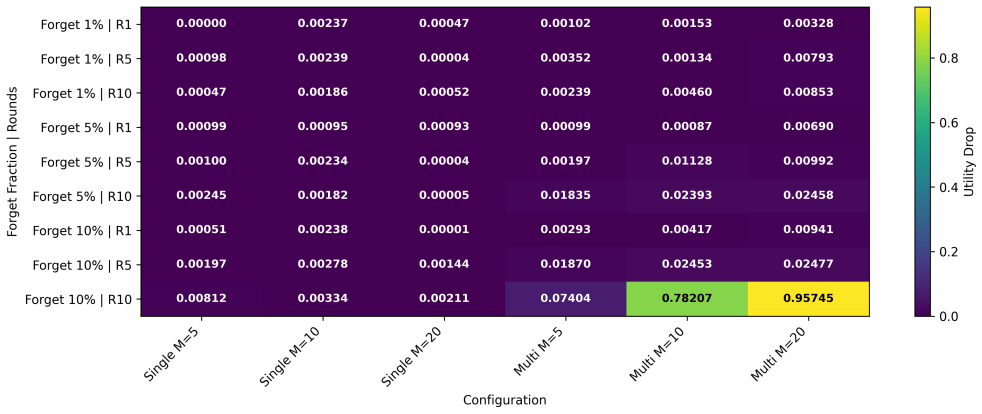
- The collapse of the M=20 configuration under aggressive deletion reveals a fundamental data-budget constraint: shard-based unlearning systems must ensure that no shard's retained data falls below a minimum viability threshold, which scales with both shard count and expected cumulative deletion volume.
Editorial analysis
A structured set of objections, weighed in public.
Referee Report
Summary. This manuscript proposes integrating a Double Deep Q-Network (DDQN) ransomware detector with multi-shard SISA (Sharded, Isolated, Sliced, Aggregated) retraining to enable privacy-compliant machine unlearning under GDPR/CCPA-style deletion requests. The DDQN learns a reward-guided detection policy with asymmetric security costs (false negatives penalized more than false positives), while SISA localizes retraining to affected shards. The framework is evaluated across 270 configurations (shard counts M=5,10,20; forget fractions 1%,5%,10%; deletion rounds 1,5,10; single- and multi-shard scenarios) on a balanced 2,000-sample Windows 11 behavioral dataset with 103 features. Four evaluation dimensions are assessed: utility preservation, oracle-verified forgetting, membership-inference privacy risk via Q-margin ROC-AUC, and computational efficiency. The baseline DDQN achieves F1=0.9925 and AUC=0.9983. The authors find that moderate shard counts (M=5-10) provide the best efficiency-stability trade-off, reducing retraining time to 5-30s versus 80-330s for full retraining, while maintaining MIA scores near 0.5. The paper honestly reports failure modes, including ensemble collapse for M=20 under aggressive repeated deletions.
Significance. The integration of value-based deep reinforcement learning with SISA-based machine unlearning is a novel and practically motivated contribution, as prior SISA work has focused on supervised learning and the combination with RL-based cybersecurity detection is largely unexplored. The dual-audit protocol combining oracle-verified forgetting and Q-margin-based membership-inference auditing is a thoughtful evaluation design that goes beyond runtime-only metrics common in unlearning papers. The systematic deletion-stress evaluation (270 configurations with 5-fold CV) and transparent reporting of boundary-condition failures (M=20 collapse) are commendable. The practical relevance to compliance-oriented security operations is clear. However, the significance is tempered by the small dataset size (2,000 samples), the use of a lightweight MIA proxy rather than adaptive attacks, and an unresolved concern about retraining budget adequacy that potentially affects the privacy claims.
major comments (4)
- §3.5.3, Table 4: The unlearning retraining budget is set to 2,000 steps per affected shard, while initial SISA training uses 5,000 steps per shard and oracle retraining uses 5,000 steps. This 60% reduction for unlearning retraining is not justified, and no convergence diagnostic (loss curves, Q-value distributions, reward stabilization) is reported for the retrained shards. This is load-bearing for the privacy claim: the MIA proxy (Eqs. 24-25) distinguishes members from non-members using ensemble Q-margin ROC-AUC. If 2,000 steps is insufficient for the retrained DDQN to converge, Q-margins would be compressed toward zero, artificially pushing MIA AUC toward 0.5 regardless of whether genuine unlearning occurred. The favorable privacy result (MIA ≈ 0.5 across most configurations in Table 9) could thus be an artifact of undertraining rather than evidence of successful forgetting. The asymm_
- §5.1, Table 5 vs. Tables 6-7: The baseline (non-SISA) DDQN achieves F1=0.9925, but the SISA ensemble's pre-unlearning F1 scores are notably lower: 0.97968 (M=5), 0.96802 (M=10), and 0.95257 (M=20) as shown in the 'F1 Before' columns of Tables 6-7. This represents a pre-unlearning degradation of 1.3-4.0 percentage points that is not analyzed in depth. The paper focuses on post-unlearning delta (ΔF1) but does not discuss why the SISA ensemble underperforms the global model before any deletion occurs. This matters because the central claim of 'high detection performance' is typically benchmarked against the non-SISA baseline. The authors should explicitly acknowledge and explain this pre-unlearning gap (e.g., reduced per-shard sample diversity, ensemble aggregation effects) and clarify whether the reported F1>0.99 claim in the abstract refers only to the non-SISA baseline.
- §3.6.3, Eqs. 24-25: The membership inference 'attack' is a proxy based on Q-margin ROC-AUC between training and test samples. This is a lossless/loss-threshold MIA at best and does not represent an adaptive adversary. The paper states in §6 that 'relied on a Q-margin-based MIA proxy rather than stronger adaptive attacks' is a limitation, but the abstract and conclusions present MIA ≈ 0.5 as evidence of 'limited privacy leakage.' The gap between the proxy metric and actual adversarial privacy risk should be more clearly scoped: the current evaluation shows that Q-margin distributions do not distinguish members from non-members, but this does not rule out leakage detectable by more sophisticated attacks (e.g., neural-network-based MIA, calibration attacks). The claims in the abstract and §5.4 should be qualified accordingly.
- §3.1, §5: The dataset comprises 2,000 samples (1,000 ransomware, 1,000 benign) with 103 features. While the paper acknowledges this as a limitation in §6, several claims depend on scale. The computational efficiency claim (5-30s vs. 80-330s for full retraining) is measured on a dataset where full retraining takes only ~34s for a single DDQN (Table 5). The 80-330s oracle times in Table 10 likely reflect 5-fold CV overhead. The scalability of SISA's efficiency advantage to larger datasets (where full retraining would take hours, not seconds) is not demonstrated. The paper should clarify whether the efficiency results are expected to hold proportionally at scale or whether the overhead of managing M independent shard models introduces fixed costs that would change the trade-off at larger N.
minor comments (7)
- §3.3, Eq. 9: The reward function uses values +1, -2, -0.5. These are listed as free parameters in the axiom ledger but their sensitivity is not analyzed. A brief note on why these specific ratios were chosen (e.g., 4:1 FN:FP ratio) would strengthen reproducibility.
- Table 1: The family name 'GandCrab (Grancrab)' appears inconsistent. The parenthetical 'Grancrab' should be clarified or corrected.
- §5.2: The explanation for M=20 collapse under 10%×10 rounds is well-reasoned (shard starvation below 10-sample minimum), but the minimum retained shard size threshold of 10 (Table 4) is introduced without prior justification. Why 10 and not 20 or 50?
- Figure 6: The axis labels and configuration codes (e.g., 'S | M10-F5-R5') are compact but require careful parsing. A legend or more descriptive labels would improve readability.
- §3.5.4, Eq. 18: Majority voting is used for aggregation, but the paper does not discuss ties (e.g., M=2 or even M with split votes). While M∈{5,10,20} avoids exact ties, the aggregation method should note this assumption.
- Table 11: The comparison with prior work is contextual (different datasets/protocols), which the authors acknowledge. However, adding a column for dataset size or evaluation protocol would help readers assess comparability.
- §3.3: The discount factor γ=0.1 is described as emphasizing immediate rewards. This is reasonable for per-sample classification, but the paper could note that this effectively reduces the MDP to a contextual bandit, which has implications for the 'reinforcement learning' framing.
Circularity Check
No significant circularity detected
full rationale
The paper's derivation chain is self-contained and does not exhibit circularity. The core components—DDQN, SISA, and the MIA proxy—are drawn from external literature (Bourtoule et al. 2021; Hasselt et al. for DDQN). The oracle model (Eq. 23) is trained from scratch on retained data, providing an independent ground truth for verification rather than being defined in terms of the unlearned model. The Q-margin (Eq. 19) is derived from the DDQN's learned Q-values, not fitted to the evaluation metric. The MIA proxy (Eq. 24-25) uses these margins to measure distinguishability, which is an independent measurement, not a self-definitional loop. While there is a self-citation to a preliminary version (Ferdous et al. 2026), it is explicitly described as a limited one-shard extension and does not serve as a load-bearing premise for the present paper's central claims. The skeptic's concern about undertraining (2,000 vs. 5,000 steps) is a validity threat regarding convergence verification, not a circularity issue, as the evaluation metrics are not defined in terms of their own inputs by construction.
Axiom & Free-Parameter Ledger
free parameters (7)
- Reward weights (+1, -2, -0.5) =
+1/-2/-0.5
- Discount factor gamma =
0.1
- Learning rate alpha =
0.001
- Epsilon decay schedule =
1.0 to 0.05 over 5000 steps
- Shard counts M =
5, 10, 20
- Unlearning retraining budget =
2000 steps
- Minimum retained shard size =
10 samples
axioms (4)
- domain assumption SISA shard isolation localizes sample influence to its shard
- domain assumption DDQN Q-margins serve as valid confidence scores for MIA auditing
- domain assumption Majority voting across shard models preserves detection quality
- domain assumption Behavioral features from ANY.RUN sandbox are representative of real-world ransomware
Cite this review
Pith. "Pith review of Auditable Machine Unlearning for Privacy-Compliant Ransomware Detection Using Multi-Shard SISA and Deep Reinforcement Learning." pith.science (2026). https://pith.science/paper/X5SKH6CV
@misc{pith2026260706860,
  author       = {Pith},
  title        = {Pith review of: Auditable Machine Unlearning for Privacy-Compliant Ransomware Detection Using Multi-Shard SISA and Deep Reinforcement Learning},
  year         = {2026},
  howpublished = {\url{https://pith.science/paper/X5SKH6CV}},
  note         = {Machine review of arXiv:2607.06860}
}
read the original abstract
Ransomware poses an escalating cybersecurity threat as attackers continuously modify behavioral patterns to evade static defenses. Although existing machine learning-based detectors often achieve strong predictive performance, they generally assume fixed training data and do not support the selective removal of previously learned samples. This limitation conflicts with privacy regulations such as the GDPR and CCPA, which require the removal of sensitive user data upon request. To address this challenge, we propose an auditable ransomware detection and unlearning framework that integrates deep reinforcement learning with multi-shard SISA retraining. In the proposed system, a Double Deep Q-Network (DDQN) learns a reward-guided detection policy from behavioral features under asymmetric security costs, while multi-shard SISA enables privacy-compliant selective sample removal through shard-level retraining. The framework was evaluated using four criteria: utility preservation, oracle-based forgetting validation, membership inference auditing, and computational efficiency. On a balanced Windows 11 behavioral dataset comprising 2,000 samples and 103 features, the baseline DDQN detector achieved an F1 score of 0.9925 and an AUC of 0.9983. The experimental results show that single-shard unlearning maintains minimal utility degradation and low oracle disagreement, whereas moderate shard counts (M = 5-10) provide the best efficiency-performance trade-off, reducing retraining time to 5-30 s compared with 80-330 s for full retraining. In addition, the membership inference scores remain close to 0.5 across most configurations, indicating limited privacy leakage after unlearning. These findings demonstrate that a privacy-compliant ransomware detection framework can jointly achieve high detection performance, auditable deletion verification, and efficient sample removal.
Figures




Reference graph
Works this paper leans on
-
[1]
Trend Micro. URL:https://www.trendmicro. com/vinfo/au/security/news/cybercrime-and-digital-threats/ narrowed-sights-bigger-payoffs-ransomware-in-2019. accessed: Oct. 01,
work page 2019
-
[2]
Abbasi,M.S.,Al-Sahaf,H.,Mansoori,M.,Welch,I.,2022. Behavior-based ransomware classification: A particle swarm optimization wrapper- based approach for feature selection. Applied Soft Computing 121, 108744. URL:https://www.sciencedirect.com/science/article/pii/ S1568494622001867, doi:https://doi.org/10.1016/j.asoc.2022.108744. abuse.ch,
-
[3]
Xrguard: A model-agnostic approach to ransomware detection using dynamic analysis and explainable ai. IEEE Access 13, 53159–53170. doi:10.1109/ACCESS.2025.3553562. ANY.RUN,
-
[4]
Gad-sisa: A scalable defense against label flipping attack, in: 2025 IEEE 17th International Conference on Computational Intelligence and Communication Networks (CICN), pp. 893–898. doi:10.1109/CICN67655.2025.11368228. Bourtoule,L.,Chandrasekaran,V.,Choquette-Choo,C.A.,Jia,H.,Travers, A., Zhang, B., Lie, D., Papernot, N.,
-
[5]
Machine unlearning, in: 2021 IEEE symposium on security and privacy (SP), pp. 141–159. doi:10.1109/SP40001.2021.00019. Braue, D.,
-
[6]
Global ransomware damage costs.https:// cybersecurityventures.com/ransomware-market-report-2022. Cyberse- curity Ventures. Accessed: Feb. 11,
work page 2022
-
[7]
Computers & Security 150, 104293
Ransoguard: A rnn-based framework leveraging pre-attack sensitive apis for early ransomware detection. Computers & Security 150, 104293. URL:https: //www.sciencedirect.com/science/article/pii/S0167404824005996, doi:https://doi.org/10.1016/j.cose.2024.104293. Cui, B., Hu, Y., Qu, T., He, Y., Sun, L.,
-
[8]
High-Confidence Computing 6, 100338
A novel zero- day ransomware detection approach based on cvae and 1d- cnn. High-Confidence Computing 6, 100338. URL:https: //www.sciencedirect.com/science/article/pii/S266729522500042X, doi:https://doi.org/10.1016/j.hcc.2025.100338. Deng, X., Cen, M., Jiang, M., Lu, M.,
-
[9]
Privacy-Aware Machine Unlearning with SISA for Reinforcement Learning-Based Ransomware Detection
Privacy-aware machine unlearn- ing with sisa for reinforcement learning-based ransomware detection. arXiv preprint arXiv:2604.16760 doi:https://doi.org/10.48550/arXiv. 2604.16760. Ferdous,J.,Islam,R.,Mahboubi,A.,Islam,M.Z.,2025. Anoveltechnique for ransomware detection using image based dynamic features and transfer learning to address dataset limitations...
work page internal anchor Pith review Pith/arXiv arXiv doi:10.48550/arxiv 2025
-
[10]
Ai-based ransomware detection: A comprehensive review. IEEE Access 12, 136666–136695. doi:10.1109/ACCESS.2024.3461965. Gulmez, S., Gorgulu Kakisim, A., Sogukpinar, I.,
-
[11]
Computers & Security 139, 103703
Xran: Explainable deep learning-based ransomware detection using dynamic analysis. Computers & Security 139, 103703. URL:https: //www.sciencedirect.com/science/article/pii/S016740482400004X, doi:https://doi.org/10.1016/j.cose.2024.103703. :Preprint submitted to Elsevier Page 18 of 19 Hampton, N., Baig, Z., Zeadally, S.,
-
[12]
Journal of Information Security and Applications 40, 44–51
Ransomware behavioural analysis on windows platforms. Journal of Information Security and Applications 40, 44–51. doi:10.1016/j.jisa.2018.02.008. Herrera-Silva,J.A.,Hernández-Álvarez,M.,2023. Dynamicfeaturedataset for ransomware detection using machine learning algorithms. Sen- sors
-
[13]
Computers & Security 135, 103510
Behavioral fingerprinting to detect ran- somware in resource-constrained devices. Computers & Security 135, 103510. URL:https://www.sciencedirect.com/science/article/pii/ S0167404823004200, doi:https://doi.org/10.1016/j.cose.2023.103510. Iosifache,
-
[14]
JournalofNetworkandComputerApplications230,103950
Leveraging appli- cationpermissionsandnetworktrafficattributesforandroidransomware detection. JournalofNetworkandComputerApplications230,103950. doi:10.1016/j.jnca.2024.103950. Jiang, Y., Yu, G., Wang, Q., Wang, X., Ma, B., Sun, C., Ni, W., Liu, R.P.,
-
[15]
Split unlearning, in: Proceedings of the 2025 ACM SIGSAC ConferenceonComputerandCommunicationsSecurity,Associationfor Computing Machinery, New York, NY, USA. p. 948–962. URL:https: //doi.org/10.1145/3719027.3744787, doi:10.1145/3719027.3744787. Kumar, S., Singh, S.K., Sarin, S., Subba, C.K., Arya, V., Nand- hini, N., Gupta, B.B., Chui, K.T.,
-
[16]
Cyber Security and Applications 3, 100095
Leveraging dynamic embeddings and reinforcement learning with bayesian networks for ransomware resiliences. Cyber Security and Applications 3, 100095. URL:https://www.sciencedirect.com/science/article/pii/ S2772918425000128, doi:https://doi.org/10.1016/j.csa.2025.100095. Li, N., Zhou, C., Gao, Y., Chen, H., Zhang, Z., Kuang, B., Fu, A.,
-
[17]
IEEE Transactions on Neural Networks and Learning Sys- tems 36, 13709–13729
Machine unlearning: Taxonomy, metrics, applications, challenges, and prospects. IEEE Transactions on Neural Networks and Learning Sys- tems 36, 13709–13729. doi:10.1109/TNNLS.2025.3530988. Liu,Z.,Ye,H.,Chen,C.,Zheng,Y.,Lam,K.Y.,2025. Threats,attacks,and defenses in machine unlearning: A survey. IEEE Open Journal of the Computer Society 6, 413–425. doi:10....
-
[18]
Computers & Security 130, 103265
Improv- ing ransomware detection based on portable executable header using xception convolutional neural network. Computers & Security 130, 103265. URL:https://www.sciencedirect.com/science/article/pii/ S016740482300175X, doi:10.1016/j.cose.2023.103265. Nguyen, T.T., Huynh, T.T., Ren, Z., Nguyen, P.L., Liew, A.W.C., Yin, H., Nguyen, Q.V.H.,
-
[19]
ACM Transactions on Intelligent Systems and Technology 16, 1–46
A survey of machine unlearning. ACM Transactions on Intelligent Systems and Technology 16, 1–46. URL: https://doi.org/10.1145/3749987, doi:10.1145/3749987. Palo Alto Networks,
-
[20]
Romdhana, A., Merlo, A., Ceccato, M., Tonella, P.,
Adverl-elf: Adversarial elf malware generation using reinforcement learning , 1–7doi:10.1109/ DAC63849.2025.11132466. Romdhana, A., Merlo, A., Ceccato, M., Tonella, P.,
-
[21]
Computers & Security 131, 103311
Assessing the security of inter-app communications in android through reinforcement learning. Computers & Security 131, 103311. URL:https: //www.sciencedirect.com/science/article/pii/S0167404823002213, doi:https://doi.org/10.1016/j.cose.2023.103311. Rookard, C., Khojandi, A.,
-
[22]
Computers & Security 140, 103786
Rriot: Recurrent reinforcement learning for cyber threat detection on iot devices. Computers & Security 140, 103786. URL:https://www.sciencedirect.com/science/article/pii/ S0167404824000877, doi:https://doi.org/10.1016/j.cose.2024.103786. Sehgal, S., Bansal, H., Verma, A.,
-
[23]
Extending grapheraser: Scalable and secure partition-based graph unlearning on large-scale network, in: 2025 IEEE 5th International Conference on ICT in Business Industry & Government (ICTBIG), pp. 1–9. doi:10.1109/ICTBIG68706.2025. 11323936. SnapFiles,
-
[24]
Maturing criminal marketplaces present new challenges to defenders (sophos 2023 threat report).https://www.scribd.com/ document/628559505/Sophos-Threat-Report-2023. Accessed: Sep. 21,
-
[25]
The ransomware threat landscape. Ransomware Threat Landscape. doi:10.2307/j.ctv1f8xc7v. Tang, Y., Sun, J., Wang, H., Deng, J., Tong, L., Xu, W.,
-
[26]
A method of network attack-defense game and collaborative defense decision-making based on hierarchical multi-agent reinforcement learning. Computers & Security 142, 103871. URL:https: //www.sciencedirect.com/science/article/pii/S016740482400172X, doi:https://doi.org/10.1016/j.cose.2024.103871. ThorstenSick,I.P.,2024. Whatiscuckoosandbox?https://cuckoosan...
-
[27]
Available online:https://www.trendmicro.com/ vinfo/gb/security/news/ransomware-by-the-numberst
Phobos emerges as a formidable threat in q1 2024, lockbit stays in the top spot. Available online:https://www.trendmicro.com/ vinfo/gb/security/news/ransomware-by-the-numberst. VirusShare,
work page 2024
-
[28]
Expert Systems with Applications 296, 129225
A swarm intelligence-enhanced ransomware detection framework via dynamic memory feature optimization. Expert Systems with Applications 296, 129225. URL:https://www.sciencedirect.com/science/article/pii/ S0957417425028416, doi:https://doi.org/10.1016/j.eswa.2025.129225. Xiao, F., Chen, S., Yang, J., He, H., Jiang, X., Tan, X., Jin, D.,
-
[29]
Computers & Security 148, 104180
Grain: Graph neural network and reinforcement learning aided causality discovery for multi-step attack scenario reconstruction. Computers & Security 148, 104180. URL:https: //www.sciencedirect.com/science/article/pii/S0167404824004851, doi:https://doi.org/10.1016/j.cose.2024.104180. Xu,J.,Wu,Z.,Wang,C.,Jia,X.,2024. Machineunlearning:Solutionsand challenge...
-
[30]
Mobtext-sisa: Efficient machine unlearning for mobility logs with spatio-temporal and natural-language data, in: Proceedings of the 33rd ACMInternationalConferenceonAdvancesinGeographicInformation Systems, Association for Computing Machinery, New York, NY, USA. p. 1186–1189. URL:https://doi.org/10.1145/3748636.3763226, doi:10. 1145/3748636.3763226. Zscaler,
-
[31]
2022 threatlabz state of ransomware report.https://www.zscaler.com/resources/industry-reports/ 2022-threatlabz-ransomware-report.pdf. Accessed: Oct. 12,
work page 2022
-
[32]
Enhancingdynamicmalwarebehavioranalysis throughnovelwindowseventswithmachinelearning
Önal,G.,Güven,M.,2025. Enhancingdynamicmalwarebehavioranalysis throughnovelwindowseventswithmachinelearning. IEEEAccess13, 153937–153958. doi:10.1109/ACCESS.2025.3604979. :Preprint submitted to Elsevier Page 19 of 19
discussion (0)
Sign in with ORCID, Apple, or X to comment. Anyone can read and Pith papers without signing in.