REVIEW 4 major objections 5 minor 28 references
Bamboo-forest crystal geometry yields zero or negative compressibility in metal cyanides
Reviewed by Pith at T0; open to challenge. T0 means a machine referee read the full paper against a public rubric. the ladder, T0–T4 →
T0 review · glm-5.2
2026-07-09 23:11 UTC pith:XS6GE7H3
load-bearing objection DFT study of NLC/ZLC in metal cyanides — solid methodology but the symmetry-tolerance issue is a real soft spot the 4 major comments →
Negative and Zero Linear Compressibility in MCN (M = Ag, Au, Cu): A First-Principles Study
The pith
A machine-rendered reading of the paper's core claim, the machinery that carries it, and where it could break.
Core claim
The central discovery is that the MCN family achieves zero or negative linear compressibility through a bamboo-forest mechanism: one-dimensional rigid metal-cyanide rods held together by weak inter-rod interactions allow hydrostatic pressure to compress the packing density in the perpendicular plane while leaving the rod direction nearly unchanged or slightly expanded. This is distinct from previously known NLC mechanisms such as wine-rack hinging, polyhedral tilting, or layer sliding.
What carries the argument
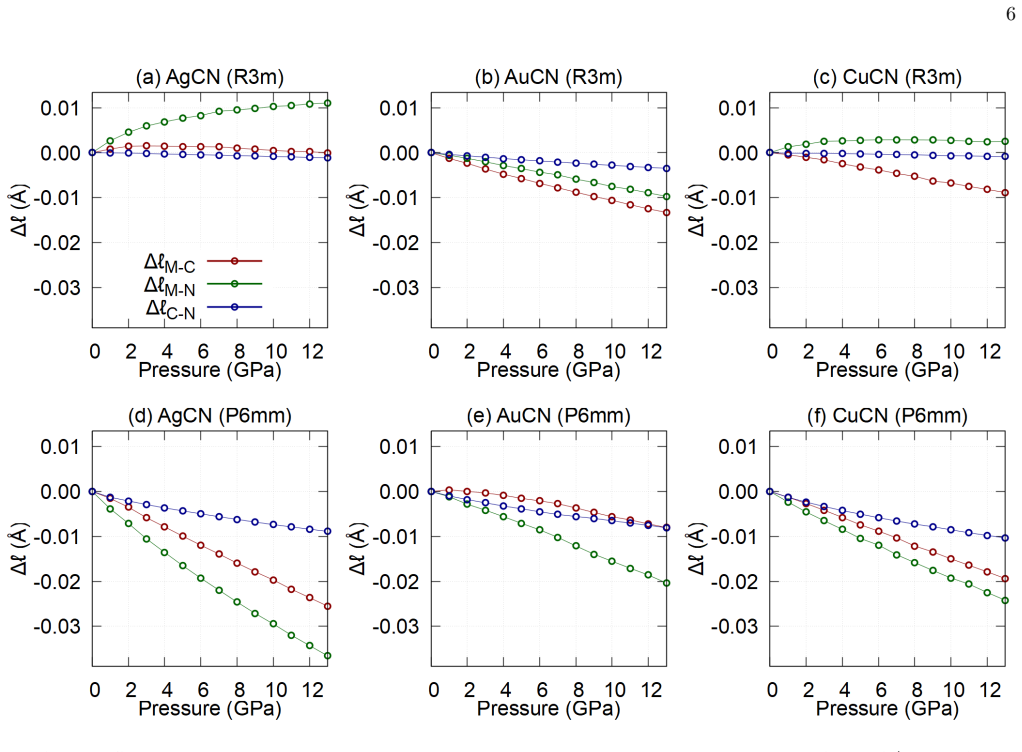
The load-bearing machinery is the elastic anisotropy ratio C33/C11, which exceeds 10 in all six structures. The c-axis elastic constant C33 (along the rods) is governed by extremely stiff bonds involving light atoms (C and N), as confirmed by phonon frequencies up to 68 THz. The in-plane softness is confirmed by a transverse phonon mode at only 1.2 THz, corresponding to weak inter-rod bonding. The combination produces minimum linear compressibility values along c that are near zero (0.08-1.84 TPa^-1 in P6mm phases) or negative (-0.93 to -1.52 TPa^-1 in R3m AgCN with two of three functionals).
Load-bearing premise
The R3m and P6mm high-symmetry phases are treated as physically realizable, but at standard computational symmetry tolerance they relax into lower-symmetry Cm and Cmm2 phases. The authors restore the higher symmetry by loosening the tolerance, noting energy differences below 10^-5 eV. If the lower-symmetry phases are the true ground states, the computed elastic constants and compressibility values could differ.
What would settle it
High-pressure X-ray diffraction or neutron scattering on single crystals of AgCN, AuCN, or CuCN in the R3m or P6mm phases could directly measure the c-axis lattice parameter as a function of hydrostatic pressure. If the c-axis contracts normally rather than staying constant or expanding, the ZLC/NLC prediction and the bamboo-forest mechanism would be falsified.
Editorial analysis
A structured set of objections, weighed in public.
Referee Report
Summary. This manuscript uses first-principles DFT calculations to investigate negative and zero linear compressibility (NLC/ZLC) in the MCN family (M = Ag, Au, Cu) across R3m and P6mm phases. The authors predict three previously unreported phases (P6mm for AgCN and CuCN; R3m for AuCN), compute elastic constants using six exchange-correlation functionals, and find that all six structures exhibit extreme elastic anisotropy (C33 >> C11) leading to ZLC or NLC along the c-direction. They propose a 'bamboo forest' mechanism where rigid 1D MCN rods accommodate pressure through changes in packing density rather than rod compression, and show via finite-pressure calculations that the anomalous response persists up to 13 GPa. The methodology is standard and the comparison with experimental lattice constants and phonon frequencies validates the computational approach.
Significance. The paper makes a concrete contribution by expanding the known family of ZLC/NLC materials and proposing a mechanism distinct from the wine-rack, tilting, and sliding mechanisms previously reported. The prediction of new energetically competitive phases is a falsifiable claim testable by high-pressure XRD. The identification of ultra-high phonon frequencies (up to 68 THz) and large phonon gaps as signatures of the 1D rigidity is a useful physical insight. The persistence of ZLC/NLC over a wide pressure range (up to 13 GPa) is a practically relevant finding. However, the significance is tempered by the fact that the NLC prediction is functional-dependent for AgCN (R3m) and that the ZLC values for most structures are small in magnitude, placing them near the boundary between ZLC and merely low compressibility.
major comments (4)
- §Structural and Elastic Properties, paragraph 1: The central claim that all six MCN phases exhibit ZLC or NLC depends on elastic constants computed at R3m and P6mm structures. The authors acknowledge that at standard symmetry tolerance (10^-5 Å), these structures relax into lower-symmetry Cm and Cmm2 phases, and they restore higher symmetry by loosening tolerance to 10^-3 Å. Since elastic constants are second derivatives of the energy with respect to strain, computing them at a point that is not a true local minimum (the high-symmetry structure) is problematic: the curvature of the energy surface can differ between the high-symmetry flat/saddle point and the true minimum. The lower-symmetry phases (Cm has 13 independent elastic constants vs. R3m's 7) have additional terms that could alter the computed linear compressibility. The authors should either (a) compute the full elastic tensor (
- §Structural and Elastic Properties, paragraph 5 and Table III: The NLC prediction for AgCN (R3m) is functional-dependent — r2SCAN and PBEsol predict negative compressibility along c, while PBE-D3 does not (Table III: β_min = 0.29 TPa^-1 for PBE-D3 vs. -1.52 and -0.93 for PBEsol and r2SCAN). The authors note this but do not resolve it. Given that PBE-D3 is identified as one of the two best-performing functionals (Table I), the discrepancy is not minor. The authors should discuss which functional is more reliable for elastic properties specifically (not just lattice constants) and whether the NLC claim for AgCN (R3m) is robust. As it stands, the claim 'all six members exhibit ZLC or NLC' is not uniformly supported across functionals.
- §Structural and Elastic Properties, paragraph 4 and Table III: AuCN in the R3m phase is mechanically unstable with PBEsol (C44 = -1.02 GPa) and r2SCAN (C44 = -0.79 GPa), stabilized only by dispersion corrections (PBE-D3 and PBEsol-D3). The authors retain this phase but do not adequately justify why dispersion corrections should stabilize a phase that is otherwise unstable. Since this is one of the six structures central to the paper's claim, the mechanical instability should be addressed more carefully — for instance, by examining the phonon dispersion of AuCN (R3m) for imaginary modes, which would directly test dynamical stability.
- §Structural and Elastic Properties, paragraph 5: The authors state that the linear compressibility values correspond to the zero-pressure limit and then investigate finite pressure up to 13 GPa (Fig. 2). However, the connection between the zero-pressure elastic constants (Table III) and the finite-pressure behavior (Fig. 2) is not made quantitative. For AgCN (R3m), the insets in Fig. 2 show NLC, but the magnitude of NLC (the slope of Δc vs. P) is not reported as a compressibility value for comparison with the zero-pressure β_min. Providing the finite-pressure linear compressibility values would strengthen the claim that NLC 'persists over a wide pressure range.'
minor comments (5)
- Table I: The percent errors for PBE (17% for AgCN a-parameter) seem unusually large. This should be briefly commented on — is this a known failure of PBE for these systems due to missing dispersion?
- Fig. 2: The y-axis label 'Δa/a₀' or similar should be explicitly stated; currently the figure caption says 'Change in lattice parameters' but the axes are not fully labeled in the caption.
- §Structural and Elastic Properties, paragraph 3: The statement 'dispersion corrections improve predictions for PBE but not for the other functionals' could be quantified — by how much do D3 corrections change the errors for PBEsol and r2SCAN?
- Table III: The E_max entries marked '-' for AuCN (R3m) with PBEsol and r2SCAN are described as 'unphysical values.' This should be briefly explained — what makes them unphysical?
- The term 'bamboo forest' is introduced without prior context. A brief sentence explaining the analogy (rigid vertical rods with sparse packing) at first use would help readers.
Circularity Check
No circularity found: compressibility values derived from first-principles elastic constants via standard thermodynamic relations with no fitted parameters or self-definitional loops.
full rationale
The paper's derivation chain is self-contained and non-circular. Elastic constants C_ij are computed from first-principles DFT using the finite difference method (stress-strain relationships). Linear compressibilities, Young's moduli, and bulk moduli are then derived from these elastic constants using the ELATE software, which applies standard thermodynamic relations with no free parameters fitted to the target result. The 'bamboo forest' mechanism is a structural interpretation of the computed anisotropy (C33 >> C11), not a derivation from fitted quantities. The predicted new phases (P6mm for AgCN/CuCN, R3m for AuCN) are generated by chemical substitution and relaxed ab initio, with their energetic competitiveness assessed independently. No self-citation is load-bearing for the central claims. The functional-dependent sign of compressibility (e.g., NLC for AgCN R3m with r2SCAN but not PBE-D3) is reported transparently rather than being forced. The concerns about high-symmetry phases not being true structural minima (relaxing to Cm/Cmm2 at standard tolerance) are correctness risks, not circularity issues — the elastic constants are still computed from DFT energy curvatures, not defined in terms of the compressibility they aim to predict.
Axiom & Free-Parameter Ledger
axioms (4)
- domain assumption Density functional theory with the tested functionals (PBE-D3, PBEsol, r2SCAN) accurately describes the structural and elastic properties of MCN crystals.
- ad hoc to paper The R3m and P6mm high-symmetry phases are physically realizable and represent the correct structural models for these materials.
- domain assumption The finite-difference method as implemented in VASP yields accurate single-crystal elastic constants for these anisotropic structures.
- domain assumption No pressure-induced phase transitions occur within 0-13 GPa for the studied phases (except possibly CuCN near 11 GPa).
invented entities (1)
-
'Bamboo forest' mechanism
independent evidence
read the original abstract
Negative linear compressibility (NLC) is the counterintuitive phenomenon in which a crystallographic axis expands under hydrostatic pressure. A related phenomenon, zero linear compressibility (ZLC), occurs when an axis shows no length change under pressure. Both responses are rare and arise in materials with highly anisotropic mechanical properties. Motivated by recent reports of anomalous behavior in metal cyanides - including negative thermal expansion and NLC - we use first-principles calculations to investigate the potential of the MCN family (M = Ag, Au, Cu) to exhibit ZLC or NLC. Our simulations reveal three main findings. First, we predict the existence of previously unreported phases: the P6mm phase for AgCN and CuCN, and the R3m phase for AuCN. Second, all six members of the MCN family studied exhibit extreme elastic anisotropy, which indeed leads to ZLC or NLC in each case. Third, we identify a mechanism for these responses distinct from previously reported ones. The mechanism arises from the unique "bamboo forest" geometry of the material: weakly interacting rigid rods whose sparse packing allows pressure to be accommodated through changes in packing density rather than rod compression. This mechanism enables the anomalous response to persist over a wide pressure range, contrasting favorably with other materials that exhibit similar behavior. Our findings expand the relatively small family of materials known to exhibit ZLC or NLC and provide deeper insight into the microscopic origin of these unusual mechanical responses.
Figures



Reference graph
Works this paper leans on
-
[1]
R. H. Baughman, S. Stafstrom, C. Cui, and S. O. Dantas. Materials with negative compressibilities in one or more dimensions.Science, 279(5356):1522–1524, March 1998. doi:10.1126/science.279.5356.1522
-
[2]
A. L. Goodwin, D. A. Keen, and M. G. Tucker. Large negative linear compressibility of Ag 3[Co(CN)6].Pro- ceedings of the National Academy of Sciences of the United States of America, 105:18708–18713, 2008. doi: 10.1073/pnas.0804789105
-
[3]
Andrew B. Cairns and Andrew L. Goodwin. Nega- tive linear compressibility.Phys. Chem. Chem. Phys., 17:20449–20465, 2015. doi:10.1039/C5CP00442J. URL http://dx.doi.org/10.1039/C5CP00442J
-
[4]
Joseph M. Ogborn, Ines E. Collings, Stephen A. Mog- gach, Amber L. Thompson, and Andrew L. Good- win. Supramolecular mechanics in a metal–organic framework.Chem. Sci., 3:3011–3017, 2012. doi: 10.1039/C2SC20596C. URLhttp://dx.doi.org/10. 1039/C2SC20596C
-
[5]
Qingxin Zeng, Kai Wang, Yuancun Qiao, Xiaodong Li, and Bo Zou. Negative linear compressibility due to layer sliding in a layered metal–organic framework.The Jour- nal of Physical Chemistry Letters, 8(7):1436–1441, 2017. doi:10.1021/acs.jpclett.7b00121. 8
-
[6]
Francisco Colmenero. Negative linear compressibility in nanoporous metal-organic frameworks rationalized by the empty channel structural mechanism.Physi- cal Chemistry Chemical Physics, 23(14):8508–8524, 2021. doi:10.1039/D1CP00214G. URLhttps://doi.org/10. 1039/D1CP00214G
-
[7]
X. Jiang, Y. Yang, M. S. Molokeev, P. Gong, F. Liang, S. Wang, L. Liu, X. Wu, X. Li, Y. Li, S. Wu, W. Li, Y. Wu, and Z. Lin. Zero linear compressibil- ity in nondense borates with a “lu-ban stool”-like struc- ture.Advanced Materials, 30(32):1801313, 2018. doi: 10.1002/adma.201801313
-
[8]
Yishuai Yu, Qingxin Zeng, Yaping Chen, Lina Jiang, Kai Wang, and Bo Zou. Extraordinarily persistent zero linear compressibility in metal-organic framework mil- 122(in).ACS Materials Letters, 2(5):519–523, 2020. doi: 10.1021/acsmaterialslett.0c00090
-
[9]
Qingxin Zeng, Wenbo Qiu, Jian Hao, Kai Wang, and Yinwei Li. Tunable zero linear compressibility under a rational designed mechanism of modular ”dumbbell”: A density functional theory study.ACS Materials Letters, 4 (4):541–547, 2022. doi:10.1021/acsmaterialslett.2c00074
-
[10]
S. J. Hibble, G. B. Wood, E. J. Bilb´ e, A. H. Pohl, M. G. Tucker, A. C. Hannon, and A. M. Chippindale. Structures and negative thermal expansion properties of the one-dimensional cyanides, cucn, agcn and aucn. Zeitschrift f¨ ur Kristallographie, 225:457–472, 2010. doi: 10.1524/zkri.2010.1314
-
[11]
M. K. Gupta, Baltej Singh, R. Mittal, S. Rols, and S. L. Chaplot. Lattice dynamics and thermal expan- sion behavior in the metal cyanidesmCN (m= Cu, ag, au): Neutron inelastic scattering and first-principles calculations.Phys. Rev. B, 93:134307, Apr 2016. doi: 10.1103/PhysRevB.93.134307. URLhttps://link.aps. org/doi/10.1103/PhysRevB.93.134307
-
[12]
Swayam Kesari, Alka B. Garg, Nilesh P. Salke, and Rekha Rao. Giant negative linear compressibility in or- thorhombic copper cyanide.Phys. Rev. Lett., 134:126102, Mar 2025. doi:10.1103/PhysRevLett.134.126102. URL https://link.aps.org/doi/10.1103/PhysRevLett. 134.126102
-
[13]
D. V. Korabel’nikov, I. A. Fedorov, and Y. N. Zhu- ravlev. Compressibility and electronic properties of metal cyanides.Physics of the Solid State, 63:1021–1027, 2021. doi:10.1134/S106378342107012X
-
[14]
Graham A. Bowmaker, Brendan J. Kennedy, and Ja- son C. Reid. Crystal structures of aucn and agcn and vibrational spectroscopic studies of aucn, agcn, and cucn.Inorganic Chemistry, 37(16):3968–3974, 1998. doi: 10.1021/ic9714697
-
[15]
M. K. Horton, P. Huck, R. X. Yang, and et al. Ac- celerated data-driven materials science with the materi- als project.Nature Materials, 24:1522–1532, 2025. doi: 10.1038/s41563-025-02272-0
-
[16]
Anubhav Jain, Shyue Ping Ong, Geoffroy Hautier, Wei Chen, William Davidson Richards, Stephen Dacek, Shreyas Cholia, Dan Gunter, David Skinner, Gerbrand Ceder, and Kristin A. Persson. Commentary: The ma- terials project: A materials genome approach to acceler- ating materials innovation.APL Materials, 1(1):011002,
-
[17]
doi:10.1063/1.4812323
-
[18]
G. Kresse and J. Hafner. Ab initio molecular dynamics for liquid metals.Physical Review B, 47:558–561, 1993. doi:10.1103/PhysRevB.47.558
-
[19]
G. Kresse and J. Furthm¨ uller. Efficiency of ab-initio total energy calculations for metals and semiconductors using a plane-wave basis set.Computational Materials Science, 6:15–50, 1996. doi:10.1016/0927-0256(96)00008-0
-
[20]
John P. Perdew, Kieron Burke, and Matthias Ernz- erhof. Generalized gradient approximation made sim- ple.Physical Review Letters, 77:3865–3868, 1996. doi: 10.1103/PhysRevLett.77.3865
-
[21]
Perdew, Kieron Burke, and Matthias Ernzerhof
John P. Perdew, Kieron Burke, and Matthias Ernzerhof. Generalized gradient approximation made simple [phys. rev. lett. 77, 3865 (1996)].Physical Review Letters, 78: 1396, 1997. doi:10.1103/PhysRevLett.78.1396
-
[22]
Stefan Grimme, Jens Antony, Stephan Ehrlich, and Helge Krieg. A consistent and accurate ab initio parametriza- tion of density functional dispersion correction (dft-d) for the 94 elements h-pu.The Journal of Chemical Physics, 132(15):154104, 04 2010. ISSN 0021-9606. doi: 10.1063/1.3382344. URLhttps://doi.org/10.1063/1. 3382344
-
[23]
Perdew, Adrienn Ruzsinszky, G´ abor I
John P. Perdew, Adrienn Ruzsinszky, G´ abor I. Csonka, Oleg A. Vydrov, Gustavo E. Scuseria, Lucian A. Con- stantin, Xiaolan Zhou, and Kieron Burke. Restoring the density-gradient expansion for exchange in solids and surfaces.Phys. Rev. Lett., 100:136406, Apr 2008. doi: 10.1103/PhysRevLett.100.136406. URLhttps://link. aps.org/doi/10.1103/PhysRevLett.100.136406
-
[24]
James W. Furness, Aaron D. Kaplan, Jinliang Ning, John P. Perdew, and Jianwei Sun. Accurate and numer- ically efficient r 2scan meta-generalized gradient approx- imation.The Journal of Physical Chemistry Letters, 11 (19):8208–8215, 2020. doi:10.1021/acs.jpclett.0c02405
-
[25]
Romain Gaillac, Pluton Pullumbi, and Fran¸ cois-Xavier Coudert. Elate: an open-source online application for analysis and visualization of elastic tensors.Journal of Physics: Condensed Matter, 28(27):275201, may 2016. doi:10.1088/0953-8984/28/27/275201. URLhttps:// doi.org/10.1088/0953-8984/28/27/275201. See also the ELATE application:https://progs.couder...
-
[26]
Olaf Reckeweg, Cora Lind, Arndt Simon, and Fran- cis J. DiSalvo. Synthesis, thermal and x-ray investiga- tions of the high-temperature phase of copper(i) cyanide. Zeitschrift f¨ ur Naturforschung B, 58 B(1):155–158, 2003. doi:10.1515/znb-2003-0123
-
[27]
Nanostructured thermoelectrics.Materials Science and Engineering: R: Reports, 67(2):19–63, 2010
Paothep Pichanusakorn and Prabhakar Bandaru. Nanostructured thermoelectrics.Materials Science and Engineering: R: Reports, 67(2):19–63, 2010. ISSN 0927- 796X. doi:https://doi.org/10.1016/j.mser.2009.10.001. URLhttps://www.sciencedirect.com/science/ article/pii/S0927796X09000904
-
[28]
Wahyu Setyawan and Stefano Curtarolo. High- throughput electronic band structure calculations: Challenges and tools.Computational Materials Science, 49(2):299–312, 2010. ISSN 0927-0256. doi: https://doi.org/10.1016/j.commatsci.2010.05.010. URL https://www.sciencedirect.com/science/article/ pii/S0927025610002697. 9 Supplemental Material (a) AgCN (R3m) (b) ...
discussion (0)
Sign in with ORCID, Apple, or X to comment. Anyone can read and Pith papers without signing in.