REVIEW 3 major objections 8 minor 27 references
Reviewed by Pith at T0; open to challenge.
T0 means a machine referee read the full paper against a public rubric. The mark states how deep the mechanical check went, never who wrote it. the ladder, T0–T4 →
T0 review · glm-5.2
Representation, not prompt design, limits SAM in medical segmentation
2026-07-09 00:40 UTC pith:W4V4WL2E
load-bearing objection Probabilistic representation learning for prompt-free SAM: solid idea, marginal gains, no significance testing the 3 major comments →
HPR-SAM: Hierarchical Probabilistic Representation Learning for Prompt-free SAM-based Medical Image Segmentation
The pith
A machine-rendered reading of the paper's core claim, the machinery that carries it, and where it could break.
Core claim
The central claim is a reframing of the prompt-free SAM problem: rather than designing better prompt generators, one should learn richer anatomical representations and let those representations drive prompt quality. The mechanism is probabilistic — replacing deterministic prototypes with Gaussian distributions and mixtures thereof — organized hierarchically across global, intra-structure, and local reliability scales. The ablation supports the claim that all three branches contribute, with the full model reaching 85.09% Mean Dice on Synapse versus 74.86% for the baseline without any of the three modules. DAR alone provides the largest single gain (+7.88%), while MAR and LRR add smaller but累积
What carries the argument
Three probabilistic representation branches: DAR (single Gaussian per organ for global priors), MAR (mixture of Gaussians per organ for sub-pattern diversity), LRR (per-token Gaussian with mutual-likelihood matching against class-level reliability references), combined by HPF (two-stage learnable weighted fusion of prediction maps).
Load-bearing premise
The paper assumes that all three probabilistic representation branches are necessary and complementary, but the ablation shows that DAR alone accounts for most of the improvement (from 74.86% to 82.74%), while MAR and LRR each add less than one percentage point on top of DAR. The marginal gains from the full hierarchy over simpler combinations (e.g., DAR+LRR at 84.32% vs. full model at 85.09%) leave open whether the added complexity is justified.
What would settle it
Ablation showing that DAR alone, or DAR combined with only one other branch, matches the full model's performance within noise margins on held-out data.
If this is right
- If representation quality is the true bottleneck, then future prompt-free SAM methods should invest in representation learning rather than prompt generator architecture, potentially simplifying the design space.
- The probabilistic representation approach could generalize to other foundation-model adaptation tasks beyond medical imaging, wherever deterministic prototypes are used to summarize variable visual categories.
- The few-shot results (4 cardiac scans, 3 prostate scans) suggest that probabilistic representations may be particularly effective under data scarcity, where deterministic prototypes are most likely to overfit to limited examples.
- The per-organ learnable fusion coefficients in HPF imply that different organs benefit from different representation branches — this could inform organ-specific adaptation strategies in clinical deployment.
Where Pith is reading between the lines
- The ablation shows DAR alone captures most of the gain (82.74% vs. 74.86% baseline), and the marginal contributions of MAR (+0.62% over DAR) and LRR (+1.58% over DAR+MAR) raise the question of whether a simpler single-branch probabilistic model could achieve comparable results with lower computational cost.
- The framework's compatibility with SAM's original decoder means the probabilistic representations are projected into the same prompt space SAM expects — this suggests the representation improvement is orthogonal to decoder architecture and could stack with decoder-side refinements like those used by H-SAM or PG-SAM.
- The LRR module's reliability estimation, if it truly identifies low-confidence regions, could be surfaced as an uncertainty map for clinical review, potentially flagging cases where automated segmentation should be verified by a radiologist.
Editorial analysis
A structured set of objections, weighed in public.
Referee Report
Summary. The paper proposes HPR-SAM, a prompt-free SAM adaptation framework for medical image segmentation that shifts focus from prompt generator design to anatomical representation learning. The framework introduces three probabilistic representation modules—DAR (global priors), MAR (intra-structure diversity), and LRR (local reliability)—whose predictions are fused via a Hierarchical Prediction Fusion (HPF) module. Experiments are conducted on Synapse (fully supervised), LA and PROMISE12 (few-shot). The method achieves 85.09% Mean Dice on Synapse, claiming state-of-the-art among SAM-based methods, and reports the best few-shot results on LA (84.65%) and PROMISE12 (81.26%). The core idea of modeling anatomical representations probabilistically rather than deterministically is well-motivated, and the ablation study in Table III provides reasonable evidence for component complementarity, particularly regarding HD95 improvement when all three branches are combined.
Significance. The paper addresses a relevant problem in prompt-free SAM adaptation for medical image segmentation. The reframing of prompt quality as a representation expressiveness problem is a reasonable conceptual contribution. The ablation study (Table III) is informative, particularly the HD95 progression showing that the full three-branch model achieves 11.94mm versus 17.74–18.08mm for any two-branch combination—a meaningful improvement that supports the hierarchical design. The release of anonymous code is a positive step toward reproducibility. The few-shot results on PROMISE12 (+4.31% over H-SAM) are more convincing than the Synapse headline claim. However, the significance of the Synapse SOTA claim is tempered by the small test set size (12 cases), the marginal Dice improvement, and the substantially worse HD95 compared to H-SAM and PG-SAM.
major comments (3)
- §IV-B, Table I: The headline SOTA claim on Synapse rests on a 0.30% Mean Dice improvement over PG-SAM (84.79% vs 85.09%) and 0.44% over H-SAM (84.65%), evaluated on only 12 test cases. No statistical significance tests, confidence intervals, or multi-seed variance estimates are reported. With 12 cases, a 0.30% mean Dice difference is within plausible noise from random seed variation or minor data split perturbations. The authors should either (a) report multi-seed variance and significance tests, or (b) moderate the SOTA claim to acknowledge that the Synapse ranking is not statistically substantiated. This is load-bearing because the Synapse SOTA claim is the primary headline in the abstract and contributions.
- §IV-B, Table I: HPR-SAM's HD95 (11.94mm) is substantially worse than H-SAM (7.29mm) and PG-SAM (7.61mm). The paper attributes this to competitors' 'decoder-side refinement for boundary enhancement' but provides no evidence for this claim—neither a citation, an architectural analysis, nor an ablation isolating the effect of decoder refinement. If H-SAM and PG-SAM do use such modules, the authors should cite the specific components; if not, the attribution should be removed. As stated, the explanation is unsupported and the HD95 gap undermines the claim of 'competitive boundary localization.' The paper should either substantiate this attribution or present the HD95 gap as a known limitation.
- §III-E, Eqs. (19)–(20): The HPF module uses learnable target-specific coefficients (α_c, β_c) that are optimized during training. The reader's report raises a concern about circularity—these coefficients are fitted on training data and then applied to test predictions. While this is standard for learnable fusion weights, the paper does not report the learned values of α_c and β_c, nor does it analyze whether they generalize across datasets or are dataset-specific. Since HPF is a core contribution and the fusion is target-wise, reporting the learned coefficients (or at least their distribution across targets) would strengthen the claim that the fusion is principled rather than overfit. Additionally, it is unclear whether α_c and β_c are shared across the three datasets or re-learned per dataset.
minor comments (8)
- §IV-A: Implementation details mention LoRA rank 4 and 200 epochs of AdamW, but do not specify the learning rate, weight decay, batch size, or data augmentation specifics. Please add these for reproducibility.
- Table I: The HD95 value for H-SAM appears as '7.29' without clear separation from the Mean Dice value '84.65' in the same cell ('84.657.29'). Please use a line break or separate columns to clearly distinguish Mean Dice and HD95.
- §III-B, Eq. (3): The text '在此处键入公式。' (Chinese for 'Type formula here') appears to be a leftover editing artifact. Please remove it.
- §III-C, Eq. (8): The mixture weights ω_{c,m} are described as 'learnable' but it is not stated whether they are constrained to sum to 1 (e.g., via softmax). Please clarify the normalization.
- §III-D, Eq. (16): The mutual likelihood formula uses ||μ_i − μ̄_c||² / (Σ_i + Σ̄_c) and log(Σ_i + Σ̄_c). If Σ_i and Σ̄_c are diagonal covariance matrices, this should be stated explicitly; if they are scalar variances, the notation should reflect that. Please clarify whether these are scalar, diagonal, or full matrix operations.
- Fig. 1 caption: 'DOR' and 'MOR' appear as abbreviations for DAR and MAR. These do not match the terminology used in the rest of the paper. Please correct.
- §IV-B: The paper states HPR-SAM 'consistently improves segmentation accuracy, surpassing ... H-SAM (+0.44%), and PG-SAM (+0.30%).' These margins are small; describing them as 'consistent' improvements overstates the evidence. Consider softer language.
- References [9] and [23] appear to refer to PGP-SAM and PG-SAM respectively, which seem to be related works from overlapping author groups. The relationship between these works should be clarified for readers.
Simulated Author's Rebuttal
We thank the referee for the careful and constructive review. The referee raises three major points: (1) the Synapse SOTA claim lacks statistical substantiation given the small test set and marginal Dice improvement; (2) the HD95 gap relative to H-SAM and PG-SAM is attributed to decoder-side refinement without evidence; and (3) the HPF learnable coefficients (α_c, β_c) are not reported or analyzed for generalization. We address each point below and commit to revisions for all three.
read point-by-point responses
-
Referee: §IV-B, Table I: The headline SOTA claim on Synapse rests on a 0.30% Mean Dice improvement over PG-SAM (84.79% vs 85.09%) and 0.44% over H-SAM (84.65%), evaluated on only 12 test cases. No statistical significance tests, confidence intervals, or multi-seed variance estimates are reported. With 12 cases, a 0.30% mean Dice difference is within plausible noise from random seed variation or minor data split perturbations. The authors should either (a) report multi-seed variance and significance tests, or (b) moderate the SOTA claim to acknowledge that the Synapse ranking is not statistically substantiated. This is load-bearing because the Synapse SOTA claim is the primary headline in the abstract and contributions.
Authors: The referee is correct that a 0.30% Mean Dice difference on 12 test cases cannot be presented as a statistically reliable improvement without further evidence. We will address this through both requested remedies. First, we will conduct multi-seed experiments (at least 3 seeds) and report mean ± standard deviation for both Mean Dice and HD95 on Synapse, along with paired statistical tests (e.g., Wilcoxon signed-rank test) against PG-SAM and H-SAM. Second, we will moderate the SOTA claim in the abstract and contributions to state that HPR-SAM achieves 'competitive' or 'best-reported' Mean Dice among SAM-based methods, explicitly noting that the margin on Synapse is small relative to the test set size and that statistical significance depends on the multi-seed analysis. We agree that the current phrasing overstates the strength of the evidence. The few-shot results on PROMISE12 (+4.31% over H-SAM) and LA (+0.71% over H-SAM) provide more robust evidence of improvement, and we will foreground these in the framing. revision: yes
-
Referee: §IV-B, Table I: HPR-SAM's HD95 (11.94mm) is substantially worse than H-SAM (7.29mm) and PG-SAM (7.61mm). The paper attributes this to competitors' 'decoder-side refinement for boundary enhancement' but provides no evidence for this claim—neither a citation, an architectural analysis, nor an ablation isolating the effect of decoder refinement. If H-SAM and PG-SAM do use such modules, the authors should cite the specific components; if not, the attribution should be removed. As stated, the explanation is unsupported and the HD95 gap undermines the claim of 'competitive boundary localization.' The paper should either substantiate this attribution or present the HD95 gap as a known limitation.
Authors: The referee is correct that the current attribution is unsupported. Upon review, H-SAM (Cheng et al., CVPR 2024) employs a hierarchical two-stage decoder with a mask-guided attention mechanism that explicitly refines boundary details, and PG-SAM (Zhong et al., BIBM 2025) incorporates a fine-grained prior-guided refinement module. We will revise the manuscript to cite these specific components rather than making a generic attribution. However, we acknowledge that without an ablation isolating decoder refinement in our own framework, we cannot definitively attribute the full HD95 gap to this factor alone. Therefore, we will also present the HD95 gap as a known limitation of the current framework: HPR-SAM prioritizes representation-level improvements through probabilistic anatomical modeling while retaining the original SAM decoder without additional boundary refinement, which likely contributes to the higher HD95. We will remove the phrase 'competitive boundary localization' and replace it with an honest acknowledgment that boundary precision remains a limitation. We also note that the ablation study (Table III) shows the full three-branch model reduces HD95 from 27.98mm (baseline) to 11.94mm, indicating that the hierarchical representation itself substantially improves boundary quality even without a dedicated refinement module. revision: yes
-
Referee: §III-E, Eqs. (19)–(20): The HPF module uses learnable target-specific coefficients (α_c, β_c) that are optimized during training. The reader's report raises a concern about circularity—these coefficients are fitted on training data and then applied to test predictions. While this is standard for learnable fusion weights, the paper does not report the learned values of α_c and β_c, nor does it analyze whether they generalize across datasets or are dataset-specific. Since HPF is a core contribution and the fusion is target-wise, reporting the learned coefficients (or at least their distribution across targets) would strengthen the claim that the fusion is principled rather than overfit. Additionally, it is unclear whether α_c and β_c are shared across the three datasets or re-learned per dataset.
Authors: We agree that reporting the learned fusion coefficients is important for transparency and for substantiating the claim that HPF performs principled fusion. To clarify: α_c and β_c are re-learned per dataset, as they are target-specific and dataset-specific parameters optimized during training on each dataset's training split. We will add a table or figure reporting the learned α_c and β_c values for each anatomical target on the Synapse dataset (and where applicable, on LA and PROMISE12). This will allow readers to inspect whether the fusion weights reflect meaningful patterns—for example, whether targets with higher intra-structure variation (e.g., pancreas, stomach) receive higher α_c values, or whether targets with more ambiguous boundaries receive higher β_c values. We will also add a brief discussion of whether the learned coefficients suggest overfitting (e.g., extreme values concentrating all weight on a single branch) or principled balancing across branches. If the coefficients show dataset-specific patterns, we will discuss this as expected behavior given that anatomical characteristics differ across datasets (abdominal CT vs. cardiac MRI vs. prostate MRI). revision: yes
Circularity Check
No significant circularity; derivation is self-contained with standard probabilistic modeling and external benchmark evaluation.
full rationale
The paper's derivation chain is self-contained. DAR (Eqs. 1-5), MAR (Eqs. 6-13), and LRR (Eqs. 14-18) are standard probabilistic representation learning modules — Gaussian distributions, posterior-guided feature aggregation, and mutual likelihood matching — none of which reduce to their inputs by construction. The HPF module (Eqs. 19-20) uses learnable target-specific coefficients (α_c, β_c) to linearly combine three prediction maps, but these are standard trainable parameters optimized on training data and evaluated on held-out test sets; they are not 'fitted inputs called predictions' in the circularity sense. The training objective (Eqs. 21-24) applies standard CE+Dice loss to branch and fused predictions. The ablation study (Table III) provides independent empirical evidence for the complementarity claim, with the full model (85.09%) outperforming all sub-combinations. There is author overlap with PG-SAM [23] (Y. Zhong, Y. Hu, J. Su appear on both), but this citation is used as a comparison baseline, not as a load-bearing premise for the derivation. The paper builds on external work (Probabilistic U-Net [16], PHISeg [17], hierarchical probabilistic U-Net [19]) for its methodological foundations. No step in the derivation chain reduces to its own inputs by definition or by self-citation.
Axiom & Free-Parameter Ledger
free parameters (5)
- Temperature τ
- Number of mixture components M
- HPF fusion coefficients α_c, β_c
- Loss weights λ_Dice, λ_branch
- LoRA rank
axioms (4)
- domain assumption SAM's image encoder provides sufficiently rich features for anatomical representation learning.
- domain assumption Gaussian distributions are sufficient to model anatomical uncertainty and diversity.
- ad hoc to paper The three properties (global priors, intra-structure diversity, local reliability) are complementary and their hierarchical fusion is optimal.
- domain assumption EMA is a valid method for maintaining class-wise reliability distributions.
invented entities (4)
-
Distributional Anatomical Representation (DAR)
independent evidence
-
Multi-component Anatomical Representation (MAR)
independent evidence
-
Local Reliability Representation (LRR)
independent evidence
-
Hierarchical Prediction Fusion (HPF)
independent evidence
read the original abstract
Prompt-free adaptation of the Segment Anything Model (SAM) has emerged as a promising paradigm for automatic medical image segmentation. Existing methods mainly focus on prompt generation, while overlooking that prompt quality is fundamentally constrained by the expressiveness of anatomical representations. However, deterministic prototypes or semantic tokens are insufficient to jointly capture global anatomical priors, intra-structure diversity, and local structural reliability. To address this limitation, we propose the Hierarchical Probabilistic Representation (HPR) framework, which learns complementary anatomical representations through Distributional Anatomical Representation (DAR), Multi-component Anatomical Representation (MAR), and Local Reliability Representation (LRR), and integrates their predictions via Hierarchical Prediction Fusion (HPF) while remaining compatible with the original SAM decoder. Experiments on the Synapse, LA, and PROMISE12 datasets demonstrate that HPR-SAM achieves state-of-the-art performance on Synapse and the best performance under few-shot settings on LA and PROMISE12, validating the effectiveness of the proposed hierarchical probabilistic representation learning framework for prompt-free medical image segmentation. Code is available at https://anonymous.4open.science/r/HPR-SAM-E4AF.
Figures
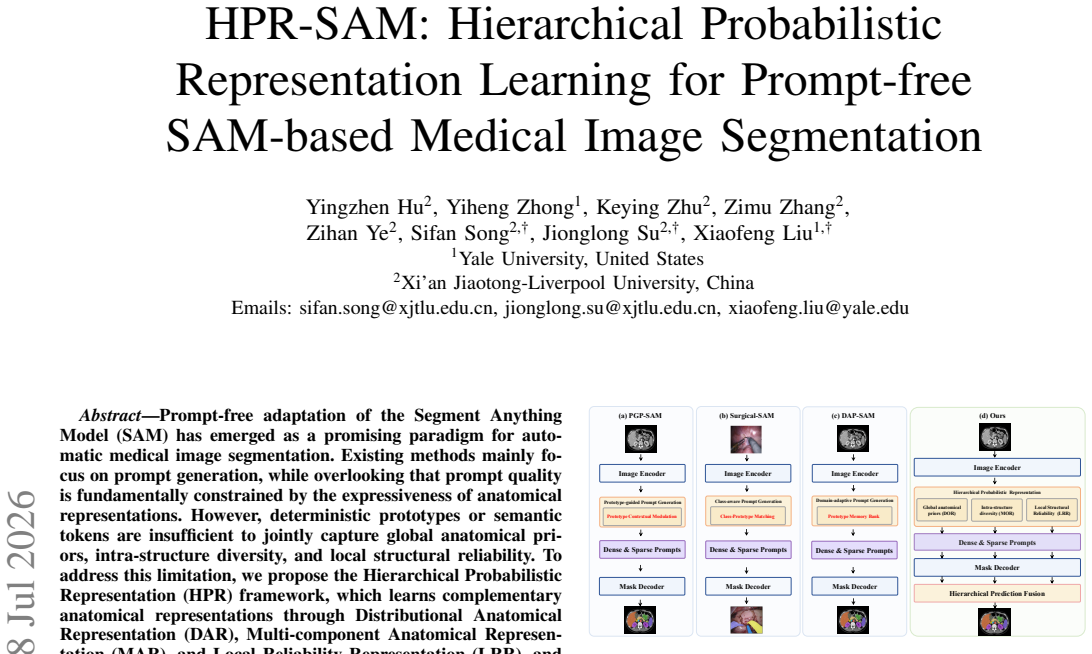


Reference graph
Works this paper leans on
-
[1]
U-net: Convolutional networks for biomedical image segmentation,
O. Ronneberger, P. Fischer, and T. Brox, “U-net: Convolutional networks for biomedical image segmentation,” inMedical Image Computing and Computer-Assisted Intervention – MICCAI 2015. Springer, 2015, pp. 234–241
work page 2015
-
[2]
nnu-net: A self-configuring method for deep learning-based biomedical image segmentation,
F. Isensee, P. F. Jaeger, S. A. A. Kohl, J. Petersen, and K. H. Maier-Hein, “nnu-net: A self-configuring method for deep learning-based biomedical image segmentation,”Nature Methods, vol. 18, no. 2, pp. 203–211, 2021
work page 2021
-
[3]
A. Kirillov, E. Mintun, N. Ravi, H. Mao, C. Rolland, L. Gustafson, T. Xiao, S. Whitehead, A. C. Berg, W.-Y . Lo, P. Dollár, and R. Girshick, “Segment anything,” inProceedings of the IEEE/CVF International Conference on Computer Vision, 2023, pp. 4015–4026
work page 2023
-
[4]
Segment anything in medical images,
J. Ma, Y . He, F. Li, L. Han, C. You, and B. Wang, “Segment anything in medical images,”Nature Communications, vol. 15, no. 1, p. 654, 2024
work page 2024
-
[5]
Customized Segment Anything Model for Medical Image Segmentation
K. Zhang and D. Liu, “Customized segment anything model for medical image segmentation,”arXiv preprint arXiv:2304.13785, 2023
work page internal anchor Pith review Pith/arXiv arXiv 2023
-
[6]
Medical sam adapter: Adapting segment anything model for medical image segmentation,
J. Wu, W. Ji, Y . Liu, H. Fu, M. Xu, Y . Xu, and Y . Jin, “Medical sam adapter: Adapting segment anything model for medical image segmentation,”Medical Image Analysis, vol. 102, p. 103547, 2025
work page 2025
-
[7]
Unleashing the potential of sam for medical adaptation via hierarchical decoding,
Z. Cheng, Q. Wei, H. Zhu, Y . Wang, L. Qu, W. Shao, and Y . Zhou, “Unleashing the potential of sam for medical adaptation via hierarchical decoding,” inProceedings of the IEEE/CVF Conference on Computer Vision and Pattern Recognition (CVPR), 2024, pp. 3511–3522
work page 2024
-
[8]
How to Efficiently Adapt Large Segmentation Model(SAM) to Medical Images
X. Hu, X. Xu, and Y . Shi, “How to efficiently adapt large segmentation model (sam) to medical images,”arXiv preprint arXiv:2306.13731, 2023
work page internal anchor Pith review Pith/arXiv arXiv 2023
-
[9]
PGP-SAM: Prototype-Guided Prompt Learning for Efficient Few-Shot Medical Image Segmentation
Z. Yan, Z. Yin, T. Lin, X. Zeng, K. Liang, and Z. Ma, “Pgp-sam: Prototype-guided prompt learning for efficient few-shot medical image segmentation,”arXiv preprint arXiv:2501.06692, 2025, accepted by ISBI 2025
work page internal anchor Pith review Pith/arXiv arXiv 2025
-
[10]
Surgicalsam: Efficient class promptable surgical instru- ment segmentation,
W. Yueet al., “Surgicalsam: Efficient class promptable surgical instru- ment segmentation,”arXiv preprint, 2024
work page 2024
-
[11]
Z. Wei, W. Dong, P. Zhou, Y . Gu, Z. Zhao, and Y . Xu, “Prompting segment anything model with domain-adaptive prototype for generaliz- able medical image segmentation,” inMedical Image Computing and Computer Assisted Intervention (MICCAI), 2024
work page 2024
-
[12]
TransUNet: Transformers Make Strong Encoders for Medical Image Segmentation
J. Chen, Y . Lu, Q. Yu, X. Luo, E. Adeli, Y . Wang, L. Lu, A. L. Yuille, and Y . Zhou, “Transunet: Transformers make strong encoders for medical image segmentation,”arXiv preprint arXiv:2102.04306, 2021
work page internal anchor Pith review Pith/arXiv arXiv 2021
-
[13]
Unetr: Transformers for 3d medical image segmentation,
A. Hatamizadeh, Y . Tang, V . Nath, D. Yang, A. Myronenko, B. Land- man, H. R. Roth, and D. Xu, “Unetr: Transformers for 3d medical image segmentation,” inProceedings of the IEEE/CVF Winter Conference on Applications of Computer Vision, 2022, pp. 574–584
work page 2022
-
[14]
Swin-unet: Unet-like pure transformer for medical image segmentation,
H. Cao, Y . Wang, J. Chen, D. Jiang, X. Zhang, Q. Tian, and M. Wang, “Swin-unet: Unet-like pure transformer for medical image segmentation,” inEuropean Conference on Computer Vision Workshops. Springer, 2022, pp. 205–218
work page 2022
-
[15]
J. Cheng, J. Ye, Z. Deng, J. Chen, T. Li, H. Wang, Y . Su, Z. Huang, J. Chen, L. Jiang, H. Sun, J. He, and S. Zhang, “Sam-med2d,”arXiv preprint arXiv:2308.16184, 2023
work page internal anchor Pith review Pith/arXiv arXiv 2023
-
[16]
A probabilistic u-net for segmentation of ambiguous images,
S. A. A. Kohl, B. Romera-Paredes, C. Meyer, J. De Fauw, J. R. Ledsam, K. Maier-Hein, S. M. A. Eslami, D. J. Rezende, and O. Ronneberger, “A probabilistic u-net for segmentation of ambiguous images,” inAdvances in Neural Information Processing Systems, vol. 31, 2018
work page 2018
-
[17]
Phiseg: Capturing uncertainty in medical image segmentation,
C. F. Baumgartner, K. C. Tezcan, K. Chaitanya, A. M. Hötker, U. J. Muehlematter, K. Schawkat, A. S. Becker, O. Donati, and E. Konukoglu, “Phiseg: Capturing uncertainty in medical image segmentation,” in International Conference on Medical Image Computing and Computer- Assisted Intervention. Springer, 2019, pp. 119–127
work page 2019
-
[18]
Y . Yuan, X. Wang, X. Yang, and P.-A. Heng, “Effective semi-supervised medical image segmentation with probabilistic representations and pro- totype learning,”IEEE Transactions on Medical Imaging, vol. 44, no. 3, pp. 1181–1195, 2025
work page 2025
-
[19]
A hierarchical probabilistic u-net for modeling multi-scale ambiguities,
S. A. A. Kohl, B. Romera-Paredes, C. Meyer, J. D. Fauw, J. R. Ledsam, K. H. Maier-Hein, S. M. A. Eslami, D. J. Rezende, and O. Ronneberger, “A hierarchical probabilistic u-net for modeling multi-scale ambiguities,” inAdvances in Neural Information Processing Systems, vol. 32, 2019
work page 2019
-
[20]
Miccai 2015 multi-atlas labeling beyond the cranial vault workshop and challenge,
B. Landman, Z. Xu, J. E. Igelsias, M. Styner, T. R. Langerak, and A. Klein, “Miccai 2015 multi-atlas labeling beyond the cranial vault workshop and challenge,”MICCAI Multi-Atlas Labeling Beyond Cranial V ault Workshop and Challenge, 2015
work page 2015
-
[21]
Global registration of left atrium images for multi-atlas based segmentation,
Z. Xionget al., “Global registration of left atrium images for multi-atlas based segmentation,” inStatistical Atlases and Computational Models of the Heart. Springer, 2021, pp. 285–293
work page 2021
-
[22]
Evaluation of prostate segmentation algorithms for mri: The promise12 challenge,
G. Litjens, R. Toth, W. van de Ven, C. Hoeks, S. Kerkstra, B. van Gin- neken, G. Vincent, G. Guillard, N. Birbeck, J. Zhanget al., “Evaluation of prostate segmentation algorithms for mri: The promise12 challenge,” Medical Image Analysis, vol. 18, no. 2, pp. 359–373, 2014
work page 2014
-
[23]
Pg-sam: A fine-grained prior-guided sam framework for prompt-free medical image segmentation,
Y . Zhong, Z. Luo, C. Liu, F. Tang, Y . Hu, Z. Peng, M. Hu, J. Su, Z. Ge, and I. Razzak, “Pg-sam: A fine-grained prior-guided sam framework for prompt-free medical image segmentation,” in2025 IEEE International Conference on Bioinformatics and Biomedicine (BIBM). IEEE, 2025, pp. 3369–3376
work page 2025
-
[24]
TransDeepLab: Convolution-Free Transformer-based DeepLab v3+ for Medical Image Segmentation
R. Azad, E. K. Aghdam, A. Rauland, Y . Jia, A. B. Avval, A. Bozorgpour, S. Karimijafarbigloo, J. P. Cohen, E. Adeli, and D. Merhof, “Trans- deeplab: Convolution-free transformer-based deeplab v3+ for medical image segmentation,”arXiv preprint arXiv:2208.00713, 2022
work page internal anchor Pith review Pith/arXiv arXiv 2022
-
[25]
DAE-Former: Dual Attention-guided Efficient Transformer for Medical Image Segmentation
R. Azad, A. Kazerouni, M. Heidari, E. K. Aghdam, A. Molaei, Y . Jia, A. Jose, R. Roy, and D. Merhof, “Dae-former: Dual attention-guided efficient transformer for medical image segmentation,”arXiv preprint arXiv:2212.13504, 2023
work page internal anchor Pith review Pith/arXiv arXiv 2023
-
[26]
M. M. Rahman and R. Marculescu, “Multi-scale hierarchical vision transformer with cascaded attention decoding for medical image seg- mentation,”Medical Image Analysis, 2024
work page 2024
-
[27]
Sam-adapter: Adapting segment anything in underperformed scenes,
T. Chen, H. Xiang, S. Liu, Y . Yang, E. He, Y . Qiao, and M.-H. Yang, “Sam-adapter: Adapting segment anything in underperformed scenes,” inProceedings of the IEEE/CVF International Conference on Computer Vision Workshops (ICCVW), 2023
work page 2023
discussion (0)
Sign in with ORCID, Apple, or X to comment. Anyone can read and Pith papers without signing in.