REVIEW 1 major objections 7 minor 17 references
Painlevé equations gain prime-indexed integrals of motion in finite characteristic
Reviewed by Pith at T0; open to challenge. T0 means a machine referee read the full paper against a public rubric. the ladder, T0–T4 →
T0 review · glm-5.2
2026-07-09 22:16 UTC pith:E7SAWNGM
load-bearing objection Clean construction of Painlevé integrals in characteristic p; minor gaps at p=2 and non-triviality for general p the 1 major comments →
On difference-differential Lax pairs and integrals of Painlev\'e equations in finite characteristic
The pith
A machine-rendered reading of the paper's core claim, the machinery that carries it, and where it could break.
Core claim
The central discovery is that the p-fold product of the spectral coefficient matrix A(z), when traced in characteristic p, decomposes into a universal form: the leading terms are automatically conserved (being polynomials in t^p - t and parameter differences), and the constant term is a nontrivial integral of motion of the associated Painlevé equation. This works for every Painlevé equation admitting a rank-two degree-two difference-differential Lax pair, yielding one integral per prime p.
What carries the argument
The construction rests on three ingredients: (1) a difference-differential Lax pair Y(z+1)=A(z)Y(z), D_t Y(z)=B(z)Y(z) where A(z) is a 2×2 degree-two matrix polynomial, whose compatibility is the Painlevé equation; (2) the p-fold matrix product M_p(z)=A(z+p-1)···A(z), whose characteristic polynomial coefficients are integrals of motion by Proposition 2.1 (a direct consequence of the compatibility condition D_t A = B(z+1)A - A B(z) and Jacobi's formula); (3) Lemma 2.2, which uses the power-sum congruence Σ n^k mod p and an orbit-counting argument under cyclic permutations to show that Tr M_p(z) = (Tr A_2)^p Z^2 + Tr[A_1(A_1^{p-1}-A_2^{p-1})]Z + Tr M_p(0) for odd primes p, where Z = z^p - z.
Load-bearing premise
The structural decomposition of Tr M_p(z) in Lemma 2.2 relies on the trace being invariant under cyclic shifts of the matrix product and on a power-sum congruence modulo p. The orbit-counting argument assumes that non-fixed-point orbits under the cyclic permutation all have length exactly p, which holds for generic configurations but could break down for special or degenerate choices of the coefficient matrices A_1, A_2, potentially introducing additional terms into the trace
What would settle it
The main claim could fail if, for some Painlevé equation and some prime p, the trace of M_p(z) in characteristic p contains terms beyond the three-term form (Tr A_2)^p Z^2 + Tr[...]Z + Tr M_p(0). This would happen if the orbit-counting argument in the proof of Lemma 2.2 misses contributions from index tuples whose orbit under cyclic permutation has length strictly dividing p (impossible for prime p unless the orbit is a fixed point) or if the power-sum congruence (A.1) is applied incorrectly for some range of degrees. Concretely, one could test any specific integral I_p^(J) by direct symbolic-
If this is right
- The integrals provide new conserved quantities for Painlevé dynamics over finite fields, which could constrain the orbits of solutions and potentially connect to arithmetic geometry of Painlevé transcendents.
- The method extends to any differential equation admitting a difference-differential Lax pair with a degree-two matrix polynomial, suggesting applications beyond the Painlevé family.
- A rank-three Lax pair exists for P_II in the literature; applying the same p-fold product construction to rank-three systems would test whether integrals of motion arise there as well.
- The existence of these integrals in characteristic p, contrasted with their absence over the complex numbers, suggests that the arithmetic of Painlevé transcendents may be qualitatively different from their analytic theory.
- The integrals could serve as diagnostic tools for studying reductions of Painlevé equations modulo primes and for understanding the structure of solution spaces over finite fields.
Editorial analysis
A structured set of objections, weighed in public.
Referee Report
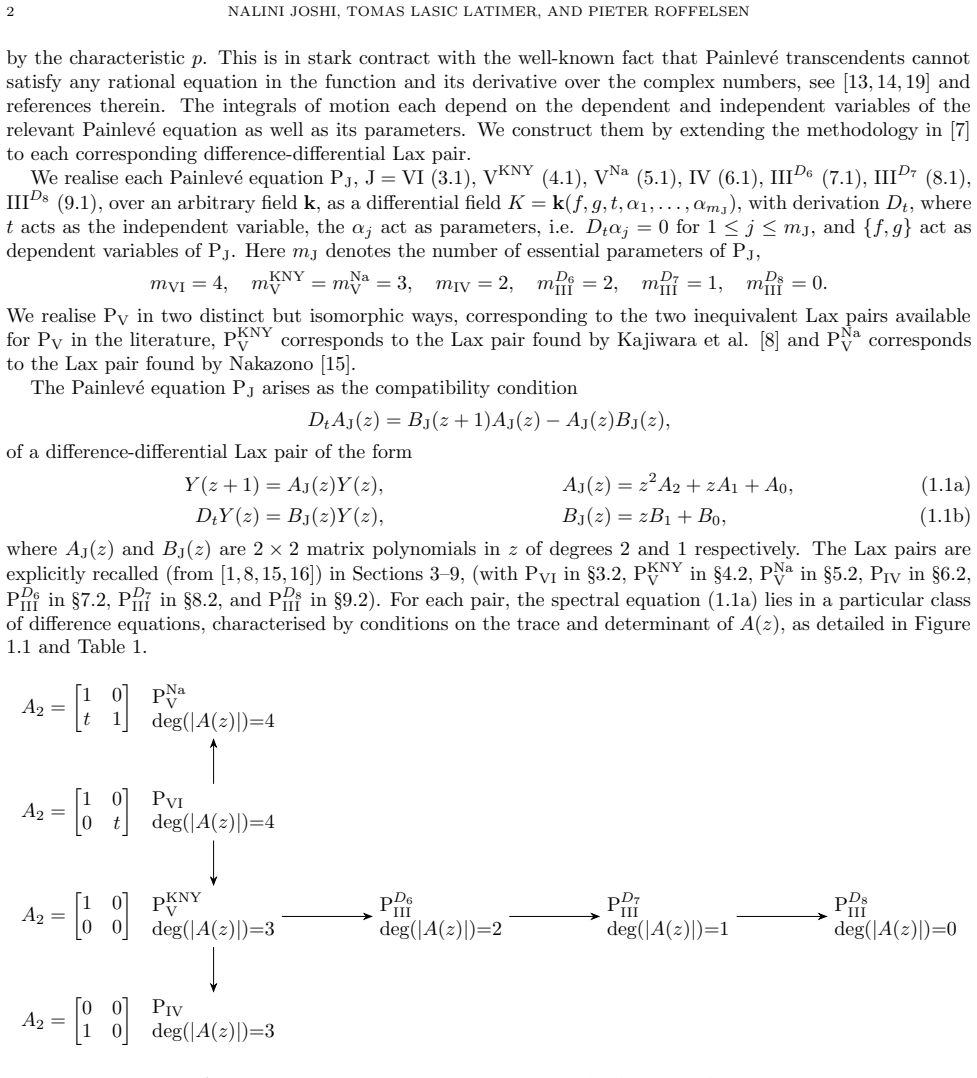
Summary. This paper collects all known rank-2 difference-differential Lax pairs for the classical Painlevé equations (P_VI through P_III^{D_8}) and normalizes them into a unified 2×2 matrix framework where the spectral coefficient matrix A(z) is a degree-2 polynomial in z. The authors then apply a general method (extending their prior work [7]) to extract integrals of motion in characteristic p from these Lax pairs. The central construction is Proposition 2.1: given the Lax compatibility condition D_t A(z) = B(z+1)A(z) - A(z)B(z), the matrix product M_p(z) = A(z+p-1)···A(z) satisfies D_t M_p = [B, M_p], so the coefficients of the characteristic polynomial of M_p(z) are integrals of motion. Theorem 2.3 then shows that Tr M_p(z) decomposes as I_p^{(J)} + c_1 Z + c_2 Z^2 (where Z = z^p - z), with I_p^{(J)} being a non-trivial integral for each Painlevé equation P_J and each prime p. Explicit integrals are displayed for small primes (p = 2, 3, 5, 7).
Significance. The paper makes a solid contribution to the emerging arithmetic study of Painlevé equations in finite characteristic. The key strengths are: (1) the unification of scattered Lax pairs from the literature [1, 8, 15, 16] into a single degeneration framework (Figure 1.1, Table 1), which is a useful reference in its own right; (2) the parameter-free, self-contained derivation of integrals from the Lax compatibility condition — no fitting or normalization choices force the result; (3) the explicit verification in Appendix B that I_7^{VI} vanishes on a known algebraic solution reduced mod 7, providing a concrete falsifiable check. The contrast with the characteristic-zero setting (where Painlevé transcendents admit no rational first integrals) is striking and well-motivated.
major comments (1)
- [Theorem 2.3] The theorem states the result for 'any prime p,' but Lemma 2.2 (and its proof in Appendix A) covers only odd primes. The p=2 case is stated to follow 'by direct calculation' without showing the calculation, and Remark A.2 explicitly flags that the power-sum formula (A.1) breaks at p=2. While the p=2 integrals are explicitly displayed (e.g., I_2^{VI} in §3.4, I_2^{IV} in §6.4) and can be independently verified by computing D_t I_2 = 0, the proof of the structural decomposition (2.6) for p=2 is not provided. The authors should either include the p=2 calculation or restate Theorem 2.3 to cover odd primes, with p=2 treated as a verified special case.
minor comments (7)
- [Theorem 2.3 / §2] The non-triviality of I_p^{(J)} for general p is asserted ('We find that I_p is a non-trivial integral of motion') but not proven for arbitrary p. It is evident from the displayed examples for small primes, but a brief remark on why non-triviality is expected for all p (or a statement that it is verified case-by-case) would strengthen the claim.
- [§5.4] The relation I_p^{V(KNY)} + I_p^{V(Na)} = A_3(A_1+A_2+A_3) - (A_2+A_3)t^p is stated to hold for p = 2,3,5,7,11 and conjectured for all primes. This is an interesting observation but is presented as an empirical conjecture. A brief comment on why this relation is expected would be helpful.
- [Table 1, P_IV row] The eigenvalues of A(z) for P_IV are listed as λ_1 = +z^{3/2} + (1/2)tz + O(z^{1/2}) and λ_2 = -z^{3/2} + (1/2)tz + O(z^{1/2}), involving half-integer powers. This is inconsistent with the other rows where eigenvalues are polynomials or Laurent series in integer powers of z. A brief clarification of this normalization would help the reader.
- [Theorem 2.3] The notation δ_{p,2} in the formula for c_1^{(IV)} is defined inline ('δ_{p,2} = 1 when p = 2 and zero otherwise'), which is clear, but it appears only in this one entry. A footnote or a more uniform treatment would improve readability.
- [§3.4] The distinction between I_2^{VI} and its 'simplified' version Ĩ_2^{VI} (where terms polynomial in f^p, g^p, t^p are dropped) is explained, but the remark that the simplified version loses invariance under translational symmetries (Remark 2.4) could be stated more prominently, as it affects the interpretation of the displayed integrals.
- [References] Reference [7] is cited as a 2026 arXiv preprint (2602.09298). If this has been published or accepted by the time of revision, the reference should be updated.
- [General] The paper would benefit from a brief remark on computational methodology: the integrals for larger p (e.g., I_7^{VI} in Appendix B) are quite lengthy, and a statement of whether these were computer-verified (and if so, in what system) would aid reproducibility.
Circularity Check
No circularity found — derivation is parameter-free and self-contained
full rationale
The paper's central result (Theorem 2.3) follows from a clean chain: Proposition 2.1 (direct algebraic consequence of Lax compatibility + Jacobi's formula), Lemma 2.2 (fully proven in Appendix A using standard power-sum congruences and cyclic trace invariance), and spectral data from Table 1 (read off from Lax pairs taken from independent literature [1, 8, 15, 16]). No parameters are fitted. No integral is defined in terms of itself. The sole self-citation [7] is methodological and non-load-bearing because the method is fully reproduced with proofs in the present paper. The p=2 case has a minor proof gap (Lemma 2.2 covers only odd primes; p=2 is asserted by direct calculation), but the displayed p=2 integrals are independently verifiable. This is a correctness concern, not circularity.
Axiom & Free-Parameter Ledger
axioms (5)
- standard math Lax compatibility: D_t A(z) = B(z+1)A(z) - A(z)B(z) implies the Painlevé equation
- standard math Jacobi's formula for derivative of determinant: D_t det(M) = Tr(adj(M) · D_t M)
- standard math Power sum congruence: sum_{n=0}^{p-1} n^k ≡ -1 if (p-1)|k, 0 otherwise (mod p)
- standard math Freshman's dream: (x+y)^p = x^p + y^p in characteristic p
- domain assumption The Lax pairs collected from [1, 8, 15, 16] are correct and compatible
read the original abstract
We collect rank two difference-differential Lax pairs for classical Painlev\'e equations in the literature and put each in $2\times 2$ matrix form with the coefficient matrix of the spectral equation a degree two matrix polynomial. We describe and apply a general method to obtain integrals of motion in characteristic $p$ from these Lax pairs. For every relevant Painlev\'e equation, this leads to a countable list of integrals of motion, with one entry for each prime $p$.
Figures
Reference graph
Works this paper leans on
-
[1]
V. `E. Adler,Nonlinear chains and Painlev´ e equations, Phys. D73(1994), no. 4, 335–351
work page 1994
-
[3]
Boalch,The fifty-two icosahedral solutions to Painlev´ e VI, J
P. Boalch,The fifty-two icosahedral solutions to Painlev´ e VI, J. Reine Angew. Math.596(2006), 183–214
work page 2006
-
[4]
D. Arinkin and A. Borodin,Moduli spaces ofd-connections and difference Painlev´ e equations, Duke Math. J.134(2006), no. 3, 515–556
work page 2006
-
[5]
A. Buium and Yuri I. Manin,Arithmetic differential equations of Painlev´ e VI type, Arithmetic and geometry, London Math. Soc. Lecture Note Ser., vol. 420, Cambridge Univ. Press, Cambridge, 2015, pp. 114–138. MR3467121 [6]NIST Digital Library of Mathematical Functions. F. W. J. Olver, A. B. Olde Daalhuis, D. W. Lozier, B. I. Schneider, R. F. Boisvert, C. ...
work page 2015
-
[6]
N. Joshi and P. Roffelsen,On integrals of non-autonomous dynamical systems in finite characteristic, arXiv preprint, posted on 2026, DOI 10.48550/arXiv.2602.09298, available at2602.09298
-
[7]
K. Kajiwara, M. Noumi, and Y. Yamada,Geometric Aspects of Painlev´ e Equations, J. Phys. A50(2017), no. 7
work page 2017
-
[8]
Kanki,Integrability of discrete equations modulo a prime, SIGMA Symmetry Integrability Geom
M. Kanki,Integrability of discrete equations modulo a prime, SIGMA Symmetry Integrability Geom. Methods Appl.9(2013), Paper 056, 8. MR3141527
work page 2013
- [9]
-
[10]
O. Lisovyy and Y. Tykhyy,Algebraic solutions of the sixth Painlev´ e equation, J. Geom. Phys.85(2014), 124–163
work page 2014
-
[11]
K. MacMillan and J. Sondow,Proofs of power sum and binomial coefficient congruences via Pascal’s identity, Amer. Math. Monthly118(2011), no. 6, 549–551
work page 2011
-
[12]
Nagloo,Model theory and differential equations, Notices Amer
J. Nagloo,Model theory and differential equations, Notices Amer. Math. Soc.68(2021), no. 2, 177–185
work page 2021
-
[13]
J. Nagloo and A. Pillay,On the algebraic independence of generic Painlev´ e transcendents, Compos. Math.150(2014), no. 4, 668–678
work page 2014
-
[14]
Nakazono,Reduction of lattice equations to the Painlev´ e equations:P IV andP V, J
N. Nakazono,Reduction of lattice equations to the Painlev´ e equations:P IV andP V, J. Math. Phys.59(2018), no. 2
work page 2018
-
[15]
C. M. Ormerod and E. Rains,A symmetric difference-differential Lax pair for Painlev´ e VI, J. Integrable Syst.2(2017), no. 1, xyx003, 20
work page 2017
-
[16]
N. Joshi and P. Roffelsen,On the crystal limit of theq-difference sixth Painlev´ e equation, J. Nonlinear Sci.35(2025), no. 1, Paper No. 31, 30
work page 2025
-
[17]
,Arithmetic dynamics of a discrete Painlev´ e equation, Journal of Physics A: Mathematical and Theoretical59(2026), no. 19
work page 2026
-
[18]
Umemura,Painlev´ e equations and classical functions, Sugaku Expositions11(1998), no
H. Umemura,Painlev´ e equations and classical functions, Sugaku Expositions11(1998), no. 1, 77–100. School of Mathematics and Statistics F07, The University of Sydney, NSW 2006, Australia Email address:nalini.joshi@sydney.edu.au Email address:tomas.lasiclatimer@sydney.edu.au Email address:pieter.roffelsen@sydney.edu.au
work page 1998
discussion (0)
Sign in with ORCID, Apple, or X to comment. Anyone can read and Pith papers without signing in.