REVIEW 4 major objections 6 minor 36 references
Reviewed by Pith at T0; open to challenge.
T0 means a machine referee read the full paper against a public rubric. The mark states how deep the mechanical check went, never who wrote it. the ladder, T0–T4 →
T0 review · glm-5.2
Retail behavior learned from receipts beats frontier LLMs at predicting purchases
2026-07-09 22:03 UTC pith:USEKNUBG
load-bearing objection Retail behavior model shows real gains but overclaims consistency; GPT-5.5 baseline methodology is the load-bearing gap the 4 major comments →
Large Behavior Model: A Promptable Digital Twin of the Retail Customer
The pith
A machine-rendered reading of the paper's core claim, the machinery that carries it, and where it could break.
Core claim
The paper establishes that a language model's fidelity in simulating an individual customer's decisions is governed by the quality of behavioral evidence supplied in the prompt, not by the model's parameter count or generic reasoning ability. This is demonstrated through the B-hard difficulty ladder: with no in-prompt evidence the model performs near chance; with a single legible similarity line it reaches 95.9% accuracy versus 73.4% for a frontier LLM. The bottleneck is prompt signal, not model capacity. Continued pre-training on verbalized transaction data is the stage that transfers behavioral knowledge across retailers and tasks; supervised fine-tuning mainly teaches output format; andGR
What carries the argument
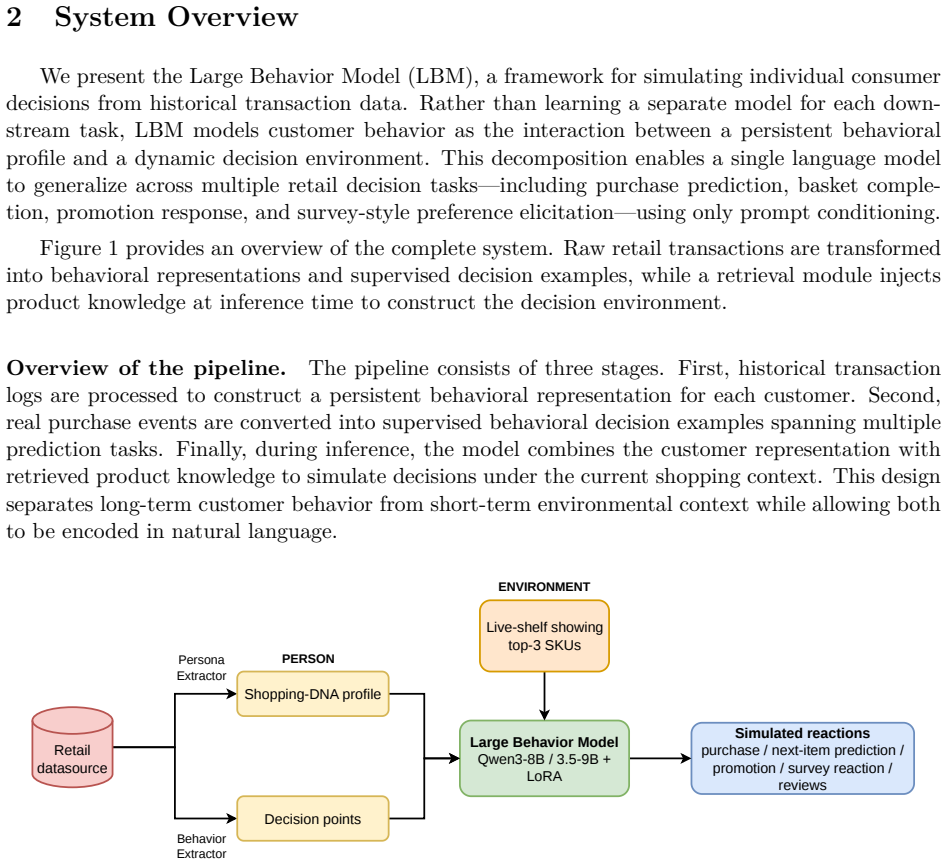
Person-Environment decomposition (B = f(P, E)) where P = Shopping-DNA textual profile + segment-level LoRA adapter, E = top-3 retrieved SKUs via ChromaDB; four-stage training: behavioral data verbalization, continued pre-training, supervised fine-tuning, GRPO with verifiable YES/NO rewards and Jaccard scoring
Load-bearing premise
The Shopping-DNA profile—a handcrafted textual summary of a customer's transaction history—faithfully preserves the behavioral information needed for decision simulation. The paper itself acknowledges this compresses rich transactional histories into natural-language descriptions, but the entire framework's performance depends on whether that verbalization step retains temporal sequences, price elasticities, and cross-category interactions without material loss.
What would settle it
If the textual Shopping-DNA summary systematically drops or distorts behavioral signal that a structured embedding or sequence model would preserve, then the model's decisions reflect the summary's limitations rather than the customer's actual behavior. The cross-dataset results already hint at this: performance degrades on datasets where predictive signal is encoded in platform-specific identifiers or engineered numerical features rather than semantically interpretable patterns.
Editorial analysis
A structured set of objections, weighed in public.
Referee Report
Summary. The paper proposes the Large Behavior Model (LBM), a language-model framework for simulating individual retail customer decisions. The approach decomposes behavior into a persistent customer representation (Shopping-DNA profile plus segment-level LoRA adapters) and a dynamic decision environment supplied via retrieval-augmented generation. A four-stage training pipeline—continued pre-training (CPT), supervised fine-tuning (SFT), GRPO reinforcement learning, and RAG-based inference—is applied to verbalized transaction data. The model is evaluated on purchase prediction, hard-negative discrimination, basket completion, promotion response, and cross-domain voucher redemption, with comparisons against GPT-5.5 and external benchmarks (DMBGN, UCI, Tmall, Shopee). The central claim is that grounding language models in longitudinal behavioral evidence, rather than relying on generic LLM priors, is the primary driver of improved personalized decision simulation.
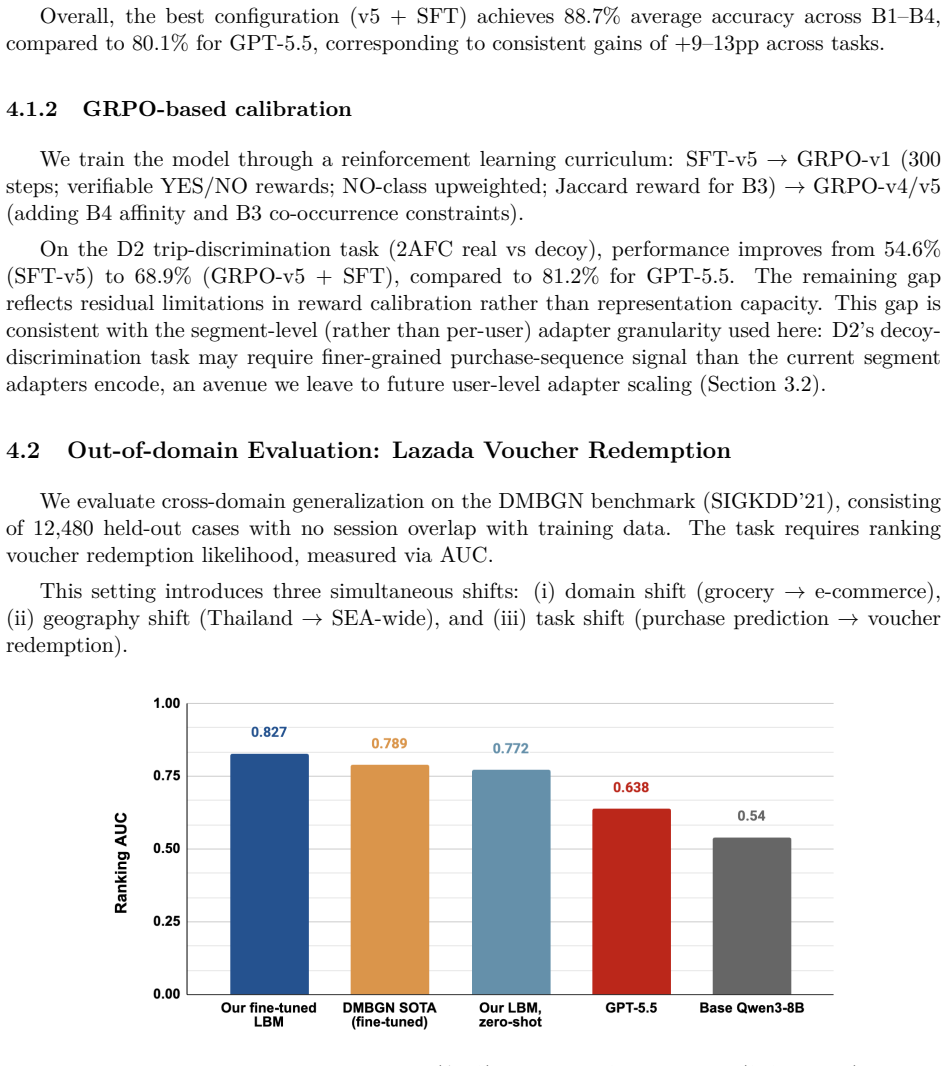
Significance. The paper addresses a genuine gap: unifying multiple retail behavioral tasks (purchase prediction, basket completion, promotion response, survey simulation) under a single prompt-conditioned language model, rather than training separate task-specific models. The Person–Environment decomposition is a clean conceptual framing, and the four-stage training pipeline is a reasonable engineering contribution. The ablation finding that CPT drives generalization while SFT mainly shapes format (§3.7) is a useful empirical insight. The zero-shot cross-domain transfer result on DMBGN (0.772 AUC, §4.2) is notable if the comparison is fair. The reproducibility appendix (Appendix A) provides concrete hyperparameters, hardware, and evaluation details, which is commendable.
major comments (4)
- The abstract claims the model 'consistently outperforms frontier general-purpose language models on in-domain retail tasks,' but §4.1.2 reports that on the D2 trip-discrimination task—an in-domain evaluation—LBM achieves 68.9% versus GPT-5.5's 81.2%, a 12.3pp deficit. §4.2.1 further reports that on the Shopee cross-domain task, GPT-5.5 achieves 0.825 AUC versus LBM's 0.65. These are not marginal gaps and directly contradict 'consistently.' The paper attributes the D2 gap to 'segment-level adapter granularity' and 'reward calibration' (§4.1.2) but provides no direct evidence—no per-user adapter experiment is run to confirm the hypothesis. The abstract and §4.1 claims should be revised to accurately scope where the model outperforms and where it does not, or the D2 and Shopee results require explanation that reconciles them with the 'consistent' claim.
- The GPT-5.5 baseline methodology is never described. It is unclear whether GPT-5.5 receives the same Shopping-DNA profile, RAG-retrieved products, and prompt structure as LBM. The paper's own B-hard finding (§3.6, §3.7, Figure 3) states 'the bottleneck is prompt signal, not weights': with no in-prompt evidence, accuracy is near chance; with explicit similarity lines, it reaches 95.9%. If GPT-5.5 is evaluated without equivalent prompt context (Shopping-DNA profile, RAG-retrieved products), the comparison conflates learned behavioral representations with richer prompt engineering, undermining the central claim that behavioral grounding—not prompt content—drives improvement. A clear description of the GPT-5.5 evaluation protocol is load-bearing for the comparative claims throughout §4.1–4.2.
- The claim of scalability to 'millions of users' (§1, contributions) is supported by an evaluation on 1,500 customers with held-out baskets (Table 1) and a larger-scale run of 662 users (§4.1.1). While the segment-level LoRA architecture is in principle scalable, the empirical evidence covers three orders of magnitude fewer users than claimed. The paper should either scope the scalability claim to match the evaluation scale or provide evidence at larger scale.
- The Shopping-DNA profile (§3.2) is a handcrafted textual summary of customer behavior. The entire framework's performance depends on whether this verbalization preserves the predictive signal from raw transactions. The paper acknowledges this is a compression of 'rich transactional histories into natural language descriptions' (§6) but provides no analysis of what behavioral information is lost or distorted in this step. Given that the central claim is about behavioral grounding, some characterization of the representational fidelity of the Shopping-DNA profile—e.g., comparing performance with profiles of varying richness, or analyzing failure cases traceable to profile compression—would substantially strengthen the contribution.
minor comments (6)
- Table 1: The 'Customers' row lists '1,500 (held-out baskets)' for the test set, which is ambiguous—does this mean 1,500 customers with held-out baskets, or 1,500 held-out baskets? Clarify.
- §3.5, Table 2: The B-task formulation lists B1–B4, but §4.1.2 references a 'D2 trip-discrimination task' that is not defined in Table 2. The relationship between D2 and the B-tasks should be clarified.
- §4.1, Table 3: The model is labeled 'Our LBM (base + SFT-Lotus)' while Table 4 uses 'Our LBM (GRPO v5 + SFT-Lazada).' The naming inconsistency and the shift from Lotus to Lazada between tables should be explained.
- Figure 3 caption references 'v1, v2, v3' prompt variants but these are not defined in the main text. The B-hard difficulty ladder (§3.6) is mentioned only briefly; a clearer definition of the prompt variants would aid reproducibility.
- §4.2.1: The Tmall result (0.53–0.59 AUC, improving to 0.619) is described as below SOTA (0.703). The paper should clarify whether this is a fundamental limitation of the approach or a prompt-engineering issue, given the B-hard finding that prompt signal is the primary bottleneck.
- Appendix A: The GRPO reward description ('exact YES/NO and format; NO-rows weighted ×2; Jaccard on B3') is terse. A more detailed specification of the reward function would improve reproducibility.
Circularity Check
No significant circularity; the central claim is tested against external benchmarks and external models, with one minor self-citation that is not load-bearing.
full rationale
The paper's central claim—that grounding language models in longitudinal behavioral evidence improves personalized decision simulation—is evaluated against external benchmarks (DMBGN, UCI, Tmall, Shopee) and compared against an external frontier model (GPT-5.5). The B-hard evaluation (§3.6, Figure 3) provides a non-circular, falsifiable observation: performance scales with prompt evidence quality, demonstrating that the model operates as an evidence-conditioned system rather than a latent similarity engine. The four-stage training pipeline (CPT → SFT → GRPO) is ablated, and each stage's contribution is independently measured (§3.7). The Shopping-DNA profile is constructed exclusively from training-period transactions (§3.2), preventing future leakage, and held-out baskets are used for evaluation (Table 1). The D2 and Shopee results where LBM underperforms GPT-5.5 (§4.1.2, §4.2.1) are reported transparently, which would be unlikely if the evaluation were circularly constructed to guarantee success. The only self-citation is to the authors' own Twin-2K-500 dataset [34] for cross-dataset survey transfer (§4.2.2), but this is a supplementary evaluation on unseen users, not a load-bearing premise for the central claim. The derivation chain is self-contained: behavioral representations are learned from transaction data, evaluated on held-out decisions, and compared against external baselines. No step reduces to its inputs by construction. The score of 2 reflects the minor self-cited dataset usage without independent verification, which does not undermine the paper's independent empirical content.
Axiom & Free-Parameter Ledger
free parameters (7)
- LoRA rank r =
8
- LoRA alpha =
16
- RAG top-k =
3
- GRPO NO-class upweighting =
2x
- GRPO steps =
300-500
- User-level adapter threshold =
80-300 examples
- Embedding dimensionality =
1024
axioms (5)
- domain assumption Customer behavior can be faithfully represented as natural language text (Shopping-DNA profile) without material loss of predictive signal.
- domain assumption Lewin's field theory (B=f(P,E)) is an appropriate formal framework for LLM-based behavioral simulation.
- ad hoc to paper Segment-level LoRA adapters provide sufficient behavioral granularity for customer-level simulation.
- domain assumption Continued pre-training on verbalized transactions transfers behavioral knowledge better than SFT alone.
- domain assumption GPT-5.5 is an appropriate baseline for retail behavioral tasks.
invented entities (3)
-
Shopping-DNA profile
no independent evidence
-
B-hard difficulty ladder
no independent evidence
-
B-task formulation (B1-B4)
no independent evidence
read the original abstract
Customer behavior modeling underpins recommendation, marketing, and decision support, yet existing approaches either optimize predictive accuracy without explaining decisions or simulate users without grounding them in real behavioral data. We present the Large Behavioral Model (LBM) that learns customer decision making directly from large-scale retail transactions through a unified Person-Environment formulation. Customer state is represented by a behavioral profile derived from historical purchases, while product context is incorporated through retrieval-augmented generation. The model is trained using continued pre-training on verbalized behavioral data, supervised fine-tuning for decision generation, and reinforcement learning with verifiable rewards for evidence-based calibration. We evaluate the proposed framework on purchase prediction, hard-negative discrimination, basket completion, promotion response, and cross-domain voucher redemption. The model consistently outperforms frontier general-purpose language models on in-domain retail tasks while demonstrating strong zero-shot and fine-tuned transfer across retailers and decision domains. Ablation studies show that continued pre-training is the primary driver of behavioral generalization, retrieval is most effective when applied during both training and inference, and reinforcement learning improves reliance on explicit behavioral evidence over generic language-model priors. These results demonstrate that behavioral knowledge encoded in transaction histories can be effectively learned by language models, providing a scalable foundation for customer digital twins and behavior simulation.
Figures


Reference graph
Works this paper leans on
-
[1]
Conditional logit analysis of qualitative choice behavior,
D. McFadden, “Conditional logit analysis of qualitative choice behavior,” inFrontiers in Econometrics, P. Zarembka, Ed. Academic Press, 1974, pp. 105–142
work page 1974
-
[2]
K. E. Train,Discrete Choice Methods with Simulation, 2nd ed. Cambridge University Press, 2009
work page 2009
-
[3]
Marketing analytics for data-rich environments,
M. Wedel and P. K. Kannan, “Marketing analytics for data-rich environments,”Journal of Marketing, vol. 80, no. 6, pp. 97–121, 2016. 14
work page 2016
-
[4]
Lewin,Principles of Topological Psychology
K. Lewin,Principles of Topological Psychology. McGraw-Hill, 1936
work page 1936
-
[5]
N. K. Malhotra,Marketing Research: An Applied Orientation, 7th ed. Pearson, 2019
work page 2019
-
[6]
A logit model of brand choice calibrated on scanner data,
P. M. Guadagni and J. D. C. Little, “A logit model of brand choice calibrated on scanner data,”Marketing Science, vol. 2, no. 3, pp. 203–238, 1983
work page 1983
-
[7]
Matrix factorization techniques for recommender sys- tems,
Y. Koren, R. Bell, and C. Volinsky, “Matrix factorization techniques for recommender sys- tems,”Computer, vol. 42, no. 8, pp. 30–37, 2009
work page 2009
-
[8]
Neural collaborative filtering,
X. He, L. Liao, H. Zhang, L. Nie, X. Hu, and T.-S. Chua, “Neural collaborative filtering,” in Proceedings of the 26th International Conference on World Wide Web (WWW). International World Wide Web Conferences Steering Committee, 2017, pp. 173–182
work page 2017
-
[9]
Self-attentive sequential recommendation,
W.-C. Kang and J. McAuley, “Self-attentive sequential recommendation,” inProceedings of the IEEE International Conference on Data Mining (ICDM). IEEE, 2018, pp. 197–206
work page 2018
-
[10]
BERT4Rec: Sequential rec- ommendation with bidirectional encoder representations from transformer,
F. Sun, J. Liu, J. Wu, C. Pei, X. Lin, W. Ou, and P. Jiang, “BERT4Rec: Sequential rec- ommendation with bidirectional encoder representations from transformer,” inProceedings of the 28th ACM International Conference on Information and Knowledge Management (CIKM). ACM, 2019, pp. 1441–1450
work page 2019
-
[11]
J. Zhaiet al., “Actions speak louder than words: Trillion-parameter sequential transducers for generative recommendations,”arXiv preprint arXiv:2402.17152, 2024
work page internal anchor Pith review Pith/arXiv arXiv 2024
-
[12]
Recommender systems with generative retrieval,
S. Rajputet al., “Recommender systems with generative retrieval,” inAdvances in Neural Information Processing Systems (NeurIPS), 2023
work page 2023
-
[13]
Training language models to follow instructions with human feedback,
L. Ouyang, J. Wu, X. Jianget al., “Training language models to follow instructions with human feedback,” inAdvances in Neural Information Processing Systems (NeurIPS), vol. 35, 2022, pp. 27730–27744
work page 2022
-
[14]
A. Dubey, A. Jauhri, A. Pandeyet al., “The Llama 3 herd of models,”arXiv preprint arXiv:2407.21783, 2024
work page internal anchor Pith review Pith/arXiv arXiv 2024
-
[15]
Qwen Team, “Qwen3 technical report,”arXiv preprint arXiv:2505.09388, 2025
work page internal anchor Pith review Pith/arXiv arXiv 2025
-
[16]
Gemma 2: Improving Open Language Models at a Practical Size
Gemma Team, M. Riviere, S. Pathaket al., “Gemma 2: Improving open language models at a practical size,”arXiv preprint arXiv:2408.00118, 2024
work page internal anchor Pith review Pith/arXiv arXiv 2024
-
[17]
Generative agents: Interactive simulacra of human behavior,
J. S. Park, J. C. O’Brien, C. J. Cai, M. R. Morris, P. Liang, and M. S. Bernstein, “Generative agents: Interactive simulacra of human behavior,” inProceedings of the 36th Annual ACM Symposium on User Interface Software and Technology (UIST). ACM, 2023, pp. 1–22
work page 2023
-
[18]
Out of one, many: Using language models to simulate human samples,
L. P. Argyle, E. C. Busby, N. Fulda, J. R. Gubler, C. Rytting, and D. Wingate, “Out of one, many: Using language models to simulate human samples,”Political Analysis, vol. 31, no. 3, pp. 337–351, 2023
work page 2023
-
[19]
LLM Agents Grounded in Self-Reports Enable General-Purpose Simulation of Individuals
J. S. Park, C. Q. Zou, A. Shaw, B. M. Hill, C. Cai, M. R. Morris, R. Willer, P. Liang, and M. S. Bernstein, “Generative agent simulations of 1,000 people,”arXiv preprint arXiv:2411.10109, 2024. 15
work page internal anchor Pith review Pith/arXiv arXiv 2024
-
[20]
Large Content And Behavior Models To Understand, Simulate, And Optimize Content And Behavior
A. Khandelwal, A. Agrawal, A. Bhattacharyyaet al., “Large content and behavior models to understand, simulate, and optimize content and behavior,” 2024. [Online]. Available: https://arxiv.org/abs/2309.00359
work page internal anchor Pith review Pith/arXiv arXiv 2024
-
[21]
Can LLM Agents Simulate Multi-Turn Human Behavior? Evidence from Real Online Customer Behavior Data
Y. Lu, J. Huang, Y. Hanet al., “Can llm agents simulate multi-turn human behavior? evidence from real online customer behavior data,” 2026. [Online]. Available: https://arxiv.org/abs/2503.20749
work page internal anchor Pith review Pith/arXiv arXiv 2026
-
[22]
Shop-r1: Rewarding llms to simulate human behavior in online shopping via reinforcement learning,
Y. Zhang, T. Wang, J. Gesiet al., “Shop-r1: Rewarding llms to simulate human behavior in online shopping via reinforcement learning,” 2026. [Online]. Available: https://arxiv.org/abs/2507.17842
-
[23]
Customer-r1: Personalized simulation of human behaviors via rl-based llm agent in online shopping,
Z. Wang, Y. Lu, Y. Zhang, J. Huang, and D. Wang, “Customer-r1: Personalized simulation of human behaviors via rl-based llm agent in online shopping,” 2025. [Online]. Available: https://arxiv.org/abs/2510.07230
-
[24]
The need for a socially- grounded persona framework for user simulation,
P. N. Venkit, Y. Li, Y. Pruksachatkun, and C.-S. Wu, “The need for a socially- grounded persona framework for user simulation,” 2026. [Online]. Available: https: //arxiv.org/abs/2601.07110
-
[25]
Nemotron-personas: Multilingual, region-specific synthetic persona datasets,
NVIDIA, “Nemotron-personas: Multilingual, region-specific synthetic persona datasets,” https://huggingface.co/collections/nvidia/nemotron-personas, 2026, hugging Face Collection, accessed 2026
work page 2026
-
[26]
A survey on llm-based conversational user simulation,
B. Ni, Y. Wang, L. Wanget al., “A survey on llm-based conversational user simulation,” inProceedings of the 19th Conference of the European Chapter of the Association for Computational Linguistics (Volume 1: Long Papers). Association for Computational Linguistics, 2026, p. 4266–4301. [Online]. Available: http://dx.doi.org/10.18653/v1/2026. eacl-long.200
-
[27]
Mind the sim2real gap in user simulation for agentic tasks,
X. Zhou, W. Sun, Q. Maet al., “Mind the sim2real gap in user simulation for agentic tasks,”
-
[28]
Available: https://arxiv.org/abs/2603.11245
[Online]. Available: https://arxiv.org/abs/2603.11245
-
[29]
Digital twins as funhouse mirrors: Five key distortions,
T. Peng, G. Gui, M. Bruckset al., “Digital twins as funhouse mirrors: Five key distortions,”
-
[30]
Digital Twins as Funhouse Mirrors: Five Key Distortions
[Online]. Available: https://arxiv.org/abs/2509.19088
work page internal anchor Pith review Pith/arXiv arXiv
-
[31]
Long context, less focus: A scaling gap in llms revealed through privacy and personalization,
S. Gu, “Long context, less focus: A scaling gap in llms revealed through privacy and personalization,” 2026. [Online]. Available: https://arxiv.org/abs/2602.15028
-
[32]
User-LLM: Efficient LLM Contextualization with User Embeddings
L. Ning, L. Liu, J. Wu, N. Wu, D. Berlowitz, S. Prakash, B. Green, S. O’Banion, and J. Xie, “User-llm: Efficient llm contextualization with user embeddings,” 2024. [Online]. Available: https://arxiv.org/abs/2402.13598
work page internal anchor Pith review Pith/arXiv arXiv 2024
-
[33]
Do llms benefit from user and item embeddings in recommendation tasks?
M. R. I. Hossain, L. Feng, L. Sigal, and M. O. Ahmed, “Do llms benefit from user and item embeddings in recommendation tasks?” 2026. [Online]. Available: https://arxiv.org/abs/2601.04690
-
[34]
CURP: Codebook-based Continuous User Representation for Personalized Generation with LLMs
L. Wang, X. Mou, X. Liu, X. Huang, and Z. Wei, “Curp: Codebook-based continuous user representation for personalized generation with llms,” 2026. [Online]. Available: https://arxiv.org/abs/2602.00742 16
work page internal anchor Pith review Pith/arXiv arXiv 2026
-
[35]
Retrieval-augmented generation for knowledge-intensive nlp tasks,
P. Lewis, E. Perez, A. Piktuset al., “Retrieval-augmented generation for knowledge-intensive nlp tasks,” inAdvances in Neural Information Processing Systems, vol. 33, 2020, pp. 9459– 9474
work page 2020
-
[36]
O. Toubia, G. Z. Gui, T. Peng, D. J. Merlau, A. Li, and H. Chen, “Twin-2k-500: A dataset for building digital twins of over 2,000 people based on their answers to over 500 questions,” arXiv preprint arXiv:2505.17479, 2025. A Reproducibility Base models.Qwen3-8B (PoC / Phase-7) and Qwen3.5-9B (G2 / cross-dataset), in 4-bit via Unsloth. LoRA.Rankr= 8,α= 16,...
work page internal anchor Pith review Pith/arXiv arXiv 2025
discussion (0)
Sign in with ORCID, Apple, or X to comment. Anyone can read and Pith papers without signing in.