REVIEW 2 major objections 7 minor 130 references
Reviewed by Pith at T0; open to challenge.
T0 means a machine referee read the full paper against a public rubric. The mark states how deep the mechanical check went, never who wrote it. the ladder, T0–T4 →
T0 review · glm-5.2
Step scaling pins large-N Yang-Mills Λ at 0.639(36)
2026-07-09 18:14 UTC pith:XDH67IHL
load-bearing objection First step-scaling determination of the large-N Yang-Mills Λ-parameter; solid execution but the 2-loop perturbative matching is the load-bearing soft spot. the 2 major comments →
The large-N Yang--Mills Λ-parameter from step scaling
The pith
A machine-rendered reading of the paper's core claim, the machinery that carries it, and where it could break.
Core claim
The Λ-parameter of pure SU(N) Yang-Mills theory — the dynamically generated scale of dimensional transmutation — varies only mildly with the number of colors. Using step scaling in a twisted-gradient-flow finite-volume scheme, the authors find that the large-N limit √(8t₀)Λ_MS(N=∞) = 0.639(36) exceeds the physical N=3 value by about 11%, with the N-dependence well described by a 1/N² expansion whose coefficient −0.85(62) is consistent with zero. This is the first large-N Λ determination achieved without asymptotic scaling, and the results are compatible with prior asymptotic-scaling estimates within current uncertainties.
What carries the argument
The step-scaling method in the Twisted Gradient Flow (TGF) scheme: a finite-volume renormalization scheme where the coupling is defined through the gradient flow (a smoothing procedure for gauge fields) evaluated at a flow time tied to the box size, and twisted boundary conditions on an asymmetric ℓ² × (ℓ/N)² volume suppress finite-volume effects by making the effective size ℓ rather than the physical volume. The coupling is projected to the topological sector Q=0 to avoid topological freezing at fine lattice spacings. The step-scaling function — which gives the coupling at half the box size given the coupling at full size — is extracted from a global fit of lattice data at multiple lattices
Load-bearing premise
The dominant uncertainty comes from extrapolating to the perturbative limit using only the two-loop (universal) β-function in the TGF scheme. At the weakest couplings reached (λ_pt ≈ 1.83), the extrapolation assumes that unknown higher-order perturbative corrections are small enough to be captured by a linear fit in λ_pt. If the three-loop coefficient is anomalously large, the extrapolated Λ values could shift beyond the quoted errors.
What would settle it
A computation of the three-loop β-function coefficient in the TGF scheme that is anomalously large would shift the λ_pt → 0 extrapolation and could move the Λ values outside the quoted error bars.
If this is right
- If the three-loop β-function coefficient in the TGF scheme were computed (e.g., via numerical stochastic perturbation theory), the dominant uncertainty from the λ_pt → 0 extrapolation would drop from linear to quadratic in the coupling, potentially reaching per-cent-level precision for Λ.
- The mild N-dependence (coefficient consistent with zero) suggests confinement-scale physics is remarkably insensitive to the number of colors, supporting the use of large-N approximations for real-world QCD phenomenology.
- The framework could be extended to a fully volume-reduced twisted Eguchi-Kawai formulation where the step-scaling sequence is generated by varying N itself, directly accessing N=∞ without finite-N extrapolation.
- Agreement with asymptotic-scaling results at the ~5% level for N>3 helps validate both methodologies, but per-cent-level precision would be needed to resolve whether the tensions discussed in the N=3 literature reflect real systematic differences or are statistical fluctuations.
- The pure-gauge Λ values feed into decoupling-based strategies for extracting the strong coupling in full QCD, so improved large-N determinations would tighten a key input for precision α_s determinations.
Where Pith is reading between the lines
- With only three data points (N=3, 5, 8) and a 1/N² coefficient consistent with zero, the functional form of the N-dependence is not tightly constrained — a 1/N correction or other non-analytic terms cannot be excluded at current precision.
- The ~11% gap between N=3 and N=∞, if confirmed at higher precision, would quantify the systematic error introduced by large-N approximations in hadron phenomenology applications.
- The agreement between step-scaling and asymptotic-scaling results at N>3, where error bars are larger, may mask real differences that are visible only at N=3 where both methods have been pushed to higher precision — the consistency at N>3 could be a consequence of larger uncertainties rather than genuine agreement.
Editorial analysis
A structured set of objections, weighed in public.
Referee Report
Summary. This paper presents the first determination of the Yang--Mills Λ-parameter at large N using step-scaling rather than asymptotic-scaling methods. The authors implement step-scaling in the Twisted Gradient Flow (TGF) scheme with twisted boundary conditions for SU(N) at N=3, 5, and 8, extract Λ_MS in units of √(8t₀) for each N, and perform a 1/N² extrapolation to N=∞. The methodology is carefully implemented: continuum extrapolations are performed at multiple lattice spacings, lattice artifacts are parameterized and controlled, the step-scaling function is determined from global fits, and scale setting uses independent infinite-volume simulations from Ref. [109]. The resulting large-N value √(8t₀)Λ_MS(N=∞) = 0.639(36) is compatible with existing asymptotic-scaling determinations within errors.
Significance. This is a methodologically important first: all prior large-N determinations of Λ relied on asymptotic scaling, which suffers from a window problem requiring simultaneously large volumes and fine lattice spacings. The step-scaling approach sidesteps this, and the use of twisted boundary conditions provides effective volume reduction advantageous for large-N studies. The N=3 result is cross-checked against prior work (Ref. [27]) using the same data but with non-perturbative SF matching, and the SU(4) step-scaling result of Ref. [24] is shown to be consistent with the fitted N-dependence. The results are compared comprehensively with the literature in Sec. V. The work is relevant both for large-N gauge dynamics and for decoupling-based strategies for α_s extraction in full QCD.
major comments (2)
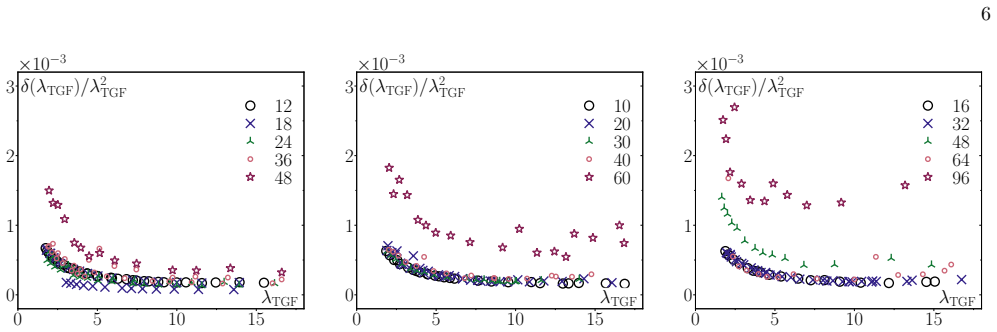
- Sec. IV D and Fig. 5: The dominant systematic uncertainty is the λ_pt → 0 extrapolation, performed linearly using only the 2-loop universal β-function in the TGF scheme. For N=3, the paper itself provides a quantitative anchor: the SF-matched result of Ref. [27] gives √(8t₀)Λ_MS = 0.607(17), compared to the TGF-only value of 0.577(23) — a ~5% upward shift when higher-order perturbative information is included. This shift is comparable to the quoted errors and directly affects the large-N extrapolation. The critical question for the central large-N claim is whether this ~5% truncation error is N-dependent. The 3-loop coefficient of the TGF β-function is scheme-dependent; while its leading large-N behavior is universal, subleading N-dependence could cause differential shifts at N=5 and N=8, biasing the fitted 1/N² slope A = −0.85(62) (currently only 1.4σ from zero) and the N=∞ intercept. I
- The authors acknowledge this issue in the outlook (Sec. V) but do not quantify the potential impact on the large-N extrapolation. Given that the large-N fit uses only 3 data points for 2 parameters with unconstrained O(1/N⁴) terms, it has limited resilience against an N-dependent systematic of this magnitude. The authors should provide a more quantitative discussion: for instance, using the N=3 SF comparison to estimate the size of the 3-loop truncation effect, and arguing (or at least discussing) whether the N-dependence of this effect is expected to be small compared to the fitted 1/N² coefficient. Without this, the reader cannot assess the robustness of the large-N intercept.
minor comments (7)
- Sec. IV C: The choice of fit orders d₁ = d₂ = 4 for N=3,8 and d₁=4, d₂=5 for N=5 is stated to be stable under variation of d₁, d₂ between 4 and 6, but no quantitative detail on this stability check is provided (e.g., how much the continuum step-scaling function changes). A brief statement of the range of variation observed would strengthen confidence.
- Sec. IV F, Eq. (53): The large-N fit assumes O(1/N⁴) corrections are negligible, but with only 3 points and 2 parameters, these are completely unconstrained. It would be useful to show the result of alternative fit ansätze (e.g., a constant fit with no 1/N² term, or a fit including a 1/N⁴ term with a prior) to demonstrate that the intercept is not an artifact of the chosen parameterization.
- Table II: The λ_pt → 0 extrapolated values (k=∞ row) appear to be obtained from a linear fit using only the last few points, but the number of points used and the fit quality (χ²/dof) are not stated. This information should be provided, perhaps in a caption or footnote.
- Sec. III, regarding the topological Q=0 projection (Eq. 28): The consistency between projected and non-projected coupling definitions was verified for N=3 in Ref. [91]. For N=5 and N=8, no such cross-check is mentioned. A brief comment on whether this has been checked, or why it is expected to hold, would be appropriate.
- Fig. 2: The two Padé fit ranges are described as motivated by a change in behavior around b ≈ 0.40–0.45, but the physical origin of this change is not explained. A brief comment would help the reader.
- Sec. IV E: The statement that √(8t₀) ≃ 0.475 fm is adopted for all N is a convention choice, but it would be worth noting explicitly that this is a definition rather than a physical measurement for N≠3, to avoid confusion.
- Typo in Sec. IV C: 'In the end, we quote results...' — the 'I' at the start appears to be a formatting artifact.
Circularity Check
No significant circularity: the Λ-parameter is extracted from non-perturbative step-scaling data matched to perturbation theory, with independent scale-setting; one minor self-citation for the N=3 dataset reuse is not load-bearing for the large-N claim.
full rationale
The paper's central result — the large-N extrapolation of √(8t₀)Λ_MS — is derived from a chain that is not circular. The step-scaling function is determined non-perturbatively from lattice simulations at N=3,5,8 (Sec. IV C, Eq. 46), the coupling is run to the perturbative regime and matched to the 2-loop β-function (Sec. IV D, Eq. 8), and the Λ-parameter in each scheme is extracted from a λ_pt→0 extrapolation (Fig. 5). The scale-setting conversion factor μ_had√(8t₀) comes from independent infinite-volume simulations in Ref. [109] (a companion paper by overlapping authors, but with separate simulation data and a distinct methodology using PTBC). The N=3 result reuses simulation data from Ref. [27] (Bribián 21), but the paper explicitly states the analysis differs (different μ_had choice, TGF-only matching vs. SF matching) and cross-checks against the SF-matched result (0.577 vs. 0.607), showing the reuse is not a definitional identity. The large-N fit (Eq. 53) is a standard 1/N² extrapolation over three independent data points, not a fit that recovers its inputs by construction. The one-loop TGF→MS conversion factor (Eq. 21) is a perturbative calculation, not a fitted input. The self-citations (Refs. [27], [109]) provide supporting infrastructure but the central derivation chain — lattice data → step-scaling function → perturbative matching → Λ extraction → large-N extrapolation — has independent content at each stage. The dominant systematic (2-loop truncation in the λ_pt→0 extrapolation) is a correctness concern, not a circularity: the paper does not define its output in terms of that extrapolation, it uses it as a controlled approximation with stated assumptions. No step reduces to its inputs by construction.
Axiom & Free-Parameter Ledger
free parameters (5)
- u₀ = λ_TGF(μ_had) =
44.81
- c =
0.3
- d₁, d₂ (fit orders) =
d₁=d₂=4 for N=3,8; d₁=4,d₂=5 for N=5
- A (large-N slope) =
-0.85(62)
- √(8t₀)Λ_MS(∞) =
0.639(36)
axioms (5)
- domain assumption Large-N volume independence via twisted boundary conditions holds at finite N with controlled finite-volume effects
- domain assumption Lattice artifacts are O(a²) = O(1/L²) at leading order
- domain assumption The 1/N² expansion of √(8t₀)Λ_MS(N) is the correct functional form for the large-N extrapolation
- domain assumption The Q=0 topological projection yields a valid renormalization scheme for step-scaling
- domain assumption Two-loop perturbative matching is sufficient with a linear λ_pt→0 extrapolation
read the original abstract
We use the step-scaling method and results obtained at $N = 3, 5$ and $8$ to determine the $N$-dependence of the dynamically generated scale $\Lambda$ of $\mathrm{SU}(N)$ Yang--Mills theories. We implement the step-scaling method in a suitable finite-volume renormalization scheme based on twisted boundary conditions, introduced to effectively achieve large-$N$ volume independence, and on a coupling defined through the gradient flow. In the $\overline{\mathrm{MS}}$ scheme, we obtain the following values in terms of the gradient flow scale $t_0$: $\sqrt{8t_0}\Lambda_{\scriptscriptstyle{\overline{\mathrm{MS}}}} = 0.577(23)$, $0.632(32)$, and $0.611(43)$ for $N=3,5$ and $8$, respectively. They extrapolate to a large-$N$ value of: $\sqrt{8t_0}\Lambda_{\scriptscriptstyle{\overline{\mathrm{MS}}}} (N=\infty) = 0.639(36)$, and the $N$-dependence is given by $\sqrt{8t_0}\Lambda_{\scriptscriptstyle{\overline{\mathrm{MS}}}}(N)=0.639(36)[1-0.85(62)/N^2+\mathcal{O}(1/N^4)]$. This work represents the first calculation of the Yang--Mills $\Lambda$-parameter in the large-$N$ limit that does not rely on asymptotic scaling strategies.
Figures


Reference graph
Works this paper leans on
-
[1]
e−1/[2b0λs(µ)] e−Is(λs(µ)) ,(3) Is(λ) = Z λ 0 dx 1 2βs(x) + 1 2b0x2 − b1 2b2 0x .(4) The values of Λ in two schemes s,s ′ can be matched ex- actly through a one-loop calculation: log Λs′ Λs = css′ 2b0 ,(5) with λs′ =λ s (1 +c ss′λs +. . .).(6) By introducing two scalesµ 1 andµ 2, one obtains the exact relation: Λs µ1 = Λs µ2 exp ( − Z λs(µ1) λs(µ2) dx 2βs...
-
[2]
(4) evaluated with then-loopβ-function
e − 1 2b0 λs (µpt ) e−I (n) s [λs(µpt)] +O[λ n−1 s (µpt)], (8) whereI (n) s (λ) is the perturbative truncation ofI s(λ) in Eq. (4) evaluated with then-loopβ-function. Instead, the non-perturbative running fromµ had toµ pt can be controlled on the lattice. In this case, the integral in the exponent of Eq. (7) reduces to, − Z λs(µhad) λs(µpt) dx 2βs(x) =− Z...
-
[3]
Determineu 1 =λ(2µ had), withµ had defined by the chosenu 0 =λ(µ had), by fitting theb-dependence of λon the lattice. This is discussed in Sec. IV B
-
[4]
From a global fit of the values ofλon the lattice, determine the inverse step-scaling functionu(σ) in a range of couplingsσthat includesu 1 and extends to the perturbative regime. This is discussed in Sec. IV C
-
[5]
Determine Λ MS/µhad by usingu(σ) to run the cou- pling to sufficiently high energies in order to match with perturbation theory. This is discussed in Sec. IV D
-
[6]
Non- perturbative aspects of fundamental interactions, in the Standard Model and beyond
Convert Λ MS/µhad to Λ MS √8t0 using the results of scale setting to determineµ had √8t0. This is dis- cussed in Sec. IV E. B. Initial step fromµ had to2µ had In this section, we describe the first step of the step- scaling sequence, that is, the choice ofu 0 =λ TGF(µhad) and the determination ofu 1 =λ TGF(2µhad). As antic- ipated in Sec. IV A, this requi...
- [7]
- [8]
- [9]
- [10]
- [11]
- [12]
- [13]
- [14]
-
[15]
SU(N) gauge theories at large N
B. Lucini and M. Panero, Phys. Rept.526, 93 (2013), arXiv:1210.4997 [hep-th]
work page internal anchor Pith review Pith/arXiv arXiv 2013
-
[16]
Introductory lectures to large-N QCD phenomenology and lattice results
B. Lucini and M. Panero, Prog. Part. Nucl. Phys.75, 1 (2014), arXiv:1309.3638 [hep-th]
work page internal anchor Pith review Pith/arXiv arXiv 2014
-
[17]
The Large $N_c$ limit of QCD on the lattice
P. Hern´ andez and F. Romero-L´ opez, Eur. Phys. J. A57, 52 (2021), arXiv:2012.03331 [hep-lat]. 15
work page internal anchor Pith review Pith/arXiv arXiv 2021
-
[18]
Prospects for large N gauge theories on the lattice
M. Garc´ ıa P´ erez, PoSLA TTICE2019, 276 (2020), arXiv:2001.10859 [hep-lat]
work page internal anchor Pith review Pith/arXiv arXiv 2020
-
[19]
B. Lucini and M. Teper, JHEP06(2001), 050, arXiv:hep- lat/0103027 [hep-lat]
-
[20]
On the running of the bare coupling in SU(N) lattice gauge theories
C. Allton, M. Teper, and A. Trivini, JHEP07(2008), 021, arXiv:0803.1092 [hep-lat]
work page internal anchor Pith review Pith/arXiv arXiv 2008
-
[21]
Rectangular Wilson Loops at Large N
R. Lohmayer and H. Neuberger, JHEP08(2012), 102, arXiv:1206.4015 [hep-lat]
work page internal anchor Pith review Pith/arXiv arXiv 2012
-
[22]
The string tension from smeared Wilson loops at large N
A. Gonzalez-Arroyo and M. Okawa, Phys. Lett. B718, 1524 (2013), arXiv:1206.0049 [hep-th]
work page internal anchor Pith review Pith/arXiv arXiv 2013
-
[23]
SU(N) gauge theories in 3+1 dimensions: glueball spectrum, string tensions and topology
A. Athenodorou and M. Teper, JHEP12(2021), 082, arXiv:2106.00364 [hep-lat]
work page internal anchor Pith review Pith/arXiv arXiv 2021
-
[24]
Testing (asymptotic) scaling in Yang-Mills theories in the large-$N_c$ limit
P. Butti and A. Gonz´ alez-Arroyo, PoSLA TTICE2023, 381 (2024), arXiv:2311.18696 [hep-lat]
work page internal anchor Pith review Pith/arXiv arXiv 2024
- [25]
-
[26]
Infinite N phase transitions in continuum Wilson loop operators
R. Narayanan and H. Neuberger, JHEP03(2006), 064, arXiv:hep-th/0601210
work page internal anchor Pith review Pith/arXiv arXiv 2006
-
[27]
Continuous smearing of Wilson Loops
R. Lohmayer and H. Neuberger, PoSLA TTICE2011, 249 (2011), arXiv:1110.3522 [hep-lat]
work page internal anchor Pith review Pith/arXiv arXiv 2011
-
[28]
Trivializing maps, the Wilson flow and the HMC algorithm
M. L¨ uscher, Commun. Math. Phys.293, 899 (2010), arXiv:0907.5491 [hep-lat]
work page internal anchor Pith review Pith/arXiv arXiv 2010
- [29]
-
[30]
The running of the coupling in SU(N) pure gauge theories
B. Lucini and G. Moraitis, Phys. Lett. B668, 226 (2008), arXiv:0805.2913 [hep-lat]
work page internal anchor Pith review Pith/arXiv arXiv 2008
-
[31]
The gradient flow running coupling with twisted boundary conditions
A. Ramos, JHEP11(2014), 101, arXiv:1409.1445 [hep-lat]
work page internal anchor Pith review Pith/arXiv arXiv 2014
-
[32]
E. I. Bribi´ an and M. Garc´ ıa P´ erez, JHEP03(2019), 200, arXiv:1903.08029 [hep-lat]
work page internal anchor Pith review Pith/arXiv arXiv 2019
-
[33]
E. I. Bribi´ an, J. L. Dasilva Gol´ an, M. Garc´ ıa P´ erez, and A. Ramos, Eur. Phys. Jour. C81, 951 (2021), arXiv:2107.03747 [hep-lat]
work page internal anchor Pith review Pith/arXiv arXiv 2021
- [34]
-
[35]
A. Gonz´ alez-Arroyo and M. Okawa, Phys. Lett. B120, 174 (1983)
work page 1983
-
[36]
A. Gonz´ alez-Arroyo and M. Okawa, Phys. Rev. D27, 2397 (1983)
work page 1983
-
[37]
Large $N$ reduction with the Twisted Eguchi-Kawai model
A. Gonz´ alez-Arroyo and M. Okawa, JHEP07(2010), 043, arXiv:1005.1981 [hep-th]
work page internal anchor Pith review Pith/arXiv arXiv 2010
-
[38]
Testing volume independence of SU(N) pure gauge theories at large N
A. Gonz´ alez-Arroyo and M. Okawa, JHEP12(2014), 106, arXiv:1410.6405 [hep-lat]
work page internal anchor Pith review Pith/arXiv arXiv 2014
-
[39]
Non-perturbative renormalization by decoupling
M. Dalla Brida, R. H¨ ollwieser, F. Knechtli, T. Korzec, A. Ramos, and R. Sommer (ALPHA), Phys. Lett. B807, 135571 (2020), arXiv:1912.06001 [hep-lat]
work page internal anchor Pith review Pith/arXiv arXiv 2020
-
[40]
Determination of $\alpha_s(m_Z)$ by the non-perturbative decoupling method
M. Dalla Brida, R. H¨ ollwieser, F. Knechtli, T. Korzec, A. Nada, A. Ramos, S. Sint, and R. Sommer (ALPHA), Eur. Phys. J. C82, 1092 (2022), arXiv:2209.14204 [hep-lat]
work page internal anchor Pith review Pith/arXiv arXiv 2022
-
[41]
M. Dalla Brida, R. H¨ ollwieser, F. Knechtli, T. Korzec, A. Ramos, S. Sint, and R. Sommer, Nature652, 328 (2026)
work page 2026
-
[42]
Past, present, and future of precision determinations of the QCD coupling from lattice QCD
M. Dalla Brida, Eur. Phys. J. A57, 66 (2021), arXiv:2012.01232 [hep-lat]
work page internal anchor Pith review Pith/arXiv arXiv 2021
-
[43]
Lattice determinations of the strong coupling
L. Del Debbio and A. Ramos, Phys. Rept.920, 1 (2021), arXiv:2101.04762 [hep-lat]
work page internal anchor Pith review Pith/arXiv arXiv 2021
-
[44]
The strong coupling constant: State of the art and the decade ahead
D. d’Enterriaet al., J. Phys. G51, 090501 (2024), arXiv:2203.08271 [hep-ph]
work page internal anchor Pith review Pith/arXiv arXiv 2024
-
[45]
Alpha_s from the non-perturbatively renormalised lattice three-gluon vertex
B. Alles, D. Henty, H. Panagopoulos, C. Parrinello, C. Pit- tori, and D. G. Richards, Nucl. Phys. B502, 325 (1997), arXiv:hep-lat/9605033
work page internal anchor Pith review Pith/arXiv arXiv 1997
-
[46]
S. Capitani, M. L¨ uscher, R. Sommer, and H. Wittig, Nuclear Physics B544, 669 (1999)
work page 1999
-
[47]
Three-loop beta function and non-perturbative $\alpha_s$ in asymmetric momentum scheme
P. Boucaud, J. P. Leroy, J. Micheli, O. Pene, and C. Roiesnel, JHEP12(1998), 004, arXiv:hep-ph/9810437
work page internal anchor Pith review Pith/arXiv arXiv 1998
-
[48]
Lattice calculation of $\alpha_s$ in momentum scheme
P. Boucaud, J. P. Leroy, J. Micheli, O. Pene, and C. Roiesnel, JHEP10(1998), 017, arXiv:hep-ph/9810322
work page internal anchor Pith review Pith/arXiv arXiv 1998
-
[49]
Asymptotic scaling of the gluon propagtor on the lattice
D. Becirevic, P. Boucaud, J. P. Leroy, J. Micheli, O. Pene, J. Rodriguez-Quintero, and C. Roiesnel, Phys. Rev. D61, 114508 (2000), arXiv:hep-ph/9910204
work page internal anchor Pith review Pith/arXiv arXiv 2000
-
[50]
Asymptotic behaviour of the gluon propagator from lattice QCD
D. Becirevic, P. Boucaud, J. P. Leroy, J. Micheli, O. Pene, J. Rodriguez-Quintero, and C. Roiesnel, Phys. Rev. D60, 094509 (1999), arXiv:hep-ph/9903364
work page internal anchor Pith review Pith/arXiv arXiv 1999
-
[51]
Consistent OPE Description of Gluon Two- and Three-point Green Function?
P. Boucaud, A. Le Yaouanc, J. P. Leroy, J. Micheli, O. Pene, and J. Rodriguez-Quintero, Phys. Lett. B493, 315 (2000), arXiv:hep-ph/0008043
work page internal anchor Pith review Pith/arXiv arXiv 2000
-
[52]
Boucaudet al., JHEP04(2000), 006, arXiv:hep- ph/0003020
P. Boucaudet al., JHEP04(2000), 006, arXiv:hep- ph/0003020
-
[53]
Remarks on the determination of the Landau gauge OPE for the Asymmetric three gluon vertex
F. De Soto and J. Rodriguez-Quintero, Phys. Rev. D64, 114003 (2001), arXiv:hep-ph/0105063
work page internal anchor Pith review Pith/arXiv arXiv 2001
-
[54]
Testing Landau gauge OPE on the Lattice with a $<A^2>$ Condensate
P. Boucaud, A. Le Yaouanc, J. P. Leroy, J. Micheli, O. Pene, and J. Rodriguez-Quintero, Phys. Rev. D63, 114003 (2001), arXiv:hep-ph/0101302
work page internal anchor Pith review Pith/arXiv arXiv 2001
-
[55]
M. G¨ ockeler, R. Horsley, A. C. Irving, D. Pleiter, P. E. L. Rakow, G. Schierholz, and H. St¨ uben (QCDSF-UKQCD Col- laboration), Phys. Rev. D73, 014513 (2006)
work page 2006
-
[56]
Asymptotic behavior of the ghost propagator in SU3 lattice gauge theory
P. Boucaud, J. P. Leroy, A. Le Yaouanc, A. Y. Lokhov, J. Micheli, O. Pene, J. Rodriguez-Quintero, and C. Roiesnel, Phys. Rev. D72, 114503 (2005), arXiv:hep-lat/0506031
work page internal anchor Pith review Pith/arXiv arXiv 2005
-
[57]
Ghost-gluon running coupling, power corrections and the determination of $\Lambda_{\bar {\rm MS}}$
P. Boucaud, F. De Soto, J. P. Leroy, A. Le Yaouanc, J. Micheli, O. Pene, and J. Rodriguez-Quintero, Phys. Rev. D79, 014508 (2009), arXiv:0811.2059 [hep-ph]
work page internal anchor Pith review Pith/arXiv arXiv 2009
-
[58]
QCD Lambda parameter from Landau-gauge gluon and ghost correlations
A. Sternbeck, E. M. Ilgenfritz, K. Maltman, M. Muller- Preussker, L. von Smekal, and A. G. Williams, PoS LA T2009, 210 (2009), arXiv:1003.1585 [hep-lat]
work page internal anchor Pith review Pith/arXiv arXiv 2009
-
[59]
SU(3) Landau gauge gluon and ghost propagators using the logarithmic lattice gluon field definition
E.-M. Ilgenfritz, C. Menz, M. Muller-Preussker, A. Schiller, and A. Sternbeck, Phys. Rev. D83, 054506 (2011), arXiv:1010.5120 [hep-lat]
work page internal anchor Pith review Pith/arXiv arXiv 2011
-
[60]
Precision determination of r_0Lambda_MS from the QCD static energy
N. Brambilla, X. Garcia i Tormo, J. Soto, and A. Vairo, Phys. Rev. Lett.105, 212001 (2010), [Erratum: Phys. Rev. Lett. 108 (2012) 269903], arXiv:1006.2066 [hep-ph]
work page internal anchor Pith review Pith/arXiv arXiv 2010
-
[61]
Determination of LambdaMS from the gluon and ghost propagators in Landau gauge
A. Sternbeck, K. Maltman, M. Muller-Preussker, and L. von Smekal, PoSLA TTICE2012, 243 (2012), arXiv:1212.2039 [hep-lat]
work page internal anchor Pith review Pith/arXiv arXiv 2012
-
[62]
Twisted space-time reduced model of large N QCD with two adjoint Wilson fermions
A. Gonz´ alez-Arroyo and M. Okawa, Phys. Rev. D88, 014514 (2013), arXiv:1305.6253 [hep-lat]
work page internal anchor Pith review Pith/arXiv arXiv 2013
-
[63]
Equation of State for SU(3) Gauge Theory via the Energy-Momentum Tensor under Gradient Flow
M. Kitazawa, T. Iritani, M. Asakawa, T. Hatsuda, and H. Suzuki, Phys. Rev. D94, 114512 (2016), arXiv:1610.07810 [hep-lat]
work page internal anchor Pith review Pith/arXiv arXiv 2016
-
[64]
K.-I. Ishikawa, I. Kanamori, Y. Murakami, A. Naka- mura, M. Okawa, and R. Ueno, JHEP12(2017), 067, arXiv:1702.06289 [hep-lat]
work page internal anchor Pith review Pith/arXiv arXiv 2017
-
[65]
SU(3) Yang Mills theory at small distances and fine lattices
N. Husung, M. Koren, P. Krah, and R. Sommer, EPJ Web Conf.175, 14024 (2018), arXiv:1711.01860 [hep-lat]
work page internal anchor Pith review Pith/arXiv arXiv 2018
-
[66]
The gradient flow coupling at high-energy and the scale of SU(3) Yang-Mills theory
M. Dalla Brida and A. Ramos, Eur. Phys. J. C79, 720 (2019), arXiv:1905.05147 [hep-lat]
work page internal anchor Pith review Pith/arXiv arXiv 2019
-
[67]
An analysis of systematic effects in finite size scaling studies using the gradient flow
A. Nada and A. Ramos, Eur. Phys. J. C81, 1 (2021), arXiv:2007.12862 [hep-lat]
work page internal anchor Pith review Pith/arXiv arXiv 2021
- [68]
-
[69]
$\Lambda$ parameter of the SU(3) Yang-Mills theory from the continuous $\beta$ function
A. Hasenfratz, C. T. Peterson, J. van Sickle, and O. Witzel, Phys. Rev. D108, 014502 (2023), arXiv:2303.00704 [hep-lat]
work page internal anchor Pith review Pith/arXiv arXiv 2023
-
[70]
C. H. Wong, S. Borsanyi, Z. Fodor, K. Holland, and J. Kuti, PoSLA TTICE2022, 043 (2023)
work page 2023
-
[71]
N. Brambilla, V. Leino, J. Mayer-Steudte, and A. Vairo, Phys. Rev. D109, 114517 (2024)
work page 2024
-
[72]
Y. Aokiet al.(Flavour Lattice Averaging Group (FLAG)), Eur. Phys. J. C82, 869 (2022), arXiv:2111.09849 [hep-lat]
work page internal anchor Pith review Pith/arXiv arXiv 2022
-
[73]
Y. Aokiet al.(Flavour Lattice Averaging Group (FLAG)), Phys. Rev. D113, 014508 (2026), arXiv:2411.04268 [hep-lat]
work page internal anchor Pith review Pith/arXiv arXiv 2026
-
[74]
Volume independence for Yang-Mills fields on the twisted torus
M. Garc´ ıa P´ erez, A. Gonz´ alez-Arroyo, and M. Okawa, Int. J. Mod. Phys. A29, 1445001 (2014), arXiv:1406.5655 [hep-th]
work page internal anchor Pith review Pith/arXiv arXiv 2014
-
[75]
The $SU(\infty)$ twisted gradient flow running coupling
M. Garc´ ıa P´ erez, A. Gonz´ alez-Arroyo, L. Keegan, and M. Okawa, JHEP01(2015), 038, arXiv:1412.0941 [hep-lat]
work page internal anchor Pith review Pith/arXiv arXiv 2015
-
[76]
Mass anomalous dimension of Adjoint QCD at large N from twisted volume reduction
M. Garc´ ıa P´ erez, A. Gonz´ alez-Arroyo, L. Keegan, and M. Okawa, JHEP08(2015), 034, arXiv:1506.06536 [hep-lat]
work page internal anchor Pith review Pith/arXiv arXiv 2015
-
[77]
Large N meson masses from a matrix model
A. Gonz´ alez-Arroyo and M. Okawa, Phys. Lett. B755, 132 (2016), arXiv:1510.05428 [hep-lat]
work page internal anchor Pith review Pith/arXiv arXiv 2016
-
[78]
Meson spectrum in the large $N$ limit
M. Garc´ ıa P´ erez, A. Gonz´ alez-Arroyo, and M. Okawa, JHEP 04(2021), 230, arXiv:2011.13061 [hep-lat]
work page internal anchor Pith review Pith/arXiv arXiv 2021
-
[79]
Scale setting for large-$N$ SUSY Yang-Mills on the lattice
P. Butti, M. Garc´ ıa P´ erez, A. Gonz´ alez-Arroyo, K.- I. Ishikawa, and M. Okawa, JHEP07(2022), 074, arXiv:2205.03166 [hep-lat]
work page internal anchor Pith review Pith/arXiv arXiv 2022
-
[80]
The large-$N$ limit of the chiral condensate from twisted reduced models
C. Bonanno, P. Butti, M. Garc´ ıa Per´ ez, A. Gonz´ alez- 16 Arroyo, K.-I. Ishikawa, and M. Okawa, JHEP12(2023), 034, arXiv:2309.15540 [hep-lat]
work page internal anchor Pith review Pith/arXiv arXiv 2023
discussion (0)
Sign in with ORCID, Apple, or X to comment. Anyone can read and Pith papers without signing in.