REVIEW 4 major objections 7 minor 39 references
Adding DFT orbital density-of-states fingerprints to each atom in a crystal graph cuts property-prediction errors by roughly a quarter, equal to about twice as much training data.
Reviewed by Pith at T0; open to challenge. T0 means a machine referee read the full paper against a public rubric. the ladder, T0–T4 →
T0 review · grok-4.5
2026-07-10 19:14 UTC pith:K2TNJC3O
load-bearing objection Solid empirical result: pDOS node features cut Tc and ε∞ errors ~23–28% and the attention maps recover real orbital physics; the “doubling the data” claim is a bit over-sold by the frozen-HP protocol. the 4 major comments →
Machine Learning Materials Properties by Encoding Orbital-Projected Density of States
The pith
A machine-rendered reading of the paper's core claim, the machinery that carries it, and where it could break.
Core claim
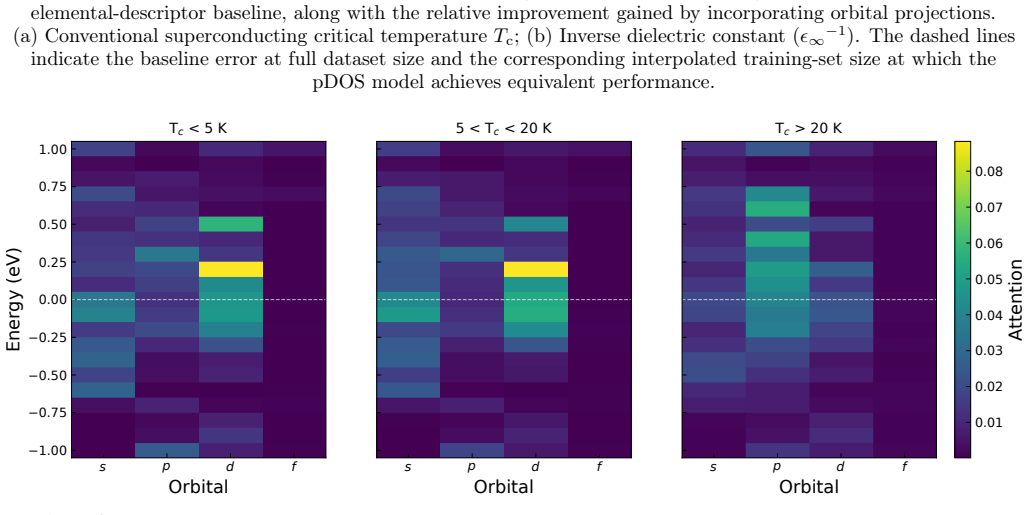
Encoding each atomic node with a fixed-length orbital-projected density-of-states fingerprint computed by DFT, then adding it to a Pettifor elemental embedding before message passing, reduces test error on Tc by 22.9 % (1.27 K to 0.98 K) and on the inverse dielectric constant by 27.9 %, improvements equivalent to roughly 1.7–1.8 times more training data, while an attention gate over the same fingerprint recovers the physically relevant orbital channels and energy windows.
What carries the argument
pDOS-augmented graph nodes: a site-resolved, orbital-channel (s,p,d,f) density-of-states vector, energy-binned relative to the Fermi level or band edges, projected and summed with a Pettifor embedding, optionally re-weighted by a spectral attention gate before message passing.
Load-bearing premise
The reported gains assume that the training set is larger than the pDOS feature vector itself and that hyperparameters tuned on the full data set remain fair when reused on smaller subsets or on the small Heusler set.
What would settle it
Retrain both the pDOS-augmented and baseline models on a held-out materials class of several thousand compounds using independently re-optimized hyperparameters; if the relative error reduction falls well below 20 % once the set size exceeds the fingerprint length, the central claim fails.
Editorial analysis
A structured set of objections, weighed in public.
Referee Report
Summary. The manuscript proposes initializing crystal-graph neural-network nodes with site- and orbital-projected density-of-states (pDOS) fingerprints from DFT, fused with Pettifor elemental embeddings, before message passing in a dual-view (atom + line-graph) transformer architecture (tuga-sp). On Alexandria-derived sets, pDOS augmentation lowers test MAE for superconducting Tc by ~22.9% (1.27 K → 0.98 K) and MSE for ε∞−¹ by ~27.9% relative to a Pettifor-only baseline, with separate Optuna hyperparameter searches per embedding. Progressive nested training-set curves are used to argue that these gains are comparable to roughly doubling the training data (~1.8× for Tc, ~1.7× for ε∞−¹). A spectral attention gate over orbital×energy bins yields compound- and property-resolved maps that align with known physics (e.g., B p states in MgB2, Nb d states in Nb3Sn/NbC). On a smaller Heusler exchange set (~800 entries), the gain shrinks to ~4%, which the authors attribute to feature dimension approaching sample size.
Significance. Node-feature design remains under-explored relative to message-passing architecture in materials GNNs. Encoding a true site-resolved quantum-mechanical observable (pDOS) rather than static elemental tables or geometry-only dynamic embeddings is a clear, transferable idea, and the full-set ablations with embedding-specific hyperparameter optimization provide credible evidence of accuracy gains on two distinct electronic properties. The attention maps that recover established orbital physics without orbital-level supervision are a genuine interpretability strength. If the data-efficiency claim holds under tighter controls, the approach would be practically valuable precisely where labels are scarce but DFT pDOS is already available (e.g., experimental Tc databases). The work is therefore of clear interest to the materials-informatics community, provided the quantitative scaling statements and generality claims are placed on firmer statistical footing.
major comments (4)
- §II.A and Fig. 2: The abstract and main text assert that pDOS gains are “comparable to those achieved by doubling the training-set size” (~1.8× for Tc, ~1.7× for ε∞−¹). These numbers come from a single nested progressive subset sequence (always retaining prior materials) evaluated under hyperparameters optimized once on the full set for each embedding and then frozen for all sizes. There is no per-size re-optimization, no independent equal-cardinality draws, and no multi-seed uncertainties. Because the pDOS vector is high-dimensional relative to Pettifor, fixed large-N capacity/regularization can differentially favor one model as N shrinks; the reported crossover may partly reflect that protocol. Either re-run learning curves with (i) independent random subsets, (ii) re-tuned or size-aware HPs, and (iii) error bars, or substantially soften the quantitative “doubling” language in the abst
- §II.C (Heusler exchange): Generality is claimed for a third property, but the set has only ~800 entries, hyperparameters are reused from the Tc study without re-optimization, and the reported improvement is only 4% (1.24 → 1.19 meV). The authors correctly note that gains shrink when N approaches feature length, yet this experiment is still used to support “broadly applicable” language. Either perform a dedicated HP search (or a reduced-dimension pDOS ablation) and report multi-seed statistics, or reframe Heusler as a negative/boundary control rather than positive evidence of generality.
- Practical scope and cost (Discussion / abstract): Using pDOS as a node feature presupposes a DFT calculation for every structure at inference time. For pure high-throughput screening of DFT-labeled properties this can erase the usual ML cost advantage; the strongest use case is scarce experimental labels with already-available DFT pDOS. The manuscript should state this tradeoff explicitly and, if possible, quantify wall-time or show a transfer setting (train on DFT labels + pDOS, evaluate on experimental Tc/ε) so that the “data-scarce regimes” claim is operationally clear rather than aspirational.
- §II.A energy-window design: The Tc window [−1, +1] eV and the ε∞ valence/conduction edge windows (plus explicit gap scalar) are property-specific free choices that already encode substantial domain knowledge. The brief statement that “accuracy barely increases with wider windows” is insufficient. A short systematic ablation (window width, bin size, gap-only vs full pDOS for ε∞) is needed to show that the reported gains are not dominated by these hand-chosen spectral cuts rather than by the full orbital fingerprint.
minor comments (7)
- Section heading “RESUL TS” contains a spurious space; fix throughout production.
- Abstract quotes 22.9% for Tc while §II.A states 22.8% (1.27 → 0.98 K); reconcile the percentage and report absolute errors with the same precision in both places.
- Fig. 2: add error bars or multi-seed bands if available; label the y-axis of panel (b) more clearly as MSE on ε∞−¹ (units).
- Attention models slightly degrade accuracy (Tc 1.01 K vs 0.98 K; ε MSE 2.0×10−⁴ vs 1.73×10−⁴). A one-sentence discussion of this accuracy–interpretability tradeoff would help readers decide when to enable the gate.
- Methods: state explicitly the pDOS feature dimension after orbital concatenation and zero-padding, the cutoff radius / neighbor construction for tuga-sp, and whether code and trained weights will be released.
- Related work: expand the comparison to dynamic node embeddings (ref. [14]) and to other electronic-structure featurizations beyond band-structure images, so the novelty relative to geometry-only dynamic embeddings is sharper.
- Fig. 6: predicted Tc for MgB2 (9.5 K) is far below both experiment and the cited isotropic ab initio value; a brief note that the model tracks the DFT-label distribution rather than experimental Tc would avoid over-reading the case studies.
Circularity Check
No circularity: supervised GNN regression of external DFT-derived labels using pDOS as additional input features; reported error reductions and data-efficiency equivalences are empirical outcomes, not identities by construction.
full rationale
The paper's central claims are empirical performance gains of a crystal GNN (tuga-sp) when atomic nodes are initialized with DFT site-projected orbital DOS fingerprints (plus Pettifor embeddings) versus elemental embeddings alone. Targets (Tc from Alexandria, inverse optical dielectric constant, Heusler isotropic exchange from SIESTA/TB2J) are external supervised labels; pDOS is an independent first-principles input computed once per structure and never defined in terms of the targets. Message-passing, attention gating (Eq. 1), and the final MLP head learn a mapping; attention maps are post-hoc diagnostics extracted after training, not quantities that force the reported MAE/MSE. The ~1.7–1.8 imes data-efficiency statements are observations read off a single nested-subset scaling curve under frozen full-set hyperparameters (Fig. 2); they are not algebraic identities or fitted constants renamed as predictions. Self-citations (Alexandria database, Pettifor embeddings, ALIGNN-style dual graphs) supply data sources and architectural components but do not supply a uniqueness theorem or load-bearing premise that collapses the claimed improvements. No equation equates the error reduction to an input by construction, no parameter fitted on a subset is re-presented as an independent prediction of a closely related quantity, and no known empirical pattern is merely renamed. The derivation chain is therefore self-contained supervised learning against external benchmarks.
Axiom & Free-Parameter Ledger
free parameters (4)
- pDOS energy window and bin width for Tc =
[−1,+1] eV / 0.1 eV
- pDOS energy windows for ε∞ =
±1 eV around band edges
- Optuna-selected GNN hyperparameters
- Methfessel-Paxton smearing width =
0.2 eV (default)
axioms (3)
- domain assumption DFT (VASP/PBE or SIESTA/PBE) site-projected densities of states are sufficiently accurate fingerprints of the electronic environment for the target properties.
- domain assumption Message-passing over atom and line graphs can usefully aggregate site-level electronic fingerprints into a global crystal representation.
- domain assumption Pettifor chemical-scale embeddings supply a useful complementary elemental prior that can be linearly fused with projected pDOS.
invented entities (2)
-
tuga-sp dual-view transformer GNN
no independent evidence
-
spectral attention-gating over pDOS bins
no independent evidence
Cite this review
Pith. "Pith review of Machine Learning Materials Properties by Encoding Orbital-Projected Density of States." pith.science (2026). https://pith.science/paper/K2TNJC3O
@misc{pith2026260707339,
  author       = {Pith},
  title        = {Pith review of: Machine Learning Materials Properties by Encoding Orbital-Projected Density of States},
  year         = {2026},
  howpublished = {\url{https://pith.science/paper/K2TNJC3O}},
  note         = {Machine review of arXiv:2607.07339}
}
read the original abstract
Graph neural networks have become the dominant machine-learning architecture for predicting materials properties from crystal structures. Yet the initialization of atomic node features has received comparatively little attention, and conventional approaches rely on static elemental descriptors that carry no information about the quantum-mechanical electronic environment of each atom in its crystalline host. Here we show that augmenting atomic node representations with site-projected orbital density of states (pDOS) fingerprints, computed directly from density functional theory calculations, yields systematic and substantial improvements in predictive performance.These representations are fused with Pettifor elemental embeddings at each atomic site before message passing. For the superconducting critical temperature $T_c$ and the optical dielectric constant $\epsilon_{\infty}$,the pDOS augmentation reduces prediction errors by 22.9% and 27.9%, respectively, relative to the elemental-descriptor baseline. These improvements are comparable to those achieved by doubling the training-set size. The gains are, however, contingent on training-set size. For the magnetic exchange energies of Heusler compounds, a substantially smaller dataset, the improvement is reduced,indicating that pDOS augmentation is most effective when the training data exceeds the length of the pDOS feature vector. We introduce an interpretable spectral attention-gating mechanism that reveals that the model autonomously learns to prioritize the orbital channels and energy windows most physically relevant to each target property. These results establish pDOS-augmented graph nodes as a broadly applicable strategy for infusing first-principles electronic-structure knowledge into graph networks, opening a practical route to high-accuracy property prediction in data-scarce regimes.
Figures




Reference graph
Works this paper leans on
-
[1]
P. Hohenberg and W. Kohn, Inhomogeneous Electron Gas, Phys. Rev.136, B864 (1964)
work page 1964
-
[2]
W. Kohn and L. J. Sham, Self-Consistent Equations In- cluding Exchange and Correlation Effects, Phys. Rev. 140, A1133 (1965)
work page 1965
-
[3]
K. T. Butler, D. W. Davies, H. Cartwright, O. Isayev, and A. Walsh, Machine learning for molecular and ma- terials science, Nature559, 547 (2018)
work page 2018
-
[4]
J. Schmidt, M. R. G. Marques, S. Botti, and M. A. L. Marques, Recent advances and applications of machine learning in solid-state materials science, npj Comput. Mater.5, 83 (2019)
work page 2019
-
[5]
D. Jha, L. Ward, A. Paul, W.-k. Liao, A. Choudhary, C. Wolverton, and A. Agrawal, ElemNet: Deep Learning the Chemistry of Materials From Only Elemental Com- position, Sci. Rep.8, 17593 (2018)
work page 2018
-
[6]
A.Jain,Machinelearninginmaterialsresearch: Develop- ments over the last decade and challenges for the future, Curr. Opin. Solid State Mater. Sci.33, 101189 (2024)
work page 2024
- [7]
-
[8]
Directional Message Passing for Molecular Graphs
J. Gasteiger, J. Groß, and S. Günnemann, Direc- tional message passing for molecular graphs, arXiv 10.48550/arXiv.2003.03123 (2020), 2003.03123
work page internal anchor Pith review Pith/arXiv arXiv doi:10.48550/arxiv.2003.03123 2003
-
[9]
K. Choudhary and B. DeCost, Atomistic line graph neu- ral network for improved materials property predictions, npj Comput. Mater.7, 185 (2021)
work page 2021
-
[10]
S. Batzner, A. Musaelian, L. Sun, M. Geiger, J. P. Mailoa, M. Kornbluth, N. Molinari, T. E. Smidt, and B. Kozinsky, E(3)-equivariant graph neural networks for data-efficient and accurate interatomic potentials, Nat. Commun.13, 2453 (2022)
work page 2022
-
[11]
I. Batatia, D. P. Kovacs, G. Simm, C. Ortner, and G. Csanyi, MACE: Higher order equivariant message passing neural networks for fast and accurate force fields, Advances in Neural Information Processing Systems35, 11423 (2022)
work page 2022
- [12]
-
[13]
C. Chen, W. Ye, Y. Zuo, C. Zheng, and S. P. Ong, Graph networks as a universal machine learning framework for molecules and crystals, Chem. Mater.31, 3564 (2019)
work page 2019
-
[14]
V.Gupta, K.Choudhary, Y.Li, M.N.T.Kilic, D.Wines, W.-k. Liao, A. Choudhary, and A. Agrawal, Dynamic embedding representation for graph neural networks to enhance materials property prediction with limited datasets, Mater. Res. Express13, 066502 (2026)
work page 2026
-
[15]
G. Kresse and J. Furthmüller, Efficiency ofab-initiototal energy calculations for metals and semiconductors using a plane-wave basis set, Comput. Mater. Sci.6, 15 (1996)
work page 1996
-
[16]
G. Kresse and J. Furthmüller, Efficient iterative schemes forab initiototal-energy calculations using a plane-wave basis set, Phys. Rev. B54, 11169 (1996)
work page 1996
-
[17]
T. Cavignac, J. Schmidt, P.-P. De Breuck, A. Loew, T. F. T. Cerqueira, H.-C. Wang, A. Bochkarev, Y. Lyso- gorskiy, A. H. Romero, R. Drautz, S. Botti, and M. A. L. Marques, AI-Driven expansion and application of the Alexandria database, J. Phys.: Mat.9, 025014 (2026)
work page 2026
-
[18]
T. F. T. Cerqueira, H. Wang, S. Botti, and M. A. L. Marques, A non-orthogonal representation for materials based on chemical similarity, npj Comput. Mater.12, 48 (2026)
work page 2026
-
[19]
D. R. Penn, Wave-number-dependent dielectric function of semiconductors, Phys. Rev.128, 2093 (1962)
work page 2093
-
[20]
M. A. L. Marques, J. Vidal, M. J. T. Oliveira, L. Reining, and S. Botti, Density-based mixing parameter for hybrid functionals, Phys. Rev. B83, 035119 (2011)
work page 2011
-
[21]
V. Trinquet, M. Evans, C. Hargreaves, P.-P. D. Breuck, and G.-M. Rignanese, Optical materials discovery and design with federated databases and machine learning, Faraday Discuss.256, 459 (2025)
work page 2025
-
[22]
T. Akiba, S. Sano, T. Yanase, T. Ohta, and M. Koyama, Optuna: A next-generation hyperparameter optimiza- tion framework, inProceedings of the 25th ACM SIGKDD International Conference on Knowledge Dis- covery & Data Mining(Association for Computing Ma- chinery, New York, NY, USA, 2019) pp. 2623–2631
work page 2019
-
[23]
J. Nagamatsu, N. Nakagawa, T. Muranaka, Y. Zenitani, and J. Akimitsu, Superconductivity at 39 K in magne- sium diboride, Nature410, 63 (2001)
work page 2001
-
[24]
J. M. An and W. E. Pickett, Superconductivity ofMgB2: covalent bonds driven metallic, Phys. Rev. Lett.86, 4366 (2001)
work page 2001
-
[25]
J. Yu, C. J. Ciccarino, R. Bianco, I. Errea, P. Narang, and B. A. Bernevig, Non-trivial quantum geometry and the strength of electron–phonon coupling, Nat. Phys.20, 1262 (2024)
work page 2024
-
[26]
B. T. Matthias, T. H. Geballe, S. Geller, and E. Coren- zwit, Superconductivity ofNb 3Sn, Phys. Rev.95, 1435 (1954)
work page 1954
-
[27]
Labbé, Relation between superconductivity and lattice instability in theβ-W compounds, Phys
J. Labbé, Relation between superconductivity and lattice instability in theβ-W compounds, Phys. Rev.172, 451 (1968). 9
work page 1968
-
[28]
A. Cucciari and L. Boeri, An ab initio answer to long- debated questions about superconductingnb 3Sn, PRX Energy5, 013006 (2026)
work page 2026
-
[29]
R. H. Willens, E. Buehler, and B. T. Matthias, Super- conductivity of the transition-metal carbides, Phys. Rev. 159, 327 (1967)
work page 1967
- [30]
-
[31]
J. M. Soler, E. Artacho, J. D. Gale, A. García, J. Jun- quera, P. Ordejón, and D. Sánchez-Portal, The SIESTA method for ab initio order-N materials simulation, J. Phys.: Condens. Matter14, 2745 (2002)
work page 2002
-
[32]
A. García, N. Papior, A. Akhtar, E. Artacho, V. Blum, E. Bosoni, P. Brandimarte, M. Brandbyge, J. I. Cerdá, F. Corsetti, R. Cuadrado, V. Dikan, J. Ferrer, J. Gale, P. García-Fernández, V. M. García-Suárez, S. García, G. Huhs, S. Illera, R. Korytár, P. Koval, I. Lebedeva, L. Lin, P. López-Tarifa, S. G. Mayo, S. Mohr, P. Orde- jón, A. Postnikov, Y. Pouillon...
work page 2020
-
[33]
J. P. Perdew, K. Burke, and M. Ernzerhof, Generalized gradient approximation made simple, Phys. Rev. Lett. 77, 3865 (1996)
work page 1996
-
[34]
X. He, N. Helbig, M. J. Verstraete, and E. Bousquet, TB2J:Apythonpackageforcomputingmagneticinterac- tion parameters, Comput. Phys. Commun.264, 107938 (2021)
work page 2021
-
[35]
A. Liechtenstein, M. Katsnelson, V. Antropov, and V. Gubanov, Local spin density functional approach to the theory of exchange interactions in ferromagnetic met- als and alloys, J. Magn. Magn. Mater.67, 65 (1987)
work page 1987
-
[36]
T. Graf, C. Felser, and S. S. P. Parkin, Simple rules for the understanding of Heusler compounds, Prog. Solid State Chem.39, 1 (2011)
work page 2011
-
[37]
J. Li, W. Fang, S. Jin, C. Suo, T. Zhang, Y. Wu, X. Xu, Y. Liu, and D.-X. Yao, A deep learning approach to search for superconductors from electronic bands, AI Sci. 1, 015001 (2025)
work page 2025
- [38]
-
[39]
I. Petousis, D. Mrdjenovich, E. Ballouz, M. Liu, D. Win- ston, W. Chen, T. Graf, T. D. Schladt, K. A. Persson, and F. B. Prinz, High-throughput screening of inorganic compounds for the discovery of novel dielectric and opti- cal materials, Sci. Data4, 160134 (2017)
work page 2017
discussion (0)
Sign in with ORCID, Apple, or X to comment. Anyone can read and Pith papers without signing in.