REVIEW 2 major objections 6 minor 54 references
Four minimal routes turn equal CW/CCW cell circling into persistent one-sided chiral migration under confinement.
Reviewed by Pith at T0; open to challenge. T0 means a machine referee read the full paper against a public rubric. the ladder, T0–T4 →
T0 review · grok-4.5
2026-07-10 18:40 UTC pith:XITPFLFB
load-bearing objection Solid dynamical-systems taxonomy of four minimal routes to CW/CCW bias in a confined polarized singlet; math and code check out, novelty is unification rather than a paradigm shift. the 2 major comments →
Directional bias of a single polarized cell under confinement
The pith
A machine-rendered reading of the paper's core claim, the machinery that carries it, and where it could break.
Core claim
Directional bias of a confined polarized singlet is produced by changes in the stability and/or basins of attraction of the clockwise and counter-clockwise motility states. Four minimal routes realize this change: intrinsic polarity torque, anisotropic friction with a body-frame offset, chiral wall-alignment, and lab-frame substrate patterns that break mirror symmetry.
What carries the argument
The reduced autonomous flow on the half-cylinder (R, Δφ), where R is radial position and Δφ is the phase lag between polarity and position angle. Reflection symmetry of this flow keeps CW and CCW centers equal; any coupling that breaks the symmetry either displaces the centers, splits their stability into a sink and a source, or tilts their basins.
Load-bearing premise
Confinement is modeled only as a continuous reorientation of the cell's polarity angle toward the disk center; the cell itself is treated as a point particle whose shape, membrane, nucleus and distributed adhesions are ignored.
What would settle it
Place single polarized cells on a disk micropattern that is mirror-symmetric and free of ridges, then systematically introduce one controlled symmetry breaker (intrinsic cytoskeletal torque, anisotropic friction with known offset, chiral wall cue, or chiral substrate ridges) while holding the others fixed; if the observed CW/CCW split and trajectory shape fail to match the predicted change in stability or basin size for that mechanism, the corresponding route is ruled out.
If this is right
- Each of the four mechanisms produces a distinct, measurable signature in trajectory shape, basin size, or bifurcation type, allowing experiments to discriminate which route is active in a given cell type.
- An adhesive spot at the center of the disk turns an all-or-nothing bias into a continuously tunable CW/CCW population ratio.
- Only substrate patterns that themselves lack mirror symmetry generate directional bias; mirror-symmetric patterns leave the split equal.
- The same dynamical principle supplies design rules for synthetic active particles or microvessels whose handedness can be programmed by geometry or friction anisotropy.
Where Pith is reading between the lines
- The common offset between body-frame polarity and lab-frame adhesion axis may be a general design rule for chiral active matter beyond cells.
- If real confinement acts mainly through contact forces or adhesion remodeling rather than polarity reorientation, the reduced (R, Δφ) picture would need to be rebuilt from a force-based contact model.
- Coupling any of the four single-cell routes to the earlier cell-doublet model could explain how multicellular chiral patterns reverse or amplify the single-cell bias.
Editorial analysis
A structured set of objections, weighed in public.
Referee Report
Summary. The manuscript develops a minimal overdamped model of a polarized point cell in disk confinement and uses dynamical-systems reduction plus simulations to classify how persistent CW/CCW bias can arise. Confinement is encoded as continuous polarity reorientation toward the disk center. The unbiased system is Hamiltonian with equal CW/CCW basins (centers at R=ℓ, Δφ=±π/2). Four routes to bias are identified: (1) intrinsic polarity torque μ, which preserves conservation but shifts centers and basin areas until a saddle-center bifurcation leaves one direction; (2) anisotropic friction with body-frame offset δ, which makes the flow dissipative and yields a single global spiral attractor; (3) chiral wall-alignment offset χ, which likewise splits stability of the two rotating states without moving them; (4) lab-frame substrate patterns that break mirror symmetry. An adhesive center spot alone preserves 50/50 outcomes but, when combined with (1)–(3), makes bias continuously tunable via basin tilting and saddle-node or Hopf bifurcations. The organizing claim is that bias emerges by changing stability and/or basins of the CW and CCW motility states.
Significance. If the analysis holds—and the appendices largely establish that it does within the stated model—this is a useful unifying framework for single-cell chirality under confinement. Strengths include closed reductions on (R,Δφ), conserved Hamiltonians for the unbiased and torque cases, Jacobian traces/determinants, Bendixson–Dulac and Poincaré–Bendixson arguments, and explicit bifurcation routes that match the reported phase portraits and ensemble statistics. Code is deposited on Zenodo, supporting reproducibility. The four-route classification and the distinction between conserved (tunable basin) versus dissipative (all-or-nothing) bias give concrete, falsifiable signatures for experiments and for designing synthetic chiral active systems. The work is theoretical and does not claim to fit chirality data; its value is the organizing principle and the minimal mechanisms.
major comments (2)
- Sec. III.C–III.D and Appendices D–E: anisotropic friction with offset δ and chiral wall offset χ both produce dissipative dynamics with one stable and one unstable spiral and an all-or-nothing CW/CCW outcome. The abstract and Discussion claim “distinct, testable predictions,” but the main text does not spell out an experimental protocol that separates these two routes (e.g., trajectory shape, dependence on substrate anisotropy vs boundary chemistry, or response to changing τ_W). Without that, the claim that the four routes are experimentally distinguishable is only partially supported. A short table or paragraph mapping each route to unique observables would make the central experimental claim load-bearing rather than aspirational.
- Sec. II, Eq. (4) and Appendix A (wall term in Eq. 15): confinement is implemented solely as continuous polarity reorientation of a point particle, with no contact force, shape, or adhesion remodeling. The Discussion notes environmental context but does not clearly state how the four-route classification would change if confinement acted primarily through hard-wall contact or distributed adhesions. This is a scope limitation rather than an internal error, but it is load-bearing for mapping to the motivating confined-cell experiments. A brief, explicit caveat in Sec. IV on which predictions are robust to alternative confinement implementations would strengthen the paper without expanding its scope.
minor comments (6)
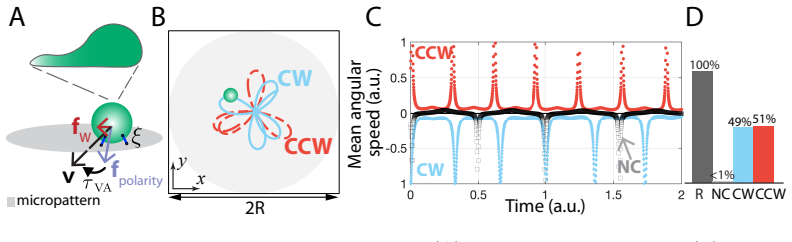
- Fig. 1D reports 49%/51% CW/CCW from 3200 runs; the footnote on sample size is helpful, but the main text should state the classification threshold for “non-coherent” (footnote 2: >20% unidirectional) more prominently so readers can reproduce the three-state split.
- Notation: the polarity angle is ϕ in the main text and φ in the appendices; unify to one symbol throughout.
- Sec. III.E / Fig. 4: “Ferencto introduce” appears to be a typographical error (“In an effort to introduce”).
- Table S1 lists μ = −0.5 (CW), 0.5 (CCW) as default cellular parameters; clarify that μ = 0 is the default unbiased case used in Sec. III.A so the table is not misread as always biased.
- Fig. 6 is a useful summary; adding a one-line note on conserved vs dissipative dynamics under each panel would help non-dynamical-systems readers.
- References [26] and [27] appear duplicated in the Introduction citation list for external fields; clean the citation string.
Circularity Check
No significant circularity: CW/CCW bias routes are derived from stated ODEs via phase-plane reductions, not fitted inputs or self-definitional claims.
full rationale
The paper is a self-contained dynamical-systems analysis of a minimal overdamped polarized-particle model. The central claim—that directional bias arises by changing stability or basins of CW/CCW motility states via four routes (intrinsic torque μ, anisotropic friction with body-frame offset δ, chiral wall offset χ, and mirror-asymmetric lab-frame patterns)—is obtained by reducing the stated force-balance and polarity equations to closed (R, Δφ) flows (Appendices A–F), then classifying equilibria, conserved quantities or Dulac multipliers, Jacobian traces/dets, and bifurcations. Outcomes are consequences of those ODEs under explicit parameter switches, not quantities fitted to chirality data and relabeled as predictions. The self-citation to prior doublet work [30] supplies modeling lineage and a comparative remark; it is not used as a uniqueness theorem, ansatz, or definition of the singlet results. Free parameters set scales of bias but do not force the qualitative organizing principle by construction. No self-definitional loop, fitted-input-as-prediction, or load-bearing self-citation chain is present.
Axiom & Free-Parameter Ledger
free parameters (7)
- τ_W (confinement / wall-alignment timescale)
- τ_VA (velocity-alignment timescale)
- μ (intrinsic polarity torque)
- α, δ (friction anisotropy and body-frame offset)
- χ (chiral wall-alignment offset)
- k0, k_W (anchor and wall spring strengths)
- γ_pol, ξ (polarity force and isotropic drag)
axioms (5)
- domain assumption Overdamped force balance: velocity equals mobility times polarity (and optional radial) force; inertia neglected.
- domain assumption Polarity dynamics follow velocity alignment plus wall reorientation (and optional μ, χ), not explicit Rho-GTPase PDEs.
- ad hoc to paper Confinement is encoded as continuous polarity reorientation toward the disk center rather than a hard wall potential or contact mechanics.
- domain assumption Cell is a point particle; spinning, membrane shape, nucleus, and distributed adhesions are ignored.
- standard math Standard planar dynamical-systems tools (Hamiltonian level sets, Jacobian classification, Bendixson–Dulac, Poincaré–Bendixson) apply on the reduced half-cylinder.
invented entities (3)
-
Intrinsic polarity torque μ
no independent evidence
-
Body-frame frictional offset δ between polarity and easy axis
no independent evidence
-
Chiral wall-alignment offset χ
no independent evidence
read the original abstract
Chiral patterns have been observed in various processes from swirling bacterial colonies to tissue morphogenesis and cytoskeletal organization, yet the physical mechanisms underlying chiral cell motion remain poorly understood. Motivated by experiments demonstrating directional bias in the circular motion of confined cells, we use the tools of dynamical systems analysis with computer simulations to identify minimal intrinsic and extrinsic mechanisms capable of generating persistent biased migration. The dynamical systems framework reveals a common organizing principle: directional bias emerges through changes in the stability and/or basins of attraction of the clockwise and counter-clockwise motility states. We find four distinct routes to such bias. First, intrinsic torque in a polarized cytoskeleton can be spatially integrated to produce biased circular motion. Second, anisotropic cell-substrate friction can generate directional preference when reduced friction along the polarity axis is coupled to a directional offset. Third, a chiral wall-alignment response can also produce a persistent directional preference. Finally, substrate patterns that break mirror symmetry, such as dextral or sinistral ridges and troughs, can likewise bias rotational direction. Together, these mechanisms yield distinct, testable predictions and suggest a unifying lens for experimental interrogation of cellular chirality and the design of synthetic systems with programmable chiral motion.
Figures


Reference graph
Works this paper leans on
-
[1]
J. Xu, A. Van Keymeulen, N. M. Wakida, P. Carlton, M. W Berns, and H. R. Bourne. Polarity reveals intrin- sic cell chirality.Proc Nat Acad Sci, 104(22):9296–9300, 2007
work page 2007
-
[2]
S. L. Vecchio, O. Pertz, M. Szopos, L. Navoret, and D. Riveline. Spontaneous rotations in epithelia as an interplay between cell polarity and boundaries.Nat Phys, 20(2):322–331, 2024
work page 2024
-
[3]
C. Brangwynne, S. Huang, K. K. Parker, and D. E. Ingber. Symmetry breaking in cultured mammalian cells.In vitro Cell Dev Biol - Animal, 36(9):563–565, 2000
work page 2000
-
[4]
P. Guillamat, C. Blanch-Mercader, G. Pernollet, K. Kruse, and A. Roux. Integer topological defects or- ganize stresses driving tissue morphogenesis.Nat Mat, 21(5):588–597, 2022
work page 2022
-
[5]
P. A. Fern´ andez, B. Buchmann, A. Goychuk, L. K. En- gelbrecht, M. K. Raich, C. H. Scheel, E. Frey, and A. R. Bausch. Surface-tension-induced budding drives alve- ologenesis in human mammary gland organoids.Nat Phys, 17(10):1130–1136, 2021
work page 2021
- [6]
-
[7]
H. G. Lee and K. J. Lee. Neighbor-enhanced diffusivity in dense, cohesive cell populations.PLoS Comp Biol, 17(9):e1009447, 2021
work page 2021
- [8]
-
[9]
A. S. Chin, K. E. Worley, P. Ray, G. Kaur, J. Fan, and L. Q. Wan. Epithelial cell chirality revealed by three- dimensional spontaneous rotation.Proc Natl Acad Sci USA, 115(48):12188–12193, 2018
work page 2018
-
[10]
A. Erzberger, A. Jacobo, A. Dasgupta, and A. J. Hud- speth. Mechanochemical symmetry breaking during morphogenesis of lateral-line sensory organs.Nat Phys, 16(9):949–957, 2020
work page 2020
-
[11]
E. L. Kozak, J. R. Miranda-Rodr´ ıguez, A. Borges, K. Dierkes, A. Mineo, F. Pinto-Teixeira, O. Viader- Llargues, J. Solon, O. Chara, and H. L´ opez-Schier. Quantitative videomicroscopy reveals latent control of cell-pair rotationsin vivo.Dev, 150(9):dev200975, 2023
work page 2023
-
[12]
L. Lu, T. Guyomar, Q. Vagne, R. Berthoz, A. Torres- S´ anchez, M. Lieb, C. Martin-Lemaitre, K. van Unen, A. Honigmann, O. Pertz, D. Riveline, and G. Salbreux. Polarity-driven three-dimensional spontaneous rotation of a cell doublet.Nat Phys, pages 1–10, 2024
work page 2024
-
[13]
Y. H. Tee, W. J. Goh, X. Yong, H. T. Ong, J. Hu, I. Y. Y. Tay, S. Shi, S. Jalal, S. F. H. Barnett, P. Kan- chanawong, W. Huang, J. Yan, Y. A. B. Lim, V. Thi- agarajan, A. Mogilner, and A. D. Bershadsky. Actin polymerisation and crosslinking drive left-right asym- metry in single cell and cell collectives.Nat. Commun., 14(1):776, 2023
work page 2023
-
[14]
L. Q. Wan, K. Ronaldson, M. Park, G. Taylor, Y. Zhang, J. M. Gimble, and G. Vunjak-Novakovic. Micropatterned mammalian cells exhibit phenotype- specific left-right asymmetry.Proc. Natl. Acad. Sci. U.S.A., 108(30):12295–12300, 2011
work page 2011
-
[15]
T.-H. Chen, J. J. Hsu, X. Zhao, C. Guo, M. N. Wong, Y. Huang, Z. Li, A. Garfinkel, C.-M. Ho, Y. Tintut, and L.L. Demer. Left-right symmetry breaking in tissue morphogenesis via cytoskeletal mechanics.Circ. Res., 110(4):551–559, 2012
work page 2012
- [16]
-
[17]
K. D. Endresen, M. Kim, M. Pittman, Y. Chen, and F. Serra. Topological defects of integer charge in cell monolayers.Soft Matt, 17(24):5878–5887, 2021
work page 2021
-
[18]
K. Kaiyrbekov, K. Endresen, K. Sullivan, Z. Zheng, Y. Chen, F. Serra, and B. A. Camley. Migration and di- vision in cell monolayers on substrates with topological defects.Proc Nat Acad Sci USA, 120(30):e2301197120, 2023
work page 2023
-
[19]
W. Liu, Y. Bao, M. L. Lam, T. Xu, K. Xie, H. Sum Man, E. Y. Chan, N. Zhu, R. H. W. Lam, and T.-H. Chen. Nanowire magnetoscope reveals a cellular torque with left–right bias.ACS nano, 10(8):7409–7417, 2016
work page 2016
-
[20]
Y. H. Tee, T. Shemesh, V. Thiagarajan, R. F. Hariadi, K. L. Anderson, C. Page, N. Volkmann, D. Hanein, S. Sivaramakrishnan, M. M. Kozlov, and A. D. Ber- shadsky. Cellular chirality arising from the self- organization of the actin cytoskeleton.Nat. Cell Biol., 17(4):445–457, 2015
work page 2015
-
[21]
K. E. Worley, A. S. Chin, and L. Q. Wan. Lineage-specific chiral biases of human embryonic stem cells during differentiation.Stem Cells Intl, 2018(1):1848605, 2018
work page 2018
-
[22]
P. Ray, A. S. Chin, K. E. Worley, J. Fan, G. Kaur, M. Wu, and L. Q. Wan. Intrinsic cellular chirality regu- lates left–right symmetry breaking during cardiac loop- ing.Proc. Natl. Acad. Sci. U.S.A., 115(50):E11568– E11577, 2018. 10
work page 2018
-
[23]
M. Cetera, G. R. Ramirez-San Juan, P. W. Oakes, L. Lewellyn, M. J. Fairchild, G. Tanentzapf, M. L Gardel, and S. Horne-Badovinac. Epithelial rotation promotes the global alignment of contractile actin bun- dles during Drosophila egg chamber elongation.Nat Comm, 5(1):5511, 2014
work page 2014
-
[24]
N. Founounou, R. Farhadifar, G. M. Collu, U. Weber, M. J. Shelley, and M. Mlodzik. Tissue fluidity medi- ated by adherens junction dynamics promotes planar cell polarity-driven ommatidial rotation.Nat Comm, 12(1):6974, 2021
work page 2021
- [25]
-
[26]
H. D. Moreau, C. Blanch-Mercader, R. Attia, M. Mau- rin, Z. Alraies, D. Sanseau, O. Malbec, M.-G. Delgado, P. Bousso, J.-F. Joanny, R. Voituries, M. Piel, and A.-M. Lennon-Dumenil. Macropinocytosis overcomes directional bias in dendritic cells due to hydraulic re- sistance and facilitates space exploration.Dev Cell, 49(2):171–188, 2019
work page 2019
-
[27]
X. Wang, M. Hossain, A. Bogoslowski, P. Kubes, and D. Irimia. Chemotaxing neutrophils enter alter- nate branches at capillary bifurcations.Nat Comm, 11(1):2385, 2020
work page 2020
-
[28]
R. Zhao, A. Afthinos, T. Zhu, P. Mistriotis, Y. Li, S. A. Serra, Y. Zhang, C. L. Yankaskas, S. He, M. A. Valverde, S. X. Sun, and K. Konstantopoulos. Cell sensing and decision-making in confinement: The role of TRPM7 in a tug of war between hydraulic pressure and cross-sectional area.Sci Adv, 5(7):eaaw7243, 2019
work page 2019
-
[29]
J. Renkawitz, A. Kopf, J. Stopp, I. De Vries, M. K. Driscoll, J. Merrin, R. Hauschild, E. S. Welf, G. Danuser, R. Fiolka, and M. Sixt. Nuclear position- ing facilitates amoeboid migration along the path of least resistance.Nature, 568(7753):546–550, 2019
work page 2019
-
[30]
E. Im, G. Badih, L. Kurzawa, A. Buttensch¨ on, and C. Copos. Competing forces of polarization and adhe- sion modulates directional migration bias in a minimal model.Biophys J, 125:1–12, 2026
work page 2026
-
[31]
Howard.Mechanics of Motor Proteins and the Cy- toskeleton
J. Howard.Mechanics of Motor Proteins and the Cy- toskeleton. Oxford University Press, 2018
work page 2018
-
[32]
A. Jilkine and L. Edelstein-Keshet. A comparison of mathematical models for polarization of single eukary- otic cells in response to guided cues.PLoS Comput Biol, 7(4), 04 2011
work page 2011
-
[33]
S. Okada, E. Yamada, T. Saito, K. Ohshima, K. Hashimoto, M. Yamada, Y. Uehara, T. Tsuchiya, H. Shimizu, K. Tatei, T. Izumi, K. Yamauchi, S. Hisanaga, J. E. Pessin, and M. Mori. CDK5- dependent phosphorylation of the Rho family GTPase TC10αregulates insulin-stimulated GLUT4 transloca- tion.J Biol Chem, 283(51):35455 – 35463, 2008
work page 2008
-
[34]
A. Buttensch¨ on and L. Edelstein-Keshet. Bridging from single to collective cell migration: A review of models and links to experiments.PLoS Comp Biol, 16(12):e1008411, 2020
work page 2020
-
[35]
C. Copos and A. Mogilner. A hybrid stochas- tic–deterministic mechanochemical model of cell polar- ization.Mol Biol Cell, 31(15):1637–1649, 2020
work page 2020
-
[36]
B. A. Camley, Y. Zhang, Y. Zhao, B. Li, E. Ben-Jacob, H. Levine, and W. J. Rappel. Polarity mechanisms such as contact inhibition of locomotion regulate persis- tent rotational motion of mammalian cells on micropat- terns.Proc Natl Acad Sci USA, 111:14770–14775, 2014
work page 2014
- [37]
-
[38]
C. Gomez-Cruz, M. Gelin, L. Pradeau-Ph´ elut, A. Mu˜ noz-Barrutia, S. Etienne-Manneville, and D. Garcia-Gonzalez. Transient cytoskeletal anisotropy encodes short-term mechanical memory.bioRxiv, pages 2026–03, 2026
work page 2026
-
[39]
W. Shi, D. T. Lam Nguyen, W. J. Goh, H. T. Ong, R. Bin Tan, C. Fu, A. D. Bershadsky, A. Mogilner, and Y. H. Tee. Ordering from the edge: Chiral multicellular pattern formation directed by actin self-organisation in cells.bioRxiv, pages 2025–10, 2025
work page 2025
- [40]
-
[41]
A. Ray, O. Lee, Z. Win, R. M. Edwards, P. W. Al- ford, D.-H. Kim, and P. P. Provenzano. Anisotropic forces from spatially constrained focal adhesions me- diate contact guidance directed cell migration.Nat Comm, 8(1):14923, 2017
work page 2017
-
[42]
C.-Y. Su, T. Matsubara, A. Wu, E. H. Ahn, and D.- H. Kim. Matrix anisotropy promotes a transition of collective to disseminated cell migration via a collective vortex motion.Adv Biol, 7(10):2300026, 2023
work page 2023
-
[43]
Directional bias of a single polarized cell under confinement
L. Dong, J. Gong, Y. Wang, J. He, D. You, Y. Zhou, Q. Li, Y. Liu, K. Cheng, J. Qian, and W. Weng. Chiral geometry regulates stem cell fate and activity.Biomat, 222:119456, 2019. 11 SUPPLEMENTAL TABLES: SUPPLEMENTAL TABLE 1: Table of parameter descriptions along with the values used in computer simulations and analysis. SUPPLEMENTAL TABLE 2: Summary of the...
work page 2019
-
[44]
Then that equilibrium is a sink, and every trajectory inΩconverges to it
someη∈C 1(Ω)s.t.∇ ·(ηF)>(<)0onΩ; and 8 2.Ωcontains a single equilibrium, hyperbolic and not a saddle. Then that equilibrium is a sink, and every trajectory inΩconverges to it. Proof.Each forward orbit is bounded, so itsω-limit set is a nonempty compact subset ofM. Hypothesis (1) excludes periodic orbits (Bendixson–Dulac), and with a single non-saddle equi...
-
[45]
Each corresponds to steady circular motion of radiusℓat angular velocity ˙θ=±1/τ W
Two interior centers at(R ∗,∆φ ∗) = (ℓ,±π/2). Each corresponds to steady circular motion of radiusℓat angular velocity ˙θ=±1/τ W
-
[46]
The cell drifts radially outward (∆φ= 0) or inward (∆φ=±π)
Two invariant lines (not equilibria) at∆φ= 0and∆φ=±π, forming theH= 0level set, where ˙∆φ= 0but ˙R=±V 0 ̸= 0. The cell drifts radially outward (∆φ= 0) or inward (∆φ=±π). They are not equilibria, but they organize the phase portrait. Proof.From ˙R= 0 either cos ∆φ= 0 (giving ∆φ=±π/2), or the trajectory has unboundedR. In the first case, ˙∆φ= 0 requires sin...
-
[47]
IfH(R 0,∆φ 0)>0, thenω(t)>0for allt, andn(T)>0for allT >0
-
[48]
IfH(R 0,∆φ 0)<0, thenω(t)<0for allt, andn(T)<0for allT >0
-
[49]
No trajectory mix CW and CCW oriented migration paths
IfH(R 0,∆φ 0) = 0, thenω= 0: the trajectory lies on∆φ∈ {0,±π}andn(T) = 0. No trajectory mix CW and CCW oriented migration paths. Proof.His conserved along trajectories, and Eq. (30) gives sgn(ω) = sgn(H). The sign ofω(t) is therefore constant, so Θ(T) = R T 0 ω dtinherits the same sign, and hence so doesn(T) = Θ(T)/(2π). Appendix C EFFECT OF INTRINSIC TOR...
-
[50]
For µ≤ −1/τ W no CCW equilibrium remains
Atµ→ −1/τ + W : the CCW center radiusR ∗ + =V 0/(1/τW +µ)diverges, and the equilibrium escapes to infinity. For µ≤ −1/τ W no CCW equilibrium remains
-
[51]
Atµ= 0: the symmetric configuration of Appendix B is recovered, with mirror-paired centers at(τ W V0,±π/2)
-
[52]
For µ≥+1/τ W no CW equilibrium remains
Atµ→+1/τ − W : the CW center radiusR ∗ − =V 0/(1/τW −µ)diverges, and the equilibrium escapes to infinity. For µ≥+1/τ W no CW equilibrium remains. For|µ|>1/τ W only one rotation direction survives in the finite-Rphase plane. The dynamics is deterministically chiral. Proof.The radii in Eq. (32) diverge precisely atµ=−1/τ W andµ= +1/τ W . The frequenciesω ± ...
-
[53]
The sinkx + is finite, and every trajectory inM \ {x − }converges to it; a single global attractor
Bounded (Bρ < A). The sinkx + is finite, and every trajectory inM \ {x − }converges to it; a single global attractor
-
[54]
Escape (Bρ≥A). The sink has escaped to infinity,x − is the only equilibrium, and every trajectory inM \ {x − }has R(t)→ ∞linearly in time, at a strictly positive asymptotic mean radial speedm ∞. The polarity precesses (B≥1) or locks onto∆φ ∞ = arcsin(−B)(B <1). 12 Proof. No periodic orbits.Recall thatv r = ˙R=ℓ(Acos ∆φ−Bsin ∆φ) andv θ =ℓ(Asin ∆φ+Bcos ∆φ),...
discussion (0)
Sign in with ORCID, Apple, or X to comment. Anyone can read and Pith papers without signing in.