REVIEW 5 minor 60 references
Topology from Decoherence
T0 review · 0 major / 5 minor · reviewed 2026-07-10 · grok-4.5
Pith's one-line read Correlated decoherence alone can open a topological point gap and drive one-way diffusion in an open lattice.
desk verdict Clean analytical example of interaction-induced point-gap topology and skin effect generated purely by correlated Hermitian jumps in a full Lindbladian. read the letter →
The pith
A machine-rendered reading of the paper's core claim, the machinery that carries it, and where it could break.
The reading
What carries the argument
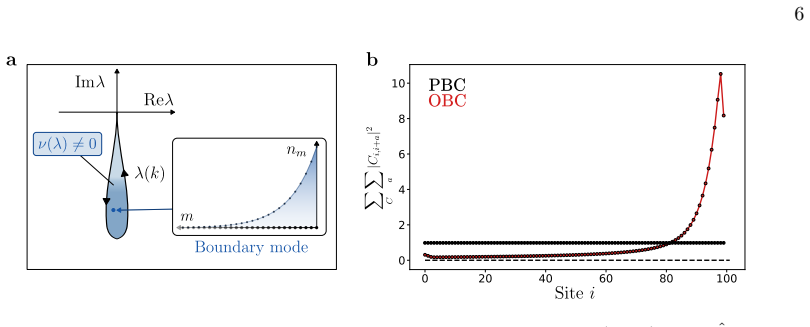
The N^{2} imes N^{2} correlation-matrix generator Ĉ, obtained by vectorizing the closed linear equation of motion for the two-point matrix C. Its discrete spectrum (the decohered band) is the object that carries the winding number u( heta) and the skin effect; continuous-spectrum modes decay too fast to control late-time diffusion.
What would settle it
Time-evolve the full many-body Lindbladian (or a sufficiently large truncation that includes four-point functions) from a localized density perturbation and check whether the late-time density profile remains asymmetrically biased in the direction predicted by the winding of Ĉ; disappearance or reversal of the bias would refute the claim.
Extended reading notes
Core claim
In a lattice of free fermions subject to the Hermitian jumps K_m = A n_m + B j_m, the noise-averaged Lindbladian produces an interaction-induced point gap in the discrete (decohered) spectrum of the correlation-matrix superoperator Ĉ. The gap carries a nonzero winding number that forces a many-body skin effect and long-time asymmetric diffusion whose direction is set by the winding and reverses only at the topological transition t = ± AB/2.
Load-bearing premise
That late-time spatial profiles of densities and currents are completely fixed by the discrete eigenmodes of Ĉ alone, so that higher-order correlators cannot wash out the observed skin effect or reverse the diffusion direction.
Editorial extensions
If this is right
- Correlated density-current noise can be deliberately engineered to produce unidirectional relaxation without post-selection.
- The direction of asymmetric diffusion can be flipped by tuning only the relative strength of current versus density dephasing, realizing a topological phase transition inside the open system.
- Any Lindbladian built from non-commuting Hermitian jumps is a candidate host for analogous interaction-induced point-gap topology.
- Experimental platforms already capable of laser-assisted hopping with spontaneous emission (ultracold atoms, superconducting qubits) can test the predicted one-way diffusion.
- Post-selection erases the effect, so only noise-averaged protocols will observe it.
Reading between the lines
- If the same mechanism survives in two dimensions, correlated dephasing could generate higher-order skin effects or mixed-state topological order without coherent drive.
- The analytic tractability of Ĉ suggests a broader program: classify all quadratic-jump Lindbladians by the topology of their discrete spectra rather than by free-fermion invariants.
- Low-temperature or non-Markovian completions of the model may convert the decohered band into a long-lived topological edge current.
- The divergence of the localization length at the transition t = ±g offers a sharp experimental signature that is independent of microscopic details.
Signed reviews
Editorial analysis
A structured set of objections, weighed in public.
Referee Report
Summary. The paper shows that environment-induced dephasing generated by correlated density-current jumps K_m = A n_m + B j_m on a 1D free-fermion chain produces, after noise averaging, an interacting Lindbladian whose correlation-matrix generator Ĉ exhibits a point-gap topology in its discrete (decohered) spectrum. The topology is diagnosed by a winding number u( heta) constructed from the momentum-space Bloch matrix C_ab(k), implies a many-body non-Hermitian skin effect under open boundaries, and yields robust asymmetric diffusion of density perturbations whose direction is fixed by the winding and reverses only at the topological transition t = ± AB/2. The effect is interaction-induced (vanishes for B = 0 or under post-selection) and remains analytically tractable via closed equations of motion for the two-point correlator.
Significance. If the results hold, the work supplies a concrete, analytically controlled route by which correlated Markovian noise itself generates many-body point-gap topology and a dynamical skin effect, distinct from both free Lindbladians and post-selected non-Hermitian Hamiltonians. The closed EOM for C, the Green’s-function solution of the decohered band at B = 0, the second-order truncation yielding ξ^{-1} ∝ (t^{2} - g^{2})| heta|, and the explicit bulk-boundary argument for Ĉ constitute genuine technical strengths. The asymmetric-diffusion signature (Fig. 2) is falsifiable and experimentally accessible in ultracold-atom or circuit-QED platforms, making the paper a clear conceptual advance for open-system topology.
minor comments (5)
- Methods, bulk-boundary paragraph: the truncation of the infinite Bloch matrix C_ab(k) to a finite relative-index window is argued via exponential decay of decohered states, but a short numerical check that the winding number u( heta) remains stable under progressive truncation for the parameters of Fig. 1 would make the argument fully self-contained.
- SM Sec. III.C, Eq. (63): the localization scaling is derived near the steady state; a one-sentence remark that the same leading Re(κ) ∝ | heta| form continues to describe the entire decohered band (as confirmed by the OBC localization plots) would remove any residual ambiguity.
- Fig. 1 caption and main-text discussion of the continuous spectrum: the phrase “fills an entire disk” is correct only in the thermodynamic limit; a parenthetical “in the N o ∞ limit” would prevent misreading for finite N.
- Introduction, final paragraph: the claim that the model “remains analytically tractable” is accurate, yet a forward reference to the O(N^{2}) complexity of Ĉ (Methods) would help readers immediately appreciate the practical advantage over full Lindbladian diagonalization.
- References: a few recent works on Liouvillian skin effects with non-Hermitian jumps (e.g., Hamanaka et al., Phys. Rev. B 108, 155114) are already cited; adding a brief contrast sentence in the Discussion would further sharpen the distinction drawn in the abstract.
Circularity Check
No significant circularity: winding number, skin-effect scaling and asymmetric diffusion are derived directly from the microscopic Lindbladian of free parameters t,A,B without fitting or load-bearing self-citation.
full rationale
The central objects (correlation-matrix generator Ĉ of Eq. (3), its momentum-space blocks C_ab(k) of Eq. (4)/(18), the winding number ν(λ) of Eq. (6), the non-Bloch localization Re(κ)∝(t^{2}-g^{2})|λ| of Eq. (7)/(63), and the long-time asymmetric diffusion of Fig. 2) are obtained by exact algebraic closure of the two-point equations of motion for quadratic Hermitian jumps, followed by standard Green’s-function and non-Bloch analysis of the discrete spectrum. Parameters t,A,B remain free inputs; the topological transition at t=±AB/2 is a derived gap-closing condition, not a fit. The only self-citation ([11], the authors’ prior PRL on Lindbladian versus post-selected topology) supplies background definitions and is not used to force uniqueness, forbid alternatives, or smuggle an ansatz. Higher-order correlators exist and the state becomes non-Gaussian, but they are irrelevant to the topology of Ĉ itself, which is algebraically exact and controls the reported two-point observables. The derivation is therefore self-contained; the single minor self-citation does not raise the score above 1.
Assumptions & free parameters
free parameters (1)
- t, A, B (hopping and jump strengths)
assumptions (4)
- domain assumption Markovian Lindblad master equation with Hermitian jump operators correctly describes the noise-averaged dynamics under white-noise assumptions.
- standard math For quadratic, particle-number-conserving H and K_m the equation of motion for the two-point correlation matrix C closes and is linear.
- domain assumption Long-time dynamics of density and current observables are controlled by the discrete (decohered) spectrum of Ĉ.
- ad hoc to paper Bulk-boundary correspondence for point-gap topology continues to hold after truncation of the infinite-dimensional Bloch matrix C_ab(k) to a finite relative-index window.
invented entities (2)
-
Correlation-matrix generator Ĉ (N²×N² superoperator)
independent evidence
-
Decohered band (discrete spectrum of Ĉ)
independent evidence
Cite this review
Pith. "Pith review of Topology from Decoherence." pith.science (2026). https://pith.science/paper/YIQBBA7Y
@misc{pith2026260707801,
  author       = {Pith},
  title        = {Pith review of: Topology from Decoherence},
  year         = {2026},
  howpublished = {\url{https://pith.science/paper/YIQBBA7Y}},
  note         = {Machine review of arXiv:2607.07801}
}
read the original abstract
Decoherence is conventionally regarded as an obstacle to realizing topological quantum phases. This has motivated extensive efforts to suppress noise in candidate topological materials and devices. Here, we show that decoherence can instead induce topological phenomena. We demonstrate this in a lattice system subject to environment-induced dephasing. The noise-averaged dynamics, governed by an interacting quantum master equation, realize a topological phase characterized by a winding number and the non-Hermitian skin effect. The dynamical consequence is striking: the correlated nature of the stochastic noise yields asymmetric diffusion, whose direction is fixed by the winding number and is reversible only through a topological phase transition. This effect is induced purely by interactions, distinguishing it from previous studies of free, effectively single-particle systems. It also disappears upon postselecting measurement outcomes, confirming that it is a genuinely open-system phenomenon with no effective Hamiltonian description. Remarkably, the model remains analytically tractable. Our results establish correlated quantum noise as a route to topology in open many-body systems, beyond free-particle and non-Hermitian Hamiltonian paradigms.
Figures


Figures from the paper (5 more)


Reference graph
Works this paper leans on
-
[1]
Wen, Colloquium: Zoo of quantum- topological phases of matter, Rev
X.-G. Wen, Colloquium: Zoo of quantum- topological phases of matter, Rev. Mod. Phys. 89, 041004 (2017)
work page 2017
-
[2]
M. J. Gilbert, Topological electronics, Commu- nications Physics4, 70 (2021)
work page 2021
-
[3]
K. v. Klitzing, G. Dorda, and M. Pepper, New method for high-accuracy determination of the fine-structure constant based on quantized hall resistance, Phys. Rev. Lett.45, 494 (1980)
work page 1980
- [4]
-
[5]
G. Lindblad, On the generators of quantum dy- namical semigroups, Communications in Math- ematical Physics48, 119 (1976)
work page 1976
- [6]
- [7]
-
[8]
S. Lieu, M. McGinley, and N. R. Cooper, Ten- fold way for quadratic lindbladians, Phys. Rev. Lett.124, 040401 (2020)
work page 2020
Show all 60 references
-
[9]
Yang, Q.-D
F. Yang, Q.-D. Jiang, and E. J. Bergholtz, Liouvillian skin effect in an exactly solvable model, Phys. Rev. Res.4, 023160 (2022)
2022
-
[10]
G´ omez-Le´ on, T
A. G´ omez-Le´ on, T. Ramos, A. Gonz´ alez- Tudela, and D. Porras, Bridging the gap be- tween topological non-hermitian physics and open quantum systems, Phys. Rev. A106, L011501 (2022)
2022
-
[11]
Chaduteau, D
A. Chaduteau, D. K. K. Lee, and F. Schindler, Lindbladian versus postselected non-hermitian topology, Phys. Rev. Lett.136, 016603 (2026)
2026
-
[12]
Zhou and Z
Z. Zhou and Z. Yu, Non-hermitian skin effect in quadratic lindbladian systems: An adjoint fermion approach, Phys. Rev. A106, 032216 (2022)
2022
-
[13]
de Groot, A
C. de Groot, A. Turzillo, and N. Schuch, Sym- metry Protected Topological Order in Open Quantum Systems, Quantum6, 856 (2022)
2022
-
[14]
Ma and C
R. Ma and C. Wang, Average symmetry- protected topological phases, Phys. Rev. X13, 031016 (2023)
2023
-
[15]
Sohal and A
R. Sohal and A. Prem, Noisy approach to in- trinsically mixed-state topological order, PRX Quantum6, 010313 (2025)
2025
-
[16]
T. D. Ellison and M. Cheng, Toward a classifi- cation of mixed-state topological orders in two dimensions, PRX Quantum6, 010315 (2025)
2025
-
[17]
T. G. Kiely and C. Xu, Phase transition of topological index driven by dephasing, Phys. 8 Rev. B112, L201112 (2025)
2025
-
[18]
Nakagawa and M
M. Nakagawa and M. Ueda, Topology of dis- crete quantum feedback control, Phys. Rev. X 15, 021016 (2025)
2025
-
[19]
I. M. Georgescu, S. Ashhab, and F. Nori, Quantum simulation, Rev. Mod. Phys.86, 153 (2014)
2014
-
[20]
Kawabata, K
K. Kawabata, K. Shiozaki, M. Ueda, and M. Sato, Symmetry and topology in non- hermitian physics, Phys. Rev. X9, 041015 (2019)
2019
-
[21]
Okuma, K
N. Okuma, K. Kawabata, K. Shiozaki, and M. Sato, Topological origin of non-hermitian skin effects, Phys. Rev. Lett.124, 086801 (2020)
2020
-
[22]
P. D. Hislop and I. M. Sigal, The essential spec- trum: Weyl’s criterion, inIntroduction to Spec- tral Theory: With Applications to Schr¨ odinger Operators(Springer New York, New York, NY,
-
[23]
Jacobs and D
K. Jacobs and D. A. Steck, A straightforward introduction to continuous quantum measure- ment, Contemporary Physics47, 279 (2006)
2006
-
[24]
Murugan and S
A. Murugan and S. Vaikuntanathan, Topo- logically protected modes in non-equilibrium stochastic systems, Nature Communications8, 13881 (2017)
2017
-
[25]
E. Tang, J. Agudo-Canalejo, and R. Golesta- nian, Topology protects chiral edge currents in stochastic systems, Phys. Rev. X11, 031015 (2021)
2021
-
[26]
Kawabata, K
K. Kawabata, K. Shiozaki, and S. Ryu, Many- body topology of non-hermitian systems, Phys. Rev. B105, 165137 (2022)
2022
-
[27]
Z. Gong, Y. Ashida, K. Kawabata, K. Takasan, S. Higashikawa, and M. Ueda, Topological phases of non-hermitian systems, Phys. Rev. X8, 031079 (2018)
2018
-
[28]
Bloch, J
I. Bloch, J. Dalibard, and S. Nascimb` ene, Quantum simulations with ultracold quantum gases, Nature Physics8, 267 (2012)
2012
-
[29]
Pichler, A
H. Pichler, A. J. Daley, and P. Zoller, Nonequi- librium dynamics of bosonic atoms in opti- cal lattices: Decoherence of many-body states due to spontaneous emission, Phys. Rev. A82, 063605 (2010)
2010
-
[30]
Dalibard and C
J. Dalibard and C. Cohen-Tannoudji, Atomic motion in laser light: connection between semi- classical and quantum descriptions, Journal of Physics B: Atomic and Molecular Physics18, 1661 (1985)
1985
-
[31]
T. Haga, M. Nakagawa, R. Hamazaki, and M. Ueda, Liouvillian skin effect: Slowing down of relaxation processes without gap closing, Phys. Rev. Lett.127, 070402 (2021)
2021
-
[32]
Bernard and T
D. Bernard and T. Jin, Open quantum sym- metric simple exclusion process, Phys. Rev. Lett.123, 080601 (2019)
2019
-
[33]
Eisler, Crossover between ballistic and diffu- sive transport: the quantum exclusion process, Journal of Statistical Mechanics: Theory and Experiment2011, P06007 (2011)
V. Eisler, Crossover between ballistic and diffu- sive transport: the quantum exclusion process, Journal of Statistical Mechanics: Theory and Experiment2011, P06007 (2011)
2011
-
[34]
Horstmann, J
B. Horstmann, J. I. Cirac, and G. Giedke, Noise-driven dynamics and phase transitions in fermionic systems, Phys. Rev. A87, 012108 (2013)
2013
-
[35]
Ho, S.-P
S.-H. Ho, S.-P. Chao, C.-H. Chou, and F.-L. Lin, Decoherence patterns of topological qubits from majorana modes, New Journal of Physics 16, 113062 (2014)
2014
-
[36]
J. Lee, Y. You, and C. Xu, Symmetry protected topological phases under decoherence, Quan- tum9, 10.22331/q-2025-01-23-1607 (2025)
2025 doi
-
[37]
Bardyn, M
C.-E. Bardyn, M. A. Baranov, C. V. Kraus, E. Rico, A. ˙Imamo˘ glu, P. Zoller, and S. Diehl, Topology by dissipation, New Journal of Physics15, 085001 (2013)
2013
-
[38]
ˇZnidariˇ c, Dephasing-induced diffusive transport in the anisotropic heisenberg model, New Journal of Physics12, 043001 (2010)
M. ˇZnidariˇ c, Dephasing-induced diffusive transport in the anisotropic heisenberg model, New Journal of Physics12, 043001 (2010)
2010
-
[39]
ˇZnidariˇ c, Exact solution for a diffusive nonequilibrium steady state of an open quan- tum chain, Journal of Statistical Mechanics: Theory and Experiment2010, L05002 (2010)
M. ˇZnidariˇ c, Exact solution for a diffusive nonequilibrium steady state of an open quan- tum chain, Journal of Statistical Mechanics: Theory and Experiment2010, L05002 (2010)
2010
-
[40]
M. V. Medvedyeva, F. H. L. Essler, and T. c. v. Prosen, Exact bethe ansatz spectrum of a tight-binding chain with dephasing noise, Phys. Rev. Lett.117, 137202 (2016)
2016
-
[41]
Barthel and Y
T. Barthel and Y. Zhang, Solving quasi-free and quadratic lindblad master equations for open fermionic and bosonic systems, Journal of Statistical Mechanics: Theory and Experiment 2022, 113101 (2022)
2022
-
[42]
ˇZunkoviˇ c, Closed hierarchy of correlations in markovian open quantum systems, New Jour- nal of Physics16, 013042 (2014)
B. ˇZunkoviˇ c, Closed hierarchy of correlations in markovian open quantum systems, New Jour- nal of Physics16, 013042 (2014)
2014
-
[43]
See the Supplementary Material for detailed derivations, including equations of motion, momentum-space expressions, and a detailed study of the skin effect
-
[44]
Buˇ ca and T
B. Buˇ ca and T. Prosen, A note on symmetry reductions of the lindblad equation: transport in constrained open spin chains, New Journal of Physics14, 073007 (2012). 9
2012
-
[45]
V. V. Albert, B. Bradlyn, M. Fraas, and L. Jiang, Geometry and response of lindbladi- ans, Phys. Rev. X6, 041031 (2016)
2016
-
[46]
This corresponds to a strong translational symmetry [44]
When postselecting, two separate translational symmetries arise, giving two momentum labels to ˆC. This corresponds to a strong translational symmetry [44]
-
[48]
Caldeira and A
A. Caldeira and A. Leggett, Path integral ap- proach to quantum brownian motion, Physica A: Statistical Mechanics and its Applications 121, 587 (1983)
1983
-
[49]
A. O. Caldeira and A. J. Leggett, Influ- ence of dissipation on quantum tunneling in macroscopic systems, Phys. Rev. Lett.46, 211 (1981)
1981
-
[50]
Hamanaka, K
S. Hamanaka, K. Yamamoto, and T. Yoshida, Interaction-induced liouvillian skin effect in a fermionic chain with a two-body loss, Phys. Rev. B108, 155114 (2023)
2023
-
[51]
H. R. Naeij, Open quantum system approaches to superconducting qubits, Quantum Informa- tion Processing24, 10.1007/s11128-025-04838- y (2025)
2025 doi
-
[52]
Topology from Decoherence
R. Shen, T. Chen, B. Yang, and C. H. Lee, Observation of the non-hermitian skin effect and fermi skin on a digital quantum computer, Nature Communications16, 1340 (2025), pub- lished online 2025-02-04. 10 METHODS Reconstructing the Lindbladian spectrum Generalizing discussions...
2025
-
[53]
Lindblad, Communications in Mathematical Physics48, 119 (1976)
G. Lindblad, Communications in Mathematical Physics48, 119 (1976)
1976
-
[54]
Gorini, A
V. Gorini, A. Kossakowski, and E. C. G. Sudarshan, Journal of Mathematical Physics17, 821 (1976)
1976
-
[55]
A. J. Daley, Advances in Physics63, 77 (2014), https://doi.org/10.1080/00018732.2014.933502
2014 doi
-
[56]
Breuer and F
H.-P. Breuer and F. Petruccione,The theory of open quantum systems(OUP Oxford, 2002). 14
2002
-
[57]
Horstmann, J
B. Horstmann, J. I. Cirac, and G. Giedke, Phys. Rev. A87, 012108 (2013)
2013
-
[58]
Barthel and Y
T. Barthel and Y. Zhang, Journal of Statistical Mechanics: Theory and Experiment2022, 113101 (2022)
2022
-
[59]
Chaduteau, D
A. Chaduteau, D. K. K. Lee, and F. Schindler, Phys. Rev. Lett.136, 016603 (2026)
2026
-
[60]
Nakagawa and M
M. Nakagawa and M. Ueda, Phys. Rev. X15, 021016 (2025)
2025
-
[61]
E. N. Economou,Green ’s functions in quantum physics(Springer, 2006)
2006
Reviewed July 10, 2026 · model on record in the stance chip above.
Discussion (0). Continue with ORCID to comment.