REVIEW 3 major objections 1 minor
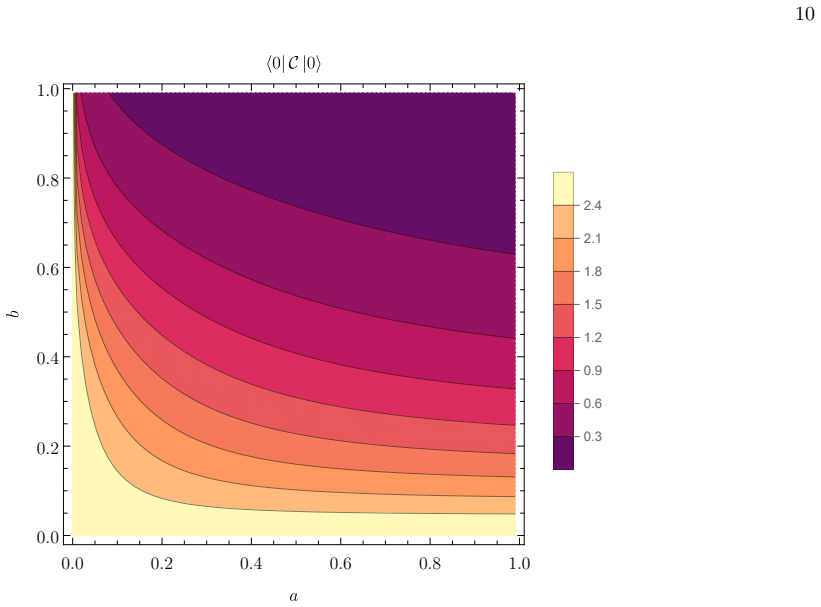
Free massless Majorana fields with modular wedge localization nearly saturate the Tsirelson bound for Bell-CHSH inequalities.
Reviewed by Pith at T0; open to challenge. T0 means a machine referee read the full paper against a public rubric. the ladder, T0–T4 →
T0 review · grok-4.5
2026-07-15 09:49 UTC pith:CN4HNMGU
load-bearing objection Abstract-only note claiming near-Tsirelson saturation for free massless Majorana fields via modular wedges; the calculation itself is invisible. the 3 major comments →
More on Majorana fields, modular localization and near saturation of the Tsirelson bound
The pith
A machine-rendered reading of the paper's core claim, the machinery that carries it, and where it could break.
Core claim
Using the free massless Majorana field in two spacetime dimensions together with modular wedge localization, the expectation value of a suitably chosen Bell-CHSH operator approaches the Tsirelson bound 2√2 from below.
What carries the argument
Modular wedge localization of free massless Majorana fields: the modular operator associated with a wedge region supplies a concrete family of localized operators whose four-point correlators yield the near-saturating Bell-CHSH value.
Load-bearing premise
The claim rests on modular wedge localization of free massless Majorana fields producing well-defined Bell-CHSH operators free of infrared or domain artifacts that would keep the correlator bounded away from the Tsirelson limit.
What would settle it
An explicit evaluation of the same Bell-CHSH expectation that remains bounded below 2√2 by a finite gap independent of all localization and cutoff parameters would refute near-saturation.
If this is right
- Relativistic free-field theory can achieve essentially maximal quantum violations of Bell inequalities.
- Modular localization supplies a constructive route to operators that probe the Tsirelson limit inside local algebras.
- The massless 1+1-dimensional Majorana model becomes a concrete laboratory for studying the sharpest quantum non-locality.
- Further refinements of the same modular construction can be used to quantify how closely the bound is approached as a function of localization parameters.
Where Pith is reading between the lines
- Near-saturation may extend to other free fermionic fields once the corresponding modular operators are identified.
- The massless infrared sector appears essential; massive deformations of the same model should therefore exhibit a systematic deficit relative to 2√2.
- Lattice regularizations of the Majorana theory ought to approach the continuum near-saturation value as the spacing is removed, offering a numerical check.
Editorial analysis
A structured set of objections, weighed in public.
Referee Report
Summary. The manuscript claims that the free massless Majorana field in 1+1 dimensions, combined with modular wedge localization, yields Bell-CHSH correlators that nearly saturate Tsirelson’s bound 2√2. The abstract presents this as a concrete Quantum Field Theory realization of near-maximal Bell violation obtained from free-field modular localization, without further elaboration of the operator construction, wedge geometry, or the quantitative approach to the bound.
Significance. If the claimed near-saturation is established with controlled continuum and infrared limits, the result would be a useful addition to the modular-localization literature on Bell inequalities in QFT: it would supply an explicit free-field example in which modular wedge localization produces CHSH values arbitrarily close to the Tsirelson bound. The free massless Majorana setting is standard and parameter-free, so a clean demonstration would be of genuine interest. At present only the abstract is available, so the significance remains conditional on the missing technical content.
major comments (3)
- Only the abstract is available for review. The central claim—that modular-wedge-localized free massless Majorana fields in 1+1D produce Bell-CHSH expectation values that nearly saturate 2√2—cannot be assessed without the explicit construction of the four dichotomic operators (or their modular approximations), the wedge-pair geometry, the infrared regularization of the massless two-point function, and the analytic or numerical evaluation of the CHSH combination. These elements are load-bearing for the result.
- The free massless Majorana theory in 1+1 dimensions is known to possess logarithmic infrared singularities and a continuous modular spectrum. Any unstated cutoff or domain restriction used to define the CHSH operators could artificially drive the correlator toward 2√2 or mask a genuine obstruction. The manuscript must demonstrate that the reported near-saturation survives a controlled continuum/IR limit; without that control the claim remains unverified.
- The abstract asserts ‘near saturation’ without a quantitative measure (e.g., a sequence of values approaching 2√2, an error estimate, or a limiting formula). Even once the full text is supplied, the paper must make precise what ‘near’ means and how the approach is controlled.
minor comments (1)
- The abstract is extremely brief and contains no equations, operator definitions, or numerical indications. Once the full manuscript is available, the abstract should at least indicate the order of magnitude of the approach to 2√2 or the principal technical tool used to control the limit.
Circularity Check
No circularity identifiable; only abstract available, so no derivation steps can be reduced to inputs by construction.
full rationale
Only the abstract is supplied; the full derivation chain, equations, operator constructions, modular localization details, correlator evaluations, and any citations are invisible. The abstract states that the free massless Majorana field in 1+1 dimensions together with modular wedge localization is used to show near-saturation of the Tsirelson bound. No parameters are fitted, no uniqueness theorem is invoked, no ansatz is smuggled via self-citation, and no quantity is redefined as its own prediction. Under the hard rule that circularity may be claimed only when a specific reduction can be quoted and exhibited, the available text yields zero circular steps. Residual concerns about infrared singularities or domain artifacts of the massless theory are correctness/robustness issues, not circularity. Score 0 with empty steps is therefore the only evidence-based outcome.
Axiom & Free-Parameter Ledger
axioms (3)
- domain assumption Free massless Majorana field theory in 1+1 dimensions is well-defined and has the standard Wightman/algebraic structure used for modular localization.
- domain assumption Modular (Tomita–Takesaki) theory applied to wedge-localized algebras yields the correct operators for Bell-CHSH correlators in this setting.
- standard math The Tsirelson bound is the relevant quantum upper limit for the Bell-CHSH combination under consideration.
read the original abstract
The free massless Majorana field in 1+1 dimensions is employed to study the Bell-CHSH inequality in Quantum Field Theory. Use of the modular wedge localization enables us to show the near saturation of the Tsirelson bound.
Figures

discussion (0)
Sign in with ORCID, Apple, or X to comment. Anyone can read and Pith papers without signing in.