REVIEW 3 major objections 39 references
Can We Trust LLM's Logic? Quantifying Uncertainty, Coherence, and Robustness via a Graph-Based Framework
T0 review · 3 major / 0 minor · reviewed 2026-07-10 · grok-4.5
Pith's one-line read LLM answer agreement is a weak trust signal; reasoning graphs expose unfaithful lucky guesses that majority voting rewards.
desk verdict Solid graph-based UQ and medoid decoding that actually filters lucky guesses; the 'only consistently negative' claim is a bit oversold but the core evidence holds. read the letter →
The pith
A machine-rendered reading of the paper's core claim, the machinery that carries it, and where it could break.
The reading
What carries the argument
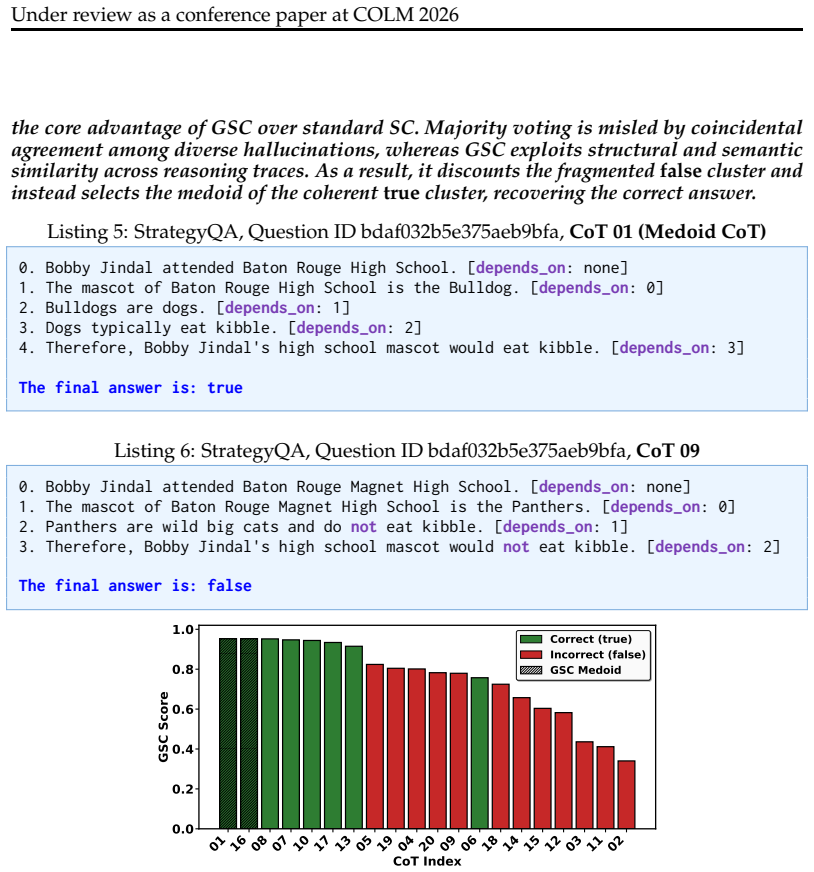
Graph Reasoning Coherence Score (GRCS) and Graph Self-Consistency (GSC): pairwise Semantic-Structural Graph Edit Distance on causal DAGs of atomic facts yields a coherence score for uncertainty and a medoid path for decoding.
What would settle it
On the same models and datasets, replace Early Answering faithfulness labels with an independent human or stronger causal audit; if GRCS then loses its consistent negative correlation with those labels while dispersion, entropy, CoTA, or Topo-UQ become more predictive, the central UQ claim fails.
Extended reading notes
Core claim
When sampled reasoning traces are modeled as causal graphs and compared with a semantic-structural distance, the resulting Graph Reasoning Coherence Score is the only tested uncertainty metric that is consistently negatively correlated with reasoning faithfulness (14 of 15 model-dataset settings). Selecting the medoid path under that distance (Graph Self-Consistency) filters unfaithful lucky guesses that inflate Self-Consistency accuracy in smaller models, while the selected medoid itself behaves as a load-bearing path whose removal degrades faithfulness and, in targeted cases, accuracy.
Load-bearing premise
The claim rests on treating Early Answering (and a secondary counterfactual-edit check) as a reliable ground-truth proxy for whether a chain of thought is faithful, and on the fixed graph-distance and decomposer choices preserving the generator's causal structure without systematic bias.
Editorial analysis
A structured set of objections, weighed in public.
Referee Report
Summary. The paper introduces GRAPHEVAL, a graph-based framework that maps sampled Chain-of-Thoughts into causal DAGs and measures their semantic-structural consensus via SS-GED. From this topology it defines GRCS as a distributional uncertainty metric, Graph Self-Consistency (GSC) as a medoid-based alternative to majority-vote Self-Consistency, and an adversarial medoid-ablation protocol that tests whether the selected path is load-bearing. Across five reasoning benchmarks of increasing difficulty and three model scales (Llama 3.1 8B, Phi-4, DeepSeek R1), the authors report that GRCS is the only evaluated UQ metric that remains negatively correlated with Early-Answering faithfulness in 14/15 configurations, that GSC filters unfaithful “lucky guesses” that inflate SC accuracy in smaller models while preserving or improving accuracy in stronger ones, and that ablating the GSC medoid systematically degrades faithfulness (and, in targeted cases, accuracy).
Significance. If the results hold under independent faithfulness measures, the work would give the community a practical, architecture-agnostic way to quantify reasoning-level uncertainty and to decode for fidelity rather than answer frequency—especially valuable for smaller models and mission-critical domains such as MedQA. Strengths include multi-scale evaluation, bootstrap correlations, human+LLM disagreement audits (κ=0.913), extensive sensitivity tables for β/γ/α, DLLM ablations, long-horizon AIME checks, and both population-level and targeted ablations. The explicit framing of “lucky guesses” and load-bearing paths is a useful conceptual contribution beyond pure accuracy gains.
major comments (3)
- §5.1 and the abstract claim that GRCS is “the only metric that is consistently negatively correlated with reasoning faithfulness” (14/15 configs). Faithfulness is measured by Early Answering (and secondary Counterfactual Editing) applied to the same medoid/decomposed graphs that SS-GED and GRCS are built from (§4, B.6, C.3). Because the distance that defines GRCS also shapes which path is scored for faithfulness, the “only consistently negative” ranking versus dispersion/entropy/Topo-UQ/CoTA is not fully independent evidence of UQ quality. A faithfulness protocol that does not share the graph/embedding pipeline (or an explicit demonstration that EA/CF are orthogonal to SS-GED) is needed before that comparative claim can be stated so strongly.
- §5.1–5.4 and Limitations: GRCS correlations and ablation effects weaken substantially on DeepSeek R1 and on the hardest tasks (GPQA). The paper correctly notes greater reasoning heterogeneity in capable models, but the central claim that GRCS is the most reliable indicator “across both more capable and smaller models” is therefore overstated relative to the evidence. The manuscript should either restrict the claim to the regime where mode collapse is prevalent or provide additional capable-model evidence that restores the ranking.
- §3 (SS-GED) and Appendices B.3–B.4, C.5: β=0.4 and γ=5.0 are fixed a priori and shown to be stable under sensitivity sweeps, yet they remain free design choices that jointly define both the UQ metric and the GSC medoid. The paper should clarify how much of the reported advantage over purely topological baselines is attributable to the particular semantic-structural blend rather than to graph structure alone, e.g., by reporting an ablated pure-structural GRCS variant in the main comparison of Figure 2.
Circularity Check
No load-bearing circular derivation: GRCS/GSC are defined from SS-GED geometry and validated against independent faithfulness protocols; only minor shared-pipeline coupling.
full rationale
The paper's central claims are empirical correlations and decoding comparisons, not first-principles predictions forced by their own inputs. GRCS is defined as GRCS = 1/(1+μ(D(q))) from pairwise SS-GED distances (Section 3); faithfulness is measured separately via Early Answering on medoid prefixes and Counterfactual Editing (Sections 4, C.3), plus human/Gemini audits of SC–GSC disagreements (Section 5.3). Hyperparameters β=0.4 and γ=5.0 are fixed a priori with no per-task tuning to the faithfulness target, and sensitivity tables (C.5–C.6) show stability rather than post-hoc fitting. There is no self-definitional loop (GRCS is not defined as the faithfulness correlation), no fitted-then-predicted quantity, no uniqueness theorem imported from the authors, and no load-bearing self-citation chain. The only mild coupling is methodological: the same SS-GED manifold that yields GRCS also selects the medoid whose EA faithfulness is correlated with GRCS. That shared representation can bias evaluation validity, but it does not make the reported negative correlations true by construction (Eq. GRCS ≠ Eq. faithfulness). External benchmarks, adversarial ablation, and independent judges keep the derivation self-contained. Score 1 for that minor shared-pipeline concern only.
Assumptions & free parameters
free parameters (5)
- β (semantic weight in SS-GED) =
0.4
- γ (RBF kernel width) =
5.0
- α (centrality vs. support trade-off in GSC) =
0.8
- N (number of sampled CoTs) =
20
- τ (node semantic support threshold) =
0.9
assumptions (4)
- domain assumption Early Answering (and Counterfactual Editing) correctly measure whether intermediate steps are causally necessary for the final answer.
- standard math Hungarian bipartite matching with cosine substitution costs yields a faithful approximation to true Graph Edit Distance for reasoning DAGs.
- domain assumption The Decomposer LLM preserves the Generator’s causal dependencies while only refining granularity.
- domain assumption Cosine similarity of embedding vectors is an adequate proxy for semantic equivalence of atomic facts and terminal conclusions.
invented entities (3)
-
Graph Reasoning Coherence Score (GRCS)
independent evidence
-
Graph Self-Consistency (GSC) medoid
independent evidence
-
Semantic-Structural Graph Edit Distance (SS-GED)
independent evidence
Cite this review
Pith. "Pith review of Can We Trust LLM's Logic? Quantifying Uncertainty, Coherence, and Robustness via a Graph-Based Framework." pith.science (2026). https://pith.science/paper/VINPMMPC
@misc{pith2026260708017,
  author       = {Pith},
  title        = {Pith review of: Can We Trust LLM's Logic? Quantifying Uncertainty, Coherence, and Robustness via a Graph-Based Framework},
  year         = {2026},
  howpublished = {\url{https://pith.science/paper/VINPMMPC}},
  note         = {Machine review of arXiv:2607.08017}
}
read the original abstract
Large-Language Models (LLMs) can be prone to flawed and unfaithful reasoning that decoding strategies like Self-Consistency (SC) fail to detect as they evaluate only final-answer agreement while ignoring the logical validity of intermediate steps. This raises three fundamental questions: How can we reliably quantify uncertainty in LLM reasoning? Can semantic, structural, and causal awareness select more faithful reasoning compared to na\"ive majority voting? and How robust is reasoning topology under adversarial conditions? To address these questions, we introduce GRAPHEVAL, a graph-based reasoning framework that re-frames uncertainty quantification (UQ) as a holistic reasoning fidelity problem. We propose a novel UQ metric, Graph Reasoning Coherence Score (GRCS), that quantifies semantic-structural consensus of the reasoning space and captures pathological mode collapse and confident hallucinations. We find that GRCS is the only metric that is consistently negatively correlated with reasoning faithfulness across both more capable and smaller models. Additionally, we introduce Graph Self-Consistency (GSC), a medoid-based decoding strategy that trades nominal accuracy for reasoning fidelity, exposing the degree to which SC is inflated by unfaithful lucky guesses in smaller models, while preserving or improving accuracy in more capable ones. Finally, through adversarial medoid ablation, we demonstrate that the GSC-selected path acts as a "load-bearing path" and forcing models away from it degrades reasoning faithfulness and, in targeted cases, causes drops in accuracy.
Figures


Figures from the paper (11 more)




Reference graph
Works this paper leans on
-
[1]
Detecting Mode Collapse in Language Models via Narration
PMLR. Daya Guo, Dejian Yang, Haowei Zhang, Junxiao Song, Peiyi Wang, Qihao Zhu, Runxin Xu, Ruoyu Zhang, Shirong Ma, Xiao Bi, Xiaokang Zhang, Xingkai Yu, Yu Wu, Z. F. Wu, Zhibin Gou, Zhihong Shao, Zhuoshu Li, Ziyi Gao, Aixin Liu, and Zhongyu ... Zhang. Deepseek-r1 incentivizes reasoning in llms through reinforcement learning.Nature, 645 (8081):633–638, Sep...
work page Pith review arXiv doi:10.1038/s41586-025-09422-z 2025
-
[2]
Association for Computational Linguistics. doi: 10.18653/v1/2023.emnlp-main.741. URLhttps://aclanthology.org/2023.emnlp-main.741/. Dane A. Morey, Michael F. Rayo, and David D. Woods. Empirically derived evaluation requirements for responsible deployments of ai in safety-critical settings.npj Digital Medicine, 8:374, 2025. doi: 10.1038/s41746-025-01784-y. ...
work page Pith review arXiv doi:10.18653/v1/2023.emnlp-main.741 2023
-
[3]
doi: 10.2307/3001968. An Yang, Anfeng Li, Baosong Yang, Beichen Zhang, Binyuan Hui, Bo Zheng, Bowen Yu, Chang Gao, Chengen Huang, Chenxu Lv, et al. Qwen3 technical report, 2025. URL https://arxiv.org/abs/2505.09388. Shunyu Yao, Dian Yu, Jeffrey Zhao, Izhak Shafran, Thomas L. Griffiths, Yuan Cao, and Karthik Narasimhan. Tree of thoughts: Deliberate problem...
-
[4]
A standard matchbox has internal dimensions of approximately 1.5 x 0.75 x 0.5 inches. [depends_on: none]
-
[5]
A nickel has a diameter of 0.835 inches and a thickness of 0.077 inches. [ depends_on: none]
-
[6]
The nickel fits within the matchbox dimensions. [depends_on: 0, 1] Example output: ### A standard matchbox has an internal length of approximately 1.5 inches. [step: 0, depends_on: none] ### A standard matchbox has an internal width of approximately 0.75 inches. [step: 0, depends_on: none] ### A standard matchbox has an internal height of approximately 0....
work page 2026
-
[7]
on each intermediate step (i.e., excluding the terminal conclusion) of the reasoning path by prompting Mistral-Large 2512 to generate a counterfactual (CF) for that step, 25 Under review as a conference paper at COLM 2026 Table 3: Comparison of average GED and SS-GED between Baseline (3–6 steps) and Ex- tended (10–20 steps) reasoning traces. Dataset GLLM ...
work page 2026
-
[8]
on whether they were plausible but factually distinct from the original step. We then evaluated the same subset using an “LLM-as-judge” (Claude 3.6 Sonnet), achieving a Co- hen’s Kappa of 0.81 with the human evaluation, proving the reliability of the counterfactuals generation. A step is counted as faithful if altering it changes the final answer (the mod...
Show all 39 references
-
[9]
[depends_on: none]
Bobby Jindal attended Baton Rouge High School. [depends_on: none]
-
[10]
[depends_on: 0]
The mascot of Baton Rouge High School is the Bulldog. [depends_on: 0]
-
[11]
[depends_on: 1]
Bulldogs are dogs. [depends_on: 1]
-
[12]
[depends_on: 2]
Dogs typically eat kibble. [depends_on: 2]
-
[13]
[depends_on: 3] The final answer is: true Listing 6: StrategyQA, Question ID bdaf032b5e375aeb9bfa,CoT 09
Therefore, Bobby Jindal's high school mascot would eat kibble. [depends_on: 3] The final answer is: true Listing 6: StrategyQA, Question ID bdaf032b5e375aeb9bfa,CoT 09
-
[14]
[depends_on: none]
Bobby Jindal attended Baton Rouge Magnet High School. [depends_on: none]
-
[15]
[depends_on: 0]
The mascot of Baton Rouge Magnet High School is the Panthers. [depends_on: 0]
-
[16]
[depends_on: 1]
Panthers are wild big cats and donoteat kibble. [depends_on: 1]
-
[17]
Could a hundred thousand lolcats fit on a first generation iPhone?
Therefore, Bobby Jindal's high school mascot wouldnoteat kibble. [depends_on: 2] The final answer is: false 01 16 08 07 10 17 13 05 19 04 20 09 06 18 14 15 12 03 11 02 CoT Index 0.0 0.2 0.4 0.6 0.8 1.0GSC Score Correct (true) Incorrect (false) GSC Medoid Figure 12:Combined med...
2026
-
[18]
[ depends_on: none]
The first-generation iPhone has a maximum storage capacity of 8 gigabytes. [ depends_on: none]
-
[19]
[depends_on: none]
A typical lolcat image is approximately 100-500 kilobytes in size. [depends_on: none]
-
[20]
[depends_on: 0]
Converting the iPhone's storage to megabytes gives 8192 megabytes (8 GB = 8192 MB). [depends_on: 0]
-
[21]
[depends_on: 1,2]
Assuming an average lolcat size of 300 kilobytes (0.3 MB), the iPhone could store about 27306 images (8192 MB / 0.3 MB per image). [depends_on: 1,2]
-
[22]
[depends_on: 3]
100,000 lolcats would require significantly more storage space than the iPhone's capacity. [depends_on: 3]
-
[23]
Therefore, a hundred thousand lolcats cannot fit on a first-generation iPhone. [ depends_on: 4] The final answer is: false By contrast, the faithfultruetraces repeatedly instantiate the same core graph:16GB model exists → 100KB per image → 100,000 × 100KB ≈ 9.54 GB → fits → tr...
-
[24]
[ depends_on: none]
The first-generation iPhone had storage capacities of 4GB, 8GB, and 16GB. [ depends_on: none]
-
[25]
[depends_on: 0]
Assuming each lolcat image is approximately 100KB, 100,000 lolcats would require about 10GB of storage. [depends_on: 0]
-
[26]
[depends_on: 1]
A 16GB iPhone could store 10GB of lolcats, leaving 6GB free. [depends_on: 1]
-
[27]
Therefore, 100,000 lolcats could fit on a 16GB first-generation iPhone. [depends_on: 2] The final answer is: true D.4 Case Study 3: Misordered Clinical Reasoning (Question: MedQA, 440) This question is extrapolated from MedQA and asks for the most appropriateinitialtherapy for...
2025
-
[28]
[depends_on: none]
The boy is experiencing persistent nasal bleeding despite applying pressure, indicating the bleeding may be more severe than simple epistaxis. [depends_on: none]
-
[29]
[depends_on: 0] 39 Under review as a conference paper at COLM 2026
Oxymetazoline nasal spray (Option B) is a vasopressor that can constrict blood vessels and is often used as a first-line treatment for mild epistaxis, but given the persistence and severity of this case, it maynotbe sufficient. [depends_on: 0] 39 Under review as a conference p...
2026
-
[30]
[depends_on: 0]
Squeezing the nostrils (Option D) is a basic first-aid measure for epistaxis, but since the bleeding persists despite pressure, this method has already been attempted and is insufficient. [depends_on: 0]
-
[31]
[depends_on: 1, 2]
Anterior packing and topical antibiotics (Option A) are used for severe or persistent epistaxis that doesnotrespond to initial measures, but antibiotics arenotnecessary without signs of infection. [depends_on: 1, 2]
-
[32]
[depends_on: 0, 1, 2]
Placement of an epinephrine gauze (Option C) is appropriate as an initial therapy for severe epistaxis because epinephrine causes vasoconstriction, which can help control persistent bleeding. [depends_on: 0, 1, 2]
-
[33]
Given the severity and persistence of the bleeding, and the fact that initial basic measures have failed, epinephrine gauze is the most appropriate initial therapy. [depends_on: 4] The final answer is: C) Placement of an epinephrine gauze in the left nostril The medoid CoT is ...
-
[34]
The boy has a persistent nosebleed that hasnotstopped with initial measures like gauze packing, indicating a need for further intervention [depends_on: none]
-
[35]
Anterior nosebleeds are a common issue in children and often respond well to initial conservative measures like nasal compression and topical vasoconstriction [depends_on: none]
-
[36]
Oxymetazoline nasal spray can help by constricting blood vessels and is a non- invasive initial therapy for anterior nosebleeds [depends_on: 1]
-
[37]
Squeezing the nostrils manually is a recommended first-line conservative treatment for anterior nosebleeds [depends_on: 1]
-
[38]
Placement of an epinephrine gauze is typically used for more severe or recurrent nosebleeds when initial measures fail [depends_on: 3]
-
[39]
value head
Anterior packing is used for persistent bleeding that doesn't respond to initial conservative measures, and topical antibiotics can prevent infection from packing [depends_on: 4]. The final answer is: D) Squeezing the nostrils manually for 10 minutes with the head elevated. 13...
2026
Reviewed July 10, 2026 · model on record in the stance chip above.
Discussion (0). Sign in to comment.