REVIEW 2 major objections 5 minor 16 references
Structured Pruning of Large Language Models via Power Transformation and Sign-Preserving Score Aggregation with Adaptive Feature Retention
T0 review · 2 major / 5 minor · reviewed 2026-07-10 · grok-4.5
Pith's one-line read Structured pruning of large language models can keep accuracy close to unstructured pruning when AFR scores are fixed by power transformation, sign-preserving aggregation, and outlier removal.
desk verdict Solid engineering fix that closes most of the structured-vs-unstructured gap for AFR; the sign-consistency story is the softest piece but the end-to-end numbers still hold. read the letter →
The pith
A machine-rendered reading of the paper's core claim, the machinery that carries it, and where it could break.
The reading
What carries the argument
The integrated AFR structured-pruning pipeline: for each neuron, remove scores outside the 2nd–98th percentiles, average signed scores then take absolute value, apply a power transform (exponent b ≈ 2.7) to the neuron-level SNIP score, and sum with the neuron-level ReFer score to rank neurons for removal.
What would settle it
On the same models and benchmarks, an ablation that keeps power transform and outlier removal but switches to absolute-value-before-average aggregation should not collapse accuracy relative to the full method; if that switch loses most of the reported gains over naive averaging, the sign-consistency claim is wrong.
Extended reading notes
Core claim
The paper establishes that AFR can be made into an effective structured pruning criterion by integrating three fixes: power transformation of SNIP scores to align distributions, sign-preserving aggregation that treats consistent optimization direction within a neuron as importance, and percentile-based outlier removal. With that pipeline, structured FFN pruning on several large models yields accuracy comparable to unstructured AFR and better than prior structured methods, while delivering practical dense-matrix speedups.
Load-bearing premise
That averaging signed weight scores and then taking the absolute value correctly ranks a neuron’s importance by how consistent its weights’ optimization directions are; if mixed signs do not mean low contribution, the ranking fails.
Editorial extensions
If this is right
- At 50% FFN structured pruning, models like Llama-3-8B and LLaVA-v1.5-13B can run about 1.56–1.57× faster on standard dense kernels without sparse libraries.
- Naive averaging of AFR scores is not a fair structured baseline; the three fixes recover large accuracy gaps (reported up to ~21 points at 20% pruning).
- Vision-language models can use full AFR on the language FFN and ReFer-only scoring on the vision tower where task gradients are undefined.
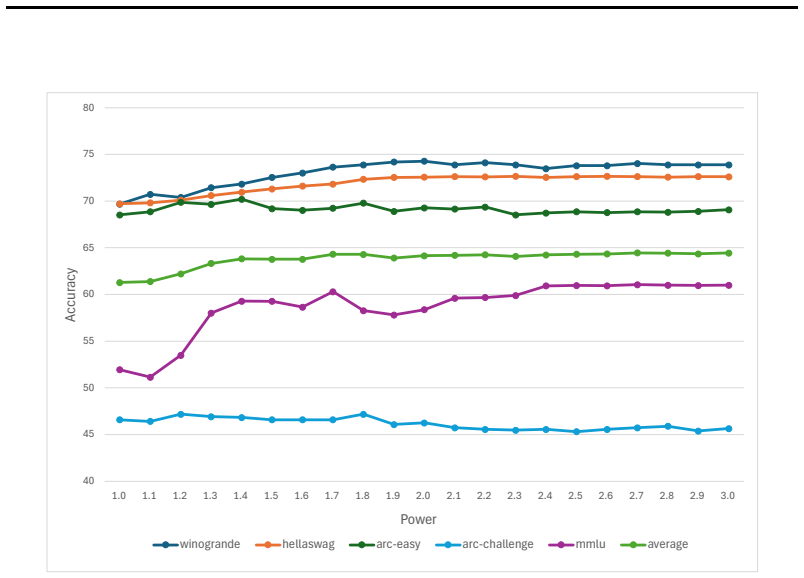
- A single power exponent near 2.7 works across the reported language benchmarks with a flat plateau from about 2.5 to 3.0.
Reading between the lines
- If sign consistency is the real structural signal, similar signed aggregation may improve other gradient-based structured criteria beyond AFR.
- Layer-wise adaptive rates (left as future work) could close more of the remaining gap to unstructured accuracy without giving up dense speedups.
- The same distribution-mismatch diagnosis may apply whenever a wide-range feature score is added to a [0,1]-concentrated gradient score before neuron aggregation.
Signed reviews
Editorial analysis
A structured set of objections, weighed in public.
Referee Report
Summary. The paper adapts Adaptive Feature Retention (AFR), an unstructured pruning score that combines ReFer and SNIP via standardization (Eq. 1), to structured (neuron-level) pruning of LLM FFNs. It identifies three obstacles to naïve aggregation (Eq. 2): distribution mismatch between ReFer and SNIP, loss of sign information that is claimed to encode optimization-direction consistency, and outlier influence. The proposed pipeline applies 2% percentile outlier removal, sign-preserving (signed-mean then absolute-value) aggregation, power transformation of SNIP scores (Eq. 3, b=2.7), and final summation. Experiments on Llama-3-8B, Vicuna-v1.5-13B and LLaVA-v1.5-13B at 20% and 50% FFN pruning report large gains over naïve averaging (up to +21 points), competitive or superior accuracy versus LLM-Pruner, LoRAP and CFSP, near-parity with unstructured AFR, and measured 1.56–1.57× inference speedups.
Significance. If the empirical claims hold, the work supplies a practical structured-pruning recipe that recovers most of the accuracy of unstructured AFR while delivering real wall-clock speedups on standard dense kernels. The multi-model evaluation (including a VLM) and the systematic Appendix A ablation of the power exponent are useful contributions. The three-component diagnosis of why naïve AFR aggregation fails is also of methodological interest to the structured-pruning community. The paper does not claim theoretical novelty beyond the engineering combination; its value is therefore primarily empirical and engineering.
major comments (2)
- Section 4.2 asserts that the signed mean (then absolute value) correctly ranks neurons by “optimization direction consistency” and that mixed signs indicate internal cancellation of limited contribution. No independent validation of this mechanistic claim is provided. Critically, the manuscript never isolates the sign-preserving step: there is no ablation that replaces only the signed-mean aggregation with the absolute-mean baseline of Eq. 2 while keeping power transformation and 2% outlier removal fixed. Consequently it remains possible that the large gains over “AFR (naive avg.)” in Tables 3–4 are driven almost entirely by the other two components, leaving the central novelty claim of Section 4.2 unsupported even though the end-to-end numbers are real. An ablation table (or at least a single-column comparison) is required before the mechanistic story can be accepted.
- Tables 3–5 report point estimates only; no multi-seed standard deviations, confidence intervals or calibration-set sensitivity are given. Given that AFR scores depend on a calibration set and that the power exponent and percentile thresholds are free parameters, the absence of error bars makes it impossible to judge whether the reported margins over LoRAP/CFSP (especially the smaller ones at 20%) are statistically reliable. At minimum, three independent calibration seeds for the main Llama-3-8B setting should be reported.
minor comments (5)
- Eq. (1) uses Z(·) for standardization but never states whether mean/std are computed over the full weight matrix, per layer, or per neuron; this affects reproducibility.
- Figure 2 caption and surrounding text refer to “AFR pruning scores” while the body of Section 3.2 discusses ReFer outliers; clarify which score is plotted.
- The integrated pipeline order in Section 4.4 (outlier removal → signed aggregation → power transform) differs from the order in which the three problems are introduced; a short justification of the chosen sequence would help.
- Table 5 lacks the unstructured-AFR and naïve-averaging baselines that appear for the language-only models, making the LLaVA gains harder to contextualize.
- Typographical inconsistencies: “Eq. equation 1”, “Eq. equation 2”, and mixed use of “SNIP” vs “SNIP” with trailing spaces appear throughout.
Circularity Check
Modest self-citation of the AFR base score from overlapping-author prior work; the three aggregation fixes and end-to-end accuracy claims are independent empirical content, not forced by construction.
-
self citation load bearing
[Section 2, Eq. (1); citations Nitta et al. 2024/2025]
"Adaptive Feature Retention (AFR) (Nitta et al., 2025) is an unstructured pruning method for pre-trained models that combines ReFer (Nitta et al., 2024) and SNIP (Lee et al., 2019) ... The AFR pruning score S_AFR(θ_n) for weight θ_n is defined as: S_AFR(θ_n) = Z(|∂∑_l F^l_svd / ∂θ_n · θ_n|) + Z(|∂L/∂θ_n · θ_n|)"
The entire structured pipeline starts from the AFR score of Nitta et al. (2024/2025), papers that share three co-authors with this work. The base score construction is therefore not an external, independently established fact but a same-group prior. This is load-bearing for what is being aggregated, yet it does not force the accuracy tables: the novel aggregation operators and the comparisons to LLM-Pruner/LoRAP/CFSP remain independent empirical content.
full rationale
The paper’s derivation chain is engineering adaptation plus empirical evaluation, not a first-principles prediction that collapses into its inputs. The only circularity-adjacent element is that the weight-level AFR score (Eq. 1) is taken wholesale from Nitta et al. (2024/2025), whose author lists overlap with the present paper (Hirakawa, Yamashita, Fujiyoshi). That citation is load-bearing for the starting score definition, but it is not a uniqueness theorem, does not forbid alternatives, and does not make the reported accuracies true by definition. The three novel steps—power transform of SNIP (Eq. 3, SNR argument Eq. 4), sign-preserving aggregation (Sec. 4.2), and 2% percentile outlier removal (Table 2)—are independently motivated and ablated; b=2.7 is a hyperparameter chosen on an ablation curve (Appendix A), not a fitted identity renamed as a prediction. Final claims are external-benchmark accuracies and measured speedups against LLM-Pruner, LoRAP, and CFSP. No equation reduces to another by construction; no fitted parameter is re-presented as an independent forecast of the same quantity. Per the hard rules, self-citation of a reimplementable prior method plus independent external evaluation warrants score 0–2. Weak validation of the sign-consistency story is a correctness/ablation gap, not circularity.
Assumptions & free parameters
free parameters (3)
- power-transformation exponent b =
2.7
- outlier-removal percentile =
2% / 98%
- target pruning rates =
20%, 50%
assumptions (3)
- domain assumption The AFR combination of standardized ReFer and SNIP correctly ranks weight importance for pre-trained LLMs.
- ad hoc to paper Signed mean magnitude after aggregation quantifies a neuron’s optimization-direction consistency and therefore its structural importance.
- domain assumption Pruning only FFN neurons (leaving attention intact) is a valid proxy for overall model compression.
Cite this review
Pith. "Pith review of Structured Pruning of Large Language Models via Power Transformation and Sign-Preserving Score Aggregation with Adaptive Feature Retention." pith.science (2026). https://pith.science/paper/DYKJKOTW
@misc{pith2026260708027,
  author       = {Pith},
  title        = {Pith review of: Structured Pruning of Large Language Models via Power Transformation and Sign-Preserving Score Aggregation with Adaptive Feature Retention},
  year         = {2026},
  howpublished = {\url{https://pith.science/paper/DYKJKOTW}},
  note         = {Machine review of arXiv:2607.08027}
}
read the original abstract
This paper proposes an improved structured pruning method for large language models (LLMs) that addresses key challenges in adapting Adaptive Feature Retention (AFR), an unstructured pruning technique, to structured pruning. When applying AFR to structured pruning, three major problems arise: distribution mismatch between heterogeneous pruning scores, loss of sign information indicating optimization direction consistency, and influence of outliers. To address these issues, we propose a unified approach combining power transformation for nonlinear distribution alignment, sign-preserving score aggregation, and percentile-based outlier removal. Experiments on Llama-3-8B, Vicuna-v1.5-13B, and LLaVA-v1.5-13B demonstrate that our method maintains accuracy comparable to unstructured pruning while achieving practical inference speedup through structured pruning.
Figures


Figures from the paper (1 more)
Reference graph
Works this paper leans on
-
[1]
Attention is All you Need , url =
Vaswani, Ashish and Shazeer, Noam and Parmar, Niki and Uszkoreit, Jakob and Jones, Llion and Gomez, Aidan N and Kaiser, ukasz and Polosukhin, Illia , booktitle =. Attention is All you Need , url =
-
[2]
Meeting on Image Recognition and Understanding (MIRU) , year=
Single-shot Foresight Pruning Balancing Knowledge Retention and Downstream Task Adaptation for Pre-trained Models , author=. Meeting on Image Recognition and Understanding (MIRU) , year=
-
[3]
Meeting on Image Recognition and Understanding (MIRU) , year=
Single-shot Foresight Pruning for Maintaining Feature Representations of Pre-trained Models , author=. Meeting on Image Recognition and Understanding (MIRU) , year=
-
[4]
Lee, Namhoon and Ajanthan, Thalaiyasingam and Torr, Philip H. S. , booktitle=
-
[5]
and Zhang, Hao and Gonzalez, Joseph E
Zheng, Lianmin and Chiang, Wei-Lin and Sheng, Ying and Zhuang, Siyuan and Wu, Zhanghao and Zhuang, Yonghao and Lin, Zi and Li, Zhuohan and Li, Dacheng and Xing, Eric P. and Zhang, Hao and Gonzalez, Joseph E. and Stoica, Ion , booktitle=. Judging
-
[6]
IEEE/CVF Conference on Computer Vision and Pattern Recognition (CVPR) , pages=
Improved Baselines with Visual Instruction Tuning , author=. IEEE/CVF Conference on Computer Vision and Pattern Recognition (CVPR) , pages=. 2024 , doi=
work page 2024
-
[7]
Sakaguchi, Keisuke and Le Bras, Ronan and Bhagavatula, Chandra and Choi, Yejin , booktitle=
-
[8]
Zellers, Rowan and Holtzman, Ari and Bisk, Yonatan and Farhadi, Ali and Choi, Yejin , booktitle=
Show all 16 references
-
[9]
Think you have Solved Question Answering? Try
Clark, Peter and Cowhey, Isaac and Etzioni, Oren and Khot, Tushar and Sabharwal, Ashish and Schoenick, Carissa and Tafjord, Oyvind , journal=. Think you have Solved Question Answering? Try
-
[10]
International Conference on Learning Representations (ICLR) , year=
Measuring Massive Multitask Language Understanding , author=. International Conference on Learning Representations (ICLR) , year=
-
[11]
and Manning, Christopher D
Hudson, Drew A. and Manning, Christopher D. , booktitle=
-
[12]
and Guo, Anhong and Lin, Chi and Grauman, Kristen and Luo, Jiebo and Bigham, Jeffrey P
Gurari, Danna and Li, Qing and Stangl, Abigale J. and Guo, Anhong and Lin, Chi and Grauman, Kristen and Luo, Jiebo and Bigham, Jeffrey P. , booktitle=
-
[13]
Advances in Neural Information Processing Systems (NeurIPS) , year=
Learn to Explain: Multimodal Reasoning via Thought Chains for Science Question Answering , author=. Advances in Neural Information Processing Systems (NeurIPS) , year=
-
[14]
Ma, Xinyin and Fang, Gongfan and Wang, Xinchao , booktitle=
-
[15]
Li, Guangyan and Zeng, Yongqiang and Huang, Jun and Zhang, Zhiqiang and Wang, Zhaocheng and Zhang, Xiaoxing and Zhao, Zhixuan , journal=
-
[16]
Wang, Yuxin and Ma, Minghua and Wang, Zhang and Chen, Jingchang and Shan, Liping and Yang, Qing and Xu, Dongliang and Liu, Ming and Qin, Bing , booktitle=
Reviewed July 10, 2026 · model on record in the stance chip above.
Discussion (0). Continue with ORCID to comment.