REVIEW 7 minor 41 references
Holographic Neural PCFG for Unsupervised Parsing
T0 review · 0 major / 7 minor · reviewed 2026-07-10 · glm-5.2
Pith's one-line read Algebra replaces black-box neural networks in grammar rule scoring
desk verdict Hol-PCFG replaces MLP rule scoring with circular correlation on torus embeddings — 99.94% fewer rule-scoring params, SOTA on six languages read the letter →
The pith
A machine-rendered reading of the paper's core claim, the machinery that carries it, and where it could break.
The reading
What carries the argument
Circular correlation (⋆) between grammar-symbol embeddings on a high-dimensional torus T^d, scored against role-specific relation vectors r^(L), r^(R), r^(T) via inner product; conditional independence of left and right children given the parent (inherited from SN-PCFG) enables efficient batch computation via circular convolution reformulation; torus projection (renormalizing frequency amplitudes to 1) after each training update maintains the constraint throughout training.
What would settle it
If the conditional independence assumption between left and right children is the true bottleneck for parsing quality in languages with strong sibling correlations, then no improvement to the scoring algebra would close the gap with models that capture sibling dependencies—and the algebraic approach would be mistaken for the cause of good performance when the factorization is actually the load-bearing component.
Extended reading notes
Core claim
The central mechanism is the replacement of MLP-based rule scoring with HolE-based circular correlation scoring over torus-constrained embeddings. Circular correlation is non-commutative (a⋆b ≠ b⋆a), which encodes the directed parent-to-child relation that grammar rules require. The operation composes two symbol embeddings into a vector of the same dimension, which is then scored against a learned relation vector via inner product. Because all embeddings are constrained to a torus (frequency-domain unit amplitude), the circular correlation of any two embeddings remains on the torus, preventing norm divergence during recursive composition. This combination—non-commutative algebra for directed
Load-bearing premise
The model assumes that the left and right children of a binary rule are conditionally independent given the parent. This factorization is what makes the algebraic scoring computationally tractable, but it means the model cannot capture correlations between siblings. If sibling independence is a poor approximation for a particular language's syntax, the algebraic scoring cannot compensate for this structural limitation.
Editorial extensions
If this is right
- If algebraic rule scoring can match or exceed neural scoring for PCFGs, similar replacements may be possible in other structured prediction tasks where neural function approximators are used but the underlying relations have known algebraic properties.
- The success of torus-constrained embeddings as an implicit regularizer suggests that norm-control via geometric constraints may be a general alternative to explicit regularization penalties in neural grammar models.
- Character-level parsing without morphological segmentation working at near-morpheme-level accuracy implies the model discovers morpheme-like units from character distributional signal alone, which bears on computational models of language acquisition in morphologically rich languages.
- The ability to induce plausible structure in non-linguistic emoticon data suggests the algebraic scoring captures compositional regularity that is not specific to natural language syntax.
Signed reviews
Editorial analysis
A structured set of objections, weighed in public.
Referee Report
Summary. The paper proposes Holographic Neural PCFG (Hol-PCFG), which replaces MLP-based rule scoring in the Neural PCFG family with algebraic relation scoring based on circular correlation (Holographic Embeddings, Nickel et al. 2016) over torus-constrained embeddings. The key idea is that PCFG rule scoring has intrinsic structure—directionality from parent to child, asymmetry between left and right children, and similarity among grammar symbols—that can be built into the scoring algebra rather than rediscovered by a black-box network from weak raw-text likelihood. All embeddings are constrained to a high-dimensional torus (unit-amplitude frequency components), which is closed under circular correlation and acts as an implicit regularizer. The model retains the SN-PCFG conditional independence factorization for binary rules, enabling reuse of the FlashInside GPU implementation. Experiments on PTB, CTB, SPMRL, and KTB show competitive or state-of-the-art performance across six languages, with 99.94% fewer rule-scoring parameters than SN-PCFG and improved training stability. Additional experiments demonstrate character-level Japanese parsing and parsing of non-linguistic kaomoji data.
Significance. This paper makes a substantive contribution to unsupervised grammar induction by identifying that the rule-scoring function in Neural PCFGs carries exploitable algebraic structure, and by showing that encoding this structure via circular correlation over torus-constrained embeddings improves parameter efficiency and training stability without sacrificing parsing quality. The mathematical formulation is clean: the torus closure under circular correlation is proven (§3.3), the efficient scoring identity (Eq. 15) is correct, and the ablation study (Table 3) properly isolates the contributions of HolE scoring, the torus constraint, and scaling parameters while holding parameter count constant across variants. The public code release and multilingual evaluation across ten languages strengthen reproducibility. The character-level Japanese parsing result (§5.3) and the kaomoji case study (§5.4) are intriguing demonstrations of generalization beyond standard word-level inputs. The 99.94% reduction in rule-scoring parameters is accurately scoped and transparently broken down in Figure 5, which also distinguishes total parameter counts from rule-scoring parameters.
minor comments (7)
- §4.2: Under maximum-likelihood training, Hol-PCFG scores 64.6 on PTB vs. SN-PCFG's 65.1 (Table 1). The paper frames this as 'competitive,' which is fair, but the abstract's 'state-of-the-art' claim should be understood as scoped to the SemInfo objective for English. The multilingual SOTA claims (Table 2) are under ML training. Consider making this scoping explicit in the abstract to avoid misreading.
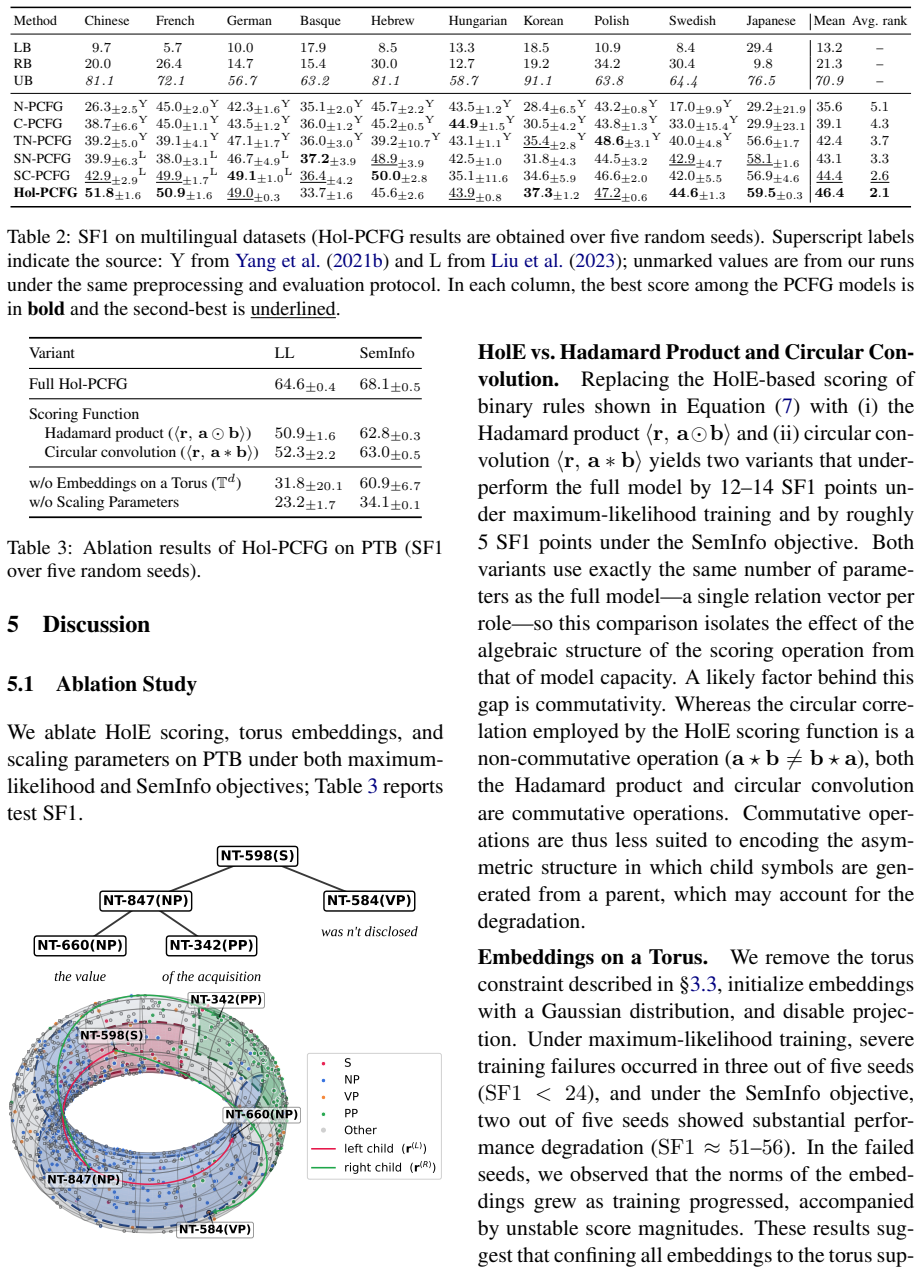
- Table 2: Hol-PCFG does not achieve the best score on Basque, Hebrew, Hungarian, or Polish. The claim of 'state-of-the-art in six languages' is accurate (English+SemInfo plus five multilingual best scores), but the paper could note where Hol-PCFG underperforms and speculate briefly on why, particularly for Basque (33.7 vs. SC-PCFG's 36.4), to strengthen the multilingual analysis.
- §3.2.3: The text states that non-commutativity of circular correlation 'encodes the directed parent-to-child relation—separating the rule in which A is the parent from the one in which it is a child—rather than the distinction between the left and right siblings.' This is a precise and important design point. The ablation in Table 3 supports it (Hadamard and convolution both degrade), but the paper could strengthen the connection by explicitly noting that the ablation results confirm the importance of non-commutativity, since the 12–14 SF1 point gap under ML training is substantial.
- §5.3: The character-level Japanese parsing result (58.9 vs. 59.5 morpheme-level SF1) is impressive, but the evaluation protocol is described only briefly. Clarify whether the character-level parse trees are converted to morpheme-level spans for evaluation, and if so, how the conversion handles character-to-morpheme alignment ambiguity.
- Figure 4: The two-dimensional torus visualization is qualitative and the authors appropriately caution that it 'necessarily discards information.' The claim that clusters 'apparently correspond to NP, PP, and S' is hedged but could use a brief note on how many nonterminals are visualized and what fraction of total parse tree nodes they represent, to contextualize the visualization and guard against over-interpretation.
- Footnote 3: The remark that T^d is technically a disconnected manifold but referred to as 'the torus' for convenience is fine, but the phrase 'flat tori (R/2πZ)^⌊(d−1)/2⌋' could benefit from a one-line clarification that the number of connected components is 2 (or 4 when d is even, accounting for the Nyquist component), for precision.
- §2.4: The sentence 'HolE achieved state-of-the-art results at the time on the knowledge-graph completion task with high parameter efficiency' could cite the specific dataset(s) and metric(s) to ground the claim, making the analogy to PCFG rule scoring more informative.
Circularity Check
No circularity: Hol-PCFG's derivation is self-contained, grounded in external benchmarks, and its self-citations are independently published prior work.
full rationale
The paper's central claims rest on three pillars, none of which reduces to its inputs by construction. (1) Parsing performance (Tables 1-2) is measured against external gold-standard treebanks (PTB, CTB, SPMRL, KTB) using standard SF1 evaluation — the model's rule probabilities are learned from raw-text likelihood, not fitted to the evaluation metric. (2) The 99.94% parameter reduction (Figure 5) is an architectural consequence of replacing MLP-based scorers with a single relation vector per role (r^(L), r^(R), r^(T)), verified by direct parameter counting against SN-PCFG. (3) The closed-form rule probabilities (Eqs. 8-11) follow from applying HolE scoring (Nickel et al., 2016 — an independent prior work by non-overlapping authors) to PCFG rules; the mathematical properties invoked (torus closure under circular correlation, the identity ⟨r, a⋆b⟩ = ⟨b, r∗a⟩ in Eq. 15) are standard Fourier analysis facts, not results defined in terms of the paper's own outputs. The torus projection technique is adapted from Yamaki et al. (2023, Hol-CCG, ACL), where two of four current authors appear — this is self-citation, but Hol-CCG was independently peer-reviewed and published, addresses a different task (supervised CCG parsing), and its projection operation is a standard complex-unit normalization, not a result that would be circular if re-derived. The ablation study (Table 3) properly isolates each design choice (HolE vs. Hadamard/convolution, torus vs. unconstrained, scaling parameters) using identical parameter counts, demonstrating that performance gains come from the algebraic structure of circular correlation rather than from capacity. No step in the derivation chain reduces to its inputs by definition, and no 'prediction' is a fitted parameter renamed.
Assumptions & free parameters
free parameters (6)
- τ_root
- τ_rule
- τ_term
- |N| =
4096 (ML) / 1024 (SemInfo)
- d =
512
- |P| =
2|N|
assumptions (4)
- domain assumption Conditional independence of left and right children given the parent (Eq. 6, §3.1)
- standard math Inside algorithm correctly marginalizes over all parse trees (§3.4)
- domain assumption Torus constraint (unit amplitude in frequency domain) prevents norm explosion (§3.3, §5.1)
- domain assumption Circular correlation is the appropriate algebraic operation for encoding directed parent-child grammar relations (§2.4, §3.2)
invented entities (1)
-
Relation vectors r^(L), r^(R), r^(T)
independent evidence
Cite this review
Pith. "Pith review of Holographic Neural PCFG for Unsupervised Parsing." pith.science (2026). https://pith.science/paper/VOWWZMHZ
@misc{pith2026260708063,
  author       = {Pith},
  title        = {Pith review of: Holographic Neural PCFG for Unsupervised Parsing},
  year         = {2026},
  howpublished = {\url{https://pith.science/paper/VOWWZMHZ}},
  note         = {Machine review of arXiv:2607.08063}
}
read the original abstract
Unsupervised constituency parsing aims to accurately induce latent tree structures from raw text alone. Recent neural parameterizations of PCFGs achieve strong performance in both supervised and unsupervised parsing, yet rely on high-capacity black-box networks for rule scoring -- as exemplified by the Neural PCFG family -- leaving rule probabilities without an interpretable mathematical form. In this paper, we propose Holographic Neural PCFG (Hol-PCFG), which recasts PCFG rule scoring as algebraic relation modeling among grammar-symbol embeddings. Hol-PCFG adapts Holographic Embeddings (Nickel et al., 2016), which scores knowledge-graph triples via circular correlation, to the left-child, right-child, and lexical-emission relations over torus-constrained embeddings, giving every rule probability a closed form that carries the intrinsic structure of grammar rules by construction. Hol-PCFG achieves state-of-the-art parsing performance in six languages while cutting rule-scoring parameters by 99.94% relative to the baseline model and training more stably. Additionally, we demonstrate that Hol-PCFG can parse Japanese directly from characters without any morphological segmentation, retaining nearly the same morpheme-level performance.
Figures


Figures from the paper (3 more)


Reference graph
Works this paper leans on
-
[1]
The Thirteenth International Conference on Learning Representations , year =
Improving Unsupervised Constituency Parsing via Maximizing Semantic Information , author =. The Thirteenth International Conference on Learning Representations , year =
-
[2]
Liu, Wei and Yang, Songlin and Kim, Yoon and Tu, Kewei , editor =. Simple Hardware-Efficient. Findings of the Association for Computational Linguistics: EMNLP 2023 , month = dec, year =. doi:10.18653/v1/2023.findings-emnlp.113 , pages =
-
[3]
Compound Probabilistic Context-Free Grammars for Grammar Induction , author =. Proceedings of the 57th Annual Meeting of the Association for Computational Linguistics , month = jul, year =. doi:10.18653/v1/P19-1228 , pages =
-
[4]
Proceedings of the National Academy of Sciences , volume =
Colin Bannard and Elena Lieven and Michael Tomasello , title =. Proceedings of the National Academy of Sciences , volume =. 2009 , doi =. https://www.pnas.org/doi/pdf/10.1073/pnas.0905638106 , abstract =
-
[5]
Jin, Lifeng and Oh, Byung-Doh and Schuler, William , editor =. Character-based. Findings of the Association for Computational Linguistics: EMNLP 2021 , month = nov, year =. doi:10.18653/v1/2021.findings-emnlp.371 , pages =
-
[6]
Jin, Lifeng and Schwartz, Lane and Doshi-Velez, Finale and Miller, Timothy and Schuler, William , journal =. Depth-Bounded Statistical. 2021 , address =. doi:10.1162/coli_a_00399 , pages =
-
[7]
Proceedings of the AAAI Conference on Artificial Intelligence , volume =
Holographic Embeddings of Knowledge Graphs , author =. Proceedings of the AAAI Conference on Artificial Intelligence , volume =. 2016 , doi =
work page 2016
-
[8]
and Santorini, Beatrice and Marcinkiewicz, Mary Ann , journal =
Marcus, Mitchell P. and Santorini, Beatrice and Marcinkiewicz, Mary Ann , journal =. Building a Large Annotated Corpus of. 1993 , url =
work page 1993
Show all 41 references
-
[9]
Xue, Naiwen and Xia, Fei and Chiou, Fu-Dong and Palmer, Martha , journal =. The. 2005 , doi =
2005
-
[10]
Overview of the
Seddah, Djam. Overview of the. Proceedings of the Fourth Workshop on Statistical Parsing of Morphologically-Rich Languages , month = oct, year =
-
[11]
The Journal of the Acoustical Society of America , volume =
Trainable Grammars for Speech Recognition , author =. The Journal of the Acoustical Society of America , volume =. 1979 , publisher =
1979
-
[12]
Unsupervised Latent Tree Induction with Deep Inside-Outside Recursive Auto-Encoders , author =. Proceedings of the 2019 Conference of the North American Chapter of the Association for Computational Linguistics: Human Language Technologies, Volume 1 (Long and Short Papers) , mo...
2019 doi
-
[13]
Unsupervised Parsing with
Drozdov, Andrew and Rongali, Subendhu and Chen, Yi-Pei and O'Gorman, Tim and Iyyer, Mohit and McCallum, Andrew , booktitle =. Unsupervised Parsing with. 2020 , address =. doi:10.18653/v1/2020.emnlp-main.392 , pages =
2020 doi
-
[14]
Proceedings of the 40th Annual Meeting of the Association for Computational Linguistics , month = jul, year =
A Generative Constituent-Context Model for Improved Grammar Induction , author =. Proceedings of the 40th Annual Meeting of the Association for Computational Linguistics , month = jul, year =. doi:10.3115/1073083.1073106 , pages =
-
[15]
Proceedings of the 45th Annual Meeting of the Association of Computational Linguistics , month = jun, year =
Fast Unsupervised Incremental Parsing , author =. Proceedings of the 45th Annual Meeting of the Association of Computational Linguistics , month = jun, year =
-
[16]
Proceedings of the 58th Annual Meeting of the Association for Computational Linguistics , month = jul, year =
An Empirical Comparison of Unsupervised Constituency Parsing Methods , author =. Proceedings of the 58th Annual Meeting of the Association for Computational Linguistics , month = jul, year =. doi:10.18653/v1/2020.acl-main.300 , pages =
2020 doi
-
[17]
2021 , address =
Yang, Songlin and Zhao, Yanpeng and Tu, Kewei , booktitle =. 2021 , address =. doi:10.18653/v1/2021.naacl-main.117 , pages =
2021 doi
-
[18]
IEEE Transactions on Neural Networks , volume =
Holographic Reduced Representations , author =. IEEE Transactions on Neural Networks , volume =. 1995 , doi =
1995
-
[19]
Holographic
Yamaki, Ryosuke and Taniguchi, Tadahiro and Mochihashi, Daichi , booktitle =. Holographic. 2023 , address =. doi:10.18653/v1/2023.acl-long.15 , pages =
2023 doi
-
[20]
An Information-theoretic Perspective of
Aizawa, Akiko , journal =. An Information-theoretic Perspective of. 2003 , doi =
2003
-
[21]
Unsupervised Recurrent Neural Network Grammars , author =. Proceedings of the 2019 Conference of the North American Chapter of the Association for Computational Linguistics: Human Language Technologies, Volume 1 (Long and Short Papers) , month = jun, year =. doi:10.18653/v1/N1...
2019 doi
-
[22]
Proceedings of the 55th Annual Meeting of the Association for Computational Linguistics (Volume 1: Long Papers) , month = jul, year =
A Minimal Span-Based Neural Constituency Parser , author =. Proceedings of the 55th Annual Meeting of the Association for Computational Linguistics (Volume 1: Long Papers) , month = jul, year =. doi:10.18653/v1/P17-1076 , pages =
-
[23]
Visually Grounded Compound
Zhao, Yanpeng and Titov, Ivan , booktitle =. Visually Grounded Compound. 2020 , address =. doi:10.18653/v1/2020.emnlp-main.354 , pages =
2020 doi
-
[24]
The Return of Lexical Dependencies: Neural Lexicalized
Zhu, Hao and Bisk, Yonatan and Neubig, Graham , journal =. The Return of Lexical Dependencies: Neural Lexicalized. 2020 , url =
2020
-
[25]
Neural Bi-Lexicalized
Yang, Songlin and Zhao, Yanpeng and Tu, Kewei , booktitle =. Neural Bi-Lexicalized. 2021 , address =. doi:10.18653/v1/2021.acl-long.209 , pages =
2021 doi
-
[26]
Proceedings of the 61st Annual Meeting of the Association for Computational Linguistics (Volume 1: Long Papers) , month = jul, year =
Unsupervised Discontinuous Constituency Parsing with Mildly Context-Sensitive Grammars , author =. Proceedings of the 61st Annual Meeting of the Association for Computational Linguistics (Volume 1: Long Papers) , month = jul, year =. doi:10.18653/v1/2023.acl-long.316 , pages =
2023 doi
-
[27]
Proceedings of the 2020 Conference on Empirical Methods in Natural Language Processing (EMNLP) , month = nov, year =
Unsupervised Parsing via Constituency Tests , author =. Proceedings of the 2020 Conference on Empirical Methods in Natural Language Processing (EMNLP) , month = nov, year =. doi:10.18653/v1/2020.emnlp-main.389 , pages =
2020 doi
-
[28]
Proceedings of the 2021 Conference on Empirical Methods in Natural Language Processing , month = nov, year =
Improved Latent Tree Induction with Distant Supervision via Span Constraints , author =. Proceedings of the 2021 Conference on Empirical Methods in Natural Language Processing , month = nov, year =. doi:10.18653/v1/2021.emnlp-main.395 , pages =
2021 doi
-
[29]
Findings of the Association for Computational Linguistics: ACL 2024 , month = aug, year =
Unsupervised Parsing by Searching for Frequent Word Sequences among Sentences with Equivalent Predicate-Argument Structures , author =. Findings of the Association for Computational Linguistics: ACL 2024 , month = aug, year =. doi:10.18653/v1/2024.findings-acl.225 , pages =
2024 doi
-
[30]
Proceedings of the 25th ACM SIGKDD International Conference on Knowledge Discovery & Data Mining , pages =
Akiba, Takuya and Sano, Shotaro and Yanase, Toshihiko and Ohta, Takeru and Koyama, Masanori , title =. Proceedings of the 25th ACM SIGKDD International Conference on Knowledge Discovery & Data Mining , pages =. 2019 , isbn =. doi:10.1145/3292500.3330701 , abstract =
2019 doi
-
[31]
International Conference on Learning Representations , year =
Neural Language Modeling by Jointly Learning Syntax and Lexicon , author =. International Conference on Learning Representations , year =
-
[32]
International Conference on Learning Representations , year =
Ordered Neurons: Integrating Tree Structures into Recurrent Neural Networks , author =. International Conference on Learning Representations , year =
-
[33]
Proceedings of the 61st Annual Meeting of the Association for Computational Linguistics (Volume 1: Long Papers) , month = jul, year =
Contextual Distortion Reveals Constituency: Masked Language Models are Implicit Parsers , author =. Proceedings of the 61st Annual Meeting of the Association for Computational Linguistics (Volume 1: Long Papers) , month = jul, year =. doi:10.18653/v1/2023.acl-long.285 , pages =
2023 doi
-
[34]
The Twelfth International Conference on Learning Representations , year =
Ensemble Distillation for Unsupervised Constituency Parsing , author =. The Twelfth International Conference on Learning Representations , year =
-
[35]
Proceedings of the 62nd Annual Meeting of the Association for Computational Linguistics (Volume 1: Long Papers) , month = aug, year =
Large Language Models Are No Longer Shallow Parsers , author =. Proceedings of the 62nd Annual Meeting of the Association for Computational Linguistics (Volume 1: Long Papers) , month = aug, year =. doi:10.18653/v1/2024.acl-long.384 , pages =
2024 doi
-
[36]
Constituency Parsing using
Bai, Xuefeng and Wu, Jialong and Chen, Yulong and Wang, Zhongqing and Chen, Kehai and Zhang, Min and Zhang, Yue , journal =. Constituency Parsing using. 2025 , doi =
2025
-
[37]
Dynamic Programming in Rank Space: Scaling Structured Inference with Low-Rank HMM s and PCFG s
Yang, Songlin and Liu, Wei and Tu, Kewei. Dynamic Programming in Rank Space: Scaling Structured Inference with Low-Rank HMM s and PCFG s. Proceedings of the 2022 Conference of the North American Chapter of the Association for Computational Linguistics: Human Language Technolog...
2022 doi
-
[38]
Shen, Yikang and Tay, Yi and Zheng, Che and Bahri, Dara and Metzler, Donald and Courville, Aaron , editor =. Proceedings of the 59th Annual Meeting of the Association for Computational Linguistics and the 11th International Joint Conference on Natural Language Processing (Volu...
2021 doi
-
[39]
Hu, Xiang and Mi, Haitao and Li, Liang and de Melo, Gerard , editor =. Fast-. Proceedings of the 2022 Conference on Empirical Methods in Natural Language Processing , month = dec, year =. doi:10.18653/v1/2022.emnlp-main.181 , pages =
2022 doi
-
[40]
Butler, Alastair and Hotta, Tomoko and Otomo, Ruriko and Yoshimoto, Kei and Zhou, Zhen and Zhu, Hong , booktitle =
-
[41]
Proceedings of the 2025 Conference on Empirical Methods in Natural Language Processing , month = nov, year =
Probability Distribution Collapse: A Critical Bottleneck to Compact Unsupervised Neural Grammar Induction , author =. Proceedings of the 2025 Conference on Empirical Methods in Natural Language Processing , month = nov, year =. doi:10.18653/v1/2025.emnlp-main.1694 , pages =
2025 doi
Reviewed July 10, 2026 · model on record in the stance chip above.
Discussion (0). Continue with ORCID to comment.