REVIEW 3 major objections 6 minor 56 references
Modeling each room as a simple Gaussian lets one diffusion model both generate and edit apartment floor plans under user constraints.
Reviewed by Pith at T0; open to challenge. T0 means a machine referee read the full paper against a public rubric. the ladder, T0–T4 →
T0 review · grok-4.5
2026-07-10 13:19 UTC pith:BCGN2KCD
load-bearing objection Competent interactive floor-plan diffusion paper: GRE as a room-level state is a real, ablated idea, metrics on RPLAN are strong, and the isotropic limitation is real but already partly owned by the authors. the 3 major comments →
GRE-Diff: Gaussian Room Embeddings for Structured Layout Diffusion
The pith
A machine-rendered reading of the paper's core claim, the machinery that carries it, and where it could break.
Core claim
The paper establishes that Gaussian Room Embeddings—each room cast as an isotropic two-dimensional Gaussian whose mean is the centroid and whose scalar variance captures spatial extent—form a continuous, order-robust geometric state that can initialize and parameterize a conditional diffusion process, thereby unifying high-quality polygonal floor-plan generation with structure-preserving interactive editing under boundary, room-type, and user-edit constraints.
What carries the argument
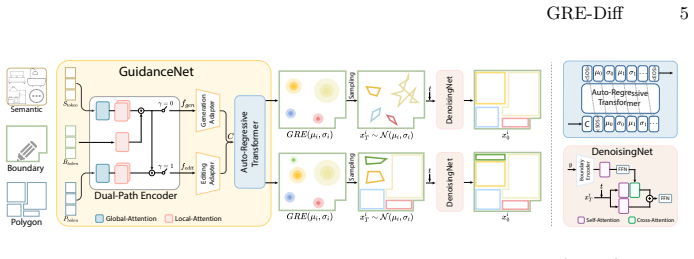
Gaussian Room Embedding (GRE): each room is a spatial Gaussian N(μ, σ²I); the predicted (μ, σ) set the initial noise and the room-dependent drift/variance of the diffusion, after which DenoisingNet recovers explicit polygons.
Load-bearing premise
A single center point and one size number per room are enough to steer diffusion into valid, functional apartment polygons even when boundaries are irregular or rooms are edited.
What would settle it
Run the model on a held-out collection of strongly non-rectilinear apartment outlines never seen in RPLAN; if FID, overlap-free rate or door-reachability collapse while room-count accuracy remains high, the isotropic GRE state is insufficient.
If this is right
- Users can obtain diverse, constraint-satisfying apartment polygons from natural-language room counts and sketched boundaries without hand-built graphs.
- The same diffusion model supports add, delete, move, repurpose and anchor edits while freezing user-chosen rooms and preserving global coherence.
- Reported metrics on RPLAN show lower FID/KID/MMD, higher coverage and higher boundary-plus-room F1 than the compared graph, GAN and diffusion baselines.
- Automatic BC/RC feedback can resample failing layouts without external snapping or post-processing.
- A dual-mode interface (LLM instructions or GUI operators) lets non-experts iterate designs inside one generative loop.
Where Pith is reading between the lines
- If GRE already unifies generation and editing, the same room-level state could serve as a shared interface for multi-turn agentic design loops that plan, check and re-edit layouts.
- Failures on highly irregular contours suggest that anisotropic or multi-mode Gaussians may be required before the method generalizes beyond residential Manhattan-like plans.
- Because GRE is compact and order-invariant, it is a natural candidate for coupling with downstream furniture-placement modules to close the empty-room-to-furnished-interior pipeline.
- The same continuous room state may transfer to multi-story or commercial layouts once training data cover those typologies.
Editorial analysis
A structured set of objections, weighed in public.
Referee Report
Summary. The paper proposes GRE-Diff, a diffusion framework for controllable apartment floor-plan generation and interactive editing. Each room is represented by an isotropic Gaussian Room Embedding (GRE) with centroid μ and scalar scale σ; GuidanceNet predicts these embeddings from multi-modal conditions (room types/counts, boundary, optional polygons), and DenoisingNet denoises polygons initialized and steered by the GRE-parameterized reverse process. The system supports LLM-parsed natural-language constraints and five GUI editing operators (Add/Delete/Move/Repurpose/Anchor) with hard fixed-room masks. On RPLAN, GRE-Diff reports best or near-best FID/KID/MMD, highest COV, and highest F1 BC-RC among seven baselines, plus strong editing Tiny-ROE/F1, user preference over Graph2Plan and GT, and high overlap-free/reachability rates. Ablations contrast dual-path attention and GRE-as-state vs conditioning-only vs plain DDPM.
Significance. If the results hold under fair comparison, this is a useful systems contribution: a single diffusion model that unifies vectorized generation and localized editing under boundary and room-count constraints, with a practical dual-mode (LLM/GUI) interface. Strengths include multi-metric evaluation on a held-out RPLAN split, an explicit ablation showing that wiring GRE into the diffusion state transition (not merely as external conditioning) improves metrics (Table S1), functionality rates (overlap-free 95.56%, reachability 96.35%), a user preference study, and an honest limitations section with failure cases. The continuous room-level state idea is a reasonable alternative to ordered vertex sequences and discrete masks for structured layout diffusion.
major comments (3)
- Sec. 3.1–3.2 and Supp. C.2: The central representation claim is that an isotropic GRE N(μi, σi²I) is a sufficient room-level geometric state to initialize and parameterize polygon diffusion (forward/reverse Eqs. 1–3). Table S1 only contrasts full GRE-state vs conditioning-only vs plain DDPM; it does not test richer room states (anisotropic covariance, oriented box, multi-mode blob). Sec. 4.5 and Fig. 8 document failures precisely where isotropy is weakest (non-rectilinear/irregular boundaries, uneven vertex density, connectivity/semantics). Either add a controlled ablation with a richer room state under the same training budget, or substantially qualify the claim that GRE is a generally adequate geometric state rather than an effective prior for RPLAN’s largely rectilinear apartments.
- Table 1 and Sec. 4.2: Baseline fairness needs tighter documentation. HouseDiffusion is evaluated without boundary constraints by design; Graph2Plan’s strong numbers depend on retrieval-assisted post-processing (FID rises to 20.10 and RC falls to 50.19% without it). WallPLAN/GSDiff use snapping/alignment. Please report a primary comparison under a common protocol (same boundary+room-type conditions, no non-neural post-processing, or with post-processing clearly factored out for all methods) so that the headline ranking (FID 4.36, F1 BC-RC 99.21%) is not partly an artifact of unequal pipelines.
- Sec. 4.1–4.2 functionality metrics and Supp. on doors/windows: Overlap-free and reachability rates (95.56% / 96.35%) use annotated door labels to build connectivity graphs, while the method itself does not generate doors/windows and instead applies a post-hoc rule-based procedure (Supp. limitation 4). Clarify whether reachability is measured on model outputs alone or after rule-based opening insertion, and report connectivity without relying on GT door annotations if the claim is that generated layouts are functionally usable end-to-end.
minor comments (6)
- Fig. 7 caption refers to “Fig. S5” in the main text narrative (“Fig. S5 shows…”); renumber or fix the cross-reference so main-text figures are self-contained.
- Notation: the reverse update in Sec. 3.2 uses αt / ᾱt inconsistently with Supp. C.2; unify the noise schedule symbols and define ᾱt explicitly in the main text.
- Table 2 Tiny-ROE = 0.00% for all operations is striking; briefly state the LPIPS threshold and how “requested edit applied” is verified (semantic label check vs geometric IoU) so the metric is reproducible.
- User study (Sec. 4.2): report inter-rater agreement or confidence intervals on the 1740 responses; preference over GT is interesting and would benefit from a short discussion of possible confounds (rendering style, wall thickness).
- Related work: briefly position GRE against BlobGAN/BlobCtrl-style spatial Gaussians and PolyDiffuse set diffusion, which are cited but not contrasted on the room-state design choice.
- Typos/clarity: “load-bearing wall constraints” in Fig. 5 caption is not fully explained in the main text; define how load-bearing walls enter the conditioning y.
Circularity Check
No significant circularity: empirical generative method evaluated on held-out data with independent ablations.
full rationale
GRE-Diff is an empirical computer-vision paper that defines Gaussian Room Embeddings (isotropic N(μ, σ²I)), trains GuidanceNet and DenoisingNet on RPLAN, and reports standard external metrics (FID/KID/MMD/COV/BC/RC/F1, Tiny-ROE, LPIPS, user study) on held-out layouts. The reverse-process equations (Supp. C.2) parameterize diffusion with predicted GRE but do not algebraically force the reported similarity or controllability numbers; those are measured against real test polygons and baselines. The key ablation (Table S1) shows that wiring GRE into the diffusion state outperforms both plain DDPM and GRE-as-conditioning-only, which is independent empirical evidence rather than a tautology. No uniqueness theorem, fitted-parameter-as-prediction, or load-bearing self-citation chain reduces the central claims to their inputs by construction. Limitations on non-rectilinear boundaries are openly stated and do not create circularity.
Axiom & Free-Parameter Ledger
free parameters (6)
- Encoder loss weights λ1, λ2, λ3 =
1.0 / 1.0 / 0.5
- Triplet soft-margin α =
0.1
- GRE quantization bins K =
50
- Learning rate and schedule =
2e-4
- Polygon/boundary sampling resolution =
64 points
- Editing coefficient γ =
0 or 1
axioms (5)
- standard math Standard DDPM-style forward/reverse diffusion with noise schedules α_t, ᾱ_t is a valid generative process for 2D polygon vertices.
- domain assumption RPLAN vectorized residential plans are a representative distribution for evaluating apartment layout quality and constraints.
- ad hoc to paper An isotropic Gaussian (μ, σI) adequately summarizes room location and extent for guiding polygon diffusion and editing.
- domain assumption LLM few-shot parsing of natural language into room counts/types and edit operators is reliable enough for the interactive pipeline.
- domain assumption Doors and windows can be added by post-hoc geometric rules without joint learning.
invented entities (2)
-
Gaussian Room Embedding (GRE)
no independent evidence
-
Dual-path GuidanceNet with generation/editing adapters
no independent evidence
read the original abstract
Designing functional and aesthetically coherent floor plans requires exploring a vast space of possible room arrangements, a task that quickly becomes overwhelming for human designers. In this paper, we propose GRE-Diff, a controllable and interactive diffusion-based framework that automates the creation and editing of apartment floor plans under user-specified constraints. By combining AI-generated suggestions with real-time, human-in-the-loop editing, the system enables users to specify room types, room counts, boundary shapes, and editing operations through LLM-parsed instructions or GUI-based interaction. It then generates a diverse set of plausible and well-structured designs for refinement. At the core of our approach is Gaussian Room Embedding (GRE), a continuous latent representation that models each room as a spatial Gaussian distribution capturing its location and extent. Extensive experiments on the RPLAN dataset show that GRE-Diff produces high-quality, constraint-aware, and editable polygonal layouts, offering a practical step toward bridging AI-driven automation and human creativity in spatial design.
Figures



Reference graph
Works this paper leans on
-
[1]
In: International conference on machine learning
Achlioptas, P., Diamanti, O., Mitliagkas, I., Guibas, L.: Learning representations and generative models for 3d point clouds. In: International conference on machine learning. pp. 40–49. PMLR (2018)
work page 2018
- [2]
-
[3]
Bińkowski, M., Sutherland, D.J., Arbel, M., Gretton, A.: Demystifying mmd gans. arXiv preprint arXiv:1801.01401 (2018)
work page internal anchor Pith review Pith/arXiv arXiv 2018
- [4]
-
[5]
Chen, J., Deng, R., Furukawa, Y.: Polydiffuse: Polygonal shape reconstruction via guided set diffusion models. Proc. Conf. on Neural Information Processing Systems 36(2024)
work page 2024
- [6]
-
[7]
Dhariwal, P., Nichol, A.: Diffusion models beat gans on image synthesis. Proc. Conf. on Neural Information Processing Systems34, 8780–8794 (2021)
work page 2021
- [8]
- [9]
- [10]
-
[11]
In: Proc.IEEE/CVFConf.onComputerVision&PatternRecognition.pp.7793–7802 (2022)
He, F., Huang, Y., Wang, H.: iplan: Interactive and procedural layout planning. In: Proc.IEEE/CVFConf.onComputerVision&PatternRecognition.pp.7793–7802 (2022)
work page 2022
-
[12]
He,K.,Zhang,X.,Ren,S.,Sun,J.:Deepresiduallearningforimagerecognition.In: Proc. IEEE/CVF Conf. on Computer Vision & Pattern Recognition. pp. 770–778 (2016)
work page 2016
-
[13]
Heusel,M.,Ramsauer,H.,Unterthiner,T.,Nessler,B.,Hochreiter,S.:Ganstrained by a two time-scale update rule converge to a local nash equilibrium. Proc. Conf. on Neural Information Processing Systems30(2017)
work page 2017
-
[14]
In: Proceedings of the 32nd ACM International Con- ference on Multimedia
Hong, S., Zhang, X., Du, T., Cheng, S., Wang, X., Yin, J.: Cons2plan: Vector floorplan generation from various conditions via a learning framework based on conditional diffusion models. In: Proceedings of the 32nd ACM International Con- ference on Multimedia. pp. 3248–3256 (2024)
work page 2024
- [15]
- [16]
-
[17]
Auto-Encoding Variational Bayes
Kingma, D.P.: Auto-encoding variational bayes. arXiv preprint arXiv:1312.6114 (2013)
work page internal anchor Pith review Pith/arXiv arXiv 2013
-
[18]
Tell2Design: A Dataset for Language-Guided Floor Plan Generation
Leng, S., Zhou, Y., Dupty, M.H., Lee, W.S., Joyce, S.C., Lu, W.: Tell2design: A dataset for language-guided floor plan generation. arXiv preprint arXiv:2311.15941 (2023)
work page internal anchor Pith review Pith/arXiv arXiv 2023
-
[19]
arXiv preprint arXiv:2503.13434 (2025)
Li, Y., Li, L., Zhang, Z., Li, X., Wang, G., Li, H., Cun, X., Shan, Y., Zou, Y.: Blobctrl: A unified and flexible framework for element-level image generation and editing. arXiv preprint arXiv:2503.13434 (2025)
- [20]
-
[21]
Decoupled Weight Decay Regularization
Loshchilov, I., Hutter, F.: Decoupled weight decay regularization. arXiv preprint arXiv:1711.05101 (2017)
work page internal anchor Pith review Pith/arXiv arXiv 2017
- [22]
- [23]
-
[24]
House-GAN++: Generative Adversarial Layout Refinement Networks
Nauata, N., Hosseini, S., Chang, K., Chu, H., Cheng, C., Furukawa, Y.: House-gan++: generative adversarial layout refinement networks. arXiv preprint arXiv:2103.02574 (2021)
work page internal anchor Pith review Pith/arXiv arXiv 2021
- [25]
-
[26]
Obukhov, A., Seitzer, M., Wu, P.W., Zhydenko, S., Kyl, J., Lin, E.Y.J.: High- fidelityperformancemetrics for generative models in pytorch (2020).https://doi. org/10.5281/zenodo.4957738,https://github.com/toshas/torch- fidelity, version: 0.3.0, DOI: 10.5281/zenodo.4957738
- [27]
-
[28]
Civil Engineering Design6(2), 41–52 (2024)
Ploennigs, J., Berger, M.: Automating computational design with generative ai. Civil Engineering Design6(2), 41–52 (2024)
work page 2024
-
[29]
ChatHouseDiffusion: Prompt-Guided Generation and Editing of Floor Plans
Qin, S., He, C., Chen, Q., Yang, S., Liao, W., Gu, Y., Lu, X.: Chathouse- diffusion: Prompt-guided generation and editing of floor plans. arXiv preprint arXiv:2410.11908 (2024)
work page internal anchor Pith review Pith/arXiv arXiv 2024
- [30]
- [31]
- [32]
-
[33]
Tang, H., Shao, L., Sebe, N., Van Gool, L.: Graph transformer gans with graph maskedmodelingforarchitecturallayoutgeneration.IEEETrans.PatternAnalysis & Machine Intelligence46(6), 4298–4313 (2024)
work page 2024
-
[34]
Kimi K2: Open Agentic Intelligence
Team, K., Bai, Y., Bao, Y., Chen, G., Chen, J., Chen, N., Chen, R., Chen, Y., Chen, Y., Chen, Y., et al.: Kimi k2: Open agentic intelligence. arXiv preprint arXiv:2507.20534 (2025) 18 J. Wang, H. Xiong, Z. Yan, M. Gong, and H. Huang
work page internal anchor Pith review Pith/arXiv arXiv 2025
-
[35]
In: 2022 IEEE International Conference on Multimedia and Expo Workshops (ICMEW)
Upadhyay, A., Dubey, A., Arora, V., Kuriakose, S.M., Agarawal, S.: Flnet: graph constrained floor layout generation. In: 2022 IEEE International Conference on Multimedia and Expo Workshops (ICMEW). pp. 1–6. IEEE (2022)
work page 2022
-
[36]
Vaswani, A.: Attention is all you need. Proc. Conf. on Neural Information Process- ing Systems (2017)
work page 2017
-
[37]
Word Representations via Gaussian Embedding
Vilnis, L., McCallum, A.: Word representations via gaussian embedding. CoRR abs/1412.6623(2014),https://api.semanticscholar.org/CorpusID:13468104
work page internal anchor Pith review Pith/arXiv arXiv 2014
-
[38]
Automation in Construction154, 105036 (2023)
Wang, L., Liu, J., Zeng, Y., Cheng, G., Hu, H., Hu, J., Huang, X.: Automated building layout generation using deep learning and graph algorithms. Automation in Construction154, 105036 (2023)
work page 2023
-
[39]
Automation in Construction 140, 104385 (2022)
Weber, R.E., Mueller, C., Reinhart, C.: Automated floorplan generation in archi- tectural design:A review ofmethods andapplications. Automation in Construction 140, 104385 (2022)
work page 2022
- [40]
-
[41]
In: Proceedings of the 2025 International Conference on Multimedia Retrieval
Xu, M., Lou, Y., Gao, X., Zhou, X.: Floorplan-diffusion: Automatic floor plan generation via pre-trained large latent diffusion model. In: Proceedings of the 2025 International Conference on Multimedia Retrieval. pp. 1617–1625 (2025)
work page 2025
-
[42]
Yang, G., Huang, X., Hao, Z., Liu, M.Y., Belongie, S., Hariharan, B.: Pointflow: 3d point cloud generation with continuous normalizing flows. arXiv (2019)
work page 2019
- [43]
-
[44]
ImgEdit: A Unified Image Editing Dataset and Benchmark
Ye, Y., He, X., Li, Z., Lin, B., Yuan, S., Yan, Z., Hou, B., Yuan, L.: Imgedit: A unified image editing dataset and benchmark. arXiv preprint arXiv:2505.20275 (2025)
work page internal anchor Pith review Pith/arXiv arXiv 2025
-
[45]
Yin, J., Zeng, P., Sun, H., Dai, Y., Zheng, H., Zhang, M., Zhang, Y., Lu, S.: Floorplan-llama: Aligning architects’ feedback and domain knowledge in architec- tural floor plan generation. In: Proceedings of the 63rd Annual Meeting of the Association for Computational Linguistics (Volume 1: Long Papers). pp. 6640– 6662 (2025)
work page 2025
- [46]
-
[47]
Zhang, K., Mo, L., Chen, W., Sun, H., Su, Y.: Magicbrush: A manually annotated dataset for instruction-guided image editing. Proc. Conf. on Neural Information Processing Systems36, 31428–31449 (2023)
work page 2023
- [48]
-
[49]
In: Proceedings of the IEEE/CVF International Conference on Computer Vision (ICCV)
Zhou, L., Du, Y., Wu, J.: 3d shape generation and completion through point-voxel diffusion. In: Proceedings of the IEEE/CVF International Conference on Computer Vision (ICCV). pp. 5826–5835 (October 2021)
work page 2021
-
[50]
three bedroom, one living room, one kitchen, one bathroom
Zong, Z., Zhan, Z., Tan, G.: Housellm: Llm-assisted two-phase text-to-floorplan generation. arXiv e-prints pp. arXiv–2411 (2024) GRE-Diff 19 Supplementary Material A INTRODUCTION This supplementary document provides detailed information on various aspects of theGRE-Diffpaper, including the LLM prompt in Section B, framework details in Section C, evaluatio...
work page 2024
-
[51]
Move room <index> to position (x,y)
-
[52]
Add a new <room_type> room at position (x,y)
-
[53]
Think: The user wants to move a bathroom
Change room <index> to <room_type> Examples Condition: [{index: 1, type: Living Room, area: 5394, center: [103, 120]}, {index: 2, type: Bedroom, area: 2684, center: [176, 89]}, {index: 3, type: Kitchen, area: 1178, center: [66, 86]}, {index: 4, type: Bathroom, area: 762, center: [125, 86]}, {index: 5, type: Bathroom, GRE-Diff 21 area: 400, center: [95, 80...
work page 1911
-
[54]
Permutation LossL perm. A room embedding should be invariant to polygonal vertex permutations and remain consistent under forward-diffused variants. To achieve this, we adopt a bidirectional triplet loss that pulls em- beddings of the same room closer while pushing embeddings of other rooms apart. For roomi, the triplet objectives are: LTri.(xi t, X0) = m...
-
[55]
Room embeddings should encode not only geom- etry but also semantics
Semantic LossLsem. Room embeddings should encode not only geom- etry but also semantics. To this end, we predict semantic labels directly from encoder features and supervise them using a Cross-Entropy loss: Lsem = NX i=1 (− CX c=1 Sgt(i, c)·log eSpred(i,c) PC j=1 eSpred(i,j) ), whereNdenotes the number of rooms,Cis the total number of semantic cat- egorie...
-
[56]
Regularization LossL reg. To maintain numerical stability and avoid pathological variances, we regularize the predicted Gaussian parameters as: Lreg = NX i=1 (||µi||2 +|| 1 σi ||2). Theregularizerconstrainstheembeddingstoremainnumericallywell-behaved, avoiding excessive mean offsets and preventing extremely small or large variances that may impair diffusi...
discussion (0)
Sign in with ORCID, Apple, or X to comment. Anyone can read and Pith papers without signing in.