REVIEW 6 minor 70 references
For cluster-algebra maps with pq>4 the dynamical degree exceeds 1, so they admit no conserved quantity and no invariant fibration.
Reviewed by Pith at T0; open to challenge. T0 means a machine referee read the full paper against a public rubric. the ladder, T0–T4 →
T0 review · grok-4.5
2026-07-10 12:39 UTC pith:VLCLXDA6
load-bearing objection Clean answer to the open integrability question for μp,q via explicit dynamical degrees and superattracting points; the calculations check out.
Complex dynamics perspective for birational maps of the plane arising from cluster algebra mutations
The pith
A machine-rendered reading of the paper's core claim, the machinery that carries it, and where it could break.
Core claim
When p and q are positive integers with pq>4 the dynamical degree of the mutation map equals (pq-2+sqrt((pq-2)^2-4))/2, which is greater than one; consequently the map admits neither an invariant fibration nor a rational conserved quantity. Parallel statements hold for most pairs of negative integers.
What carries the argument
Algebraically stable lift obtained by a finite sequence of point blow-ups; the dynamical degree is then the spectral radius of the induced linear action on the Picard group of the blown-up surface.
Load-bearing premise
That a finite sequence of point blow-ups always produces an algebraically stable model on which the pull-back operator can be computed.
What would settle it
Exhibit a single pair of integers p,q with pq>4 for which the lifted map on every finite blow-up of the plane still possesses a destabilizing orbit, or for which an explicit rational first integral can be written down.
If this is right
- Maps with pq>4 cannot be integrated by any rational conserved quantity and therefore lie outside the classical integrable regime of cluster algebra mutations.
- Each such map carries a unique measure of maximal entropy equal to the logarithm of its dynamical degree, together with positive Lyapunov exponents.
- Superattracting fixed points or period-3 cycles appear after the blow-ups, giving an independent geometric obstruction to invariant fibrations.
- The same tropical and Picard-group techniques apply immediately to the remaining open cases of mixed-sign parameters.
Where Pith is reading between the lines
- The explicit closed-form dynamical degree may allow one to decide arithmetic-degree questions for rational points under iteration of these maps.
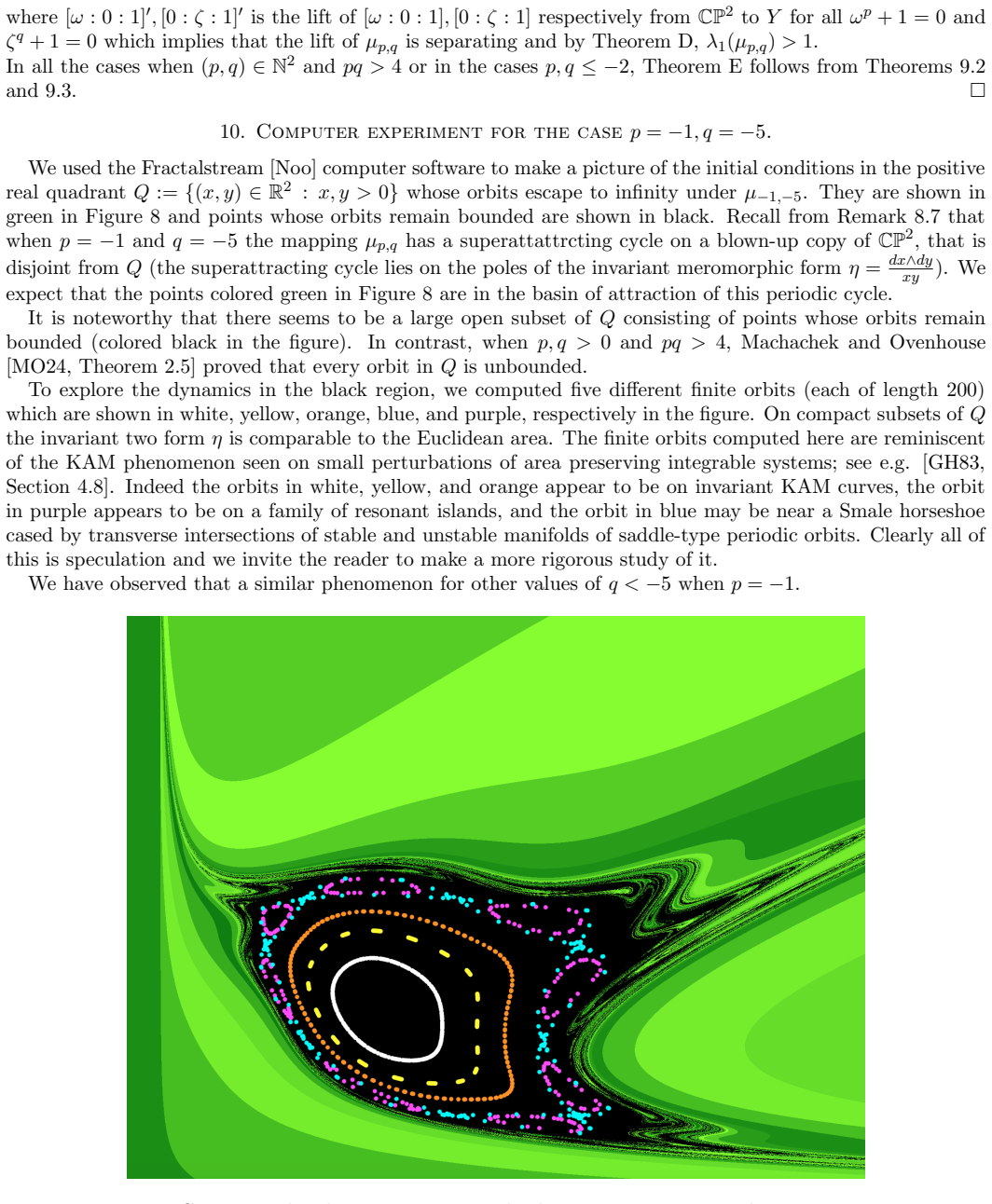
- The KAM-like pictures observed numerically for certain negative parameters suggest that the positive-entropy measure coexists with large regions of bounded, nearly integrable motion.
- Once the mixed-sign parameter plane is treated by the same methods, the entire two-parameter family will be classified by dynamical degree.
Editorial analysis
A structured set of objections, weighed in public.
Referee Report
Summary. The paper studies the birational maps μp,q of the plane arising from rank-2 cluster mutations (and their sign-reversed analogues). After compactifying to CP2 and constructing explicit algebraically stable models by finitely many point blow-ups (Xp,q for p,q≥1, Y for p,q≤-2), the authors compute the induced pull-back operators on Picard groups and extract the dynamical degrees: for p,q≥1 and pq>4 one has λ1=(pq-2+√((pq-2)2-4))/2>1 (Theorem A); for p,q≤-2, λ1 is the largest real root of a degree-4 polynomial and is likewise >1 (Theorem C). Consequently the maps admit no invariant fibration and in particular no rational conserved quantity (Theorems B,D), answering questions of Machacek–Ovenhouse and Chen–Li. Superattracting fixed points or 3-cycles supply an independent obstruction to fibrations. With algebraic stability and λ1>1 in hand, standard ergodic results yield measures of maximal entropy with positive Lyapunov exponents (Theorem E). Affine cases pq=4 are integrated explicitly via conserved quantities and Hamiltonian flows.
Significance. The work cleanly settles the integrability question for the family μp,q by importing the well-developed toolkit of complex surface dynamics (algebraic stability, dynamical degree, superattracting points, Diller–Favre/Dinh–Nguyen criteria). The dynamical-degree formulae are obtained by two independent methods (Picard spectrum and the Alonso–Suris–Wei local-index recurrence) that agree, and the algebraically stable models are constructed and verified by hand rather than merely invoked. The resulting non-existence statements answer concrete questions from the cluster-algebra literature, while the ergodic consequences illustrate the broader dynamical richness of these maps. The explicit tropical analysis and the integration of the affine cases further strengthen the contribution.
minor comments (6)
- The date line reads “July 10, 2026”; this is presumably a typographical error and should be corrected before publication.
- In the abstract and introduction the phrase “question posted by” should be “question posed by”.
- Section 1.3, Remark 1.3: the numerical evidence for λ1(μ-1,q)>1 when q=-3,-4 is useful but could be stated more precisely (e.g., approximate growth rates after a fixed number of iterates) so that a reader can reproduce the experiment.
- Figure 1 and the subsequent critical-behaviour diagrams would benefit from a short caption explaining the colour coding of the critical curves and the meaning of the arrows.
- Appendix B is valuable as an independent verification, yet a one-sentence pointer in the main text (near Theorem 6.5) that the same closed form is recovered by the local-index method would help the reader locate the cross-check.
- A few minor notational inconsistencies appear (e.g., ν p,q versus μ-p,-q; occasional use of both “superattracting” and “super-attracting”). Standardising them would improve readability.
Circularity Check
No significant circularity: dynamical degrees are spectral radii of explicitly constructed pull-back operators on Picard groups of concrete blow-up models, cross-checked by independent local-indices recurrences and superattracting points.
full rationale
The central claims (Theorems A–D) rest on two independent, fully explicit calculations. First, the authors construct algebraically stable models Xp,q (semi-simple and non-semi-simple cases, §§5.3–5.4) and Y (negative pairs, §8.1.1) by a finite sequence of point blow-ups whose charts and critical-curve images are written down; algebraic stability is verified by direct inspection that no critical curve or exceptional divisor lands on a destabilizing orbit (Prop. 5.12, Prop. 8.4, Cor. 2.13–2.14). The induced pull-back µ* on the free abelian group Pic of finite rank is then computed by intersection multiplicities read off the defining equations (Props. 6.1, 6.3); its spectral radius is extracted by elementary linear algebra (Lems. 6.2, 6.4) and equals the claimed closed-form expression for λ1. An independent route (App. B) recovers the same recurrence for deg(µ^n) via the local-indices method of Alonso–Suris–Wei, again without free parameters. Non-existence of invariant fibrations follows either from λ1>1 (Prop. 1.1, classical) or from the superattracting fixed/periodic points that the authors locate by direct differentiation in the same charts (Lems. 5.6, 5.11, 8.6 + Prop. 1.2, proved in the paper). Tropicalization (Sec. 7) and the ergodic consequences (Thm. E) are applications of external theorems once λ1>1 is known; they do not feed back into the degree computation. No parameter is fitted to data, no uniqueness theorem is imported from the authors’ prior work as a black box, and no quantity is redefined in terms of the quantity being “predicted.” The derivation is therefore self-contained and non-circular.
Axiom & Free-Parameter Ledger
axioms (4)
- standard math A birational map of a smooth projective surface admits an invariant fibration if and only if its first dynamical degree equals 1 (Diller-Favre + Dinh-Nguyen-Truong).
- standard math Existence of a finite sequence of point blow-ups rendering any birational surface map algebraically stable (Diller-Favre).
- standard math For an algebraically stable birational map, λ1 equals the spectral radius of the induced pull-back on Pic.
- standard math Algebraically stable separating maps with λ1>1 admit an invariant measure of maximal entropy with the stated Lyapunov bounds (Diller, Diller-Dujardin-Guedj).
read the original abstract
Using the methods of holomorphic dynamics we investigate planar birational mappings that arise from the theory of cluster algebras and integrable systems. Computing dynamical degrees of these mappings, many of which are greater than one, allows us to show that many of the mappings do not have a conserved quantity (nor an invariant fibration). In most of the examples, invariant fibrations can also be ruled out by finding superattracting periodic points. This answers a question posted by Machacek and Ovenhouse 2024 and by Chen and Li 2024. Moreover, having found a good algebraically stable model for the mappings and having computed the dynamical degree, we can then apply results from the ergodic theory of birational maps to produce invariant measures with positive entropy and positive Lyapunov exponents.
Figures


Reference graph
Works this paper leans on
-
[1]
Guckenheimer, John and Holmes, Philip , TITLE =. 1983 , PAGES =. doi:10.1007/978-1-4612-1140-2 , URL =
-
[2]
Noonan,Matt , TITLE =
-
[3]
Angl\`es d'Auriac, J.-Ch. and Maillard, J.-M. and Viallet, C. M. , TITLE =. J. Phys. A , FJOURNAL =. 2006 , NUMBER =. doi:10.1088/0305-4470/39/14/009 , URL =
-
[4]
doi:10.1515/crelle-2014-0020 , url =
On the Dynamical and Arithmetic Degreesof Rational Self-Maps of Algebraic Varieties , author =. doi:10.1515/crelle-2014-0020 , url =
-
[5]
doi:10.1307/mmj/1395234358 , url =
Examples of Dynamical Degree Equals Arithmetic Degree , author =. doi:10.1307/mmj/1395234358 , url =
-
[6]
Dang, N.-B. and Grigorchuk, R. and Lyubich, M. , TITLE =. Arnold Math. J. , FJOURNAL =. 2023 , NUMBER =. doi:10.1007/s40598-022-00223-0 , URL =
-
[7]
Degree growth of birational maps of the plane , JOURNAL =
Blanc, J\'. Degree growth of birational maps of the plane , JOURNAL =. 2015 , NUMBER =
work page 2015
-
[8]
Dujardin, Romain , TITLE =. Duke Math. J. , FJOURNAL =. 2006 , NUMBER =. doi:10.1215/S0012-7094-06-13122-8 , URL =
-
[9]
Roeder, Roland K. W. , TITLE =. Math. Res. Lett. , FJOURNAL =. 2015 , NUMBER =. doi:10.4310/MRL.2015.v22.n2.a13 , URL =
-
[10]
Cantat, Serge and Favre, Charles , TITLE =. J. Reine Angew. Math. , FJOURNAL =. 2003 , PAGES =. doi:10.1515/crll.2003.066 , URL =
-
[11]
Guedj, Vincent , TITLE =. Ergodic Theory Dynam. Systems , FJOURNAL =. 2005 , NUMBER =. doi:10.1017/S0143385705000192 , URL =
-
[12]
Diller, Jeffrey and Lin, Jan-Li , TITLE =. Math. Ann. , FJOURNAL =. 2016 , NUMBER =. doi:10.1007/s00208-015-1211-2 , URL =
-
[13]
and Diller, Jeffrey and Jonsson, Mattias , TITLE =
Bell, Jason P. and Diller, Jeffrey and Jonsson, Mattias , TITLE =. Acta Math. , FJOURNAL =. 2020 , NUMBER =. doi:10.4310/ACTA.2020.v225.n2.a1 , URL =
- [14]
-
[15]
Diller, Jeffrey and Roeder, Roland , TITLE =. Comment. Math. Helv. , FJOURNAL =. 2026 , NUMBER =. doi:10.4171/cmh/595 , URL =
-
[16]
Fomin, Sergey and Zelevinsky, Andrei , TITLE =. J. Amer. Math. Soc. , FJOURNAL =. 2002 , NUMBER =. doi:10.1090/S0894-0347-01-00385-X , URL =
-
[17]
Fomin, Sergey and Zelevinsky, Andrei , TITLE =. Invent. Math. , FJOURNAL =. 2003 , NUMBER =. doi:10.1007/s00222-003-0302-y , URL =
-
[18]
Journal of the American mathematical society , volume=
Cluster algebras I: foundations , author=. Journal of the American mathematical society , volume=
-
[19]
Cluster algebras II: Finite type classification
Cluster algebras II: Finite type classification , author=. arXiv preprint math/0208229 , year=
work page internal anchor Pith review Pith/arXiv arXiv
-
[20]
Mutation invariants of cluster algebras of rank 2 , journal =
Zhichao Chen and Zixu Li , keywords =. Mutation invariants of cluster algebras of rank 2 , journal =. 2024 , issn =. doi:https://doi.org/10.1016/j.jalgebra.2024.04.023 , url =
-
[21]
Diller, J. and Favre, C. , title =. Amer. J. Math. , volume =. 2001 , pages =
work page 2001
-
[22]
Diller, J. and Jan-Li Lin , title =. Math. Ann. , volume =. 2016 , pages =
work page 2016
-
[24]
Birkett, Richard A. P. , TITLE =. Ann. Fac. Sci. Toulouse Math. (6) , FJOURNAL =. 2025 , NUMBER =. doi:10.5802/afst.1805 , URL =
- [25]
-
[26]
Brin, Michael and Stuck, Garrett , title =
-
[28]
Equidistribution without stability for toric surface maps , author =. 2024 , eprint=
work page 2024
-
[30]
Conformal Geometry and Dynamics of the American Mathematical Society , volume=
Complex perspective for the projective heat map acting on pentagons , author=. Conformal Geometry and Dynamics of the American Mathematical Society , volume=
-
[31]
Experimental Mathematics , volume=
Discrete dynamical systems from real valued mutation , author=. Experimental Mathematics , volume=. 2024 , publisher=
work page 2024
-
[32]
Dinh, Tien-Cuong and Nguy\^en, Vi\^et-Anh , TITLE =. Comment. Math. Helv. , FJOURNAL =. 2011 , NUMBER =. doi:10.4171/CMH/241 , URL =
-
[33]
Dinh, Tien-Cuong and Nguy\^en, Vi\^et-Anh and Truong, Tuyen Trung , TITLE =. Commun. Contemp. Math. , FJOURNAL =. 2012 , NUMBER =. doi:10.1142/S0219199712500423 , URL =
-
[35]
Friedland, Shmuel , TITLE =. Ann. of Math. (2) , FJOURNAL =. 1991 , NUMBER =. doi:10.2307/2944341 , URL =
-
[36]
Dinh, Tien-Cuong and Sibony, Nessim , TITLE =. Ann. of Math. (2) , FJOURNAL =. 2005 , NUMBER =. doi:10.4007/annals.2005.161.1637 , URL =
-
[37]
Entropy of meromorphic maps acting on analytic sets
Entropy of Meromorphic Maps Acting on Analytic Sets , author =. doi:10.48550/arXiv.1807.06483 , url =. 1807.06483 , eprinttype =
work page internal anchor Pith review Pith/arXiv arXiv doi:10.48550/arxiv.1807.06483
-
[38]
Diller, Jeffrey , TITLE =. Indiana Univ. Math. J. , FJOURNAL =. 1996 , NUMBER =. doi:10.1512/iumj.1996.45.1331 , URL =
-
[39]
Diller, Jeffrey , TITLE =. Comment. Math. Helv. , FJOURNAL =. 2001 , NUMBER =. doi:10.1007/s00014-001-8327-6 , URL =
-
[40]
Diller, Jeffrey and Dujardin, Romain and Guedj, Vincent , TITLE =. Ann. Sci. \'. 2010 , NUMBER =. doi:10.24033/asens.2120 , URL =
-
[41]
Cluster integrable systems, q-
Bershtein, Mikhail and Gavrylenko, Pavlo and Marshakov, Andrei , journal=. Cluster integrable systems, q-. 2018 , publisher=
work page 2018
-
[42]
J.-Ch. Angl\`es d'Auriac, J.-M. Maillard, and C. M. Viallet. On the complexity of some birational transformations. J. Phys. A , 39(14):3641--3654, 2006
work page 2006
-
[43]
Jaume Alonso, Yuri B. Suris, and Kangning Wei. Dynamical degrees of birational maps from indices of polynomials with respect to blow-ups I . general theory and 2 D examples, 2023. ArXiv preprint: https://arxiv.org/abs/2303.15864
work page internal anchor Pith review Pith/arXiv arXiv 2023
-
[44]
Jaume Alonso, Yuri B. Suris, and Kangning Wei. Dynamical degrees of birational maps from indices of polynomials with respect to blow-ups II . 3 D examples, 2023. ArXiv preprint: https://arxiv.org/abs/2307.09939
work page internal anchor Pith review Pith/arXiv arXiv 2023
-
[45]
Degree growth of birational maps of the plane
J\' e r\' e my Blanc and Julie D\' e serti. Degree growth of birational maps of the plane. Ann. Sc. Norm. Super. Pisa Cl. Sci. (5) , 14(2):507--533, 2015
work page 2015
-
[46]
Bell, Jeffrey Diller, and Mattias Jonsson
Jason P. Bell, Jeffrey Diller, and Mattias Jonsson. A transcendental dynamical degree. Acta Math. , 225(2):193--225, 2020
work page 2020
-
[47]
Cluster integrable systems, q- P ainlev \'e equations and their quantization
Mikhail Bershtein, Pavlo Gavrylenko, and Andrei Marshakov. Cluster integrable systems, q- P ainlev \'e equations and their quantization. Journal of High Energy Physics , 2018(2), 2018
work page 2018
-
[48]
Richard A. P. Birkett. On the stabilisation of rational surface maps. Ann. Fac. Sci. Toulouse Math. (6) , 34(1):47--74, 2025
work page 2025
-
[49]
Mutation invariants of cluster algebras of rank 2
Zhichao Chen and Zixu Li. Mutation invariants of cluster algebras of rank 2. Journal of Algebra , 654:25--58, 2024
work page 2024
-
[50]
Jeffrey Diller, Romain Dujardin, and Vincent Guedj. Dynamics of meromorphic maps with small topological degree III : geometric currents and ergodic theory. Ann. Sci. \' E c. Norm. Sup\' e r. (4) , 43(2):235--278, 2010
work page 2010
-
[51]
J. Diller and C. Favre. Dynamics of bimeromorphic maps of surfaces. Amer. J. Math. , 123:1135--1169, 2001
work page 2001
-
[52]
N.-B. Dang, R. Grigorchuk, and M. Lyubich. Self-similar groups and holomorphic dynamics: renormalization, integrability, and spectrum. Arnold Math. J. , 9(4):505--597, 2023
work page 2023
-
[53]
Dynamics of birational maps of P ^2
Jeffrey Diller. Dynamics of birational maps of P ^2 . Indiana Univ. Math. J. , 45(3):721--772, 1996
work page 1996
-
[54]
Invariant measure and L yapunov exponents for birational maps of P ^2
Jeffrey Diller. Invariant measure and L yapunov exponents for birational maps of P ^2 . Comment. Math. Helv. , 76(4):754--780, 2001
work page 2001
-
[55]
J. Diller and Jan-Li Lin. Rational surface maps with invariant meromorphic two-forms. Math. Ann. , 364:313–352, 2016
work page 2016
-
[56]
Comparison of dynamical degrees for semi-conjugate meromorphic maps
Tien-Cuong Dinh and Vi\^et-Anh Nguy\^en. Comparison of dynamical degrees for semi-conjugate meromorphic maps. Comment. Math. Helv. , 86(4):817--840, 2011
work page 2011
-
[57]
On the dynamical degrees of meromorphic maps preserving a fibration
Tien-Cuong Dinh, Vi\^et-Anh Nguy\^en, and Tuyen Trung Truong. On the dynamical degrees of meromorphic maps preserving a fibration. Commun. Contemp. Math. , 14(6):1250042, 18, 2012
work page 2012
-
[58]
Energy, equilibrium measure and entropy for toric surface maps
Jeffrey Diller and Roland Roeder. Energy, equilibrium measure and entropy for toric surface maps, 2025. ArXiv preprint: https://arxiv.org/pdf/2509.04278
work page internal anchor Pith review Pith/arXiv arXiv 2025
-
[59]
Equidistribution without stability for toric surface maps
Jeffrey Diller and Roland Roeder. Equidistribution without stability for toric surface maps. Comment. Math. Helv. , 101(1):115--192, 2026
work page 2026
-
[60]
Une borne sup\' e rieure pour l'entropie topologique d'une application rationnelle
Tien-Cuong Dinh and Nessim Sibony. Une borne sup\' e rieure pour l'entropie topologique d'une application rationnelle. Ann. of Math. (2) , 161(3):1637--1644, 2005
work page 2005
-
[61]
Laminar currents and birational dynamics
Romain Dujardin. Laminar currents and birational dynamics. Duke Math. J. , 131(2):219--247, 2006
work page 2006
-
[62]
Entropy of polynomial and rational maps
Shmuel Friedland. Entropy of polynomial and rational maps. Ann. of Math. (2) , 133(2):359--368, 1991
work page 1991
-
[63]
Sergey Fomin and Andrei Zelevinsky. Cluster algebras. I . F oundations. J. Amer. Math. Soc. , 15(2):497--529, 2002
work page 2002
-
[64]
Sergey Fomin and Andrei Zelevinsky. Cluster algebras. II . F inite type classification. Invent. Math. , 154(1):63--121, 2003
work page 2003
-
[65]
John Guckenheimer and Philip Holmes. Nonlinear oscillations, dynamical systems, and bifurcations of vector fields , volume 42 of Applied Mathematical Sciences . Springer-Verlag, New York, 1983
work page 1983
-
[66]
Entropie topologique des applications m\' e romorphes
Vincent Guedj. Entropie topologique des applications m\' e romorphes. Ergodic Theory Dynam. Systems , 25(6):1847--1855, 2005
work page 2005
-
[67]
A compactification of Henon mappings in C^2 as dynamical systems
John Hubbard, Peter Papadopol, and Vladimir Veselov. A compactification of H \'enon mappings in ^2 as dynamical systems, 1997. ArXiv preprint: https://arxiv.org/abs/math/9709227
work page internal anchor Pith review Pith/arXiv arXiv 1997
-
[68]
Complex perspective for the projective heat map acting on pentagons
Scott Kaschner and Roland Roeder. Complex perspective for the projective heat map acting on pentagons. Conformal Geometry and Dynamics of the American Mathematical Society , 21(9):247--263, 2017
work page 2017
- [69]
- [70]
-
[71]
Discrete dynamical systems from real valued mutation
John Machacek and Nicholas Ovenhouse. Discrete dynamical systems from real valued mutation. Experimental Mathematics , 33(2):261--275, 2024
work page 2024
-
[72]
Fractalstream computer software
Matt Noonan. Fractalstream computer software. https://code.google.com/archive/p/fractalstream/
-
[73]
Roland K. W. Roeder. The action on cohomology by compositions of rational maps. Math. Res. Lett. , 22(2):605--632, 2015
work page 2015
-
[74]
Igor R. Shafarevich. Basic algebraic geometry. 1 . Springer-Verlag, Berlin, second edition, 1994. Varieties in projective space, Translated from the 1988 Russian edition and with notes by Miles Reid
work page 1994
discussion (0)
Sign in with ORCID, Apple, or X to comment. Anyone can read and Pith papers without signing in.