REVIEW 3 major objections 4 minor 32 references
Unified Face Attack Detection via Fine-Grained Semantic Guidance
T0 review · 3 major / 4 minor · reviewed 2026-07-10 · grok-4.5
Pith's one-line read Fine-grained text describing forgery cues lets a dual-alignment network learn more generalizable face-attack detectors than vision alone.
desk verdict Solid engineering lift from fine-grained forgery captions + dual alignment; the ScoreCAM-seeded pipeline is a real but non-fatal soft spot, not a collapse of the claim. read the letter →
The pith
A machine-rendered reading of the paper's core claim, the machinery that carries it, and where it could break.
The reading
What carries the argument
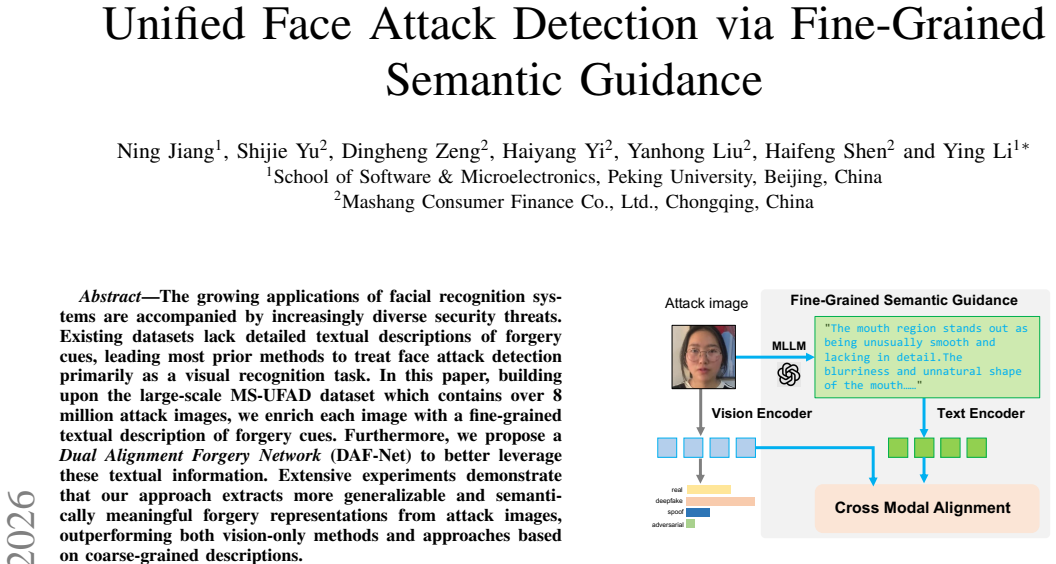
Dual Alignment Forgery Network (DAF-Net) with Semantic Forgery Aggregation Modules: learnable queries that gather discrete visual patches into forgery regions and textual tokens into phrases, then align them at both global and fine-grained levels so that only the visual branch is needed at inference.
What would settle it
Train the same architecture on identical images but replace the fine-grained captions with either random text or the original coarse shared captions; if the reported gains in ACER, accuracy, and F1 disappear, the claim that fine-grained semantic guidance is responsible collapses.
Extended reading notes
Core claim
When each attack image is paired with a fine-grained textual description of its own forgery cues, a dual-alignment network that matches both global image-text pairs and region-phrase pairs learns forgery representations that generalize better across identities and generation methods than representations learned from images alone or from coarser captions.
Load-bearing premise
The offline pipeline that generates the descriptions—heatmaps from a pre-trained detector, color/blur differences, a hand-built artifact list, and a multimodal language model—must produce captions that truly capture the forgery cues rather than merely restating what the visual model already knows.
Editorial analysis
A structured set of objections, weighed in public.
Referee Report
Summary. The paper enriches the large-scale MS-UFAD face-attack dataset with over 8 million fine-grained textual descriptions of forgery cues, generated via a pipeline that combines a pre-trained detector, ScoreCAM localization, quantifiable color/blur differences, a hand-curated artifact corpus, and InternVL3. It then introduces DAF-Net, a dual-branch network (vision and text encoders from BLIP) that inserts Semantic Forgery Aggregation Modules (SFAMs) with learnable queries and cross-attention to form region/phrase-level features, trained with classification loss plus global contrastive and fine-grained late-interaction alignment losses (Eqs. 1–5). Only the visual branch is used at inference. Experiments on a held-out multi-method test subset claim that fine-grained text yields lower ACER (12.30) and higher ACC/F1 than vision-only baselines and coarser class-level or MS-UFAD captions (Table I), with ablations isolating the alignment losses and SFAMs (Table II) and attention visualizations supporting more focused localization (Fig. 6).
Significance. If the gains are cleanly attributable to independent fine-grained linguistic guidance rather than restating visual cues already known to the caption generator, the work would supply both a valuable multi-modal resource and a practical dual-alignment recipe that improves generalization across attack types and generators. The scale of the annotation effort, the explicit region–phrase aggregation design, and the consistent ablation trends are concrete strengths that would be useful to the face-attack and multi-modal forensics communities.
major comments (3)
- [Section III-A, Fig. 2] Section III-A and Fig. 2: The caption pipeline is conditioned on a pre-trained face-attack detector (ScoreCAM heatmaps + color/blur quantiles + hand-written artifact corpus fed to InternVL3). Because localization and cue inventory already encode the visual model’s knowledge, the subsequent dual-alignment losses (Eqs. 2–4) and SFAM queries risk simply re-aligning the student to the teacher’s own attention rather than to novel linguistic structure. No human agreement, cue-level precision/recall, or control that severs the detector–caption dependence is reported; without such evidence the central claim that “fine-grained semantic guidance” is responsible for the Table I lift cannot be cleanly attributed.
- [Table I, Section III-B] Table I and the evaluation protocol: All reported numbers are single-run point estimates with no error bars, multiple random seeds, or statistical tests. In addition, the 201 453-pair test subset is described as a “representative” hand-sampled slice of >3.6 M items; the sampling procedure and verification that it preserves the identity/method distribution are not detailed. These omissions leave open the possibility that the 2–3-point ACER gains are within run-to-run variance or sampling noise.
- [Table I, Section V-C] Section V-C / Table I baselines: The vision-only and text-guided comparisons are limited to ResNet50, ViT, BLIP-ViT (±SFAM) and three text granularities inside the authors’ own DAF-Net. Stronger recent multi-modal or domain-generalization face-attack methods (e.g., those cited in Related Work) are absent, making it hard to judge whether the absolute performance is competitive or merely better than the paper’s internal controls.
minor comments (4)
- [Abstract, Section IV] Notation and typography: “Dual Alignment Forgery Network(DAF-Net)” and similar compounds lack spaces; “F orgery” appears with an extraneous space in several places (abstract, Section IV). Standardize.
- [Section IV-C, Eq. (3)] Equation (3) and Fig. 5: The fine-grained score H averages both row-wise and column-wise maxes; a short sentence clarifying why both directions are needed (versus unidirectional late interaction) would improve readability.
- [Fig. 3, Fig. 6] Fig. 3 and Fig. 6 captions: The color coding (black/blue/green) and the precise meaning of the attention overlays are only partially explained in the text; a legend or expanded caption would help.
- [Section V-A] Hyper-parameters (N=32 queries, K=2 blocks, λ=0.1, τ=0.07, α=0.2, LSE scale r) are listed in Implementation Details but never ablated; a brief sensitivity note would strengthen reproducibility claims.
Circularity Check
No derivation reduces to its inputs by construction; only minor self-citation of the base MS-UFAD dataset, which is not load-bearing for the performance claims.
-
self citation load bearing
[Abstract / Section I / Section III-B (MS-UFAD reference [8])]
"building upon the large-scale MS-UFAD dataset which contains over 8 million attack images, we enrich each image with a fine-grained textual description of forgery cues. … the extensive MS-UFAD dataset comprises approximately 8 million images alongside corresponding textual descriptions of forgery artifacts."
The image corpus and the coarse-grained control texts are taken from prior work by overlapping authors. This is ordinary dataset reuse and is not load-bearing for the novel claim (fine-grained captions + DAF-Net outperform both the self-cited coarse texts and pure vision baselines); the performance deltas are measured on new annotations and a new model.
full rationale
This is an empirical computer-vision paper whose central claim (Table I: FG-text DAF-Net ACER 12.30 outperforming CG-text 15.24 and vision-only 15.88) rests on held-out evaluation of a new architecture (DAF-Net + SFAM) and newly generated captions, not on any closed-form derivation, uniqueness theorem, or fitted parameter re-labeled as a prediction. The sole self-citation of note is the base MS-UFAD corpus (Jiang et al., 2025, overlapping authors), which supplies the images and the coarse-grained texts used as a control; the fine-grained captions, the dual-alignment losses (Eqs. 2–4), the SFAM modules, and all reported metrics are original to the present work and are measured against external generative methods held out of training. The offline caption pipeline (pre-trained detector + ScoreCAM + InternVL3) is a methodological choice that may inject visual-model knowledge into the texts, but that choice does not make any equation or reported number equal to its own input by construction; the paper never claims a first-principles derivation that would be invalidated by such dependence. Consequently the circularity score remains near zero.
Assumptions & free parameters
free parameters (6)
- number of learnable queries N =
32
- SFAM depth K =
2
- alignment loss weight λ =
0.1
- temperature τ (global contrastive) =
0.07
- triplet margin α (fine-grained) =
0.2
- LSE pooling scale r
assumptions (4)
- ad hoc to paper MLLM (InternVL3) guided by ScoreCAM heatmaps, color/blur quantiles and a hand-written artifact corpus produces descriptions that correctly name the true forgery cues rather than hallucinating or merely echoing the pre-trained detector.
- domain assumption Region-phrase granularity (after SFAM) is more useful for face-attack detection than raw patch-word alignment.
- domain assumption The 201 453-pair evaluation subset is statistically representative of the full 3.6 M multi-method test distribution.
- standard math Standard cross-entropy, InfoNCE and hard-negative triplet losses are appropriate supervision for learning generalizable forgery features.
invented entities (3)
-
Semantic Forgery Aggregation Module (SFAM)
-
Dual Alignment Forgery Network (DAF-Net)
-
8-million fine-grained forgery caption resource
Cite this review
Pith. "Pith review of Unified Face Attack Detection via Fine-Grained Semantic Guidance." pith.science (2026). https://pith.science/paper/R7AZ4FPI
@misc{pith2026260708156,
  author       = {Pith},
  title        = {Pith review of: Unified Face Attack Detection via Fine-Grained Semantic Guidance},
  year         = {2026},
  howpublished = {\url{https://pith.science/paper/R7AZ4FPI}},
  note         = {Machine review of arXiv:2607.08156}
}
read the original abstract
The growing applications of facial recognition systems are accompanied by increasingly diverse security threats. Existing datasets lack detailed textual descriptions of forgery cues, leading most prior methods to treat face attack detection primarily as a visual recognition task. In this paper, building upon the large-scale MS-UFAD dataset which contains over 8 million attack images, we enrich each image with a fine-grained textual description of forgery cues. Furthermore, we propose a Dual Alignment Forgery Network(DAF-Net) to better leverage these textual information. Extensive experiments demonstrate that our approach extracts more generalizable and semantically meaningful forgery representations from attack images, outperforming both vision-only methods and approaches based on coarse-grained descriptions.
Figures


Figures from the paper (3 more)


Reference graph
Works this paper leans on
-
[1]
Unified Physical-Digital Face Attack Detection
H. Fang, A. Liu, H. Yuan, J. Zheng, D. Zeng, Y . Liu, J. Deng, S. Escalera, X. Liu, J. Wanet al., “Unified physical-digital face attack detection,”arXiv preprint arXiv:2401.17699, 2024
work page Pith review arXiv 2024
-
[2]
Unified detection of digital and physical face attacks,
D. Deb, X. Liu, and A. K. Jain, “Unified detection of digital and physical face attacks,” inFG. IEEE, 2023
work page 2023
-
[3]
End-to- end reconstruction-classification learning for face forgery detection,
J. Cao, C. Ma, T. Yao, S. Chen, S. Ding, and X. Yang, “End-to- end reconstruction-classification learning for face forgery detection,” inProceedings of the IEEE/CVF conference on computer vision and pattern recognition, 2022, pp. 4113–4122
work page 2022
-
[4]
Face x-ray for more general face forgery detection,
L. Li, J. Bao, T. Zhang, H. Yang, D. Chen, F. Wen, and B. Guo, “Face x-ray for more general face forgery detection,” inProceedings of the IEEE/CVF conference on computer vision and pattern recognition, 2020, pp. 5001–5010
work page 2020
-
[5]
Vl-fas: Domain generalization via vision-language model for face anti-spoofing,
H. Fang, A. Liu, N. Jiang, Q. Lu, G. Zhao, and J. Wan, “Vl-fas: Domain generalization via vision-language model for face anti-spoofing,” in ICASSP 2024-2024 IEEE International Conference on Acoustics, Speech and Signal Processing (ICASSP). IEEE, 2024, pp. 4770–4774
work page 2024
-
[6]
Mfclip: Multi-modal fine-grained clip for generalizable diffusion face forgery detection,
Y . Zhang, T. Wang, Z. Yu, Z. Gao, L. Shen, and S. Chen, “Mfclip: Multi-modal fine-grained clip for generalizable diffusion face forgery detection,”IEEE Transactions on Information F orensics and Security, 2025
work page 2025
-
[7]
Tf-fas: twofold-element fine-grained semantic guidance for generaliz- able face anti-spoofing,
X. Wang, K.-Y . Zhang, T. Yao, Q. Zhou, S. Ding, P. Dai, and R. Ji, “Tf-fas: twofold-element fine-grained semantic guidance for generaliz- able face anti-spoofing,” inEuropean Conference on Computer Vision. Springer, 2024, pp. 148–168
work page 2024
-
[8]
Ms-ufad: A large-scale dataset for real-world unified face attack detection with text descriptions,
N. Jiang, D. Zeng, L. Gao, S. Chen, Z. Kong, Y . Liu, J. Li, Y . Feng, T. Yuan, W. Deng, Q. Lu, and Y . Li, “Ms-ufad: A large-scale dataset for real-world unified face attack detection with text descriptions,” in ICASSP, 2025, pp. 1–5
work page 2025
Show all 32 references
-
[9]
Score-cam: Score-weighted visual explanations for convo- lutional neural networks,
H. Wang, Z. Wang, M. Du, F. Yang, Z. Zhang, S. Ding, P. Mardziel, and X. Hu, “Score-cam: Score-weighted visual explanations for convo- lutional neural networks,” inProceedings of the IEEE/CVF conference on computer vision and pattern recognition workshops, 2020, pp. 24–25
2020
-
[10]
Internvl3: Exploring advanced training and test-time recipes for open-source multimodal models,
J. Zhu, W. Wang, Z. Chen, Z. Liu, S. Ye, L. Gu, H. Tian, Y . Duan, W. Su, J. Shao, Z. Gao, E. Cui, X. Wang, Y . Cao, Y . Liu, X. Wei, H. Zhang, H. Wang, W. Xu, H. Li, J. Wang, N. Deng, S. Li, Y . He, T. Jiang, J. Luo, Y . Wang, C. He, B. Shi, X. Zhang, W. Shao, J. He, Y . Xion...
-
[11]
Available: https://arxiv.org/abs/2504.10479
[Online]. Available: https://arxiv.org/abs/2504.10479
-
[12]
Faceforensics++: Learning to detect manipulated facial images,
A. Rossler, D. Cozzolino, L. Verdoliva, C. Riess, J. Thies, and M. Nießner, “Faceforensics++: Learning to detect manipulated facial images,” inProceedings of the IEEE/CVF international conference on computer vision, 2019, pp. 1–11
2019
-
[13]
Celeb-df: A large-scale challenging dataset for deepfake forensics,
Y . Li, X. Yang, P. Sun, H. Qi, and S. Lyu, “Celeb-df: A large-scale challenging dataset for deepfake forensics,” inIEEE Conference on Computer Vision and Patten Recognition (CVPR), 2020
2020
-
[14]
The deepfake detection challenge (dfdc) dataset,
B. Dolhansky, J. Bitton, B. Pflaum, J. Lu, R. Howes, M. Wang, and C. C. Ferrer, “The deepfake detection challenge (dfdc) dataset,”arXiv preprint arXiv:2006.07397, 2020
2006 arXiv
-
[15]
Oulu-npu: A mobile face presentation attack database with real-world variations
Z. Boulkenafet, J. Komulainen, L. Li, X. Feng, and A. Hadid, “Oulu-npu: A mobile face presentation attack database with real-world variations.” 2017
2017
-
[16]
Casia-surf: A large-scale multi-modal benchmark for face anti-spoofing,
S. Zhang, A. Liu, J. Wan, Y . Liang, G. Guo, S. Escalera, H. J. Escalante, and S. Z. Li, “Casia-surf: A large-scale multi-modal benchmark for face anti-spoofing,”IEEE Transactions on Biometrics, Behavior , and Identity Science, vol. 2, no. 2, pp. 182–193, 2020
2020
-
[17]
Celeba- spoof: Large-scale face anti-spoofing dataset with rich annotations,
Y . Zhang, Z. Yin, Y . Li, G. Yin, J. Yan, J. Shao, and Z. Liu, “Celeba- spoof: Large-scale face anti-spoofing dataset with rich annotations,” in European conference on computer vision. Springer, 2020, pp. 70–85
2020
-
[18]
Towards general visual-linguistic face forgery detection,
K. Sun, S. Chen, T. Yao, Z. Zhou, J. Ji, X. Sun, C.-W. Lin, and R. Ji, “Towards general visual-linguistic face forgery detection,” in Proceedings of the Computer Vision and Pattern Recognition Conference (CVPR), June 2025, pp. 19 576–19 586
2025
-
[19]
Common sense reasoning for deepfake detection,
Y . Zhang, B. Colman, X. Guo, A. Shahriyari, and G. Bharaj, “Common sense reasoning for deepfake detection,” inEuropean conference on computer vision. Springer, 2024, pp. 399–415
2024
-
[20]
Face anti-spoofing based on color texture analysis,
Z. Boulkenafet, J. Komulainen, and A. Hadid, “Face anti-spoofing based on color texture analysis,” in2015 IEEE international conference on image processing (ICIP). IEEE, 2015, pp. 2636–2640
2015
-
[21]
Context based face anti- spoofing,
J. Komulainen, A. Hadid, and M. Pietik ¨ainen, “Context based face anti- spoofing,” in2013 IEEE sixth international conference on biometrics: theory, applications and systems (BTAS). IEEE, 2013, pp. 1–8
2013
-
[22]
Secure face unlock: Spoof detection on smartphones,
K. Patel, H. Han, and A. K. Jain, “Secure face unlock: Spoof detection on smartphones,”IEEE transactions on information forensics and security, vol. 11, no. 10, pp. 2268–2283, 2016
2016
-
[23]
Face anti-spoofing using patch and depth-based cnns,
Y . Atoum, Y . Liu, A. Jourabloo, and X. Liu, “Face anti-spoofing using patch and depth-based cnns,” in2017 IEEE international joint conference on biometrics (IJCB). IEEE, 2017, pp. 319–328
2017
-
[24]
Detecting deepfakes with self-blended images,
K. Shiohara and T. Yamasaki, “Detecting deepfakes with self-blended images,” inProceedings of the IEEE/CVF conference on computer vision and pattern recognition, 2022, pp. 18 720–18 729
2022
-
[25]
Ucf: Uncovering common features for generalizable deepfake detection,
Z. Yan, Y . Zhang, Y . Fan, and B. Wu, “Ucf: Uncovering common features for generalizable deepfake detection,” inProceedings of the IEEE/CVF international conference on computer vision, 2023, pp. 22 412–22 423
2023
-
[26]
Learning transferable visual models from natural language supervision,
A. Radford, J. W. Kim, C. Hallacy, A. Ramesh, G. Goh, S. Agarwal, G. Sastry, A. Askell, P. Mishkin, J. Clarket al., “Learning transferable visual models from natural language supervision,” inInternational conference on machine learning. PmLR, 2021, pp. 8748–8763
2021
-
[27]
Rethinking vision- language model in face forensics: Multi-modal interpretable forged face detector,
X. Guo, X. Song, Y . Zhang, X. Liu, and X. Liu, “Rethinking vision- language model in face forensics: Multi-modal interpretable forged face detector,” inProceedings of the Computer Vision and Pattern Recognition Conference, 2025, pp. 105–116
2025
-
[28]
Blip: Bootstrapping language-image pre-training for unified vision-language understanding and generation,
J. Li, D. Li, C. Xiong, and S. Hoi, “Blip: Bootstrapping language-image pre-training for unified vision-language understanding and generation,” inInternational conference on machine learning. PMLR, 2022, pp. 12 888–12 900
2022
-
[29]
FILIP: Fine-grained interactive language-image pre-training,
L. Yao, R. Huang, L. Hou, G. Lu, M. Niu, H. Xu, X. Liang, Z. Li, X. Jiang, and C. Xu, “FILIP: Fine-grained interactive language-image pre-training,” inInternational Conference on Learning Representations, 2022
2022
-
[30]
Decoupled weight decay regularization,
I. Loshchilov and F. Hutter, “Decoupled weight decay regularization,” arXiv preprint arXiv:1711.05101, 2017
2017 arXiv
-
[31]
Deep residual learning for image recognition,
K. He, X. Zhang, S. Ren, and J. Sun, “Deep residual learning for image recognition,” inProceedings of the IEEE conference on computer vision and pattern recognition, 2016, pp. 770–778
2016
-
[32]
An image is worth 16x16 words: Transformers for image recognition at scale,
A. Dosovitskiy, “An image is worth 16x16 words: Transformers for image recognition at scale,”arXiv preprint arXiv:2010.11929, 2020
2010 arXiv
Reviewed July 10, 2026 · model on record in the stance chip above.
Discussion (0). Continue with ORCID to comment.