REVIEW 3 major objections 5 minor 53 references
Analysts use AI crime-linkage suggestions selectively and still verify them against traditional behavioural evidence.
Reviewed by Pith at T0; open to challenge. T0 means a machine referee read the full paper against a public rubric. the ladder, T0–T4 →
In a real UK law-enforcement deployment, crime analysts selectively used AI linkage predictions and validated them against behavioural matrices, attending most to MO similarity and geography.
T0 review reviewed 2026-07-10 challenge →
load-bearing objection Solid first industrial multi-modal usability study of an operational AI crime-linkage tool; the selective-use and feature-attention findings hold under the paper’s own scope despite the small volunteer sample. the 3 major comments →
How Analysts Use AI in High-Stakes Crime Linkage: An Industrial Study
The pith
A machine-rendered reading of the paper's core claim, the machinery that carries it, and where it could break.
The reading
Core claim
Analysts used the AI predictions selectively and frequently validated them against behavioural (non-AI) evidence, reflecting partial trust and continued reliance on established practice. They attended to all presented model features, with the heaviest attention on MO similarity and geographical proximity, valued those explanations, and still opened the behavioural matrix repeatedly to verify ranked candidates. The tool is therefore used as decision support that must be checked, not as a substitute for traditional analysis.
What carries the argument
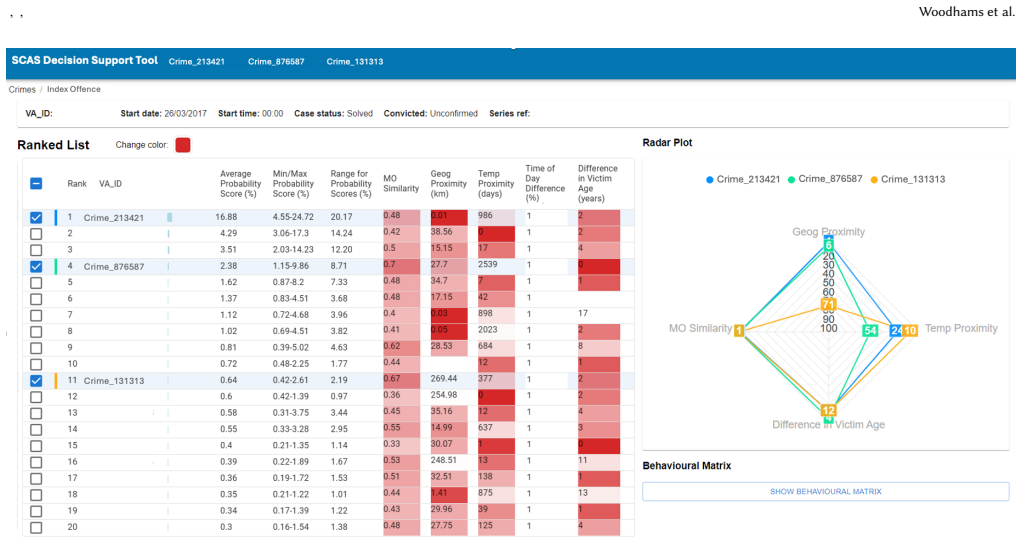
A mixed-methods usability evaluation of the LATIS crime-linkage interface: direct observation, eye-tracking of fixations on ranked scores and feature cells, mouse-tracking of behavioural-matrix openings, and post-session usability questionnaires, run with operational analysts on three real crime series.
Load-bearing premise
That six volunteer analysts completing sixteen sessions on three pre-selected series, each engineered so a true link appears in the top twenty, represent how crime-linkage units will use the tool in ordinary operational work.
What would settle it
A larger, non-volunteer sample of analysts working unselected live cases with no planted top-twenty link who rarely open the behavioural matrix and accept AI ranks without cross-check would overturn the selective-validation claim.
If this is right
- AI crime-linkage tools should surface feature-level explanations beside ranked scores because analysts attend to and value them.
- Traditional non-AI checks such as the behavioural matrix must be embedded tightly in the same workflow so verification is efficient.
- In-situ evaluation with real users and real data is required to surface selective trust and integration needs before wider deployment.
- Interaction flexibility (mark reviewed rows, hide irrelevant features or columns) is needed to keep focus and reduce effort.
- Perceived usability can rise with familiarity alone, so early mixed usefulness scores do not by themselves rule out later operational acceptance.
Where Pith is reading between the lines
- The same selective-trust pattern is likely in other high-stakes domains where experts already have strong non-AI methods they must defend.
- Guaranteeing a true link in the top twenty may have inflated attention to AI ranks relative to noisier real deployments.
- Continued fixation on MO and geography lower in the list suggests analysts use those feature columns as a secondary filter once probability bars fade.
- Without usable multi-feature comparison views, reliance on the behavioural matrix for verification may stay higher than necessary.
Editorial analysis
A structured set of objections, weighed in public.
Referee Report
Summary. The paper reports a mixed-methods industrial usability evaluation of LATIS, an AI decision-support tool for behavioural crime linkage co-developed with the UK NCA SCAS. Six analysts completed 16 sessions on three real crime series (top-20 ranked lists seeded with at least one true link), combining direct observation, eye-tracking, mouse-tracking of the behavioural matrix, and post-session USE/UXIV/QUIS surveys plus free-text. Findings indicate selective use of AI probability scores, frequent cross-validation against the non-AI behavioural matrix, attention to all five model features (highest on MO similarity and geographical proximity), positive ease-of-use/ease-of-learning ratings but mixed usefulness, and concrete suggestions for better integration of explanations with traditional analytic practices.
Significance. If the observational patterns hold, this is a useful contribution to HCI and AI-for-policing: it supplies rare in-situ multi-modal evidence (eye- and mouse-tracking plus surveys) from expert analysts working with real sensitive data, rather than mock tasks or self-report alone. The triangulation supports design implications that AI predictions should be presented with feature-level explanations aligned to domain priorities (MO, geography) and tightly coupled to non-AI evidence (behavioural matrix) to support verification and partial trust. Strengths include the co-design history, operational setting, transparent handling of the radar-plot data error, and an explicit threats-to-validity section. These elements make the work more actionable than typical lab studies of XAI in high-stakes domains.
major comments (3)
- [Section 3.1 / Section 6] Section 3.1 (and Threats 6): The sample comprises only six volunteer SCAS analysts (three analysts, three senior) who completed a fixed-order sequence of three pre-selected series, each engineered so that at least one true link appears in the top-20. While the multi-modal data consistently show selective AI use and matrix cross-checking within this sample, the design risks volunteer bias, learning effects (explicitly noted in rising USE scores across sessions), and inflated engagement from the forced-link seeding. These factors are load-bearing for the general claims about “how analysts use AI” and the derived design implications; the paper should either (a) more tightly scope all claims to “this team and tool under these conditions” or (b) add a short sensitivity discussion quantifying how the forced-link and order constraints might affect the observed validation rates.
- [Section 3.3 / Section 4.2] Section 3.3 and Findings 4.2–4.3: The radar-plot component was discarded after participants correctly identified incorrect data values. This is handled transparently, yet the tool description (Section 2.2, Figure 1) and study-design overview still present the radar plot as a core explanation view. Consequently the RQ2 claim that “analysts attended to … the model features presented as explanations” rests solely on the ranked-list colour cells and the behavioural matrix. The manuscript should explicitly restate that the attention and valuation findings apply only to the ranked-list feature explanations and matrix, and remove or clearly flag any residual implication that the radar plot contributed usable evidence.
- [Section 4.2] Section 4.2 (Figures 5–6) and RQ2: Fixation percentages and heat-maps are purely descriptive; no inferential statistics, confidence intervals, or baseline comparisons are reported for differences among the five features or across sessions. Given that the paper’s second research question asks whether analysts attend to all features and that the strongest attention claim is used to argue alignment with model importance, at least non-parametric tests or bootstrapped intervals on the fixation proportions would make the “greatest attention to MO and geographical proximity” statement more robust. Without them the claim remains impressionistic.
minor comments (5)
- [Section 5] Section 5: typographical error “final descisions remain the responsibility”.
- [Figure 5] Figure 5 caption: missing space in “Behavioural Matrixrepresents the button”.
- [Table 1] Table 1: the “Time (min)” columns are hard to parse; consider separating average open duration from total open time more clearly, and note that two participants completed only two sessions.
- [Section 4.1] Section 4.1: the statement that overall USE scores “increased from session 1 to session 2, and then increased further in session 3” would benefit from reporting the actual mean scores or a simple plot so readers can judge the magnitude of the learning effect.
- [References] References: a few DOIs and arXiv links appear incomplete or point to future versions; double-check consistency before camera-ready.
Circularity Check
No circularity: empirical mixed-methods usability study whose claims rest on new observation, eye/mouse-tracking and survey data rather than fitted parameters or self-referential definitions.
full rationale
The paper reports an industrial usability evaluation of a previously co-developed AI crime-linkage tool (LATIS/DST). Its three research questions and four listed contributions are answered exclusively by the new mixed-methods data collected in situ (direct observation notes, Eyelink 1000 fixations, mouse-click logs of the behavioural-matrix pop-up, and post-session USE/UXIV/QUIS scores across 16 sessions with six SCAS analysts). No equation, parameter fit, or uniqueness theorem is used to generate the reported interaction patterns; the AI model itself is treated as a black-box input whose outputs are merely observed. Prior self-citations ([36], [2], [30], [47]) supply only tool-background and ethical-context statements and are not load-bearing for the usability claims. The discarded radar-plot data and the forced top-20 true-link design are acknowledged as threats to validity, not as circular constructions. Consequently the derivation chain is self-contained against the recorded behavioural evidence and contains none of the six circularity patterns.
Axiom & Free-Parameter Ledger
axioms (3)
- domain assumption Offenders are sufficiently behaviourally consistent and distinctive that crimes can be linked by MO, geography and temporal proximity (assumptions of behavioural consistency and distinctiveness).
- ad hoc to paper Displaying only the top-20 ranked crimes and seeding at least one true link inside that window adequately reflects real analyst workflow.
- domain assumption Eye-fixation percentages and mouse-open counts are valid proxies for attention and verification behaviour.
Cite this review
Pith. "Pith review of How Analysts Use AI in High-Stakes Crime Linkage: An Industrial Study." pith.science (2026). https://pith.science/paper/EW4UJ625
@misc{pith2026260708274,
  author       = {Pith},
  title        = {Pith review of: How Analysts Use AI in High-Stakes Crime Linkage: An Industrial Study},
  year         = {2026},
  howpublished = {\url{https://pith.science/paper/EW4UJ625}},
  note         = {Machine review of arXiv:2607.08274}
}
read the original abstract
Crime linkage analysis is used in many countries to identify series of offences that may have been committed by the same individual. In practice, specialist analysts manually search for behavioural and situational connections across large crime databases, an effort that is time-consuming, cognitively demanding, and can involve repeated exposure to disturbing material. To support this work, an Artificial Intelligence (AI)-enabled decision-support tool was co-developed with a UK law enforcement agency to assist analysts in identifying likely crime linkages. This paper reports an industrial evaluation of the crime-linkage tool. We conducted a mixed-methods usability study combining direct observation, eye-tracking, mouse-tracking, and surveys to examine how analysts engage with AI predictions and with the model features presented as explanations. Our findings show that analysts used the AI predictions selectively and frequently validated them against behavioural (non-AI) evidence, reflecting partial trust and an ongoing reliance on established analytical practices. We also found that analysts attended to the presented model features and valued their availability, while identifying opportunities to improve how explanations are presented and integrated into the workflow. Overall, our results highlight the need for AI-enabled decision-support tools to better integrate explanations and traditional analytical methods, and demonstrate the importance of in-situ evaluation for engineering usable and trustworthy AI in high-stakes settings.
Figures


Reference graph
Works this paper leans on
-
[1]
Liberal, Miren Arrese, and Helena Matute
Ujué Agudo, Karlos G. Liberal, Miren Arrese, and Helena Matute. 2024. The impact of AI errors in a human-in-the-loop process.Cognitive Research: Principles and Implications9, 1 (2024), 1. doi:10.1186/s41235-023-00529-3
-
[2]
Dalal Alrajeh, Vesna Nowack, Patrick Benjamin, Katie Thomas, William Hobson, Carolina Gutierrez Muñoz, Catherine Hamilton-Giachritsis, Juliane A. Kloess, Jessica Woodhams, Daniel Butler, Mark Law, Ralph Morton, Benjamin Costello, Amy Burrell, Tim Grant, Prachiben Shah, Frances Laureano de Leon, and Mark Lee. 2026. Data-Dependent Goal Modeling for ML-Enabl...
-
[3]
Aaron Opoku Amankwaa and Carole McCartney. 2021. The effectiveness of the current use of forensic DNA in criminal investigations in England and Wales. WIREs Forensic Science3, 6 (2021), e1414. doi:10.1002/wfs2.1414
-
[4]
and Inkpen, Kori and Teevan, Jaime and
Saleema Amershi, Dan Weld, Mihaela Vorvoreanu, Adam Fourney, Besmira Nushi, Penny Collisson, Jina Suh, Shamsi Iqbal, Paul N. Bennett, Kori Inkpen, Jaime Teevan, Ruth Kikin-Gil, and Eric Horvitz. 2019. Guidelines for Human- AI Interaction. InProceedings of the 2019 CHI Conference on Human Factors in Computing Systems(Glasgow, Scotland Uk)(CHI ’19). Associa...
-
[5]
R. M. Arthur, J. Hoogenboom, R. D. Green, M. C. Taylor, and K. G. de Bruin
-
[6]
doi:10.1007/s00414-017-1711-6 Epub 2017 Oct 18
An Eye Tracking Study of Bloodstain Pattern Analysts During Pattern Classification.International Journal of Legal Medicine132, 3 (2018), 875–885. doi:10.1007/s00414-017-1711-6 Epub 2017 Oct 18. PMID: 29046954. How Analysts Use AI in High-Stakes Crime Linkage: An Industrial Study , ,
-
[7]
C. Baber and M. Butler. 2012. Expertise in crime scene examination: Comparing search strategies of expert and novice crime scene examiners in simulated crime scenes.Human Factors54, 3 (2012), 413–424. doi:10.1177/0018720812440577
-
[8]
Craig Bennell, Sarah Bloomfield, Brent Snook, Paul Taylor, and Catherine Barnes
-
[9]
Psychology, Crime & Law16, 6 (2010), 507–524
Linkage analysis in cases of serial burglary: Comparing the performance of university students, police professionals, and a logistic regression model. Psychology, Crime & Law16, 6 (2010), 507–524. doi:10.1080/10683160902971030
-
[10]
C. Bennell, R. Mugford, H. Ellingwood, and J. Woodhams. 2014. Linking crimes using behavioural clues: Current levels of linking accuracy and strategies for moving forward.Journal of Investigative Psychology and Offender Profiling11, 1 (2014), 29–56. doi:10.1002/jip.1395
-
[11]
M. Blumenschein, M. Behrisch, S. Schmid, S. Butscher, D. R. Wahl, K. Villinger, B. Renner, H. Reiterer, and D. A. Keim. 2018. Smartexplore: Simplifying high- dimensional data analysis through a table-based visual analytics approach. In 2018 IEEE Conference on Visual Analytics Science and Technology (V AST). IEEE, 36–47. doi:10.1109/VAST.2018.8400459
-
[12]
N. M. Bradburn, L. J. Rips, and S. K. Shevell. 1987. Answering autobiographical questions: The impact of memory and inference on surveys.Science236 (1987), 157–161. doi:10.1126/science.3563494
-
[13]
A. Burrell and R. Bull. 2011. A preliminary examination of crime analysts’ views and experiences of comparative case analysis.International Journal of Police Science and Management13, 1 (2011), 2–15. doi:10.1350/ijps.2011.13.1.212
-
[14]
1991.A Facet Approach to Offender Profiling
David Canter, Roger Heritage, Michael Wilson, Adrian Davies, Sue Kirby, Robert Holden, and Ian Donald. 1991.A Facet Approach to Offender Profiling. Technical Report. Home Office, London, UK. Research Report
work page 1991
-
[15]
Rong-Chi Chang and Meng-Jung Tsai. 2022. Visual behavior patterns of successful decision makers in crime scene photo investigation: An eye tracking analysis. Journal of Forensic Sciences67 (01 2022). doi:10.1111/1556-4029.14970
-
[16]
J. P. Chin, V. A. Diehl, and K. L. Norman. 1988. Development of an Instrument Measuring User Satisfaction of the Human-Computer Interface. InProceedings of the SIGCHI Conference on Human Factors in Computing Systems (CHI ’88). ACM, New York, NY, USA, 213–218. doi:10.1145/57167.57203
-
[17]
M. Craik and A. Patrick. 1994. Linking serial offences.Policing10 (1994), 181–187. doi:10.1080/10576119408726958
-
[18]
2018.The Practice of Crime Linkage
Kari Davies. 2018.The Practice of Crime Linkage. Doctoral dissertation. University of Birmingham, Birmingham, UK. https://etheses.bham.ac.uk/id/eprint/8309/5/ Davies18PhD.pdf
work page 2018
-
[19]
Vagner Figueredo de Santana, Larissa Monteiro Da Fonseca Galeno, Emilio Vital Brazil, Aliza Heching, and Renato Cerqueira. 2023. Retrospective End-User Walkthrough: A Method for Assessing How People Combine Multiple AI Models in Decision-Making Systems. arXiv:2305.07530 [cs.HC] https://arxiv.org/abs/ 2305.07530
work page internal anchor Pith review Pith/arXiv arXiv 2023
-
[20]
Ronald P. Dempsey, James R. Brunet, and Veljko Dubljević. 2023. Exploring and Understanding Law Enforcement’s Relationship with Technology: A Qualitative Interview Study of Police Officers in North Carolina.Applied Sciences13, 6 (2023). doi:10.3390/app13063887
-
[21]
H. Elffers. 2010. Misinformation, misunderstanding and misleading as validity threats to accounts of offending. InOffenders on offending: Learning about crime from criminals, W. Bernasco (Ed.). Willan, Cullompton, 13–23
work page 2010
-
[22]
Eric Halford and Ian Gibson. 2025. Using machine learning to conduct crime linking of residential burglary.International Journal of Law, Crime and Justice80 (2025), 100716. doi:10.1016/j.ijlcj.2024.100716
-
[23]
R. R. Hazelwood and J. I. Warren. 2004. Linkage analysis: Modus operandi, ritual, and signature in serial sexual crime.Aggression and Violent Behavior9 (2004), 307–318. doi:10.1016/j.avb.2004.02.002
-
[24]
Sam Hepenstal. 2025. Towards Socio-Technical Evaluation for Artificial Intelli- gence in Policing. InArtificial Intelligence in HCI, Helmut Degen and Stavroula Ntoa (Eds.). Springer Nature Switzerland, Cham, 339–353
work page 2025
-
[25]
Loerakker, Marloes Vredenborg, and Paweł W
Elize Herrewijnen, Meagan B. Loerakker, Marloes Vredenborg, and Paweł W. Woźniak. 2024. Requirements and Attitudes towards Explainable AI in Law Enforcement. InProceedings of the 2024 ACM Designing Interactive Systems Con- ference(Copenhagen, Denmark)(DIS ’24). Association for Computing Machinery, New York, NY, USA, 995–1009. doi:10.1145/3643834.3661629
-
[26]
Attila Kóvári. 2024. AI for Decision Support: Balancing Accuracy, Transparency, and Trust Across Sectors.Information15, 11 (2024), 725. doi:10.3390/info15110725
-
[27]
G. N. Labuschagne. 2006. The use of a linkage analysis as evidence in the conviction of the Newcastle serial murderer, South Africa.Journal of Investigative Psychology and Offender Profiling3 (2006), 183–191. doi:10.1002/jip.51
-
[28]
Liang, Chenyang Yang, and Brad A
Jenny T. Liang, Chenyang Yang, and Brad A. Myers. 2024. A Large-Scale Survey on the Usability of AI Programming Assistants: Successes and Challenges. In Proceedings of the IEEE/ACM 46th International Conference on Software Engineering (Lisbon, Portugal)(ICSE ’24). Association for Computing Machinery, New York, NY, USA, Article 52, 13 pages. doi:10.1145/35...
-
[29]
Zachary C. Lipton. 2018. The mythos of model interpretability.Commun. ACM 61, 10 (Sept. 2018), 36–43. doi:10.1145/3233231
- [30]
-
[31]
National Crime Agency. 2025. Serious Crime Analysis Section: Providing Specialist Capabilities for Law Enforcement. https://www.nationalcrimeagency. gov.uk/what-we-do/how-we-work/providing-specialist-capabilities-for-law- enforcement/serious-crime-analysis. Accessed: 29 October 2025
work page 2025
-
[32]
Vesna Nowack, Dalal Alrajeh, Carolina Gutierrez Munoz, Katie Thomas, William Hobson, Patrick Benjamin, Catherine Hamilton-Giachritsis, Tim Grant, Juliane Kloess, and Jessica Woodhams. 2025. Towards User-Centred Design of AI-Assisted Decision-Making in Law Enforcement. InProceedings of the 29th International Conference on Evaluation and Assessment in Softw...
-
[33]
Femi Osasona, Olukunle Oladipupo Amoo, Akoh Atadoga, Temitayo Oluwaseun Abrahams, Oluwatoyin Ajoke Farayola, and Benjamin Samson Ayinla. 2024. Reviewing the Ethical Implications of AI in Decision Making Processes.Interna- tional Journal of Management & Entrepreneurship Research6, 2 (2024), 322–335. doi:10.51594/ijmer.v6i2.773
-
[34]
Marco Tulio Ribeiro, Sameer Singh, and Carlos Guestrin. 2016. "Why Should I Trust You?": Explaining the Predictions of Any Classifier. InProceedings of the 22nd ACM SIGKDD International Conference on Knowledge Discovery and Data Mining(San Francisco, California, USA)(KDD ’16). Association for Computing Machinery, New York, NY, USA, 1135–1144. doi:10.1145/...
-
[35]
Pekka Santtila, Jenny Junkkila, and N. Kenneth Sandnabba. 2005. Behavioral linking of stranger rapes.Journal of Investigative Psychology and Offender Profiling 2, 2 (2005), 87–103. doi:10.1002/jip.26
-
[36]
Pekka Santtila, Sari Korpela, and Helinä Häkkänen. 2004. Expertise and decision- making in the linking of car crime series.Psychology, Crime & Law10, 1 (2004), 97–112. doi:10.1080/1068316021000030559
-
[37]
G. Sedrakyan, E. Mannens, and K. Verbert. 2019. Guiding the choice of learning dashboard visualizations: Linking dashboard design and data visualization con- cepts.Journal of Computer Languages50 (2019), 19–38. doi:10.1016/j.jcl.2019.01. 001
-
[38]
M. Tonkin, J. Lemeire, J. Woodhams, D. Alrajeh, M. Webb, S. Galambos, H. Smailes, and A. Burrell. 2025. Building the Statistical Evidence Base for Crime Linkage Decision-Support Tools with Sexual Offences.Journal of Quantitative Criminology (2025). doi:10.1007/s10940-025-09622-w
- [39]
-
[40]
doi:10.1016/j.jcrimjus.2017.04.002
Using offender crime scene behavior to link stranger sexual assaults: A comparison of three statistical approaches.Journal of Criminal Justice50 (2017), 19–28. doi:10.1016/j.jcrimjus.2017.04.002
-
[41]
Matt Tonkin and Martin Joseph Weeks. 2021. Crime linkage practice in New Zealand.Journal of Crime Prevention and Community Safety: An International Journal7, 1 (2021), 63–76. doi:10.1108/JCRPP-01-2020-0013
-
[42]
Glassman, Peter Groenwegen, Sumit Gulwani, Austin Z
Priyan Vaithilingam, Elena L. Glassman, Peter Groenwegen, Sumit Gulwani, Austin Z. Henley, Rohan Malpani, David Pugh, Arjun Radhakrishna, Gustavo Soares, Joey Wang, and Aaron Yim. 2023. Towards More Effective AI-Assisted Programming: A Systematic Design Exploration to Improve Visual Studio In- telliCode’s User Experience. InProceedings of the 45th Interna...
-
[43]
E. Z. Victorelli and J. C. dos Reis. 2023. Evaluating User Experience in Information Visualization Systems: UXIV an Evaluation Questionnaire. InHuman Interface and the Management of Information. Thematic Area, HIMI 2023, Held as Part of the 25th HCI International Conference, HCII 2023, Copenhagen, Denmark, July 23–28, 2023, Proceedings, Part I, H. Mori an...
-
[44]
E. Wall, S. Das, R. Chawla, B. Kalidindi, E. T. Brown, and A. Endert. 2017. Podium: Ranking data using mixed-initiative visual analytics.IEEE Transactions on Visu- alization and Computer Graphics24, 1 (2017), 288–297. doi:10.1109/TVCG.2017. 2680235
-
[45]
J. Woodhams, R. Bull, and C. R. Hollin. 2007. Case linkage: Identifying crimes committed by the same offender. InCriminal Profiling: International Theory, Research, and Practice, R. N. Kocsis (Ed.). Humana Press Inc., Totowa, NJ, 117– 133
work page 2007
-
[46]
J. Woodhams, K. Davies, S. Galambos, and M. Webb. 2021. A descriptive analysis of the temporal and geographical proximities seen within UK series of sex offenses. Journal of Police and Criminal Psychology36 (2021), 706–715. doi:10.1007/s11896- 021-09473-8
-
[47]
Jessica Woodhams and Matthew Tonkin. 2017. Offender Profiling and Crime Linkage. InForensic Psychology: Crime, Justice, Law, Interventions, Graham M. Davies and Anthony R. Beech (Eds.). Wiley-Blackwell, Chapter 10. doi:10.1002/ 9781394259281.ch10
work page 2017
-
[48]
J. Woodhams, M. Tonkin, A. Burrell, H. Imre, J. M. Winter, E. K. M. Lam, G. J. ten Brinke, M. Webb, G. Labuschagne, C. Bennell, L. Ashmore-Hills, J. van der Kemp, S. Lipponen, T. Pakkanen, L. Rainbow, C. G. Salfati, and P. Santtila. 2019. Linking serial sexual offences: Moving towards an ecologically valid test of the principles of crime linkage.Legal and...
-
[49]
Kaeko Yokota, Goro Fujita, Kazumi Watanabe, Kaori Yoshimoto, and Taeko Wachi
-
[50]
doi:10.1002/bsl.793 Published by John Wiley & Sons, Ltd
Application of the behavioral investigative support system for profiling perpetrators of serial sexual assaults.Behavioral Sciences & the Law25, 6 (2007), 841–856. doi:10.1002/bsl.793 Published by John Wiley & Sons, Ltd
-
[51]
Tonkin, Sarah Galambos, Jessica Woodhams, and Dalal Alrajeh
Yicheng Zhan, Fahim Ahmed, Amy Burrell, Matthew J. Tonkin, Sarah Galambos, Jessica Woodhams, and Dalal Alrajeh. 2026. Enhancing Binary Encoded Crime Linkage Analysis Using Siamese Network. arXiv:2511.07651 [cs.LG] https: //arxiv.org/abs/2511.07651
-
[52]
Jakub Štěpán Novák, Jan Masner, Petr Benda, Pavel Šimek, and Vojtěch Merunka
-
[53]
doi:10.1080/10447318.2023.2221600
Eye Tracking, Usability, and User Experience: A Systematic Review.In- ternational Journal of Human–Computer Interaction40, 17 (2024), 4484–4500. doi:10.1080/10447318.2023.2221600
This paper was first reviewed by grok-4.5 on July 10, 2026.
discussion (0)
Sign in with ORCID, Apple, or X to comment. Anyone can read and Pith papers without signing in.